Homan Warns Denver Mayor to ‘Get the Hell Out of the Way’

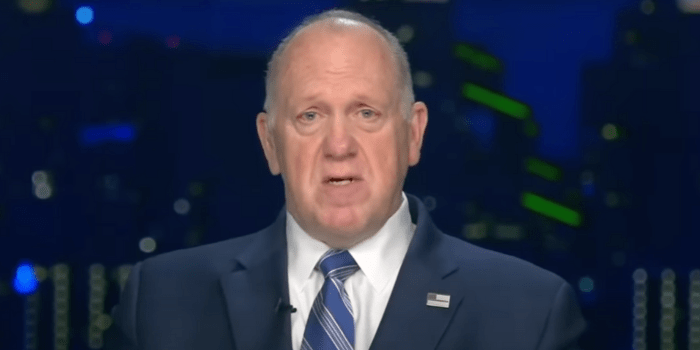
(Maire Clayton, Headline USA) President-elect Donald Trump’s incoming “border czar” Tom Homan said he will have no issue arresting Democrats that try to stop the new administration’s border policies.

Democratic Denver Mayor Mike Johnston already stated he would fight Trump’s plan to deport illegal immigrants and was “not afraid” of the possibility of going to jail.

Homan told Fox News host Sean Hannity Monday night he would have no issue arresting the mayor if he fails to follow the law.

“You are absolutely breaking the law,” Homan said regarding Johnston’s potential plan to hinder the upcoming border security effort.

Homan said it is hard to believe government officials would not want public safety threats removed.

“But, look, me and the Denver mayor, we agree on one thing,” he said. “He’s willing to go to jail, I’m willing to put him in jail.”

The “border czar” warned Democrats it is a felony to “harbor and conceal an illegal alien from immigration authorities.”

After Homan was selected by Trump for the border role, he had a stern warning for any Democrats who are planning on fighting the new policies.

“If they’re not willing to help, then get the hell out of the way because [Immigration and Customs Enforcement] is going to do their job,” he said.

Former House Speaker Newt Gingrich outlined in a Monday post to social media how the Denver mayor clearly does not understand the current law.

“The mayor of Denver doesn’t seem to understand that the United States Army settled the question of states, counties and cities defying the federal government in a meeting at Appomattox in 1865 when General Lee surrendered,” he wrote.

He noted it would be “an act of insurrection” on the mayor’s part.

“Denver attempting to block the federal government detention and deportation of illegal aliens would be an act of insurrection,” he continued, “and would be immediately crushed by the federal government.”

Biden’s Plan to Attend Ex-Enemy’s Inauguration Rekindles Rumors of Bromance

(Headline USA) The White House confirmed this week that President Joe Biden and First Lady Jill Biden will attend President-elect Donald Trump’s inauguration in January, fueling rumors that Biden smoothed over his differences with Trump after being ousted by his own party from the 2024 race.

“The president promised that he would attend the inauguration of whomever won the election,” senior deputy press secretary Andrew Bates told reporters on Monday. “He and the first lady are going to honor that promise and attend the inauguration.”

Bates added that, despite their having previously advanced rhetoric that Trump was Adolf Hitler incarnate and would effect the end of democracy, the Bidens viewed attending the inauguration “as an important demonstration of commitment to our democratic values and to honoring the will of the people as we continue to provide an orderly and effective transition.”

In the wake of the heavily disputed 2020 election and Jan. 6 uprising at the U.S. Capitol, Trump did not attend Biden’s inauguration in 2021, becoming the fifth president in U.S. history to skip his successor’s swearing-in. Earlier this year, Biden referenced Trump’s absence and jabbed that Trump just didn’t have “good manners.”

However, Biden and Trump have connected since Trump’s historic win earlier this month. The two met at the White House shortly after the election for nearly two hours.

“It was a substantive meeting,” press secretary Karine Jean–Pierre said at the time. “They discussed important national security and domestic policy issues facing the nation and the world.”

Biden even offered Trump a warm “welcome back” as they were photographed together in the White House.

“We’re looking forward to having, like we said, a smooth transition, do everything we can to make sure you’re accommodated, what you need,” Biden said.

Trump responded, “Politics is tough, and it’s many cases not a very nice world, but it is a nice world today, and I appreciate very much a transition that’s so smooth it’ll be as smooth as it can get, and I very much appreciate that, Joe.”

As noted by Twitchy, some conservatives have speculated that Biden secretly backed Trump in the final months of the 2024 campaign after being ousted from the top of the 2024 ticket by Democratic leaders.

The unusual situation, paired with the emergence of artificial-intelligence-driven advances in memeing, have helped spark some users to imagine the sudden civility between the Left’s two leading pariahs as something more.

PETA Accuses Butterball of Sexually Abusing Turkeys Before Thanksgiving

(Julianna Frieman, Headline USA) Butterball, the largest turkey company in the U.S., faced allegations of sexually abusing its turkeys before they were slaughtered between April and July of 2006.

The undercover investigation into the Butterball slaughterhouse in Ozark, Arkansas, conduced by People for the Ethical Treatment of Animals, surfaced ahead of Thanksgiving Day.

Workers at the slaughterhouse, which kills approximately 50,000 turkeys each day, allegedly told an investigator they punched, kicked, humped and slammed birds into walls, according to statements made public by PETA.

“Workers were cruelly slamming live birds in shackles, and one strangled a bird to death. One worker said he likes to kill birds for ‘fun,’ and pointed out one he had punched in the face,” the PETA investigator’s notes from April 6, 2006 said.

The investigator made note of other acts of cruelty against the ill-fated turkeys, including one employee who allegedly stomped on a bird’s head until its skull exploded and another who stuck his finger into a turkey’s vagina.

Butterball’s procedure for killing a turkey first requires workers to hang the bird by its legs, then to paralyze it in electrified water, according to PETA.

They then must slit the bird’s throat before defeathering them in extremely hot water.

One worker told the undercover investigator, “If you jump on their stomachs right, they’ll pop … or their insides will come out of their rectums,” according to log notes, which characterized workers as “frustrated.”

“One worker swung a turkey like a baseball bat into the metal bar of the trailer. He did this again later, slamming a bird into a handrail. I could see the bird’s spine and there was a lot of blood. He laughed about this,” the investigator wrote on May 3, 2006.

On May 16, 2006, one allegedly threw turkeys at concrete walls, which escalated into two other workers throwing dead birds at live birds.

On July 13, 2006, the investigator recorded that multiple Butterball workers violently tried to decapitate a turkey, according to the log.

“One worker smashed birds into the shackles. A pool of water had collected at our ankles,” the investigator wrote on July 26, 2006, the last day detailed in the log. “The guys would throw the turkeys into the water and kick them to make them splash, then kill them to make them stop splashing.”

Julianna Frieman is a freelance writer published by the Daily Caller, Headline USA, The Federalist, and The American Spectator. Follow her on Twitter at @JuliannaFrieman.

Chinese Central Bank Just Secretly Bought 60 Tonnes of Gold

(Jan Nieuwenhuijs, Money Metals News Service) The People’s Bank of China (PBoC) is covertly buying very large amounts of gold, adding upward pressure to a tense gold market.

An explosive cocktail of Western institutional investors and central banks in the East buying gold this year is making the gold price rise sharply. Interest rate cuts and geopolitical strain will sustain this bull market.

U.K. Gold Exports to China Are a Proxy for PBoC Buying

Last July, I published an analysis proving how the Chinese central bank covertly buys gold in the London Bullion Market through bullion banks.

All “non-monetary” gold (privately owned metal) in China is traded over the Shanghai Gold Exchange (SGE)1. However, since the war in Ukraine began, there has been more supply in the Chinese market than sold through the SGE; the “surplus” reflects what the PBoC buys.

Gold exports from the U.K. are virtually all in the form of 400-ounce bars from the London Bullion Market. The retail market in the U.K. pales in comparison to the wholesale market that deals in “large bars” (400-ounce bars).

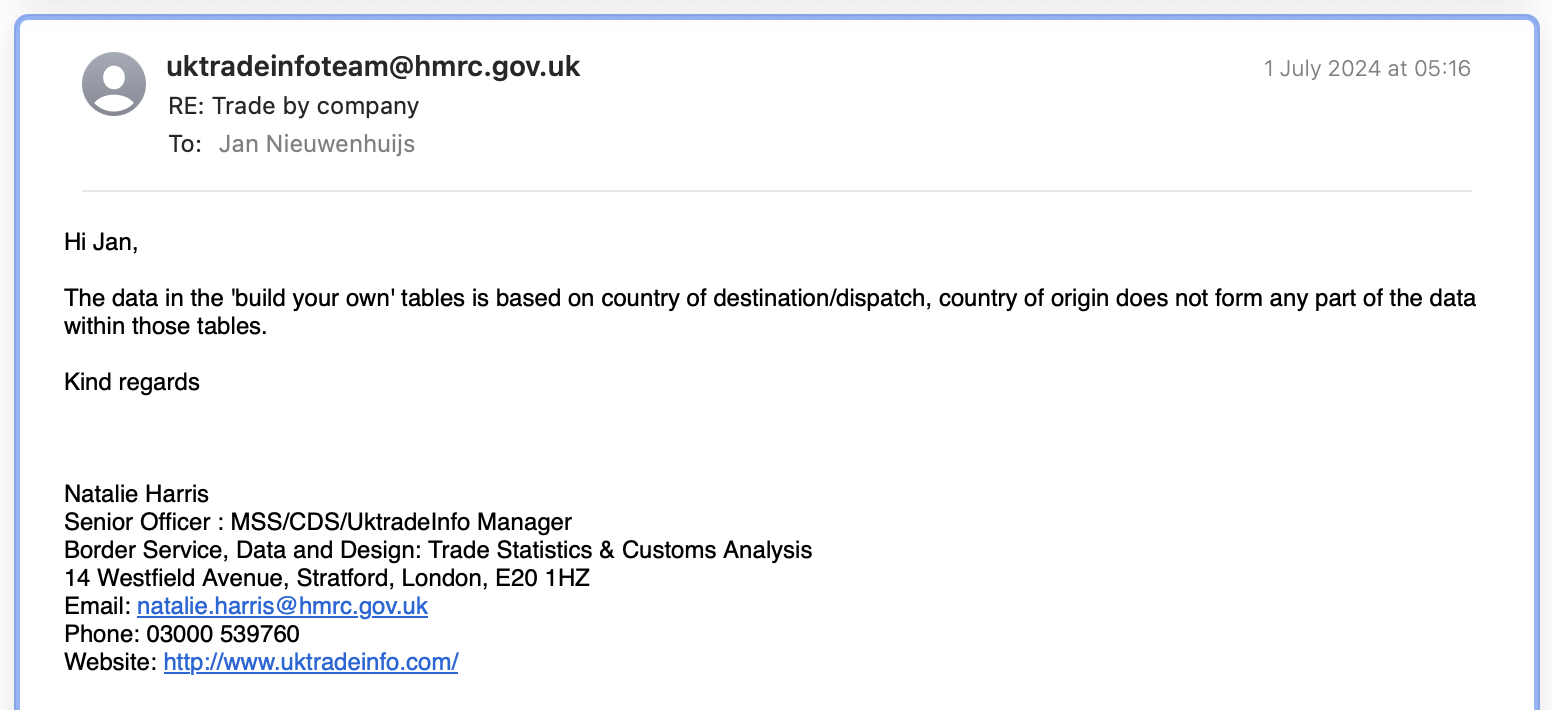
On the SGE, very few large bars are traded—the Chinese private sector prefers 1 Kg bars. My research shows that direct exports from the U.K. to China are, in fact, purchases by the PBoC. These purchases show up in cross-border trade statistics because the PBoC buys the gold from bullion banks that take care of shipping and insurance and thus have to deal with customs.

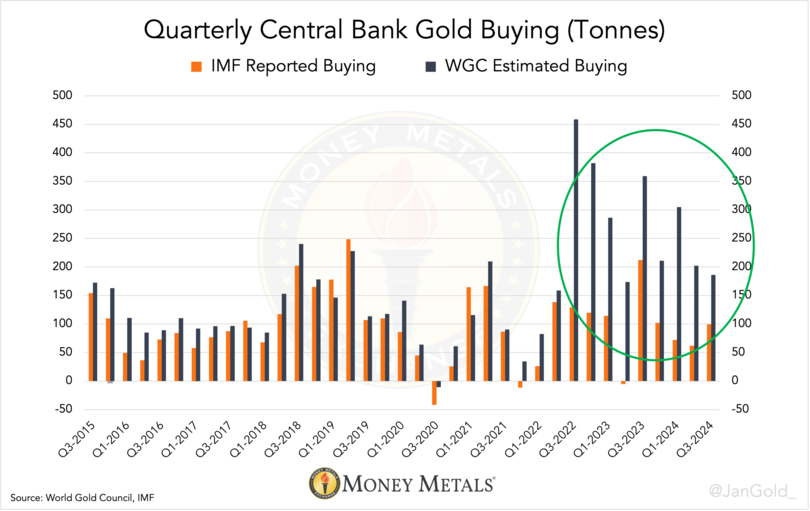
The above matches other evidence of the PBoC acquiring gold surreptitiously. By now, most gold investors are aware that the massive difference between what the World Gold Council (WGC) estimates central banks purchase in aggregate (based on field research) and what central banks in total report to the IMF is mainly attributable to the central bank of China.

Chart 1. Since mid-2022, actual central bank gold purchases have been dramatically higher than the IMF was willing to report.

Chart 1. Since mid-2022, actual central bank gold purchases have been dramatically higher than the IMF was willing to report.

This secret buying by central banks has exploded since the outbreak of the war in Ukraine early 2022 because, at that point, the West froze Russia’s dollar assets. Next to the PBoC, the Saudi Central Bank (SAMA) is known to be buying gold under the radar, albeit in smaller sizes.

More Proof the PBoC Buys Gold in London

Elaborating on the above, the PBoC has made it overtly clear what they did in September: buy 60 tonnes of gold from bullion banks operating in the London Bullion Market.

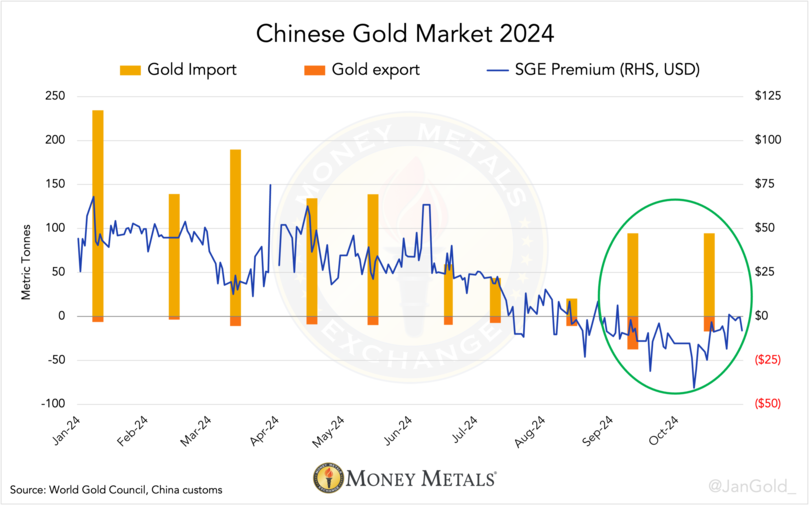
As we saw private gold demand move from East to West halfway through 2024, driving the price up, the premium at the SGE took a nose dive into negative territory. But, surprisingly, Chinese customs data from September shows gross gold import accounted for 95 tonnes2.

According to the rules in the Chinese gold market, all bullion imports into the domestic markets must be sold through the SGE first. But if the SGE trades at a discount, why would any bank import gold to sell at a loss? Of course, they do not. When the SGE trades at a steep discount, gold imports into the domestic market are not bought by the private sector.

Chart 2. In green, large imports while private demand on the SGE is weak, indicated by a discount relative to the gold price in London. Imports shown are destined for the PBoC, not the private sector<sup>3</sup>.

Chart 2. In green, large imports while private demand on the SGE is weak, indicated by a discount relative to the gold price in London. Imports shown are destined for the PBoC, not the private sector3.

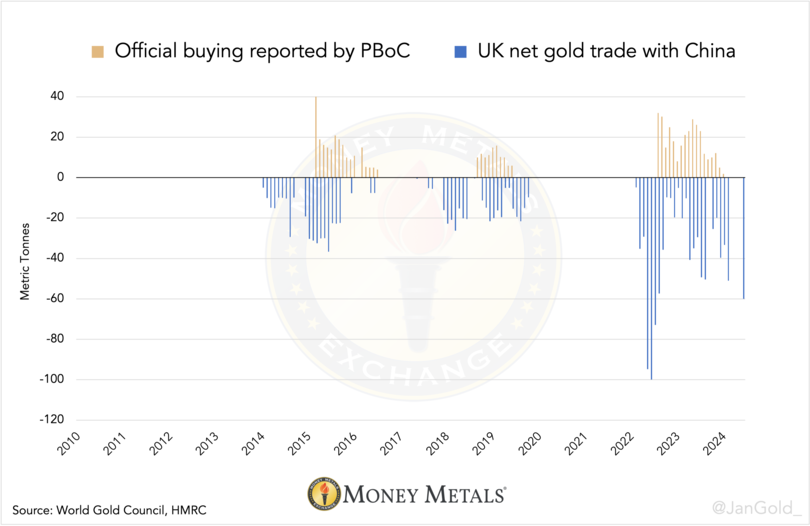
What has happened is that 60 tonnes imported from the U.K. in September2 were swiftly handed over to the PBoC (exempt from rules) when they arrived in Beijing and carried to central bank vaults4.

Chart 4. Direct gold exports from the U.K. to China (PBoC purchases) are correlated with additions publicly disclosed by the Chinese central bank. Although, the PBoC usually takes up to a year to openly report on its acquisitions and keeps about 65% of it hidden.

Chart 3. Direct gold exports from the U.K. to China (PBoC purchases) are correlated to gold additions disclosed by the Chinese central bank. Although, the PBoC usually takes up to a year to publicly report its acquisitions and keeps about 65% of it hidden.

An Explosive Gold Market

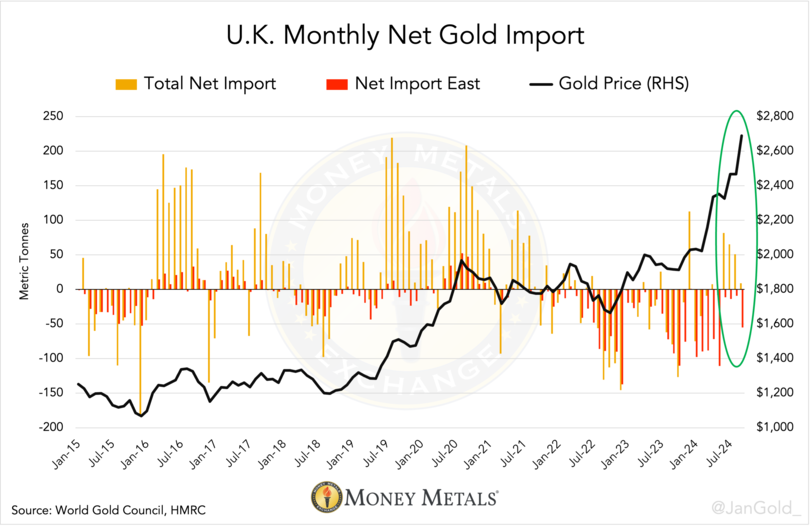
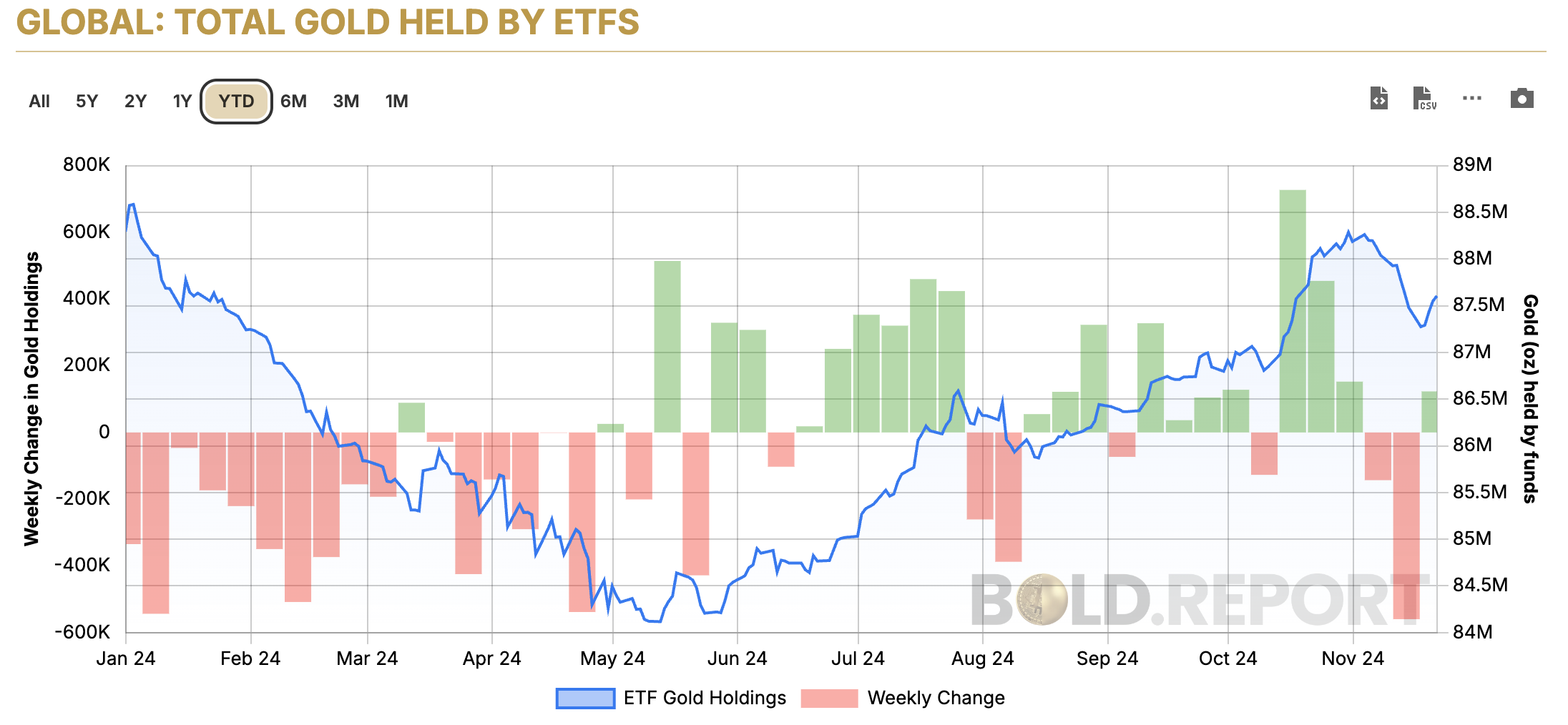
So, in September 2024, the PBoC covertly bought at least 60 tonnes in London—it could have bought gold in other places as well. Western investors were also driving up the gold price, as evidenced by swelling ETF holdings and net gold imports into London.

Chart 3. Gold imports to the U.K. rose sharply in 2024 for the first time in several years.

Chart 4. Gold imports to the U.K. rose sharply in 2024 for the first time in several years.

Early 2024, I wrote on the Chinese central bank driving gold up: “As the gold price will be making new all-time highs, I expect more Western investors to join buying gold, through ETFs and outright, as they will fear currency debasement just as the Chinese central bank. It will be a perfect storm for gold.”

This has become a reality as the price of gold is up 30% year-to-date. Meanwhile, the PBoC keeps the “pedal to the metal” (pun intended). In chart 2, we can see that in October, the SGE was trading at a discount while imports reached 95 tonnes, which was the same as in the prior month. I strongly suspect the PBoC was secretly buying gold in London again.

Large investors on both hemispheres are buying gold hand over fist. Ongoing wars and fiscal deficits aren’t waning, and the safe haven of choice for institutional money is gold.

We are in the midst of a perfect storm for gold that is to continue for years to come until debt levels and the global power distribution have rebalanced.

I will provide a computation of how much gold the PBoC truly owns in a forthcoming article. You may be surprised.

Notes
  1. There are laws and tax incentives that make most mine output, imports, scrap supply, and disinvestment in the Chinese domestic market to be sold through the SGE.
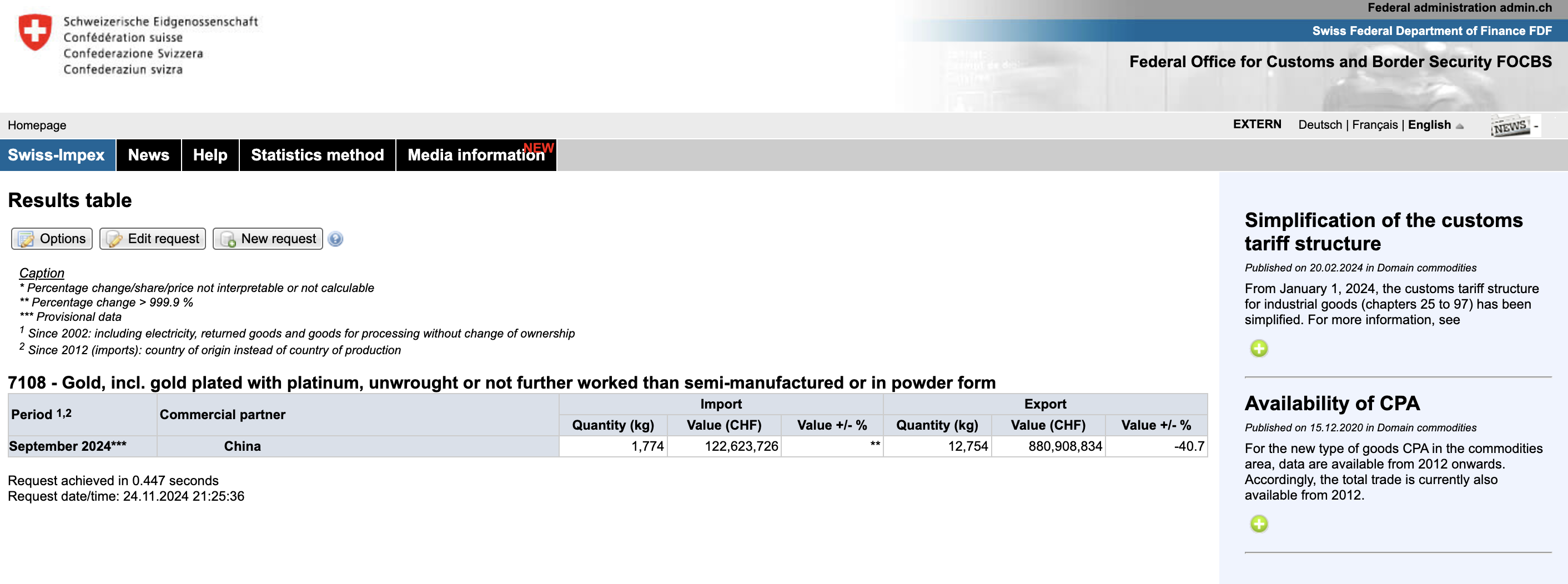
  2. Chinese customs reports gold import per “country of origin.” So, a Swiss-made gold bar stored in London and subsequently exported to China will be reported by the Chinese as an import from Switzerland. Based on China’s import data, we can’t distinguish how much it shipped from the U.K., only export numbers from British customs can tell, as these stand for “country of destination/dispatch.”
  3. Gross gold export from China was exceptionally high in September, but this was mainly shipped out from the Guangdong province to Hong Kong. China’s vast jewelry industry is located in Shenzhen in the Guangdong province. Most likely, when demand in China fell in September, creating a discount on the SGE, fabricators in Chinese Free Trade Zones, such as Shenzhen, sold their inventory outside of China (Hong Kong).
  4. According to Chinese customs, gross gold import into the Beijing region for September accounted for 69 tonnes, which is roughly in line with the U.K.’s gross export to China of 60 tonnes. Possibly, the 9-tonne gap (69 – 60) can be matched to a 12-tonne export from Switzerland to China (though the Swiss export bars in all sizes).

Seven Key Indicators to Watch as the Dollar Declines

(Mike Maharrey, Money Metals News Service) There’s been a lot of talk about “de-dollarization,” with many countries trying to minimize their exposure to the U.S. dollar.

But is the dollar really in trouble?

Investment guru Nick Giambruno thinks it is. In fact, he believes the dollar will ultimately collapse.

But it’s sometimes difficult to see the dollar’s decline because it is happening very slowly. In a recent article published by Doug Casey’s International Man, Giambruno highlights seven key indicators we can watch as the U.S. government falls deeper into a “perpetual debt spiral.”

1. Federal Budget Deficits: At $1.83 trillion, the Biden administration ran the third-largest deficit in history in fiscal 2024. It’s projected to get worse, with annual deficits reaching nearly $3 trillion by 2034. And as Giambruno points out, this is based on an unrealistic, rosy forecast without any wars, recessions, or other crises to raise federal spending.

2. The existing Federal Debt: The national debt eclipsed $36 trillion on Nov. 21. It took just 118 days to add another trillion to Uncle Sam’s debt load. That represents just under 123 percent of the country’s GDP. Giambruno pointed out that GDP is a flawed statistic, counting government spending as a positive contribution to economic growth. When you pull government outlays from the equation, the debt’s size relative to the productive economy is even bigger.

3. Interest on the Debt: The Federal government spent over $1 trillion on interest expense alone in fiscal 2024. Interest payments were up 28.6 percent over fiscal 2023 levels. The U.S. government paid more in interest than it did for national defense ($882 billion) or Medicare ($874 billion). The only spending category larger than interest on the debt was Social Security ($1.46 trillion.) Interest expense is expected to eclipse Social Security outlays in the near future.

4. The Federal Fund Rate: The Federal Reserve cut interest rates for the second time at the November meeting. After holding rates at zero for nearly a decade after the 2008 financial crisis, and slashing them to zero again during the pandemic, the Fed has addicted the economy to easy money. But facing surging price inflation, the Fed was forced to quickly raise rates. The problem is this debt-riddled bubble economy can’t function in a higher interest rate environment. As Giambruno pointed out, “The Fed has now pivoted back to monetary easing and rate cuts without having defeated inflation. That’s because the skyrocketing interest expense threatens the solvency of the U.S. government and forces the Fed to cut interest rates and keep them artificially low to try to control interest costs.”

5. Money Supply: Giambruno reminded us, “The Fed has only two tools in its toolbox: currency debasement and gaslighting.” He noted that the only way the Fed can control government interest costs is to inflate the money supply. The money supply contracted as the Fed raised rates to fight price inflation, but it began expanding again this summer. That is, by definition, inflation. Even with the decrease in the money supply during the inflation fight, it has still skyrocketed by 37 percent since 2020. “If your after-tax wealth has not increased by 37 percent since 2020, then you are not keeping up with the Fed’s monetary debasement. You are losing ground and on the road to serfdom.”

6. CPI: As Giambruno put it, “The CPI is misleading government propaganda intended to conceal the government’s atrocious currency debasement.” As I often remind people, the CPI significantly understates price inflation. The government revised the CPI formula in the 1990s so that it understates the actual rise in prices. Based on the formula used in the 1970s, CPI is closer to double the official numbers. Giambruno put it bluntly, “Using the CPI as a measure of price increases for 340 million people is even more preposterous than taking the average temperature across 50 states in the U.S. as a meaningful statistic to determine what clothes you should wear today.” Nevertheless, he said it’s useful to monitor CPI, “not as a meaningful metric to gauge inflation, but as a metric to analyze the Fed’s actions and gaslighting.”

7. The Price of Gold: Nobody can arbitrarily increase the supply of gold. Therefore, as the number of dollars floating around out there increases, the price of gold tends to rise. This is why gold is an inflation hedge. Giambruno asks the key question: “If the gold price is already hitting record highs, imagine what could happen now that the Fed has flipped back to monetary easing with potentially even more currency debasement than the previous rounds of stimulus.”

Watching these indicators will help you understand exactly how much trouble the dollar is really in.

‘You’re Gonna Be Embarrassed’: Panel Cries Fake News as Scott Jennings Cites CNN’s Own Reporting

(Julianna Frieman, Headline USA) CNN panelists raged Monday night about a survey reporting that billionaire Elon Musk’s social media platform X is more ideologically balanced than it was as Twitter, bemoaning the survey as fake news—even after they learned CNN reported on the survey.

On NewsNight, political commentator Scott Jennings hit back at Amazon Prime Video show host Cari Champion for criticizing X as a Republican echo chamber.

“I heard what you’re saying about X. I saw a survey this week. It’s now the most ideologically balanced user platform of any platform,” he told Champion, who interjected immediately.

“Scott, stop! Stop! It’s too early. I just sat down,” she whined. “I’ve only been here for two minutes.”

Jennings told Champion she was “gonna be embarrassed” by the source of the survey he referenced, which prompted CNN panelist Ashley Allison and guest host Audie Cornish to chime in and ask, “Who’s the source?”

Jennings revealed CNN reported on the survey earlier, but Champion said, “it’s not accurate and you know it.”

CNN’s Harry Enten recently reported that under Musk, X has become more ideologically balanced as an equal number of Republicans and Democrats told a survey they use the platform for news.

In 2024, survey data showed that 48% of Democrats and 47% of Republicans used X for news, compared to 65% of Democrats and 31% of Republicans in 2022.

Cornish interrupted to say that once Musk rebranded Twitter as X after his acquisition in 2022, major changes to the platform took place.

She pointed out that President-elect Donald Trump gave Musk a role in his incoming administration.

Trump partnered Musk with former GOP presidential candidate Vivek Ramaswamy, another successful businessman, to head the new Department of Government Efficiency.

Cornish rerouted the discussion to Musk teasing a buyout of struggling MSNBC, which Comcast announced will soon be offloaded into a spinoff company, among other channels, and separated from NBC News.

She suggested billionaires buying mass media companies was dangerous.

Musk reposted the one-minute CNN clip, amused by the end when one panelist said former Microsoft CEO Bill Gates purchasing a media company would not be concerning because that billionaire “is sane.”

“Listen to the end of the clip lmao,” Musk wrote on X.

Julianna Frieman is a freelance writer published by the Daily Caller, Headline USA, The Federalist, and The American Spectator. Follow her on Twitter at @JuliannaFrieman.

The Fed Lost Another $20B in 3rd Quarter; You Will Get the Bill

(Mike Maharrey, Money Metals News Service) The Federal Reserve booked $19.9 billion in operating losses in the third quarter.

Keep in mind that Fed losses ultimately become your losses. The taxpayer is on the hook for the central bank’s shortcomings.

Fed losses in the last quarter were 35 percent lower than in Q3 2023, but up from just over $16 billion in Q2.

The Fed has been bleeding red ink since Q4 2022, with total losses amounting to over $200 billion.

Why is the Fed Hemorrhaging Money? 

The central bank’s own rate hikes are squeezing its bottom line. Its financial condition offers a glimpse behind the curtain into the unseen consequences of its attempt to ratchet down the price inflation it created with quantitative easing (QE) and artificially low interest rates since the 2008 Financial crises, including the monetary malfeasance of the pandemic era.

The Federal Reserve assures us that these massive paper losses don’t have any effect on its operation and won’t hinder its monetary policy.

That’s because the central bank writes its own rules. It can literally chart losses indefinitely. The U.S. Treasury bears the brunt of the central bank’s poor performance and ultimately passes those losses on to the taxpayer.

Why Is the Fed Losing Money?

As mentioned, Fed losses are the result of its own monetary policy. As rates go up, the central bank must pay more interest to banks that park funds there. But the interest income earned by Treasury bonds and mortgage-backed securities doesn’t climb as quickly. Meanwhile, the Fed has been shrinking its balance sheet as part of its inflation-fighting strategy. That means fewer assets generating interest income.

The St. Louis Fed explained it this way:

“Tightening causes the net interest rate spread to fall; that is, it causes net income to fall for a constant size of the Fed’s balance sheet. This occurs because the Fed runs a maturity mismatch: It owns long-term securities and owes short-term liabilities.

“Specifically, when the Fed raises the policy rate, it is immediately paying more interest on bank reserves and reverse repos—a large portion of the Fed’s liabilities: 42.5 percent and 17.0 percent, respectively, as of Nov. 8, 2023. However, the Fed’s assets are longer-term and often pay a fixed interest rate. Therefore, when the Fed raises the policy rate, its net interest rate spread falls.”

It’s also interesting to note that, like many commercial banks, the Fed has substantial unrealized losses. If you mark all the bonds held by the Fed to market value, the loss on paper stands at around $818 billion.

That’s down from just over $1 trillion at the end of Q2, thanks to a drop in long-term yields earlier this year. But yields have climbed again in recent weeks despite Fed rate cuts, and unrealized losses may cross that $1 trillion threshold by the end of the year.

Unrealized losses were the catalyst for the banking crisis in the spring of 2023.

WolfStreet offered a good explanation of how banks got into this situation:

“During the pandemic money-printing era, banks, flush with cash from depositors, loaded up on securities to put this cash to work, and they loaded up primarily on longer-term securities because they still had a yield visibly above zero, unlike short-term Treasury bills which were yielding zero or close to zero and sometimes below zero at the time. During that time, banks’ securities holdings soared by $2.5 trillion, or by 57 percent, to $6.2 trillion at the peak in Q1 2022.” 

In other words, the Federal Reserve incentivized the bond-buying spree even as it was loading up on bonds via QE.

Why Are Taxpayers on the Hook for Federal Reserve Losses?

When it comes to the Fed, losses don’t matter – at least not to the central bankers running the show.

While a normal bank losing billions every quarter would be in big trouble, central bankers at the Fed can rest easy. It doesn’t matter at all. They can run losses from now until the end of time, and things will go on business as usual.

But somebody feels the pain.

That somebody is Uncle Sam.

And when Uncle Sam feels pain, we the people feel pain.

That’s because we will ultimately suffer because we (the taxpayers) are going to foot the bill.

Under the Federal Reserve charter, the central bank remits net operating profits to the U.S. Treasury. This serves as an income source for the federal government and lowers the budget deficit. According to the St. Louis Fed, the central bank returned nearly $1 trillion to the U.S. Treasury between 2011 and 2021.

But when the Fed loses money, the Treasury loses its payday. To date, the negative balance due to the Treasury Department sits at $210 billion.

That means the feds ran even bigger budget deficits than they would have thanks to the Federal Reserve losing money.

And who pays for federal budget deficits?

Taxpayers.

Bigger deficits mean Congress either has to raise taxes to cover the shortfall or the Treasury has to borrow even more money. Either way, taxpayers pay. They either get a bigger tax bill, or they pay for the borrowing via the inflation tax when the Fed eventually prints money to monetize the debt.

Meanwhile, it’s tea and crumpets over at the Eccles Building.

Typically, managers are forced to take drastic measures when their companies suffer big losses. They try to slash costs. Sometimes, they lay off employees. If losses mount high enough, they might have to borrow money or sell assets. If they can’t stop the business from bleeding red ink, the company will ultimately face bankruptcy.

When the Fed loses money, the central bankers don’t have to do anything other than some creative accounting.

And therein lies the rub.

The reason the Federal Reserve can get away with this financial malfeasance is because they get to make up their own accounting rules.

You read that correctly. The central bank operates under its own special rules.

Imagine if you got to make up your own accounting rules when calculating your taxes. I bet your taxes wouldn’t be very high.

Well, you’ll be unsurprised to learn that the rules for the Fed work to its advantage.

According to its own special made-up accounting rules, a net loss at the Fed magically transforms into a “deferred asset.”

Under Generally Accepted Accounting Principles, operating losses reduce a business’s reported capital or surplus. But in Fed accounting, the central bank gets to create an “asset” on its balance sheet out of thin air equal to the loss. Business goes on as usual. If losses mount, the size of this “asset” grows.

The Fed explains the “deferred asset” like this:

“[I]n the unlikely scenario in which realized losses were sufficiently large enough to result in an overall net income loss for the Reserve Banks, the Federal Reserve would still meet its financial obligations to cover operating expenses. In that case, remittances to the Treasury would be suspended, and a deferred asset would be recorded on the Federal Reserve’s balance sheet.”

In an article published by the Mises Wire last year, Alex Pollock noted that without this accounting trick, the Fed would have negative capital.

Here are the combined Fed’s correct capital accounts as of June 30, based on Generally Accepted Accounting Principles. They result in a capital of negative $32 billion: 

  • Paid-in capital: $36 billion
  • Retained earnings: $68 billion
  • Total capital: $32 billion

As The Hill reported, “Among other things, this accounting ‘innovation’ ensures that the Fed can keep paying dividends on its stock.”

Don’t you wish the IRS would let you use “innovative” accounting on your tax returns?

This “differed asset” has no upper limit. The Fed can keep losing money into perpetuity, and it won’t matter – at least as far as the central bank is concerned. The “asset” will just continue to grow.

Once the Fed starts making money again, it will reduce the amount of this imaginary asset. That means the U.S. Treasury won’t see another dime from the Fed until this “asset” is zeroed out.

How long will it be before the Fed starts making money again?  

That remains unclear.

According to an analysis by the St. Louis Fed in November 2023, it won’t likely occur until 2027. An independent analyst told Reuters the life of this mythical “deferred asset” could extend into 2028.

The bottom line is, however long the Fed continues to lose money and during the time it pays down its “deferred asset,” the federal government will experience a reduction in revenue, resulting in budget deficits higher than they otherwise would have been.

A revenue cut is less than ideal when Uncle Sam is already buried in over $36 trillion in debt and continues to run massive budget deficits every single month. It means the U.S. government will have to borrow even more money that the Fed will ultimately have to monetize.

And it’s less than ideal for the U.S. taxpayer how will ultimately foot the bill for higher interest expense and the price inflation created as the Fed ultimately monetizes the debt.


Disney Spikes Transgender Volleyball Character from Marvel Cartoon

0

(Matt Lamb, Headline USA) Disney spiked an episode featuring a transgender volleyball player due to political concerns, according to leaked information.

A crew member alleged Disney scrapped the episode, a copy of which was leaked online, “because of which party that won the recent election,” as reported by Polygon, an entertainment news site.

Republicans won, in part, because of effective messaging on issues such as Kamala Harris’s support for transgender surgeries for prisoners and men playing in girls’ sports.

The show, Moon Girl and Devil Dinosaur included a transgender volleyball player who wanted to play on the girls’ team.

The specific episode, titled “The Gatekeeper” was supposed to air next year. The show itself did not appear particularly popular, as Disney canceled it after just two seasons.

However, there were produced episodes ready to use, including this one.

The player, named Brooklyn, complained in the episode about previously having to play on the boys’ soccer team, according to Polygon.

“Brooklyn’s comments about her athletic past are overheard by the opposing team’s coach, Greer (played by Amy Sedaris), who tries to have the teenager disqualified from the game,” Polygon reported. “But Brooklyn’s coach, gym teacher Coach Hrbek, tells Greer, ‘Brooklyn IS a girl, and she’s gonna play.'”

“I’m trans, my very existence breaks Greer’s rules,” the character reportedly said.

Disney disputed the claims it scrapped the episode due to the transgender character and politics.

Polygon reported the “source” said the decision was made a year ago. The episode is reportedly being “held.”

It is also possible, according to another website, that the company will put the episode on Disney+, just not Disney Channel.

The storyline, about a transgender volleyball player who wants to play against women, mirrors that of Blaire Fleming.

The San Jose State University volleyball player has come under scrutiny due to allegations that the athlete is a biological male.

Fleming’s presence, and domination, has led a handful of teams to forfeit, rather than play against SJSU.

Disney has faced criticism for several years for its involvement in pushing LGBT propaganda and woke content.

The entertainment company has co-sponsored LGBT “Pride” events that included nude adults in front of children.

An episode of the Star Wars show The Acolyte included lesbian witches using force to get pregnant.

Four Dem. Firms Earned $600M Pushing Pro-Kamala Ads

(Dmytro “Henry” Aleksandrov, Headline USA) It was recently reported that four Democratic firms earned $600 million for promoting ads celebrating former Democratic presidential nominee Kamala Harris before President-elect Donald Trump won the 2024 election.

Federal Election Commission (FEC) records that the Washington Free Beacon reviewed indicated that Harris’s presidential campaign directed almost $600 million to just four media consulting firms that have deep ties to Democrats.

The Beacon reported that the latest available FEC data showed the Harris campaign had spent over $880 million as of October 16. However, the Beacon noted that the overall price would skyrocket to $1.5 billion after the campaign files its post-election FEC report on December 5.

According to the news source, Media Buying & Analytics, Gambit Strategies, Bully Pulpit Interactive and Dupont Circle Strategies were the four companies that took 70% of Harris’s campaign’s total spending.

Media Buying & Analytics earned $281 million, Gambit Strategies earned $122 million, Bully Pulpit Interactive earned over $101 million and Dupont Circle Strategies earned over $94 million for pushing pro-Harris propaganda.

The recent news came after the defeated Harris team was left with $20 million in debt after Trump was declared the election winner, resulting in Trump trolling Harris and her supporters by offering to pay off her debts.

“I am very surprised that the Democrats, who fought a hard and valiant fight in the 2020 Presidential Election, raising a record amount of money, didn’t have lots of [dollars] left over. Now they are being squeezed by vendors and others,” Trump wrote on Truth Social.

“Whatever we can do to help them during this difficult period, I would strongly recommend we, as a Party and for the sake of desperately needed UNITY, do. We have a lot of money left over in that our biggest asset in the campaign was ‘Earned Media,’ and that doesn’t cost very much. MAKE AMERICA GREAT AGAIN!”

It was also reported that Harris’s campaign bribed Al Sharpton with $500,000 so that he would not ask Harris tough and uncomfortable questions during the interview.

The New York Times also revealed that Harris’s campaign had been spending $100 million weekly.

Matt Gaetz Considering Run for Fla. Gov. in 2026

(Dmytro “Henry” Aleksandrov, Headline USA) Former Rep. Matt Gaetz, R-Fla., teased his supporters by suggesting that he may run for governor of his home state in the 2026 election.

On Nov. 23, former Rep. Anthony Sabatini, R-Fla., suggested on Twitter that Gaets would become the next governor of Florida.

In response, Gaetz included Florida’s flag in his post, indirectly stating that he may run for office in his home state.

However, Gaetz stated at the beginning of September that he doesn’t plan to replace Gov. Ron DeSantis, R-Fla.

“I have no plans to run for Florida Governor. I believe God has me exactly where I’m supposed to be at the moment, working for FL-01. That said, it is incredibly heartwarming and humbling that so many polls show Floridians trust me atop the other choices for the job. Many terrific Republicans will likely run for Governor in the Sunshine State – but it ONLY matters if we elect [President-elect Donald Trump] in 2024. Time to focus,” he wrote on Twitter.

Gaetz acknowledged that many people encouraged him to run for governor in 2023, but he repeated that he doesn’t plan to replace DeSantis.

“Many did encourage me to consider running for governor one day. But we have an outstanding governor who will be in that position through 2026,” he said, adding that he was focusing on helping Trump win the 2024 election.

Trump recently nominated Gaetz as Attorney General, praising him as a “deeply gifted and tenacious lawyer.”

“Matt will end Weaponized Government, protect our Borders, dismantle Criminal Organizations and restore Americans’ badly shattered Faith and Confidence in the Justice Department,” Trump stated.

After facing pushback and realizing that RINOs in Congress may not approve him for this position, Gaetz withdrew himself from the nomination to avoid postponing the implementation of Trump’s policies.

Trump nominated former Florida Attorney General Pam Bondi to replace Gaetz, praising her for being tough on crime and making the “streets safe for Florida families.”

After that, Gaetz stated he doesn’t plan to return to Congress, saying that eight years is probably enough time.”

It was also recently alleged that DeSantis would not appoint Gaetz as senator after Trump nominated former Sen. Marco Rubio, R-Fla., as the Secretary of State.