In a Rare Candid Moment, Three Central Bankers Talk Up Gold

(Mike Maharrey, Money Metals News Service) While central banks around the world have been aggressively adding gold to their reserves, central bankers don’t tend to talk much about the yellow metal.

Three central bank officials went off script at the London Bullion Market Association conference in Miami.

Reserve managers from the central banks of Mexico, Mongolia, and the Czech Republic sat together on a panel at the conference, and all three indicated their countries plan to add even more gold to their reserves in the near future as geopolitical tensions increase and global interest rates decline, creating more inflationary pressure.

Banco de México international reserves director Joaquín Tapia said, “Given the context that we are facing right now — lower rates, your political tension, U.S. election, a lot of uncertainty — maybe the share of gold in our portfolios could be increasing as well.”

Central Bank of Mongolia director general of the financial markets department Enkhjin Atarbaatar said, “I expect that the reserves will continue to grow, and I also expect that the share of gold in our reserves will likely increase in the future.”

Czech National Bank deputy executive director of risk management Marek Sestak said, “I completely agree as well.”

The Czech National Bank has been quietly increasing its reserves in small increments for the past 18 months. It has boosted its gold reserves by 33 tons over this period and now owns 45 tons of the yellow metal.

Central bankers praising gold is something of an anomaly. Many are buying gold, but they don’t tend to praise its virtues publicly.

National Bank of Poland Governor Adam Glapiński is an exception to the rule. He wasn’t at the LBMA meeting, but he recently said the Polish central bank plans to increase its gold holdings to 20 percent of total reserves.

“Once we achieve this, we will join the ranks of the world’s top economies.”

When he announced a plan to expand gold reserves in 2021, Glapiński said holding gold was a matter of financial security and stability. 

“Gold will retain its value even when someone cuts off the power to the global financial system, destroying traditional assets based on electronic accounting records. Of course, we do not assume that this will happen. But as the saying goes – forewarned is always insured. And the central bank is required to be prepared for even the most unfavorable circumstances. That is why we see a special place for gold in our foreign exchange management process.”

Glapiński also pointed out that “Gold is free from credit risk and cannot be devalued by any country’s economic policy. Besides, it is extremely durable, virtually indestructible.”  

Poland was the biggest central bank gold buyer in the second quarter. In the last five months, the Polish central bank has accumulated an additional 39 tons of gold. It now holds about 15 percent of its reserves in the yellow metal.

Central banks’ net gold purchases globally totaled 1,037 tons in 2023. It was the second straight year central banks added more than 1,000 tons to their total reserves.

Central bank gold buying in 2023 built on the prior record year. Total central bank gold buying in 2022 came in at 1,136 tons. It was the highest level of net purchases on record dating back to 1950, including since the suspension of dollar convertibility into gold in 1971.

How Price Gouging Laws and Economic Fallacies Hurt Consumers: Insights from Money Metals’ Mike Maharrey

(Money Metals News Service) In the latest episode of Money Metals’ Midweek Memo, host Mike Maharrey uses an upcoming hurricane, Milton, as a backdrop to discuss flawed economic policies, particularly price gouging laws, and economic fallacies stemming from Keynesian thought.

As he prepares for the storm in Florida, Maharrey takes the opportunity to explain why certain popular economic policies hurt consumers in the long run, even if they seem beneficial on the surface.

Price Gouging Laws: Good Intentions, Bad Economics

Maharrey begins by discussing price gouging laws, which are commonly implemented in states like Florida during emergencies. These laws are intended to prevent businesses from raising prices excessively on essential goods like water, gas, and hotel rooms during a disaster.

However, Maharrey points out the fundamental flaws in these policies:

“It’s supply and demand economics 101. Price gouging bans during storms are equally absurd from an economic standpoint.”

He explains that these laws, while popular, lead to unintended consequences. For example, when prices are capped, people tend to hoard supplies, resulting in shortages. Allowing prices to rise, on the other hand, helps prevent panic buying and encourages suppliers from outside the affected area to bring in more goods.

Maharrey uses an umbrella analogy to illustrate his point:

“If umbrella prices were forced to remain low… you might go out and buy a bunch of umbrellas… But if prices are allowed to spike in response to demand, you would probably make do with just one or two umbrellas.”

Maharrey also emphasizes the importance of viewing price gouging from an unemotional, economic perspective:

“Economics doesn’t care whether there’s a disaster or not… economic principles do what they do, and they don’t give two wits about your feelings on the matter.”

The Broken Window Fallacy and Keynesian Economics

The Broken Window Fallacy and Keynesian Economics

In the second half of the episode, Maharrey critiques the Keynesian idea that natural disasters can stimulate economic growth due to the increased spending on recovery efforts. He references the well-known broken window fallacy, first explained by economist Frédéric Bastiat, to debunk the idea that destruction can benefit the economy.

He sums up the fallacy with an analogy:

If a child throws a rock through a shop window, the shopkeeper must pay to repair it. Some might argue this boosts the economy by creating work for the glazier, but in reality, the shopkeeper’s money could have been spent on something more productive.

As Maharrey explains, “Destroying things does not make you better off… if that was true, then I’d go take a sledgehammer to my wife’s car.”

He also mentions Paul Krugman’s infamous statement that a fake alien invasion would stimulate the economy:

“Krugman actually said… if we discovered space aliens were planning to attack and we needed a massive buildup… the slump would be over in 18 months.”

Take Control of Your Financial Future with Sound Money

Maharrey concludes the podcast by advising listeners to protect their financial futures with sound money like gold and silver. With governments constantly manipulating the economy through inflationary policies, he believes holding precious metals is a way to safeguard wealth:

“You have to take control of your own life and do the best you can to minimize the impact of this stuff… one way you can do that is to hold on to real money—gold and silver.”

For those interested in taking action, Maharrey suggests contacting Money Metals Exchange to learn more about how precious metals can fit into their investment strategy. You can do it online or call the customer service phone number: 1-800-800-1865.

“The government can’t print gold. It can’t print silver. It can’t create inflation with gold and silver.”

Sound Money Leader Speaks to SilverWars on Removing Taxation from Gold and Silver

(Money Metals News Service) Jp Cortez, executive director of the Sound Money Defense League, recently joined Jon Forrest Little on SilverWars to discuss states releasing gold and silver from state taxation across the country.

I. Introduction

The discussion opens with a strong emphasis on the critical role of grassroots advocacy in promoting sound money legislation. Cortez underscores the need for local involvement and activism to foster change at the state level. He explains how the Sound Money Defense League benefits immensely from the grassroots support of Money Metals Exchange customers who are advocating for these issues on the ground in any given state.

II. Recent Successes of Money Metals’ Public Policy Efforts

  • Strategic Focus: Money Metals and the Sound Money Defense League have been prioritizing state-level initiatives aimed at eliminating sales taxes on precious metals, among other projects. This focus has resulted in significant legislative wins, showcasing the effectiveness of targeted advocacy.
  • Examples of Successes: Several states are highlighted where sound money legislation has been enacted, reinforcing the idea that local efforts can yield tangible results. Specific victories in states like Louisiana, Alabama, and New Jersey are mentioned, illustrating the momentum behind these initiatives. In the Sound Money Defense League‘s 10th year of advocacy, 7 states passed pro- sound money legislation.

III. Public Opinion on Local Governance

  • Paradox in Public Engagement: Cortez notes a contradiction in public sentiment—while people are often most impacted by local governance, they often neglect to engage in local elections, focusing instead on national politics. This disconnection can hinder progress on sound money policies that require local support and advocacy.

IV. Community Involvement

  • Significance of Grassroots Advocacy: Grassroots activism is positioned as essential for promoting sound monetary policies. Jp stresses that effective change often begins at the local level, with states serving as critical examples for others to follow.
  • Role of Education and Awareness: The importance of educating the public on the implications of sound money policies and the benefits of local governance is discussed, emphasizing that informed citizens are more likely to participate actively in advocacy efforts. Costco’s recent foray into selling precious metals and Money Metals announcing a brand-new, state of the art precious metals depository in Idaho are two key data points that point towards an increase in investment and general awareness of precious metals.

V. Challenges and Victories

  • Specific State Examples:
    • New Jersey: Recent developments regarding sound money legislation are examined, focusing on the challenges faced in advancing these policies. The state’s political climate and public sentiment are analyzed to understand the obstacles to success.
    • New Mexico: Ongoing efforts in New Mexico to promote sound money initiatives are discussed, highlighting the challenges of overcoming legislative hurdles and the need for sustained grassroots support. New Mexico is one of only five states in the United States that still levy a tax on the purchase of gold and silver.

VI. Conclusion

  • Call to Action: The discussion concludes with a powerful call for increased public engagement in local governance and sound money initiatives. Jp encourages individuals to take an active role in their communities, emphasizing that local advocacy is vital for achieving broader legislative goals.

Important Questions Addressed

  1. How can grassroots advocacy effectively influence sound money legislation?
    • Grassroots efforts create a direct line of communication between advocates and legislators, allowing for tailored strategies that resonate with local communities.
  2. What successful strategies have been employed in various states?
    • Highlighting case studies of states that have successfully enacted sound money policies demonstrates practical approaches that can be replicated elsewhere.
  3. Why do citizens often overlook local governance in favor of national politics?
    • The discussion explores the psychological and cultural factors that contribute to this tendency, suggesting that greater awareness of local issues could bridge this gap.
  4. What specific challenges remain in advancing sound money policies in states like New Jersey and New Mexico?
    • Identifying political opposition, public misunderstanding, and legislative complexities offers insight into the hurdles that advocates must navigate.

Rowe to Be Fired? DHS Review Recommends New Leadership at Secret Service

(Ken Silva, Headline USA) A DHS-appointed panel investigating the attempted assassination of Donald Trump at a Pennsylvania campaign rally released its findings on Thursday, recommending that the Secret Service clean house and refocus its agents on the main mission: protecting dignitaries.

The DHS panel’s review is one of several investigations into the Butler Trump shooting. Others are being conducted by the House, Senate and the DHS Inspector General.

The 52-page report issued Thursday took the Secret Service to task for specific problems leading up to the July 13 rally in Butler as a well as deeper one within the agency’s culture. It recommended bringing in new, outside leadership and refocusing on its protective mission.

“Although experience within the Service is laudable and important, and some members of a future leadership team will likely be Secret Service veterans, the events of Butler suggest that there is an urgent need for fresh thinking informed by external experience and perspective,” the panel wrote.

“The new, external leadership will still undoubtedly draw on subordinates with deep experience within the Service to aid them in their acclimation, but ultimately, the non-Service perspective will benefit the protective mission during this critical juncture.”

The panel’s recommendations suggest that Secret Service Acting Director Ronald Rowe and other senior officials could be ousted from the agency soon. So far, no agents have been fired over the events of Butler.

The panel also recommended that the Secret Service focus on its main mission, as opposed to conducting investigations. The Secret Service initially focused on stopping counterfeiters before it started protecting U.S. Presidents in the wake of the assassination of William McKinley in 1901.

“The Service shall specifically consider what current responsibilities the Service needs to shed or discharge so that it can provide its protective mission with all resources required to fulfill that responsibility,” the panel recommended.

“The Panel does not make these recommendations or related observations lightly, but rather offers them in view of the crucial nature of the Secret Service’s protective mission for the ongoing continuity of American government and democratic functioning and the extent to which the events of July 13 at Butler have revealed critical deficits in the Service’s ability to operate that mission,” the panel added.

“In that context, in the Panel’s opinion, it is simply unacceptable for the Service to have anything less than a paramount focus on its protective mission, particularly while that protective mission function is presently suboptimal.”

The report follows investigations by members of Congress, the agency’s own investigators and by Homeland Security’s oversight body.

The panel members were Mark Filip, deputy attorney general under President George W. Bush; David Mitchell, who served in numerous state and local law enforcement roles in Maryland and Delaware; Janet Napolitano, homeland security secretary under President Barack Obama; and Frances Fragos Townsend, Bush’s assistant for homeland security and counterterrorism.

The Associated Press contributed to this report.

Ken Silva is a staff writer at Headline USA. Follow him at x.com/jd_cashless.

These 3 Conditions Must be Met Before Silver Surges Like Gold

(Jesse Colombo, Money Metals News Service) Just two months ago, the precious metals community was growing frustrated with gold after its choppy, lukewarm summer price action. At that time, I kept urging investors to stay patient as I believed that gold was about to break out in multiple non-U.S. currencies, which would result in a powerful surge.

Sure enough, that’s exactly what unfolded, and I believe even more gains are ahead. Now, I’m noticing the same frustration with silver, as it has remained stagnant for the past five months.

In this article, my goal is to encourage investors to remain patient with silver, as I believe it’s on the verge of a strong breakout, much like gold—once these key conditions are met.

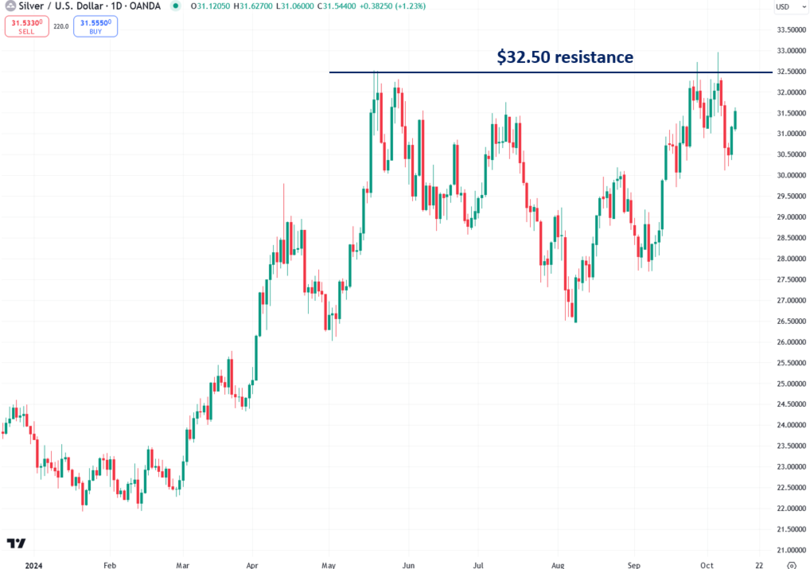
The first condition is straightforward yet largely overlooked by investors and has proven surprisingly challenging to achieve: the spot price of silver must close decisively above its $32.50 resistance level, backed by strong trading volume.

The $32.50 resistance level was established at the May high, after which silver pulled back and remained stagnant over the summer. Silver recently attempted to break above that level on September 26th and October 4th, but both efforts fell short, leading to subsequent pullbacks.

I believe the time is approaching, however, when silver will finally break through and close above that level, sparking a significant rally. Once that happens, I expect silver to surge rapidly to approximately $50.

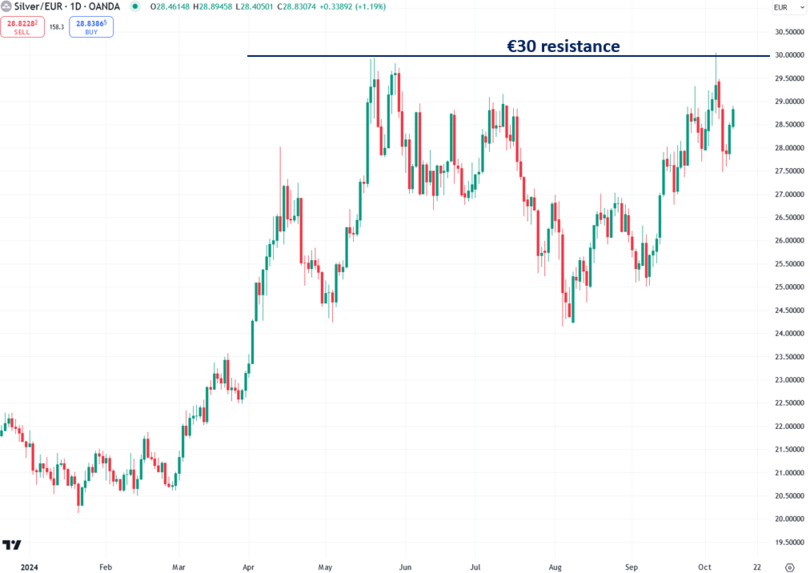
The next condition is that silver, priced in euros, must close decisively above the €30 resistance level that formed at the May peak. This event would help confirm a close above $32.50, greatly reducing the chances of it being a false breakout.

I find it valuable to analyze silver priced in euros, as this approach removes the impact of U.S. dollar fluctuations, offering a clearer view of silver’s intrinsic strength or weakness. Notably, silver priced in euros often respects round numbers like €26, €27, and €28, frequently establishing key support and resistance levels at these points. These levels are worth watching closely—take a look for yourself.

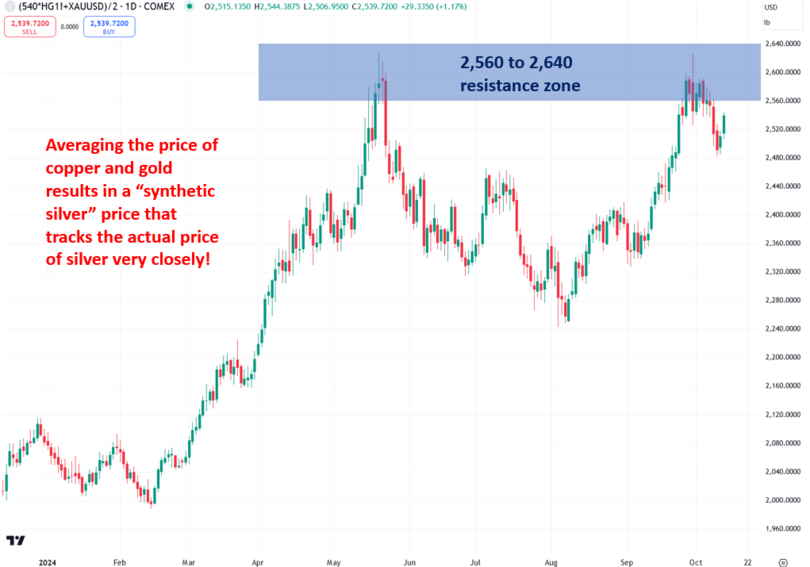
The final condition is more esoteric, but I believe it will significantly reduce the likelihood of an upcoming silver breakout being a false one: an index I developed, called the Synthetic Silver Price Index, must close above its key resistance zone between 2,560 and 2,640. This index represents the average of gold and copper prices, with copper’s price adjusted (multiplied by 540) to prevent gold’s higher price from disproportionately influencing the index (to learn more about this methodology, please watch a presentation I created).

The price of copper is an often overlooked factor in silver’s performance and rivals the influence of gold. The index closely mirrors silver’s price movements, yet surprisingly, silver’s price itself isn’t even an input!

As I said earlier in this piece, there is a high probability that silver will quickly run to $50 once those three conditions are met. I’m focusing on $50 as a relatively short-term target because it’s a significant psychological level and the peak reached during both the 1980 and 2011 rallies.

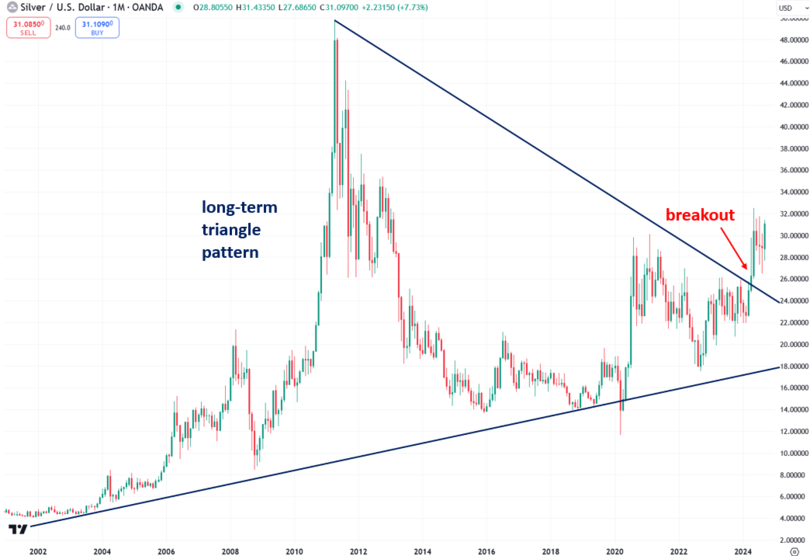
One of the reasons why I’m so bullish on silver is because its monthly chart reveals a recent breakout from a massive, two-decade-long triangle pattern. This breakout signals that silver is on the verge of a powerful bull market:

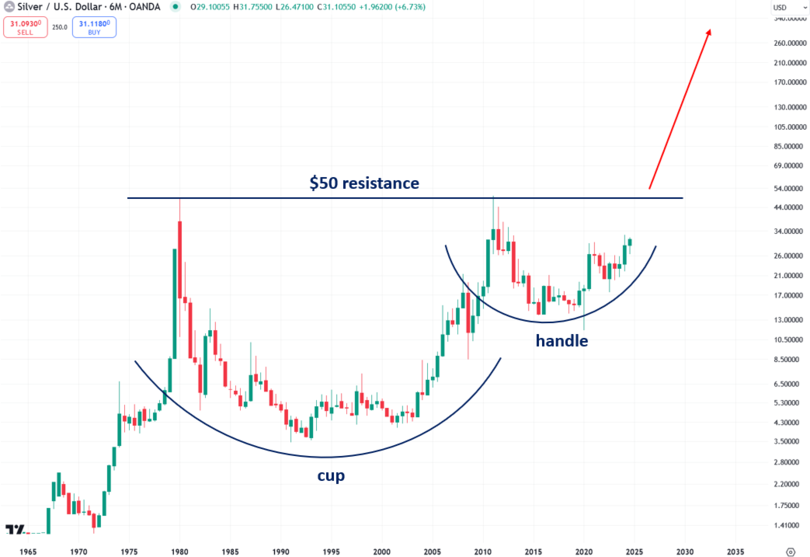
If that isn’t exciting enough, silver’s logarithmic chart, dating back to the 1960s, reveals a cup and handle pattern that suggests silver could reach several hundred dollars per ounce during this bull market. However, a close above the $50 resistance is necessary to confirm this scenario.

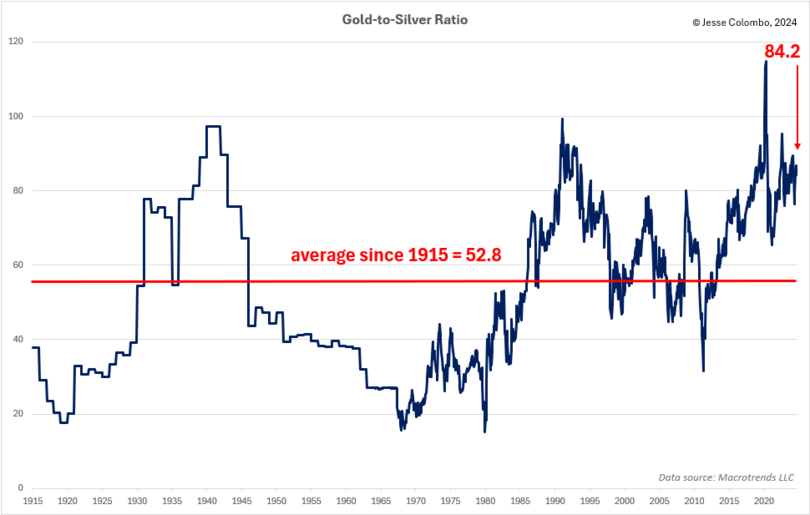
Although silver has already surged nearly 50% this year, there are plenty of reasons to believe it is just getting started. One reason is that the long-term gold-to-silver ratio chart shows silver is currently significantly undervalued compared to gold. If the ratio were to revert to its historical average of 52.8 since 1915, even without any increase in gold’s price, silver would be valued at a solid $50.36 per ounce.

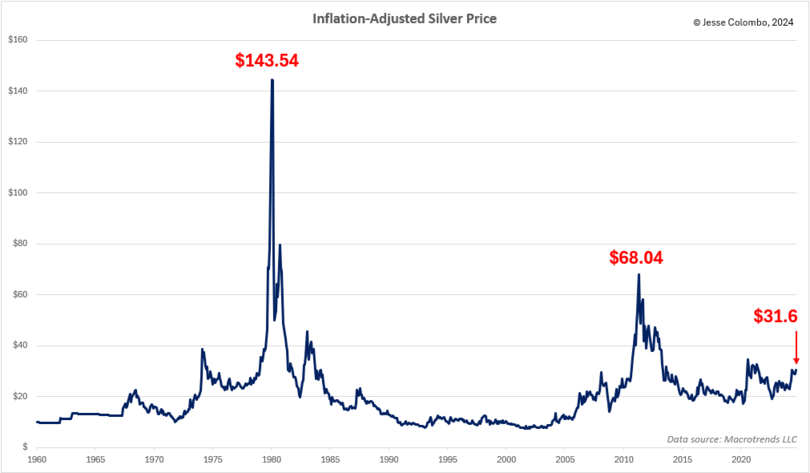
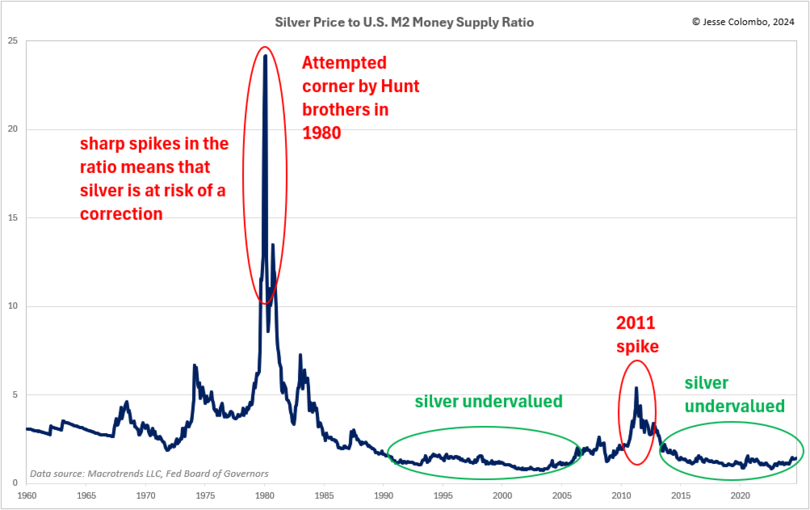
Adjusting silver’s price for inflation further highlights how undervalued it is by historical standards. During the Hunt brothers-induced spike in 1980, silver reached an inflation-adjusted price of $143.54. In the 2011 bull market, driven by quantitative easing, it hit $68.04. Currently trading at just $31.60, silver has significant room to rise if it’s to catch up with these previous inflation-adjusted peaks.

Another way to assess whether silver is undervalued or overvalued is by comparing it to various money supply measures. The chart below shows the ratio of silver’s price to the U.S. M2 money supply, providing insight into whether silver is keeping pace with, outpacing, or lagging behind money supply growth.

If silver’s price significantly outpaces money supply growth, the likelihood of a strong correction increases. Conversely, if silver lags behind money supply growth, it suggests a potential period of strength ahead. Since the mid-2010s, silver has slightly lagged behind M2 growth, which, combined with other factors discussed in this piece, could position it for a strong rally.

To summarize, silver is on the launch pad, building up energy for a significant breakout. While investor frustration is understandable after months of stagnation, the technical and fundamental indicators suggest that silver is building momentum for an impressive move.

The combination of breaking key resistance levels, both in U.S. dollars and euros, along with confirmation from the Synthetic Silver Price Index, will signal that the rally has officially begun. With historical trends and undervaluation further supporting this outlook, silver could be on the verge of a major run toward $50 and beyond.

Also, watch the related video presentation I created:

https://youtu.be/jeqELLE-6aM?feature=shared

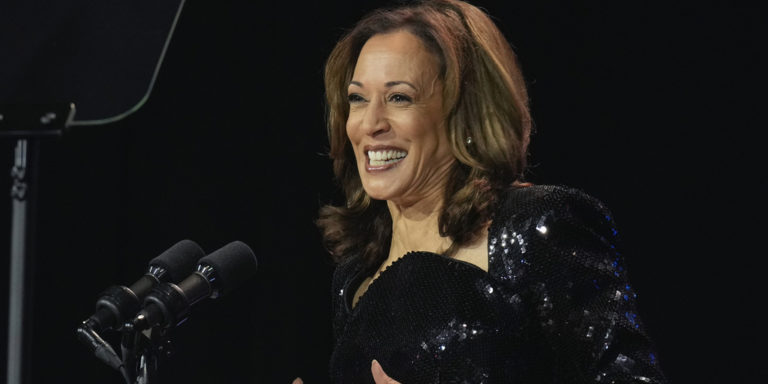
Kamala Claims Russians Brainwashed Black People

(Dmytro “Henry” Aleksandrov, Headline USA) Democratic presidential candidate Kamala Harris recently claimed that the reason why black Americans started supporting Republican presidential candidate Donald Trump was because Russia brainwashed them.

The recent news came after the Democrats discovered that they are losing black American voters, especially the ones who are male.

“They’ve already started with the misinformation and the lies. We know that there is foreign interference, and I have to say this to everybody listening to this: don’t let them take your voice,” Harris said. “I was a part of the Senate Intelligence Committee when we investigated Russia’s interference in the 2016 election. Black folks were targeted with misinformation.”

Conservatives on Twitter quickly responded to Harris’s recent statement.

“Oh, the Russians! Oh, it’s always Russia!” @BrainwashingSoc ironically wrote, attaching a photo of different corrupt American officials like Anthony Fauci, John Kerry, Barack Obama, George Soros and Bill Gates, among many others.

Others mocked her for assuming that black people are prone to being brainwashed by propaganda.

“What a racist thing for an Indian woman to say,” @thetiki71 wrote.

Some also noted that automatically assuming that black people cannot make their own decisions was indeed a bold strategy for Harris’s campaign to adopt.

However, the reason why black people are now massively leaving the Democratic Party and becoming Trump supporters is not because they were brainwashed but rather because the current administration has been deliberately destroying this country for almost four years.

When black Americans started asking Harris how exactly she would be different from Joe Biden, Harris could only offer weed and cash handouts, the money that would be taken away from other American taxpayers.

Breitbart reported that it even reached the point where Michelle Obama started promoting Harris, even though she previously stayed in the shadows. She realized Harris’s campaign was in horrible shape, and Trump was leading in the polls, including almost all battleground states. In another article, the news source reported that Obama enlisted drag queens and woke celebrities to push Harris toward the finish line.

Obama’s recent decision came after her husband, Barack Obama, and Bill Clinton attempted to resurrect Harris’s campaign by attracting more black male voters, but both failed miserably.

Border Patrol Agents Threaten to Leave If Kamala Wins

(Dmytro “Henry” Aleksandrov, Headline USA) The U.S. Border Patrol agents recently stated that they would leave their jobs and abandon the country’s southern border if Democratic presidential candidate Kamala Harris wins the 2024 election.

The recent threats imply that even if the agents stayed to do their job, Harris would still do everything possible to allow illegal aliens to enter the country.

Multiple agents told the New York Post that they couldn’t spend another four years fighting against the administration that doesn’t want them to do their job because Harris’s administration’s goal is to flood the U.S. with as many illegals as possible.

“I’m not doing this s–t again … four years of hell,” one of the anonymous agents said. According to the Post, the agent is still young and nowhere near retirement.

He also told the news source that he would definitely leave his job if Harris got inside the Oval Office.

“Under this administration, they’ve done everything they could to make our job as inefficient as possible. They can’t outwardly tell us not to do our job, but when you’re watching criminals come in and get released, it sucks,” he said.

Another agent, however, noted that the agents who are old enough to retire would also leave their jobs to protest Harris if she wins.

“Lots of guys who can retire will go. If Trump wins, they’ll stay,” the agent said. “We will have another exodus just because we will have a bunch of 20-year agents saying peace out.”

The recent news came after the agents spent almost four years trying to prevent illegals from entering the country while also fighting with the Biden-Harris administration, which has been trying to do the exact opposite.

It was previously reported that the agents were told not to report terrorists entering the country, which resulted in almost 100 illegals with the terrorist past staying inside the country.

On top of that, the agents were dealing with the increased crime and smuggled children.

“The biggest thing is that we do not control the border. The cartel controls the border. Everything that we do is a reaction to things that they have planned. Usually, we’re chasing around pawns while the kings and queens are doing whatever they want,” one of the agents said earlier this year. “Our border is by no means secure… No one is coming. No one is coming to protect you.”

CBS Caught Selectively Editing Mike Johnson’s Interview

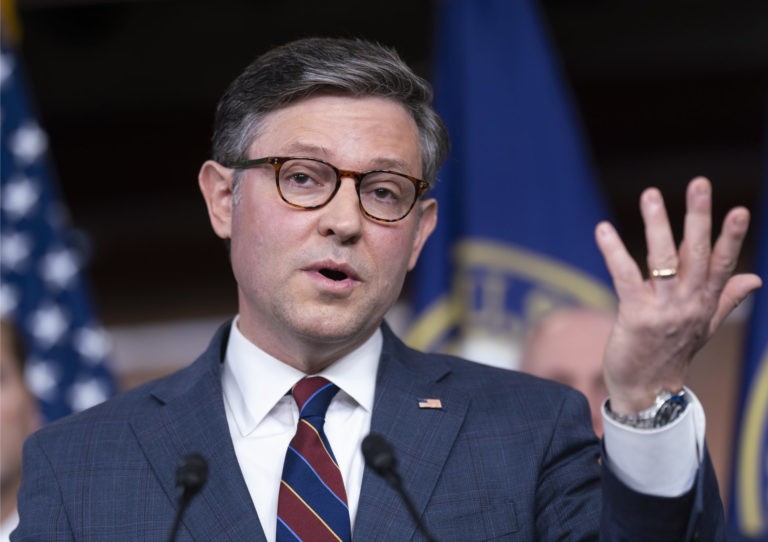
(Dmytro “Henry” Aleksandrov, Headline USA) It was recently discovered that CBS News selectively edited the interview with House Speaker Mike Johnson, R-La.

This revived conservative conversations about the network’s corruption and partisanship.

“CBS has been under fire for selectively editing their interviews to PROMOTE Democrats and UNDERMINE Republicans. Yesterday, they chose to cut FIVE important minutes out of my nearly 15-minute interview. You can be the judge as to why. Stand by for the receipts,” Johnson wrote in one of his Twitter posts.

In his follow-up posts, Johnson pointed out how the leftist network decided to get rid of some of the things that he said during the interview.

“I recently traveled to [North Carolina], and victims of Hurricane Helene told me that nearly two weeks after landfall, the Biden-Harris Administration had STILL not provided them with all the resources they desperately needed. But CBS selectively edited OUT ENTIRELY this first-hand perspective,” he wrote.

Johnson also posted a clip of him talking about Gov. Glenn Youngkin, R-Va., and his recent election integrity decision to prevent non-Americans from voting in the 2024 election. As expected, Democrats did not want Americans to know about that.

Johnson also pointed out that CBS News didn’t want its audience to hear about the Democrats in the Senate blocking the Safeguard American Voter Eligibility (SAVE) Act, which would ensure that only American citizens are allowed to vote.

“The Biden-Harris Admin let millions of illegal aliens in our country. So, the House passed the SAVE Act to ensure only American citizens vote in American elections. CBS edited that out and focused on 2020 instead of immediate threats to election integrity,” he wrote.

Conservatives on Twitter quickly responded to the blatant censorship by the network.

“They should lose their broadcast license,” @smdowner wrote.

Others also pointed out that there is no point for anyone who is not a radical leftist to talk with people on NBC News since they would twist your words or remove them, just like the network did with Johnson.

Some conservatives even addressed the network directly, criticizing them for censoring many portions of the interview.

“You are a disgrace, and no one is watching this garbage. You’re an unethical brainwashing organization and have lost all credibility and respect from the public,” author and blogger N. Davis Gibby wrote.

The recent news about Johnson’s censored interview came after multiple reports of the partisanship of CBS News, with donors and journalists having far-left political beliefs.

Additionally, it was recently revealed that CBS News’ 60 Minutes selectively edited Democratic presidential candidate Kamala Harris’s interview to remove her communist gobbledygook and make her appear like a good candidate for the job.

Loaded for Baier: Fox Host Pulls No Punches in ‘Train Wreck’ Kamala Interview

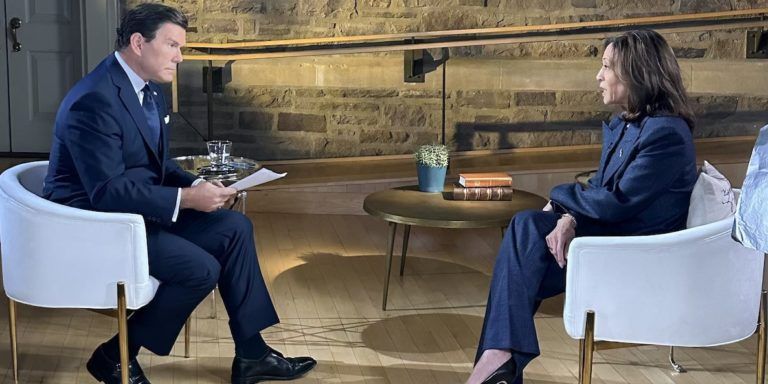
(Julianna Frieman, Headline USA) Democrat presidential nominee Kamala Harris had no choice but to face the facts Wednesday as Fox News anchor Bret Baier took a bare-knuckle approach to her first interview on the network that the Trump campaign gleefully declared a “total, unmitigated disaster.”

Baier pressed an evasive Harris in Pennsylvania with pointed questions on an array of policy issues and the cognitive health of President Joe Biden, who she insisted was fit for office shortly before he dropped his reelection bid on July 21.

“Joe Biden, I have watched from the Oval Office to the Situation Room. And he has the judgement and the experiment—experience—to do exactly what he has done in making very important decisions on behalf of the American people,” Harris said before chiding the Special Report anchor that former President Donald Trump is on the ballot and Biden is not.

Harris tried to shorten the exchange by showing up 15 minutes late and renegotiating the originally planned 30-minute timeslot. She arrived at 5:15 p.m., and the interview aired just after 6 p.m. unedited on Special Report.

The vice president, whom Biden put in charge of the crisis at the southern border, attempted to dodge the question when Baier led the interview by asking, “How many illegal immigrants would you estimate your administration has released into the country over the last three-and-a-half years?”

Harris likewise passed the buck on the open border when she told the Fox News anchor that she was not proud of the “immigration system,” skirting the blame on the Biden–Harris administration’s policies. She insisted the “immigration system” had issues predating Trump.

The Fox News interview was interspersed with relevant soundbites and graphics, including the Sept. 10 testimony of the mother of Jocelyn Nungaray, a 12-year-old girl brutally raped and murdered by illegal immigrants in June.

“Do you owe them an apology?” Baier asked Harris, referring to the Angel Families of victims of illegal immigrant crime.

Harris stopped short of taking responsibility and said, “I am so sorry for their loss.”

Baier corrected the Democrat nominee when she falsely suggested Trump allowed prisoners and illegal immigrants to receive sex-change surgeries at the taxpayer’s expense.

He told Harris “you would have a say as president” when she refused to provide a direct position on what she previously declared her support for.

Harris lost her cool after Baier pressed her on the weaponization of the Justice Department.

Despite claiming that Trump would “lock people up because they disagree with him,” he pointed out that the current administration had actively attempted to do just that.

She said Americans should trust the “experts” who say her potential administration would be better on the economy than Trump.

Baier latched onto Harris saying voters want to “turn the page.” The Fox News host rolled footage from the Democrat nominee’s Oct. 8 appearances on The View and The Late Show with Stephen Colbert, during which she admitted she did not know how her prospective presidency would differ from Biden.

“Let me be clear. My presidency will not be a continuation of Joe Biden’s presidency,” Harris, who turns 60 years old on Oct. 20, told Baier.

“And like every new president that comes into office, I will bring my life experiences, my professional experiences, and fresh and new ideas,” she continued. “I represent a new generation of leadership.”

The interview ended at a hard break, with Baier later revealing to a panel that four of Harris’s advisers off-camera were demanding that she pull the plug.

Trump Campaign National Press Secretary Karoline Leavitt called it a “TRAIN WRECK” in a follow-up statement.

“Kamala was angry, defensive, and once again abdicated any responsibility for the problems Americans are facing,” Leavitt said.

“She couldn’t give a straight answer to a single question because she has no answers,” Leavitt continued. “Kamala’s entire campaign is based on lies about President Trump. Kamala can’t handle the pressure of an interview with Fox News—she certainly can’t handle the pressure of being President of the United States.”

Julianna Frieman is a freelance writer also published by the Daily Caller and The Federalist. Follow her on Twitter at @JuliannaFrieman.

In Bizarre Eulogy, Clinton Boasts RFK Jr.’s Deceased Mother Flirted with Him

(Luis Cornelio, Headline USA) Former President Bill Clinton made bizarre remarks Wednesday while eulogizing Ethel Kennedy, RFK Jr.’s mother and widow of Sen. Robert F. Kennedy. 

Clinton, whose sexual deviancy was infamous during his political career, bragged that Ethel flirted with him and called her a “cat’s meow.”

“I was trying to think whether I could say anything that would add to what others have said and I doubt that, but I will tell you this,” Clinton said. “I thought your mother was the cat’s meow. She would flirt with me in the most innocent ways.”

These comments, which many described as inappropriate, drew laughter from the Kennedy family at the Cathedral of St. Matthew the Apostle in Washington, D.C.

Watch the full remarks below.

President Joe Biden and former President Barack Obama joined Clinton in delivering eulogies for Ethel, who died Oct. 10 after complications from a stroke.

During his remarks, Biden credited Ethel with helping him through the tragic deaths of his first wife, Nelia, and daughter, Naomi. 

“She got me through a time I didn’t want to stick around,” Biden said.  

He later added, “You know, the fact is, like she did for the country, Ethel helped my family find a way forward with principle and purpose.” 

Obama shared how he met Ethel at the 2004 Democratic National Convention, where she allegedly told him he was “going places.” 

Ethel was married to Robert for 15 years until his assassination on June 5, 1968. They had 11 children, including RFK Jr., who recently ran for the Democratic presidential nomination in 2024.