DNC Official: Donors ‘Discarded’ as Dems Gear Up for Christmas Party

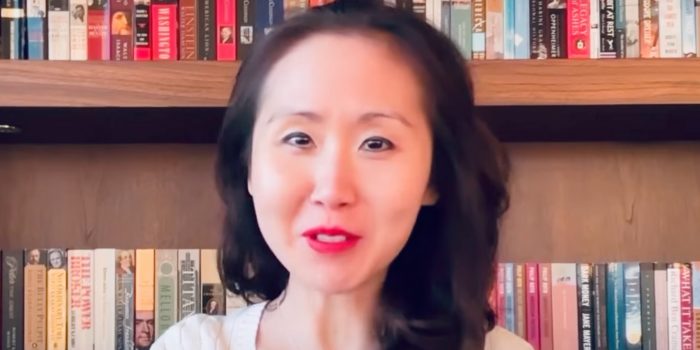
(Julianna Frieman, Headline USA) Lindy Li, a member of the Democratic National Committee’s finance committee, said Wednesday on NewsNation that her party’s donors “feel discarded” as top Democrats ignore them and divert their attention to holiday festivities.

Li, who donated to the Harris campaign, revealed that many Democrat donors told her they plan to never donate to the party again after Harris’s roughly $1.4 billion campaign that ended in massive debt and GOP victories across the country.

“People are shocked. And I’m getting someone even said that they refused to donate to the DNC ever again,” Li told NewsNation anchor Marni Hughes. “People are shocked. And also the way that they’ve been treating donors.”

Li said she takes no pleasure in saying her fellow Democrats are willing to walk away with their wallets shut.

“Again, this pains me to say it. It really I just it’s just very difficult. We feel discarded now. They don’t need us anymore. They’re basically treating us as dispensable commodities. I don’t know what else to say,” the DNC finance committee official told Hughes.

Li made clear that she understands why many of her fellow donors are ready to throw in the towel, pointing the finger at Harris as the final straw.

She suggested to the NewsNation host that Democrat donors are unwilling to waste their money for candidates who recklessly spend without a care for their fundraisers.

“It just how can the American people believe that the Democratic Party is capable of handling taxpayer funds if they can’t even handle campaign funds?” she said.

Li said the reported $20 million debt the Harris campaign incurred was not addressed on donor phone calls.

She added that donors like herself cannot unmute their microphones nor can they use the disabled comment section as party elites take the helm of these meetings.

“We have no way to ask questions. And of course, I doubt, you know, they would bring it up themselves. They clearly did not,” Li said. “So, the answer is no. None of the serious questions were addressed. It was really just patting each other on the back and ‘We’ll see you for the Christmas party.’”

Julianna Frieman is a freelance writer published by the Daily Caller, Headline USA, The Federalist, and the American Spectator. Follow her on Twitter at @JuliannaFrieman.

Trump Named TIME’s ‘Person of the Year,’ Rings Opening Bell at New York Stock Exchange

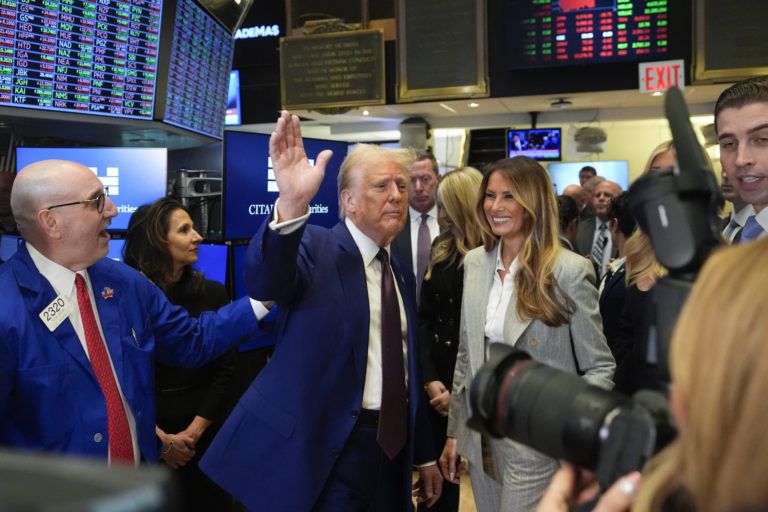
(Headline USA) President-elect Donald Trump rang the opening bell Thursday at the New York Stock Exchange after being recognized for the second time by Time magazine as its person of the year.

The honors for the businessman-turned-politician are a measure of Trump’s remarkable comeback from an ostracized former president who refused to accept his highly dubious election loss four years ago to a president-elect who won the White House decisively in November.

Before he rang the opening bell at 9:30 a.m., a first for him, Trump spoke at the exchange and called it “a tremendous honor.”

“Time magazine, getting this honor for the second time, I think I like it better this time actually,” he said.

Trump was also Time’s Person of the Year in 2016, when he was first elected to the White House.

Trump, accompanied by his wife, Melania Trump, daughters Ivanka and Tiffany and Vice President-elect JD Vance, grinned as people chanted “USA” before he rang the bell. He then raised his fist.

In his remarks, he talked up some of the people he has named to his incoming administration, including Treasury Secretary-nominee Scott Bessent, and some of his announced policies, such as a promise this week that the federal government will issue expedited permits, including environmental approvals, for projects and construction worth more than $1 billion.

“I think we’re going to have a tremendous run. We have to straighten out some problems, some big problems in the world,” he said.

Sam Jacobs, Time‘s editor in chief, said Trump was someone who “for better or for worse, had the most influence on the news in 2024” when announcing the selection on NBC’s Today show.

“This is someone who made an historic comeback, who reshaped the American presidency and who’s reordering American politics,” Jacobs said. “It’s hard to argue with the fact that the person who’s moving into the Oval Office is the most influential person in news.”

He added that “there’s always a hot debate” at the magazine over the honor, “although I have to admit that this year was an easier decision than years past.”

Despite the ease of the decision, the magazine’s notorious left-wing slant had sparked rumors that it could snub him, perhaps even in favor of his historically bad campaign rival, Vice President Kamala Harris.

He was listed as a finalist for this year’s award alongside Harris; X owner Elon Musk; Israeli Prime Minister Benjamin Netanyahu; and Kate, the Princess of Wales.

In an interview with the magazine published Thursday, Trump spoke about his final campaign blitz and election win.

“I called it ‘72 Days of Fury,’” Trump said. “We hit the nerve of the country. The country was angry.”

Trump was on Wall Street to mark the ceremonial start of the day’s trading. The Time magazine cover featuring him was projected onto a wall at the stock exchange, flanked by American flags.

Trump took the stage at the exchange flanked by family members and members of his incoming administration while his favored walk-on song, “God Bless the U.S.A.,” played.

The NYSE regularly invites celebrities and business leaders to participate in the 9:30 a.m. ceremonial opening trading. Thursday will be Trump’s first time doing the honors, which have become a marker of culture and politics.

Last year, Time CEO Jessica Sibley rang the NYSE opening bell to unveil the magazine’s 2023 Person of the Year: Taylor Swift.

Trump has long had a fascination with being on the cover of Time, where he first made an appearance in 1989.

Earlier this year, Trump sat for interviews with the magazine for a story that ran in April. Time’s billionaire owner, Salesforce CEO Marc Benioff, a prominent left-wing donor, criticized Harris for not granting the magazine an interview.

“Despite multiple requests, Time has not been granted an interview with Kamala Harris—unlike every other Presidential candidate,” Benioff said in a post on X. “We believe in transparency and publish each interview in full. Why isn’t the Vice President engaging with the public on the same level?”

In his latest interview, published Thursday, Trump reiterated that he planned to pardon most of those convicted in uprising at the U.S. Capitol on Jan. 6, 2021. “It’s going to start in the first hour,” he said of the pardons. “Maybe the first nine minutes.”

Trump said he would not ask members of his administration to sign a loyalty pledge. “I think I will be able to, for the most part, determine who’s loyal,” he said. But the former Apprentice host said he would fire anyone who doesn’t follow his policies.

On the war in Gaza, Trump said he wants to end the conflict and that Netanyahu knows it. When Trump was asked whether he trusted Netanyahu, he told Time: “I don’t trust anybody.”

The incoming president also discussed his plans for mass deportations and argued he will have the authority to use the military to assist with the effort—even though, as the magazine asserted, the Posse Comitatus Act forbids the deployment of the military against civilians.

“It doesn’t stop the military if it’s an invasion of our country,” he said. “I’ll only do what the law allows, but I will go up to the maximum level of what the law allows.”

The larger business community has applauded his promises to reduce corporate taxes and cut regulations. But there are also concerns about his stated plans to impose broad tariffs.

Republican control could mean big shifts in the stock market, and investors are adding to bets built earlier on what the higher tariffs, lower tax rates and lighter regulation that Trump favors will mean.

Adapted from reporting by the Associated Press

Angry Dems to Hold Biden’s Library Hostage Over Hunter’s Pardon

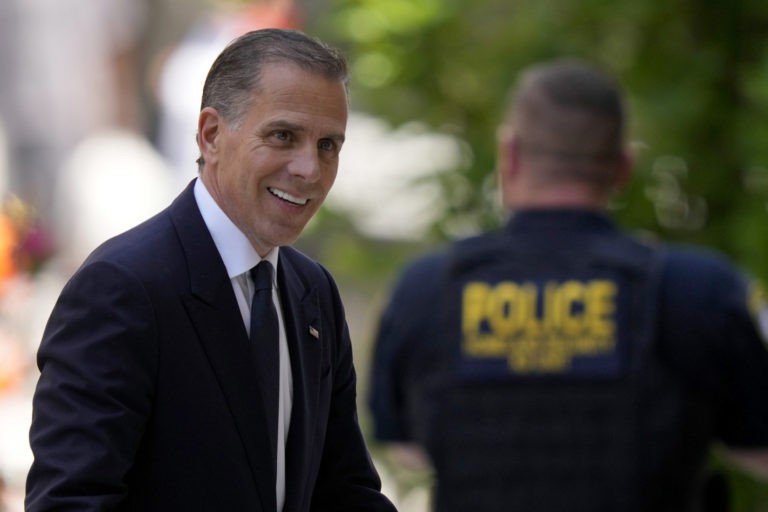
(Julianna Frieman, Headline USA) Top Democrats threatened to withhold funding for President Joe Biden’s future presidential library over the pardon of first son Hunter Biden, Axios reported Thursday.

The report indicates that high-profile Democrats are “furious” about Biden’s decision to pardon his son, which critics have panned as a short-sighted and selfish stain on the president’s legacy.

“If they had their s**t together, they would have been doing the work on this over the summer—right after he announced he was stepping aside,” one well-connected Democrat told the outlet. “Now, it’s just too late. Hopefully, they are rightsizing their expectations and budget!”

Biden family members were “shocked” by the number of Democrats publicly denouncing the president’s pardon, sources told the outlet.

While they anticipated some negative reaction, they did not precipitate the full extent of the outrage that ensued as Biden jetted off to Africa immediately after issuing his statement.

“Here’s the truth: I believe in the justice system, but as I have wrestled with this, I also believe raw politics has infected this process and it led to a miscarriage of justice – and once I made this decision this weekend, there was no sense in delaying it further,” Biden proclaimed, blaming a weaponized justice system for his son’s conviction.

Two top Biden aides, deputy chief of staff Annie Tomaini and First Lady Jill Biden’s top advisor, Anthony Bernal, are reportedly in charge of planning the outgoing president’s library, sources informed Axios.

Despite reports of funding threats, progress toward the library’s creation has occurred.

One source told Axios of the reported aggrieved donors, “No, that sentiment hasn’t come up in a single donor conversation, and work is well underway.”

Julianna Frieman is a freelance writer published by the Daily Caller, Headline USA, The Federalist, and The American Spectator. Follow her on Twitter at @JuliannaFrieman.

Crowd Bursts Out in Laughter as Jill Biden Openly Mocks Kamala Harris

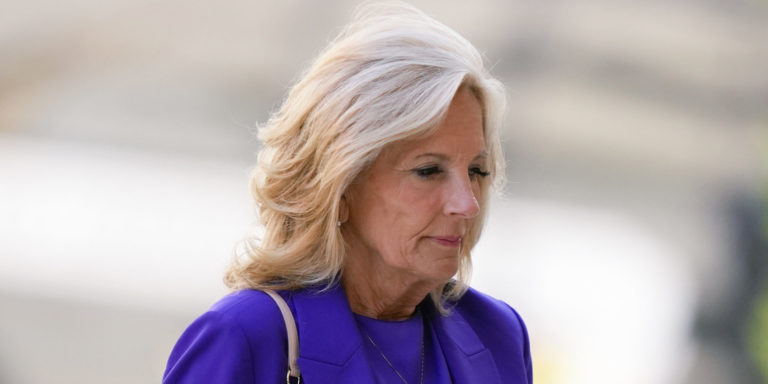
(Julianna Frieman, Headline USA) A crowd burst out in laughter Wednesday as First Lady Jill Biden appeared to openly mock Vice President Kamala Harris’s infamous “joy” slogan.

In what appeared to be a swipe at the failed 2024 Democrat presidential candidate’s short-lived campaign to bring “joy” back into politics, Jill Biden pontificated with attitude on the “joy” of the holidays during a conference about women’s health research.

The first lady encouraged attendees to direct their attention to her White House Christmas decorations—which notably looked like that of a circus—and to revel in the “joy” of the moment.

“So, I hope that you all feel that sense of, you know, peace and light, and that, uh… just for a moment when you leave here today that you feel, I don’t know. A little… a sense of joy,” she said, emphasizing her words with over-exaggerated gestures. “Because I think we all need, like… we all need to feel joy now.”

The audience laughed and Jill Biden knowingly blurted out, “You’re all reading into that!”

Jill Biden’s perceived anger toward Harris has appeared to have been brewing since President Joe Biden dropped his reelection bid in July.

The first lady has publicly displayed her apparent frustration multiple times, such as when she wore a Republican-red pantsuit on Election Day.

Biden has also appeared to signify his own ire toward the vice president since stepping aside.

The Democrat president was all smiles when he hosted President-elect Donald Trump at the White House in November to discuss the transfer of power between administrations.

Since his visit to the Notre Dame Cathedral, Trump trolled Jill Biden over an image captured of the two political rivals in what appeared to be friendly discussions.

The first lady’s steamy gaze at the president-elect generated memes online, including a fragrance ad from Trump himself featuring the image.

“Jill was very nice. A great conversation!” Trump wrote on Truth Social late Wednesday, resurfacing the photo a second time.

Julianna Frieman is a freelance writer published by the Daily Caller, Headline USA, The Federalist, and the American Spectator. Follow her on Twitter at @JuliannaFrieman.

Biden Issues Largest Act of Clemency in Modern History as Preemptive-Pardon Scandal Looms

(Headline USA) President Joe Biden is commuting the sentences of roughly 1,500 people who were released from prison and placed on home confinement during the coronavirus pandemic and is pardoning 39 Americans convicted of nonviolent crimes. It’s the largest single-day act of clemency in modern history.

Among those pardoned Thursday were a woman who led emergency response teams during natural disasters; a church deacon who has worked as an addiction counselor and youth counselor; a doctoral student in molecular biosciences; and a decorated military veteran, White House officials noted.

Also, a Chinese national with a massive collection of child pornography, they neglected to mention.

The commutations announced Thursday are for people who have served out home confinement sentences for at least one year after they were released. Prisons were uniquely bad for spreading the virus, and some inmates were released in part to stop the spread. At one point, 1 in 5 prisoners had COVID-19, according to a tally kept by The Associated Press.

Biden said he would be taking more steps in the weeks ahead and would continue to review clemency petitions. The second largest single-day act of clemency was by Barack Obama, with 330, shortly before leaving office in 2017.

“America was built on the promise of possibility and second chances,” Biden said in a statement. “As president, I have the great privilege of extending mercy to people who have demonstrated remorse and rehabilitation, restoring opportunity for Americans to participate in daily life and contribute to their communities, and taking steps to remove sentencing disparities for non-violent offenders, especially those convicted of drug offenses.”

The clemency follows a broad pardon for his son Hunter, who was prosecuted for gun and tax crimes. He was convicted by a Delaware jury in the first case and entered a guilty plea in the second.

It wasn’t a very popular move; only about 2 in 10 Americans approved of his decision, according to a poll from the Associated Press-NORC Center for Public Affairs Research.

Biden is under pressure from advocacy groups to pardon broad swaths of people, including those on federal death row, before the Trump administration takes over in January.

He’s also weighing whether to issue preemptive pardons to those who launched spurious, politically motivated investigations against Trump are facing possible consequences when he takes office. That move has generated considerable controversy and could even present a constitutional crisis due to the implications that a president could pardon individuals for crimes they hadn’t yet committed.

The president had previously issued 122 commutations and 21 other pardons. He’s also broadly pardoned those convicted of use and simple possession of marijuana on federal lands and in the District of Columbia, and pardoned former U.S. service members convicted of violating a now-repealed military ban on consensual gay sex.

Rep. Jim McGovern, D-Mass., and 34 other lawmakers are urging the president to pardon environmental and human rights lawyer Steven Donziger, who was imprisoned or under house arrest for three years because of a contempt of court charge related to his work representing Native American farmers in a lawsuit against Chevron.

Others are advocating for Biden to commute the sentences of federal death row prisoners. His attorney general, Merrick Garland, paused federal executions. Biden had said on the campaign trail in 2020 that he wanted to end the death penalty, but he never did. Now, with Trump coming back into office, it’s likely executions will resume.

More clemency grants are coming before Biden leaves office on Jan. 20, but it’s not clear whether he’ll take action to guard his political allies, surrogates and co-conspirators against possible prosecution by Trump, an untested use of the power.

The president has been taking the idea seriously and has been thinking about it for as much as six months—before the presidential election—but has been concerned about the precedent it would set, according to people familiar with the matter who spoke to the Associated Press on condition of anonymity to discuss internal discussions.

Those who received the pardons would have to accept them and the implicit admission of guilt that went with them. New California Sen. Adam Schiff, who was a part of the House committee that investigated the violent Jan. 6 uprising, said such a pardon from Biden would be “unnecessary,” and that the president shouldn’t be spending his waning days in office worrying about this.

Former Rep. Liz Cheney of Wyoming, another Jan. 6 committee member who is accused of covering up evidence to paint a false narrative during televised hearings, said in a statement this week that his suggestion that she and others be jailed for the investigations “is a continuation of his assault on the rule of law and the foundations of our republic.”

Before pardoning his son, Biden had repeatedly pledged not to do so. He claimed in a statement explaining his reversal that the prosecution had been poisoned by politics. However, the judge overseeing the California tax case promptly rebuffed those claims, noting that Biden had misrepresented the facts of the case.

As critics pointed out further evidence of the two-tiered system of justice for left-wing elites and everybody else, the decision prompted criminal-justice advocates and lawmakers to put additional public pressure on the administration to use that same power for everyday Americans.

Adapted from reporting by the Associated Press

November CPI Came In ‘As Expected’ Showing Inflation Is Sticky

(Mike Maharrey, Money Metals News Service) It seems the best we can hope for on the inflation front is a CPI report “in line with forecasts.”

The mainstream media was giddy, and the markets responded positively to the November CPI report because every metric came in as expected.

But the report wasn’t good – at least it wasn’t if you’re hoping for some relief from rising prices.

The CPI data indicates that we’re stuck on inflation.

Nevertheless, the report seemed to cement expectations that the Federal Reserve will once again cut interest rates at the December meeting. According to the CME Group’s FedWatch measure, the odds of a December cut rose to 99 percent after the CPI data came out Wednesday.

A Goldman Sachs Asset Management analyst told CNBC, “In-line core inflation clears the way for a rate cut at next week’s meeting,” and speculated that “the Fed will depart for the holiday break still confident in the disinflation process.”

My question is: what disinflation process?

The November CPI Data

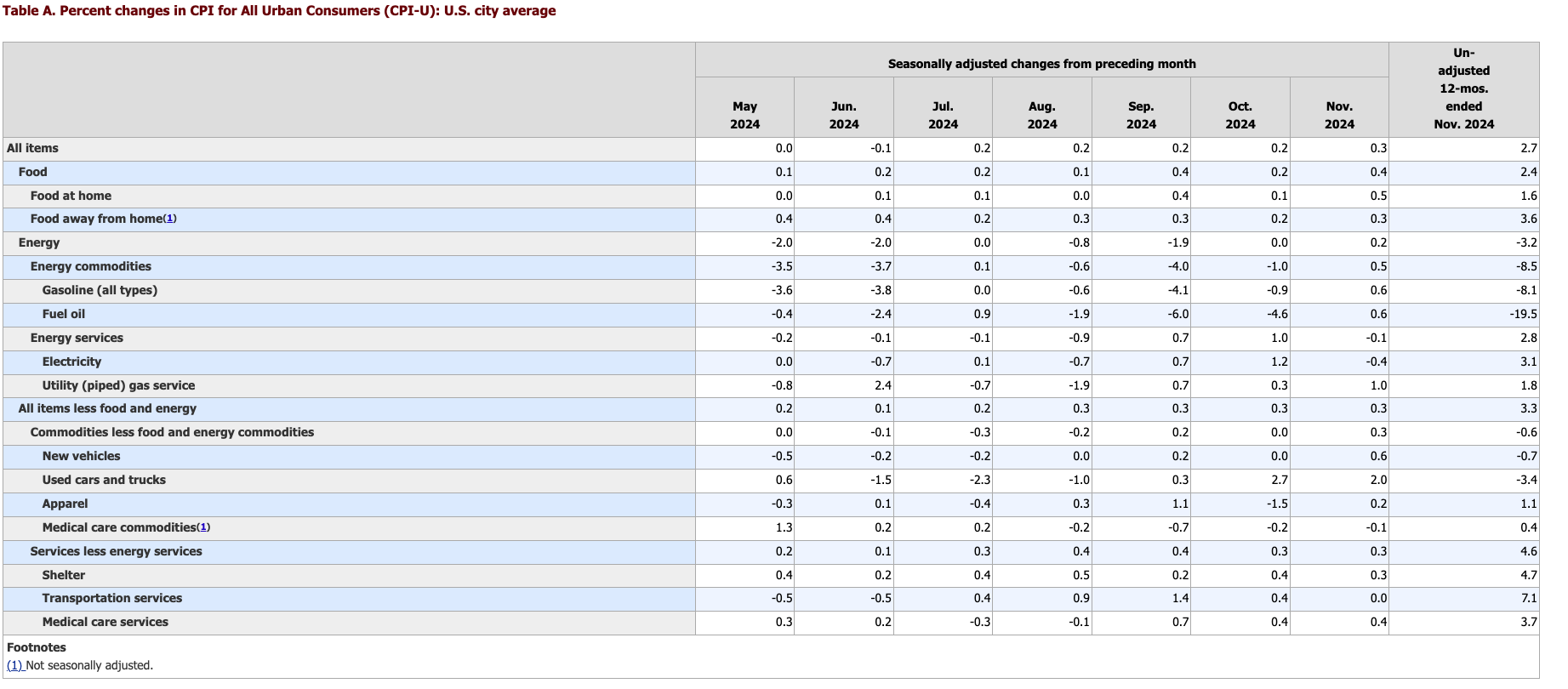
According to the latest Bureau of Labor Statistics data, prices rose 0.3 percent month-on-month in November. That nudged the headline annual CPI to 2.7 percent, up from 2.6 percent in October and 2.4 percent in September.

Stripping out more volatile food and energy prices, core CPI also rose 0.3 percent on the month. On an annual basis, core CPI came in at 3.3 percent. That was the same reading as last month and still far above the mythical 2 percent target.

In other words, there was no decline in core CPI, indicating no sign of “disinflation.”

It was the fourth straight 0.3 percent monthly increase in core CPI. If you annualize that monthly gain, you get an annual core CPI of 3.6 percent.

And looking back, core CPI was lower, at 3.2 percent, in August.

Keep in mind that the CPI doesn’t tell the entire story of inflation. The government revised the CPI formula in the 1990s so that it understates the actual rise in prices. Based on the formula used in the 1970s, CPI is closer to double the official numbers. So, if the BLS was using the old formula, we’re looking at CPI closer to 6 percent. And using an honest formula, it would probably be worse than that.

Looking more closely at the numbers, we find that falling energy prices continue to skew the CPI lower. Gasoline prices have dropped over 8 percent in the last year, and the broader energy index is down over 3 percent.

But on a monthly basis, prices rose in every category last month except energy services, utility gas services, and medical care commodities.

Food prices rose 0.4 percent on the month, and shelter costs were up another 0.3 percent.

The Fed Is Already Creating More Inflation

Despite sticky inflation, the Federal Reserve is aggressively loosening monetary policy.

In other words, the central bank has surrendered to inflation.

In fact, the central bank started loosening monetary policy when it quietly announced that it would begin to taper balance sheet reduction in June.

Keep in mind what this pivot to rate cuts and the wind-down of balance sheet reduction actually means – the Federal Reserve is ramping up the inflation machine even as it declares victory over inflation. It means more credit expansion and more money flowing into the economy.

In other words, by declaring victory over price inflation and easing its monetary policy, the Fed is effectively committing to creating more inflation.

We can already see the results in the money supply.

Properly defined, inflation is an increase in the supply of money and credit. Price inflation is one symptom of this monetary inflation.

And the money supply is growing.

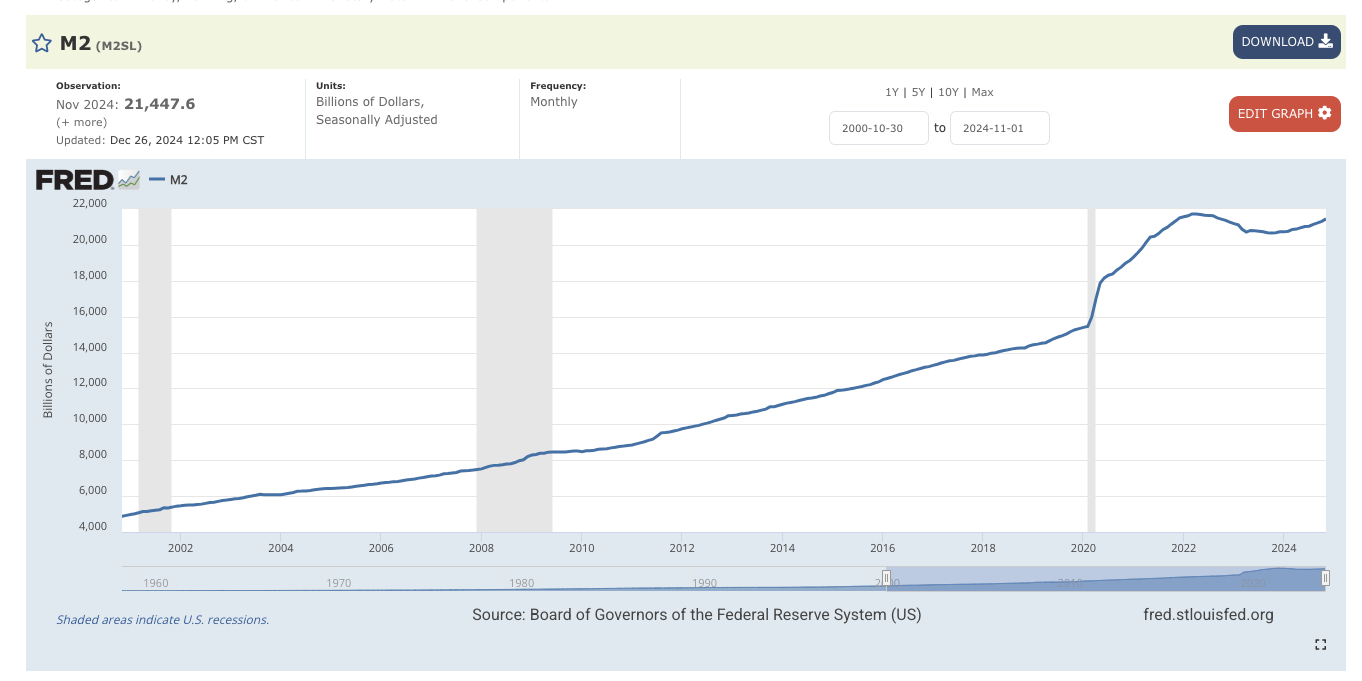
The M2 money supply bottomed a little over a year ago at $20.60 trillion. Since then, it has crept upward. As of October, it was at 21.3 trillion. That’s the highest level since December 2022.

The money supply has grown on a year-over-year basis for seven straight months.

According to the Chicago Federal Reserve’s National Financial Conditions Index, financial conditions are already historically loose. The NFCI decreased to –0.65 in the week ending December 6. A negative number indicates loose financial conditions.

As the Federal Reserve raised interest rates and shrunk its balance sheet, the money supply contracted sharply. In fact, it was the largest decline in the money supply since the Great Depression.

While this might seem impressive, it barely put a dent in the massive expansion of the money supply in the years after the 2008 financial crisis and during the pandemic. As Mises Institute senior editor Ryan McMaken noted, the recent contraction of the money supply “only puts a small dent in the huge edifice of newly created money.”

In other words, as aggressive as the Fed’s rate-cutting and balance sheet reduction was, it was a teardrop in the ocean compared to the amount of inflation created during the pandemic, not to mention in the wake of the 2008 financial crisis and Great Recession.

It’s also notable that drops in the money supply usually precede recessions, but as McMaken pointed out, “Recessions tend not to become apparent until after the money supply has begun to accelerate again after a period of slowing. This was the case in the early 1990’s recession, the Dot-com Bust of 2001, and the Great Recession.”

The resurgence of money supply growth is, by definition, inflation. We are already seeing the result as stock market values increase. Whether this new round of inflationary activity finds its way into consumer prices remains to be seen, but the stickiness in CPI is cause for concern.

Why Gold Still Reigns Supreme in the Age of Bitcoin

(Money Metals News Service) In the latest episode of the Money Metals Midweek Memo, host Mike Maharrey explored the rocky relationship between Bitcoin, gold, and their roles in today’s financial world.

Sharing personal stories, market trends, and insights, Maharrey broke down the similarities and differences between these two assets. He also looked into Federal Reserve Chairman Jerome Powell’s comments on Bitcoin and gold, offering a down-to-earth perspective for sound money advocates.

Mike’s Bitcoin Journey: A Personal Story

Mike Maharrey started the episode with a relatable story from 2016, when he received a bonus payment of one Bitcoin worth about $400 to $450. At the time, he used most of it to buy a used laptop for $350, leaving a small fraction of Bitcoin in his wallet. Like many early Bitcoin owners, Maharrey didn’t fully understand its future potential, and he largely forgot about it until the 2017 bull market pushed the price to nearly $20,000.

Excited by the sudden value increase, Maharrey sold most of his remaining Bitcoin when it dipped to the $13,000–$14,000 range. He kept a tiny bit but admitted that hindsight makes his decision bittersweet, especially as Bitcoin now trades near $100,000. Reflecting on this experience, Maharrey talked about the challenge of timing markets and the “what if” scenarios that many investors face.

The Current State of Bitcoin

Bitcoin’s recent market moves have been nothing short of dramatic. Following the U.S. presidential election, Bitcoin jumped from $69,363 to over $100,000, peaking at $103,000 before sliding back to around $97,500. While the cryptocurrency continues to attract attention, its wild price swings remain a defining feature.

Maharrey explained several reasons for Bitcoin’s recent ups and downs. Microsoft shareholders recently voted against holding cryptocurrency on the company’s balance sheet, which triggered a market selloff.

On top of that, Google’s release of its Willow Quantum Computing chip has raised new worries about blockchain security in the long run. Despite its growing acceptance, Bitcoin remains highly unpredictable.

However, Bitcoin’s annualized volatility has been decreasing as the market grows and more institutions get involved. In 2021, volatility stood at 81%, and in 2024, it has stayed below 80%. While still higher than most assets, this signals that Bitcoin is becoming somewhat more stable.

Bitcoin vs. Gold: Similarities and Differences

Maharrey spent time looking at Jerome Powell’s recent remarks comparing Bitcoin to gold. While both assets share some traits—like limited supply and resistance to central bank meddling—they are fundamentally different.

Bitcoin’s erratic price movements make it far less reliable as a “safe haven” compared to gold. Its price, often driven by speculation and tech developments, is not typical of a stable store of value.

For example, Bitcoin’s market capitalization of $1.92 trillion is still much smaller than gold’s $18 trillion, which reflects gold’s stability and long-standing role in the financial system.

Maharrey also pointed out that Bitcoin behaves more like tech stocks than traditional stores of value. Its tech-driven nature and speculative appeal make it act like a high-risk, high-reward asset.

Meanwhile, gold has been trusted for thousands of years as a dependable way to preserve wealth during uncertain times.

Interestingly, studies show little to no long-term connection between Bitcoin and gold. A Bloomberg report noted that their average long-term correlation is close to zero, which means they can work well together in a diversified portfolio.

This highlights the potential benefits of holding both as part of a well-rounded investment approach.

The Case for Diversification

Maharrey strongly encouraged listeners to spread their investments, warning against the risky “all-in” attitude often seen among Bitcoin enthusiasts. He emphasized the dangers of putting all your money into one asset, especially one as unstable as Bitcoin.

Instead, he suggested strategies that combine the strengths of both Bitcoin and gold.

One approach is to use Bitcoin profits to buy gold or silver, which can act as a safety net during Bitcoin’s unpredictable price swings. By moving profits into precious metals, investors can protect their gains while keeping the option to reinvest in Bitcoin later. Maharrey stressed that spreading investments across different assets is key to long-term financial security.

Gold as a Competitor to the Dollar

Maharrey highlighted gold’s unique role as a rival to fiat currencies like the U.S. dollar. Unlike Bitcoin, gold is universally recognized as money and has been a store of value for thousands of years. Central banks worldwide continue to stockpile gold, purchasing 694 tons so far in 2024—a clear sign of gold’s lasting importance.

Gold’s price stability and ease of conversion make it a reliable way to guard against inflation. Maharrey noted that the U.S. dollar’s share of global reserves has fallen by 14% since 2002, reflecting a slow shift toward other assets like gold. He linked this trend to inflation, rising national debt, and the U.S. dollar’s declining appeal due to its use in global politics.

While gold does face challenges—like being hard to use in small transactions—new solutions like gold-backed digital payment systems and fractional gold products are making it easier to use in everyday life.

Opportunities in Precious Metals

Maharrey pointed to recent price trends in gold and silver as possible buying opportunities. As of the episode, gold was trading above $2,700 per ounce, while silver had climbed past $32 per ounce. He urged listeners to consider adding precious metals to their portfolios, especially given the ongoing economic uncertainty.

He also suggested that gold and silver make great holiday gifts. Money Metals Exchange offers a wide range of products, including options for those looking to trade between cryptocurrencies and precious metals.

Sound Money Advocacy

Wrapping up the episode, Maharrey underlined the importance of sound money principles. While he acknowledged Bitcoin’s potential, he stressed the unmatched reliability of physical assets like gold and silver. These tangible resources provide stability and security, especially during times of crisis when digital systems might fail.


3 Ways to Buy Gold Without Breaking the Bank

(Joshua D Glawson, Money Metals News Service) When people first learn about investing in precious metals, especially gold, a common response is how much it costs to buy an ounce of gold in the form of a gold coin, gold bullion round, or gold bar.

Indeed, the price of gold has skyrocketed over the past year or so, reaching all-time highs (even considering inflation adjustment).

With the gold price steadily hovering around $2,600 to $2,700 per troy ounce, that is a large chunk of change for most beginner investors even to fathom getting started with.

So here are three easy ways to start buying gold without breaking the bank…

Adopt a Traditional Savings Technique

You could take the so-called “envelope method” to start “paying yourself” each month, setting aside a little bit of cash at a time until you have enough saved to buy one troy ounce of gold.

If we were to estimate what an ounce will cost in 3 months, you should probably plan to set aside $935 per month.

However, this method may take longer than you wish to wait, and we have no idea what the price of gold will be in 3 months anyway.

In 2024, the price of gold is up by over 30%. It could rise even more in 2025… some banks are predicting the price of gold could reach $3,000 per troy ounce. Some are even speculating gold could reach as high as $5,000 per troy ounce by 2030. (Or it could go down, of course.)

The traditional saving plan is a great way to get started buying gold, but it takes more planning, and it is a slower process than the other two methods available through Money Metals.

Grab Some Fractional Gold 

Did you know that you don’t have to buy a full ounce of gold?

You can instead buy what is known as fractional gold, which is gold sold in increments of less than an ounce in the form of bars, rounds, coins, and even potentially investment jewelry. This is a nice way to accumulate gold while staying within a budget.

Such products to consider for fractional gold include such items as, but not limited to, the following:

There are plenty more low-budget options than those listed – just visit this page on the Money Metals website.

Fractional gold is a great way to get started buying gold while not breaking the bank. The added benefit of this method is that it is much faster and more obtainable than the traditional saving method.

However, its drawback is that these smaller, less efficiently minted items tend to have higher markups (known in the precious metals industry as a “premium”) than larger, one-ounce and above gold products.

The third way of buying gold without breaking the bank may be the best way…

Harness a Monthly Gold & Silver Purchase Plan 

The monthly gold and silver purchase plan offered by Money Metals is the very best way to start buying gold without breaking the bank. This allows each individual to invest in gold on a budget of as little as $100 per month.

The benefits of this method are threefold.

First, this enables a person to invest in gold from a reputable source — Money Metals – while simultaneously allowing for the flexibility to start, stop, or modify your monthly plan at any time.

Second, this is a faster way of buying gold than saving month-by-month to eventually buy an ounce. The monthly purchase plan utilizes the fractional gold buying method, which helps to protect your purchasing power sooner rather than later.

Third, Money Metals offers members of the monthly purchase plan lower premiums than those offered to the general public. This allows a person to get VIP pricing while acquiring fractional gold on a budget.

Of course, not everyone can commit to a $100 monthly plan, and that’s okay. In cases like that, consider just making one-off purchases of fractional gold whenever possible.

As history has indicated, the price of gold, when compared to depreciating dollars, tends to rise in the long-term. In the 1990s, the price of gold was under $400 per troy ounce. Today, it is averaging over $2,600.

Whatever method you decide to go with, the important thing is to take action… and soon.

Trump Appoints Kari Lake to Oversee International Radio Broadcaster Voice of America

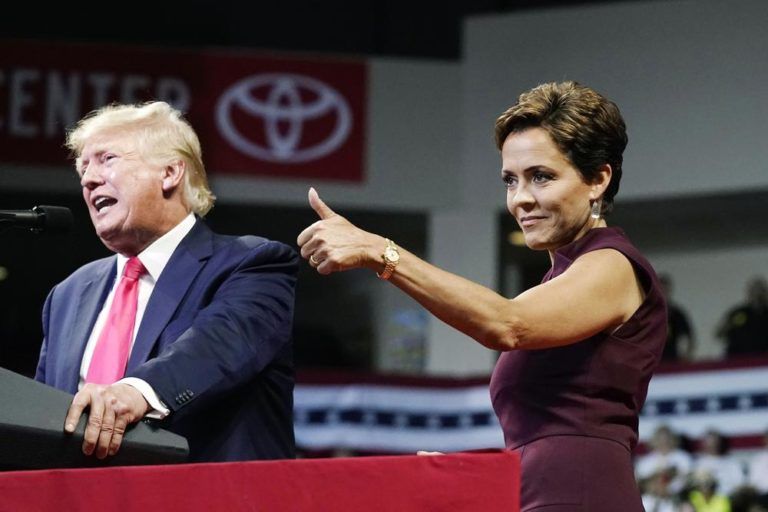
(Ben Sellers, Headline USA) Kari Lake, the loyal ally of President-elect Donald Trump who was twice denied top political posts in Arizona under highly suspicious circumstances, will get a job in the Trump administration overseeing the international broadcast network Voice of America.

“She will be appointed by, and work closely with, our next head of the U.S. Agency for Global Media, who I will announce soon, to ensure that the American values of Freedom and Liberty are broadcast around the World FAIRLY and ACCURATELY, unlike the lies spread by the Fake News Media,” Trump said in a statement announcing the new appointment, one of several evening announcements on Wednesday.

“Kari was a beloved News Anchor in Arizona, which supported me by record margins, for over 20 years,” Trump added, appearing to gloss over Lake’s own political snubs.

Election irregularities plagued Maricopa County in 2020, prompting a state-commissioned election audit, and in 2022, prompting a series of unsuccessful lawsuits from Lake after her razor-thin gubernatorial loss to then Secretary of State Katie Hobbs.

Lake again narrowly lost a U.S. Senate race this year to Democrat Rep. Ruben Gallego, but only after more than a week of extra ballot tabulation, during which some counties refused to say how many total ballots there were in their frequently fluctuating totals.

But with Trump having clearly won the state on election night, there was little appetite for legal challenges at the Republican National Committee, where Lake had received only nominal support throughout her campaign.

On Wednesday, Nov. 13, Lake graciously accepted defeat by thanking her supporters while not specifically conceding the race.

“For 30 years you trusted me to bring the news into your homes, to tell you the truth,” Lake said in her concession speech. “About three years ago, I walked away from a seven figure contract in the fake news because I couldn’t lie to you. What good is money if it comes at the cost of your soul?”

In stark contrast with her previous race, during which she told supporters that she would “never stop fighting” she said this time that they would “never stop mattering to me.”

Because of her high-profile status and former closeness with Trump, Lake’s name was floated for a number of different positions in his incoming administration. She was spotted at Mar-a-Lago, fueling additional speculation of an impending appointment.

While many saw her as a serious contender for press secretary due to her media background—or possibly a spot with the Federal Election Commission due to her firsthand knowledge of vote fraud—her tough stance on immigration had most recently fueled rumors that she might be considered for ambassador to Mexico.

Trump quelled that on Monday with his appointment of Ronald Johnson—a retired Green Beret and CIA agent who previously served as the top diplomat in El Salvador, “where he worked tirelessly with Salvadoran authorities and our team to reduce violent crime and illegal migration to the lowest levels in History.”

But seemingly in response to the media’s speculation, his announcement on Lake came just a day later.

According to its website, Voice of America “is the largest U.S. international broadcaster, providing news and information in nearly 50 languages to an estimated weekly audience of more than 354 million people.”

Created during World War II, VOA has operated since the 1970s under a charter that establishes its editorial independence.

“The long-range interests of the United States are served by communicating directly with the peoples of the world by radio,” says the website. “To be effective, the Voice of America must win the attention and respect of listeners.”

Ben Sellers is the editor of Headline USA. Follow him at x.com/realbensellers.

Sinema, Manchin Thwart Dems’ Plan to Hijack Agency Ahead of Trump Admin

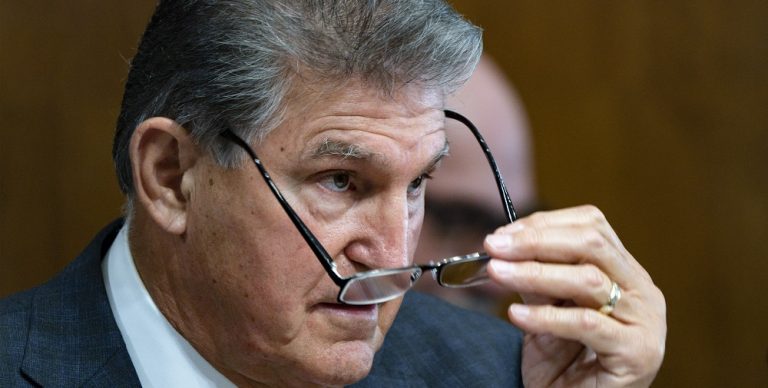
(Luis Cornelio, Headline USA) Sens. Kyrsten Sinema, D-Ariz., and Joe Manchin, D-W.V., shut down the soon-to-be-powerless Democratic Party’s ploy to extend the term of Laura McFerran as chair of the National Labor Relations Board (NLRB) just before President-elect Donald Trump takes office. 

McFerran’s term is set to expire next week, but President Joe Biden and Senate Democrats sought to renominate her for an additional five years—well past Trump’s second term.

By blocking this renomination, Sinema and Manchin joined Republicans in allowing Trump the opportunity to appoint a Republican chair who will prioritize his America First agenda. 

NLRB currently has a Democratic majority with three board members, including those appointed by Biden: David M. Prouty and Gwynne A. Wilcox. The other member, Marvin E. Kaplan, is a Republican appointed during Trump’s first term. A second Republican position remains vacant. 

Democrats’ plan to renominate McFerran was underscored by reports that outgoing Vice President Kamala Harris was prepared to rush to the Senate in case her tie-breaking vote was required. The vote ultimately failed 50-49, with Sen. Roger Marshall, R-Kan., being the only conservative not voting. 

As reported by The Hill, outgoing Senate Majority Leader Chuck Schumer, D-N.Y., whined about the thwarted nomination, claiming, “It is deeply disappointing, a direct attack on working people, and incredibly troubling that this highly qualified nominee — with a proven track record of protecting worker rights — did not have the votes.” 

As reported by Axios, Manchin arrived at the Capitol after the vote had begun and voted, “No.” Vice President-elect and Sen. JD Vance, R-Ohio., rushed into Washington, D.C. from Mar-a-Lago on Wednesday morning to thwart the nomination.  

“He got on a plane to Washington specifically to be in the Senate for this vote,” a source told Semafor. 

As reported by the outlet, Democrats needed either Manchin or Sinema to join their caucus to install McFerran into the agency for the next five years.

The NLRB describes itself as an independent federal agency responsible for protecting workers’ rights to organize and determining whether they will have unions as their bargaining representatives.  

“The agency also acts to prevent and remedy unfair labor practices committed by private sector employers and unions,” it added.