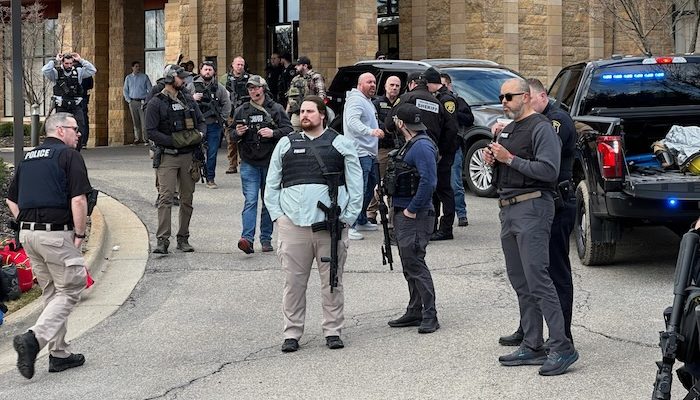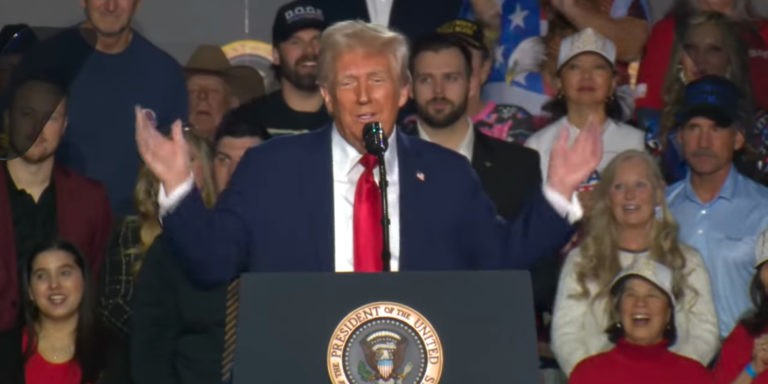
(Headline USA) Authorities in Los Angeles deployed tear gas near a federal detention center and made dozens of arrests after officers were hit by bricks at a “No Kings” rally, which was organized to protest President Donald Trump’s actions and the war in Iran.
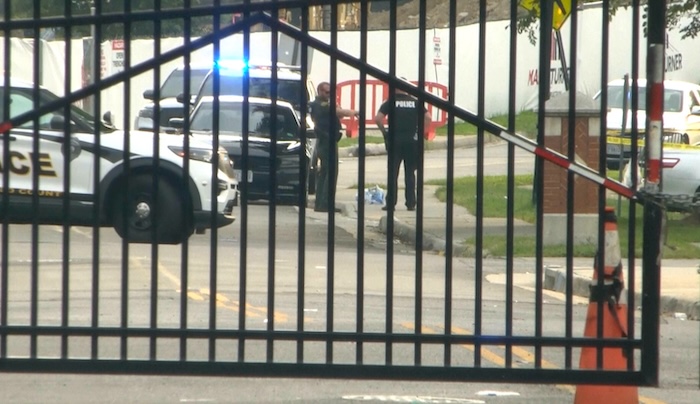
Los Angeles police said Sunday that 74 people were arrested for failing to heed a dispersal order that was given after Saturday’s rally ended. One other person was taken into custody on suspicion of possessing a weapon that police described as a dagger.
The arrests stood out from what otherwise were mostly peaceful protests. Organizers said there were more than 3,100 events registered in all 50 U.S. states.
As hundreds of protesters surrounded a federal complex in downtown Los Angeles, some threw rocks, bottles and broken concrete blocks at officers, the U.S. Department of Homeland Security said in a statement late Saturday night.
Two officers who were struck by concrete blocks sustained undetermined injuries and received medical attention, DHS said.
Andre Andrews Jr., a Navy veteran and independent journalist, had walked the entire route of the Los Angeles rally and captured video of the event. He said after authorities gave the dispersal order, they deployed tear-gas canisters when protesters didn’t comply. Some protesters wearing shields and gas masks on the other side of a fence at the federal complex picked up the canisters and tossed them back at police. Andrews said some people also smashed concrete barriers into smaller pieces and threw them at authorities.
“Does it make L.A. look bad? No. They’re bad actors causing problems, for sure,” Andrews said. “The peaceful protest was good for the cause. You have the right to do that. But the other people, they were definitely causing problems.”
Police said those arrested included eight juveniles. Also detained was a woman dressed as the Statue of Liberty, smiling as she chatted with an officer who led her away.
In Denver, the police department said on the social platform X that it declared an unlawful assembly and deployed smoke canisters after a small group of protesters blocked a road and did not leave as asked. At least eight people were arrested, as was a ninth person later who police said was throwing objects.
Nationwide, people rallied from New York City, with almost 8.5 million residents in a solidly blue state, to Driggs, a town of fewer than 2,000 people in eastern Idaho, a state Trump carried with 66% of the vote in 2024. In Minnesota, a flagship event on the Capitol lawn in St. Paul drew Bruce Springsteen as its headliner to celebrate resistance to Trump’s aggressive immigration enforcement.
Demonstrations also were held in more than a dozen other countries, according to co-executive director Ezra Levin of Indivisible, which spearheaded the events.
U.S. organizers have estimated that the first two rounds of No Kings rallies drew more than 5 million people in June and 7 million in October. Levin estimated at least 8 million participants showed up Saturday.
An analysis by Headline USA reporter Luis Cornelio casts doubt on those numbers.
(José Niño,Headline USA) Oakland County Sheriff Michael Bouchard triggered outrage and bewilderment following a press conference where he seemed to imply a man was detained for sharing an antisemitic meme. His office later acknowledged the arrest was actually on an unrelated felony stalking warrant, according to The Detroit Metro Times.
During a press conference after the March 19attack at Temple Israel in West Bloomfield, an incident his office investigated, Bouchard displayed an internet meme showing him with a Star of David on his forehead and exaggerated Orthodox Jewish features. He called the person who shared it “pond scum” and cautioned that such posts could lead to violence, as the Detroit Metro Times.
He then revealed a detail thatexploded across social media. The seven-term Republican announced the man “was arrested today in Wisconsin.”
Wisconsin Sheriff Michael J. Bouchard confirmed that a man was arrested after distributing an offensive internet meme depicting him with a Jewish star on his forehead, calling it antisemitic.
The sheriff said the man was “trying to threaten and intimidate” him by posting the… pic.twitter.com/3BtCnw6iCA
“Some pond scum felt empowered and emboldened enough to put this picture of me up to threaten and intimidate me,” Bouchard declared.
He went on, “If this person is emboldened and empowered enough or feels safe enough to do this for me, what does he do to a kid? What does he do to a Jewish family walking down the street?”
Bouchard indicated the First Amendment does not protect such speech, stating “you can’t” post offensive memes.
“If you think you can do it to somebody in law enforcement, again, what are you going to do in an alley or a street to a Jewish family or a kid walking down the street? Nuh uh, we say ‘no.’ We’re drawing the line.”
The footage circulated rapidly online, accumulating more than 1 million views and generating both outrage and confusion. Observers across the political spectrum interpreted it as a disturbing instance of law enforcement conflating political speech with criminal behavior. Others reacted defiantly, sharing similar memes and challenging authorities to pursue them.
“I live in Oakland County. F*** this guy!” one individual wrote while posting a meme of Bouchard with exaggerated Jewish features. “Come arrest me asshole! I will sue the ever living s*** out of you!”
Another cautioned, “If we lose our First Amendment rights, we lose it all.”
Additional commenters demanded lawsuits and charged Bouchard with violating free speech protections.
Only later did the sheriff’s office reveal what actually occurred. The man in Wisconsin was apprehended on an unrelated felony stalking warrant.
Rather than recognizing the confusion or accepting responsibility for how the message came across, the department attacked the public.
“For people that are whining that someone was arrested for posting a meme; sorry to disappoint,” the sheriff’s officewrote on X. “Not even for threatening, racist, AND anti-semitic comments.”
For people that are whining that someone was arrested for posting a meme; sorry to disappoint. Not even for threatening, racist, AND anti-semitic comments. He had a prior outstanding felony stalking warrant on something completely unrelated, which drew local police attention to…
— Oakland County Sheriff’s Office (@oaklandsheriff) March 24, 2026
The sheriff’s office then disabled replies, reinforcing criticism that Bouchard refuses to tolerate disagreement even when he manufactured the controversy himself, as the Detroit Metro Times.
The sheriff’s office investigated the synagogue attack on March 19. Authorities stated Ayman Ghazali, 41, a restaurant worker from Dearborn Heights, drove a vehicle into the building before exchanging gunfire with security and fatally shooting himself. Federal authorities characterized it as a targeted act of violence against the Jewish community.
The Detroit Metro Times reported that an Israeli airstrikekilled Ghazali’s two brothers, Kassim and Ibrahim, along with Ibrahim’s two children. Ibrahim’s wife sustained serious injuries and remains hospitalized.
José Niño is the deputy editor of Headline USA. Follow him at x.com/JoseAlNino
Another similar sized number of Marines from Camp Pendleton’s MEU, aboard the USS Boxer and its associated Amphibious Ready Group, are also reportedly en route to the region, and is expected to arrive in roughly a week.
Marines from the USS Tripoli arrive in the Middle East | Image from CENTCOM’s X account
The US and Israel launched the war on Iran, dubbed “Operation Epic Fury” on February 28, assassinating top Iranian officials including Ayatollah Ali Khamenei, and leading to substantial Iranian retaliation against US and Israel targets across the region.
Though US officials have been insisting for nearly a solid month that the war is on the verge of ending, it seemingly continues to pick up pace, and the deployment of more and more Marines to the region only adds to speculation that the administration ultimately has designs on it becoming a ground war.
That would likely prove wildly unpopular, particularly as the administration has struggled to define the point of the attacks is, and what end goals they envision for the conflict. This has raised fears that the escalation is ultimately happening without a well thought out plan.
Further escalation seems on the horizon with Yemen’s Houthi movement announcing today that they are joining the conflict. Much of the attention surrounding the war of late has centered on the Strait of Hormuz, a vital waterway off the Iranian coast, and the Houthis have threatened ships in the Bab al-Mandab Strait, another vital economic route for the Arabian Peninsula.
US and Israeli attacks over the weekend have centered on Khuzestan Province, and the Khuzestan Steel Company, which has announced it was halting certain of its operations after substantial damage was done in the strikes.
(Luis Cornelio, Headline USA) Some of the women subjected to Jeffrey Epstein’s abuse initially scolded the Trump administration over what they saw as a slow release of files tied to the late sex offender’s prosecution.
Months after those demands were met, they are now suing the same administration, arguing that the rushed release — carried out under a congressionally mandated deadline— may have exposed their personal information.
Filed Thursday in federal court in California, the civil lawsuit named a victim identified as “Jane Doe 1, individually and on behalf of others similarly situated.” It also listed Google as a defendant and seeks a minimum of $1,000 per class member from the federal government, meaning taxpayers would foot the bill.
The plaintiffs are also seeking undisclosed compensatory and punitive damages, along with attorney fees and other relief, to be determined by the court if the case goes to trial.
The lawsuit centers on allegations that some DOJ-released documents from December included personal details about victims that should have been withheld.
The plaintiffs further accused Google of republishing the files even after the DOJ removed them following backlash.
At the time, the DOJ was operating under a tight 30-day deadline imposed by Congress to release the files.
President Donald Trump, who signed the law establishing the deadline, had previously warned against a rushed release, citing potential risks to individuals and victims named in the documents.
Notably, some of the victims previously participated in Democrat-led protests demanding the release of the files.
Victims at press conference last year: Release all the Epstein documents immediately! We demand to be seen! We are tired of being ignored.
Now these alleged victims are claiming too much information was released and they are suing.
In the lawsuit, however, they say that the DOJ “outed approximately 100 survivors of the convicted sexual predator, publishing their private information and identifying them to the world.”
Targeting Google, the complaint added: “Even after the government acknowledged the disclosure violated the rights of the survivors and withdrew the information, online entities like Google continuously republish it, refusing victim’s pleas to take it down.”
The plaintiff said they “now face renewed trauma,” as strangers allegedly “call them, email them, threaten their physical safety, and accuse them of conspiring with Epstein when they are, in reality, Epstein’s victims.”
Epstein died in federal custody in 2019 while facing sex trafficking charges brought during Trump’s first term.
(José Niño,Headline USA) A federal judge ordered the release of a property manager connected to a suspected biological laboratory in Las Vegas who prosecutors charged with illegally possessing firearms.
According to a report by 8 News Now, U.S. Magistrate Judge Elayna Youchahreleased Ori Solomon, 55, on a personal recognizance bond. The judge ordered Solomon to surrender his passport and remain within the Continental United States. Should Solomon leave the Las Vegas area, he must inform the court.
8 News Now reported that Police and the FBIsearched a home on Sugar Springs Drive and a second residence on Saturday, January 31, discovering a “possible biological laboratory,” including “refrigerators with vials containing unknown liquids,” according to police. Sources confirmed Solomon serves as the property manager for the home. Federal documents indicate he lived in one of the two searched homes with three children.
Solomon, who is originally from Israel, resides in the country on a non-immigrant visa and is barred from owning or possessing firearms, prosecutors stated. During searches, teams recovered guns from Solomon’s home.
Officers found French and Israeli passports in Solomon’s name during the raid. After his arrest on the state charge, Solomon called a family member from jail andasked, “Is there any guns left?” according to documents that 8 News Now made a reference to.
During another search last Monday, federal officials “seized numerous firearms, ammunition, and firearm accessories” from the home, documents stated.
Federal prosecutors did not ask Youchah to detain Solomon in the gun case. Solomon does not face any federal charges connected to the biological laboratory.
The Las Vegas lab is connected to a similar incident in California where officials found infectious agents such as HIV and malaria, as the 8 News Now Investigatorsfirst reported. An LLC tied to the home’s county records matches the name of a company that is part of an ongoing federal case in California involving a biological laboratory there.
In that California case, a Chinese citizen named David Hefaces federal charges for allegedly manufacturing and distributing misbranded medical devices, according to federal prosecutors, as 8 News Now reported.
Solomon faces a state charge connected to the January 31 raid involving hazardous waste.
José Niño is the deputy editor of Headline USA. Follow him at x.com/JoseAlNino
(Luis Cornelio, Headline USA) While talk of President Donald Trump’s 2028 successor has focused on his administration’s top brass, an outsider could decide to throw his hat in the ring despite being a long shot.
Sen. Rand Paul, R-Ky., who unsuccessfully ran for the Republican nomination in 2016, is now mulling another bid for the presidency in 2028, according to an interview set to be released Sunday.
The 2028 chatter began after Paul lamented what he claimed was a lack of free-market ideas in the Republican Party.
When CBS Sunday Morning correspondent Robert Costa then cited a Washington Examiner headline suggesting he was running, Paul acknowledged he was considering a bid.
“Yeah, I don’t know yet. So maybe they know something I don’t know. We’re thinking about it, and I would say 50-50. We’ll make a decision after the election,” Paul stated.
Is Sen. Rand Paul (R-KY) going to run for president?
Paul’s comments come more than a decade after he dropped out of the 2016 race, where he finished fifth in the Iowa caucuses with less than five percent of the vote.
Politico reported at the time that he entered the 2016 race “essentially broke,” with nearly $250,000 in unpaid bills and $1.27 million in funds that were earmarked for use only in the general election.
In his CBS interview, Paul stressed his non-interventionist foreign policy views and cast himself as the lone free-market senator within the GOP.
“There used to really be a free market/Libertarian wing of the party, and now there’s not much left,” he claimed. “In fact, on many days it’s me in the Senate, the only one left for free trade.”
Paul has repeatedly found himself at odds with President Donald Trump, most recently as the sole senator to vote against Trump’s nomination of Markwayne Mullin to lead DHS.
Meanwhile, Trump has called Paul “a nasty little guy,” and on other occasions said his “ideas are actually crazy.”
If Paul enters the 2028 race, he would face steep odds against Vice President JD Vance and a crowded field of Republicans already polling far ahead of him.
A RealClearPolitics polling average, as of March 28, shows Vance leading with roughly 45 percent. The vice president’s lead is larger than that of his closest hypothetical competitors, including Donald Trump Jr., at 16.3 percent, and Secretary of State Marco Rubio, at 12.3 percent.
(Luis Cornelio, Headline USA) Americans tuning in on television or scrolling through social media may have come across headlines touting the so-called nationwide “No Kings” protests against President Donald Trump.
But a closer look at the timing and locations of many of these events may suggest the protests could have appeared larger than they were, with activists potentially moving from one nearby rally to another throughout the day.
A Headline USA review of “No Kings” events in Northern Virginia showed multiple demonstrations staggered across the day, which may have given attendees time to travel between locations.
One protest in Arlington, Virginia, was scheduled from 8:00 a.m. to 10:00 a.m. ET. Another event listed in the Roslyn neighborhood was listed on the website as two separate demonstrations later in the day.
Across Fairfax County, events were largely scheduled between 10:00 a.m. and 12:00 p.m. ET, meaning attendees from earlier rallies could have easily driven to those locations.
But between Leesburg and Ashburn, at leastfiveeventswerescheduled between 1:00 p.m. and 2:30 p.m. ET, according to Headline USA’s count.
Another event in the Reston-Herndon area was scheduled from 4:00 p.m. to 5:30 p.m. ET, potentially extending the window for activists to move between protests.
A similar pattern seemingly emerged in New York City, where a Headline USA review found multiple events across Manhattan and the Bronx that did not overlap in timing.
There were four “No Kings” protests in Manhattan. One event in Washington Heights began at 10:00 a.m. ET. Another, just a few miles south in Morningside Heights, was scheduled from 1:30 p.m. to 3:00 p.m. ET.
Another Morningside Heights event was held on the same street at the same time, though at a different corner.
Yet another protest in Midtown ran from 2:00 p.m. to 4:00 p.m. ET, while the Bronx featured two events. Of those two, one was held in the East Bronx from 12:00 p.m. to 2:00 p.m. ET and another in the South Bronx from 2:00 p.m. to 4:00 p.m. ET.
In at least two instances, the “No Kings” map listed what appeared to be duplicate events at the same location and time, raising questions about how the demonstrations were counted.
Similar observations were noted elsewhere, according to screenshots shared by a social media user identified as “Oilfield Rando.”
Here’s how communist PR deception works:
They have two protests minutes away from each other, but one protest starts 2.5 hours after the other ends.
As seen in those screenshots, two North Carolina rallies located roughly 10 minutes apart seemed to have been scheduled hours apart. There was one in Apex from 9:30 a.m. to 11:30 a.m., and another in Cary from 2:00 p.m. to 5:00 p.m. ET.
It was not immediately clear whether organizers staggered events to allow attendees to travel between locations or whether the scheduling was coincidental.
Organizers for the “No Kings” demonstrations did not respond to a Headline USA request for comment sent late Saturday seeking comment on the scheduling.
Despite the apparent overlap and timing gaps, legacy media outlets ran glowing headlines about the scope of the protests.
The New York Times, for example, declared: “A Show of Defiance Across the Nation.”
The Washington Post similarly reported: “No Kings protests draw crowds, with record number taking place across U.S.”
The Post claimed that activist “filled the streets Saturday at more than 3,300 rallies across all 50 states for No Kings.”
(Luis Cornelio, Headline USA) The FBI may finally release files tied to Rep. Eric Swalwell, D-Calif., alleged connections to a suspected Chinese spy from his early days in Congress, according to a new report.
FBI Director Kash Patel reportedly deployed agents to review and redact the Swalwell-related documents for a potential release.
The release of the files could shed light on a scandal that has long shadowed Swalwell, who is now running to become California’s next governor.
The Washington Post, citing anonymous sources, reported Saturday that FBI leaders “even discussed sending agents to China” to speak with Christine Fang, also known as “Fang Fang,” about her knowledge of Swalwell.
An FBI spokesperson disputed aspects of the reporting, stating, “The contentions in this story are incorrect. This FBI, being the most transparent in history, prepares documents for numerous different reasons, including for release to different agencies and departments to further review investigations that may have been opened under previous administrations.”
The scandal dates to the early 2010s, when Fang reportedly targeted Swalwell as part of her intelligence operation between 2011 and 2015.
She reportedly connected with him while he was a council member in Dublin, California, and later, after he was elected to Congress in 2012.
According to Axios, Fang helped place an intern in Swalwell’s congressional office, served as a bundler for his 2014 re-election campaign and reportedly put him in contact with Chinese officials.
In 2015, the FBI briefed Swalwell about Fang and her ties to the Chinese government. He reportedly cut ties after that.
Swalwell declined to comment on whether he had a sexual relationship with Fang, who allegedly slept with two other mayors as part of her espionage activities, according to Fox News and Business Insider.
Swalwell’s ties to Fang Fang were investigated by the House Ethics Committee for two years. The committee ultimately took no action in 2023.
A letter from the committee informed Swalwell, “As you are aware, on April 9, 2021, the Committee on Ethics (Committee) informed you that it had determined to investigate allegations raised in the complaint that you may have violated House Rules, laws, or other standards of conduct in connection with your interactions with Ms. Christine Fang. The Committee will take no further action in this matter.”
Swalwell celebrated the decision at the time, saying that it was “time to move on.”
(Luis Cornelio, Headline USA) The Biden orbit has been rocked by yet another murder scandal, this one allegedly involving a former White House staffer.
Nation Wood, a 22-year-old member of former President Joe Biden’s “advance” team, faces murder charges in connection with the shooting death of his 22-year-old girlfriend, Samantha Emge.
An advance team typically oversees the planning and execution of events for a political candidate or government official.
Wood’s LinkedIn profile states that his experience includes “site walkthroughs and advance coordination alongside U.S. Secret Service for senior government and high-net-worth principals.”
BREAKING: Former Biden security staffer who posed with Kamala Harris is charged with killing his girlfriend at a San Francisco home
Nation Wood, 25, was arrested after his girlfriend Samantha Emge, 22, was found shot at a home near San Francisco’s Ocean Beach
The profile claims he worked for the White House from November 2023 through 2025, after President Donald Trump was sworn in for a second term.
A photo posted on LinkedIn shows Wood standing just a few spots away from then-Vice President Kamala Harris and Second Gentleman Doug Emhoff.
The San Francisco Police Department said officers responded to a residential shooting on Tuesday at about 10:43 p.m. local time.
Emge was found bleeding from a gunshot wound and transported to a nearby hospital, where she was pronounced dead.
Homicide investigators found “probable cause” to arrest Wood on involuntary manslaughter charges.
Follow-up reports suggest that Wood may have accidentally fired his gun.
Social media posts reviewed by Headline USA suggest that Wood and Emge had been dating since at least 2024.
Jail records show Wood was booked on Wednesday at approximately 5:00 a.m. He is being held without bond and is scheduled to appear before a judge on April 1.
The charges came just months after Bill Stevenson, the ex-husband of former First Lady Jill Biden, was arrested for allegedly killing his wife, Linda.
(Money Metals News Service) In a recent episode of the Money Metals podcast, host Mike Maharrey sat down with renowned precious metals analyst Jeff Clark to unpack the sharp pullback in gold prices and the dominant narratives driving market sentiment. As of their Thursday afternoon recording, gold had declined again, with many analysts attributing the weakness to rising oil prices, inflation fears, and expectations that the Federal Reserve will keep interest rates higher for longer.
Clark pushed back on the certainty of that narrative. While acknowledging that higher inflation could justify rate hikes, he emphasized that the outcome is far from inevitable. Much depends on how geopolitical tensions unfold and whether economic conditions deteriorate. If the conflict drags on and begins to damage economic growth, the Fed could just as easily pivot toward rate cuts, even in the face of elevated inflation.
Maharrey reinforced this point by highlighting historical precedent. During crises such as 2008, the 2019 market instability, and the pandemic, the Fed consistently chose monetary easing over tightening. The assumption that rates must rise in response to current conditions, therefore, may be overly simplistic.
(Interview Starts Around 5:39 Mark)
Inflation Fears and the Paradox of Selling Gold
A central contradiction discussed in the episode is the current wave of selling in gold despite widespread expectations of rising inflation. Traditionally viewed as an inflation hedge, gold is being liquidated at the very moment many investors fear inflation could accelerate.
Clark noted that while oil price spikes may temporarily lift certain prices, inflation is measured monthly and may prove short-lived if geopolitical tensions ease within a month or two. Even a brief surge in inflation readings during March and April would not necessarily justify a sustained tightening cycle or a wholesale abandonment of inflation hedges.
Both Maharrey and Clark suggested that markets may be overreacting to short-term headlines. The assumption that inflation will persist long enough to drive policy changes remains uncertain, and selling gold on that premise could prove premature.
Mining Sector Margins Remain Exceptionally Strong
Turning to the mining sector, Clark offered a striking perspective on profitability. The average all-in sustaining cost across the gold mining industry currently sits around $1,500 per ounce. Against an average gold price exceeding $4,500 in the first quarter, this implies margins of roughly 66%.
Even if gold were to average $4,000, miners would still enjoy margins near 62%, far surpassing most industries. Clark contrasted this with grocery stores, which often operate on margins of just 1% to 2%, and even highly profitable companies like Apple, which report margins around 32%.
Despite these robust fundamentals, mining stocks have not yet fully reflected this profitability. This disconnect, Clark argued, represents significant untapped upside potential.
Why Gold Stocks and Gold Itself Haven’t Broken Out
One of the most compelling insights from the discussion is that both gold mining stocks and gold itself have not yet broken out relative to broader equity markets. Clark pointed to ratios comparing gold and mining stocks to indices like the NASDAQ, noting that both remain near levels seen during the COVID period and even below 2016 in some cases.
This means that despite gold rising from around $2,000 to over $4,300, it has not meaningfully outperformed equities. For these ratios to return to prior peaks, gold and mining stocks would need to rise significantly, equities would need to fall, or both.
Clark suggested that the missing ingredient is a sustained bear market in general equities. While the NASDAQ has entered correction territory, down about 10% from its highs, there has not yet been the kind of prolonged downturn that forces mainstream investors to rotate into gold and mining stocks.
Until that shift occurs, institutional capital may continue favoring gold itself over mining equities.
Deleveraging and Short-Term Volatility
The episode also explored the mechanics behind gold’s recent decline. Clark explained that leveraged institutional positions can amplify selloffs. When gold prices begin to fall, funds may be forced to liquidate positions to meet margin requirements or cover losses elsewhere.
Maharrey pointed to historical examples, including the early stages of the 2008 financial crisis, when gold initially dropped sharply before embarking on a powerful rally. In that case, approximately 43% of the prior bull run was erased before monetary stimulus drove prices significantly higher.
This pattern suggests that short-term declines do not necessarily invalidate the broader bullish trend.
What the Market Is Missing Beneath the Headlines
Clark argued that the intense focus on war-related headlines is obscuring more important long-term drivers of the gold market. While daily news cycles emphasize oil prices and geopolitical developments, deeper structural issues remain unresolved.
Among these is the reality that all global currencies are now fiat, a historically unprecedented situation. Clark emphasized that gold serves as insurance against the long-term consequences of currency debasement and systemic instability.
He also noted that debt and deficit issues remain unaddressed, and monetary policy risks continue to build in the background. Even the assumption that interest rates will rise is not universally held, with roughly 44% to 46% of analysts expecting hikes and about 60% anticipating no change in April at the time of the discussion.
These uncertainties reinforce the case for maintaining exposure to gold despite short-term volatility.
A “$1,000 Sale” and Opportunity in the Dip
Clark framed the recent pullback as a rare opportunity rather than a warning sign. With gold trading more than $1,000 below its late-January peak, he described the current environment as a “sale” for investors.
For those with less than 5% of their assets allocated to gold, he suggested this dip represents a chance to build positions at more favorable prices. Importantly, he emphasized that investors do not need to deploy capital all at once but can accumulate gradually.
This perspective aligns with the broader theme of the episode: volatility creates opportunity. Rather than reacting emotionally to short-term price swings, investors should focus on long-term fundamentals and strategic positioning.
Navigating Volatility with Discipline
In closing, Clark offered a philosophical framework for navigating turbulent markets. Drawing on an analogy from his colleague Jeff Valks, he noted that sailors do not expect calm seas every day. Instead, they prepare for storms and continue forward.
Applying this to investing, Clark encouraged maintaining positions, buying during dips, and keeping sight of the larger macroeconomic picture. The combination of volatility and opportunity, he argued, is precisely what defines successful long-term investing.
Clark also revealed that his firm has been actively buying during the current correction, underscoring confidence in the long-term trajectory of gold and mining stocks.
As Maharrey concluded, many of the reasons investors were bullish on gold before the current geopolitical tensions—rising debt, currency debasement, and unresolved fiscal imbalances—remain firmly in place. The war may dominate headlines, but the underlying drivers of the gold market have not changed.