Trump’s DC Prosecutor Vows to Chase DOGE Doxxers to ‘End of the Earth’

(Luis Cornelio, Headline USA) The individuals and news organizations behind the relentless doxxing of workers at the Department of Government Efficiency may face legal consequences—including criminal prosecution. 

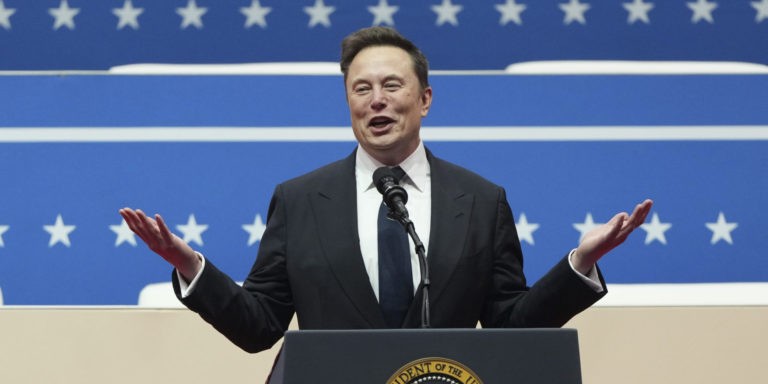
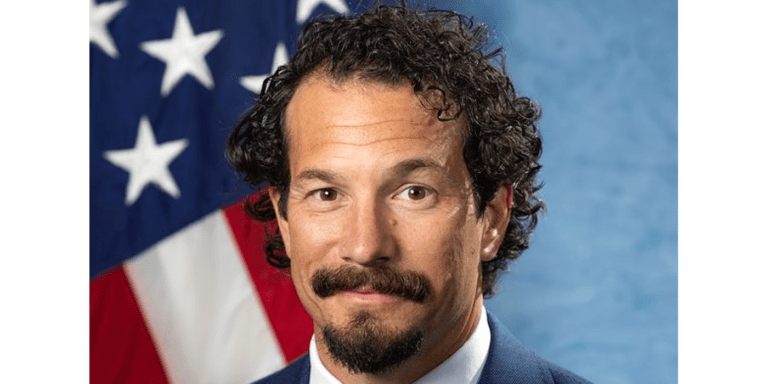
Ed Martin, President Donald Trump’s interim U.S. attorney for the DC district, has launched a criminal inquiry into those responsible for what appeared to be a coordinated effort to attack, smear and harass officials working to eliminate corruption and waste within the federal government. 

Martin announced the investigation in a letter to Elon Musk and his top aide, Steve Davis. They both had seemingly referred a group of individuals and networks accused of potentially “stealing government property and/or threatening government employees.” 

“After your referral, as is my practice, I will begin an inquiry,” Martin wrote on Friday.

“Please let me reiterate again: if people are discovered to have broken the law or even acted simply unethically, we will investigate them and we will chase them to the end of the Earth to hold them accountable,” he added. 

The acting U.S. attorney also emphasized that his prosecutors “will not rest” in their probe. He declared that “no one should abuse American taxpayer dollars nor American taxpayer workers,” and then added nobody “is above the law.” 

The investigation comes just days after a wave of media attacks targeting DOGE staffers working to accomplish Trump’s campaign promise to cut wasteful spending. Some of their names have been publicly exposed, while others have faced the wrath of cancel culture. 

Martin addressed the ongoing attacks in a Feb. 3 letter to Musk, offering to deploy his team of prosecutors to help protect DOGE’s work and its employees. 

“Any threats, confrontations, or other actions in any way that impact their work may break numerous laws,” Martin warned. 

“Let me assure you of this: we will pursue any and all legal action against anyone who impedes your work or threatens your people,” he added. 

In the same Feb. 3 letter, Martin rebuked the previous administration for turning a blind eye to Antifa and BLM rioters who wreaked havoc in apparent failed bids to gain political power and intimidate conservatives. 

Taylor Swift Fans Angry after Travis Kelce Commented on Trump

(Maire Clayton, Headline USA) Taylor Swift fans were angry after her boyfriend Travis Kelce, who is a tight end for the Kansas City Chefs, said he was looking forward to playing in front of President Donald Trump.

Kelce made the comments in a pre-Super Bowl press conference ahead of the Sunday game in New Orleans.

“That’s awesome. It’s a great honor.” he responded on being able to play in front of the president.

He elaborated and said regardless of political party having a sitting president in attendance is “pretty cool.”

“I think you know, no matter who the president is, I know I’m excited because it’s the biggest game of my life, you know, and having the president there—it’s the best country in the world—and that’s pretty cool.”

Swifties quickly turned on the singer’s boyfriend and took to social media to express their angry.

“Travis used the term: ‘honour’ shows his political tone-deafness at best and apathy towards how Trump attacked Taylor at worst,” one user wrote.

Swift previously threw her support behind former Vice President Kamala Harris failed bid for the presidency. The Blank Space singer posted a lengthy Instagram post, where she signed off “Childless Cat Lady.”

The post caused Trump to post his opinion of Swift to Truth Social.

“I HATE TAYLOR SWIFT!” the president said in all caps.

Other users wanted Swift to dump Kelce after the remarks.

“[I]f my partner was being neutral about someone who talked S**T about me we would be broken up QUICKLY!!!!” the user wrote.

Many believed Swift will now breakup and write an album as the singer frequently uses her personal life in her songs.

While Swifties took issue with the comments, others expressed that they were pleased Kelce kept his answer neutral.

“He’s representing his team. He has to say that,” another user added. “That’s the diplomatic answer.”

Acting FBI Director Faces Scrutiny as DOJ Agrees Not to Publicly Release List of Anti-Trump Agents

(Headline USA) Acting FBI Director Brian Driscoll, who himself helped to coordinate a controversial 2022 raid on President Donald Trump’s Mar-a-Lago residence, affirmed his refusal to cooperate with a White House directive to weed out partisan FBI agents who may attempt to engage in seditious “resistance” activities.

The revelation in court on Thursday prompted critics to call for Driscoll to be replaced while awaiting the Senate confirmation of Trump nominee Kash Patel for the post.

It echoed, in some ways, the insubordination that prompted Trump to fire figures such as acting Attorney General Sally Yates and FBI Director James Comey at the start of his first term, once it became clear that denizens of the deep state were engaged in subversive efforts to undermine the Republican president.

Yet, despite the concerns of a repeat  of the Russia-collusion hoax, the Justice Department, under the stewardship of newly confirmed Attorney General Pam Bondi, signaled a willingness—for the time being—to what seemed to be a compromise to continue masking the identities of anti-Trump FBI operatives.

In a court filing Friday, the DOJ agreed to refrain from publicly identifying any FBI agents whose conduct wass under review as Trump’s administration examines the investigations into the Jan. 6, 2021, uprising at the U.S. Capitol.

Attorneys for FBI employees filed two lawsuits Tuesday to halt the collection and potential dissemination of agents’ names. Many within the FBI feared the Justice Department would use a list of names to conduct mass firings.

Trump appeared to raise that prospect at an appearance at the White House on Friday. Asked whether his administration would fire agents involved in the Jan. 6 investigations, he said he would “fire some of them because some of them were corrupt” and added that the process would be done quickly and “surgically.”

Attorneys for the disloyal FBI agents asked U.S. District Judge Jia Cobb to issue an order temporarily barring the federal government from publicly identifying them. A hearing on that request started Thursday and was scheduled to resume Friday, but government lawyers asked the judge to cancel it and sign off on their agreement instead.

In Friday’s court filing, the Justice Department said the government will not release the list of agents to the public, either “directly or indirectly,” before the judge rules on the merits of the lawsuits.

Thousands of FBI employees who worked on Jan. 6 cases were asked to complete in-depth questionnaires. In response to the request, the FBI provided Justice Department officials with personnel details about several thousand employees.

The bureau initially identified agents by employee number rather than by name. But Friday’s court filing says the FBI subsequently turned over a record that pairs the numbers with corresponding names.

Attorneys for the Justice Department and FBI agents spent several hours inside and outside Cobb’s courtroom on Thursday, but they were unable to reach an agreement before the end of the day.

The Justice Department set a deadline Tuesday for the FBI to provide a list of all current and former FBI agents who worked on Jan. 6 criminal investigations so officials could determine if they should be disciplined.

Attorneys for FBI agents claimed it would cause them irreparable harm if their names were released. They noted the names of individual employees from other federal agencies already have spread on social media, making them targets of online harassment.

“The risk to these agents is horrendous,” said plaintiffs’ attorney, left-wing lawfare activist Norman Eisen.

Government attorneys argued that the plaintiffs’ request for a temporary restraining order “is based entirely on speculation” according to a court filing.

“Plaintiffs can point to nothing that suggests the Government intends to make public the list in this case,” they wrote. “To the contrary, the Department and FBI management have repeatedly stressed the purpose of the list is to conduct an internal review, not expose dedicated special agents to public insult or ridicule.”

In a memo Wednesday, acting Deputy Attorney General Emil Bove said agents “who simply followed orders and carried out their duties in an ethical manner” while investigating the J6 political dissidents faced no risk of being fired. But the memo also provided no reassurances for any agents found to have “acted with corrupt or partisan intent.”

Adapted from reporting by the Associated Press

Trump Turns Tables on Activist ‘Court’ that Threatened to Arrest Netanyahu

(Headline USA) President Donald Trump signed an executive order imposing sanctions on the International Criminal Court, an activist organization with no legal authority that previously threatened to arrest Israeli Prime Minister Benjamin Netanyahu for “war crimes.”

Neither the U.S. nor Israel is a member of or recognizes the court, which has doggedly harassed Netanyahu for his military response in Gaza after the Oct. 7, 2023 Hamas massacre in Israel that killed some 2,000 innocent victims.

Tens of thousands of Palestinians, including children, have been killed during Israel’s military’s response due to Hamas using them as human shields by operating its terrorist syndicate through a network of underground tunnels using schools, hospitals and other high-density locations likely to maximize collateral damage.

Surveys show that the vast majority of Palestinians living in Gaza—and elsewhere—are sympathetic with Hamas and are complicit in abetting its activities, including the ongoing rape, torture and slaughter of Israeli hostages.

The order Trump signed Thursday charges the ICC with engaging in “illegitimate and baseless actions targeting America and our close ally Israel” and of abusing its power by issuing “baseless arrest warrants” against Netanyahu and his former defense minister, Yoav Gallant.

“The ICC has no jurisdiction over the United States or Israel,” the order states, adding that the court had set a “dangerous precedent” with its actions against both countries.

During the presidency of Democrat Bill Clinton, the United States participated in negotiations that led to the adoption of the Rome Statute, which established the court as a tribunal of last resort to prosecute the world’s worst atrocities—war crimes, crimes against humanity and genocide—if individual governments did not take action.

The U.S. voted against the Rome Statute in 1998. Clinton signed the statute in 2000 but did not send the treaty to the U.S. Senate to be ratified.

When George W. Bush became president in 2001, he effectively canceled the U.S. signature and led a campaign to pressure countries to enter bilateral agreements not to hand over Americans to the ICC.

Trump’s latest round of sanctions came as Netanyahu was visiting Washington. He and Trump held talks Tuesday at the White House, and Netanyahu spent some of Thursday meeting with lawmakers on Capitol Hill.

The new executive order says the U.S. will impose “tangible and significant consequences” on those responsible for the ICC’s “transgressions.” Actions may include blocking property and assets and not allowing ICC officials, employees and relatives to enter the United States.

Any sanctions could cripple the court by making it harder for its investigators to travel and by compromising U.S.-developed technology to safeguard evidence. The court last year suffered a major cyberattack that left employees unable to access files for weeks.

Activists complained that targeting the court in the same way that it tried to intimidate the leaders of foreign nations was unfair since it was unaware that there might be consequences for its actions.

“You can disagree with the court and the way it operates, but this is beyond the pale,” Sarah Yager, Washington director of Human Rights Watch, said in an interview prior to the announcement.

Nonetheless, they also doubled down by insinuating they would wage futher lawfare to undermine the new administration’s efforts to rebalance the scales of justice.

“The order also raises serious First Amendment concerns because it puts people in the United States at risk of harsh penalties for helping the court identify and investigate atrocities committed anywhere, by anyone,” claimed Charlie Hogle, staff attorney with American Civil Liberties Union’s National Security Project.

Like Israel, the U.S. is not among the court’s 124 members and has long harbored suspicions that a global court could arbitrarily prosecute U.S. officials.

A 2002 law authorizes the Pentagon to liberate any American or U.S. ally held by the court.

In 2020, Trump sanctioned chief prosecutor Karim Khan’s predecessor, Fatou Bensouda, over her decision to open an inquiry into “war crimes” committed by all sides, including the U.S., in Afghanistan.

However, those sanctions were lifted under President Joe Biden, and the U.S. began to tepidly cooperate with the tribunal—especially after Khan in 2023 charged Russian President Vladimir Putin with war crimes in Ukraine, a move that aligned with the Biden adminsitration’s strategic interests in Ukrainian nation-building.

It is unclear why Khan did not condemn “all sides” in the Ukraine war, for which the Biden administration funneled hundreds of billions of U.S. tax dollars, much of it still unaccounted for.

In support of the Ukraine measures, neocon warhawk Sen. Lindsey Graham, R-S.C., organized meetings in Washington, New York and Europe between Khan and GOP lawmakers who have been among the court’s fiercest critics.

But the ICC’s selective outrage over Israel’s actions left Graham feeling betrayed by Khan.

“This is a rogue court. This is a kangaroo court,” Graham said in an interview in December.

“There are places where the court makes perfect sense,” he continued. “Russia is a failed state. People fall out of windows. But I never in my wildest dreams imagined they would go after Israel, which has one of the most independent legal systems on the planet.”

U.S. authorities—especially those on the Right—who supported the ICC’s partisan agenda when the tradewinds were blowing their way, while assuming it offered neutral and impartial justice, did so at their own peril.

“The legal theory they’re using against Israel has no limits and we’re next,” Graham said.

Trump’s national security adviser, Mike Waltz, further accused the court of having an anti-Semitic bias.

Adapted from reporting by the Associated Press

U.S. Taxpayer Funds Went to Foreign Competition for Domestic Shrimpers

(Nolan McKendry, The Center Square) Fishermen and shrimpers in the United States have been in a decades-long battle with the very institutions meant to protect them, specifically the U.S. Treasury Department and its World Bank delegation.

U.S. trade law bars the support of competing industries in which there is excess supply.

Despite such laws, U.S. taxpayers spent two decades funding “aquaculture” projects in Vietnam, India, Ecuador and Indonesia, countries that now supply the overwhelming majority of shrimp to U.S. consumers.

“There’s a law on the books that requires the United States, their directors that are at these international financial institutions, to use their voice and vote to oppose any project that where there’s a commodity that’s produced in surplus and where export to the United States would seriously injure a domestic industry,” Nathan Rickard, a trade lawyer who represents the Southern Shrimp Alliance, told The Center Square. “They just haven’t done it.”

Foreign industry is one thing, but having to compete with the World Bank and the United Nations is another. And shrimpers’ own tax dollars being used to facilitate their own annihilation adds insult to injury.

Since U.S shrimpers began making noise about the Treasury Department’s activity, the World Bank delegation has been voting against such proposed projects, but the damage is done.

According to the Southern Shrimp Alliance, there have been 70 foreign projects identified as shrimp and aquaculture related, 89% of which have secured a vote of support from the Treasury Department’s World Bank delegation.

According to the 2023 annual report from the United Nations Development Programme, the U.S. is the 8th largest source of funds for all UNDP projects at $215 million. The report also shows that the U.S. is the second largest contributor to “regular resources,” which are resources “without restriction.”

Many of the shrimp farms receiving aid are worth hundreds of millions of dollars, such as Promarisco, an Ecuadorian seafood conglomerate, who was granted $60 million. Most grants are awarded directly to the government, rather than private companies.

“For loans and grants financial assistance in Ecuador, the funds went directly to private shrimp exporters for the expansion of their agriculture and for their export capacity,” Rickard said.

Since 2005, India has received $371 million, with one grant amounting to $200 million. India is the leading shrimp importer for the U.S. by a wide margin.

According to Rickard, the idea is that the assistance of international financial institutions is meant for developing countries, meaning U.S. shrimpers are out of luck.

“The thinking is that you can get financing in the United States without having to rely on development assistance,” Ricard said.

In 2022, the U.S. Department of Agriculture announced $50 million in grants to “support seafood processors, processing facilities and processing vessels through the Seafood Processors Pandemic Response and Safety Block Grant Program.”

Grants totaling $50 million divided amongst the whole seafood industry might be a useful crutch, but not enough to compete against individual projects receiving $60 million.

Further, the projects receiving these massive grants are not shrimpers, but shrimp farms. Farms, unlike shrimpers and shrimp boats, have an endless supply not contingent on the season or the market conditions.

When a product is in massive supply, basic economic principles dictate that prices tend to drop as supply outpaces demand.

This can make it difficult for producers to cover costs, leading to business closures or industry consolidation. In the case of shrimp, large-scale foreign farms—backed by development funding—can flood the U.S. market with cheap shrimp, undercutting domestic shrimpers who face higher operating costs.

“So, even if the market conditions say, ‘Hey, you’re going to lose money if you harvest,’ they still have to harvest,” Dave Williams, founder of SeaD Consulting, told The Center Square.

Williams added that even tariffs don’t always evoke a meaningful result.

Duties, or tariffs, are typically imposed to level the playing field by making imported goods more expensive, but in this case, they may not be enough to counteract the fundamental problem: Oversupply from foreign shrimp farms.

This relentless supply can keep prices depressed, limiting the effectiveness of tariffs. Even with tariffs in place, U.S. shrimpers still face an uphill battle against an industry that isn’t constrained by seasonal harvests or natural stock limitations.

So, Williams argues that the sector’s struggles could be remedied by focusing on demand instead of supply constraints, pointing to widespread mislabeling of imported shrimp as domestic.

With imports making up 93% of the market, shifting just a small share toward authentic Gulf shrimp could significantly raise prices for local producers.

Reducing the mislabeling rate from 71% to 30% could generate an estimated $750 million annually for the industry, underscoring the push for stricter labeling enforcement to protect Gulf shrimp’s market share.

“Is it easier to deal with the 93% of imports or the 7% of domestic production?” Williams asked.

“It’s the artificial marketing of imported shrimp as Gulf shrimp is what is the major problem, and that’s what we’re dealing with,” Williams said.

Duffy Roils Anti-Life Dems w/ Memo Tying Transportation Funds to Birth Rates

(Headline USA) Shortly after he was confirmed as President Donald Trump’s transportation secretary, Sean Duffy circulated a memo that instructed his department to prioritize families by, among other things, giving preference to communities with marriage and birth rates higher than the national average when awarding grants.

While the underlying objective seemed to be to pressure Democrats to abandon their support of unfettered abortions, critics clumsily danced around the core issue while reacting in outrage over the perceived lack of fairness.

Sen. Richard Blumenthal, D-Conn., called the directive last week “deeply frightening,” while Sen. Patty Murray, D-Wash., called it “disturbingly dystopian.”

Sarah Hayford, sociology professor and director of the Institute for Population Research at Ohio State University, said she had never heard of birth rates being used to set funding priorities.

“I was a little surprised,” she said, coyly glossing over the abortion issue. “Often the policy around birth rates is trying to address challenges or barriers to people not having children. This seems more focused on rewarding people for already having children.”

However, it is not the first time that transportation funding has been leveraged to pressure states into accepting unrelated social reforms. After the group Mothers Against Drunk Driving successfully lobbied in 1984 for federal legislation to raise the drinking age from 18 to 21, then-President Ronald Reagan used roads to coerce states to enforce it.

Duffy’s memo also called for a policy prohibiting governments that get Department of Transportation funds from imposing vaccine and mask mandates and requiring their cooperation with the administration’s immigration enforcement efforts.

With hundreds of billions of dollars in transportation money still unspent from a 2021 infrastructure law, such changes could be a boon for projects in Republican-majority states, which on average have higher fertility rates than those leaning Democratic, where abortions are still permitted and encouraged.

Some blue-state governors, in fact, have refused to grant red states their sovereign right to ban or limit the controversial, baby-killing procedure. After Louisiana officials recently charged a New York abortionist with sending pills to an underage girl via an online service, New York Gov. Kathy Hochul defiantly refused to cooperate in any extradition efforts.

States controlled by Democrats were also more likely to implement draconian mask and vaccine measures during the COVID-19 pandemic, and many have passed sanctuary laws that undermine the Trump administration’s deportation efforts.

Leftist critics characteristically lacked self-awareness, however, when it came to demanding federal aid with no strings attached.

“Distributing transportation funding based marriage and birth rates is bizarre and a little creepy,” complained Kevin DeGood, senior director of infrastructure and housing policy at the far-left, George Soros-funded Center for American Progress.

“States and regions with aging populations tend, on average, to have lower birth rates,” DeGood ranted. “… Are they somehow not deserving of transportation investment?”

According to the latest figures from the Centers for Disease Control and Prevention in 2022, the 14 states with the highest fertility rates backed Trump in the November election while the bottom 11 plus the District of Columbia supported Democrat Kamala Harris. Marriage rates tend to skew higher for red states too, but by a smaller margin.

Vice President JD Vance has long expressed concern about declining birth rates, citing national economic needs as well as the inherent value of children.

Democrats have answered back by claiming an open-border immigration policy should be the solution, not policies discouraging the systemic slaughter of pre-born children.

Sen. Marsha Blackburn, R-Tenn., raised the idea of tying transportation funding to population growth during Duffy’s confirmation hearing.

“People are leaving some of these blue states and coming to places like Tennessee,” she said. “And this means that we need to look at where those federal highway dollars are spent and placing them in areas with growing needs rather than areas that are losing population.”

Longstanding transportation policy already considers where kids live, claimed Beth Jarosz, senior program director at the nonprofit Population Reference Bureau.

“If what you’re trying to do is support families, birth rates aren’t necessarily the best way to do that,” she insisted, glossing over the abortion issue by observing that many growing families move to new communities when they find their homes are too small.

Blumenthal said the transportation secretary’s focus on birth and marriage rates was “reminiscent of what you might see in the People’s Republic of China.”

That appeared to be a reference to the Asian superpower’s “one child” policy, which required families to kill their children—unlike the one Duffy is proposing that encourages families to be fruitful and multiply.

“On its face, it’s social engineering. But clearly and indisputably, it is a dagger aimed at blue states,” Blumenthal whined.

“It is patently discriminatory if you look at the numbers,” he continued. “This criteria was designed to punish blue states and coerce states to change their lawful policy on tolls, vaccines and immigration.”

Rep. Kweisi Mfume, D-Md., said he feared Duffy’s directives would harm some grants already announced—including $85 million awarded to Baltimore in the final weeks of the Biden administration to transform a blighted stretch of U.S. 40 known as the “highway to nowhere.”

“If it’s an effort to reward red states, he ought to just go ahead and say that,” Mfume said. “Otherwise, there will be a lot of challenges by states and advocacy organizations all over the country who have no choice but to fight back, and that fight will become a legal one.”

Yet Jarosz obliviously insisted that the policy’s political intentions were unclear, noting communities like San Diego and Sacramento in California were above the national average in terms of birth rates, while certain rural areas of the country were below.

Joel Roberson, who handles transportation and infrastructure cases at the Washington, D.C., law firm Holland & Knight, said administrations have widespread authority to set their own criteria for awarding money. However, communities denied funding could file a lawsuit arguing they endured an illegal “disparate impact.”

As for whether Trump could redirect transportation grants awarded under Biden, Roberson said it largely depends on the status of the project and whether Congress has already appropriated the funding.

State transportation officials have expressed confidence that changes in priorities won’t impact the federal funds states use to set their own transportation priorities and build roads. But many other grants are awarded at the discretion of the administration in power.

Less clear is the status of some already approved discretionary grants, such as an agreement signed just before former President Joe Biden left office committing $1.9 billion toward a nearly $5.7 billion project to add four new L stations in South Side Chicago.

Blumenthal, a former state attorney general and federal prosecutor, said Duffy’s memo created “uncertainty and confusion” and pointed out it doesn’t carry any legal weight like statutes and regulations do.

He predicted courts would ultimately reject the policy.

“Anybody can write a memo,” Blumenthal said.

Adapted from reporting by the Associated Press

Surging U.S. Inflation Expectations Propel Gold Higher

(Jesse Colombo, Money Metals News Service) Since President Trump took office and introduced his policies, financial markets have faced a wave of uncertainty driven by a mix of complex and often conflicting forces.

This volatility has led to choppy market conditions, but for precious metals investors, uncertainty has been a boon. Over the past month, gold has surged by approximately $200, while silver has climbed $3, or 10%.

One key driver behind this rally is rising U.S. inflation expectations, as newly released data confirms.

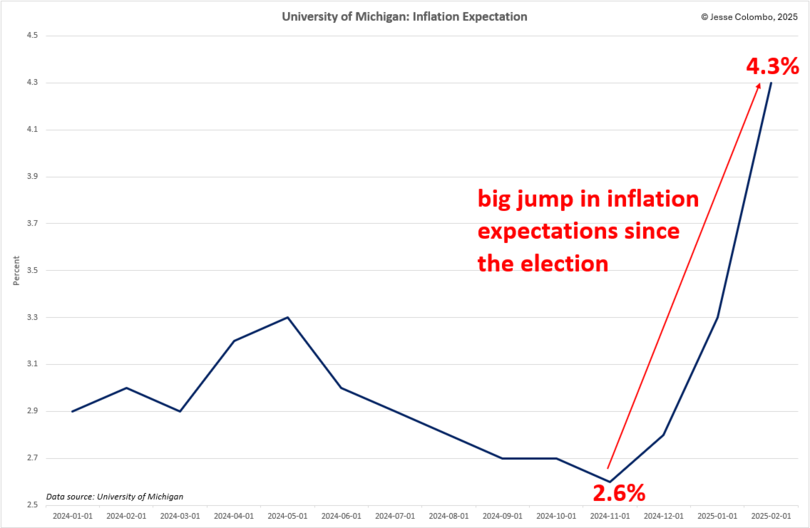
U.S. consumers’ 12-month inflation expectations jumped to 4.3% in February, the highest level since November 2023, according to the University of Michigan’s monthly consumer sentiment survey.

This 1.7 percentage point surge over the past three months is the sharpest increase since February 2020.

The primary driver behind this spike is growing concern over President Trump’s tariff policies and their potential to trigger trade wars and drive inflation higher.

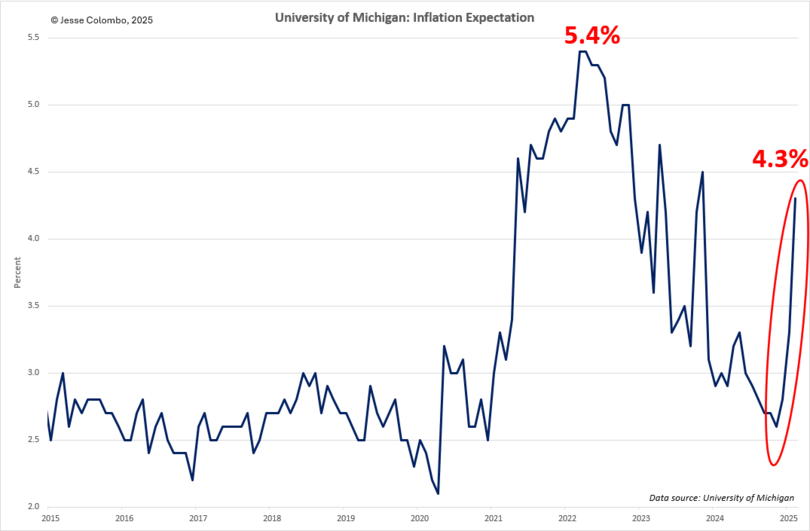
A decade-long chart of inflation expectations highlights the significance of February’s sharp jump.

At 4.3%, we are now just 1.1 percentage points below the peak of 5.4% seen in March and April 2022—when inflation, particularly soaring gasoline prices, fueled the height of the ‘Let’s Go Brandon’ protest movement.

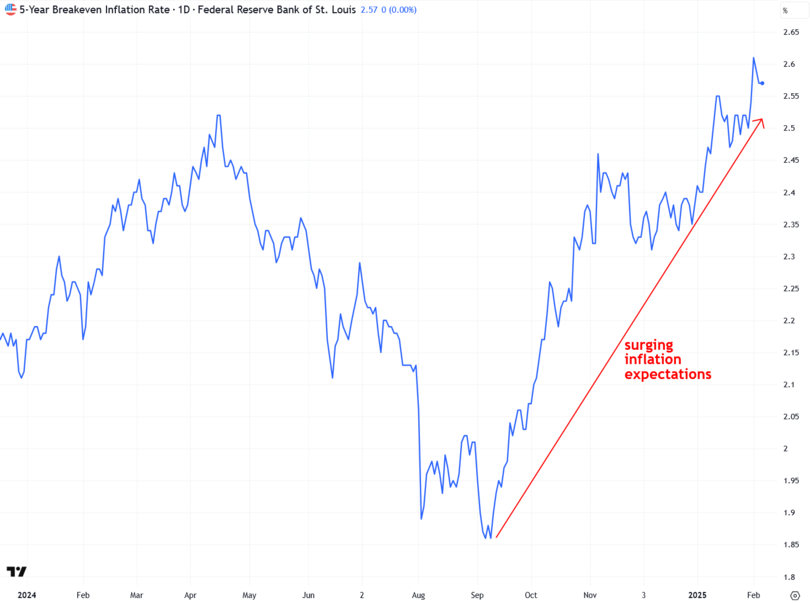
The recent surge in inflation expectations is further confirmed by other indicators, such as the 5-year inflation breakeven rate.

This rate, calculated as the difference between the yield on a nominal 5-year U.S. Treasury note and a 5-year Treasury Inflation-Protected Security (TIPS), reflects the market’s forecast for average annual inflation over the next five years.

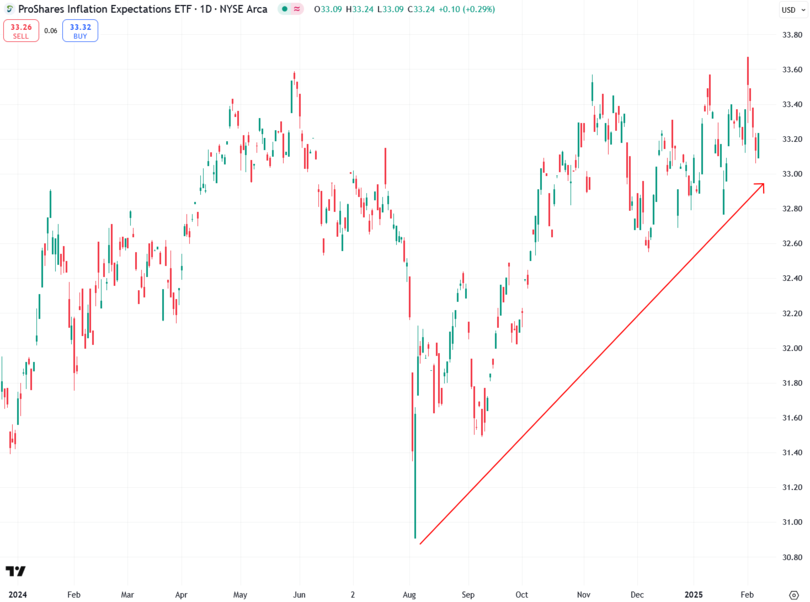
Other market-based indicators also reflect rising inflation expectations, such as the ProShares Inflation Expectations ETF (ticker symbol: RINF).

This exchange-traded fund moves in tandem with inflation expectations, rising when they increase and falling when they decline.

As shown in the chart below, RINF has been trending upward in recent months, mirroring the rise in the 5-year inflation breakeven rate.

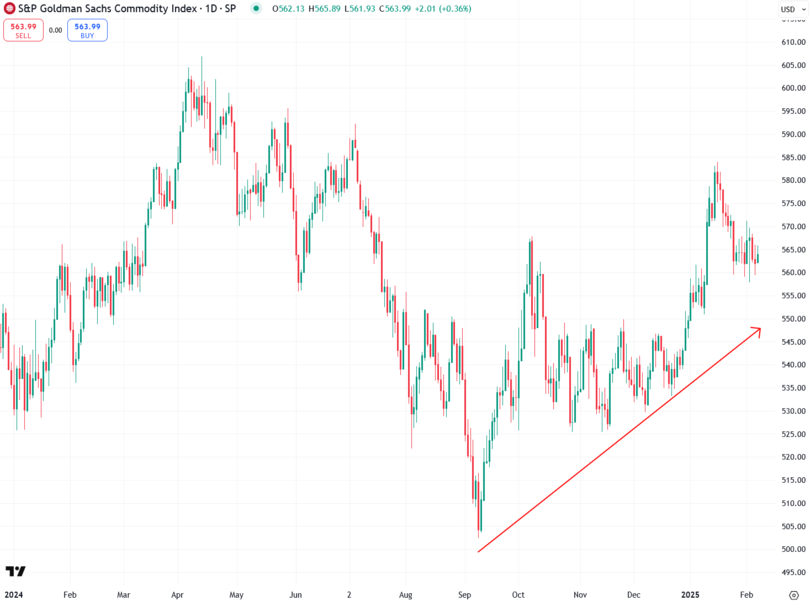
Finally, commodity prices—one of the most traditional indicators of inflationary pressures—have been climbing in recent months. The S&P Goldman Sachs Commodities Index (S&P GSCI) has been rising, reinforcing the signals from other inflation indicators.

With multiple indicators pointing to rising inflation over the next year, it’s no surprise that gold has surged since December. Given these trends, there’s a strong likelihood that gold will push toward $3,000 and beyond in the near future.

After much speculation and negotiation, President Donald Trump agreed to delay the 25% tariffs initially imposed on Canada and Mexico.

However, it’s important to remember that this is merely a delay, not a cancellation. These tariffs could easily return in a month or two.

Meanwhile, the 10% tariff on all imports from China remains in effect. Additionally, Trump has stated that tariffs ‘will definitely happen with the European Union’ and could take effect ‘pretty soon,’ though no concrete plans have been announced yet.

Inflation expectations have been rising in response to tariff risks because companies facing higher import costs typically pass some or all of these expenses on to consumers, driving prices higher.

Additionally, the likelihood of a broader trade war increases as other countries retaliate with tariffs of their own—a process already underway with China.

Fortunately for precious metals investors, these developments have been a tailwind for gold and silver and should be for the foreseeable future.


Jesse Colombo is a financial analyst and investor writing on macro-economics and precious metals markets. Recognized by The Times of London, he has built a reputation for warning about economic bubbles and future financial crises. An advocate for free markets and sound money, Colombo was also named one of LinkedIn’s Top Voices in Economy & Finance. His Substack can be accessed here.

Bill to Remove Medical Debt from Credit Scores in Washington Moves Forward

(Carleen Johnson, The Center Square) State lawmakers are forwarding a bill that would change how medical debt impacts Washingtonians’ credit scores.

Senate Bill 5480 doesn’t erase medical debt completely but “Declares a medical debt void and unenforceable if it is reported to a consumer credit reporting agency or credit bureau,” according to a Senate Bill Report.

State lawmakers are forwarding a bill that would change how medical debt impacts Washingtonians’ credit scores.

Senate Bill 5480 doesn’t erase medical debt completely but “Declares a medical debt void and unenforceable if it is reported to a consumer credit reporting agency or credit bureau,” according to a Senate Bill Report.

The report goes on to say the bill “Prohibits specific entities from reporting medical debts to a consumer credit reporting agency or credit bureau, on pain of committing a violation of the Consumer Protection Act.

According to an Economic Opportunity Institute article from the summer of 2024, approximately 95% of people in Washington have health insurance, but the amount of money being spent is still outpacing what they can afford.

State lawmakers are forwarding a bill that would change how medical debt impacts Washingtonians’ credit scores.

Senate Bill 5480 doesn’t erase medical debt completely but “Declares a medical debt void and unenforceable if it is reported to a consumer credit reporting agency or credit bureau,” according to a Senate Bill Report.

The report goes on to say the bill “Prohibits specific entities from reporting medical debts to a consumer credit reporting agency or credit bureau, on pain of committing a violation of the Consumer Protection Act.

According to an Economic Opportunity Institute article from the summer of 2024, approximately 95% of people in Washington have health insurance, but the amount of money being spent is still outpacing what they can afford.

The report goes on to say the bill “Prohibits specific entities from reporting medical debts to a consumer credit reporting agency or credit bureau, on pain of committing a violation of the Consumer Protection Act.

According to an Economic Opportunity Institute article from the summer of 2024, approximately 95% of people in Washington have health insurance, but the amount of money being spent is still outpacing what they can afford.

Trump to Attend Super Bowl as New Orleans Rebounds from Snow, Terrorism

(Ben Sellers, Headline USA) In Lafourche Parish, Louisiana—one of the boot state’s southernmost regions, jutting out into the newly renamed Gulf of America—residents of the shrimping- and fishing-based bayou community credit President Donald Trump with having fixed global warming during his first few weeks in office.

A rare blizzard last month blanketed the area with around 8 to 10 inches of snow, the most it has seen since 1895. The last recent snowstorm in the region—during the first year of Trump’s first presidential term, in 2017—landed a distant third in the record books, rivaling a 1940 snow that saw around 3.5 inches.

Trump’s appeal in the deep-red state, which broke for him by 60% to former Vice President Kamala Harris’s 38% in last year’s presidential election, has never been in doubt.

Gov. Jeff Landry, a Republican, has arguably been one of the staunchest supporters of the “MAGA” agenda at the state level, with his own push to implement common-sense conservative policies mirroring the Trump administration’s recent “shock and awe” reforms after winning the popular vote, both houses of Congress and all of the major swing states.

But the crossover appeal of Trump’s first few action-packed weeks in office will be put to the test Sunday when he visits New Orleans, which broke for Harris by a margin of 82% to 15%.

Trump is expected to attend Sunday’s Super Bowl, becoming the first president ever to do so, according to the Times–Picayune‘s NOLA.com website.

Many undoubtedly will be watching to see whether he receives a warm or frosty reception as the latest indicator of public approval and support for his policies.

Trump’s presence is likely to upstage that of outspoken leftist songbird Taylor Swift—whose beau, tight end Travis Kelce, will return with the Kansas City Chiefs for their third consecutive appearance and the fifth in six years, again taking on their 2023 opponent, the Philadelphia Eagles.

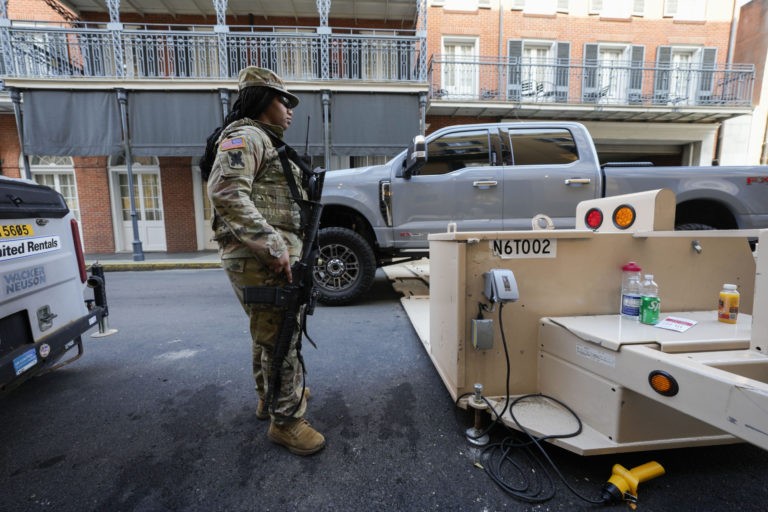
However, the highly anticipated NFL championship also comes amid heightened security concerns following a New Year’s Day massacre by a domestic terrorist on the city’s iconic Bourbon Street.

Likewise, Trump is no stranger to violence following at least two assassination attempts on the campaign trail last year—one of which bloodied his ear and came inches from ending his life.

Democrats this week once more reiterated their calls for political violence, with House Minority Leader Hakeem Jeffries, D-N.Y., controversially urging riotous Trump opponents to “fight it in the streets.”

Chiefs fans have also dealt with public violence after a mass shooting last February, during the team’s Super Bowl victory parade, killed one and injured 22 spectators—including eight children.

And a tragic Jan. 31 jet crash in Philadelphia that left seven dead and others critically injured may have Eagles fans equally on edge, although its causes are presumed to have been accidental.

While New Orleans, which hosts a world-renowned Mardi Gras celebration every year, is no stranger to street closures and other logistical challenges that come with being a tourism hotspot, this perfect storm of factors is sure to lead to extra precautions for both game attendees and local residents.

“Extensive planning and coordination have been in place to ensure the safety of all attendees, players, and staff,” Secret Service spokesman Anthony Guglielmi said in a statement, according to NOLA.com.

“Security measures have been further enhanced this year, given that this will be the first time a sitting President of the United States will attend the event,” he added.

Ahead of next month’s Mardi Gras, the stakes are especially high for the “Big Easy” to reassure tourists that there is no reason for concern—despite criticism of some public-safety officials over the handling of the Jan. 1 attack.

“We’re going above and beyond what we’ve seen in the past when we’ve hosted previously,” Mayor LaToya Cantrell said, according to the Associated Press. “We know we’re safer than we’ve ever been before.”

In Kansas City and Philadelphia, measures were also being put in place to ensure public safety in the game’s aftermath.

Nonetheless, some Chiefs fans remained on edge following last year’s parade attack.

“There’s a lot of people that’ll think twice about attending an event like that,” Kansas City resident Branson Albertson told the AP on Thursday, as he, his wife and their kids posed for photos inside a Chiefs-bedecked Union Station—near where last year’s shooting happened.

“But I still think there’ll be a big turnout,” he added.

Sharon Billington, a 63-year-old Chiefs fan who also visited Union Station, told the AP that she planned to watch on TV. She had family at last year’s victory parade and was terrified.

“The world is just not in a position to have that right now,” she said of a large rally.

Philly’s boisterous fans have been known to cause havoc in the streets after big wins, even before concerns about terrorism and mass violence became commonplace.

In 2023, when the Eagles last won a National Football Conference title, a group of people crashed through the hard plastic roof of a bus shelter where they had been dancing, injuring several of them. And a college student was killed last month by falling off a pole following the Eagles’ conference championship.

“The Philadelphia Police Department is on an all-hands-on-deck approach to ensure everyone’s safety,” Police Commissioner Kevin J. Bethel said Friday, while sporting a kelly-green suit in a nod to the city’s NFL team.

“Our officers will be out in full force across the city, ready to keep the festivities running smoothly,” he added. “You don’t want to be in a celebratory moment, [and] have a tragedy occur.”

Ben Sellers is the editor emeritus of Headline USA. Follow him at x.com/realbensellers.
The Associated Press contributed to this report.

Trump to Zelenskyy: No Nukes for You!

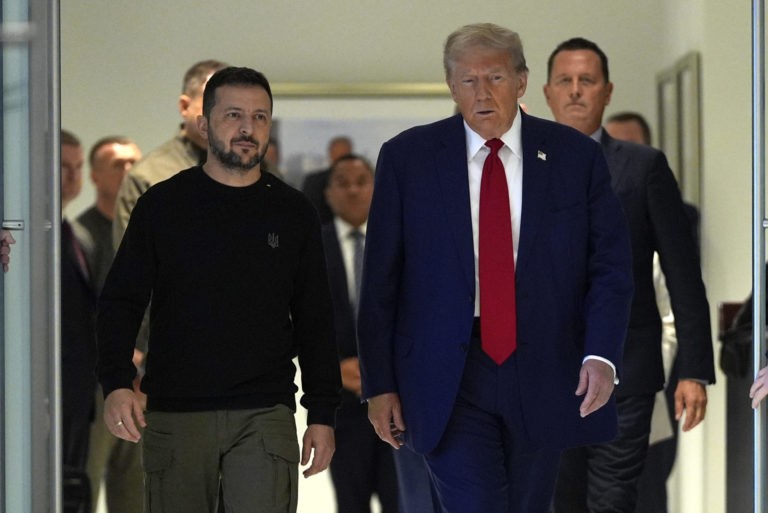
(Ken Silva, Headline USA) The Trump administration has reportedly rejected Ukrainian President Volodymyr Zelenskyy’s calls for nuclear weapons to fight Russia.

“The chance of them getting their nuclear weapons back is somewhere between slim and none. Let’s be honest about it, we both know that’s not going to happen,” Trump’s special envoy for Ukraine and Russia, Retired Gen. Keith Kellogg, told Fox News last week—as reported by The Libertarian Institute’s Kyle Anzalone.

Anzalone noted that Trump’s envoy to the conflict was responding to remarks made by Zelenskyy in an interview with Piers Morgan that was released earlier this week

In that interview, Zelensky reportedly said, “So let’s do it the following way. Give us back nuclear arms. Give us missile systems. Partners, help us finance the one million [man] Army. Move your contingent on the parts of our state where we want.”

Kremlin spokesman Dmitry Peskov reportedly responded sharply those comments by saying: “Such statements and remarks, in general, border on madness. There is a non-proliferation regime for nuclear weapons, among other things.”

Ukraine gave up its nuclear weapons program in the early 1990s, after the Soviet Union fell. But there doesn’t seem to be any change of the country regaining nukes while Trump is in power, given Trump’s repeated calls for global denuclearization.

Just last month, Trump renewed called for denuclearization with Russia and China.

“We were talking about denuclearization of our two countries, and China would have come along. China right now has a much smaller nuclear armament than us, or field, than us, but they’re going to be catching [up] at some point,” Trump reportedly said at the World Economic Forum in Davos, Switzerland.

“I will tell you that President Putin really liked the idea of cutting back on nuclear, and I think the rest of the world, we would have gotten them to follow, and China would have come along too. China also liked it. Tremendous amounts of money are being spent on nuclear, and the destructive capability is something that we don’t even want to talk about. It’s too depressing,” he reportedly added.

Ken Silva is a staff writer at Headline USA. Follow him at x.com/jd_cashless.