Calif. Says It Will Continue to Allow Trans Athletes in Women’s Sports Despite Trump’s Executive Order

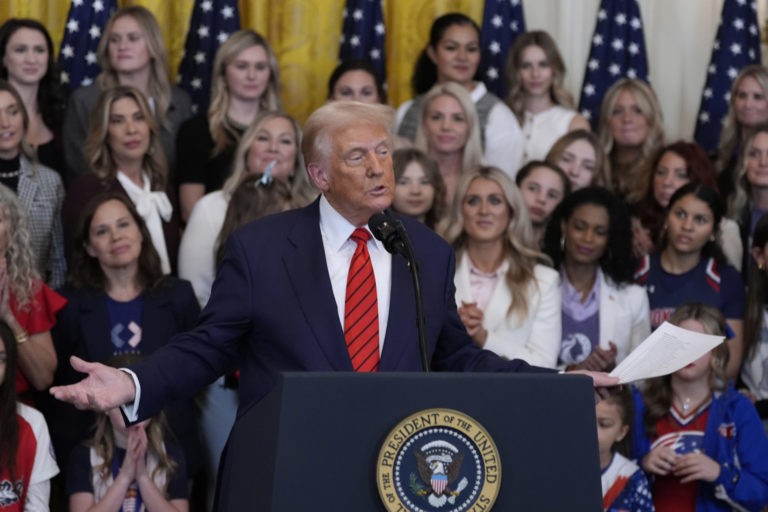
(Maire Clayton, Headline USA) California Interscholastic Federation stated it would not follow President Donald Trump’s executive order regarding transgender athletes participating in women’s sports, according to the San Francisco Chronicle.

CIF claimed the organization “provides students with the opportunity to belong, connect, and compete in education-based experiences in compliance with California law.”

California Family Council Outreach Director Sophia Lorey blasted the decision while speaking with Fox News Digital.

“I am disgusted that CIF is disregarding yesterday’s executive order and instead doubling down on policies that are not only unfair, but dangerous for young women across California,” Lorey said. “By prioritizing their idol of transgender ideology over the safety and rights of female athletes, they are knowingly exposing high school girls to unsafe competition and stripping them of opportunities guaranteed for them under Title IX.”

Lorey added that she believes the organization will eventually realize it made the wrong decision to violate Trump’s order.

“They will have to answer for why they sacrificed the safety, fairness, and dignity of young girls to bow to an ideological agenda,” she continued. “But the rest of us will not stand by while female athletes are illegally prevented from competing fairly in their own sports.”

The National Collegiate Athletic Association had a different approach and changed its gender eligibility policies shortly after Thursday’s order.

“The new policy limits competition in women’s sports to student-athletes assigned female at birth only,” NCAA said in a statement.

However, biological women will still be allowed to compete in male sports.

Trump took to Truth Social to praise the fact NCAA had to change its policy.

“This is a great day for women and girls across our Country,” he wrote. “Men should have NEVER been allowed to compete against women in the first place, but I am proud to be the President to SAVE Women’s Sports.”

The New Politico?: Semafor Invites 200+ Globalists to D.C. for Davos-Like Conference

(Headline USA) The media company Semafor is planning a Washington economic conference for hundreds of globalist elites in April that it hopes will rival the annual World Economic Forum in Davos, Switzerland, for influence.

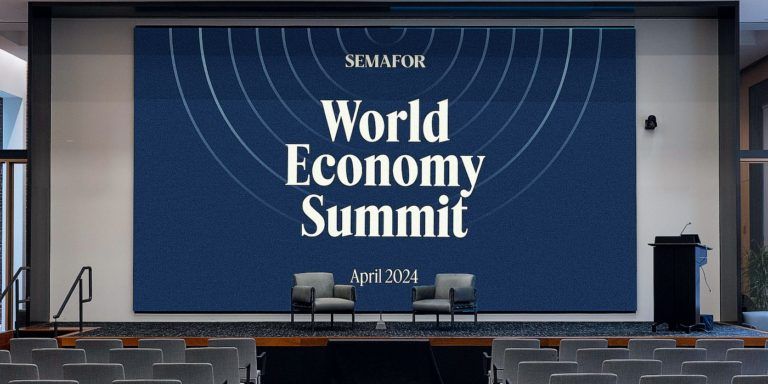
World Economy Summit, scheduled for April 23-25 in Washington, D.C., is being co-chaired by two top Democrat donors to the Obama and Biden administrations: Carlyle Group co-founder David Rubenstein and former Obama Commerce Secretary Penny Pritzker, who most recently was appointed by then-President Joe Biden to oversee economic redevelopment in Ukraine in cooperation with BlackRock and Bank of America.

Jourrnalists from Semafor—a relative newcomer in the mainstream media ecosphere founded by former BuzzFeed editor Ben Smith and Bloomberg Media CEO Justin B. Smith (no known relation)—will moderate a series of discussions on topics like global finance, energy, growth and the tech revolution.

Several Biden Cabinet members and other prominent Democrats are included on the list of speakers, including former Transportation Secretary Pete Buttigieg, former Commerce Secretary Gina Raimondo and former Health and Human Services Secretary Xavier Becerra.

Semafor said it hoped that Trump administration officials would also attend, adding to the news value, but none had been booked yet.

The announcement by Semafor was met with some circumspection as many believe the annual Davos summit has become a depraved ritual for unaccountable elites to plot social-engineering strategies in support of a new world order.

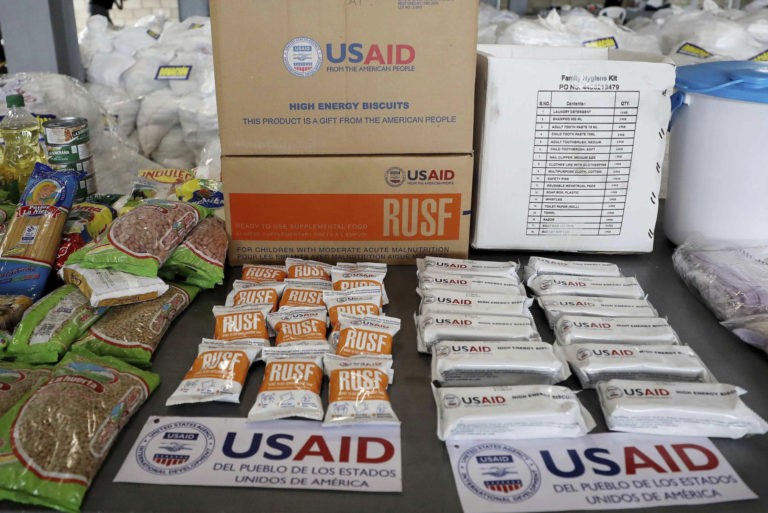
It also comes as President Donald Trump and his team—including billionaire Elon Musk, the chair of the Department of Government Efficiency—have worked swiftly to shut down shadowy agencies like the United States Agency for International Development that have routinely engaged in bankrolling psy-op and propaganda campaigns, color revolutions and nation-building, with little public knowledge of their activities.

A recent bombshell revealed that Politico and other major media outlets exerting strong influence on Capitol Hill had been receiving millions of dollars in government funding before being abruptly cut off by incoming Trump officials.

Ben Smith was one of Politico‘s early stars, working at the upstart outlet for four years, between 2008 and 2012, before moving to BuzzFeed and, later, the New York Times.

Semafor said Wednesday that more than 200 CEOs have already committed to attend its April event. Although the forum is now in its third year, the surge in attendance suggested an explosion of interest due, in large part, to curiosity about Trump’s policies.

“It is really turning into what will be the closest thing to what Davos has accomplished in Switzerland,” said co-founder Justin B. Smith.

A similar Washington conference two years ago brought together about 50 CEOs, and leadership attendance expanded to about 75 in 2024. While that growth showed interest in monitoring regulatory efforts in Washington, there’s little doubt what has propelled the interest this year.

“Trump’s election has added fuel to the project’s acceleration and growth,” Justin B. Smith said.

With other finance leaders and spectators, Semafor is hoping for about 5,000 people to attend its conference. Leaders of Netflix, FedEx, Instacart, Mattel, United Airlines, Whole Foods and WeWork are among the confirmed attendees, the company said.

Adapted from reporting by the Associated Press

BIDEN BIRD FLU: Hochul Drives Up Egg Costs, Stokes Panic w/ Shutdown of NYC Poultry Markets

(Headline USA) With echoes of 2020 and Democrat leaders’ successful efforts to tank the U.S. economy in a pandemic frenzy, Gov. Kathy Hochul stoked new—albeit unfounded—worries, and further drove up the sky-high cost of eggs and chicken.

Hochul’s shutdown of New York City poultry markets on Friday comes even as leftist demagogues like House Minority Leader Hakeem Jeffries, D-N.Y. have tried to deflect by blaming President Donald Trump for the supply shortages.

All live poultry markets in New York City and some of its suburbs were ordered to close for a week after the detection of seven cases of bird flu, which has also hit farms nationwide, led to the slaughter of millions of birds.

Hochul admitted that there was no immediate threat to public health and that the temporary closure of bird markets in the city—and its Westchester County and Long Island suburbs—was due to an abundance of caution. No cases of bird flu have been detected among humans in New York, officials said.

The order came after birds infected with the virus were found during routine inspections of live bird markets in the New York City boroughs of the Bronx, Brooklyn and Queens.

The Centers for Disease Control and Prevention has said the virus posed low risk to the general public. The agency said there have been 67 confirmed cases of bird flu in humans in the U.S., with illnesses mild and mostly detected among farmworkers who were exposed to sick poultry or daily cows.

The first bird flu death in the U.S. was reported last month in Louisiana, with health officials saying the person was older than 65, had underlying medical problems and had been in contact with sick and dead birds in a backyard flock.

In New York, live bird markets where the virus was detected have to dispose of all poultry in a sanitary manner, according to the state’s order.

Other bird markets that do not have cases will have to sell off remaining poultry, clean and disinfect and then remain closed for at least five days and be inspected by state officials before reopening.

In both cases, New York consumers are likely to feel the pinch due to the added regulatory costs and lost sales.

The H5N1 strain of bird flu has been spreading among wild birds, poultry, cows and other animals. Officials have urged people who come into contact with sick or dead birds to wear respiratory and eye protection and gloves when handling poultry.

More than 156 million birds nationwide have been affected by the outbreak, many at large farming operations that have had to slaughter their entire flocks.

The supply shortage, in turn, has led grocery stores and restaurants, including Waffle House and Chick-fil-a, to adjust their prices and practices.

A separate strain of bird flu has also reportedly been detected in cows, raising the prospect of a major nationwide meat shortage that could undermine Trump’s efforts to drive down inflation.

Jeffries was one of several Democrats who sought to exploit the problem—which began during the Biden administration—by faulting Trump for failing to bring down the cost of eggs after his first four days in office.

Adapted from reporting by the Associated Press

Report: Apple Ordered to Provide Gov’t Access to ALL User Data on the Cloud

(Ken Silva, Headline USA) The Washington Post reported Friday that the United Kingdom’s deep state has demanded that Apple create a back door for them to retrieve all the content any Apple user worldwide has uploaded to the cloud—what would be an unprecedented erosion of online privacy and civil liberties.

Citing anonymous sources, the Post reported that the British government’s undisclosed order was issued last month. It reportedly requires Apple to give officials blanket capability to view fully encrypted material.

Typically, Apple has assisted authorities on a case-by-case basis—such as helping the FBI access a terrorist’s phone, for example. The Post noted that the access sought by the UK “has no known precedent in major democracies.”

According to the Post, the UK’s order was made pursuant to the sweeping U.K. Investigatory Powers Act of 2016, which authorizes law enforcement to compel assistance from companies to access user data.

“The law, known by critics as the Snoopers’ Charter, makes it a criminal offense to reveal that the government has even made such a demand,” the Post reported.

“Apple can appeal the U.K. capability notice to a secret technical panel, which would consider arguments about the expense of the requirement, and to a judge who would weigh whether the request was in proportion to the government’s needs. But the law does not permit Apple to delay complying during an appeal.”

An Apple spokesman reportedly declined to comment. The Post reported that Apple is likely to stop offering encrypted storage in the UK.

“Yet that concession would not fulfill the U.K. demand for backdoor access to the service in other countries, including the United States,” the newspaper added.

Western countries, including the U.S., have been pushing for total access to online user data for years.

In March 2021, for example, former FBI Director Chris Wray told the Senate Judiciary Committee that encryption was stifling his agents from investigating domestic extremism.

According to Wray and other law enforcers, tech companies should be able to build “backdoors” into their encryption that preserves privacy, while allowing for access when necessary. That, they say, strikes the proper balance between data security and national security.

However, numerous tech experts, civil libertarians, and others say that it’s impossible to build a backdoor that can’t be exploited by hackers. They also say that by banning encryption, the United States would be following in the footsteps of authoritarian countries such as China, which blocked the encrypted messaging app Signal.

“It is important to understand that any kind of back door (or front door) access for the ‘good guys’ can also be exploited by the ’bad guys,’” the pro-industry Information Technology & Innovation Foundation stated in a July 2020 report.

“For example, key escrow systems would introduce new attack vectors that could allow attackers to gain access to encrypted information, such as by compromising the system that maintains copies of the keys.”

Ken Silva is a staff writer at Headline USA. Follow him at x.com/jd_cashless.

Reflecting on the Gold Democrats

(Lawrence Reed, Money Metals News Service) The official platforms of American political parties are often short on substance and long on platitudes. Sometimes, they are a mishmash of contradictions and promises that won’t be kept. Almost nobody reads them even in the year of their adoption, let alone a century later.

Except for me. I’m a history buff.

A Party That Stood on Principle, Not Promises

Among the many platforms I’ve read over the years, I do have some favorites. One was that of a faction of the Democratic Party known as the Locofocos. The Locofocos emerged in the early years of the Democratic Party as an anti-Tammany, pro-worker group. They stood for Jeffersonian principles—small and honest government, no subsidies and special favors, sound money, private property, and the rights of the individual. Many Locofoco beliefs became canon in the Democratic Party for decades, right through the presidencies of Grover Cleveland in the 1880s and 1890s.

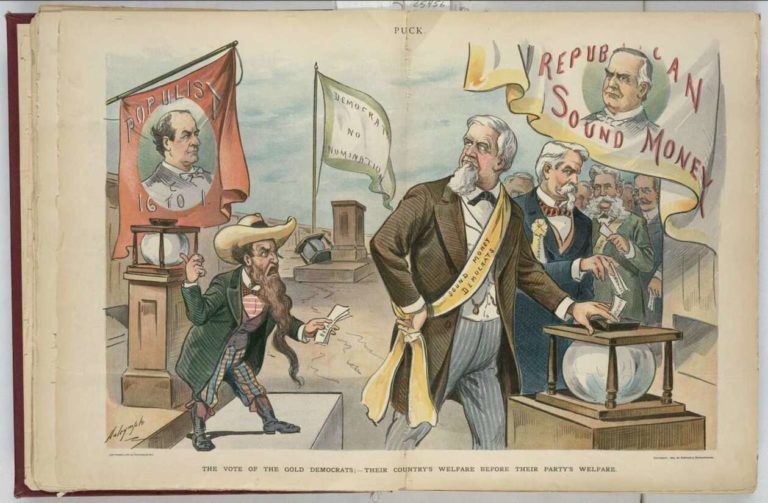
By 1896, however, the Democrats were drifting from these principles. At their convention that year in Chicago, the young William Jennings Bryan of Nebraska delivered his famous “Cross of Gold” oration that mesmerized the delegates, prompting them to reject much of what Democrats had stood for since Thomas Jefferson’s days. Instead, they fell for easy money and a bevy of dubious interventionist schemes.

Disgusted at the party’s embrace of Bryanism, traditional Democrats broke off, formed the new National Democratic Party, and nominated their own candidates for President and Vice President.

The 1896 Platform: A Last Stand for Sound Money and Limited Government

The NDP platform of 1896 opened with stirring words of time-honored principles and a well-deserved assault on the main Democratic Party that had just deserted them:

The [National] Democratic Party is pledged to equal and exact justice to all men of every creed and condition; to the largest freedom of the individual consistent with good government; to the preservation of the Federal Government in its constitutional vigor and the support of the States in all their just rights; to economy in the public expenditures; to the maintenance of the public faith and sound money; and it is opposed to paternalism and all class legislation.

The Declarations of the Chicago Convention [the one that nominated Bryan] attack individual freedom, the right of private contract, the independence of the judiciary, and the authority of the President to enforce Federal laws. They advocate a reckless attempt to increase the price of silver by legislation to the debasement of our monetary standard, and threaten unlimited issues of paper money by the Government. They abandon for Republican allies the Democratic cause of tariff reform to court the favor of protectionists to their fiscal heresies.

The platform attacked the Republicans for “extravagant appropriations beyond the needs of good government.” It condemned tariffs for anything but “revenue only” and rejected tariffs designed to “protect” domestic producers and political allies.

It praised gold as “the best money known to man” and opposed congressional attempts to compel the federal government to subsidize silver or print fiat paper money. It reaffirmed the decades-old policy of the Democratic Party that “entirely divorced the Government from banking and currency issues.” (The Gold Democrats of 1896 were the “End the Fed” party years before the Federal Reserve’s creation.)

The platform endorsed civil service reform so that government employment would emphasize merit rather than cronyism. It demanded “strict economy in the appropriations and in the administration of the Government.”

It spoke glowingly of Grover Cleveland, the outgoing President who had restrained government spending and defended the gold standard. The platform lauded

the fidelity, patriotism, and courage with which President Cleveland has fulfilled his great public trust, the high character of his administration, his wisdom and energy in the maintenance of civil order and the enforcement of its laws, its equal regard for the rights of every class and every section, its firm and dignified conduct of foreign affairs, and its sturdy persistence in upholding the credit and honor of the nation…

Why the National Democratic Party Faded—But Shouldn’t Be Forgotten

In Indianapolis in September, the NDP nominated former Illinois Governor John M. Palmer as their presidential candidate for the 1896 election. In the end, Republican William McKinley won easily. Rather than support a quixotic, last-minute third-party effort, rank-and-file Gold Democrats deserted Bryan but went for McKinley instead of Palmer.

McKinley, at least, was a gold man. In 1900, he signed the Gold Standard Act into law. It formally defined the American dollar by gold weight and required the Treasury to redeem, upon demand and in gold coin only, any paper dollars presented to it. The dollar was effectively “as good as gold,” at $20.67 per ounce.

Though Bryan never won the presidency (he was the Democrats’ candidate in 1896, 1900, and 1908), he certainly transformed the party. They were out of the White House for sixteen years. When they finally returned, with the election of Woodrow Wilson in 1912, the party and its principles were almost unrecognizable from when Grover Cleveland left office in 1897. Wilson helped undermine the gold standard by cursing the country with a central bank (not by coincidence, today’s unbacked paper dollar is worth less than a nickel of its value then). The next Democratic president, Franklin Roosevelt, would make gold-holding Americans into common criminals.

In the vain hope that Bryanism would be a temporary aberration, the National Democrats (NDP) of 1896 had stood athwart history, yelling, “Stop!” Sadly, Bryan had changed the party forever, and the NDP proved to be a flash in the pan. The Democratic Party continued its leftward march.

The Gold Democrats of the 1896 NDP held firm for good policy but quickly evaporated. Nonetheless, as David T. Beito and Linda Royster Beito note, the party they briefly led deserves to be remembered:

It stands out as the last classical liberal political movement of the nineteenth century, and it did not have a successor for many decades to come. Within a few years of its disappearance, the limited-government ideas defended by the NDP were all but forgotten. In 1912, for example, all three major candidates, William Howard Taft, Woodrow Wilson, and Theodore Roosevelt, put forward interventionist agendas. Not until the 1970s would classical liberal ideas finally reoccupy a significant position in political and policy debates.

Please don’t blame me for the dollar’s century-long decline in purchasing power. I would have voted Locofoco in 1836 and Gold Democrat in 1896.

Originally Published on FEE.org.


Lawrence W. Reed is FEE’s President Emeritus, Humphreys Family Senior Fellow, and Ron Manners Global Ambassador for Liberty, having served for nearly 11 years as FEE’s president (2008-2019). He is the author of the 2020 book, Was Jesus a Socialist? as well as Real Heroes: Incredible True Stories of Courage, Character, and Conviction and Excuse Me, Professor: Challenging the Myths of Progressivism.

The Dollar: The DEI Hire of Money

(Mike Maharrey, Money Metals News Service) Dollars are the DEI hire of money.

Dollars identify as money, but, well…

Why do people get so upset about mandated DEI (Diversity, Equity, and Inclusion) policies, anyway?

Because they know that when a policy mandates a specific number of a certain kind of people in a position, you will inevitably end up with unqualified or underqualified people doing jobs that are way over their heads because they were put in the position based on criteria other than competence at said job.

That’s why I called dollars the DEI of money. It is unqualified for the job, but it is there because the government said so. It has a monopoly on money, and it locks out better-qualified candidates like gold and silver.

A Weird Question

People sometimes ask me, “Mike, why are you so into gold?”

Quite frankly, I think it’s kind of a weird question.

You would never ask somebody, “Why are you so into dollars?” The answer is self-evident. Dollars are money. And of course, pretty much everybody is “into” money.

Well, gold and silver are money. So, when people ask me why I want gold, in my head, I hear them asking, “Dude, why do you want money?”

Well, duh.

But why gold and silver in particular?

Well, they are real money. They aren’t some DEI hire trying to be money like fiat dollars are.

Gold and silver are sound money. They hold their value over time, unlike government fiat currency, which is constantly being devalued by the governments that issue it.

Paper Pretending to Be Money

Dollars aren’t real money at all. As J.P. Morgan once said, “Gold is money. Everything else is credit.”

Thomas Paine was equally blunt.

“Money is Money, and Paper is Paper. – All the invention of man cannot make them otherwise.”

And Thomas Jefferson drilled down to the crux of the matter.

“Paper is poverty, that it is only the ghost of money, and not money itself.”

You might call paper dollars trans money. It’s one thing attempting to be another. But you really can’t call a dollar “money” when you’ve surgically cut its connection with gold or silver.

The Problem With Fiat Currency

Investopedia defines fiat money as a government-issued currency not backed by a physical commodity such as gold or silver.

So, what is fiat backed by?

“The full faith and credit” of the issuing government.

In other words – nothing.

Fiat money is just paper (or digits in a computer). It only has value because the government says so, and the majority of people accept it at its word. It doesn’t hurt that governments have the power to maintain a monopoly over their currency through legal tender laws, keeping competing currencies at bay.

So, what’s the problem?

It can be created out of thin air.

Governments can run off as much fiat money as they want. We often refer to this as “money printing,” although today, it’s not even that hard. There is no printing press required. A government or central bank can create new money with a few keyboard strokes.

As economist Thorsten Polleit put it, fiat money economies are built on lies.

“Fiat currencies are produced by central banks and commercial banks’ credit expansion. In fact, central banks in cahoots with commercial banks increase the outstanding money supply by extending loans to firms, private households, and government entities. It amounts to money creation from thin air or—in a way—counterfeiting money.”

We go to prison for counterfeiting. The government does it as a matter of policy.

But when you really think about it, there is no fundamental difference between me printing off a bunch of bills and calling it “money” and the government doing it. If I could get enough people to believe my paper had value, it could be money, too.

Sound money such as gold and silver, or currencies backed by a commodity, are limited by the supply of that commodity. You can’t print gold or silver. That means if a country issues a gold-backed currency, the only way it can create more is to acquire more gold. This limits the issuance of new money, minimizing inflation and keeping the value of money relatively constrained and constant.

This is a great scenario for the citizenry, but not so great for governments. Expanding the money supply enables government to borrow and spend more than it otherwise could. Spending money is political power.

You can see the problem, right?

The reason FDR began cutting gold’s ties to the dollar was so he could borrow and spend more. It was a boon for the federal government, helping it grow into the behemoth it is today.

But it hasn’t been so great for you or me.

The greenback has lost more than 85 percent of its value since President Richard Nixon severed the dollar from the last vestiges of the gold standard. The purchasing power of a 1971 dollar is equal to about 13 cents today.

Meanwhile, the dollar value of gold has gone from $35 an ounce to around $2,800 an ounce today. In percentage terms, that’s a 7,900 percent increase.

Fiat money also introduces counterparty risk. In simple terms, it is the possibility that the party on the other side of a transaction might not fulfill its obligation.

Who is the counterpart behind fiat money?

The government.

If you trust the government to maintain a sound, stable currency, I guess there’s no problem. But if you don’t?

Get sound money.

After all, you don’t want your portfolio dominated by DEI hires, now do you?


Mike Maharrey is a journalist and market analyst for MoneyMetals.com with over a decade of experience in precious metals. He holds a BS in accounting from the University of Kentucky and a BA in journalism from the University of South Florida.


Musk Vows to Reinstate ‘Big Balls’ at DOGE Following Online Uproar over Doxxing

Update: Hours after the publication of this article, President Donald Trump and Vice President JD Vance both called for the DOGE staffer to be rehired. DOGE founder Elon Musk signaled that he will do so. You can see Trump’s remarks about the DOGE staffer here. The rest of this story remains unchanged.

(Ken Silva, Headline USA) President Donald Trump’s historic election win last November was said to represent a repudiation of cancel culture and the “woke” politics that have plagued the country since the Obama administration—so why did Elon Musk’s Department of Government Efficiency just fire a staffer over controversial social media posts?

The Wall Street Journal’s Katherine Long—who, ironically, once worked at the U.S. Agency for International Development—first reported the news about the DOGE staffer’s firing Friday, revealing his identity as 25-year-old Marko Elez. According to the Journal, Elez ran a now-deleted social-media account that advocated racism and eugenics.

“Just for the record, I was racist before it was cool,” Elez’s account reportedly posted in July, according to the Journal.

“You could not pay me to marry outside of my ethnicity,” the account reportedly wrote on X in September.

The Journal further noted that “the user appeared to have a special dislike for Indian software engineers.

“99% of Indian H1Bs will be replaced by slightly smarter LLMs, they’re going back don’t worry guys,” the user reportedly posted in December, referring to large language models such as OpenAI’s ChatGPT.

“Normalize Indian hate,” the account wrote the same month, according to the Journal, explaining that the tweet was referencing a post noting the prevalence of people from India in Silicon Valley.

Elez resigned after the Journal contacted the White House about the matter. He reportedly decline to comment, while DOGE hasn’t issued a public statement on the matter.

Elez’s resignation sparked right-wing backlash online.

“Dear Elon Musk, stop canceling your people,” Douglas Mackey, the former political dissident who faced federal charges for posting memes, posted on Twitter/X.

Slueths also quickly uncovered the background of Long, the journalist who wrote the story, revealing her to have worked for the USAID.

“That’s incredible. The journo who doxxed the DOGE staffer worked at 3 of the Top 4 Blobcraft Agencies I stress in lectures do organized political warfare as intelligence work: USAID, State, and DOD’s Political-Military branch,” said right-wing pundit and intelligence expert Mike Benz. “Literally the only resume point missing is CIA.”

The anonymous account Just Loki summed up the dismal situation in a nutshell: “I for one am less than thrilled that we have Central Asian intelligence assets posing as journalists trying to get special government employees fired because their handlers are trying to avoid budget cuts.”

Ken Silva is a staff writer at Headline USA. Follow him at x.com/jd_cashless.

Central Banks Increase Gold Reserves By Over 1,000 Tonnes for the Third Straight Year

(Mike Maharrey, Money Metals News Service) Central bank gold demand topped 1,000 tonnes for the third straight year in 2024.

To put that into perspective, central bank gold reserves increased by an average of just 473 tonnes annually between 2010 and 2021.

On net, central banks increased their gold holdings by 1,044.6 tonnes last year, according to data compiled by the World Gold Council. It was the 15th consecutive year of expanding gold reserves.

The World Gold Council said the increase in gold reserves last year was no surprise.

“But the continued strength of demand exceeded even our already lofty expectations.”

Last year was the third-largest expansion of central bank gold reserves on record, coming in just 6.2 tonnes lower than in 2023 and 91 tonnes lower than the all-time high set in 2022. (1,136 tonnes).

Central banks likely added even more unreported gold. For instance, the People’s Bank of China quietly purchased over 100 tonnes of gold in October and November.

The WGC includes an estimate of “unreported” buying in its data, but likely understates the actual numbers.

Who Bought All This Gold?

The National Bank of Poland was the biggest buyer in 2024, adding 90 tonnes of gold to its reserves.

Last year, National Bank of Poland Governor Adam Glapiński indicated the central bank plans to increase its gold holdings to 20 percent of its reserves. 

“This makes Poland a more credible country, we have a better standing in all ratings, we are a very serious partner, and we will continue to buy gold.”

The country currently holds about 18 percent of its reserves in gold.

The Polish central bank began aggressively increasing its gold reserve in 2021 when Glapiński announced a plan to buy 100 tons of the yellow metal. The National Bank of Poland reached that goal in the fall of 2023 and continued its buying spree.

When he announced the initial plan to expand its gold reserves, Glapiński said holding gold was a matter of financial security and stability. 

“Gold will retain its value even when someone cuts off the power to the global financial system, destroying traditional assets based on electronic accounting records. Of course, we do not assume that this will happen. But as the saying goes – forewarned is always insured. And the central bank is required to be prepared for even the most unfavorable circumstances. That is why we see a special place for gold in our foreign exchange management process.”

Glapiński also pointed out that “Gold is free from credit risk and cannot be devalued by any country’s economic policy. Besides, it is extremely durable, virtually indestructible.” 

Turkey ranked second in gold buying among central banks last year, expanding its reserves by 74.8 tonnes.

The Turkish central bank sold a significant amount of gold in 2023 in the midst of an inflationary crisis. This created a surge in domestic demand for gold as Turks rushed to shield themselves from a depreciating lira. To manage gold demand and reduce the strain on its current account deficit, the Turkish government imposed restrictions on gold imports, and the Turkish central bank released gold from its reserves into the local market to alleviate tight supply conditions.

The Central Bank of Turkey returned to buying last year, albeit at a slower rate than before the crisis.

The Reserve Bank of India added the third-largest amount of gold to its reserves in 2024, purchasing 73 tonnes. The RBI added to its gold holdings every month except for December. At the end of 2024, the RBI gold reserves totaled 876 tonnes, making up 11 percent of total reserves.

An Indian economist told the Times of India that the push to accumulate gold was based on both political and economic reasons. He said that the “reliability” of the U.S. dollar has “diminished.” He noted the “noticeable decline” in the confidence in U.S. dollar assets.

Another economist told the Times, “It makes a lot of sense (to invest in gold), given the increased volatility in the FX market, elevated interest rates in the U.S., and, of course, also as the central banks in each economy would like to diversify the asset classes in which they are parking their reserves.”

India recently transported 100 tonnes of its gold from the UK back into India.

The People’s Bank of China publicly returned to the table in November after a 6-month pause with a 5-tonne increase to its official gold reserves.

China was the biggest central bank gold buyer in 2023 but stopped announcing increases to its reserves in May.

The Chinese central bank was the biggest buyer in December, officially adding 10 tonnes to its holdings.

Even with the pause in reporting, the People’s Bank of China still added 44 tonnes of gold to its official reserves.

China has a history of adding to publicly stated reserves and then going silent.

The People’s Bank of China accumulated 1,448 tons of gold between 2002 and 2019 and then reported nothing for more than two years before resuming reporting in the fall of 2022. Many speculate that the Chinese continued to add gold to its holdings off the books during those silent years.

As already mentioned, China almost certainly has much more gold than it admits. Jan Nieuwenhuijs reported that the People’s Bank of China secretly bought large amounts of gold, even as official buying was on pause. The renowned Money Metals researcher has shown that the Chinese central bank covertly purchases gold in the London Bullion market through bullion banks.

Several other Eastern European countries joined Poland in expanding their gold reserves.

The Czech National Bank bought gold at a steady pace throughout the year, adding 20 tonnes of gold to its holdings. The Czech central bank now holds just over 50 tonnes of gold, a threefold increase since the end of 2023.

The Central Bank of Hungary increased its gold reserves by 16 tonnes with one large purchase in September.

The National Bank of Serbia (8 tonnes) and the National Bank of Georgia (7 tonnes) were the other two notable buyers in the region.

Another notable buyer was the State Oil Fund of Azerbaijan. The country’s sovereign wealth fund added 25 tonnes of gold in the first three quarters of 2024. As of the end of the year, Q4 data was unavailable. At the end of Q3, gold accounted for just under 18 percent of the fund’s investment portfolio.

The following central banks also added at least 1 tonne of gold to their reserves last year:

  • Iraq – 20 tonnes
  • Kyrgyz Republic – 17 tonnes
  • Uzbekistan – 11 tonnes
  • Ghana – 11 tonnes
  • Qatar – 10 tonnes
  • Oman – 4 tonnes
  • Russia – 3 tonnes
  • Taiwan – 2 tonnes
  • Zimbabwe  – 1 tonne
  • UAE – 1 tonne

The Philippines was the biggest seller, shrinking its gold reserves by 30 tonnes between March and August. Officials say the sale was in response to rising gold prices and was part of “an active management strategy around its gold reserves.”

The central bank resumed buying gold in September and October.

Kazakhstan ended the year with a 10-tonne decline in gold reserves. It is not uncommon for banks that buy from domestic production – such as Uzbekistan and Kazakhstan – to switch between buying and selling.

Singapore shrank its gold reserves by 10 tonnes.

All of this data is subject to change. The World Gold Council noted, “Disclosures by central banks often come with a lag. In addition, other official institutions, such as sovereign wealth funds, rarely ever publish their holdings.”

The World Gold Council said despite 15 straight years of increasing global gold reserves, “their hunger for gold shows no sign of being quelled.”

“Geopolitical and economic uncertainty remains high in 2025, and it seems as likely as ever that central banks will once again turn to gold as a stable strategic asset.”


Mike Maharrey is a journalist and market analyst for MoneyMetals.com with over a decade of experience in precious metals. He holds a BS in accounting from the University of Kentucky and a BA in journalism from the University of South Florida.

Politico Admits Cashing In on Millions in Taxpayer Money

(Luis Cornelio, Headline USA) Politico addressed the mounting criticism after revelations that it has received millions in taxpayer dollars from the federal government. Even President Donald Trump has weighed in on the controversy. 

The scandal erupted after reports exposed that USAID, the now-defunct federal agency, funneled funds to Politico, LLC.  

Politico has been “awarded” more than $34 million in taxpayer dollars through 1,349 transactions with the federal government in total. USAID paid Politico $44,000 in transactions from 2023 to 2024.

In response, Politico CEO Goli Sheikholeslami and Editor-in-Chief John Harris confirmed that Politico has indeed received taxpayer money.

In a note published on Politico, the executives said the federal government has paid for access to Politico Pro, one of the outlet’s subscription-based services—though they insisted that Politico’s main newsroom has not.

“It is a professional subscription service used by companies, organizations, and, yes, some government agencies,” Sheikholeslami and Harris wrote. “They subscribe because it makes them better at their jobs — helping them track policy, legislation and regulations in real-time with news, intelligence and a suite of data products.”

The executives did not clarify whether Politico PRO’s finances are separate from its newsroom or if both operate under the same entity. Despite this lack of transparency, Politico personalities quickly defended their company.

“Nothing bad is happening to POLITICO. The entire controversy is built on disinformation,” Marty Kady, the former editor of Politico Pro, told Headline USA via text message. 

“Of course POLITICO pro does $8 million of business with various government agencies. They sell a subscription,” added Kady, who recently left Politico for a job as a Washington Post general manager. “The company is fine. It has like $300 million in revenue a year.” 

Critics, however, remain unconvinced, with some pointing to Politico’s willingness to act as a mouthpiece for Democrats. 

In 2020, days before the presidential election, Politico infamously published a Biden campaign-tied letter from 51 former intelligence officials dismissing the New York Post’s bombshell reporting on Hunter Biden’s laptop. 

The article falsely suggested the laptop story had “all the classic earmarks of a Russian information operation.” Politico’s headline went even further: “Hunter Biden story is Russian disinfo, dozens of former intel officials say.” 

That claim backfired spectacularly—as the laptop was real. So real that the FBI used it as evidence to prosecute Hunter Biden. 

To this day, Politico has yet to retract or edit the article.

Trump chimed in on the scandal:

Disturbing Video Captures Pelosi Struggling to Walk as Calls for Resignation Continue

(Luis Cornelio, Headline USA) Nancy Pelosi has surely seen better days. 

A newly released video captured the once-formidable speaker of the House visibly struggling to walk outside the U.S. Capitol on Thursday—less than two months after undergoing hip surgery following a brutal fall. 

The video, captured by the Daily Caller and shared on X, showed Pelosi inching toward a minivan, gripping a cane in each arm as a three-man security detail and a staffer assisted her. 

“Tell me we need term limits without telling me we need term limits,” the Caller quipped in the video’s caption, echoing growing calls for fresh leadership in Congress. 

At 84, Pelosi is one of the oldest members of Congress and remains a prime target of criticism for refusing to step aside and make way for younger generations.

Ironically, she was one of the leading voices in pressuring former President Joe Biden to exit the 2024 presidential race amid age concerns.

Pelosi suffered a major fall and underwent hip replacement surgery during an official visit to Luxembourg in December 2024, just days after then-Senate Minority Leader Mitch McConnell, 82, sprained his wrist and cut his face. 

McConnell fell twice again on Wednesday, a day before Pelosi’s video emerged online. He was escorted out of the Senate in a wheelchair.

Though Pelosi’s surgery was deemed “successful,” she has appeared noticeably frail and unsteady in recent appearances on the House floor. 

The Caller video showed the California congresswoman in a blue suit—but her signature stilettos were nowhere in sight. Instead, she wore what appeared to be sheepskin-lined slip-on clogs. 

Pelosi first entered the House in 1987 and was most recently re-elected to her 20th term in November. Despite her consecutive victories, she has long faced pressure to step aside. 

In 2018, then-freshman Rep. Alexandria Ocasio-Cortez, D-N.Y., led a push for new leadership, forcing Pelosi to promise she would not serve as speaker or Democratic leader beyond four years.

“Over the summer, I made it clear that I see myself as a bridge to the next generation of leaders, a recognition of my continuing responsibility to mentor and advance new Members into positions of power and responsibility in the House Democratic Caucus,” Pelosi said at the time. 

Fast forward to 2025, and Pelosi has already filed for re-election in the 2026 midterms.