‘Ghetto’ Lawmaker Disrupts Hearing, Releases ‘Diss Track’ to Attack Marjorie Taylor Greene

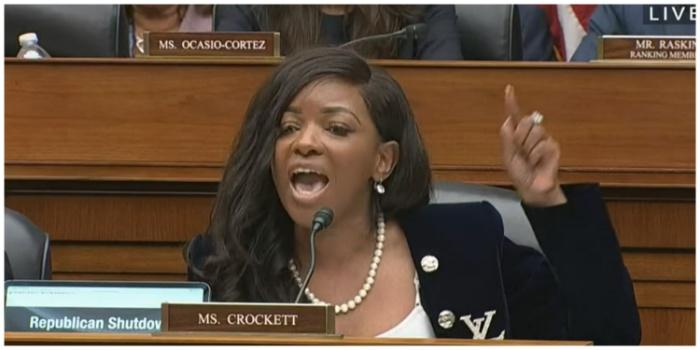
(Jacob Bruns, Headline USA) Hysterics broke out in a U.S. House of Representatives hearing as lawmakers began to insult each other’s appearances, culminating in a trashy tirade against Rep. Marjorie Taylor Greene, R-Ga., NBC News reported.

Rather than letting tempers subside, however, Rep. Jasmine Crockett, D-Texas, and fellow Democrats doubled down afterward by editing the disgraceful exchange into a “diss track” that went viral online for all the wrong reasons.

The House Oversight Committee was meeting in order to discuss whether Attorney General Merrick Garland ought to be held in contempt of Congress—due specifically to the Justice Department’s refusal to turn over relevant evidence related to the special counsel investigation into President Joe Biden’s mishandling of classified documents and, more broadly, the possible collusion with prosecutors waging lawfare campaigns against former President Donald Trump.

In a defiant video Thursday, Garland set the tone for the contentious hearing by suggesting that the DOJ was above the law since it is the agency tasked with enforcing any criminal referrals or subpoenas sent from Congress.

Apart from the power of the purse strings, elected officials have few other leverage options, while the corrupt Justice Department has proven that it can undermine even the most powerful lawmakers through blackmail and coercion.

Nonetheless, as investigative journalist Julie Kelly observed, the Biden administration may have undermined its own position in trying to assert “executive privilege” over the recorded interview between the president and special counsel Robert Hur.

Several Biden judges previously rejected Trump’s efforts to assert a similar claim of executive privilege while investigating the Jan. 6 uprising.

In short, Democrats found themselves trapped in a corner, snared by their own tactics, and sought to lash out accordingly in order to distract the public from the serious nature of the charges against Garland—whose contempt measure the panel ultimately voted to advance.

The hearing nearly went off the rails, however, when Greene suggested that Crockett was struggling to read a statement because of her fashion choices.

“I think your fake eyelashes are messing up what you’re reading,” Greene stated.

Greene’s comment triggered Rep. Alexandria Ocasio–Cortez, D-N.Y., causing her to demand an apology.

“That is absolutely unacceptable,” Ocasio–Cortez said. “How dare you attack the physical appearance of another person?”

The exchange devolved into an exchange of insults, culminating in Greene telling AOC that she does not “have enough intelligence” to engage in a real debate with her.

Still, Greene eventually agreed to strike her comment about Crockett while refusing to apologize. “You will never get an apology out of me.”

Things appeared to be settling down, but Crockett decided to create further tension, later passive-aggressively referring to Greene as a “bleach blond, bad-built butch body.”

Rep. Jared Moskowitz, D-Fla., first tweeted out the remixed “diss track” version, which he labeled “Oversight after Dark.”

Crockett then dubbed the new music duo Jared and Jazz, comparing them with Kendrick Lamar.

However, some Twitter users were less taken, slamming the Texas Democrat as a “disgrace” and “Ghetto Barbie.”

Oversight Committee chairman James Comer, R-Ky., told the panel on Thursday that he did not understand the exchange due to his hearing problems.

“I have two hearing aids. I’m very deaf,” he said. “I’m not understanding—everybody’s yelling. I’m doing the best I can.”

After a recess, the committee voted 24-20 along party lines in favor of recommending that AG Garland be held in contempt.

The motion will now go to House Speaker Mike Johnson, R-La., who will bring the resolution before the full House in the near future.

Afghanistan 2.0? Rep. Gaetz Demands Answers about U.S. Withdrawal from Chad

(Ken Silva, Headline USA) The Pentagon’s impending withdrawal from Niger is starting to capture the attention of conservative media, due in large part to U.S. Army revelations about water and medicine shortages for troops there.

Meanwhile, Defense Department officials are also working to get out of another African country, Chad. And like in Niger, Rep. Matt Gaetz, R-Fla., is raising concerns about a lack of transparency and an apparent lack of plan for executing a safe withdrawal.

Gaetz wrote to Defense Secretary Lloyd Austin on Friday, seeking answers about reports he’s seen in the media.  The New York Times reported on April 24 that the DoD would be removing roughly 75 Green Berets from N’djamena, Chad, after the country’s government demanded they leave. Then, on May 1, CNN reported that half the U.S. service members stationed at a French military base in Chad have been relocated to Germany.

Gaetz asked Austin seven questions about Chad, including what’s his plans for a safe withdrawal, whether the Pentagon will leave equipment there—as it did in Afghanistan in 2021—and whether the U.S. will charge Chad for any assets left in the country.

Gaetz also asked if any other African countries are set to expel the U.S.

Additionally, Gaetz wanted to know more about reports of Russian troops cohabitating in a Niger air base with Americans.

“Given that you have confirmed the presence of Russian troops at Airbase 101 in Niger, which houses U.S. troops, are there any Russian, Chinese, or any non-friendly forces cohabitating or sharing battle space with U.S. forces on military bases in Chad or anywhere else in Africa? If so, list the bases and the number of adversarial troops on base,” Gaetz told Austin.

The Pentagon’s impending withdrawal from Niger and Chad stems from the countries’ new governments declaring that the U.S. military presence there is illegal. In a letter published last month by the Post, an Army whistleblower accused Biden of endangering the troops’ lives by leaving them in Niger against the wishes of the country’s new government.

The withdrawal from Niger means the U.S. will presumably have to close its six-year-old, $110 million U.S. air base that was used for drone warfare.

Ken Silva is a staff writer at Headline USA. Follow him at twitter.com/jd_cashless.

DOJ Treating Satanic Cult ‘764’ Like a Criminal Gang

(Ken Silva, Headline USA) The U.S. legal system typically limits prosecutors from mentioning a defendant’s ideological beliefs or affiliations, so as not to prejudice a jury.

But in the case of Richard “Rabid” Densmore—who faces charges of aiding and abetting the sexual exploitation of a child, conspiring to sexually exploit a child, coercion and enticement, and possession of child pornography—his affiliation with the Satanic cult 764 is a key piece of evidence that a jury needs to know, according to the Justice Department.

Accordingly, the DOJ said this week that it intends to have FBI agent Jason Hall testify about the 764’s history, Densmore’s affiliation with 764, and what Densmore did as a member of that group.

The DOJ has explained in court filings that “764” is an offshoot of the Order of the Nine Angles, or O9A—a neo-Nazi accelerationist group involved in multiple terrorist plots. According to the Justice Department and others, O9A has a terroristic goal in mind: to corrupt the youth, which will accelerate the collapse of Western society.

The reason Densmore’s affiliation with 764 is so important, the DOJ said, is to prevent him from claiming that he accidentally or unknowingly possessed child porn. Citing analogous gang affiliation cases, the DOJ argued in its brief that jurors are entitled to see that Densmore was not pretending and was not 764 in name only.

“This case takes place in the 764 universe … Densmore exploited minors and sought exploitative material as reputational currency to gain notoriety within communities that prize such content. Densmore did not work alone; rather, he conspired with and aided and abetted another member of his 764- affiliated Discord server to sexually exploit, and coerce and entice, a minor,” the DOJ said in a filing Monday.

“Without the critical contextual evidence of Densmore’s affiliation with groups that deliberately target children for CSAM and self-harm content, the jury will be misled into believing—including based on Densmore’s self-serving statements that he is not a pedophile—that Densmore did not intend to obtain sexually explicit material from Victim 1 or that he did not knowingly and intentionally possess child pornography,” the DOJ added.

“In this way, Densmore’s group affiliation is both a prelude to and completes the story of the charged offenses.”

The DOJ said it intends to introduce some graphic evidence, including images of young girls who cut “764,” “Sewer” and “Rabid”—the latter two names referring to Densmore’s online chatroom and his nickname, respectively—into their skin. While the defense may argue that such evidence is inflammatory and prejudicial, the prosecutors reiterated that it’s necessary to prove their case against Densmore.

“These images are necessary to prove the sincerity of Densmore’s 764 affiliation; to correct any confusion that the jury may have about whether Densmore was playacting, role playing—common in these online communities—or somehow skirting the edges of 764 activity,” the DOJ said Monday.

“The jury should know that Densmore was an adherent who followed 764’s aims of victimizing children through the specific means of obtaining [child porn] and self-harm content.”

Densmore is set to stand trial on August 5.

The FBI initially executed a search warrant on his home in February 2023, finding child porn and other material related to the 764 cult.

For some reason, Densmore was a free man for another 11 months.

Then, after he was arrested on Jan. 29, a judge let him loose on bail. Densmore’s bail was revoked after the DOJ filed an emergency motion about the matter.

At first, he agreed in March to plead guilty to one count of sexual exploitation of a minor in a deal with the DOJ. But sometime over the next few weeks, he apparently changed his mind, and his lawyer withdrew from the case in early April.

Other 764 Cases

Densmore is one of a slew of O9A- and 764-affiliated Satanists to be prosecuted in recent months.

The government’s crackdown on the above-mentioned Satanic pedophile groups started in November 2021, when the FBI arrested 764 member Angel Almeida. Details of Almeida’s 764 activities weren’t made public until records about his case were unsealed late last year.

More recently, the Justice Department filed charges in December against another 764 member, Kalana Limkin, for allegedly promoting child pornography, sexual extortion, and trafficking, animal cruelty and self-harm of minors.

Additionally, U.S. Marshals arrested 764 member Kyle Spitze in February on child porn charges. Spitze’s disturbing story can be read here.

Also in February, Canadian police announced the arrest of a 14-year-old male who was affiliated with 764.

Ken Silva is a staff writer at Headline USA. Follow him at twitter.com/jd_cashless.

The Gold and Silver Ship Will Set Sail!

(Mike Maharrey, Money Metals News Service) Over the last couple of months, gold has scaled record highs, peaking at over $2,430 an ounce before correcting and settling in the $2,300 range. 

That’s a healthy gain. But you could argue that gold remains significantly underpriced given the inflation we’ve experienced that continues to rapidly devalue the dollar.

That leaves many people wondering when gold is really going to break out.

It’s impossible to predict the timing of such things, but as Metals Specialist Garth Patchen put it, “It will leave the port-of-call at some point.”

“And like Noah’s Ark of old, those who miss the boat will face a catastrophe.”

The thing is there are only so many seats on board, and prices are relatively cheap at present.  

Do you really want to wait until the final hour?

Patchen paints a vivid word picture.

Imagine the masses trying to clamor aboard at the last minute, in the last hours before the doors close.

Unfortunately, their flimsy financial “life preservers” (fiat dollar-denominated assets) won’t be adequate. They’re not going to float in the tempest to come.

Imagine trying to bail out of stocks when they’re dropping like a rock in an effort to salvage something close to your original investment (principal).

Imagine trying to get your cash out of the bank when “capital controls” are instituted, and you can only pull out $3,000 per day or less — or none.

Imagine trying to purchase physical gold and silver at much, much higher prices.

Imagine the FOMO (Fear of Missing Out).

Imagine the fearful, stressful rush to find safety in the face of an oncoming disaster.

Imagine if you can, how sweet the sleep is of those who have prepared ahead of time for any eventuality.

And the worst scenario?

Imagine missing the boat altogether.

Patchen sums it up this way:

“We implore you to think like a squirrel, prepare for winter like a bear, maybe even migrate like geese, and duck for cover while you can. Every day, Money Metals Exchange assists its customers in preparing for the financial storms that are on the horizon — for the bleak winter(s) ahead. When your capital assets are safe and secure, in the form of physical gold and silver, you will rest a lot easier.  They are one component of preparing for any eventuality. There is a lifeboat with open seats awaiting you right now.  What are you waiting on?” 


Mike Maharrey is a journalist and market analyst for MoneyMetals.com with over a decade of experience in precious metals. He holds a BS in accounting from the University of Kentucky and a BA in journalism from the University of South Florida.

Several States Take Steps to Block a Central Bank Digital Currency

(Mike Maharrey, Money Metals News Service) Several states have taken action over the last two years in an effort to block the implementation of a central bank digital currency (CBDC) in the United States.

Indiana was the first state to pass legislation relating to central bank digital currency. Enacted in 2023, the law explicitly excludes a CBDC from the definition of money under the state’s Uniform Commercial Code (UCC). The law amends the definition of money to specify, “The term does not include a central bank digital currency that is currently adopted, or that may be adopted, by the United States government, a foreign government, a foreign reserve, or a foreign sanctioned central bank.”


A similar law was enacted in Florida last year, and this year South Dakota, Tennessee, and Utah followed suit. A Nebraska bill repealing the capital gains tax on gold and silver also changed the definition of money in the state tax code to exclude CBDC.

This year, Indiana took a second step to hinder the implementation of a CBDC with the enactment of a measure prohibiting state agencies from accepting payments made with a central bank digital currency for any service, tax, license, permit, fee, information, or other amount due the governmental body. It also bars government agencies from requiring payments to be made with a central bank digital currency.

Additionally, under the law, state government bodies are prohibited from advocating for or supporting the testing, adoption, or implementation of a central bank digital currency by the United States government.

Alabama, North Dakota, and Georgia have passed similar laws. 

Impact

It remains unclear how changing the definition of money in the UCC and other steps taken at the state level would play out in practice against a CBDC if the federal government attempts to implement one.

The UCC is a set of uniformly adopted state laws governing commercial transactions in the U.S. According to the Uniform Law Commission, “Because the UCC has been universally adopted, businesses can enter into contracts with confidence that the terms will be enforced in the same way by the courts of every American jurisdiction. The resulting certainty of business relationships allows businesses to grow and the American economy to thrive. For this reason, the UCC has been called ‘the backbone of American commerce.’”

Passage of this legislation would, as noted by one opponent of the legislation, put a CBDC “into the bucket of ‘general intangibles” – rather than money, and wouldn’t ban its use completely.

But it could still potentially gum up the works and make it difficult for the government to fully implement a CBDC.

Opponents of the strategy and supporters of CBDC generally take the position that states can’t do anything to stop a CBDC, since – according to their view – under the supremacy clause “any federal law on this point will automatically override state law.”

We’ve heard this song and dance on other issues before. That’s what they said when California legalized medical marijuana in 1996. It didn’t quite turn out that way.

In the ramp-up to the 1996 vote on Proposition 215, voters were repeatedly told that legalization of marijuana, even for limited medical purposes, was a fruitless effort, since, under the supremacy clause, any such state law would be automatically overridden by the Controlled Substances Act of 1970 (CSA). At best, opponents told Californians, the state would end up in a costly, and losing court effort.

But despite those warnings, Californians voted yes, setting in motion the massive state-level movement we see today, where a growing majority of states have legalized what the federal government prohibits. Ultimately, the federal government will likely have to back down, even if just to save face, because it has become impossible to fully enforce its federal prohibition over this massive state and individual resistance.

A similar scenario played out in response to the REAL ID Act of 2005. The national ID system still isn’t fully up and running more than 17 years after the “final deadline” for full implementation.

Why not?

Because a significant number of states decided not to participate, drug their feet, or in some cases, simply provide residents with a choice to opt-out. Federal officials have confirmed that state-level roadblocks to implementation are the primary reason for the continuing delays.

“Roadblock” is likely how this and other state-based strategies to oppose a CBDC will play out. This is part of James Madison’s four-step blueprint for how states can stop federal programs.

But, as can be seen so far with issues like marijuana and the REAL ID Act, whether a federal program is implemented or not ultimately gets down to the number of roadblocks put up by states, and more importantly, the willingness of the people to participate, or not.

What Is CBDC?

Generally speaking, digital currencies are virtual banknotes or coins held in a digital wallet on a computer or smartphone. The difference between a central bank (government-imposed) digital currency and peer-to-peer electronic currencies such as Bitcoin and Ethereum is the value of CBDC is backed and controlled by the government, just like traditional fiat currency.

Governments sell the idea of CBDC by promising to provide a safe, convenient, and more secure alternative to physical cash. We’re also told it will help stop dangerous criminals who like the intractability of cash. But there is a darker side – the promise of control.

At the root of the move toward government digital currency is “the war on cash.” The elimination of cash creates the potential for the government to track and even control consumer spending.

Imagine that all cash disappeared this morning and all that was left was a government-controlled digital currency. You would be forced into doing all business electronically with this government money. It would be impossible to hide even the smallest transaction from the government’s eyes. Something as simple as your morning trip to Dunkin would be known by government functionaries. As Bloomberg put it in an article published when China launched a digital yuan pilot program in 2020, digital currency “offers China’s authorities a degree of control never possible with physical money.”

Governments could even “turn off” your ability to make purchases. Bloomberg described the level of control a digital currency could give Chinese officials.

The PBOC (People’s Bank of China) has also indicated that it could put limits on the sizes of some transactions, or even require an appointment to make large ones. Some observers wonder whether payments could be linked to the emerging social-credit system, wherein citizens with exemplary behavior are ‘whitelisted’ for privileges, while those with criminal and other infractions find themselves left out. ‘China’s goal is not to make payments more convenient but to replace cash, so it can keep closer tabs on people than it already does,’ argues Aaron Brown, a crypto investor who writes for Bloomberg Opinion.

Economist Thorsten Polleit explained the level of Big Brother-like government control possible with the advent of a digital euro in an article published by the Mises Wire.

As he put it, “The path to becoming a surveillance state regime will accelerate considerably” if and when governments begin issuing CBDC.

In 2022, the Federal Reserve released a “discussion paper” examining the pros and cons of a potential U.S. central bank digital dollar. According to the central bank’s website, there has been no decision on implementing a digital currency, but this pilot program reveals the idea is further along than most people realized.

The Tenth Amendment Center contributed to this report.


Mike Maharrey is a journalist and market analyst for MoneyMetals.com with over a decade of experience in precious metals. He holds a BS in accounting from the University of Kentucky and a BA in journalism from the University of South Florida.

16 Dems Side with GOP in Condemning Biden’s Aid Blockade to Israel

(Luis Cornelio, Headline USA) The House of Representatives passed legislation Thursday to block President Joe Biden from controversially withholding U.S. aid from Israel as it confronts Gaza.

Notably, the bill received the surprising support of 16 Democrats.

The legislation, named the Israel Security Assistance Support Act, was prompted by Biden’s decision to block congressionally approved U.S. aid to the Jewish state earlier this month.

This action is seen by some as potentially constituting an impeachable offense, drawing parallels to the Democratic precedent set during the 2020 impeachment of former President Donald Trump. 

In a tweet from 2019, Biden himself criticized Trump for allegedly withholding “Congressionally appropriated aid” to Ukraine in exchange for political favors, calling for his impeachment.

Biden’s decision to withhold aid coincided with mounting political concerns about a potential Israeli invasion of Rafah. 

Rafah is the southern city in Gaza where a majority of Palestinians sought refuge after a military operation launched by the Jewish state following Hamas’s Oct. 27 terrorist attack, aimed at rescuing hostages and cracking down on terrorists. 

Following the initial move of several Democrats who wrote a letter to the White House urging the expedited shipment of U.S. aid to Israel, a notable number of them later crossed the aisle to support the Republican-led Israel Security Assistance Support Act. 

The bill mandates the prompt delivery of approved defense aid to Israel, condemns the Biden administration’s blockade of aid, reaffirms Israel’s right to self-defense against Hamas and requires the federal government to issue detailed reports on any future blockage of aid. 

The 16 Democrats who voted for the bill include Reps. Matt Cartwright, Pa.; Angie Craig, Minn.; Henry Cuellar, Texas; Don Davis, N.C.; Lois Frankel, Fla.; Jared Golden, Maine; Josh Gottheimer, N.J.; Greg Landsman, Ohio; Jared Moskowitz, Fla.; Frank Pallone, N.J.; Mary Sattler Peltola, Alaska; Marie Gluesenkamp Perez, Wash.; David Scott, Ga.; Darren Soto, Fla.; Thomas Suozzi, N.Y.; and Ritchie Torres, N.Y. 

Biden has stated his intention to veto such a bill if it reaches his desk. Consequently, Senate Majority Leader Chuck Schumer, D-N.Y., has indicated that he will not bring the bill to the Senate floor.

House Speaker Mike Johnson, R-La., called out both Schumer and Biden’s threats against the bipartisan legislation:

Indicted Sen. Menendez Blames Cancer-Stricken Wife for Bribery

(Luis Cornelio, Headline USA) Sen. Bob Menendez, D-N.J., has attributed the alleged illegal acts at the center of his federal criminal indictment to his cancer-stricken wife, Nadine Menendez.

During opening statements in his federal trial, the senator’s defense team told the jury that Menendez was blindsided by his wife regarding the gold bars and cash allegedly found in his closet.

This defense strategy was revealed a day before Nadine Menendez announced that she is suffering from Grade 3 breast cancer, which will require a mastectomy. 

Initially, Nadine Menendez was scheduled to face trial alongside her husband but was separated from the proceedings due to her medical condition. Her trial is now set for July. 

“We are of course, concerned about the seriousness and advanced stage of the disease. She will require follow up surgery and possibly radiation treatment,” Bob Menendez wrote in a press release on Thursday. 

“We hope and pray for the best results,” he added. “We ask the press and the public to give her the time, space and privacy to deal with this challenging health condition as she undergoes surgery and recovery.” 

It is not immediately clear whether blaming his wife is part of a broader strategy to convince the jury that both are innocent of the 18 charges, which include accepting bribes, acting as a foreign agent and obstruction of justice. 

Federal prosecutors claim that Nadine Menendez served as the intermediary for the bribes, which allegedly came from Egypt and Qatar. 

According to the liberal New York Times, Bob Menendez’s defense attorney, Avi Weitzman, told the jury that his client was unaware of “what she was asking others to give her,” and that he “did not know the gold bars that existed in that closet.” 

The charges against the Menendez duo include receiving gold and cash in exchange for favorable policies for Egypt and Qatar, amounting to several hundreds of thousands of dollars. 

Dem. Congressional Candidate Paid Thousands to Commie Chinese Agent

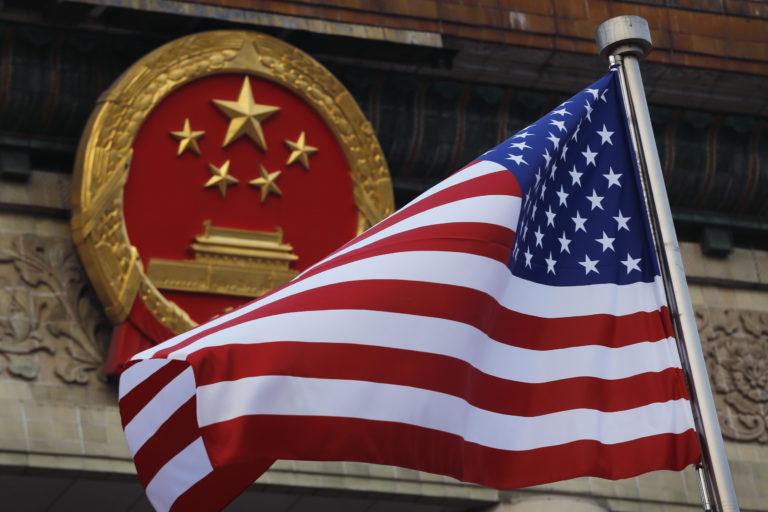
(Dmytro “Henry” Aleksandrov, Headline USA) Federal Election Commission records indicated that a Democrat running for Congress in California’s Silicon Valley paid a Chinese foreign agent for advertising.

Evan Low, a California assemblyman who is running for Congress in the state’s 16th Congressional District, paid approximately $5,000 to Sing Tao Newspapers for print advertisements in February 2024, an FEC filing revealed.

In 2021, the Department of Justice ordered Sing Tao U.S., a Chinese-owned newspaper that distributes papers in California, to register under the Foreign Agents Registration Act (FARA).

In China, Sing Tao’s coverage has been characterized as pro-Chinese Communist Party (CCP), with the paper publishing an editorial, in which it argued that police should curb the demonstrations during the 2014 anti-government protests in Hong Kong by using a “gunpowder keg,” the Daily Caller reported.

Radio Free Asia, a U.S.-government-funded news outlet, also reported that sources familiar with Chinese media have linked Sing Tao to the CCP. It was also found by Radio Free Asia that two of the company’s directors had served on the Chinese People’s Political Consultative Conference, which serves as an advisory body to China’s National People’s Congress.

Additionally, at least five of Sing Tao’s seven board members belong to organizations that are part of the CCP’s “united front” political influence network, the Caller reported.

The newspaper previously disputed its status as a foreign agent, with Robin Mui, Sing Tao U.S. CEO, saying the news corporation had to register due to an investor’s involvement in the Chinese realty business.

“Sing Tao is a major news outlet for Chinese speakers in the Bay Area,” a spokesperson for the Low campaign said in a statement to the Caller.

The Chinese consulate also said that, in 2017, Low met with the consul general of the Chinese Consulate General in San Francisco while serving as an assemblyman. During the meeting, they discussed strengthening communication between the Chinese government at the California State Assembly and promoting cooperation between California and China.

Study: More than 1 in 4 Non-Citizens May Be Registered to Vote in 2024 Election

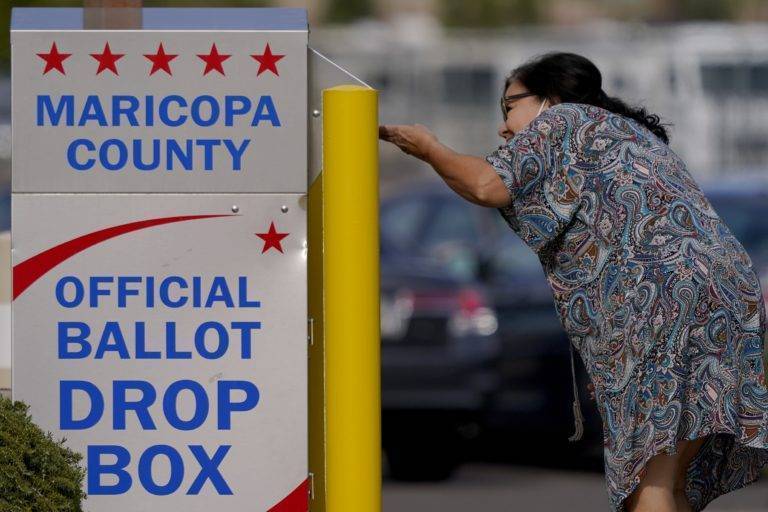
(Dmytro “Henry” Aleksandrov, Headline USA) A new study discovered that many non-citizens have registered to vote in America’s elections, which could radically change the outcomes of the 2024 election.

The study by Just Facts was based on the latest available data and an enhanced version of a stress-tested methodology from a scholarly journal, Slay News reported.

About 10% to 27% of non-citizen adults who are living in the United States are now illegally registered to vote, researchers found.

During 2022, more than 19 million adult non-citizens living in the country were recorded by the U.S. Census and, given their voter registration rates, this means that about two million to five million of them are illegally registered to vote.

These figures are potentially high enough to change the outcomes of major elections, including congressional seats and the presidency.

The study also found that “roughly one-quarter of non-citizens” in the U.S. “were likely registered to vote,” “6.4% of non-citizens actually voted,” 81.8% of them “reported voting for Barack Obama” and illegal votes cast by non-citizens “likely” changed “important election outcomes” in favor of Democrats, “including Electoral College votes” and a “pivotal” U.S. Senate race that enabled Democrats to pass Obamacare.

Just Facts then conducted a comparable study that used the same datasets, a more straightforward methodology and related studies to constrain assumptions and, as a result, it was discovered that roughly 27% of non-citizens were registered to vote and about 16% of them voted in the 2008 national elections.

These results raised serious concerns about how these non-citizens would influence the results of the 2024 election. The news source reported that about 5% to 13%, or roughly 1.0 million to 2.7 million, of non-citizens will illegally vote in the 2024 presidential and congressional elections unless stronger election integrity measures are implemented.

To prevent illegal voting by non-citizens, Republicans in Congress recently introduced a 22-page bill to “require proof of United States citizenship” to register to vote in federal elections, the news source reported.

NYC Artist Mocks Alvin Bragg w/ Hilarious Balloon Stunt: ‘D***heads!’

(Luis Cornelio, Headline USA) A New York City artist has comically trolled the prosecutor leading the criminal charges against former President Donald Trump for allegedly falsifying business records. 

Scott LoBaido, a self-described patriot and artist, appeared at the Manhattan courthouse where Trump is facing trial, releasing 100,000 pink, penis-shaped balloons featuring the faces of Manhattan District Attorney Alvin Bragg.

The balloons also featured Special Counsel Jack Smith and Manhattan judges Juan Merchan, who presides over the business records case and Arthur Engoron, who oversaw a civil lawsuit against Trump by the New York attorney general.

LoBaido launched the balloons as part of his “The Diks of Hazard” art installation, which he announced on his Instagram and Twitter pages, where he boasts over 368,000 followers. 

“Dik! Dik! Dik!” he exclaimed in a video posted on social media, displaying balloons with the faces of Bragg, Smith and the judges. “Bunch of f**king dicks!”

The video also captures the moment LoBaido parks a U-Haul rental truck in front of the courthouse. 

He then steps out, opens the truck’s rear door, and releases the balloons, many of which begin to flood the courthouse’s exterior.

Members of the NYPD asked LoBaido to move the vehicle away from the courthouse. “Sir you gotta move the car,” an officer said. LoBaido ignored the request, continuing to release more balloons. 

In the aftermath, LoBaido said, “As a New Yorker, this is how we talk.” 

According to the New York Post, the art show cost roughly $1,500 and took him 48 hours to attach the faces of the prosecutors and judges to the balloons.

LoBaido’s actions were fueled by his belief that Bragg, Smith, Engoron and Merchan aimed to destroy the former president and the “Constitution.” 

Smith was appointed by Democrat Attorney General Merrick Garland to investigate Trump over the January 6 events and documents found at Mar-a-Lago. 

Bragg, a far-left prosecutor, ran for office with the promise to indict Trump if elected. 

Merchan is presiding over the case led by Bragg, while Engoron presided over the case filed by New York Attorney General Letitia James, a Democrat, against the Trump Organization and the former president.