FBI Sting Nabs 21-Year-Old Schizophrenic Who Talked to Undercover Agent for 5 Years

(Ken Silva, Headline USA) The FBI arrested last week a 21-year-old alleged terrorist for trying to fight with ISIS in Africa.

But the criminal complaint filed against the alleged terrorist, Michael Sam Teekaye Jr., reveal that he’s a severely mentally ill person who’s been talking to an undercover FBI agent since he was 16.

According to the Oct. 15 criminal complaint, Teekaye came on the FBI’s radar shortly after September 2019, when he “admitted he wanted to cut the head off of [a fellow student] and kill him.”  Teekaye was subject to an emergency mental health petition at the time.

The FBI learned of Teekaye about three months later, when agents learned that he was “expressing extremist Islamist ideology” online.

“Shortly thereafter, TEEKAYE began interacting with a male Online Covert Employee (“OCE”),” the criminal complaint said.

In January 2020, the FBI spoke with Teekaye’s parents and searched his laptop. Teekaye was then subject of another emergency petition and was hospitalized at the Psychiatric Institute of Washington. FBI agents interviewed him again a month later—he’s still only 16 at the time—and he told him he wanted “to go overseas as a fighter had waned, and he felt he was being used by people online,” the complaint said.

“He also said that because the FBI was watching him, he would not have a chance to pursue efforts to fight overseas,” the complaint added.

Teekaye’s since been diagnosed with early onset schizophrenia and a slew of other disorders.

Fast forward more than two years, and Teekaye was arrested for brandishing a knife outside of a school. He pleaded guilty to a misdemeanor charge of disorderly conduct, and was given Probation Before Judgment and placed on supervised probation until September 2025.

In March 2023, Teekaye again communicated with an undercover agent online about Islamic terrorism. In these conversations, he started mulling the idea of joining an ISIS affiliate in Africa, according to the criminal complaint.

“In WhatsApp conversations with the UCO on April 12-13, 2023, TEEKAYE clarified that ‘plan A’ is to go overseas, specifically West Africa, to conduct an attack. TEEKAYE stated that ‘plan B’ is to conduct an attack in the U.S., but it is ‘too risky anyways,’” the complaint said.

It appears as though the undercover agent was a female luring him with promises of a romantic relationship, and baiting him into a potential attack on Israelis. The two discussed marriage repeatedly, according to the FBI complaint, and at one point Teekaye accused the agent of “talking like you want to do an attack with me” when they were discussing Israel.

By early October of this year, Teekaye had obtained a visa and a plane ticket to travel to Turkey.

“On October 14, 2024, FBI agents observed TEEKAYE travel to BWI airport in a rideshare vehicle, check in for flight BA 228 bound for London, and proceed through the security checkpoint. TEEKAYE was arrested at approximately 5:59PM,” the complaint said.

“After being advised of his Miranda rights, TEEKAYE made the following unprovoked statements, among others: ‘I’ll just get out in 20 years and do something here. Okay? Okay? You will never stop me. Jihad will never stop,’” the complaint added.

“While making these statements, TEEKAYE began kicking one of the FBI arresting agents. He then stated that he hoped to ‘kill a guard’ while in prison.”

Teekaye had an initial appearance in Maryland federal court on Monday.

Teen Terrorism Stings

His arrest marked at least the sixth teenager arrested by the FBI over the last year-plus in highly dubious terrorism stings.

In July 2023, then-18-year-old  Davin Meyer was arrested as he was about to board an international flight—also out of Denver—allegedly to travel to the Middle East and fight for ISIS. Meyer’s mother, who originally approached law enforcement out of concern for her son, said that the FBI entrapped the boy.

Before Meyer was arrested in July 2023, the FBI announced in June that it arrested 18-year-old Mateo Ventura for intending to support ISIS. However, Ventura’s father, has also accused the FBI of entrapping his son.

Along with Meyer and Ventura, the FBI arrested a 17-year-old boy in August 2023 for supposedly plotting to carry out an ISIS-inspired terrorist attack on American soil.

More recently, the FBI arrested a teenager in December who was supposedly on his way from Denver to fight for ISIS in the Middle East. But like the others, the details of that case show that the teenager, 18-year-old Humzah Mashkoor, was targeted online since he was 16 by at least four undercover FBI agents. And moreover, Mashkoor suffers from mental illness and has high-functioning autism, according to his family.

And most recently, the FBI arrested 18-year-old Alexander Scott Mercurio in April on terrorism charges after targeting him for years in an investigation that involved at least three undercover informants and an undercover agent.
60 Minutes Denies ‘Deceitful’ Edit of Kamala Interview, but Refuses to Release Transcript

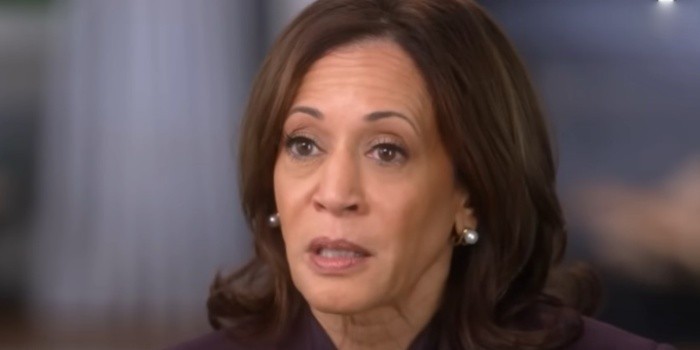
(Headline USA) CBS News’s 60 Minutes claimed this week that it did not edit its interview with Vice President Kamala Harris to make the Democratic candidate look better, but it nonetheless refused to release the full transcript of the interview with Harris to prove as much, CNN reported.

After coming under fire from former President Donald Trump’s campaign last week for airing two different answers from Harris to the same question, CBS released a statement on Sunday insisting its edit of Harris’s remarks was not meant to be “deceitful.”

“Former President Donald Trump is accusing 60 Minutes of deceitful editing of our Oct. 7 interview with Vice President Kamala Harris. That is false,” the statement began.

“60 Minutes gave an excerpt of our interview to ‘Face the Nation’ that used a longer section of her answer than that on 60 Minutes. Same question. Same answer. But a different portion of the response,” the outlet added.

CBS went on to claim that it edits its interviews with every politician in this way to make answers “more succinct.”

The Trump campaign, however, pointed out that 60 Minutes admitted “to doing exactly what President Trump accused them of doing. They edited in a different response—from another part of [Harris’s] answer—to make Kamala Harris sound less incoherent than she really was.”

Moreover, if 60 Minutes was really trying to act in an unbiased way, it would release the full transcript of its hourlong interview with Harris, the Trump campaign argued.

Other proponents of journalistic integrity pointed out that there were precedents—mostly during the Trump administration—of CBS News providing that level of transparency.

Meanwhile, critics have observed that while the network edited its interview with Harris to make her answer more coherent, it did the opposite in a recent interview with House Speaker Mike Johnson, R-La., for which CBS removed important context to make the answer nonsensical.

The controversy over Harris’s interview with 60 Minutes began after the show shared a promotional video of the interview on social media, showing Harris give a word-salad response to a question about the Biden administration’s response to the conflict in the Middle East.

When the interview aired in primetime, a shorter answer from Harris to that same question was shown instead.

CBS and 60 Minutes have not said whether they will ever make the full transcript of the Harris interview available to the public.

Major Shift Revealed as Western Investors Suddenly Run to Gold

(Jan Nieuwenhuijs, Money Metals News Service) In the past two years, the East has been responsible for a momentous move upward in the gold price, decoupling it from the West’s pricing model. But Western investors have taken back the baton and have been driving gold higher since June 2024.

Tellingly, Western investors are abandoning their old pricing model, too. Instead of participating in the gold market for speculative reasons, they are now buying gold as a safe haven. This is highly bullish because Wall Street has little exposure to gold.

Meanwhile, on a net basis, the East is not selling. In this tight market, the gold price is sharply rising: year-to-date, it’s up more than 30%.

Gold Prices Are Driven by the Marginal Buyer

What sets the price of gold is usually determined by global flows of gold from West to East or vice versa. It’s important to understand who the marginal buyer (price setter) actually is for several reasons.

Identifying the marginal buyer provides context to why the gold price goes up or down. Historically (for the past 100 years), Western institutional supply and demand have set the price, while the East lowered volatility by selling into bull markets or buying in bear markets.

As the East has recently shown, it can be a driving force in the gold market as well, and the reasons for doing so haven’t faded1. Were we to see continuous buying in two hemispheres at the same time, it would create a perfect storm in gold.

The Awakening of the East

During the upward move in gold from late 2022 until May 2024, it was clear to market observers this wasn’t driven by Exchange Traded Fund (ETF) buying, as ETF holdings declined over this period.

Neither was it caused by OTC buying in London or Switzerland, as both trading centers were net exporters. Before 2022, ETF inventories would swell, and the U.K. and Switzerland would be net importing when the gold price increased.

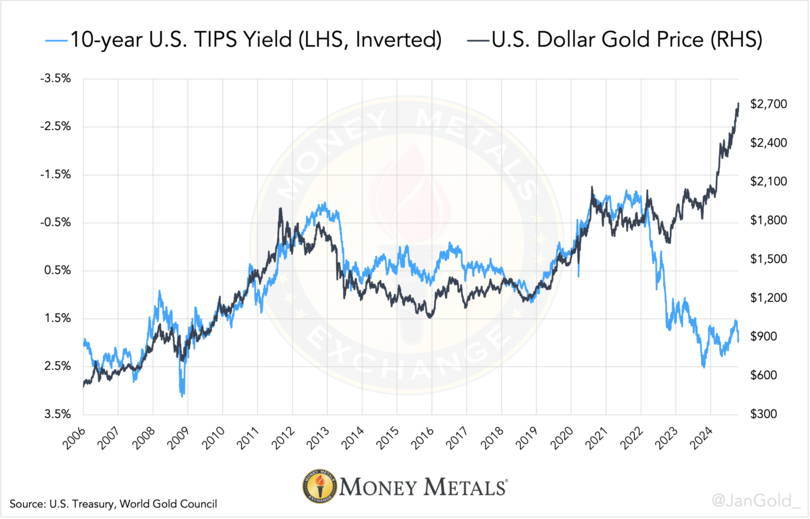
Something new was occurring as gold decoupled from the 10-year Treasury Inflation Protected Securities (TIPS) yield in 2022. Although this made little sense in the long run2, Western traders preferred the TIPS yield for pricing gold from 2006 through early 2022.

To a large extent, the Chinese and Saudi central banks—and to a lesser extent, the private sector in, for example, China, Thailand, and Turkey—were driving gold higher due to geopolitical tensions and deteriorating financial conditions.

From early 2022 until Q2 2024, central banks, in aggregate, bought 2,500 tonnes, of which, according to my research, the People’s Bank of China bought 1,600 tonnes, and its Saudi peer bought 160 tonnes (as explained here and here).

The East was in charge of the gold market during this period.

Western Investors Are Back Buying Gold

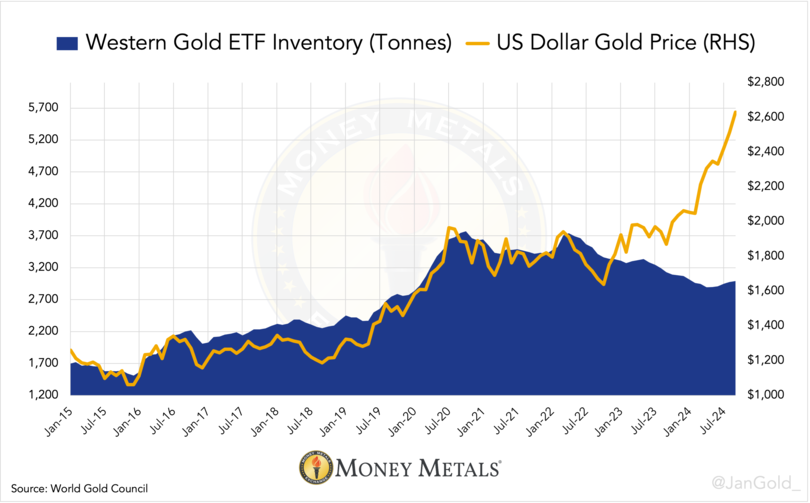
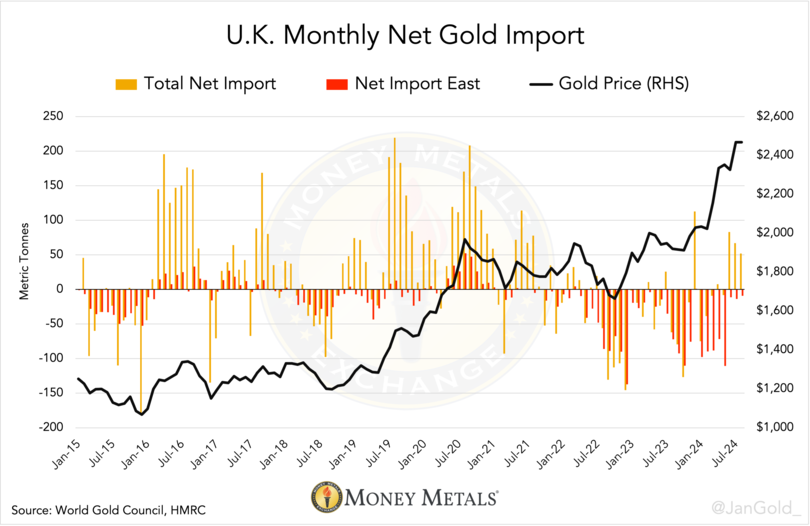
What happened since last June is that the gold price has been rising, gold ETF inventory has gone up, and the U.K.—home of the London Bullion Market—has turned into a net importer.

Chart 1. Monthly Western gold ETF holdings. ETF holdings by the rest of the world are only 6% of total gold ETF holdings. Money Metals Exchange.

Chart 1. Monthly Western gold ETF holdings. ETF holdings by the rest of the world are only 6% of total gold ETF holdings.

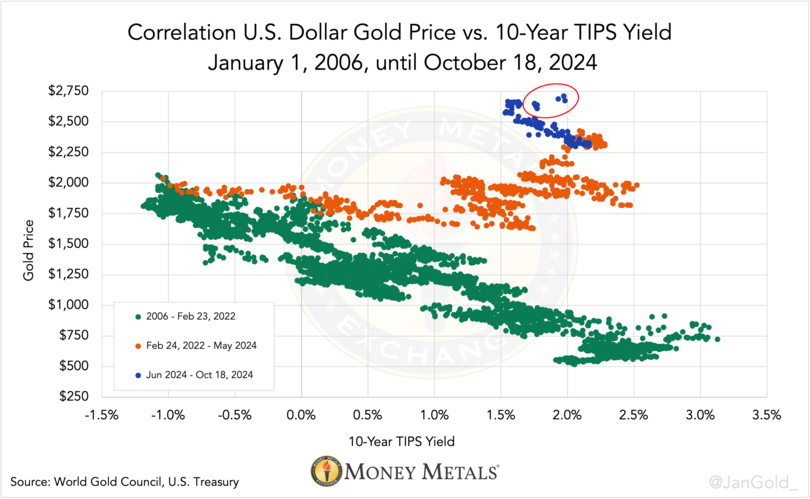
In addition, the gold price was correlated to the TIPS yield again for more than four months. But starting this month, this correlation is now breaking down while the West continues to be the driving force for higher prices.

Chart 2. TIPS yield versus gold price up until October 18, 2024. Money Metals Exchange.

Chart 2. TIPS yield versus gold price up until October 18, 2024.

Chart 3. Since June, the blue dots were forming a new diagonal cloud, reaffirming the old TIPS model at a higher price, though in October, the model is aborted (red oval). Money Metals Exchange.

Chart 3. Since June, the blue dots have been forming a new diagonal cloud, reaffirming the old TIPS model at a higher price, though in October, the model was aborted (red oval).

Meanwhile, gold demand in the East has moderated. The premium at the Shanghai Gold Exchange went negative starting in July (and still is), Chinese imports have declined in recent months, and the same goes for India.

Global indicators signal the West is back in charge of the market.

A Tight Gold Market

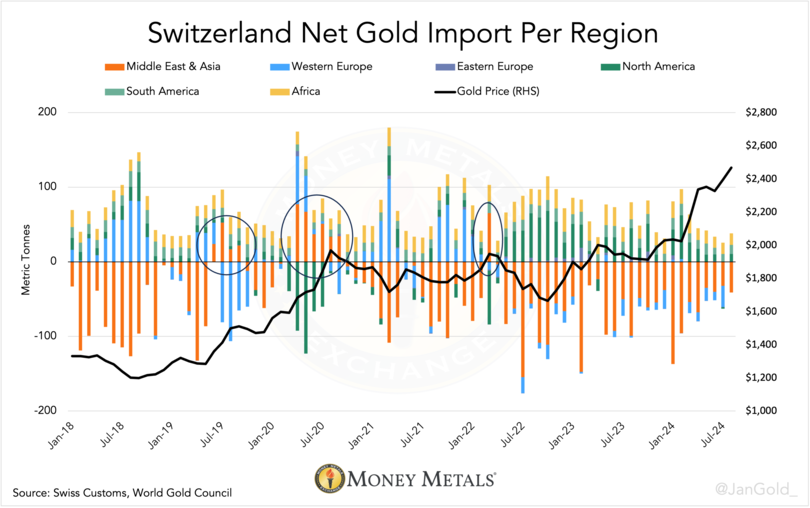
The gold market hasn’t entirely gone back to how it was before 2022. Dishoarding by the East to the world’s largest refining hub, Switzerland (as we saw before 2022 during rising gold prices) has not reoccurred since. My take is that the East is catching some breath in the most recent run-up, but it’s not done buying.

Chart 4. Net gold flows through Switzerland by region. Since Q2 2022, the East, on net, has not been dishoarding to Switzerland, despite higher prices. Money Metals Exchange.

Chart 4. Net gold flows through Switzerland by region. Since Q2 2022, the East, on net, has not been dishoarding to Switzerland, despite higher prices.

While the U.K., in total, has been a net importer of gold from June through August, causing the gold price to rise, there was a net outflow from Britain to countries in the Middle East and Asia over this time horizon.

Chart 5. Net gold import by the U.K. and its net flow with the East. Many ETFs store their physical gold in London. About 35% of the U.K.’s net flow can be ascribed to ETF hoarding and dishoarding, according to data by Goldchartsrus.com. Money Metals Exchange.

Chart 5. Net gold import by the U.K. and its net flow with the East. Many ETFs store their physical gold in London. About 35% of the U.K.’s net flow can be ascribed to ETF hoarding and dishoarding, according to data by Goldchartsrus.com.

Investors in the West buying gold amid a tight market makes the price rise fast.

Wall Street Is Buying Gold as Financial Insurance

Whenever the West pegs the gold price to the TIPS yield, it enters the market mostly for speculative reasons. Instead of aiming, e.g., for a gold allocation of 10%, speculators evaluate real rates (TIPS yield) and make a decision to go long or short the yellow metal. At the end of the day, these speculators only care about making profitable bets on price direction3.

Now, Western investors have shifted from this model, and the gold price is going up. It demonstrates they are changing their views on gold, i.e., from a speculative trade to financial insurance.

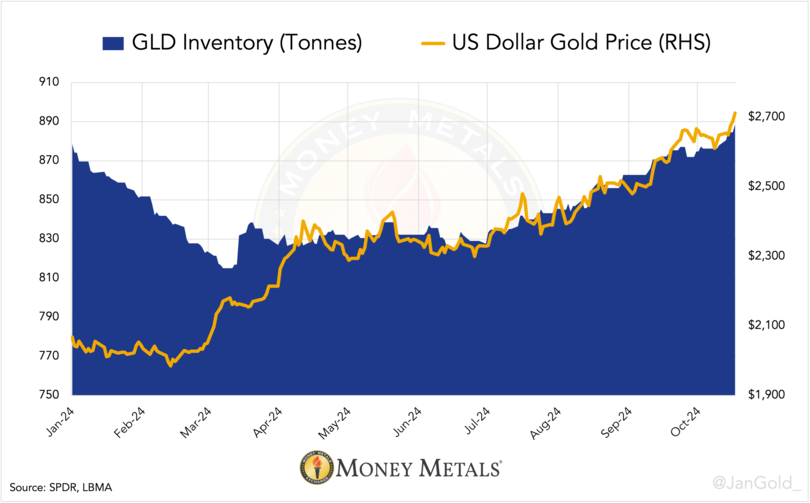
Chart 6. GLD inventory versus gold price up until October 18, 2024. Money Metals Exchange.

Chart 6. GLD inventory versus gold price up until October 18, 2024.

By using daily data from the largest gold ETF in the West (GLD) as a proxy for regional sentiment, we may conclude Western investors are still driving up gold. Note, this doesn’t mean Western investors all buy derivates such as ETFs; they buy gold outright as well.

Gold Outlook Remains Positive

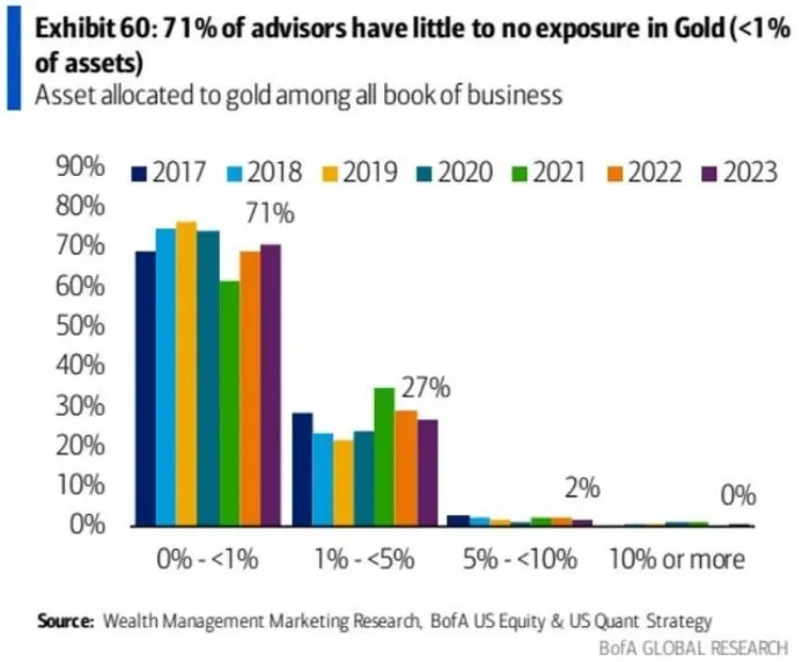
In 2023, a survey by Bank of America (BofA) indicated that 71% of U.S. investment advisors recommend a gold allocation between 0 and 1%, which is almost nothing.

What’s more, their recommendation hasn’t changed since 2017, even though consumer price inflation has since risen to multi-decade highs, two wars have broken out, the West froze $300 billion in Russia’s foreign exchange reserves, and U.S. fiscal policy has spiraled out of control.

These developments make financial instruments that have counterparty risk (and that can be printed infinitely) less popular, which supports the case of owning physical gold.

Chart 7. Courtesy of BofA. Money Metals Exchange.

Chart 7. Courtesy of BofA.

In a June 2024 survey among North American investors by the World Gold Council (WGC), some institutions that didn’t own any gold said one of their barriers was that “other large institutions are not investing in gold.” Wall Street is clearly underweight gold, and there is ample room for price upside when all entities board ship and allocate a substantial share of their portfolios to gold.

A few days ago, a strategist at BofA, ironically, said that gold looks to be the last “safe haven” asset standing, incentivizing traders, including central banks, to increase exposure because Treasurys face risks as U.S. debt levels soar.

“With lingering concerns over U.S. funding needs and their impact on the U.S. Treasury market, the yellow metal may become the ultimate perceived safe haven asset,” BofA wrote.

In conclusion, let’s focus on the main cause that drives gold by examining the long-term ratio between credit and gold.

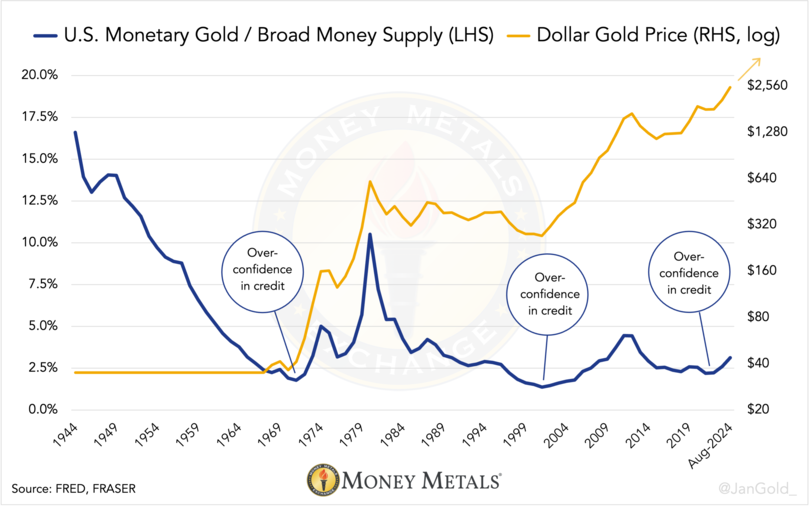
The rationale behind this approach is that when too much credit is created, the financial system becomes unstable, and the gold price needs to rise, adding more trust to the financial system and restoring stability.

Chart 8. U.S. official gold reserves are divided by the broad dollar money supply (M2). Money Metals Exchange.

Chart 8. U.S. official gold reserves are divided by the broad dollar money supply (M2).

In the past, every time the ratio between the value of the U.S. monetary gold and the dollar money supply reached a bottom—meaning an abundance of credit was created relative to gold owned by the government providing trustworthiness to its currency—a gold bull market followed.

Similar credit-gold ratios indicate we are in the first innings of a gold bull market. We will analyze these long-term ratios in depth in a forthcoming article.

Notes

  1. Geopolitical tensions (war and the weaponization of the dollar), high debt levels, lofty equity valuations, and currency debasement.
  2. To me, the TIPS model has always been illogical because it correlates a nominal price to an interest rate denominated in percentages one on one. Given that the total U.S. public debt, to which the TIPS yield applies, grows much faster than the above-ground gold supply, I don’t see how that model is sustainable.
  3. Kindly note the gold market is bigger than what is suggested above. The marginal buyer, now in London, sets the price at which the rest of the market (mine supply, jewelry and coin demand, etc.) clears. When gold is correlated to the TIPS yield, investors can be adding to their positions but not in size.

Why Are Long-Term Bond Yields Rising Despite Rate Cuts?

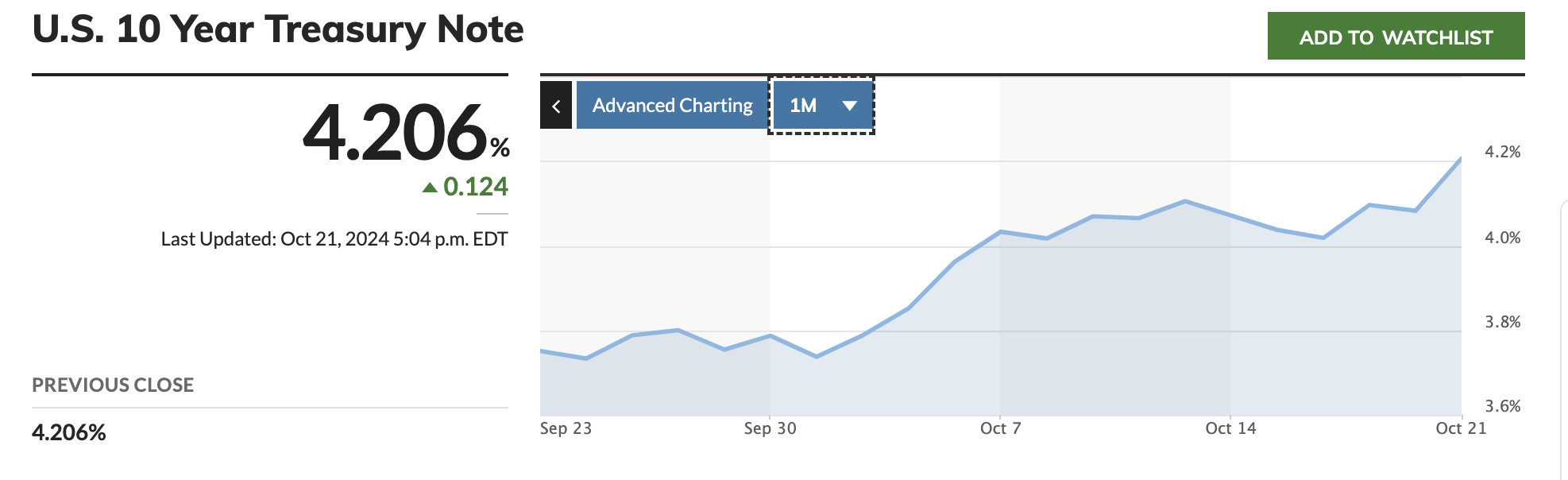
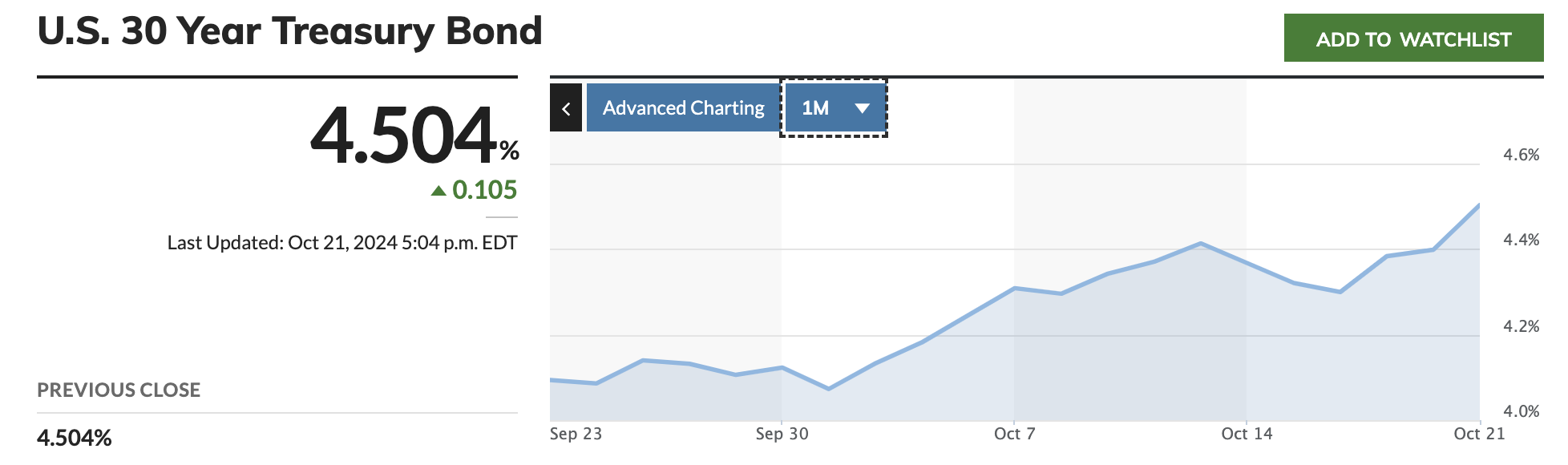
(Mike Maharrey, Money Metals News Service) Since the Federal Reserve enacted its supersized rate cut in mid-September, the yields on 10-year and 30-year Treasuries have spiked.

I don’t think that was the plan.

After all, the point of a rate cut is to lower interest rates, not raise them.

This reveals a dirty little secret: the Fed can manipulate short-term interest rates by dictate, but it doesn’t have the same kind of control over long-term rates.

And this is a big problem for the federal government as it struggles with rapidly increasing borrowing costs.

When the Fed announced its 50 basis-point rate cut, the yield on the 10-year Treasury was around 3.7 percent. On Monday (Oct. 21), the yield closed at 4.2 percent.

The 30-year yield was at 4 percent on the last day of the September Federal meeting. It has jumped to 4.5 percent on Monday.

This big jump in yields followed a temporary dip in rates after the Fed announced its rate cut.

It’s interesting to note that gold has continued to set new records despite the surge in bond yields. Historically, rising interest rates are a headwind for gold.

What’s Going on in the Bond Market?

Why have Treasury yields gone up even with the Federal Reserve trying to push interest rates lower?

The conventional wisdom is investors are now expecting the economy to be stronger moving forward. Therefore, the Fed may have to cut rates at a slower pace. This is certainly plausible, but given that the economy really isn’t all that strong (and a lot of that “strength” has been purchased with government borrowing and spending), it would behoove us to consider some other factors.

There are two other signals the bond market could be sending.

First, rising rates on the long end of the curve could indicate investors are worried about higher price inflation in the long term. When inflation expectations rise, investors demand higher returns on bonds in order to compensate for a depreciating dollar.

Second, rising bond yields could indicate sagging demand for U.S. debt.

Bond yields are inversely correlated with bond prices. When the demand for Treasuries softens, prices fall, and yields rise to entice more buyers into the market.

A Big Problem for the Federal Government

No matter what is causing it, rising bond yields are a big problem for Uncle Sam as he tries to finance the ever-growing federal budget deficits.

The federal government is already struggling with rapidly rising borrowing costs. The U.S. Treasury paid $1.13 trillion in interest expense in fiscal 2023. It was the first time interest expense has ever eclipsed $1 trillion.

Interest payments were up 28.6 percent over fiscal 2023 levels.

The U.S. government paid more in interest than it did for national defense ($882 billion) or Medicare ($874 billion). The only spending category larger than interest on the debt was Social Security ($1.46 trillion.)

I’m sure government people in Washington D.C. hoped the Fed’s pivot to rate cuts would relieve some of the interest pressure, but so far, that hasn’t happened.

It’s quite possible that the Fed won’t be able to lower federal borrowing costs with even with deeper interest rate cuts. As already mentioned, the central bank can move the short end of the rate curve, but it has a much harder time manipulating long-term rates. There are too many other contravening factors.

Ultimately, the federal government needs the Fed to step in and put its big fat thumb on the bond market. That would mean a return to quantitative easing (QE).

In QE operations, the central bank buys Treasuries on the open market. This increased (artificial) demand drives bond prices higher and puts downward pressure on yields. This would be an ideal scenario for the U.S. government. It needs all the help it can get to facilitate its borrow/spend addiction.

But the Fed runs QE operations with money created out of thin air. The new money gets injected into the monetary system and the economy. This is, by definition, inflation.

In other words, the Fed is between a rock and a hard place. It needs to get interest rates down for the Treasury (Fed officials claim they don’t care about the government’s fiscal issues, but I call BS.), but doing so runs the risk of reigniting price inflation, which isn’t exactly dead and buried.

Could We Be Heading for a Secular Bear Market in Bonds?

The rise of long-term Treasury yields in the face of interest rate cuts raises the specter of a long-term bear market in bonds.

This is exactly what analyst Jim Grant thinks is happening.

During an interview in the summer of 2023, Grant said he thought we were about to enter “a long cycle of rising interest rates” and a “generational” bear market in bonds.

“The great question of whether rates are mean or reverting? So, what characterizes interest rate movements is their generation length phasing, not necessarily cycles, but there are phases.

“Interest rates fell for the last quarter of the 19th century, rose for the first 20 years of the 20th, fell from 1920, ‘46 rose in ‘46 to ‘81, fell from ‘81 to, call it, 2021. So, at each juncture, there was some mark of excess, some mark of speculative excess blow-off.  Certainly, in 1981, you know, a 20 percent-plus funds rate seemed excessive. A 14 percent yield in 1984 in long bond when the CPI was printing at four or five that seemed excessive. 10 percentage points of real yield — that seemed a lot.

“So, I speculate that we are embarked on a long cycle of rising rates. And I say that first of all, for reasons of pattern recognition, there’s no theory behind it. But I observe that in 2020 and ‘21, some unimaginably large number of debt securities were priced to yield less than nothing. Bloomberg keeps this particular figure. And I bet still, perhaps you could check me on this, I bet still, there’s like a hundred billion of bonds priced to yield less than nothing worldwide. But there were $18 trillion, I think, at the peak.

“[It was] the most extraordinary expression of unqualified bullishness on an asset class because it had the name of ‘bonds’ which had been falling in yield, rising in price. So no, it would not surprise me at all if we were embarked on something resembling a generation-length bear market in bonds, meaning rising yields and falling prices that would fit the form.”

As already explained, a long-term bear market in bonds would be a disaster for the federal government.

Whether or not Grant is correct remains to be seen, but there is no doubt yields are rising despite the Fed’s best effort, and that should at least raise eyebrows.

State Trooper Blocked from Secret Service Briefing on Morning of Trump Shooting

(Ken Silva, Headline USA) It’s been widely reported that the Secret Service didn’t attend a local law enforcement briefing before the deadly July 13 Trump rally in Butler, Pennsylvania. Instead, the Secret Service had its own briefing that morning.

Questions persist as to why federal and local law enforcement didn’t coordinate with each other. According to a new report from the House Task Force investigating the Trump shooting, a Pennsylvania State Police trooper did try to attend the Secret Service’s morning briefing on July 13—but a federal agent prevented him from doing so.

“USSS held its own briefing at 1000 with USSS assets at the site. USSS counter snipers and [local] sniper assets spoke with each other following these briefings, but witnesses testified to the Task Force that there was no broader briefing among USSS and local or state partners, nor were they aware of an intent to hold such a briefing,” stated the House Task Force report, released Monday.

“In fact, a PSP trooper who was assigned to the USSS Command Post for the rally was invited to the 1000 USSS briefing by one USSS agent, then subsequently asked to leave by another.”

Based on the House Task Force report’s description, the PSP trooper who was prevented from attending the Secret Service briefing was Sgt. Joseph Olayer, who was inside the Secret Service command center at the time of the shooting. Olayer was responsible for relaying info between the Secret Service and local law enforcement—who had their own, separate command center—and his identity was first reported by the Washington Post on Aug. 3.

Olayer didn’t immediately respond to this publication’s query about who blocked him from attending the July 13 Secret Service briefing, and why. His lack of attendance may have been a factor that led to the shooting of Donald Trump, the death of rallygoer Corey Comperatore, and the hospitalization of at least two others.

Indeed, as has been documented in several official reports, the federal and local law enforcement agencies had tremendous difficulty relaying information to each other during the Trump rally. Olayer had to use his cell phone to relay information between the locals and the feds.

According to DHS-commissioned report released last week, Olayer incorrectly assumed that the local command post had PSP radio equipment. He wouldn’t even have been able to communicate with Butler ESU Commander Ed Lenz, but for the fact that the two were already personal friends, the report also revealed.

“[Olayer] surmised, but was never specifically informed, that the local mobile command post had access to a PSP radio,” the DHS report stated.

“At key moments in the chronology of events, communications between the local mobile command post and [Olayer] actually were occurring by cell phone rather than radio, and even this was fortuitously facilitated by a personal friendship the PSP sergeant had with the Butler ESU commander in the local mobile command post.”

However, perhaps the most fatal mistake made inside the Secret Service command center was made not by Olayer, but by Secret Service senior official Jeffrey Burr, who was in charge of communications. Burr failed to inform the Secret Service snipers and Trump’s personal security detail that Thomas Crooks was on the AGR rooftop with a rifle, according to a Senate Homeland Security Committee investigation.

Ken Silva is a staff writer at Headline USA. Follow him at x.com/jd_cashless.

Regulators Won’t Stop Big Bank Malfeasance

(Clint Siegner, Money Metals News Service) TD Bank just made headlines for pleading guilty to the crime of money laundering and a variety of other charges. Bankers there provided services to despicable people who needed a way to recycle the cash proceeds acquired by selling everything from drugs to children.

TD Bank, which will pay a total of $3.09 billion in fines, is yet another giant bank with a long rap sheet.

Too Big to Jail

The bank’s CEO, Bharat Masrani, said “This is a difficult chapter in our bank’s history. These failures took place on my watch as CEO, and I apologize to all our stakeholders.”

Bureaucrats in a handful of government agencies put out press releases. They talked triumphantly about their strong and decisive action and proudly announced the largest fine ever imposed for violation of the Bank Secrecy Act.

Before anyone starts clapping their hands, here is a list of things regulators didn’t cover:

  • The CEO didn’t indicate he was going to take responsibility by resigning.
  • Regulators didn’t announce that any top executives would be prosecuted.
  • The cost of the fines will be shouldered by the shareholders directly and the depositors indirectly (who played no part in the criminal activity), not by the employees who actually committed the violations.
  • Regulators didn’t put an estimate on the profits earned by the bank through the illicit activity. It’s possible executives simply view the fines as a cost of doing business.
  • The bank’s licenses for operations and trading have not been threatened. There is apparently nothing a large, multinational bank can do which would result in regulators pulling the licenses and shutting them down.
  • There is no detail as to what the regulators will do with the billions they collect. Given the track record, it likely won’t be anything good or useful.

The regulators tasked with keeping the banking industry on the straight and narrow are part of the problem.

Investors and consumers are going to have to hold the world’s largest banks to account.

For now, though, their stock prices are doing just fine.

Perhaps most customers have decided moving accounts is more trouble than it is worth. However, there are plenty of smaller, more accountable credit unions and banks without a rap sheet.

Elsewhere there are some signs investors and customers are waking up and taking action. Target, Budweiser, and Disney have all felt the sting of a boycott in recent years. The idea that you should stop doing business with people who act against your interests and/or values is picking up steam.

Likewise, the boom in gold and silver markets during the past few years is essentially a no-confidence vote in a variety of failing institutions.

Elon Musk Says He Had to Upgrade His Security after Endorsing Trump

(Headline USA) Billionaire tech mogul Elon Musk said this week that he’s had to upgrade his private security service after endorsing former President Donald Trump.

During a town hall in Pittsburgh, Pennsylvania, on Sunday in support of Trump’s candidacy, Musk said he had become a target of the Left since throwing his support behind Trump. 

“I’m like, enemy No. 2 of what? Uh, democracy? I mean I’m pro-democracy. I’m literally trying to uphold the Constitution and ensure we have a free and fair election,” Musk said, referring to a Der Spiegel cover that labeled Musk as “Public Enemy No. 2,” the first being Trump.

“I’m definitely upgrading my security. Guess I better cancel that open-car parade,” Musk said in a nod to the 1963 assassination of President John F. Kennedy. 

On a more serious note, Musk said he had been a “little shook” by the “level of vitriolic hatred on the Left,” of which he once considered himself a part.

“They claim they’re tolerant. And yet, they’re incredibly intolerant and spewing hate,” Musk said.

“Whereas on the Right I see people who tend to regard people on the Left as, well, misguided, but they don’t hate them,” he continued. “… But the amount of hate coming from the Left is like, wow, next level.” 

The Left’s hatred for those standing up for free speech and economic opportunity is part of what inspired Musk to become politically involved, he revealed.

“I hate politics,” Musk told voters. “I don’t want to be in politics. I’m a technologist. I build rockets and cars. I derive joy from seeing people enjoy the products that my companies make. But the stakes are so high that I had no choice but to take a stand.”

As part of his effort to elect Trump, Musk’s political-action committee revealed this week that it was giving away $1 million every week to a random voter who signs its petition in support of the First and Second amendments.

PANIC: Jews Throw Kamala Under Bus

(Dmytro “Henry” Aleksandrov, Headline USA) Democratic presidential nominee Kamala Harris’s campaign continues losing voters.

The Manhattan Institute recently revealed that just 67% of Jewish Americans are ready to vote for Harris in the 2024 election. Even though it is still way over half of the Jewish population, the number is shocking, considering that 80% of Jews supported Democrats in the 1990s.

“Many [Jewish voters] are likely uncomfortable with the Democratic Party’s tolerance of voices that criticize Israel in extreme terms, such as labeling the country ‘genocidal,’” Jesse Arm, Chief of Staff at the Manhattan Institute, wrote, according to the Daily Caller. “This is evidenced by the fact that Jews are almost universally supportive of Israel — a mere 5% of Jewish voters say they are not supporters of the Jewish state.”

The Manhattan Institute also suggested that the primary reason why so many American Jews started leaving the Democratic Party was because they noticed the rising anti-Semitism of Democrats.

“The Democratic advantage among Jewish voters has been consistently slipping,” Arm added. “Although Jewish voters remain largely aligned with the Democratic Party, there are growing cracks in that support.”

However, people on Twitter suggested that there are even fewer Jews in the United States who support Harris.

“She’s not getting 65% – It’s not happening. All these polls and even the exits include nondenominational Jews, meaning a segment of people who do not even identify as Jews by religion. Ultra-progressive leftists, it skews any poll,” @Jewtastic wrote.

Other people noted that Jews start to vote for conservatives when they realize that their security is on the line.

“We’re known to be intelligent individually, although suicidally stupid as a group because we’re obsessed with appearing morally superior regardless of circumstance. The Israelis don’t even have the death penalty – not even for first-degree murder, the murder of police officers or soldiers, and terrorism, even when it results in mass casualties,” @GaryGol88424403 wrote.

Jews are not the only voters whom Democrats, in general, and Harris’s campaign, in particular, lose. As it was previously reported, Asian Americans are also massively leaving the Democratic Party, primarily because of economic reasons.

Desperate Kamala Threatens Black Men to Vote for Her

(Dmytro “Henry” Aleksandrov, Headline USA) Democratic presidential nominee Kamala Harris and the leftists who work for her campaign are getting desperate. 

It was recently reported that the Harris campaign released an ad on Snapchat and Instagram, threatening men, specifically black men, to vote if they decided not to vote before.

In the ad, a young man is introduced to several young women. All of them like that he is tall, rich and athletic. However, when they ask him whether he plans to vote, and he says he doesn’t, all the girls reject him.

The moral of the story? If you want to be in a relationship with a woman, vote or stay alone for the rest of your life.

Even though the ad doesn’t specifically tell young black men to vote for Harris, its intention is obvious, considering that the Harris campaign sponsored it, and women tend to vote for Democrats.

Co-owner of Trending Politics, Colin Rugg, shared the ad in one of his Twitter posts and reported that the ads are “running near college campuses in key swing states.”

He also noted that the ad primarily targets women (65%) so that they would blackmail their current or potential apolitical boyfriends.

“The desperation is real,” Rugg wrote in another social media post.

Conservatives in the comments sections under Rugg’s posts relentlessly mocked the Harris campaign.

“This is what a failing campaign looks like,” the Dear America host Graham Allen wrote.

A self-described “grumpy cartoonist,” George Alexopoulos, stated that sexual desires should be sacrificed to save the United States.

“Making America Great Again is better than any amount of stank pu**,” he wrote.

Others mocked the lack of leftists’ understanding of why young straight men flee the party

“Ah, yes. More ads written by women & gay men. ‘I don’t know why we’re polling poorly with straight males,'” @humanfreqtrader wrote.

The recent news came after it was discovered that men of all races are leaving the Democratic Party and, therefore, refuse to vote for Harris.

Trump’s Madison Square Garden Rally Tickets Sold Out in 3 Hours

(Dmytro “Henry” Aleksandrov, Headline USA) Republican presidential nominee Donald Trump sold all the tickets to his rally at New York City’s Madison Square Garden in less than three hours.

Trump shared the news exclusively with Breitbart News.

“We sold it out in less than three hours. But people are going to come anyway. We have big screens outside. It’s going to be unbelievable. So come anyway. I mean, come, maybe you get in, I don’t know, but it sold out very quickly,” Trump told Breitbart News Washington Bureau Chief Matthew Boyle. “It’s fantastic. It’s going to be fantastic.”

Not surprisingly, leftists compared Trump and his supporters to Hilter and urged other left-wing radicals to sabotage the rally.

Recent news indicated that Democrats and Democratic presidential nominee Kamala Harris, in particular, may lose New York State and New York City, as previously noted when Trump had a rally in New York at the end of September.

“When do New Yorkers ever stop for anything? Trump is on his way through the city to his rally in Uniondale, and thousands of New Yorkers have lined the streets to see him. No wonder he believes he can win New York. This is gorgeous,” @BehizyTweets wrote.

Different news sources, including the New York Post, also reported how Trump supporters in the state “flooded” Nassau Coliseum.

Conservatives on Twitter were also pleasantly surprised about what happened at the end of last month.

“Nassau Coliseum was packed out to see the 47th POTUS tonight on Long Island. President Trump was on fire and on point. So honored to be part of this special night. I was told by an official that 20,000 people were outside as part of the overflow crowd. Incredible rally!” former Rep. Lee Zeldin, R-N.Y., wrote.

Earlier this year, Trump also rallied in the middle of the Bronx, one of New York City’s boroughs. Both Trump supporters and leftist propagandists working for different mainstream media outlets were shocked about the fact that so many people came to support Trump, especially considering that people living both in New York State and New York City have been voting “blue no matter who” for many years.

As reported by 100% Fed Up, California also became more conservative after Trump had another rally, with thousands of people attending to support their favorite candidate.

The recent news explains why Harris and her vice presidential pick, Gov. Tim Walz, D-Minn., decided to campaign and have interviews in New York and California instead of concentrating on the swing states.