Corporate Bankruptcies at Highest Level Since Great Recession

(Mike Maharrey, Money Metals News Service) Federal Reserve Chairman Jerome Powell and other Fed officials have started signaling interest rate cuts are coming, but it’s almost certainly too late to rescue a debt-ridden bubble economy addicted to easy money. 

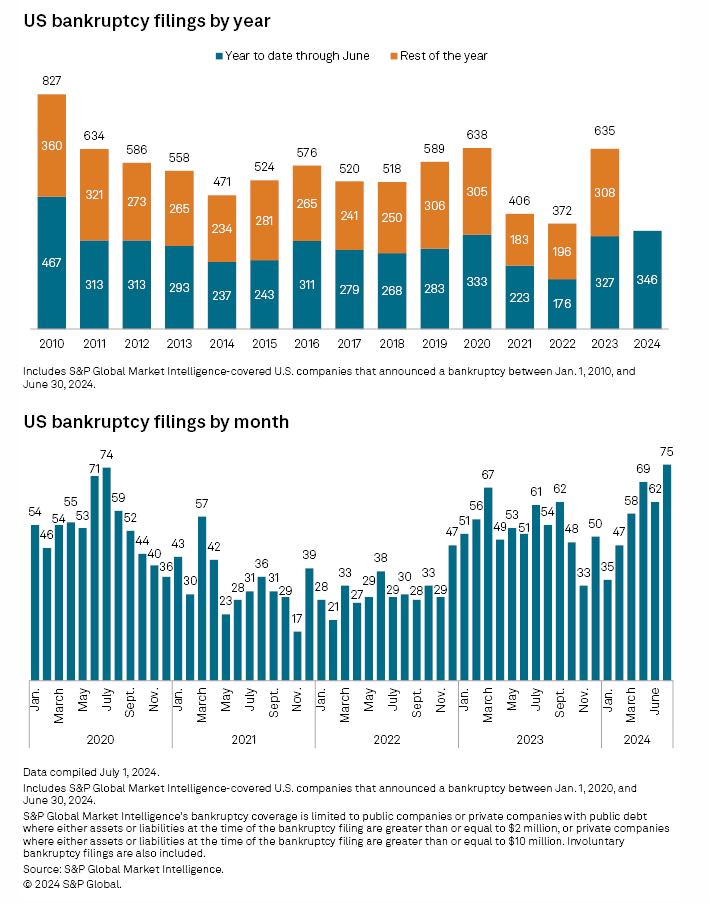
We’re already seeing the impacts of tighter monetary policy rippling through the economy with corporate bankruptcies through the first half of 2024 at the highest level in over a decade. That includes during the pandemic era in 2020 and 2021.

S&P Global called the surge of bankruptcies in June “historic” noting that it was the highest number recorded in a single month since at least the beginning of 2020.

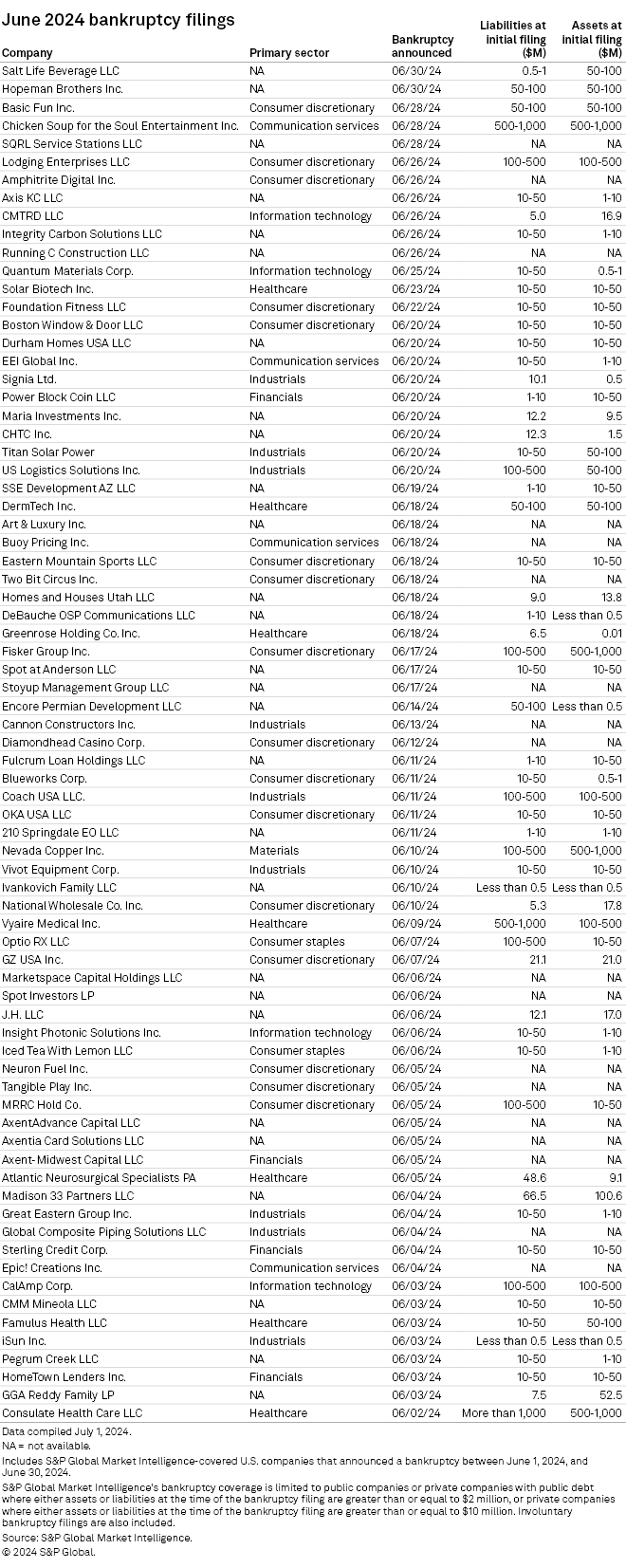
According to S&P Global data, 75 corporations filed for bankruptcy in June alone. That drove the number of filings through the first six months of 2024 to 346, “higher than any comparable figure in the prior 13 years.”

The last time we saw bankruptcy filings at this level through the first half of a year was in 2010 in the wake of the Great Recession.

In 2023, there were 642 bankruptcy filings, also the highest number since 2010. 
What is causing corporations to go bankrupt?

The first factor S&P Global mentioned was “higher interest rates,” along with supply chain issues and slowing consumer spending.

It is likely the slowdown in consumer spending is also due to higher interest rates.

As price inflation gripped the economy after the pandemic stimulus spree, Americans blew through their savings to make ends meet. Aggregate savings peaked at $2.1 trillion in August 2021. As of June 2023, the San Francisco Fed estimated that aggregate savings had dropped to $190 billion.

In other words, Americans ran through $1.9 trillion in savings in just two years. 

Then they turned to credit cards. Now Americans are hitting their credit limits. Consumer debt has surged to a record $5.06 trillion with over $1 trillion in credit card bills.

Air is leaking out of the credit bubble, spending has slowed, and companies are feeling the squeeze.

Parsing the corporate bankruptcy filing data, it appears we are in the early stages of an economic meltdown. Most of the filings were in the consumer discretionary sector made up of companies manufacturing goods or providing services that people want but don’t need. The consumer discretionary category includes hotels, restaurants, clothing retailers, sporting goods sellers, media companies, etc.

The data seems to indicate that consumers are cutting back on discretionary spending as they continue to try to make ends meet in this inflationary world.

This is what the beginning of a recession looks like.

According to S&P Global, 55 of the corporate bankruptcies in the first half of 2024 fell into the consumer discretionary category. Sixteen of those filings were in June. 

Three of the most recognizable companies in this category to file for bankruptcy in H1 were Red Lobster, Chicken Soup for the Soul Entertainment, and Joann Fabrics.

There were also 40 bankruptcies in the healthcare sector, 40 in industrials, 20 in information technology, 19 in consumer staples, and 16 in the financial sector. The rest of the filings came from the materials, communication services, energy, and utilities sectors.

You will find a complete list of filings through H1 2024 at the end of this article.

The Blood Is on the Fed’s Hands

If you are looking for a scapegoat to blame for the surge in corporate bankruptcies, look no further than the Federal Reserve.

It raised rates and the U.S. economy cannot function long-term in a high interest rate environment. Easy money is gone, and companies are struggling to survive without that mother’s milk.

Or to put it another way, the economy is addicted to the drug of easy money. The drug dealer took it away and now the addict is going through withdrawals.

It’s fair to say the central bank had no choice but to raise rates. After all, price inflation was scorching the U.S. economy. But the real problems started long before the rate hiking cycle – and the Fed caused them too.

In the wake of the 2008 financial crisis, the Fed dropped interest rates to zero and held them there for nearly a decade. It didn’t start trying to normalize rates in earnest until 2017, and it failed miserably. In the fall of 2018, the economy started getting wobbly and the stock market crashed. The Fed paused rate hikes in December 2018 and cut rates three times the following year. The pandemic gave the central bank the excuse it needed to slash rates back to zero in 2020.

The result was well over a decade of artificially low interest rates and money creation. 

Other central banks followed the Fed’s lead. More than a decade of easy money had a predictable effect. Corporations, governments, and individuals ran up mountains of debt.

And why not?

Money was cheap, and policymakers gave the impression that the easy money gravy train would never reach the end of the tracks. Everybody just assumed interest rates near zero were the new normal. The Federal Reserve and the U.S. government incentivized borrowing, so people borrowed. After all, incentives matter. 

But with all of the money and credit creation, price inflation was also inevitable.

At first, the central bankers at the Fed tried to ignore it, but when it became clear that price inflation wasn’t transitory, the Fed was forced to act.

Now we’re in an untenable environment with debt bubbles as far as the eye can see straining under the pressure of higher interest rates.

This is precisely why the Fed desperately wants to cut rates and will likely deliver a cut in September.

But it will almost certainly be too little too late. The damage is done, just like the damage was already done when the Fed started cutting rates in 2007 attempting to stop the looming meltdown in the housing market. A year later, we got a financial crisis and the Great Recession.

The Fed is stuck between the proverbial rock and hard place. It can ease interest rates, risking a resurgence of price inflation, or it can hold its ground and risk crashing the economy.

The surge in corporate bankruptcies is just one visible crack in the foundation of the economy. There are certainly more we haven’t noticed yet.

That means you should probably hold on to your hats. It’s about to get bumpy.

Mike Maharrey is a journalist and market analyst for MoneyMetals.com with over a decade of experience in precious metals. He holds a BS in accounting from the University of Kentucky and a BA in journalism from the University of South Florida.


Political and Economic Turmoil Suddenly Surging

(Mike Gleason, Money Metals News Service) As Republicans gathered to nominate Donald Trump for President of the United States, they witnessed another historic event. Gold hit a new all-time high above $2,500 an ounce.

The monetary metal made gains following the attempted assassination of the former President and his continued surge in the polls. Even Democrat pollsters now admit Trump is now the clear favorite to win the election.

Democrat party elites from the Obamas to Nancy Pelosi to Chuck Schumer apparently see no path to victory for faltering incumbent Joe Biden. Reports suggest they are pushing him to step down at this late hour out of sheer panic and desperation.

The same Democrat machine operatives who made sure their primary elections would ensure Biden would face no serious opposition are now looking to discard their own hand-picked candidate like an old, worn-out appliance.

On the other side, Republicans, with a few notable exceptions, seem enthusiastic about their nominee. But given Trump’s age, the threats made on his life, and the fact that he would be Constitutionally limited to serving only one term, his pick for Vice President carries heightened significance.

On Wednesday, JD Vance took to the stage to introduce himself to millions of Americans and accept the GOP Vice Presidential nomination. A former Trump critic, the young Senator from Ohio drew on his personal background to try to connect with the struggles of blue collar and rural Americans.

Vance, a relative newcomer to politics, rose to prominence following his bestselling book, Hillbilly Elegy.

In the Senate, he has helped lead the anti-Woke culture wars. He introduced the Dismantle DEI Act, which would bar government agencies from implementing Diversity, Equity, and Inclusion quotas. Senator Vance has also sponsored bills to stop transgender surgeries from being performed on minors.

He has irked outgoing Senate Minority Leader Mitch McConnell and other establishment Republicans by opposing billions in aid for Ukraine’s war effort.

On the economic front, Vance favors getting tough on China with tariffs. He has suggested that China and other countries are artificially weakening their currencies in order to boost their exports to the U.S.

According to Vance, a strong U.S. dollar on foreign exchange markets isn’t necessarily a good thing. It makes foreign-produced goods cheap relative to domestically-produced goods, which leads to a loss of manufacturing jobs at home.

President Trump has made similar points.

Trump is also a proponent of low interest rates. Should he return to the White House in January, it won’t be surprising if on Day One he urges Federal Reserve Chairman Jerome Powell to cut rates further and faster than he presumably will have already done. Futures markets project a near 100% chance of a rate cut in September.

A Trump/Vance administration can be expected to favor weak dollar policies even as it attempts to get inflation down by lifting restrictions on domestic energy production and ending Joe Biden’s Green New Deal deficit spending spree.

Another notable speaker at the GOP convention was Representative Matt Gaetz. He mocked disgraced Democrat Senator Robert Menendez, who was recently convicted on corruption and bribery charges. Menendez had accepted lavish gifts, including gold bars, from foreign agents.

Matt Gaetz: Under Biden-Harris inflation has gotten so bad. You can no longer bribe Democrat senators with cash alone. You have to use gold bars just so the bribes hold value. Oh, the swamp draining will recommence soon, and I will be President Trump’s strongest ally in Congress.

News Report: Former President Trump says he’ll consider JPMorgan’s CEO Jamie Dimon for Treasury Secretary if he wins the election. That’s according to a Bloomberg interview. Trump also says he won’t try to oust Federal Reserve Chair Jerome Powell before the central banker’s term ends. Powell’s term, by the way, is up in 2026, and his seat on the Fed Board of Governors ends two years later. Trump appointed Powell to lead the central bank in 2018.

Sound money advocates aren’t particularly optimistic that Trump will drain the swamp of Wall Street financiers and entrenched central bankers who ultimately control the nation’s purse strings.

But Representative Gaetz is certainly on point about gold maintaining purchasing power much better than U.S. fiat dollars.

Meanwhile, industrial commodities along with economically sensitive sectors of the stock market suffered this week on fears the economy is losing steam. Leading economic indicators are deteriorating. And the number of Americans who applied for unemployment benefits jumped to 243,000 last week.

Dangers loom for stock market investors. Physical precious metals will continue to serve as a safe haven from risky financial assets and the ongoing depreciation of the U.S. currency.

Yes, the election outcome could bring significant changes to Washington. But it won’t change the inflationary nature of the Federal Reserve system. Nor will it change the debt-strapped government’s dependence on it.


Mike Gleason is a Director with Money Metals Exchange, a national precious metals dealer with over 500,000 customers. Gleason is a hard money advocate and a strong proponent of personal liberty, limited government, and the Austrian School of Economics. A graduate of the University of Florida, Gleason has extensive experience in management, sales, and logistics, as well as precious metals investing. He also puts his longtime broadcasting background to good use, hosting a weekly precious metals podcast since 2011, a program listened to by tens of thousands each week.

Money Metals Podcast: Ed Steer on Gold, Silver and Market Dynamics

(Money Metals News Service) In a recent episode of the Money Metals podcast, host Mike Maharrey interviewed Ed Steer, a seasoned analyst with nearly 30 years of experience in the gold and silver markets.

Steer, the publisher of the Gold and Silver Digest and a member of the Gold Antitrust Action Committee, shared his expert insights on the current dynamics in precious metals, particularly focusing on market manipulations, supply-demand fundamentals, and future price projections.

(Interview Begins Around 7:04 Mark)

Who is Ed Steer?

Ed Steer
Ed Steer

Ed Steer is a veteran analyst with nearly three decades of experience in the gold and silver precious metals market. He is the publisher of the Gold and Silver Digest and a member of the Board of Directors of the Gold Antitrust Action Committee (GATA).

Steer is well-known for his expertise in the dynamics of the precious metals market, particularly regarding market manipulations, supply-demand fundamentals, and the pricing of gold and silver. His insights are frequently sought after by investors and enthusiasts in the precious metals community.

Market Manipulation and Interest Rate Dynamics

Market Manipulation and Interest Rate Dynamics

The conversation began with Maharrey noting the recent trajectory of gold prices, which reached new record highs. Steer attributed this surge to signals from Federal Reserve officials, including Jerome Powell, suggesting an imminent interest rate cut.

Steer acknowledged that the news of potential easing contributed to the price increase but emphasized that the price action primarily occurred in the COMEX futures market.

He highlighted the significant role of the paper market in setting prices, asserting that the suppression of silver prices was evident, as silver remained significantly below its 2011 highs, despite gold’s breakout.

“The gold price was certainly came on the news, on that news that there was going to be an easing of interest rates in September. But the fact of the matter is that all the price action that was of importance took place in the COMEX futures market, and it’s the paper market where the price is set.”

Silver Market Suppression

Silver Market Suppression

The discussion moved to the silver market, where Steer explained the ongoing suppression in the paper market, a practice dating back to the early 1970s when President Nixon took the U.S. off the gold standard. Steer noted that silver prices have been manipulated since then, primarily through COMEX futures contracts.

He pointed out that despite a structural deficit in silver supply, prices remain suppressed due to aggressive paper trading. The Silver Institute reports a four-year structural deficit in silver, exacerbated by the physical market dynamics where demand consistently outstrips supply.

“The prices of all precious metals have been actively suppressed almost since that time, and it’s reached the point now that it’s a hundred percent paper market driven, the silver price. And the Silver Institute, as everybody knows, we’re in the fourth year of a structural deficit in silver, which is only getting worse as every day goes by.”

Supply-Demand Fundamentals and Physical Shortages

Supply-Demand Fundamentals and Physical Shortages

Steer underscored the frantic movement of silver in and out of COMEX, SLV, and various ETFs worldwide. He highlighted that the physical market’s activity indicates a severe shortage, with thousand-ounce Good Delivery bars being rapidly moved to cover deficits.

Ted Butler’s research showed that JP Morgan accumulated about a billion ounces of silver by 2011 to meet these shortages, but they have already divested more than half of that stockpile.

Steer predicted that once JP Morgan exhausts its silver reserves, the price management scheme will collapse, leading to significantly higher prices.

“I follow the amount of silver that’s moving in and out of the COMEX and SLV and the other various silver ETFs and mutual funds everywhere on Planet Earth on a daily basis. And the amount of metal that’s being shipped in and shipped out and being delivered, is issued and stopped, it’s just amazing.”

Investment Strategies in Precious Metals

Investment Strategies in Precious Metals

Addressing skepticism from investors wary of market manipulation, Steer recommended a balanced approach. He advised splitting investments between physical silver and precious metal equities, emphasizing the importance of holding physical commodities.

Steer suggested that even with market suppression, the supply-demand fundamentals will eventually dictate much higher prices, making current investments in silver a strategic move.

Steer recommended mutual funds like the VanEck Gold Fund and SILJ for those preferring equity investments, providing diversification and reducing individual stock risks.

“For the average investor, basically, all they need to know is that it’s the only commodity that hasn’t had a new record high. It hasn’t broken through its new record high and setting new record high prices in the last 13 or last 40 years.”

Global Dynamics and Central Bank Accumulations

Global Dynamics and Central Bank Accumulations

Steer discussed the global competition for gold, particularly in East Asia, where countries like China, India, and Vietnam have been accumulating significant quantities.

He noted that while silver does not see the same level of state-backed accumulation, there is heavy demand from countries like India and, previously, Turkey. He highlighted that central banks, such as the Russian Federation, hold silver reserves, although they do not actively announce their accumulations.

“The Silver Institute has stated categorically that, for the last four years, we’re in this structural supply-demand deficit. And that’s really all you need to know about the silver market. And at the moment, JP Morgan is the only entity on Planet Earth with the physical silver in-house to satisfy this deficit.”

Future Outlook and Repricing of Commodities

Future Outlook and Repricing of Commodities

Steer emphasized that commercial traders, including major bullion banks, are acutely aware of the supply-demand imbalances. He predicted that the eventual repricing of silver and other commodities is inevitable, driven by the fundamental shortages and increasing demand.

He referenced Keith Neumeyer’s prediction of three-digit silver prices, aligning with his view that the current suppression is unsustainable.

“They’ve painted themselves into a corner, and there’s no way out of this thing, except for a massive repricing of silver in particular and all commodities in general.”

Conclusion

Buy Gold Buy Silver Investing Money Metals Exchange

Ed Steer’s insights on the Money Metals podcast provided a comprehensive analysis of the precious metals market. He highlighted the persistent market manipulation, the critical supply-demand dynamics, and the eventual repricing of silver and gold.

Steer’s advice for investors to hold physical silver and diversify through precious metal mutual funds offers a strategic approach to navigating the manipulated market and positioning for future gains.

Vance’s Campaign Theme Originated as Anti-Bush Protest Song

(Elias Irizarry, Headline USA) Sen. J.D. Vance, R-Ohio, the current Republican vice-presidential candidate, took the stage for the first time since being nominated on Wednesday, July 17, to an anthem unfamiliar to the Republican Party—“America First” by country star Merle Haggard.

The song features lyrics such as “Why don’t we liberate these United States? We’re the ones who need it the most,” and “Let’s get out of Iraq and get back on the track, and let’s rebuild America first.”

Haggard first wrote the song in protest of the invasion of Iraq by the administration of President George W. Bush, a Republican.

Bush, whose brother Jeb, the former Florida governor, was humiliated by Trump during the 2016 GOP primary, was notably absent from the 2024 convention and has remained silent for much of hos post-presidency with a few exceptions to collaborate with fellow ex-presidents Bill Clinton and Barack Obama.

Although Haggard died in 2016, Variety‘s Chris Willman recounted a 2004 interview with the legendary country-music outlaw, in which he explained his motivation for writing the political anthem.

“‘America First’ was written in part as an anti-Bush, anti-Iraq War protest song,” Willman noted.

“At the time, Haggard’s song would have reasonably been seen as anti-Republican,” he added. “And nowadays, the Republican party is anti-Republican, too—or anti-Bush-era-Republican, to be precise.”

According to Willman, Haggard attributed his experiences driving across the country to the song, describing horrible infrastructure, and farmers running out of business, as well as anger regarding airport security and the PATRIOT Act.

Online reactions to the playing of America First varied.

The X account for conservative website WorldNetDaily notably saw it as a “huge f**k you” to the Republican Establishment, as Vance touts a more nationalistic and America First approach to governing.

Vance reportedly was the choice favored by popular conservative pundit and influencer Tucker Carlson, an outspoken Ukraine war critic, while Carlson’s former boss, Fox News founder Rupert Murdoch, is reported to have lobbied heavily for North Dakota Gov. Doug Burgum and to have staunchly opposed the selection of Vance.

However, others, such as X user Sydney Jo Wray, felt that Haggard would be rolling in his grave over the playing of his music, considering he wrote an ode to Hillary Clinton in her 2008 campaign titled Let’s Put a Woman in Charge.

Headline USA reached out to Haggard’s son, Ben, who performed with him in his band and continues to carry on the Haggard name and legacy in his own music, and we will update with any response.

Follow Elias Irizarry at twitter.com/eliasforsc

Report: Failed Trump Assassin Threatened School Shooting, Bombing at Age 15

(Ken Silva, Headline USA) The Daily Mail interviewed one of alleged Trump shooter Thomas Matthew Crooks’s former classmates, who said that the failed assassin threatened to “shoot up” his high school when he was just 15-years old. Crooks was 20 when he died on Saturday.

“We had like this anonymous place you could post things or tell on someone on our computers at school and he posted something like, ‘Don’t come to school tomorrow,’ and something else that made it sound like he’d put bombs in the cafeteria bathrooms,” said the former classmate, 20-year-old Vincent Taormina.

“Half of us just didn’t come to school the next day – I didn’t. But it wasn’t taken seriously. We all texted one another and it came out pretty quickly that it was Thomas and his friend group who’d made the threats to shoot [the school] up,” Taormina told the Daily Mail.

While authorities didn’t take Crooks’s threat seriously at the time, the FBI is apparently investigating it now.

Taormina’s interview with the Daily Mail follows a separate interview he provided to Fox News, where he said Crooks was an anti-Trumper. He also mentioned the school shooting plot in his Fox interview.

“Everybody was saying it was Thomas who made a threat, and it was that friend group. Everyone was mainly blaming the friend group, but a name that kept coming up was Thomas,” Taormina told Fox News. “And he never did anything, you know. I mean, he left school for a couple of days.”

Additionally, the former classmate pushed back against rumors that Crooks was severely bullied in high school.

“I could name you a few students who were severely bullied, and I remember their names. He’s not one of them,” said Taormina, referring to Crooks.

According to Taormina, there were plenty of signs regarding Crooks, and he said that there was no way that somebody else couldn’t have seen it coming.

“Somebody should have known, because he was not a loner. And with both of his parents being counselors, how do you not see that warning sign?” said Taormina. “People are going to get their fares in order before they do something this bold and this drastic—and nobody saw it?”

The fallout from the assassination attempt at the July 13 Trump rally in Pennsylvania continues to worsen, as investigators seek to find a motive behind Crooks’ attempt on the former President’s life.

As of Friday, the FBI was reportedly trying to access communications Crooks had on at least three encrypted platforms, whose servers are located overseas. According to Axios, the FBI has served legal processes on 30 companies, and is waiting on returns from 18 of those companies, including the ones running the foreign encrypted applications.

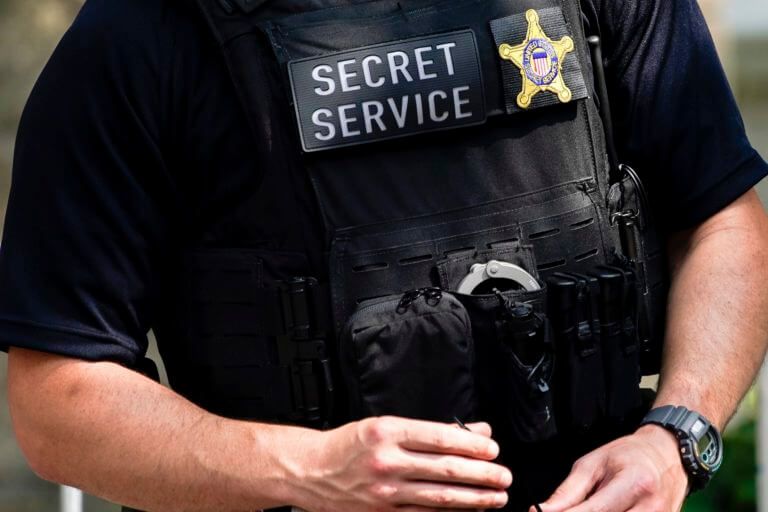
The assassination attempt has landed the Secret Service in hot water, as the Department of Homeland Security reportedly sought to prevent a briefing between the House Oversight Committee and Director Kimberly Cheatle demanding answers over the handling of the incident.

Cheatle is still set to testify publicly before the Oversight Committee on Monday.

Ken Silva is a staff writer at Headline USA. Follow him at twitter.com/jd_cashless.

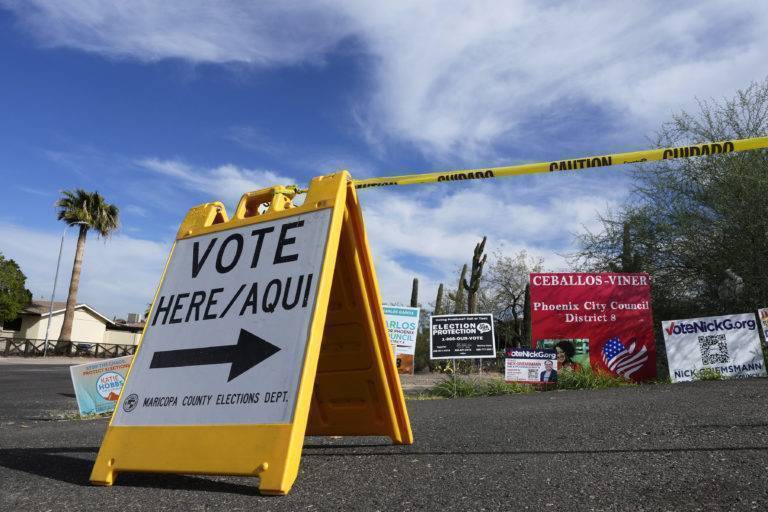
Court Blocks Ariz. Illegals from Registering to Vote… Until September

(Jacob Bruns, Headline USA) In a decision released Thursday, the 9th Circuit Court of Appeals determined that illegal immigrants were not allowed to vote in Arizona.

However, the ruling will apply only through the primary elections, Votebeat Arizona reported.

With an appeals court scheduled to hear the case in September, it leaves open the possibility that the Gov. Katie Hobbs’s outrageous election-law loophole to let illegals vote in federal races may yet be reversed ahead of the Nov. 5 general election, with little time left afterward to seek additional remedy.

The current Arizona law inexplicably requires proof of citizenship for state elections but not for federal ones. With Democrats currently in control, recent advertisements actively encouraged illegal immigrants to fill out applications for ballots, warning them that without ID they would only be sent the federal ballot.

The 9th Circuit’s temporary stay requires those registering to vote in the state have to provide proof of citizenship for federal elections as well.

The Circuit Court in any case reversed the decision of a lower court, which had argued that the National Voter Registration Act preempted the need for proof of citizenship with respect to voting in federal elections in particular, even if the State of Arizona could still require it for state and local elections.

Arizona State Senate President Warren Petersen said the ruling was a victory for those who care about free and fair elections.

“Only U.S. citizens should be allowed to vote in our elections,” he wrote in response.

“It sounds like common sense, but the radical left elected officials in our state continue to reject this notion, disrespecting the voices of our lawful Arizona voters.”

According to Petersen, however, the only way to adequately address the issue in the long run is for the United States Congress to act.

“We are grateful the court is upholding this provision in our law, and it’s time for Congress to take action to ensure only lawful U.S. citizens are voting in federal races,” he concluded.

Not all were pleased with the ruling. Progressive Arizona election lawyer Jim Barton called the ruling “bad news,” because it may mean lower voter turnout if only citizens can vote.

Sen. Hawley Demands Info on Trump Shooter’s Connection to BlackRock

(Ken Silva, Headline USA) Sen. Josh Hawley wrote a letter to BlackRock CEO Larry Fink this week, seeking information on the investment firm’s ties to alleged Trump shooter Thomas Matthew Crooks.

In one of the many yet-to-be-explained aspects of Saturday’s assassination attempt against Donald Trump, it was revealed soon thereafter that Crooks had previously appeared in a BlackRock commercial.

Crooks’s appearance in the BlackRock commercial immediately led to speculation about how else he could be tied to the notorious firm, which uses its market power to push leftist policies such as “decarbonization” by, among other ways, influencing the companies’ boards of directors.

While it’s not clear what the significance of Crooks’s BlackRock ties would be, Hawley at least would like to know more information, he told Fink.

“You must immediately preserve all records relating to this advertisement and your company’s association with Thomas Crooks, including any and all communications your company has had with him, his family, or his school,” Hawley said in his Wednesday letter.

“As Congress continues its investigations into the shootings, such information is vital to ensure that the American people ultimately learn the truth.”

Hawley seeks a response from Fink by this Wednesday.

On the same day he wrote to Fink, Hawley also wrote to the Inspector General of the Department of Homeland Security, requesting responsive records related to the Secret Service’s staggering security failures that led to Trump nearly being killed, a firefighter being murdered and two others being hospitalized.

“This incident represents a staggering security failure by the U.S. Secret Service and the Department of Homeland Security (DHS) to appropriately protect the former president and prevent violence at a peaceful political event. A host of critical questions remain unanswered, and it is vital that the American people know the truth as soon as possible,” Hawley said to the DHS IG.

Hawley’s questions to the IG included information relating to the identity, motive, or actions of the shooter; as well as all information relating to the decision to establish a security perimeter that failed to include the shooter’s position. He seeks answers “as soon as possible,” his letter said.

Meanwhile, Secret Service Director Kimberly Cheatle is set to testify Monday before the House Oversight Committee.

Ken Silva is a staff writer at Headline USA. Follow him at twitter.com/jd_cashless.

Whistleblower: Majority of Trump’s Security Detail Weren’t Actual Secret Service Agents

(Ken Silva, Headline USA) A whistleblower has come out of the woodwork with more shocking revelations about Saturday’s near assassination of presidential frontrunner Donald Trump, including that the majority of Trump’s security detail were not in fact Secret Service agents—but were instead drawn from the DHS’s Homeland Security Investigations, or HSI.

The whistleblower’s disclosure was revealed in a Friday letter from Sen. Josh Hawley, R-Mo., to DHS Secretary Alejandro Mayorkas.

“The July 13 rally was considered to be a ‘loose’ security event. For example, detection canines were not used to monitor entry and detect threats in the usual manner. Individuals without proper designations were able to gain access to backstage areas. Department personnel did not appropriately police the security buffer around the podium and were also not stationed at regular intervals around the event’s security perimeter,” Hawley said in his letter, citing his anonymous whistleblower.

“In addition, whistleblower allegations suggest the majority of DHS officials were not in fact USSS agents but instead drawn from the department’s Homeland Security Investigations (HSI). This is especially concerning given that HSI agents were unfamiliar with standard protocols typically used at these types of events, according to the allegations.”

Nearly as shocking as the whistleblower’s allegations was the next paragraph of Hawley’s letter. There, he revealed that the Secret Service apparently hung up on Congress during this week’s private briefing, before most senators could ask any questions.

“Unfortunately, your department has not been appropriately forthcoming with Members of Congress—abruptly ending the only call with USSS before most senators could even ask a question,” Hawley said. “This is completely unacceptable and contrary to the public’s interest in transparency.”

In his letter, Hawley asked Mayorkas seven questions, including how his agency determined the security levels for the Trump rally, what percentage of the DHS agents at the event were from HSI rather than Secret Service agents, and how long agents physically spent on the ground surveying the site before the event.

Hawley seeks answers within seven days.

Meanwhile, Secret Service Director Kimberly Cheatle is set to testify before the House Oversight Committee on Monday.

Ken Silva is a staff writer at Headline USA. Follow him at twitter.com/jd_cashless.

Son Eric: Donald Trump Ran for Office ‘Out of Deep Concern’ for America’s Future

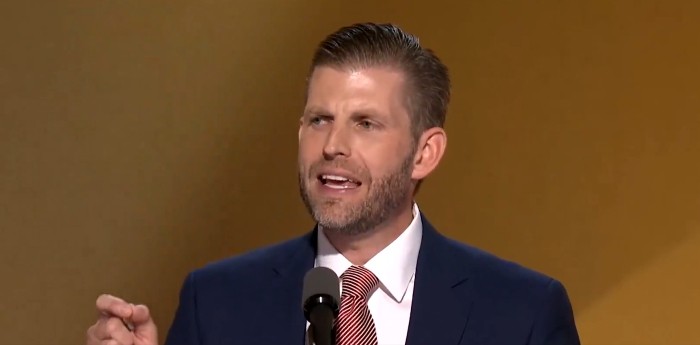
(Nolan Mckendry, The Center Square) Eric Trump spoke of his father’s hopes for the United States, his purpose in office, and his perseverance through cultural and political attacks Thursday at the final night of Republican National Convention in Milwaukee.

“Unlike the current president, it was not a decision to enrich his family,” Eric Trump said. “It was a decision made out of a deep concern for America’s future.”

Former President Donald Trump, who accepted the GOP nominee for president in 2024, is unique in his status as an outsider, never holding office prior to his election in 2016. Since then, Donald Trump has turned opponents into supporters, been involved in countless controversies, faced two impeachments, and was convicted in New York on 34 felony counts in June.

“My father has been ruthlessly silenced, slandered, and attacked by a corrupt administration,” Eric said of his father. “We know, and America knows, they’re not just after you, they’re after all of us, and you just happen to be standing in their way.”

Eric Trump’s speech comes after his father was millimeters away from being assassinated at a rally in Butler, Pa., on Saturday.

“The greatest retribution will be success,” Eric said. “Under President Trump, the swamp will be drained, America will be respected, our cities will be safe, our streets will be clean, and our border will be secure.”

The former president’s platform includes securing the southern border, returning illegal crossers to their countries, promising that “on day one, we will begin the largest domestic deportation operation in the history of our country,” his son said.

“In 2016, many people began to doubt the promise of America,” Eric Trump said. “The economy was struggling, jobs were scarce, our standing on the world stage was weak at best, veterans were forgotten, our military was in shambles, and our education system was broken.”

Eric’s speech reflected on an America First agenda.

“To the homeless veteran sleeping under a bridge, as illegal immigrants are housed in the most expensive hotels in New York: I’m sorry, we know it is wrong and we will fix it,” Eric Trump said.

“Along with the southern border, Agenda47 promises to secure low-cost energy, address drug addiction, and “dismantle the deep state.”

Near-Death Experience Imbues Trump w/ Spirit of Transcendental Unity at RNC

(Elias Irizarry, Headline USA) Following a line-up of colorful speakers such as Hulk Hogan and Kid Rock, former President Donald Trump took the stage Thursday for the first time since his assassination attempt to formally accept the Republican nomination for president.

In contrast to the machismo of his high-energy opening acts, Trump’s own speech at the Republican National Convention in Milwaukee, Wisc., struck a notably subdued note as he looked to tone down the divisive rhetoric that has cleft the nation into warring tribes, instead offering himself up as a president to represent all Americans.

“We are bound together by a single fate and shared destiny,” he said. “We rise together or we fall apart. So tonight, with faith and devotion, I proudly accept your nomination for President of the United States.”

Nonetheless, it wasn’t without elements of his signature showmanship—and with all the love and adulation being directed upon him in his crowning moment, he seemed almost reluctant to leave the stage, adding a roughly hourlong bonus speech of improvised material, perhaps to compensate for the rally cut short five days prior in Butler, Pa.

Trump walked onstage to a giant neon sign of his name as Lee Greenwood performed his iconic song “God Bless the USA.”

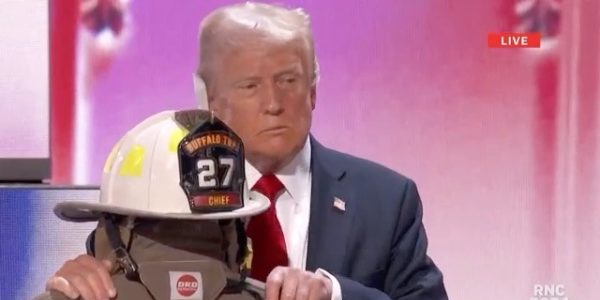
Behind him, firefighters in formal attire rolled out and saluted the uniform of ex-fire chief Corey Comperatore, who was slain in the assassination attempt on Saturday, July 13.

“I stand before you this evening with a message of confidence, strength, and hope,” Trump said to roaring applause. “Four months from now, we will have an incredible victory and we will begin the four greatest years in the history of our country.”

The former president—and now GOP presidential nominee for the third consecutive time—thanked the American people for their support and outpouring of love following his assassination, recounting his firsthand version of the events now etched into the nation’s collective memory through photos and videos that will take their place in the annals of U.S. history.

“I’ll tell you exactly what happened—and you’ll never hear it from me a second time, because it’s actually too painful to tell,” said Trump. 

Trump explained that he had turned his head to look at a chart of illegal immigration statistics and felt a sharp pain in his ear. He put his hand to his ear, saw blood, and dropped to the ground. When he stood back up, he was stunned to see everyone still standing there instead of stampeding.

He also spoke in detail about Comperatore and the other victims who had been injured, walked over to the uniform of Comperatore, kissed his helmet, and called for a moment of silence.

With rumors abounding that President Joe Biden—currently in isolation with COVID-19—might soon exit the presidential race following last month’s disastrous debate, Trump seemed ready to transcend the old mode of politics as usual. He had reportedly rewritten his speech entirely following the attempt on his life to focus more on national unity.

Trump mentioned Biden by name only once and apologized for saying his name.

“Our planet is teetering on the edge of World War III,” he said, promising to “end every single international crisis that the current administration has created.”

He additionally pledged to end inflation, lower gas prices, stop the surge of illegal immigration and fix the economy, promising to “drill, baby, drill.”

“Just a few short days ago, my journey with you nearly ended—and yet, here we are tonight, all gathered together, talking about the future, promise, and renewal of a thing we love very much,” said Trump. “It’s called America.”

Follow Elias Irizarry at twitter.com/eliasforsc.