Fani Willis Forced to Admit Existence of Jan 6 Docs After Court Ruling

(Luis Cornelio, Headline USA) Fulton County District Attorney Fani Willis claimed her office has no documents to release regarding her communications with anti-Trump individuals—days after a court found her in default for failing to respond to open records requests. 

Willis made the statement on Monday amid a lawsuit filed by Judicial Watch over her communications with Special Counsel Jack Smith and the discredited and now-defunct Jan. 6 Committee.

On Monday, Willis asserted her office found no documents or communications with Smith. She also claimed that documents about the Jan. 6 Committee are “legally exempted or excepted from disclosure.” She previously, and falsely, claimed such documents did not exist.

Judicial Watch President Tom Fitton did not mince words in response to Willis’s secrecy and prior defiance of open records laws. 

“Judicial Watch and a state court forced Fani Willis to confirm additional documents exist about her collusion with the partisan Pelosi January 6 Committee to ‘get Trump,’” Fitton said. “But Willis, citing legal exemptions for a prosecution that’s essentially dead in the water, now wants to hide these records from the American public.”

Judicial Watch affirmed it will “push back push back in court against this disingenuous secrecy.”

Judicial Watch filed the lawsuit in March 2024 after Fulton County and Willis denied having any documents related to a Georgia Open Records Act request filed in August 2023. 

At the time, Judicial Watch correctly predicted that Willis’s “representation about not having records responsive to the request is likely false.” 

Judicial Watch knew Willis’s assurances were false because, as unveiled by the House Judiciary Committee, she had reached out to Jan. 6 Committee Chairman Benny Thompson for documents related to Georgia elections and the protests of Jan. 6. 

In May 2024, Judicial Watch asked a judge to declare a default judgment against Willis after she failed to respond to the March lawsuit. She had gone 30 days without responding to the lawsuit as required by state law. 

On Dec. 2, 2024, a judge ruled against Willis, forcing her to admit that her office does possess communications and documents related to the Jan. 6 Committee. 

Judicial Watch’s battle for transparency came after Willis filed Racketeer Influenced and Corrupt Organizations charges against Trump and 18 other co-defendants for merely questioning the results of the 2020 election. 

The case, however, began to fall apart when it was exposed that Willis had a sexual affair with Nathan Wade, the prosecutor she hired to handle the case.

Wade was forced to step down after a judge ruled the controversial affair created an apparent conflict of interest, as the duo went on several trips paid for by Wade. 

Willis denied any wrongdoing, claiming she reimbursed Wade for all expenses. When pressed for receipts or evidence of the reimbursement, Willis admitted there was none.

The case currently sits on appeals, as Trump seeks to have Willis removed from the case and the entire matter dismissed.

It is not immediately clear what will happen with the case as Trump is set to be inaugurated as the 47th president on Jan. 20, 2025. 
Letitia James Announces Decision on Whether to Drop Civil Case Against Trump

(Luis Cornelio, Headline USA) New York Attorney General Letitia James appeared unfazed by the will of the people, announcing she would not drop her infamous civil case against President-elect Donald Trump.

James communicated her decision through a letter from New York Deputy Solicitor General Judith Vale, addressed to Trump’s defense attorney D. John Sauer. Vale vaguely claimed Trump’s request to have the case dismissed following the election had “no basis.” 

“The ordinary burdens of civil litigation do not impede the President’s official duties in a way that violates the U.S. Constitution,” Vale wrote, as reported first by The Hill. 

Vale suggested that the civil matter, unlike criminal charges, would not affect Trump as he prepares to head back to the White House on Jan. 20, 2025. 

“This civil enforcement action is not a criminal action, and [the] Supreme Court did not impose any criminal sanction on Mr. Trump or any other defendant,” Vale added. “ 

“Accordingly, the various actions taken by the Special Counsel’s office or the District Attorney’s Office of New York County in the respective criminal cases brought by those offices against Mr. Trump are irrelevant here,” she continued. 

Vale’s letter responded to Sauer’s demand that James’s case be dismissed. Sauer’s request, made on Nov. 26, cited Special Counsel Jack Smith’s dismissal of criminal prosecutions against Trump. 

Trump’s Manhattan case filed by District Attorney Alvin Bragg could soon be dismissed by Judge Juan Merchan. 

“In the aftermath of his historic election victory, President Trump has called for our Nation’s partisan strife to end, and for the contending factions to join forces for the greater good of the country,” Sauer wrote.  

Sauer, who was nominated to serve as Trump’s solicitor general in the incoming administration, added: “This call for unity extends to the legal onslaught against him and his family that permeated the most recent election cycle.” 

Sauer added, “This case, like the many others against President Trump, is a flashpoint of national partisan division.” 

James’s case against Trump stems from her campaign promise to exploit the justice system to target him if elected attorney general. After taking office, she launched a lengthy and broad investigation into Trump and his organization, accusing him of inflating his finances and property values to secure favorable loans. 

Trump and legal experts have questioned the lawsuit’s basis—but not Justice Arthur Engoron who ordered Trump to pay $464 million in fines and bond. An appeals court later reduced this figure to $175 million as Trump formally appealed the civil judgment. 

Deportation Strategy to Include Targeting Sanctuary Cities, New Border Czar Says

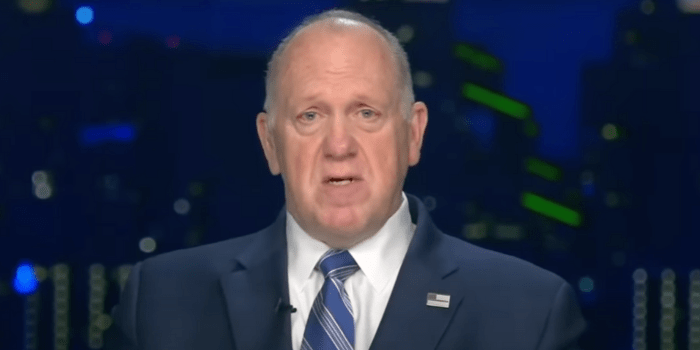
(President-elect Donald Trump’s deportation strategy will include targeting so-called sanctuary jurisdictions, his new border czar, Tom Homan, said.

In an interview with The Center Square, Homan said the plan will prioritize national security threats and violent criminals. This includes those with U.S. Immigration and Customs Enforcement detainer requests.

According to a recent ICE report, a deputy director in the Biden administration said some local jurisdictions “reduced their cooperation with ICE, to include refusal to honor ICE detainer requests, even for noncitizens who have been convicted of serious felonies and pose an ongoing threat to public safety” due to their so-called “sanctuary city” policies.

“However, ‘sanctuary’ policies can end up shielding dangerous criminals, who often victimize those same communities,” he said, The Center Square reported.

While many Democratic leaders in so-called sanctuary jurisdictions have said they won’t cooperate with ICE, Homan said that federal immigration law, Title 8 USC 13.24 iii, requires them to do so. Anyone who “harbors or conceals illegal aliens from federal law enforcement officers” are committing a crime, he said.

“Impeding a federal law enforcement officer is a crime,” he told The Center Square. Those who “knowingly harbor or conceal an illegal alien from ICE” is also a crime.

He’s also asked, “What mayor or governor doesn’t want public safety threats out of their communities? That’s their number one responsibility is to protect their communities. That’s exactly what we are going to do.”

Homan said he will work with anyone, Democrats and Republicans, to ensure public safety.

“I’m willing to meet with anybody. Our priority on Day One is public safety.” He’s encouraging local leaders to work with him “to make your community safer.”

The goal is to have local jurisdictions cooperate with ICE requesting to take into custody any illegal foreign national already in a local jurisdiction’s custody. Removing the alleged offender from a local jurisdiction will also reduce costs for the city, county and state.

The plan does not require local officers to be immigration officers but to work with ICE agents, Homan said.

ICE agents are able to identify who’s booked in a county jail, for example, because everyone who’s arrested has their fingerprints input into a national criminal NCIC database, which federal agents have access to. Not providing access to those detained in a publicly funded facility is harboring, he argues.

Homan is also asking Trump’s nominated Attorney General Pam Bondi, assuming she’s confirmed, to fully review and issue a formal opinion about whether local jurisdictions that refuse to comply with an ICE detainer request are violating federal law. It is also likely under Bondi that sanctuary jurisdictions would face federal prosecution.

Other options on the table include Congress imposing penalties on sanctuary jurisdictions, including withholding federal funds from law enforcement agencies and city and county governments that harbor illegal border crossers, Homan said.

Homan’s appeal already worked with New York City’s Democratic mayor saying he will work with the Trump administration and Denver’s Democratic mayor who backtracked on a claim that he’d direct police to block federal agent operations.

Federal agents already operate in Denver, including at a Denver ICE field office and U.S. Customs and Border Protection port of entry at the airport.

Todd Lyons, acting assistant director of field operations for ICE’s Enforcement and Removal Operations in New England, argues elected officials “preaching their sanctuary city status are making it easier for those who commit sex crimes and fentanyl dealers. We need cities and towns to work with us to keep these criminals out of neighborhoods.

“We focus on the worst of the worst and all the political rhetoric is not helping,” he told the Boston Herald.

Of the more than 660,000 criminal foreign nationals identified to be deported by ICE, the majority are living freely in the U.S.

They include those convicted of, or charged with, homicide (14,914), sexual assault (20,061), assault (105,146), kidnapping (3,372), and commercialized sexual offenses, including sex trafficking (3,971).

In Massachusetts, sanctuary policies were implemented in multiple cities including Boston, prohibiting police officers from cooperating with ICE.

ICE agents have been arresting violent criminals in Massachusetts, including men convicted of aggravated rape, assault and battery, and fugitives wanted in their home countries for violent sexual crimes.

In many cases, sanctuary jurisdictions refused to cooperate with ICE, instead released violent offenders into the community who then committed additional crimes, The Center Square reported.

Local officials advancing sanctuary policies “are welcoming criminals to the state. They are doing their own communities a disservice,” Lyons said. “All we are asking for is to make an arrest of someone already arrested.”

Homan said to local jurisdictions, “work with us to make your community safer.”

Those who won’t, he said, can “get the hell out of the way.”

Why the Secrecy? Liz Cheney Threatens Investigators Not to Expose Jan. 6 Evidence

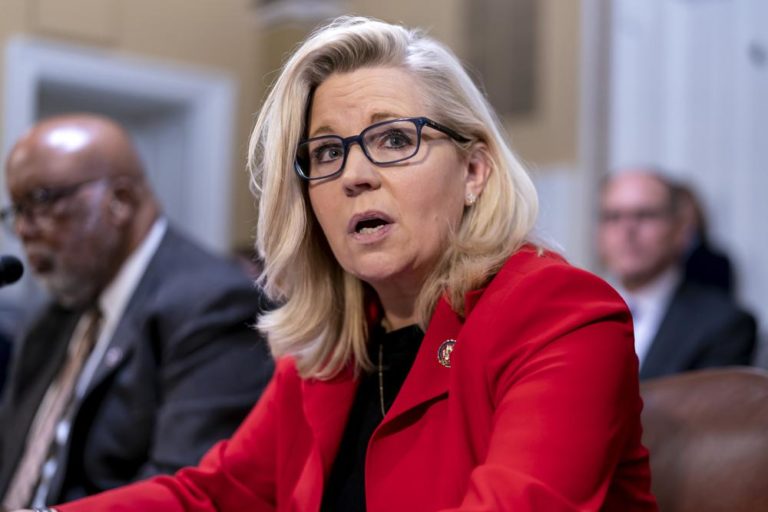
(Luis Cornelio, Headline USA) Disgraced former Rep. Liz Cheney issued a threatening warning to the incoming Trump administration about a potential criminal investigation into the controversial work of the discredited Jan. 6 Committee. 

In comments to the leftist New York Times, Cheney declared Sunday that any attorney daring to investigate or expose the committee’s actions could face severe penalties, likely orchestrated by bar associations and similar entities.

“There is no conceivably appropriate factual or constitutional basis for what Donald Trump is suggesting — a Justice Department investigation of the work of a congressional committee — and any lawyer who attempts to pursue that course would quickly find themselves engaged in sanctionable conduct,” Cheney claimed. 

Cheney’s remarks came in response to President-elect Donald Trump’s sharp rebuke of the Jan. 6 Committee for allegedly destroying key documents related to its work. Trump suggested such deletions amount to criminal offenses. 

“Cheney did something that’s inexcusable, along with [Rep. Bennie] Thompson and the people on the un-select committee of political thugs and, you know, creeps,” Trump said Sunday during a tell-all interview on NBC News’s Meet the Press. “They deleted and destroyed all evidence.” 

Trump added, “And Cheney was behind it. And so was Bennie Thompson and everybody on that committee. For what they did, honestly, they should go to jail.” 

Trump’s comments referenced a report issued by House Republicans that accused the Jan. 6 Committee of deleting evidence. Such deleted evidence contradicted Democratic talking points and vindicated the president-elect from several accusations. 

According to Rep. Barry Loudermilk, R-Ga., these actions were part of the committee’s deliberate effort to cherry-pick information to support a political narrative. 

The House Administration Committee’s Oversight Subcommittee allegedly found that Cheney and Thompson “failed to turn over video recordings of witness interviews and depositions despite using these recordings in their high-profile, primetime hearing.” 

It added, “The Subcommittee recovered over one hundred deleted or password-protected files, including some files that were deleted days before Republicans took the majority. They also hid multiple transcribed interviews of witnesses who had firsthand knowledge of Trump‘s actions on January 6.” 

Cheney’s threats against investigators appear aimed at silencing anyone who pursues House Republicans’ leads.

The former congresswoman’s comments employ a tactic often used by the left to punish conservatives seeking perceived accountability.

Republican attorneys who questioned the 2020 election results faced ethics complaints, hefty fines and even disbarment.

In contrast, Democrats, who have repeatedly denied election results and voted against certifying Republican victories, have not faced similar consequences. 

Trump Shooting Task Force Didn’t Receive FBI Records on 2nd Assassination Attempt

(Ken Silva, Headline USA) The House Task Force created to investigate the July 13 assassination attempt on Donald Trump released its final report Tuesday, rehashing what happened in Butler, Pennsylvania and making a slate of recommendations for how the Secret Service should conduct itself moving forward.

It appears there’s little new information in the final report. Much of the report’s contents have already been disclosed through Senate and DHS-led investigations, as well as independent journalism—including from this outlet, which exclusively obtained alleged shooter Thomas Crooks’s autopsy and toxicology reports.

The lack of new info in the final report is at least partially attributable to the Justice Department’s stonewalling. According to the report, the FBI declined to provide any documents about the second, Sept. 15 assassination attempt that occurred at Trump’s Florida golf course—despite the fact that the Task Force’s legal authority was expanded to investigate that case, too.

“The Secret Service is continuing to conduct its mission assurance review of the assassination attempt in West Palm Beach, Florida, the contents of which have not been shared with the Task Force,” the report said.

“The FBI provided no documents in response to the Task Force’s request and provided only a single status briefing on September 25,” the report added.

The FBI also didn’t provide the Task Force with much information about Crooks himself.

The report said the FBI provided the Task Force with access to only 81, out of over 1,000, witness interview reports—known as 302s—comprising roughly 180 pages.

Task Force Chair Rep. Mike Kelly, R-Pa., and ranking member Jason Crow, D-Co., both said they never learned what motivated Crooks to shoot Trump.

In a Sunday interview with Meet the Press, Crow blasted the DOJ’s lack of transparency. He said Congress should have the right to review evidence from a criminal investigation in a private setting where the information can’t be leaked. He said he regularly receives briefs on military and intelligence operations under the same conditions.

Kelly and Crow promised to continue pressing the DOJ on the matter.

“If DOJ and FBI think they can wait us out and stonewall us, they are wrong,” Crow said.

Ken Silva is a staff writer at Headline USA. Follow him at x.com/jd_cashless.

Everyday Economics: Could a Fed Rate Cut in December Be the Last of This Cycle?

() The U.S. labor market continues to show signs of a persistent slowdown.

At the same time, inflation data is mixed, with core inflation exceeding expectations while headline inflation continued to moderate. Accelerating producer prices suggest that inflation may be more stubborn than previously anticipated.

This scenario could lead to fewer Fed rate cuts ahead, potentially keeping interest rates higher for American consumers in the foreseeable future.

Despite rebounding from October’s hurricane disruptions, the U.S. economy added 518,000 jobs over the past three months, compared to 593,000 during the same period last year.

Stronger-than-expected job gains in November do not necessarily indicate that the U.S. economy is reheating.

Although the 4.2% unemployment rate is slightly below the Federal Open Market Committee’s median forecast of 4.4%, recent data continues to highlight a persistent labor market slowdown.

On the inflation front, the picture remains mixed. Core inflation, as measured by the personal consumption expenditures price index, rose 2.8% year-over-year in October, exceeding the Fed’s latest Summary of Economic Projections.

However, headline inflation, which the Fed anticipated to end the year at 2.3%, is currently on target.

This week’s data will provide the first inflation update for November. While the Consumer Price Index is informative, the Producer Price Index tends to be a more reliable predictor of both the level and growth rate of the PCE price index, the Fed’s preferred measure of inflation.

Historically, rising producer prices signal future pain for consumers, as the gap between the PPI and PCE tends to close over time. Since May, the gap between these measures had nearly disappeared, but producer prices are now climbing faster than consumer prices.

In October, final demand PPI rose 2.4% year-over-year, accelerating from 1.9% in September, while headline PCE edged up to 2.3% from 2.1% the prior month.

Consensus estimates suggest that PPI increased by 0.2% in November, pushing the index to a 2.6% year-over-year gain. While stronger-than-expected CPI and PPI figures could drive Treasury yields higher and raise questions about additional Fed rate cuts in 2025, the December rate cut is widely regarded as a done deal.

Elsewhere in the economy: U.S. productivity is estimated to have risen by 2.2% in Q3. Whether this trend continues into 2025 remains to be seen. Without sustained productivity growth, a shrinking labor force combined with re-accelerating wage increases could point to rising consumer price inflation pressures.

BREAKING: Attorneys for Would-Be Trump Assassin Considering ‘Insanity Defense’

(Ken Silva, Headline USA) The Justice Department disclosed in a Tuesday afternoon court filing that attorneys for Ryan Routh are considering an insanity defense for their client, who allegedly tried killing Donald Trump on Sept. 15 at his Florida golf course.

The DOJ’s disclosure came in a filing opposing Routh’s request to have his trial bumped from February to December 2025. The DOJ signaled that it would oppose an insanity defense, which is when a defendant argues that he’s not criminally culpable due to mental illness.

Routh’s attorneys say they need more time to prepare for trial, due in large part to the massive amounts of discovery, as well as Routh’s restrictive conditions in Miami federal prison. In their Tuesday filing, the DOJ agreed to delay the trial by a few months—but not by 10.

Along with opposing the 10-month delay, prosecutors expressed concern that an attempt to plead an insanity defense would also postpone the case.

“In a recent discussion about scheduling, defense counsel raised the possibility of an insanity defense for Routh, a subject they say they need time to evaluate. If Routh did seek to claim insanity, that defense, even if meritless (as it would be), would cause a significant disruption to the pretrial and trial schedule,” prosecutors said.

As for Routh’s reasons for a 10-month delay, the DOJ said they were meritless.

Even though Routh has received terabytes of discovery, most of that information comes from his own phones and electronic devices—meaning that he should already be familiar with that evidence, prosecutors argued.

“The 18 cell phones they highlight, for example. Seventeen are the Defendant’s. Almost all of the other devices are his as well. The contents of these devices are presumably well known to Routh,” prosecutors said.

“The vast majority of discovery we have produced is extractions from these devices. And while defense counsel may not be personally familiar with these devices, the lion’s share of their contents likely has little relevance to any serious defense.”

Prosecutors also argued that despite the seriousness of Routh’s crimes, the case is relatively straightforward.

“While extremely grave, this is not a complex, multi-year fraud scheme, or a massive racketeering operation, or multi-defendant transactional smuggling network. Those types of offenses by definition involve significant discovery and require intensive document review. Routh’s offenses in this case do not,” they said.

“The Defendant’s request for a continuance until no later than December 2025 should be denied.”

The parties are set to argue about the matter at a Wednesday status hearing.

Prosecutors have accused Routh, 58, of Hawaii, of stalking Trump for a month before he built a sniper’s nest near the Trump International golf course in West Palm Beach.

Federal prosecutors charged Routh with possession of a firearm by a felon, possession of a firearm with an obliterated serial number, and attempted assassination of a major presidential candidate.

Routh has pleaded not guilty.

Ken Silva is a staff writer at Headline USA. Follow him at x.com/jd_cashless.

Gas Prices Declining, May Rise after Fall of Syrian Government

() An ongoing war in Syria has suddenly ended with the overturning of the longstanding Syrian government, creating national-security and humanitarian concerns but also threatening global oil markets.

“Russian oil and gas companies have operated in Syria for years adding to the world’s supply,” Daniel Turner, executive director of the energy workers advocacy group, Power the Future, told the Center Square.

“The future of those operations is now in jeopardy,” he continued. “This could be a strategic blow for Putin, but these are global commodities, and we are not immune from the price fluctuations.”

While gas prices have remained relatively stable so far, instability in the Middle East can cause price spikes. However, that instability may already be baked in given the ongoing Israel—Hamas war and Iran’s involvement via proxy terrorist groups.

The average price for a gallon of regular gas is about $3.00, according to AAA, much lower than the spike to $5 per gallon earlier in President Joe Biden’s term. AAA reported last week that gas prices hit the lowest point in 3 years.

“The national average is tantalizingly close to falling below $3 a gallon, and it could happen in a few days,” Andrew Gross, AAA spokesperson, said in a statement.

“But 32 states already have an average below or well below $3,” he continued. “Hockley County, Texas, appears to have the lowest county average, at $2.30.”

Turner argued an expansion of American energy production would help insulate Americans from the volatility overseas.

“This furthers the need for America’s return to Energy dominance, and part of President Trump‘s election mandate,” Turner said.

“Americans deserve reliable, affordable energy, regardless of what’s happening in a chaotic world,” he added. “And when we reopen our natural gas supply lines, places like Western Pennsylvania can provide our allies with the energy. They need further weakening Russia’s economy and military. Better days are on the horizon.”

Gas prices vary widely by state.

From AAA:

The nation’s top 10 most expensive gasoline markets are Hawaii ($4.56), California ($4.39), Washington ($3.99), Nevada ($3.66), Oregon ($3.53), Alaska ($3.46), Washington, DC ($3.22), Pennsylvania ($3.21), Illinois ($3.20), and Arizona ($3.18).

The nation’s 10 least expensive gasoline markets are Oklahoma ($2.52), Mississippi ($2.62), Texas ($2.63), Arkansas ($2.63), Kansas ($2.67), Missouri ($2.69), Tennessee ($2.70), Iowa ($2.70), Louisiana ($2.73), and Kentucky ($2.74).

Deficit Soars as Biden Heads out the Door

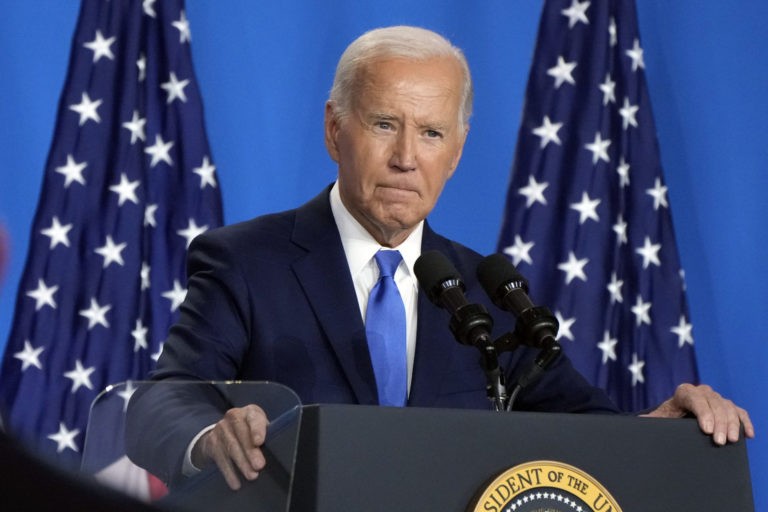
() The latest federal numbers show the U.S. deficit is soaring as President Joe Biden heads out of office.

The U.S. Congressional Budget Office released its monthly budget review on Monday, which showed that in the first two months of this fiscal year, the federal government has run up a deficit of $622 billion. Projecting out over a full fiscal year, that would equate to a $3.7 trillion deficit.

“That amount is $242 billion more than the deficit recorded during the same period last fiscal year,” CBO said in its report.

That figure means the deficit is nearly 40% higher than this time last year.

“The most alarming turkey in November was the federal government’s inability to live within its means,” Maya MacGuineas, president of the Committee for a Responsible Federal Budget, said in a statement. “We are only two months into the fiscal year, and we have already borrowed a staggering $622 billion, with $365 billion in the month of November alone.”

Deficits never surpassed one trillion dollars before the COVID-19 pandemic. Since then, they remain well above one trillion and for this next fiscal year are well beyond the pace to surpass $1 trillion.

The deficit last fiscal year was about $1.8 trillion.

Billionaire Elon Musk, now an advisor to President-elect Donald Trump, lamented the debt, which is about $36 trillion, on X Monday.

“If we don’t fix the deficit, everything will suffer, including essential spending like DoD, Medicare & Social Security,” Musk said. “It’s not optional.”

CBO did explain that some of the increase is from accounting changes.

From CBO:

The change in the deficit was influenced by the timing of outlays and revenues alike. Outlays in October 2023 were reduced by shifts in the timing of certain federal payments that otherwise would have been due on October 1, 2023, which fell on a Sunday. (Those payments were made in September 2023.) Outlays in November 2024 were boosted by the shift to that month of payments due December 1, 2024, a Saturday. If not for those shifts, the deficit thus far in fiscal year 2025 would have been $541 billion, or $88 billion more than the shortfall at this point last year, and outlays would have been $38 billion more.”

Small Business Optimism Spikes after Election

() Small business owners’ optimism saw a significant spike after President Donald Trump won the White House and Republicans took both chambers of Congress, according to the latest survey data.

The National Federation of Independent Businesses released the data Monday, which showed that small business owners surveyed after the election had the highest optimism since June 2021.

“The election results signal a major shift in economic policy, leading to a surge in optimism among small business owners,” NFIB Chief Economist Bill Dunkelberg said in a statement.

According to the NFIB, the biggest factor in that optimism came because the net percent of owners expecting economic improvement rose a whopping 41 points to the highest levels since Trump was last in office in June 2020.

“Main Street also became more certain about future business conditions following the election, breaking a nearly three-year streak of record high uncertainty,” he added.

Elevated inflation has been crushing small businesses in recent years, especially since they do not have the same access to capital as larger businesses that allows them to weather those economic storms.

That inflation, on the heels of the COVID-19 pandemic, has left many small business owners struggling.

“The net percent of owners expecting higher real sales volumes rose 18 points to a net 14% (seasonally adjusted), the highest reading since February 2020,” NFIB said. “The net percent of small business owners believing it is a good time to expand their business rose eight points to a net 14%. This is the highest reading since June 2021.”

Trump has pledged to lower taxes and decrease energy costs by expanding domestic energy production. He has also vowed to cut the size of government, generally seen as the source of costly regulations for businesses.

“Owners are particularly hopeful for tax and regulation policies that favor strong economic growth as well as relief from inflationary pressures. In addition, small business owners are eager to expand their operations,” Dunkleberg said.