Columbia Pro-Palestine Activist Alleged to be a Foreign Intelligence Asset

(José Niño, Headline USA) A U.S. District Judge extended the order of a pro-Palestinian activist’s deportation this Wednesday. Meanwhile, a Middle East publication has reported that the activist, Mahmoud Khalil, might be a foreign intelligence asset.

At a hearing in New York’s Manhattan federal court, U.S. District Judge Jesse Furman extended his order to block Mahmoud Khalil’s deportation order from earlier this week. 

In the meantime, Furman is determining if Khalil’s arrest was unconstitutional.

Mahmoud Khalil is a Syrian-born Palestinian refugee who is completing his graduate studies at Columbia University and is vocal about his support for the Palestinian people’s resistance against the state of Israel. 

On Sunday, U.S. Immigration and Customs Enforcement (ICE) arrested Khalil as part of the Trump administration’s crackdown on campus protests that are deemed antisemitic and an alleged threat to Jewish students on campus. 

 The following day, in a post on Donald Trump‘s Truth Social platform, the U.S. president described Khalil as a “Radical Foreign Pro-Hamas Student” and revealed that his arrest was “the first arrest of many to come”.

“We know there are more students at Columbia and other Universities across the Country who have engaged in pro-terrorist, anti-Semitic, anti-American activity, and the Trump Administration will not tolerate it,” Trump stated.

Khalil was arrested at his Columbia University apartment after ICE agents informed him that his green card had been revoked. He was then transferred to an ICE detention facility in Louisiana. 

The Trump administration has accused Khalil of allegedly engaging in antisemitic activity and supporting Palestinian resistance organization Hamas — which the U.S. government has designated as a terrorist organization. Khalil was accused of reportedly organized protests that disrupted classes and intimidated Jewish American students.

White House Press Secretary Karoline Leavitt announced that Khalil is being targeted under a law allowing the Secretary of State to deem individuals “adversarial to the foreign policy and national security interests of the United States of America”. The Department of Homeland Security stated that Khalil’s arrest was “in support of President Trump’s executive orders prohibiting anti-Semitism” and alleged that Khalil “led activities aligned to Hamas, a designated terrorist organization”.

Deputy Chief of Staff for Policy and Homeland Security Advisor Stephen Miller stated on social media platform X that “Those who sympathize with terrorism are unwelcome on our shores. They will be denied entry or sent home.”

Khalil’s attorneys have filed a habeas corpus petition challenging the legality of his arrest and detention. They argue that his arrest was in retaliation for exercising his First Amendment rights. In addition, they argued that the transfer to Louisiana was unconstitutional and there is no evidence of Khalil providing support to terrorist groups. 

According to the Middle East Eye, Khalil previously worked as a local manager for the Syria Chevening Program, a prestigious UK government international scholarship program, in addition to the Conflict, Stability, and Security Fund.

Former British diplomat Andrew Waller, who was a policy advisor at the Syria Office while Khalil worked there from 2018 to 2022, told MEE that the Trump administration’s narrative of Khalil was defamatory and false.

“He went through a vetting process to get the job and was cleared to work on sensitive issues for the British government,” Waller asserted.

“It’s outright defamation what Trump has done. Mahmoud is an extremely kind and conscientious person and he was loved by his colleagues at the Syria Office,” he added. “You couldn’t find anyone who’d say a bad word about him, he was very good at his job.”

But Khalil isn’t the only foreign intelligence asset involved in the dispute. According to Mint Press News reporter Alan MacLeod, Khalil’s dean, Dr. Keren Yarhi-Milo, is a former Israeli military intelligence officer.

“Yarhi-Milo played a significant role in drumming up public concern about a supposed wave of intolerable anti-Semitism sweeping over the campus … Before entering academia, Dr. Yarhi-Milo served as an officer and an intelligence analyst with the Israeli Defense Forces,” Macleod wrote in an article that was published Tuesday.

Given that she was recruited into the intelligence services because of her ability to speak Arabic fluently, her job likely entailed surveilling the Arab population.

Independent journalist Glenn Greenwald was highly critical of Khalil’s arrest, describing it as “an indisputable proposition that the Supreme Court has for 200 years affirmed.” He also highlighted that many conservatives have “abandoned their defense of free speech” when it comes to criticism of Israel.

Ann Coulter, known for her provocative conservative hardline anti-immigration views, surprisingly questioned the arrest and potential deportation of Mahmoud Khalil.

Coulter posted on X: “There’s almost no one I don’t want to deport. But, unless they’ve committed a crime, isn’t this a violation of the first amendment?”

Khalil remains in ICE detention in Louisiana after a procedural hearing in New York.

Nearly 100 protesters were arrested on March 13 after a sit-in at Trump Tower in Manhattan demanding Khalil’s release.

José Niño is the deputy editor of Headline USA. Follow him at x.com/JoseAlNino

Multiple Gov’t Officials Arrested in Utah Pedophile Scandal

(Maire Clayton and José Niño, Headline USA) The former Utah fire chief and the judge who released him on bail have both been charged with multiple child sex crimes. The two also allegedly had a relationship with each other, according to reports.

Tremonton Fire Chief Ned Brady Hansen and Judge Kevin Robert Christensen allegedly were sharing child pornography and discussing fantasies of sexually abusing children.

Hansen was originally arrested in January after the National Center for Missing & Exploited Children received a tip that child pornography was being shared with Hansen later admitting it occurred to officers, according to KSTU.

Law enforcement officers suggested due to the nature of the alleged crime Hansen be denied bail; however, Christensen allowed Hansen to be released.

As the FBI was investigating Hansen’s case, they soon learned Hansen was corresponding with Christensen.

Court documents revealed that Hansen and Christensen took part in sexually charged chats concerning children, including discussions about sexually abusing and exploiting minors related to them.

During an interview with police, Hansen reportedly admitted to being addicted to pornography and developing “tastes for younger females” in the last few years. 

Hansen kicked off his firefighting career in South Ogden and assumed the position of assistant fire chief in Logan in 2000. Hansen was the Jackson Hole Fire/EMS chief from 2017 to 2022. He subsequently retired and moved back to Logan, per a report by Jackson Hole News & Guide.

In August 2023, Hansen went back to firefighting when he was hired to serve as the Tremonton fire chief. 

KUTV noted Christensen has been placed on administrative leave pending an investigation.

“Christensen did not disclose that he had engaged in sexually charged chats regarding children with [Hansen],” the charging documents said per KUTV. “Law enforcement believes this fact materially affected the decision-making of Christensen at the time he released Hansen.”

The documents added Hansen and Christensen met “in real life to engage in sexual acts,” in addition to their communication on the internet-based chatting app KIK.

Both are now facing multiple felony charges.

Hansen was re-arrested on Tuesday, as Christensen was arrested last week, according to KSTU. Both remain in custody.

The affidavit for Christensen’s arrest said “he is a greater danger to flee to avoid prosecution,” KUTV reported at the time of his arrest.

“The position of trust he holds in the community and the actions he undertook while in this position significantly undermine the confidence of the community in the legitimacy of the criminal justice system,” it continued.

Oregon Health Official Identifies as a Turtle—Really

(Maire Clayton, Headline USA) A member of a state panel advising the director of the Oregon Health Authority attempted to say “turtle” was one of their pronouns.

JD Holt made the wild statement during a Dec. 20 virtual meeting.

“Hello everybody, it’s JD. I use they, them and turtle for my pronouns,” Holt said. “I’m in the Springfield-Eugene area and I get to be part of the council.”

Holt also reportedly goes by “JD Terrapin” on Facebook, according to Fox News. However, it appears the account has been removed at the time of this article.

The wannabe turtle is one of roughly a dozen members on the Consumer Advisory Council that “may review, evaluate and provide feedback on all site reviews related to mental health services provided by OHA.”

The clip quickly went viral on social media with users blasting the absurdity of the comments.

“So the inmates are running the asylum,” DC correspondent Alison Steinberg wrote.

British social-media influencer Oli London decided to jokingly correct Steinberg by writing, “In this case, the turtles are running the asylum,” and added a turtle emoji.

“On the bright side, since JD joined the OHA, he’s really come out of his shell,” one X user noted.

Popular account Libs of TikTok shared a compilation of Holt using the “turtle” pronoun at multiple sessions.

OHA told Fox News Digital that every member on the council along with their views “are highly valued.”

“In following Oregon statute, every member of the Oregon Consumer Advisory Council is someone with lived experience, bring [sic] the voice and experiences of people across the state that have experienced behavioral health challenges,” said OHA spokesperson Amber Shoebridge.

It was found Holt shared extreme views on Facebook and would promote how to disrupt Immigration and Customs Enforcement checkpoints, Fox News reported before the account was deactivated.

Sen. Grassley Relaunches Investigation of HHS’s Migrant Child-Trafficking Scandal

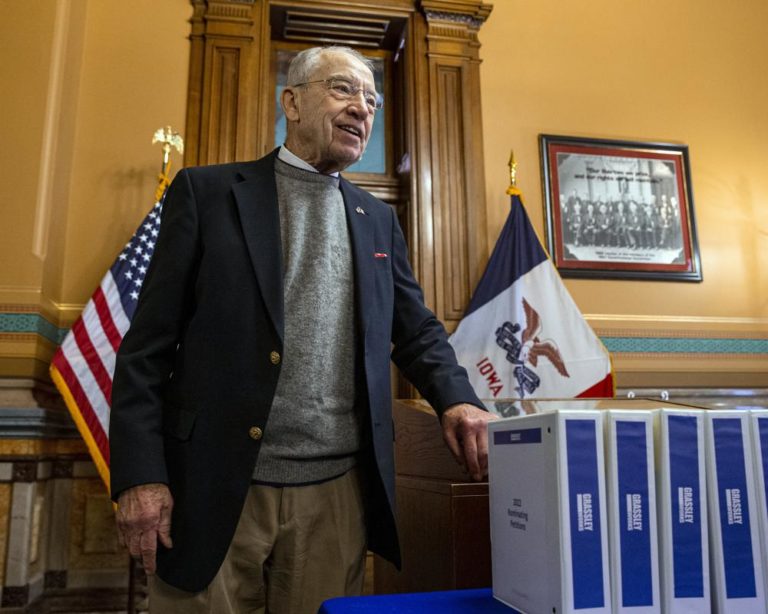
(José Niño, Headline USA) Senate Judiciary Committee Chairman Chuck Grassley, R-IA, is reviving his comprehensive investigation of the Department of Health and Human Services’ (HHS) unaccompanied migrants children program. Grassley is calling on 23 HHS contractors and grantees to provide answers about their work on the program.

Under the preceding Biden regime, this program, with the support of HHS contractors, allegedly let tens of thousands of migrant children to be lost or sent to abusers, criminals, and traffickers.

“[Last year], I sent an urgent inquiry to two dozen organizations that provided care for, or services related to, unaccompanied children in the custody of HHS. The organizations within the scope of my review have received over $9.3 billion in combined taxpayer funding from HHS and yet have chosen not to fully respond to Congress. I won’t accept further delay while children are at risk,” Grassley noted.

“It’s unacceptable for recipients of taxpayer funding to refuse to provide information to Congress about the use of those funds. And it’s beyond unacceptable for these federally-funded entities to refuse to answer questions designed to determine whether they protected children,” Grassley added. “I’m determined to protect UACs in U.S. custody and expose, through my oversight, fatal defects in the process for the purposes of ending child trafficking and other forms of exploitation.”

Grassley sent letters to the following contractors and recipients:

  1. A Greater Love Foster Family Agency, Inc.  
  2. A New Leaf, Inc.  
  3. Alba Care Services Inc.  
  4. Asset Protection & Security Services LP  
  5. BCFS Health and Human Services  
  6. Bethany Christian Services  
  7. Cayuga Centers  
  8. Center for Family Services  
  9. Cherokee Federal  
  10. Compass Connections  
  11. Endeavors  
  12. General Dynamics Information Technology, Inc.  
  13. Global Refuge  
  14. Heartland Human Care  
  15. Holy Family Institute  
  16. Morrison Child & Family Services  
  17. National Youth Advocate Program, Inc.  
  18. Rapid Deployment Inc  
  19. Southwest Key Programs  
  20. Sunny Glen Children’s Home  
  21. The Providencia Group LLC  
  22. U.S. Committee for Refugees and Immigrants Inc.  
  23. VisionQuest National Ltd 

HHS contractors and grantees receive taxpayer dollars to ostensibly provide unaccompanied migrant children with basic goods and services and vet their adult sponsors through background checks, home visits, screenings, and verification of the sponsor’s relationship to the child. In the previous Congress, Grassley’s probe into the matter uncovered alarming levels of mismanagement of the program and potential proof of child smuggling and trafficking taking place.

Headline USA has previously covered Grassley’s release of documents demonstrating that HHS sent at least two unaccompanied children to homes with connections to the El Salvadoran gang, La Mara Salvatrucha, more popularly recognized as MS-13.

Gangs like MS-13 are notorious for their connections to human trafficking and other bone-chilling activities involving children.

For example, Alicia Hopper, a prominent researcher on human trafficking, provided shocking testimony before Congress last November about transnational criminal organizations allegedly engaging in the organ-harvesting of child migrants.

“In my conversation with the former sex trafficker and ex-Sinaloa cartel member, he revealed the lengths family members will go to for a dying relative, illustrating how organ traffickers exploit this vulnerability,” Hopper’s written testimony highlighted.

José Niño is the deputy editor of Headline USA. Follow him at x.com/JoseAlNino

Rachel Maddow’s Ratings Continue to Plummet

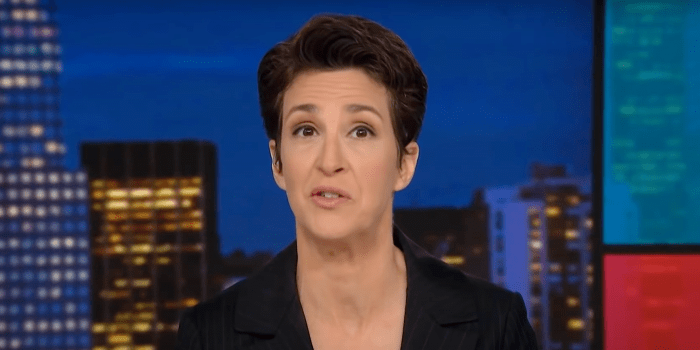
(Maire Clayton, Headline USA) MSNBC host Rachel Maddow ratings have gone down by almost 25% since President Donald Trump won the 2024 election, according to Fox News.

Her numbers have dropped from 2.3 million viewers to 1.8 million viewers. It only gets worse for the leftist host as she lost 29% of younger viewers aged 25-54.

Fox News compared the first two months of 2025 to the first two months of 2024 and found Maddow lost 24% among both total viewers and the key demographic.

The rating slump doesn’t come as a surprise as MSNBC reportedly cut the majority of staffers who worked on Maddow’s show.

Maddow blasted her bosses for the massive layoffs.

“That has never happened at this scale, in this way before when it comes to programming changes, presumably because it’s not the right way to treat people, and it’s inefficient and it’s unnecessary,” Maddow said. “And it kind of drops the bottom out of whether or not people feel like this is a good place to work, and so we don’t generally do things that way.”

Media critic William Jacobson told Fox News it was to be expected that there would be a decline in viewership.

“It’s not surprising that an audience built around the promise of defeating Trump would significantly fade away when Trump won,” Jacobson said.

Maddow will soon return to only hosting once a week in April, as she has been on air every weekday during the first 100 days of Trump’s presidency.

“When she goes back to one night a week for $25 million a year, which is one hell of a deal, the network will continue to shrink to the point where it may appear that they have more employees than actual viewers,” Fox News contributor Joe Concha told the outlet.

Fiscal 2025 Budget Deficit Tops $1 Trillion

(Mike Maharrey, Money Metals News Service) The federal government ran yet another massive budget deficit in February, pushing the total budget shortfall to over $1 trillion just five months into the fiscal year.

The federal government spent $307.01 billion more than it took in last month. That drove the cumulative deficit for fiscal 2025 to $1.15 trillion with seven months left. It is the biggest deficit ever through five months.

The Treasury collected $296.42 billion in February. That was a 9.3 percent increase in revenue over February 2024.

So far, in fiscal 2025, government tax receipts total $1.89 trillion. That’s about $3 billion more than the same period last year, but according to a Treasury Department official, the 2024 revenue figure was inflated by deferred tax payments from 2023 related to natural disasters.

The real problem is on the spending side of the ledger.

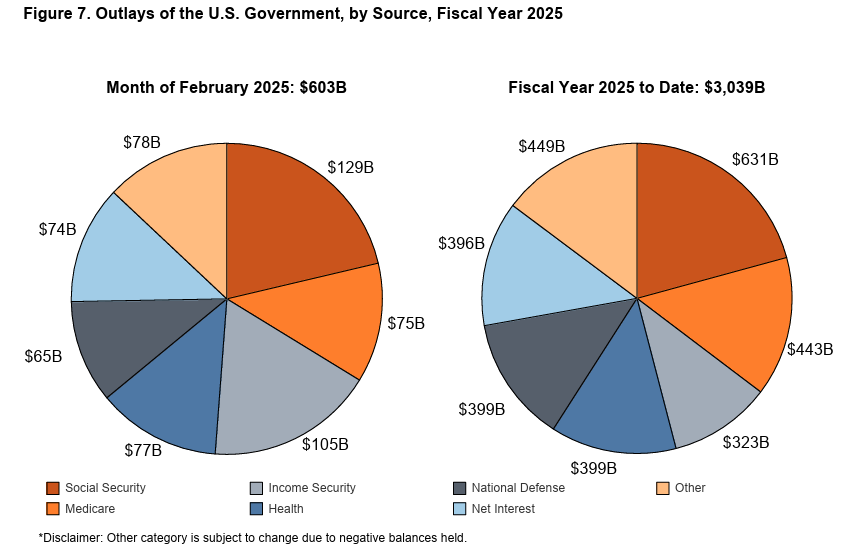
The Trump administration blew through $603.44 billion last month, a 6.3 percent increase over February 2024. That drove total spending in fiscal 2025 to $3.04 trillion, a 13.4 percent increase compared to the first five months of fiscal 2024.

You might recall that President Biden promised that the [pretend] spending cuts would save “hundreds of billions” with the debt ceiling deal (aka the [misnamed] Fiscal Responsibility Act).

That never happened.

And appears the Republicans aren’t going to do any better. The spending plan being kicked around by Congress would increase the deficit by some $6 trillion over the next decade.

The truth is the federal government always manages to find new reasons to spend money, whether for natural disasters at home or wars overseas. The Biden administration blew through a staggering $6.75 trillion in fiscal 2024, a 10 percent increase over 2023 outlays.

Interest on the national debt cost $85.87 billion in February. That brought the total interest expense for the fiscal year to $478.05 billion, up 10.3 percent over the same period in 2024.

So far, in fiscal 2025, the federal government has spent more on interest on the debt than it has on national defense ($399 billion) or Medicare ($443 billion). The only higher spending category is Social Security.

Uncle Sam paid $1.13 trillion in interest expenses in fiscal 2023. It was the first time interest expense has ever eclipsed $1 trillion. Projections are for interest expense to break that record in fiscal 2025.

Much of the debt currently on the books was financed at very low rates before the Federal Reserve started its hiking cycle. Every month, some of that super-low-yielding paper matures and has to be replaced by bonds yielding much higher rates. And even with the recent Federal Reserve rate cuts, Treasury yields have pushed upward as demand for U.S. debt sags.

This is one of the reasons everybody is clamoring for interest rate cuts despite stubborn price inflation.

Ramifications

These big deficits pile onto a national debt that officially topped $36 trillion in November. Currently, the debt level is steady because the federal government is up against the debt ceiling. However, you can expect the huge surge in debt once Congress raises the ceiling. (And it will raise the ceiling.)

Some people claim that borrowing, spending, and big national debts don’t matter.

They do.

According to the national debt clock, the current debt level represents 122.48 percent of GDP. Studies have shown a debt-to-GDP ratio of over 90 percent retards economic growth by about 30 percent.

And as the Bipartisan Policy Center points out, the growing national debt and the mounting fiscal irresponsibility undermine the dollar.

“Confidence in U.S. creditworthiness may be undermined by a rapidly deteriorating fiscal situation, an increasing concern with federal debt set to grow substantially in the coming years.”

This could lead to lower economic growth, higher unemployment, and less investment wealth.

Lack of confidence in the U.S. fiscal situation could also lower demand for U.S. debt. This would force interest rates on U.S. Treasuries even higher to attract investors, exacerbating the interest payment problem. As already mentioned, we saw a big spike in Treasury yields despite Fed rate cuts.

Biden ran the debt higher at a dizzying pace, but to be fair, this isn’t just a Biden problem. Every president since Calvin Coolidge has left the U.S. with a bigger national debt than when he took office.

DOGE has done a great job of pointing out government waste, but it’s going to take more to get the borrowing and spending under control. Even if the Trump administration manages to slash discretionary spending as promised, that only accounts for 27 percent of total spending. The vast majority is for entitlements, and there is little political will to take the scissors to Social Security or Medicare.

And the sad fact is that most people in positions of power are content to kick the debt can down the road. They reason, ‘Nothing has happened yet, so why worry?’ But the problem with playing kick the can down the road is that you eventually run out of road.


Mike Maharrey is a journalist and market analyst for Money Metals with over a decade of experience in precious metals. He holds a BS in accounting from the University of Kentucky and a BA in journalism from the University of South Florida.

Gold and Silver Look Ready to Rock and Roll

(Jesse Colombo, Money Metals News Service) The financial markets have been all over the place this week, with stocks swinging back and forth without a clear direction.

The session opened on a positive note after a benign U.S. Consumer Price Index (CPI) report showed core inflation rising just 3.1% in February, lower than expected. This initially lifted stock indices, but the rally quickly faded as selling pressure took over, signaling market weakness and hesitation to rebound after recent declines.

Amid the uncertainty, gold and silver stood out as bright spots, gaining 0.89% and 1.8%, respectively, and moving toward a key technical breakout that could mark the next leg of the precious metals bull market.

Gold has shown impressive resilience in recent weeks, holding steady even as the broader markets plunged—a clear sign of strength. Over the past year, its powerful nearly $1,000 per ounce uptrend has been punctuated by healthy consolidations, and this recent pause appears to be another of those necessary breathers.

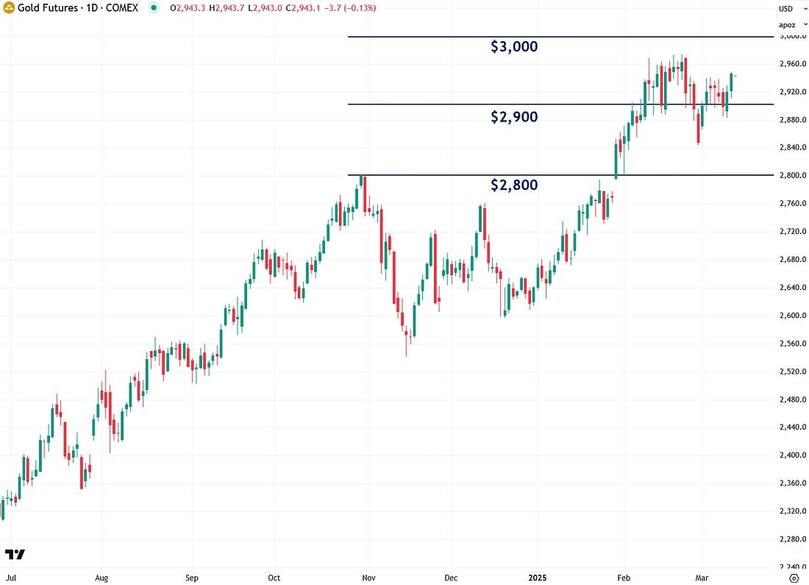
I closely track $100 increments in COMEX gold futures, as they often serve as key support and resistance levels. Despite a few attempts to dip below $2,900, gold has held firm, and today’s rise suggests it may finally be ready to challenge the critical $3,000 resistance—a level of immense psychological significance.

A decisive, high-volume close above this threshold should pave the way for even greater gains, potentially pushing gold toward $3,380 in this rally, assuming it follows its trajectory of the past three economic cycles.

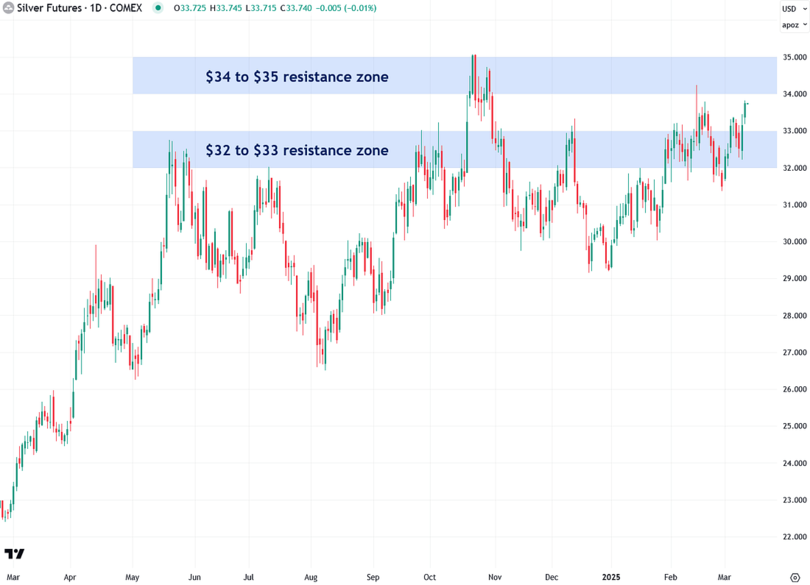
Let’s turn to silver, which had an impressive day, finally closing above the critical $32 to $33 resistance zone—a level it had struggled to break all year. Once silver clears this barrier, it’s likely to surge.

Fortunately, we may now be witnessing the early stages of that breakout. However, for stronger confirmation, I want to see a decisive close above the $34 to $35 resistance zone that formed at the late October high.

Once that happens, I believe silver will have nothing holding it back, setting the stage for a move into the $40 to $50+ range.

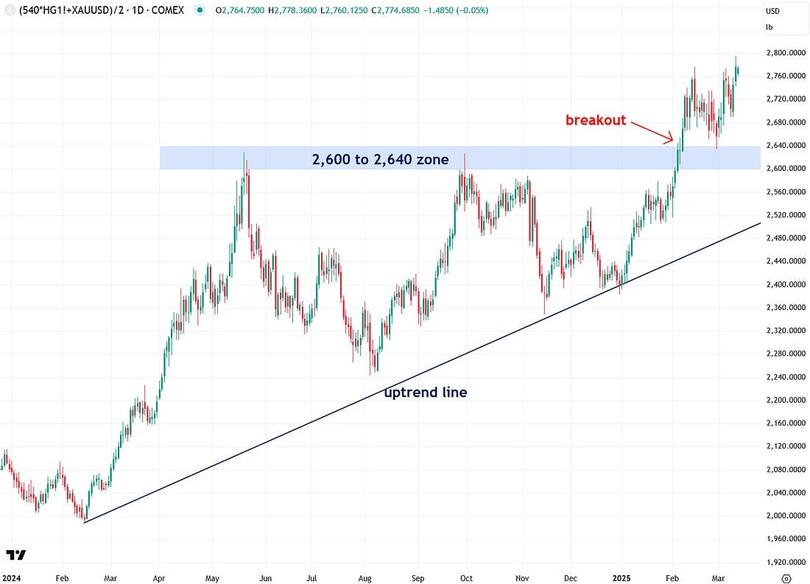
While most people instinctively recognize gold’s influence on silver prices, fewer realize the significant role copper plays in influencing silver’s movement. This understanding led me to develop the Synthetic Silver Price Index (SSPI)—an indicator designed to validate silver’s price movements and filter out potential fakeouts. The SSPI is calculated as the average price of gold and copper, with copper adjusted by a factor of 540 to ensure gold doesn’t disproportionately impact the index. Remarkably, despite silver not being an input, the SSPI closely mirrors silver’s price movements.

For several months, I’ve been closely watching the SSPI as it struggled to break above the critical 2,600 to 2,640 resistance zone, repeatedly emphasizing that a breakout above this level would be a strong bullish confirmation for silver.

Thanks to recent impressive rallies in both copper and gold, that long-anticipated breakout has finally occurred, signaling that a significant move in silver is likely imminent.

The Synthetic Silver Price Index is gaining strong momentum, fueled by rallies in both gold and copper, which are in solid technical positions.

Copper recently broke out of a triangle pattern, sparking a strong uptrend. The next key test is the $5 to $5.20 resistance zone—if copper can achieve a decisive close above this level, it should trigger an even stronger phase of its bull market.

Given their correlation, this breakout would likely propel silver to impressive new highs as well.

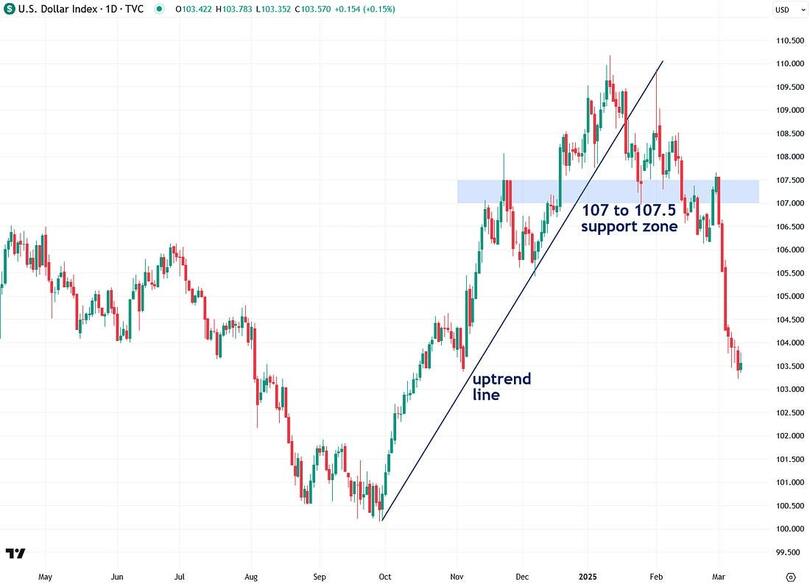
Meanwhile, one of the key reasons precious metals have remained strong recently is the sharp decline in the U.S. Dollar Index.

Since the Dollar Index and precious metals move inversely, weakness in the dollar typically fuels bullish momentum in gold and silver, and vice versa.

The dollar’s surge leading up to and following the U.S. presidential election triggered a steep drop in gold and silver, leading many to believe the rally was over—but that wasn’t the case.

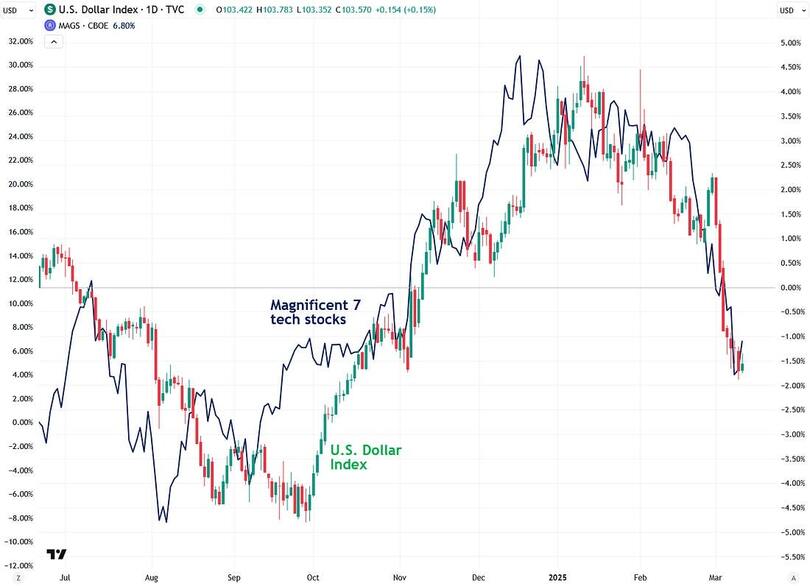
Interestingly, one of the primary drivers behind last fall’s surge in the U.S. Dollar Index—coinciding with Donald Trump’s increasing odds of winning the presidential election—was a massive influx of global capital into the U.S. stock market.

Much of this capital flowed into the so-called “Magnificent Seven” stocks: Alphabet, Amazon, Apple, Meta, Microsoft, NVIDIA, and Tesla.

The chart below compares the U.S. Dollar Index with the Magnificent Seven ETF (ticker: MAGS), highlighting their strong correlation during both the fall rally and the recent sharp decline.

This pullback in the Magnificent Seven—stocks that I believe are caught in a speculative bubble—has contributed to the dollar’s weakness, which, in turn, has provided a tailwind for precious metals.

There’s even more good news for precious metals and mining stock investors.

As Crescat Capital’s macro strategist Tavi Costa recently highlighted, the U.S. Dollar Index is currently at one of its most overvalued levels relative to other fiat currencies in over 120 years of data. Similar extremes in 1933 and 1985 were short-lived and followed by significant devaluations.

Given this historical precedent, there’s a strong probability of further dollar weakness ahead—an outcome that would be highly favorable for precious metals and mining stocks.

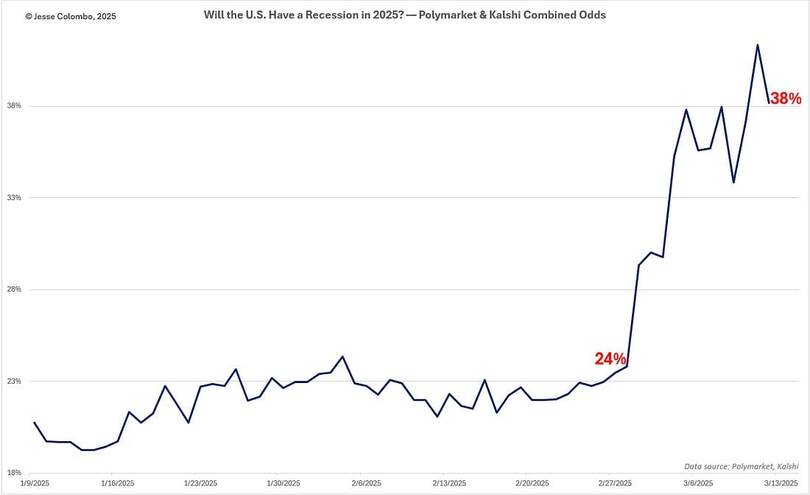
Another factor weighing on the dollar and stocks—while providing a tailwind for gold and silver—is the growing risk of a recession.

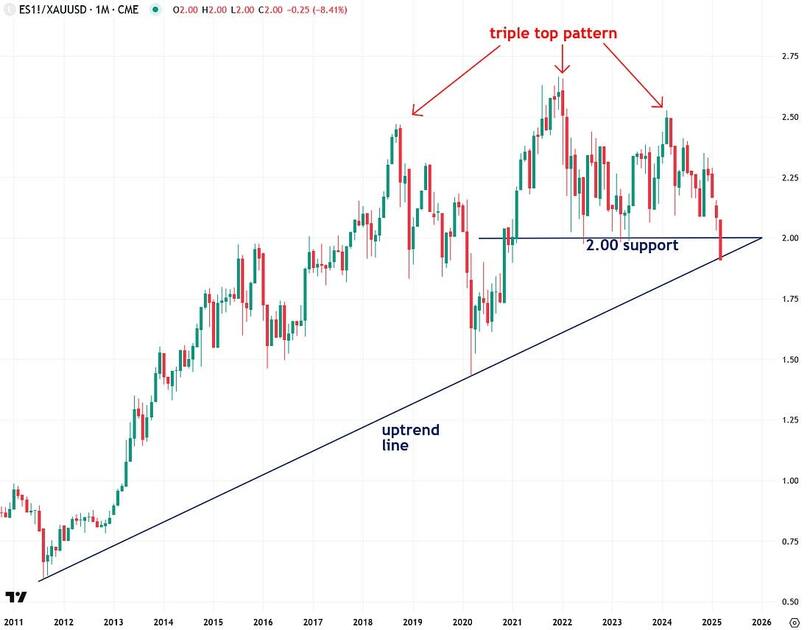
A noteworthy development in the past few days is the sharp breakdown of the bellwether S&P 500 index relative to gold.

As shown in the chart below, the S&P 500-to-gold ratio has fallen below the key 2.00 support level this week and is now on the verge of breaking below a long-term uptrend line dating back to 2011.

This signals a major capital rotation from stocks into gold, a shift that historically precedes periods where gold significantly outperforms equities.

Such transitions often mark the beginning of the most explosive phases of a precious metals bull market as well as equity bear markets. Note that the monthly S&P 500-to-gold ratio candle needs to close under both support levels for full confirmation.

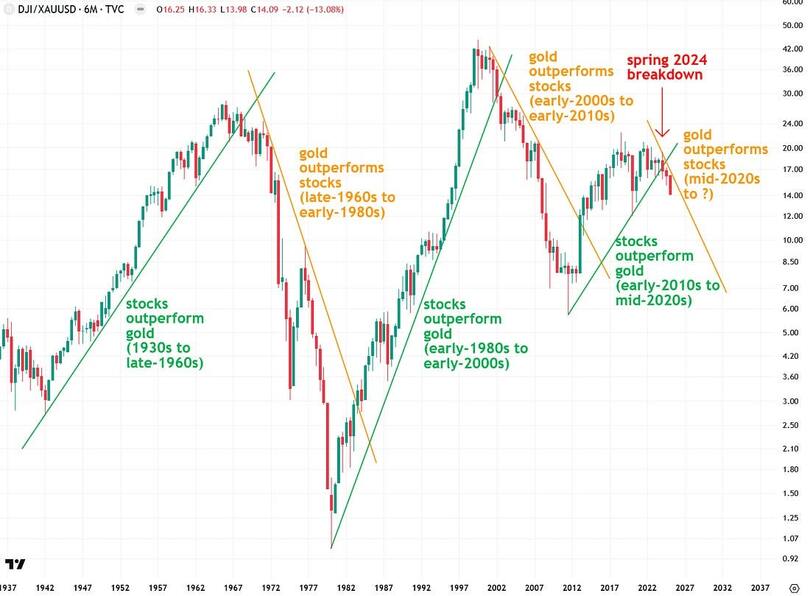
This week’s breakdown in the S&P 500-to-gold ratio further reinforces the trend I’ve highlighted in recent months with the Dow-to-Gold ratio. That chart showed a major breakdown beginning a year ago, and the decline is now accelerating.

This signals that the precious metals bull market is still in its early stages, rather than nearing maturity, implying significant upside potential ahead.

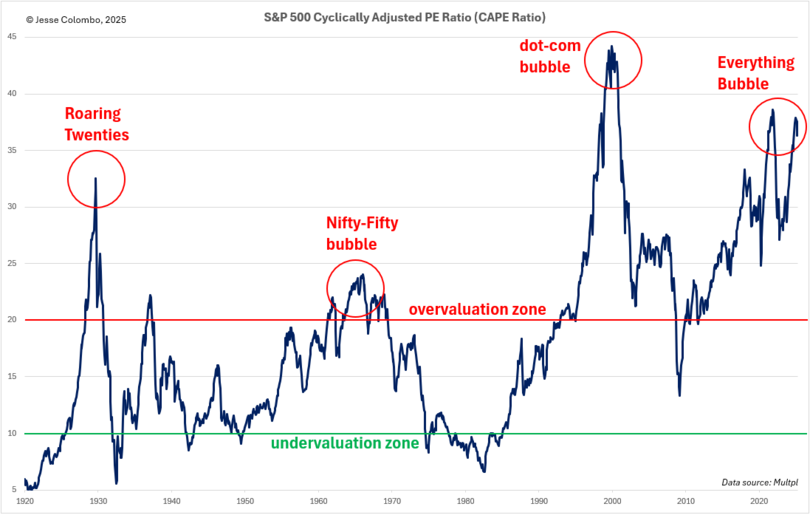
The ratios of major U.S. stock indices to gold have much further to fall, as they remain deeply entrenched in a massive bubble—one confirmed by multiple indicators, including the S&P 500’s cyclically adjusted price-to-earnings (CAPE) ratio.

As the bubble deflates and valuations revert to the mean, I see trillions of dollars flowing into precious metals and mining stocks, driving them significantly higher.

I ultimately see gold reaching at least $15,000 per ounce and silver surpassing $300 as these bubbles burst, triggering a massive financial reset.

In summary, gold and silver remain in strong positions, holding up well despite recent volatility in global financial markets.

I have a strong sense that a major breakout is imminent, but full confirmation is needed—specifically, COMEX silver futures must close above the $34 to $35 resistance zone, and COMEX gold futures must surpass the critical $3,000 level.

Once these breakouts occur, I expect the next phase of the precious metals bull market to shift into a much more dynamic and powerful stage, contrasting with the steady, orderly climb of the past year.


Jesse Colombo is a financial analyst and investor writing on macro-economics and precious metals markets. Recognized by The Times of London, he has built a reputation for warning about economic bubbles and future financial crises. An advocate for free markets and sound money, Colombo was also named one of LinkedIn’s Top Voices in Economy & Finance. His Substack can be accessed here.

BREAKING: Jewish Protestors Storm Trump Tower

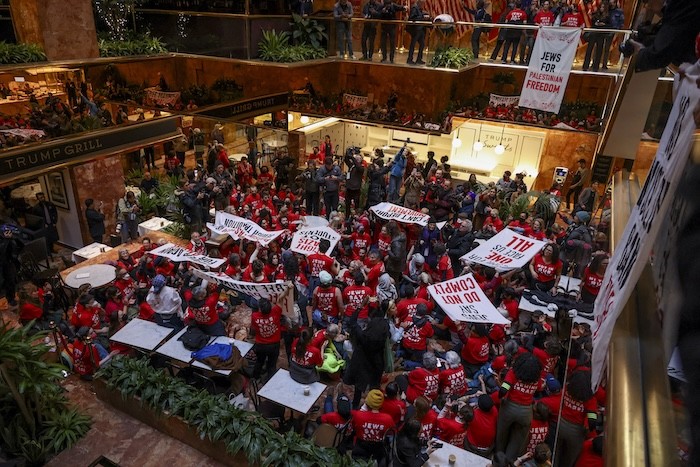
(Headline USA) Demonstrators from a Jewish group filled the lobby of Trump Tower on Thursday to denounce the immigration arrest of Mahmoud Khalil. a pro-Palestinian activist who helped lead protests against Israel at Columbia University.

The Jewish Voice for Peace protesters, who carried banners and wore red shirts reading “Jews say stop arming Israel,” chanted “Bring Mahmoud home now!”

After warning the protesters to leave the Fifth Avenue building, officers arrested 98 of them on various charges including trespassing, obstruction and resisting arrest, a police official said at a news briefing.

It’s not clear how so many protestors were allowed inside Trump Tower in the first place. The Trump administration has publicly commented on the matter as of the publication of this article.

Khalil, a 30-year-old permanent U.S. resident who is married to an American citizen and who hasn’t been charged with breaking any laws, was arrested outside his New York City apartment on Saturday and faces deportation. He’s being held at an immigration detention center in Louisiana.

President Donald Trump has said Khalil’s arrest was the first “of many to come” and vowed on social media to deport students who he said engage in “pro-terrorist, anti-Semitic, anti-American activity.” The White House didn’t immediately respond to a message seeking comment about the Trump Tower demonstration.

Among those who took part in Thursday’s protest was actor Debra Winger, who has discussed her Jewish faith and upbringing over the years.

“I’m just standing up for my rights, and I’m standing up for Mahmoud Khalil, who has been abducted illegally and taken to an undisclosed location,” she told The Associated Press. “Does that sound like America to you?”

Protester Sophie Edelhart, who studies Yiddish at a school in Canada, said she took part in the demonstration because she didn’t want to “cede ground” to Trump and “fascism.” She said the building, with its golden escalator that Trump rode before announcing his 2016 presidential run, was a symbolic target.

Trump Tower serves as headquarters for the Trump Organization and is where the president stays when he is in New York. The skyscraper often attracts demonstrations, both against and in support of its namesake, though protests inside are less common. The building’s main entrance opens to a multi-story atrium that is open to the public and connects visitors to stores and eateries such as the Trump Grill.

Kaz Daughtry, the deputy mayor for public safety and a former longtime New York Police Department official, said no one was injured in Thursday’s protest. But he said the city would assess the situation and review its procedures “so this cannot happen again.”

Khalil’s supporters say Khalil’s arrest is an attack on free speech and have staged protests elsewhere in the city and around the country. Hundreds demonstrated Wednesday outside a Manhattan courthouse during a brief hearing on his case.

Columbia was a focal point of the pro-Palestinian protest movement that swept across U.S. college campuses last year and led to more than 2,000 arrests.

On Thursday, Khalil and seven students identified by pseudonyms filed a lawsuit seeking to block a Congressional committee from obtaining Columbia and Barnard College disciplinary records for students involved in campus protests.

The lawsuit, filed in federal court in Manhattan against the schools, the Republican-led House Committee on Education and the Workforce and its chairman, Rep. Tim Walberg, R-Mich., seeks a permanent injunction barring Congress from forcing the schools to provide the records and the universities from complying with it.

The committee sent a letter last month demanding that Columbia and Barnard provide the records or risk billions of dollars in federal funding. The plaintiffs contend that the committee is abusing its power in an attempt “to chill and suppress speech and association based on the viewpoint expressed” and that its investigation “threatens to significantly infringe on First Amendment rights.”

Khalil, whose wife is pregnant with their first child, finished his requirements for a Columbia master’s degree in December. Born in Syria, he is a grandson of Palestinians who were forced to leave their homeland, his lawyers said in a legal filing.

Adapted from reporting by the Associated Press

Patriotic Whistleblower Explains in Court Why He Leaked Secret Pentagon Docs about Ukraine

(Headline USA) Jack Teixeira, the Massachusetts Air National Guard member who caused an international uproar when he leaked highly classified documents about the war in Ukraine, pleaded guilty to military charges of obstructing justice at his court-martial Thursday and called himself a “proud patriot.”

In a 10-minute address, Teixeira said he was “exposing and correcting the lies that were perpetrated by President Biden and force-fed to the American people” about the war in Ukraine.

“I believe the Department of Justice was politicized against President Trump and myself,” added Teixeira, who said he acted alone. He called on Trump and members of his administration to reverse his convictions.

“If I saved one American, Russian or Ukrainian life in this money-grabbing war, my punishment was worth it,” he said.

The plea agreement calls for dishonorable discharge and no jail time. The judge approved the plea agreement, but had not addressed his sentencing yet, which was expected to occur later Thursday afternoon.

Teixeira pleaded guilty to the obstruction charge, admitting that he used a hammer to destroy a cellphone, a computer hard drive and an iPad after seeing some news reports of the leaked documents. He also admitted to telling his friend to destroy messages exchanged on a communication app.

“I was scared about a potential law enforcement investigation into me and my friends,” he said in court Thursday.

As the sentencing phase began, Teixeira’s parents said he took an early interest in the military as a child. His father, also named Jack Teixeira, described him as “a good kid, energetic, intelligent, and quirky.”

When his son decided to join the military, “I was excited about it,” the elder Teixeira said. ”It was a good option for Jack.” He said it gave him direction and the chance to see the world.

“He made a mistake,” his mother, Dawn Dufault, said. “Everyone makes mistakes. He’s my son, I love him. He deserves a second chance.”

Thursday’s military tribunal hearing comes after Teixeira was already sentenced in federal court last year to 15 years in prison. In federal court, he pleaded guilty to six counts of willful retention and transmission of national defense information under the Espionage Act, following his arrest in the most consequential national security breach in years.

Among other revelations, Teixeira’s disclosures showed that the U.S. has boots on the ground in Ukraine, the U.S. the Biden administration spied on Ukrainian President Volodymyr Zelenskyy and that the war there was going worse for Ukraine that officials were saying publicly—while shoveling more than $100 billion toward that effort.

The leaked documents also revealed assessments of the defense capabilities of Taiwan and internal arguments in Britain, Egypt, Israel, South Korea and Japan. Teixeira also admitted to posting information about a U.S. adversary’s plans to harm U.S. forces serving overseas.

Teixeira worked as an information technology specialist responsible for military communications networks. His lawyers described Teixeira as an autistic, isolated individual who spent most of his time online, especially with his Discord community, and never meant to harm the United States.

Instead of being hailed as a whistleblower for exposing Biden’s lies and malfeasance, mainstream media outlets and Democrat politicians have accused him of being a traitor. The New York Times and government-funded publication Bellingcat went as far as help the FBI identify Teixeira as the alleged leaker.

Since then, the FBI has reportedly been visiting the homes of people who posted stories about the leaked Pentagon documents in an “intimidating” attempt to remove such content from the internet.

The judge presiding over Teixeira’s case also issued an unconstitutional order for reporters and other third parties to destroy Teixeira’s sentencing memorandum, which was apparently inadvertently filed on the public court docket when it was supposed to be sealed. The judge rescinded her unconstitutional order a day later.

Ken Silva contributed to this report.

Adapted from reporting by the Associated Press.


Improved CPI Data Sets Stage for More Inflation

(Mike Maharrey, Money Metals News Service) Price inflation moderated in February, setting the stage for more inflation. The CPI data for last month wasn’t bad. It broke a four-month upward trend, and the numbers all came in lower than forecast.

But the CPI data for last month wasn’t great either. Even with the dip in the numbers, the headline annual CPI rate is still higher than it was last November, and core CPI remains mired above 3 percent.

The February CPI Data

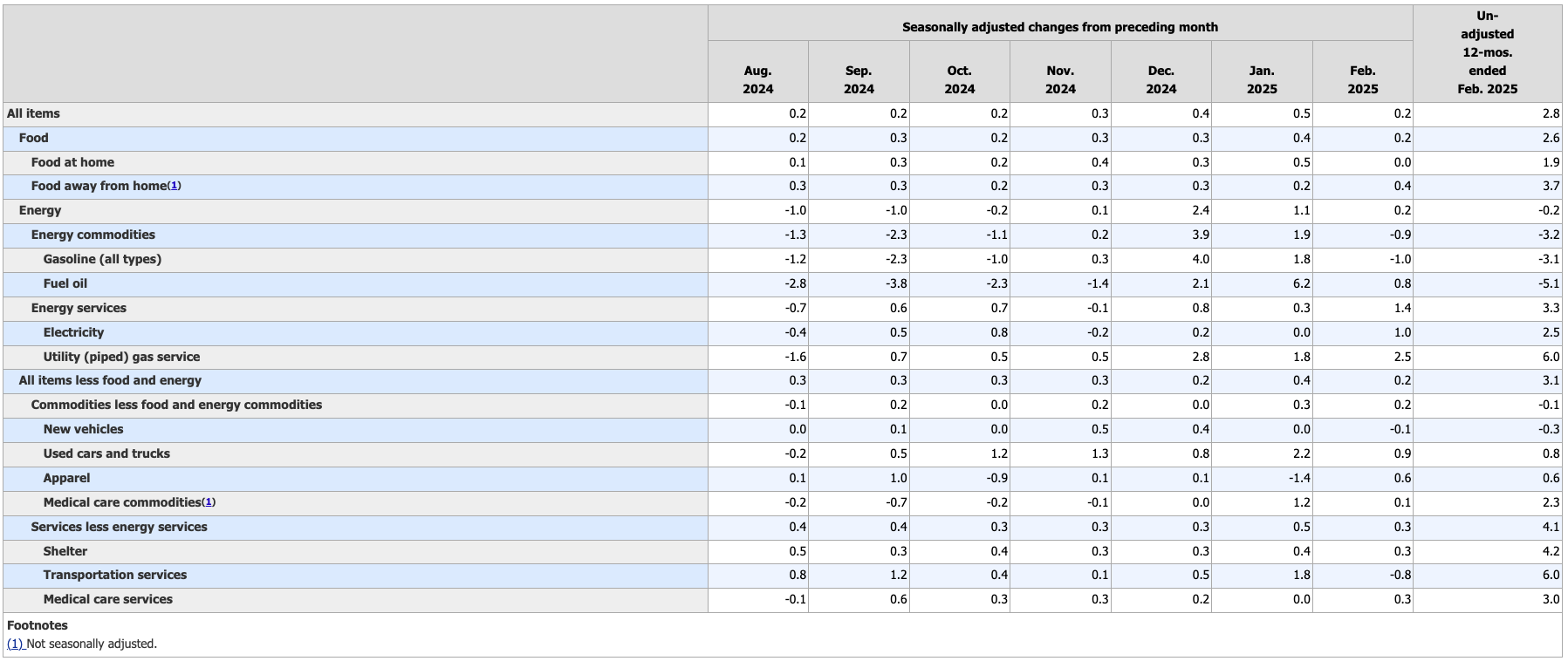
On an annual basis, prices rose by 2.8 percent in February, according to the latest release from the Bureau of Labor Statistics (BLS). This was down from 3.0 percent in January.

It’s important to put this number into context. This was the first drop in the annual CPI rate since September. Before that, prices crept up from 2.4 percent in September, 2.6 percent in October, 2.7 percent in November, and 2.9 percent in December.

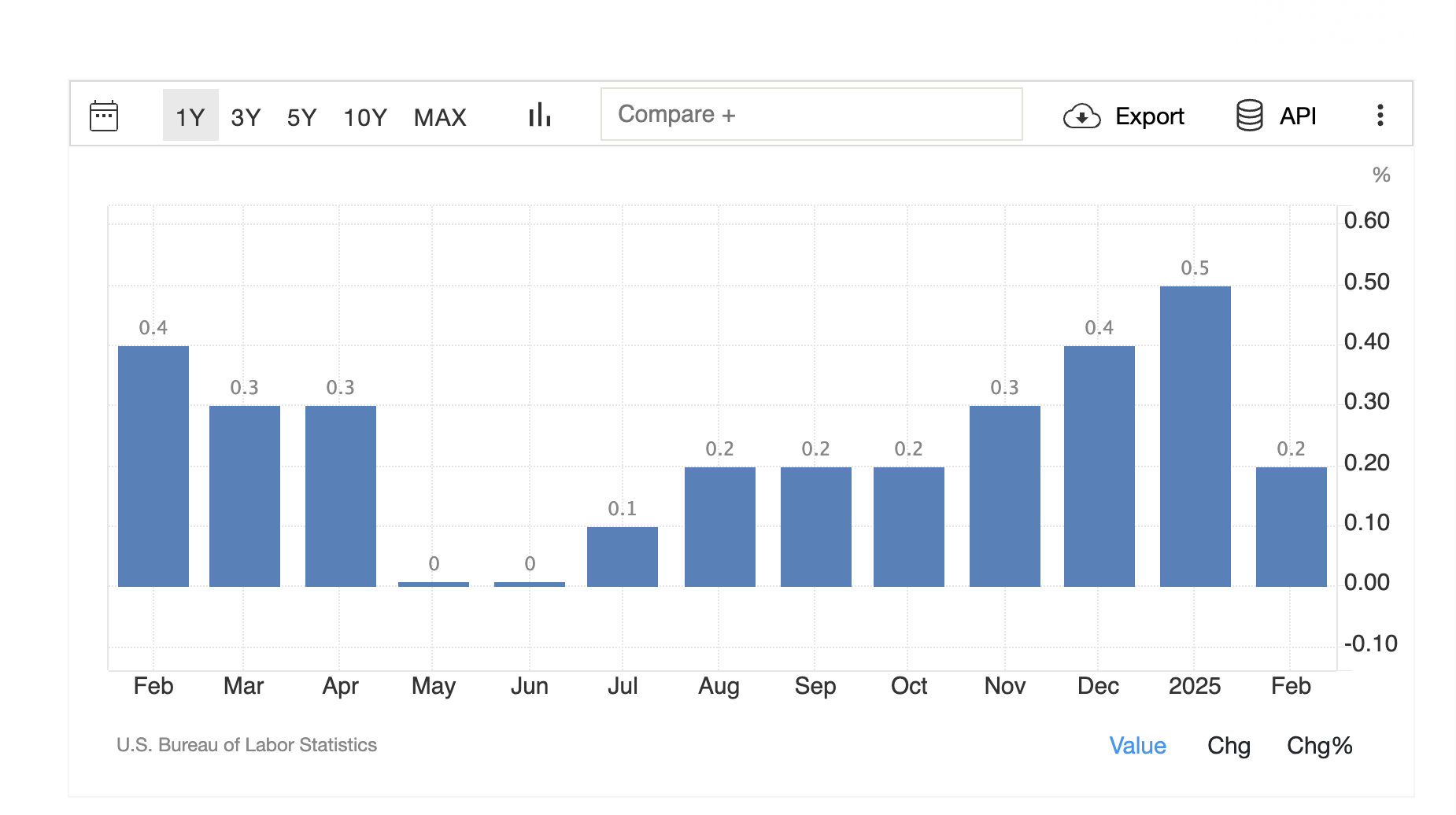
We’ve also seen this song and dance before. Month-on-month CPI dropped to zero last spring, only to surge again later in the year.

Chart courtesy of Trading Economics

One shouldn’t draw conclusions from a one-off report. It could be the beginning of a downward trend, but it could also be an anomaly.

Stripping out more volatile food and energy prices, the core CPI also moderated, coming in at 0.2 percent in February. That pushed the annual core CPI down to 3.1 percent. Core CPI has been mired in this range since last May and we still haven’t seen a core reading below 3 percent.

One might note that all these numbers remain well above the mythical 2 percent target.

Also keep in mind that the CPI doesn’t tell the entire story of inflation. The government revised the CPI formula in the 1990s so that it understated the actual rise in prices. Based on the formula used in the 1970s, CPI is closer to double the official numbers. So, if the BLS was using the old formula, we’re looking at CPI closer to 6 percent. And using an honest formula, it would probably be worse than that.

Looking more closely at the data, we find that a big drop in gasoline prices (-1.0 percent month-on-month) and energy commodities (-0.9 percent month-on-month) helped push overall CPI down.

Lower airline fares and dip in new car prices also helped pull the index lower.

Prices in virtually every other category rose last month, albeit at a slower rate.

This underscores a painful reality — you’re still paying more for everything even when there is “good news” on the price inflation front.

The producer price index data was also cooler than expected, adding more optimism on the inflation front.

On a monthly basis, PPI was unchanged. The forecast was for a 0.3 percent increase in producer prices. Core PPI fell -0.1 percent month-on-month. On an annual basis producer prices were up 3.2 percent, with the core PPI coming in at 3.4 percent. Both annual numbers were 0.1 percent below the forecast.

There was one hint of caution in the mainstream analysis of the February CPI data. Many analysts noted that the February report doesn’t reflect the impact of tariffs.

Setting the Stage for More Inflation

The better-than-expected CPI report boosted optimism that the Federal Reserve might resume cutting interest rates sooner than expected. A CNBC headline trumpeted, “Latest U.S. inflation data gives Fed cover to lower rates.”

FX Empire analyst James Hyerczyk said that the CPI numbers could prompt the Fed to cut rates earlier than forecast, triggering the next leg up for gold.

In other words, one month of mildly optimistic CPI data has raised expectations for more inflation!

Rate cuts encourage borrowing. In turn, this boosts the money supply. This is, by definition, inflation. One of the symptoms of this monetary inflation is price inflation. In other words, any victory over price inflation opens the door for the Fed to resume the very policy that gave us higher price inflation to begin with.

We’re already seeing this inflationary pressure manifest after the first round of rate cuts and the slowdown balance sheet reduction.

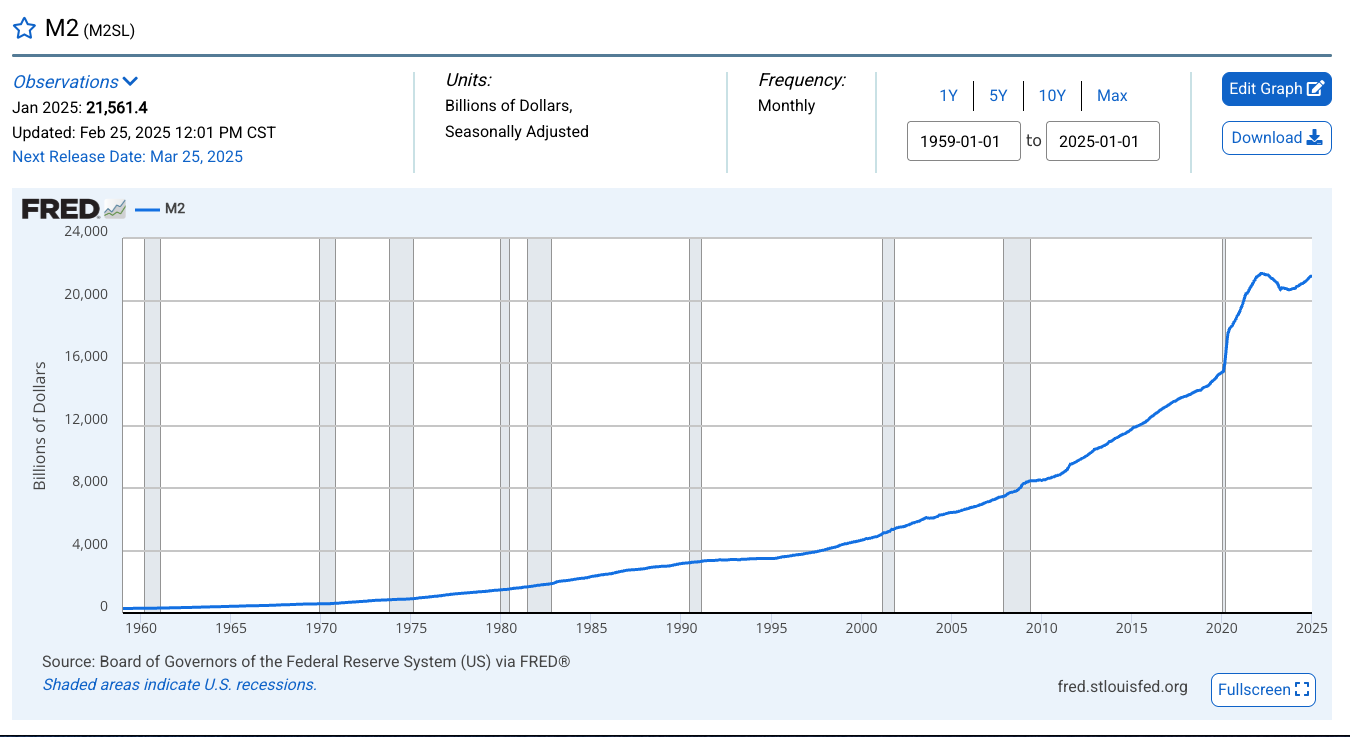
The M2 money supply bottomed a little over a year ago at $20.60 trillion. Since then, it has crept upward. As of January, it was at 21.56 trillion. That’s the highest level since September 2022 and approaching the all-time high of $21.72 trillion hit in the spring of 2022.

The money supply rose by 0.4 percent in December alone. This represents an annual monetary inflation rate of nearly 5 percent.

The Chicago Fed National Financial Conditions Index also reflects this increasingly inflationary environment. As of the week ending March 7, the NFCI stood at -0.57. A negative number reflects historically loose financial conditions.

And the markets want even more looseness!

This underscores the problem facing the central bankers over at the Fed.

The reality is the Federal Reserve is in a Catch-22. Given the escalating inflationary pressure, it needs to push rates even higher. After all, it never did do enough to slay the inflation monster. The bottom line is that the inflation dragon isn’t dead. Sure, the Fed might have knocked it to the mat. But it’s not down for the count.

On the other hand, the central bank needs to cut rates because the economy is addicted to easy money. Given the levels of debt and the amount of malinvestment, the economy can’t function in this higher interest rate environment. It needs its easy money drug.

How Powell & Company will navigate this remains to be seen, but they certainly can’t simultaneously raise and lower interest rates. They are walking a tightrope. The question is which way will they fall?


Mike Maharrey is a journalist and market analyst for Money Metals with over a decade of experience in precious metals. He holds a BS in accounting from the University of Kentucky and a BA in journalism from the University of South Florida.