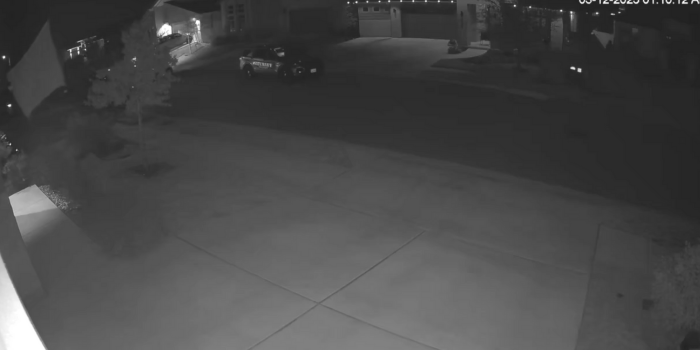
(Maire Clayton, Headline USA) Conservative influencers are increasingly being targeted in swatting incidents—false alarm 9-1-1 calls that lead police to responding to an unsuspecting person’s home.
Journalist Breanna Morello first reported the growing issue in a Friday post on Substack.
Those affected include Benny Johnson, Joe Pags, Catturd, Gunther Eagleman, Chase Geiser and Shawn Farash, with others wanting to remain anonymous.
Morello found a pattern with five out of the six individuals in how they were swatted.
The “individuals received unsolicited pizza deliveries from either Papa John’s or Domino’s, typically occurring just before or after the swatting calls.”
“These orders, marked ‘COD’ (cash on delivery), were not prepaid, leaving the targets to deal with confused delivery drivers,” Morello continued. “In some cases, the phone numbers attached to the orders traced back to local police departments, suggesting a deliberate attempt to escalate the prank—or mask its origins.”
Catturd posted on X they got swatted for the fourth time early Friday morning.
I was just swatted again for the 4th time. As I tweeted earlier, I live in the middle of nowhere and know all the cops here. (because of the past swattings) they knew what it was immediately and just called me and sent one officer who I just had a great conversation with. Really…
Infowars reporter Chase Geiser said he was swatted twice within a 12 hour period early Wednesday morning.
FBI Director Kash Patel addressed the growing issue Friday in a social media post.
“I want to address the alarming rise in ‘Swatting’ incidents targeting media figures,” Patel began. “The FBI is aware of this dangerous trend, and my team and I are already taking action to investigate and hold those responsible accountable.”
I want to address the alarming rise in ‘Swatting’ incidents targeting media figures. The FBI is aware of this dangerous trend, and my team and I are already taking action to investigate and hold those responsible accountable.
This isn’t about politics—weaponizing law enforcement…
— FBI Director Kash Patel (@FBIDirectorKash) March 14, 2025
Patel added there would be additional updates regarding the incidents.
“This isn’t about politics—weaponizing law enforcement against ANY American is not only morally reprehensible but also endangers lives, including those of our officers,” he noted. “That will not be tolerated. We are fully committed to working with local law enforcement to crack down on these crimes.”
Eagleman, who was also targeted in prior swatting attempts, quickly thanked Patel for addressing the issue.
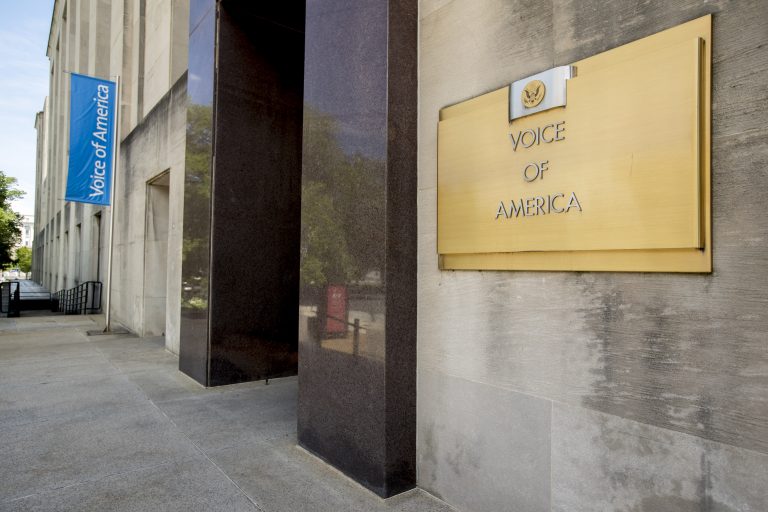
(Headline USA) The government agency that runs the Voice of America has moved to terminate contracts with The Associated Press, Reuters and Agence France-Presse, and told its journalists Friday to stop using material from the wire services.
Kari Lake, the former broadcaster turned Republican politician who was selected by President Donald Trump to run VOA, estimated the move would save $53 million.
I moved today to cancel expensive and unnecessary newswire contracts for US Agency for Global Media, including tens-of-millions of dollars in contracts with The Associated Press, Reuters, and Agence France-Presse.
USAGM is an American taxpayer funded News Organization with an…
The new administration has quickly asserted its authority at VOA, which has delivered news from an American perspective to countries across the world. While awaiting official approval to take over, Lake was brought on as special adviser at the U.S. Agency for Global Media, which oversees VOA and sister organizations like Radio Free Europe.
She announced via social media on Thursday that she was ending the “expensive and unnecessary contracts” with the wire services.
“We should not be paying outside news organizations to tell us what the news is,” said Lake, who ran unsuccessfully for Arizona governor. “With a nearly billion-dollar budget, we should be producing news ourselves. And if that’s not possible, the American taxpayer should demand to know why.”
In a meeting on Friday, VOA staffers were told to stop using wire service material for their reports, according to journalists who spoke under condition of anonymity because they were not authorized to speak publicly on the issue.
At many news organizations, audio, video and text reports from wire services are used to supplement reports from locations where the company’s own journalists are not located.
There was no immediate comment from the AP or Reuters on Friday. AFP declined comment.
In another social media post, Lake said that she’s in fact-finding mode and “boy, am I finding a lot of nonsense that the American taxpayer should not be paying for.”
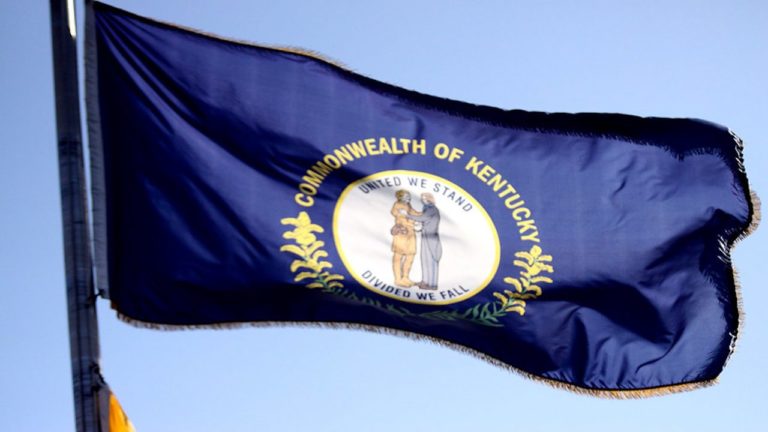
(Money Metals News Service) The Kentucky legislature has overwhelmingly passed a new sound money bill, sending the measure to Gov. Andy Beshear for his signature.
House Bill 2 aims to prevent the collection of sales taxes on gold and silver, and would enable taxpayers to sue the state for recovery of improper tax collections since a similar bill became law last summer.
Last year, Gov. Beshear purported to have exercised a line-item veto deleting a gold and silver sales tax exemption that had been included in a 2024 revenue bill. At the time, he sneered at Kentucky savers, saying, “If you own gold, you can afford to pay sales tax.”
In response, the legislature deemed Beshear’s line veto invalid and directed the provision to be formally codified by the Revisor of Statutes (which it was). The state attorney general also declared the governor’s veto invalid because the line-item veto power only exists in the state constitution with respect to appropriations bills, which this was not.
Ignoring state law, the governor directed the Kentucky Department of Revenue to continue collecting the tax, threatening businesses and investors with legal action.
Introduced by freshman legislator Rep. T.J. Roberts in January, House Bill 2 passed the state House, 76-17 and subsequently cleared the state Senate by another overwhelming vote of 30-6.
The bill reads: “Any aggrieved taxpayer who has had taxes collected from them in any purchase that are exempt under KRS 139.480(37), may maintain an action for a refund on behalf of themselves and others similarly situated, without need to resort to any administrative process, against any person collecting or holding such tax funds, including the Secretary of the Finance and Administration Cabinet and the Commissioner of the Department of Revenue.”
This bill is supported and sponsored by leaders of the Republican majority and was assigned a single-digit House Bill number, a designation usually assigned to priority bills with strong support.
In an interview with the Sound Money Defense League today, Rep. Roberts said, “The Kentucky state legislature has again affirmed that purchases of gold and silver should not be taxed. Gov. Beshear’s blatant abuse of power ends with the passage of House Bill 2.”
“Citizens of Kentucky, or of any state in the United States, for that matter, shouldn’t be taxed for trying to use, buy, or transact in honest, sound money,” said the freshman legislator from District 66 who has already become known for his pro-liberty views.
If HB 2 becomes law – whether signed by the governor or by veto override, aggrieved taxpayers will be entitled to reimbursement of their attorney’s fees and legal costs.
Rep. Roberts says he expects a veto from the governor, but that he’s committed to rallying the votes required to override it.
The Sound Money Defense League and Money Metals Exchange have worked for years in Kentucky to pass sound money legislation. Kentucky aims to become the 46th state to end this tax on purchases of gold and silver.
(Mike Maharrey, Money Metals News Service) I ran across a story the other day that can serve as a cautionary tale. I’ll tell you up front that there are a lot of unanswered questions in this story, but with a little speculation, I think I can squeeze out a lesson.
The lesson is to keep your mouth shut!
Headline: Florida Man Uses Fake ID to Steal Gold Bars.
You have to love those “Florida Man” headlines, right?
Anyway, according to the Hillsborough County Sheriff’s Office, a UPS truck pulled up to a Tampa home. A man approached the driver and told him the package belonged to him. The driver did the right thing. He didn’t just hand some rando the package. He asked for ID, which the man produced.
Turns out the ID was fake.
And what was in the package?
Gold bars.
Ouch.
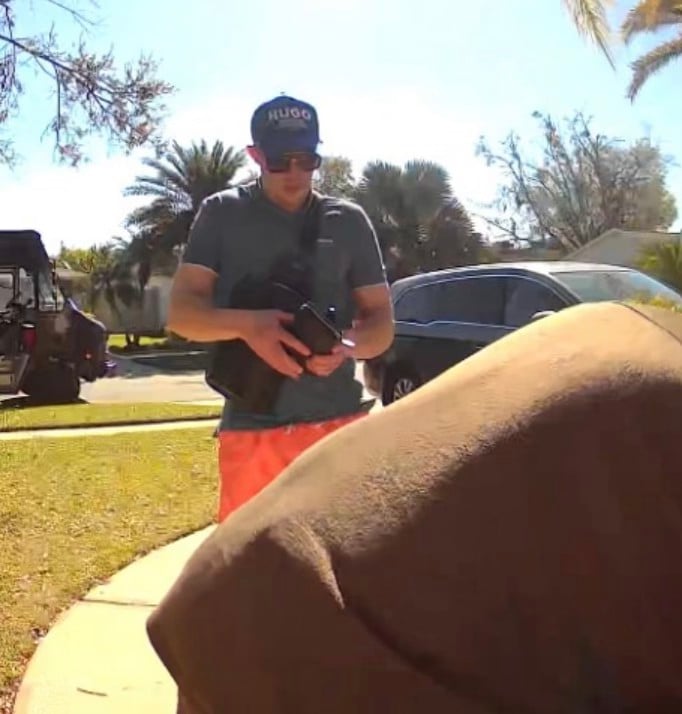
By the way, here’s a picture of our intrepid suspect:
Gold theft suspect. Tampa, Florida.
As I mentioned, this story comes with a lot of questions, chief among them: how did this guy get a fake ID matching up to a person who happened to be getting a shipment of gold?
A lot of people on the sheriff’s Facebook page speculated that it was an inside job. That’s certainly possible. An unscrupulous sales rep could have tipped off the thief. This underscores the importance of only doing business with reputable dealers.
But there’s another possibility — the person who bought the gold ran his mouth and the thief knew it was coming.
I throw this theory out for your consideration because something similar happened to my step dad.
He took a large sum of money out of the bank, talking loudly about how he didn’t trust the banking system. Somebody overheard him. Two thieves somehow managed to track him down. Posing as utility workers, they forced their way into his home, pistol whipped him, tied him up with a plastic bag over his head, and made off with a significant amount of cash.
Thankfully, he was able to get his hands loose and remove the bag before he suffocated. Police eventually caught the thieves and they admitted they knew he had cash because an associate overheard him talking in the bank.
It’s highly possible that the victim of this Tampa heist told people he was buying gold. Or maybe he posted about it on social media. As my stepdad’s story reveals – people listen and word gets around. And unsavory characters can be pretty dang resourceful when it comes to getting information.
Of course, this is all speculation, but keeping one’s mouth shut is always good advice. You don’t want to trumpet your business to the world.
However, it happens all the time.
Just the other day, somebody posted about all the gold they have at home on Facebook. He was bragging about how he wasn’t going to be the victim of some third-party vault who might not take good care of his gold. I guess that fair, but he is setting himself to lose his gold to thieves breaking into your home. Trust me, your home vault isn’t nearly as secure as you might imagine. I read a story recently about a band of burglars who made off with a huge safe that was bolted to the floor.
The bottom line is keep your business your business. Don’t paint a target on your back by advertising what you have, and don’t have.
Mike Maharrey is a journalist and market analyst for Money Metals with over a decade of experience in precious metals. He holds a BS in accounting from the University of Kentucky and a BA in journalism from the University of South Florida.
(Mike Maharrey, Money Metals News Service) Policies such as tariffs have consequences – both good and bad. It’s easy to focus on a policy decision’s perceived benefits, but it’s crucial to consider potential negative ramifications.
So, how could a prolonged trade war impact the precious metals markets?
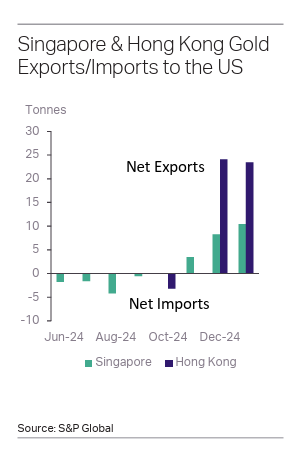
According to Metals Focus, about 600 tonnes of gold flowed into COMEX vaults in New York from December to February. Much of this gold came from London, but Singapore and Hong Kong also reported net outflows of about 70 tonnes.
As Metals Focus notes, the outflows of metal from Asia have tightened precious metals supplies driving wholesale premiums higher. We’ve also seen gold shortages in South Korea where the state-run mint paused gold bar sales.
This could be just the tip of the iceberg when it comes to the impact of tariffs on the precious metals market.
The Electronics Sector
Silver, and to a lesser extent gold, are both important inputs in the electronics sector. Industrial offtake accounts for over 50 percent of the annual silver demand. Much of this silver is used in electronics and solar energy applications.
Industrial demand is expected to rise by 7 percent this year and surpass 700 million ounces for the first time. Industrial demand set a record of 654.4 million ounces in 2023. As was the case last year, silver offtake for green energy applications is driving the increase in industrial demand.
Trump trade war 1.0 already altered the structure of electronics and semiconductor supply chains.
In 2018, the U.S. levied over $400 billion in tariffs on Chinese imports. In response, many companies sought to “de-risk” their supply chains by expanding their networks into other regions, including South-East Asia, India, Mexico, and Central and Eastern Europe.
It’s interesting to note that gold surged during this period, eclipsing $1,500 an ounce for the first time in six years by mid 2019.
The pandemic further disrupted supply chains. China’s draconian lockdowns led to a virtual halt in global electronics production. Once again responding to incentives, many companies sought to insulate themselves from future disruptions by adopting a “China+1” strategy to decentralize their supply chains.
Metals Focus said these factors have driven significant shifts in the industry.
“Vietnam has now emerged as a vital global hub for electronics manufacturing, particularly in mobile phones, laptops, and other electronic devices. Thailand has also become the largest producer of printed circuit boards (PCBs) in South-East Asia. While Malaysia, with a 13 percent share of the global packaging and testing market, is positioning itself as a key center for semiconductors. Finally, India has risen to become the world’s second-largest producer of mobile phones.”
While this decentralization has undoubtedly made supply chains more robust, electronic exports to the U.S. remain susceptible to U.S. tariff policies.
The recent announcement of large-scale reciprocal tariffs by the Trump administration has thrown the electronics industry into chaos. Metals Focus pointed out that multinational electronics manufacturers relied on “free trade” agreements as they built their supply chain networks.
“These companies have benefited from low-cost production in third countries, supplying products to the U.S. market through such agreements. However, this U.S. policy has created a dilemma for supply chains, necessitating major adjustments to their global operations.”
President Trump has said his goal is to bring manufacturing back to the U.S. While this may be a worthy endeavor, it won’t happen quickly or without a lot of pain.
Metals Focus noted that there are significant challenges in shifting manufacturing back to the U.S., particularly when it comes to semiconductors, photovoltaics, and auto production.
“This endeavor will be a long, drawn-out process, that requires significant human and capital investment from other countries to rebuild supply chain infrastructure.”
Analysts and Metals Focus said this may create opportunities for “local raw material suppliers to leverage their advantages and increase market share.”
According to a research paper by scientists at the University of New South Wales, solar manufacturers will likely require over 20 percent of the current annual silver supply by 2027. By 2050, solar panel production will use approximately 85–98 percent of the current global silver reserves.
China dominates the photovoltaic sector due to its capacity, price, and technological advantages. According to Metals Focus, assembly capacity has grown in South-East Asia, but much of this growth was fueled by Chinese investment.
In an attempt to return solar manufacturing to the U.S., the Biden administration upped tariffs on silicon-based solar products and critical metals imported from China to 50 percent on Jan. 1. The tariffs have since been expanded to include modules produced in Southeast Asia.
But according to Metals Focus, the U.S. faces significant challenges, “including insufficient production capacity for upstream raw materials, such as wafers and polysilicon, and key materials like silver paste and EVA film, which are primarily sourced from Chinese companies.”
“Additionally, many essential components for module assembly still require imports, impacting the industry’s autonomy. It is estimated that production costs in the US remain approximately 20-30% higher than in China, and even with tariff protection, competitiveness is constrained. China’s advantages in photovoltaic (PV) technology are expected to remain unchallenged in the short-term, allowing it to continue dominating the global solar market in the coming years.”
This underscores the fact that realigning global manufacturing isn’t as simple as slapping tariffs on things.
The Automotive Sector
The automotive industry will also feel the effects of tariffs.
The U.S. auto sector must compete against foreign imports. It seems like tariffing vehicles coming into the country would boost U.S. manufacturing, but it’s not that simple. The U.S. auto industry leans heavily on imported parts. Mexico supplies about 40 percent and Canada an additional 20 percent.
Metals Focus analyst project that a 25 percent tariff will increase vehicle prices, putting a drag on the entire sector.
“This will also impact PGMs [platinum group metals] used in emission systems. According to estimates by Metals Focus, if the US auto market loses 1m units in sales due to tariffs, PGM demand could fall by 160koz. This issue not only affects car manufacturers, but also has broader implications for the global precious metals market, influencing investment and production planning in related industries.”
According to Metals Focus, the bottom line is tariff policy is driving “significant” changes in global supply chains, including the movement of precious metals.
“Policies being enacted and proposed in the US and other regions are expected to further reshape the global production and trade landscape. Many companies are contemplating relocating some production bases to mitigate the effects of tariffs, but trade disputes may lead to retaliatory tariffs between nations, introducing further uncertainty into the redistribution of global industrial chains. Additionally, while tariffs may not significantly boost industrial demand in the US — due to increased production costs that could diminish their competitiveness — the competition for key raw materials and advanced technologies is likely to intensify.”
Mike Maharrey is a journalist and market analyst for Money Metals with over a decade of experience in precious metals. He holds a BS in accounting from the University of Kentucky and a BA in journalism from the University of South Florida.
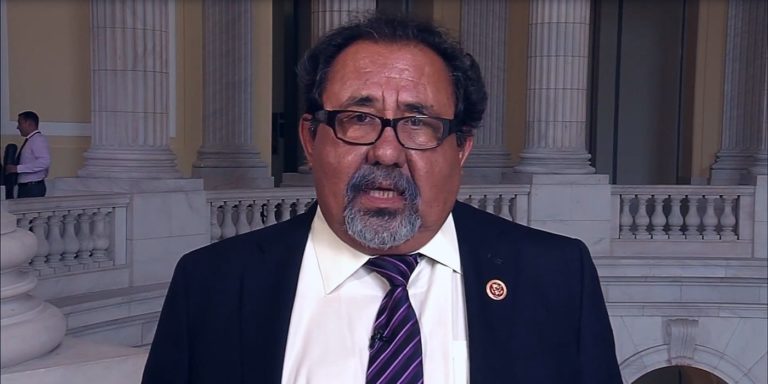
(Headline USA) Rep. Raúl M. Grijalva, D-Ariz., died Thursday—making him the second Democrat to die in office in as many weeks.
Grijalva, who was 77, had risen to chair the U.S. House Natural Resources Committee during his 12 terms representing southern Arizona, a powerful perch he used to shape the nation’s environmental policies.
Grijalva died of complications from cancer treatment, his office said in a statement. The treatments had sidelined him from Congress in recent months.
He stepped down as the top Democrat on the Natural Resources committee earlier this year, after announcing that he planned to retire rather than run for reelection in 2026.
Grijalva announced nearly a year ago that he had been diagnosed with cancer but would be able to continue his work. Despite missing hundreds of House votes, he sought reelection in 2024 and won easily in one of the most solidly Democratic districts in Arizona.
The seat, which represents a district spanning southern Arizona from Tucson to the border with Mexico, will remain vacant until a replacement is selected in a special election later this year.
The Democratic primary in the mostly Hispanic district is likely to be a fierce battle between allies of Grijalva, a longtime southern Arizona power broker who led an influential bloc of progressive elected officials, and a more moderate faction. Possible contenders include his daughter, Adelita Grijalva, a member of the Pima County Board of Supervisors, and Tucson Major Regina Romero, one of Grijalva’s longtime allies.
Another Democratic House member, Rep. Sylvester Turner of Texas, died last week from health issues.
Turner, in turn, had replaced U.S. Rep. Sheila Jackson Lee, who died last July after being diagnosed with pancreatic cancer.
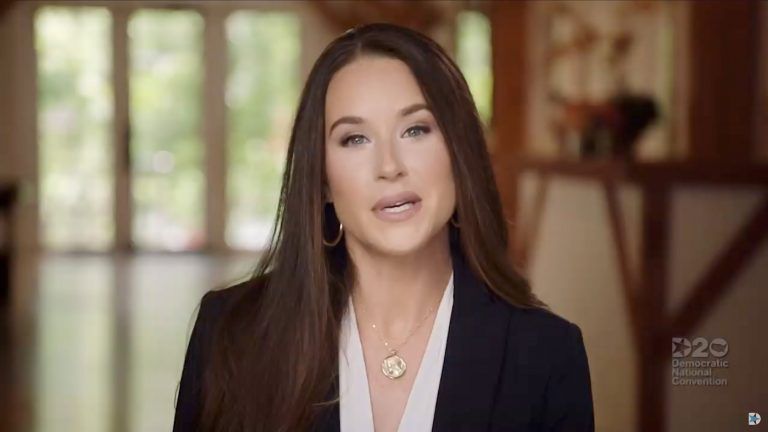
(Luis Cornelio, Headline USA) The Trump administration could soon cancel a taxpayer-funded lease on a Pennsylvania house used by the Secret Service to protect Ashley Biden, the adult daughter of former President Joe Biden.
The Department of Government Efficiency, which is recommending sweeping cuts to federal spending, listed the property among hundreds of government leases marked for termination. The house costs taxpayers $36,348 annually. In total, 700 agreements have been flagged for cancellation.
According to the Philadelphia Inquirer, DOGE’s move contradicts the Secret Service’s plan to honor Biden’s moratorium, which extended Ashley Biden’s taxpayer-funded protection through July 2025—months after her father left office.
Typically, only former presidents receive continued protection after leaving office.
“This Secret Service work site is essential to our operations and necessary to effectuate our protective functions,” Secret Service spokesperson Anthony Guglielmi told the Inquirer.
The General Services Administration, which has assisted DOGE in managing properties and finding cost-saving measures, denied involvement in targeting the Biden-tied property.
“None of the leases cited were flagged by GSA for termination,” GSA spokesperson Will Powell affirmed. “Both the Philadelphia and Wilmington leases are intact until the end of their term.”
It is unclear whether DOGE preemptively listed the house as part of its cost-saving measures in anticipation of its July termination.
The cost of protecting the Biden family has sparked controversy before. The Secret Service previously paid more than $30,000 per month to rent a luxury mansion in Malibu to protect Hunter Biden—who at the time was paying $20,000 a month for his own mansion.
“Typically, wherever a protectee sets up their residence, the Secret Service is forced to find someplace to rent nearby at market value,” said retired senior USSS agent Don Mihalek in an interview with ABC News in 2022.
“This isn’t new. The Service has had to do this in past administrations, and unfortunately, the housing market right now has driven the prices up substantially,” Mihalek added.
(Luis Cornelio, Headline USA) The Nevada man accused of plotting a third assassination attempt on President Donald Trump has filed a $100 million defamation lawsuit against Riverside County, several outlets reported on Thursday.
Vem Miller was arrested while heading to a Trump rally in California’s Coachella Valley on Oct.12, 2024. He faced charges of possession of an unregistered shotgun, a loaded handgun and a high-capacity magazine.
Riverside County Sheriff Chad Bianco prematurely claimed that his deputies had “probably” foiled a third plot to kill Trump. The former president—who went on to win the presidential election—narrowly escaped two assassination attempts in July and September.
🚨NEW: Riverside County Sheriff, Chad Bianco, gives statement on Trump's 3rd assassination attempt.
The suspect had several guns, fake passports, fake driver's licenses, fake VIP credentials, and a fake license plate.
Miller, who suggested Bianco’s comments were based on a fallacy, described himself as a Trump supporter and said he wanted to see the former president at his rally.
Miller claimed he voluntarily told deputies he had the guns in his car—but said he was ignorant of California’s gun laws as the reason for transporting them. He subsequently pleaded guilty to misdemeanor weapons charges.
“There was an assassination that happened on that day,” Miller said. “And it really was my character.”
In an interview with Fox 11, Miller added, “It’s a necessary step because you have a sheriff here that thought via character assassination that he could build a reputation for himself for his governor run. And this is something that should simply not occur, that somebody in a powerful position like that gets to destroy somebody’s life and reputation for his own personal gain.”
Miller defended his lawsuit, claiming Bianco’s false statements have destroyed his life and prompted death threats.
“My parents are deeply traumatized by this,” he continued. “I’ve had just consistent threats, innuendos via social media, via text message, sometimes on a daily level. And I’ve just had to alter how I do things. Like even at the press conference today, it was just unnerving to be back in Riverside and just having to watch my back consistently all the time.”
(José Niño, Headline USA) Daniel Davis, a decorated combat vet and Afghanistan war whistleblower, was reportedly set to become the next Deputy Director of National Intelligence under DNI Tulsi Gabbard.
The news of Davis’s impending appointment excited conservatives and libertarians who favor his non-interventionist approach to foreign policy.
However, the Office of the Director of National Intelligence (ODNI) issued a statement on Wednesday that Davis had been pulled from consideration.
Davis’ withdrawal came after significant controversy and backlash from hawkish and pro-Zionist individuals and organizations.
He has been openly critical of U.S. military interventions overseas, particularly in the Middle East. He faced backlash for his criticism of Israel’s response to the October 7, 2023, Hamas attack, describing the U.S.’s support for the war in Gaza as a “stain on our character as a nation.”
Davis’ potential appointment provoked backlash from both sides of the political aisle. Senator Mark Warner, D-VA, called Davis “utterly unqualified” for the role, alluding to his statements about the October 7 attack.
Conservative pundits such as Mark Levin were also critical of Davis’ potential appointment. “Wow. So bizarre. Fighting antisemitism like never before but installing this guy,” Levin stated. “Hard to understand this pick by Gabbard.”
Davis defended himself against Levin’s smear.
Just curious, Mark, what u find problematic with that X post, which i fully stand behind? Is it that u are unconcerned that the former SecState embarrassed the United States with a gross double-standard, undermining our moral authority to hold those who genuinely do bad things to… https://t.co/psgiY4vOUG
— Daniel Davis Deep Dive (@DanielLDavis1) March 12, 2025
“By supporting self-evident double standards and war aims that violate our own laws, we undermine our own security and that of our ally Israel,” he said Wednesday on Twitter/X. “I would argue, Mark, you are neither pro-America nor effectively pro-Israel if you support such actions.”
However, other organizations joined the criticism of Davis, including the Anti-Defamation League, which condemned the potential appointment as “extremely dangerous.” In a post on X, the ADL stated that Davis “diminished Hamas’s 10/7 attack, undermined US support for Israel’s right to defend itself, and blatantly denies the grave threat the Iranian regime poses to global stability and American interests.”
It would be extremely dangerous for Daniel Davis to be the Deputy Director of National Intelligence. He has diminished Hamas’s 10/7 attack, undermined US support for Israel’s right to defend itself, and blatantly denies the grave threat the Iranian regime poses to global… pic.twitter.com/eyQmBFUe7d
Following the intense backlash, Gabbard opted to not proceed with Davis’s appointment.
Davis retired from the U.S. Army as a Lt. Col. after 21 years of active service. He was deployed to combat zones on four separate occasions:
Deployed to combat zones four times:
Operation Desert Storm in 1991
Iraq in 2009
Afghanistan in 2005 and 2011
Davis made national news in 2009, when he came out as a whistleblower, revealing that top Pentagon officials were lying about the progress they were making in Afghanistan. Davis was proven correct some 10 years later when the Afghanistan Papers were released, which showed that the Pentagon knew the war hadn’t been going well for years.
The Defense Priorities fellow was awarded the Bronze Star Medal for Valor at the Battle of 73 Easting in 1991. He received a second Bronze Star Medal in Afghanistan in 2011.
Davis currently serves as a senior fellow and military expert at Defense Priorities, a foreign policy think-tank based in Washington, DC. He is the author of “The Eleventh Hour in 2020 America” and is a regular contributor to major news outlets, including Fox News Channel, BBC World News, CNN, and CNBC.
Kelley Vlahos, a writer for the foreign policy publication Responsible Statecraft, lamented the withdrawal of Davis’s appointment.
“This is the kind of America First guy that the administration needed. He is a Christian conservative with a stern moral compass and had been hopeful for the new administration and its early foreign policy moves,” she wrote on Wednesday.
Mr. Trump, you would've been lucky to have Dan Davis on your team.
“He risked his reputation in 2009, losing out on a typical post-military career in some cushy sinecure mucking it up with other establishmentarians planning the next war, or worse, a board seat at Lockheed or Northrop Grumman. Instead, he has been toiling away at the truth. And this is how the system rewards him. Shame.”
José Niño is the deputy editor of Headline USA. Follow him at x.com/JoseAlNino
(Headline USA) The Trump administration is demanding that U.S.-funded United Nations agencies fill out a questionnaire disclosing any ties to communism, socialism or anti-American beliefs, according to U.S. and U.N. officials and a copy of the survey obtained by The Associated Press.
UNICEF and the U.N. Refugee Agency joined the remaining offices and bureaus at the recently dismantled U.S. Agency for International Development in receiving the questionnaire, which probed on several Trump administration concerns, including whether any of the programs were promoting diversity, equity and inclusion efforts.
It was unclear how widely the administration sent the survey, which was verified by a current USAID staffer, a U.S. official and three U.N. officials.
“I’m aware from some of our colleagues that a number of agencies have received these types of questionnaires,” U.N. spokesman Stephane Dujarric told reporters Thursday when asked about the survey.
The other officials spoke about the document on condition of anonymity for fear of reprisal.
It is the latest effort by President Donald Trump’s administration to root out what it calls “waste, fraud and abuse” in the federal government, including by reevaluating foreign assistance. Secretary of State Marco Rubio said the administration has cut 83% of programs overseas run by USAID, the main U.S. foreign aid agency.
While some questions in the survey touch on routine issues like whether a project has a risk management framework, others probe organizations’ stand on a range of hot-button issues for Republicans, including whether they provide any abortion-related care or do work on DEI or “gender ideology” issues.
The questionnaire asks respondents to confirm that “this is not a climate or ‘environmental justice’ project,” that the organization encourages free speech and that it “does not work with entities associated with communist, socialist, or totalitarian parties, or any party that espouses anti-American beliefs.”
One question frames the U.N. agencies themselves as a problem, asking organizations whether their projects “reinforce U.S. sovereignty by limiting reliance on international organizations or global governance structures (e.g., UN, WHO)?”
A second part of the survey asks organizations to give a score from “no impact” to “major impact” on questions including, “What impact does this project have on preventing illegal immigration to the U.S.?” and “How much does this project directly impact efforts to counter malign influence, including China?”
The comparatively few staffers left at USAID were among the federal employees still striving to complete the questionnaires, despite the Trump administration’s announcement that it had already decided to gut the agency’s contracts, the USAID staffer said.
Last November, the House Judiciary Committee revealed that Biden-Harris administration partnered with foreign United Nations workers to bypass the Southwest border and quietly send thousands of immigrants to the U.S.—on the American taxpayer dime, no less.
The Biden-Harris’s partnership with the UN came through a program launched in June 2023 called the Safe Mobility Initiative, which allows aliens outside the U.S. to consult with foreign national employees from UN and the International Organization for Migration.
Moreover, once they’re in the country, the foreigners are eligible for numerous public benefits, including cash assistance, medical assistance, employment preparation, job placement, English language training, and other services offered through the Department of Health and Human Service’s Office of Refugee Resettlement, the report added.