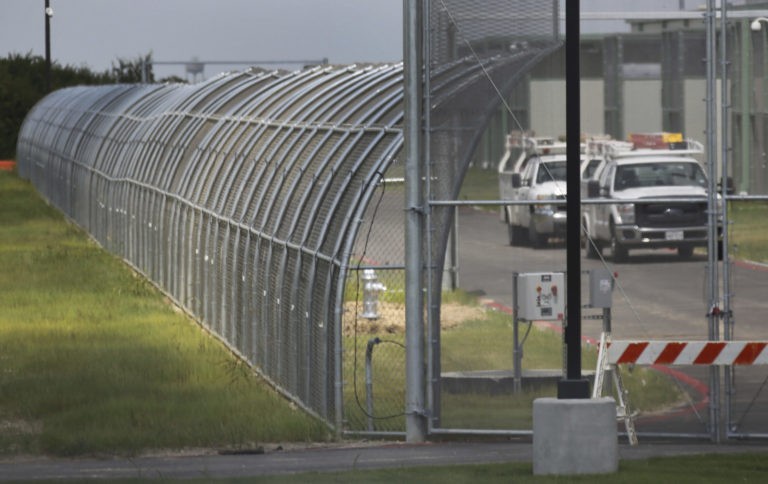
(Headline USA) A former U.S. Marine Corps reservist has been arrested and charged with attempted murder in connection with an attack at a Texas immigration detention center in which a police officer was shot in the neck, federal prosecutors said Tuesday.
Benjamin Hanil Song, 32, is the latest person charged in the Fourth of July assault in which attackers dressed in black military-style clothing opened fire outside the Prairieland Detention Center in Alvarado, southwest of Dallas, according to the U.S. Attorney’s Office for the Northern District of Texas.
Song, from Dallas, was arrested after a weeklong search and has been charged with three counts of attempted murder of federal agents and three counts of discharging a firearm in relation to a crime of violence, the office said in a statement. He is accused of purchasing four of the guns linked to the attack, it said.
Check out the sophistication of the Antifa-linked terror cell members in Dallas-Fort Worth charged with attempted murder after opening fire on an ICE facility in Alvarado on July 4th. They were heavily armed with military gear, guns, AR-15 style rifles, 12 sets of Kevlar bullet… pic.twitter.com/fOpvMw4ZFn
— Elizabeth MacDonald (@LizMacDonaldFOX) July 8, 2025
U.S. District Court records do not list names of attorneys representing Song or scheduled court appearances. U.S. Attorney’s Office for the Northern District of Texas did not immediately respond to an email asking whether Song has an attorney.
The officer wounded in the attack has since been released from the hospital.
Ten people, most of them from the Dallas-Fort Worth area, have previously been charged with attempted murder of a federal officer and discharging a firearm in relation to a crime of violence. Another person has been charged with obstruction of justice for concealing evidence, while two others were charged with accessory after the fact for allegedly helping Song get away.
If convicted, most of the defendants could face up to life imprisonment, while those charged with obstruction of justice and accessory after the fact would face lesser penalties if convicted, according to federal prosecutors.
The shooting took place as President Donald Trump’s administration ramps up deportations.
The attackers initially set off fireworks and spray-painted vehicles and a guard structure, including the words “Ice Pig,” according to a criminal complaint. This was “designed to lure correctional officers outside the facility,” according to U.S. Attorney’s Office. Correctional officers called 911 and an Alvarado police officer responded and someone in the woods opened fire.
Another person across the street fired 20 to 30 rounds at correctional officers who were unarmed after they walked out of the facility, according to the office’s statement.
After the group fled, sheriff’s deputies stopped seven people about 300 yards (275 meters) from where the officer was shot, according to a criminal complaint.
“They were dressed in black, military-style clothing, some had on body armor, some were covered in mud, some were armed, and some had radios,” the complaint said.
A sheriff’s office detective also stopped a van leaving the area and found two AR-style rifles and a pistol, along with ballistic-style vests and a helmet, the complaint said.
The driver, the only person in the van, said he had been at the detention center. He said he had met some people online and drove some of them to the detention center from Dallas to “make some noise,” according to the complaint.
Song’s cellphone’s location data shows it was near the detention center from about 11:30 p.m. on July 4 and throughout the day on July 5, according to a criminal complaint.
“Though Song escaped by hiding overnight after the attack, we were confident he would not remain hidden for long,” Acting United States Attorney for the Northern District of Texas Nancy E. Larson said in a statement. “The fourteen individuals who planned and participated in these heinous acts will be prosecuted, and we expect justice will be swift.”
(Luis Cornelio, Headline USA) Newly released emails further expose the behind-the-scenes push within the Biden DOJ’s push to manufacture a criminal case against President Donald Trump.
The emails—obtained by the Senate Judiciary Committee and first reported by legal expert Margot Cleveland—show the FBI scrambling to go after Trump despite having no evidence.
One email revealed former FBI Agent Tim Thibault plotting with colleagues how to zero in on the Willard Hotel. Trump allies used the hotel as a command center to monitor the 2020 election results.
2/ They wanted to open an investigation to allow for investigative activities. NOTE open an investigation to investigate a crime of which they had evidence! pic.twitter.com/p3WtqMRs0T
According to the email, Thibault was actively hunting for a crime tied to the Willard Hotel. He laid out two options: launch an assessment or open a preliminary investigation.
He objected to the first option, noting it would limit the FBI’s authority. Under an assessment, interviews and “more probative” actions were barred. Subpoenas would be tightly restricted.
Thibault admitted the office was “hard at work attempting to predicate a Preliminary investigation.” This route, he said, would enable a broader and likely more aggressive investigation.
In short, the FBI tried to launch a criminal probe without a shred of evidence.
The email, dated March 2, 2022, came just six months before Special Counsel Jack Smith unsealed an indictment over Trump’s efforts to question the 2020 election.
Federalist senior legal writer Margot Cleveland said the officials involved should be referred to the Inspector General for further investigation.
One recipient on the email chain was Wayne Jacobs, a senior FBI agent whom Director Chris Wray later promoted to lead the Philadelphia field office.
As Headline USA previously reported, Jacobs is married to former J6 committee investigator Soumya Dayananda.
That connection has raised red flags, especially after Dayananda bragged that the charges against Trump closely mirrored her committee’s work.
Despite his ties to Dayananda and the Biden-era FBI, Jacobs remains on the taxpayer payroll, running one of the agency’s most powerful field offices.
The FBI fired Thibault in 2024 after he violated the Hatch Act by making political posts on social media. Whistleblowers have accused Thibault of showing a “pattern of active public partisanship.” Thibault participated in probes of both Trump and Hunter Biden.
(Luis Cornelio, Headline USA) A Secret Service agent unknowingly disclosed sensitive information about his White House assignment to an undercover Project Veritas journalist, all the while mocking President Donald Trump.
The agent, identified by the media group on Monday as Marc Hendrickson, came across the undercover journalist on a dating app and appeared eager to impress her. First, he invited her to the White House and then sent a photo of his exact location while on the building’s lawn.
🚨BREAKING: Project Veritas Invited to @WhiteHouse by @SecretService Agent Exposing Reckless Security Breach One Year After Trump Assassination Attempt
Hendrickson described himself as a “liberal” since age 18 and criticized Trump in private messages, claiming the president was “doing a lot of whacky shit right now.”
In another exchange, Hendrickson extended an invitation to the stranger to visit him at the White House, though it’s unclear if he meant inside the building or outside.
“Well if you’re close to the White House you can come here and I say hi,” he reportedly wrote.
In response, the undercover reporter said: “Haha that would be cool. I’m not working the next two three days. You’re at the White House?”
“Yes,” Hendrickson responded.
One year after the Trump Butler assassination attempt, Project Veritas released text messages from a Secret Service Agent inviting a stranger to the White House, disclosing operational details, and disparaging President Trump.
According to a work profile, Hendrickson has been with the Secret Service since July 2021 and has protected high-level officials, including the president, vice president and first lady.
Project Veritas portrayed Hendrickson’s messages as a potential security breach.
“This behavior reveals how easily he could be compromised or manipulated by adversaries, potentially granting hostile actors critical access or intelligence that jeopardizes the safety of President Trump and the nation,” the group stated.
Project Veritas also noted the timing of the revelation, calling it “particularly chilling as it coincides with the one-year anniversary of the July 13, 2024, assassination attempt on President Trump – a stark reminder of the relentless threats facing our leaders.”
The Secret Service did not respond to Project Veritas’s request for comment.
Correction: This article mistakenly referred to Trump as the “former” President.
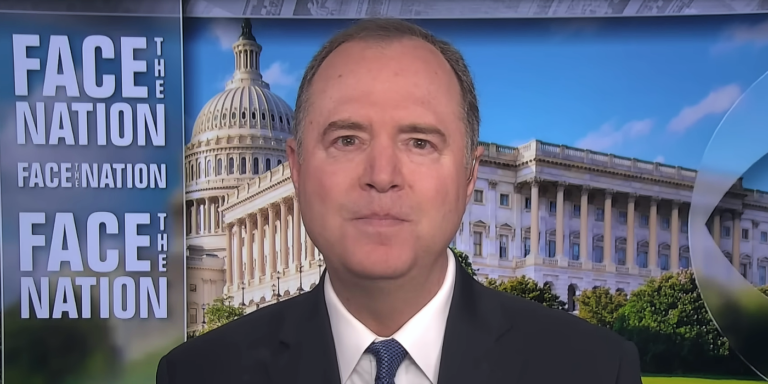
(Luis Cornelio, Headline USA) Federal housing investigators have referred Sen. Adam Schiff, D-Calif., to the DOJ for a formal investigation after uncovering discrepancies tied to his claimed primary residence.
Fannie Mae’s financial crimes division found that Schiff and wife, Eve, engaged in a sustained pattern of possible occupancy misrepresentation” on home loans spanning from 2009 to 2020, according to several news outlets.
Schiff owns two houses—one in Maryland, near the U.S. Capitol, and another in California—but has listed both as his primary residence on mortgage loan applications.
According to experts, some borrowers list a secondary home as a primary residence to secure lower interest rates. This may amount to mortgage fraud.
President Donald Trump scolded Schiff in a lengthy Truth Social post, saying he had “always suspected Shifty Adam Schiff was a scam artist.”
“Adam Schiff said that his primary residence was in MARYLAND to get a cheaper mortgage and rip off America, when he must LIVE in CALIFORNIA because he was a Congressman from CALIFORNIA. I always knew Adam Schiff was a Crook,” Trump stated.
The alleged fraud began in 2009, when Schiff refinanced his Maryland property and listed it as his primary residence. He did not change this status until 2020.
Trump called on prosecutors to bring Schiff to justice for any potential criminal offenses.
Schiff, for his part, dismissed Trump’s allegations as retaliation.
“This is just Donald Trump’s latest attempt at political retaliation against his perceived enemies,” he said. “So it is not a surprise, only how weak this false allegation turns out to be.”
In 2019, Schiff, then a U.S. representative and chair of the House Intelligence Committee, led Trump’s first impeachment effort and repeatedly colluded with the media to push the since-debunked Trump-Russia collusion hoax.
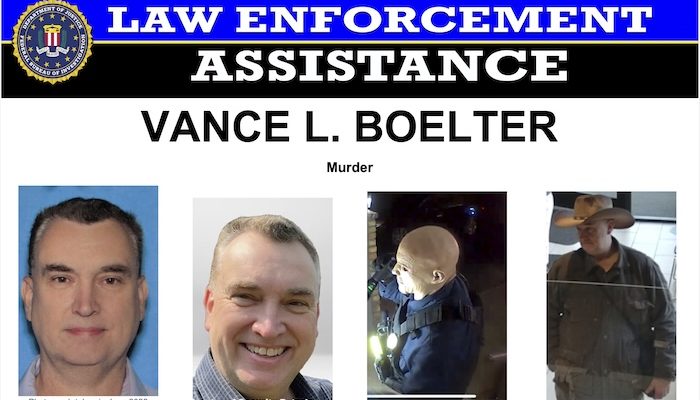
(Headline USA) A man indicted Tuesday on charges he fatally shot the Democratic leader in the Minnesota state House and her husband, and wounded another lawmaker and his wife, confessed to the crimes in a rambling handwritten letter to FBI Director Kash Patel, but didn’t say why he targeted the couples, prosecutors said.
Vance Boelter also wrote in the letter that Minnesota Gov. Tim Walz had approached him about killing the state’s two U.S. senators, fellow Democrats Amy Klobuchar and Tina Smith. The Minnesota Star Tribune reported similar allegations last month.
Boelter does have a loose link to Walz, who ran for Vice President last year on Kamala Harris’s ticket. Boelter was appointed to the workforce development board by then-Minnesota Gov. Mark Dayton in 2016 and then reappointed in 2019 by Walz to a four-year term that expired in 2023.
However, U.S. Attorney Joseph Thompson suggested Tuesday that Boelter’s accusation against Walz is a figment of the alleged assassin’s imagination.
“There is little evidence showing why he turned to political violence and extremism,” Thompson said. “What he left were lists: politicians in Minnesota, lists of politicians in other states, lists of names of attorneys at national law firms.”
MINNESOTA MAN: According to dicuments found in the Tim Walz-appointed assassin’s car, Vance Boelter was secretly trained by the military and instructed by Tim Walz himself to assassinate Rep. Amy Klobuchar so Walz could claim her Senate seat. pic.twitter.com/R6r8D26Jt2
The indictment handed up murder, stalking and firearms charges against Boelter. The murder counts in the deaths of former Democratic House Speaker Melissa Hortman and her husband, Mark, could carry the federal death penalty. The indictment also charged Boelter with shooting and wounding a state senator and his wife, and attempting to shoot their adult daughter.
Thompson said a decision on whether to seek the death penalty “will not come for several months” and will be up to U.S. Attorney General Pam Bondi. Minnesota abolished its state death penalty in 1911, but President Donald Trump’s administration says it intends to be aggressive in seeking capital punishment for eligible federal crimes.
Prosecutors initially charged Boelter with the same six counts. But under federal court rules they needed a grand jury indictment to take the case to trial. His arraignment, where he could enter a plea, will probably be scheduled for later in the week, Thompson said
Boelter’s federal defender, Manny Atwal, did not immediately return messages seeking comment on the indictment and the new allegations.
Political extremism as a motive
Thompson also disclosed new details at a news conference. He said investigators had found the handwritten letter, which was addressed to the FBI chief, in a car Boelter abandoned near his home.
“In the letter, Vance Boelter claims that he had been trained by the U.S. military off the books and he had conducted missions on behalf of the U.S. military in Asia, the Middle East and Africa,” Thompson said.
The letter doesn’t specifically say though why he targeted the Hortmans and Hoffmans.
Boelter’s political and religious views
Friends have described Boelter as an evangelical Christian with politically conservative views who had been struggling to find work. At a hearing July 3, Boelter said he was “looking forward to the facts about the 14th coming out.”
In an interview published by the New York Post on Saturday, Boelter insisted the shootings had nothing to do with his opposition to abortion or his support for Trump, but he declined to discuss why he allegedly killed the Hortmans and wounded the Hoffmans.
“You are fishing and I can’t talk about my case…I’ll say it didn’t involve either the Trump stuff or pro life,” Boelter wrote in a message to the newspaper via the jail’s messaging system.
Boelter also faces state murder and attempted murder charges in Hennepin County, but the federal case will go first.
Other details of the case
Prosecutors say Boelter, 57, who has lived in rural Sibley County south of Minneapolis, was disguised as a police officer, driving a fake squad car, wearing a realistic rubber mask and wearing tactical gear around 2 a.m. on June 14 when he went to the home of Sen. John Hoffman, a Democrat, and his wife, Yvette, in the Minneapolis suburb of Champlin. He allegedly shot the senator nine times, and Yvette Hoffman eight times, but they survived. He also allegedly tried to kill their adult daughter, Hope, but they pushed her out of the way and she was not hit.
🚨Tracking Connections to MN Assassin We geofenced Boelter’s family farm and found a unique device. We followed that device for the last 3 years – located in places like Africa, Nepal, and Washington, DC.
Prosecutors allege he then stopped at the homes of two other lawmakers. One wasn’t home while a police officer may have scared him off from the other target. Boelter then allegedly went to the Hortmans’ home in nearby Brooklyn Park and killed both of them. Their dog was so gravely injured that he had to be euthanized.
Brooklyn Park police, who had been alerted to the shootings of the Hoffmans, arrived at the Hortman home around 3:30 a.m., moments before the gunman opened fire on the couple, court documents said. Boelter allegedly fled and left behind his car, which contained notebooks listing dozens of Democratic officials as potential targets with their home addresses, as well as five guns and a large quantity of ammunition.
Thompson said the gun used to shoot the Hoffmans was found near the Hortman home, while the gun used to shoot the Hortmans was recovered from a pond near their home a few days later.
Law enforcement officers finally captured Boelter about 40 hours later, about a mile from his rural home in Green Isle, after what authorities called the largest search for a suspect in state history.
Remembering the victims
Sen. Hoffman is out of the hospital and is now at a rehabilitation facility, his family announced last week, adding he has a long road to recovery. Yvette Hoffman was released a few days after the attack.
Hope Hoffman said in a statement Tuesday that she was relieved that Boelter will be prosecuted to the fullest extent of the law.
“Though I was not shot physically, I will now forever coexist with the PTSD of watching my parents be nearly shot dead in front of me and seeing my life flash before my eyes with a gun in my face,” she said.
Hortman led the House from 2019 until January and was a driving force as Democrats passed an ambitious list of liberal priorities in 2023. She yielded the speakership to a Republican in a power-sharing deal after the November elections left the House tied, and she took the title speaker emerita.
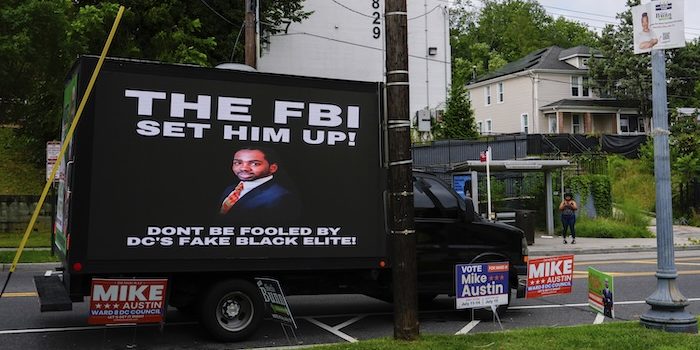
(Headline USA) A former D.C. Council member is returning to his seat, five months after he was kicked out for his involvement in a federal bribery investigation.
Trayon White defeated three challengers in a special election Tuesday to fill the Ward 8 council seat that has been vacant since his expulsion in February.
White, 41, was arrested by the FBI last August. After an internal investigation, the remaining 12 D.C. Council members voted unanimously to oust him from the council. However, White was free to enter the special election because he had not been convicted on a felony.
He won reelection just a few months later in an indication of a scandal-proof popularity that echoes his political mentor: former D.C. Mayor Marion Barry.
His federal trial won’t start until January 2026, but preliminary evidence includes videos of White pocketing cash-stuffed envelopes from a city contractor, allegedly in return for securing lucrative city contracts.
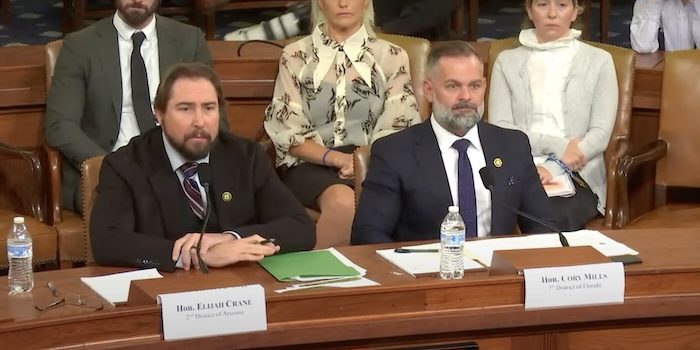
(José Niño, Headline USA) Rep. Cory Mills, R-Fla. is facing eviction from his luxury Washington D.C. penthouse after months of unpaid rent totaling over $85,000, documents reveal.
According to political reporter Roger Sollenberger, formerly of The Daily Beast, Mills “is being evicted for failure to pay months of rent at his D.C. penthouse. Owner claims Mills owes $85,000. He was served with notice for failure to pay in January. Ledger shows he paid late nearly every month since moving in, missing several months entirely.”
SCOOP: Rep. Cory Mills is being evicted for failure to pay months of rent at his D.C. penthouse. Owner claims Mills owes $85,000. He was served with notice for failure to pay in January. Ledger shows he paid late nearly every month since moving in, missing several months entirely pic.twitter.com/t6k1RS8BvC
— Roger Sollenberger (@SollenbergerRC) July 14, 2025
Court filings reveal that Mills was first served notice in January, giving him until February 26 to pay his outstanding balance. Sollenberger reports that “when Mills was served in January, the owner notified him that he had until Feb 26 to pay. On Feb 20, his girlfriend reported him to the police for assaulting her at that penthouse, which she later recanted.”
The tenant ledger tells a story of persistent financial problems, as highlighted in Sollenberger’s coverage: “According to the owner’s ledger, Mills has been late on rent 18 times, skipping some months entirely then backpaying.”
Mills has publicly contested the claims, calling Sollenberger and offering an explanation for his rent troubles.
“Cory Mills just called me and claimed he hadn’t paid his rent because his online payment link has been broken………. ?” Sollenberger added.
When reached by Sollenberger, Mills allegedly refused to answer any questions about his business and personal financial disclosures: “Mills also refused to answer any of my questions about his business and personal financial disclosures, and said he was calling to ‘mock’ me for reporting his landlord’s eviction claims a D.C. superior court filing.”
The congressman’s difficulties are not limited to unpaid personal rent. Sollenberger further revealed that Mills’ business operations are unraveling. “Mills’ company has also failed to pay its debts. They got bad news earlier this month, when its lender told investors that the investment fund supporting his company had failed and would be shut down.”
According to an additional update shared by Sollenberger, Mills’ lender has begun the process of calling in personal and corporate debts, further compounding his financial woes: “NEW: 4th of July card from Rep. Cory Mills’ lender, now winding down the debt because it was so bad. Mills never disclosed personal liability for tens of millions in corporate loans owed to a foreign entity. But the lender has liens on his stake AND his company’s weapons factory.”
NEW: 4th of July card from Rep. Cory Mills' lender, now winding down the debt because it was so bad. Mills never disclosed personal liability for tens of millions in corporate loans owed to a foreign entity. But the lender has liens on his stake AND his company's weapons factory. pic.twitter.com/GdSF1YvETo
— Roger Sollenberger (@SollenbergerRC) July 4, 2025
Sollenberger also unearthed details of Mills’ broader financial troubles, noting, “When Mills tweeted this, he had multiple defaults on an SBA loan and also failed to pay his property taxes that year on the house he put up as collateral for the loan”.
When pressed directly about the rental issues and his broader financial entanglements, Mills has reportedly provided evasive answers and, according to Sollenberger, resorted to mockery rather than clarification: “Mills also refused to answer any of my questions about his business and personal financial disclosures, and said he was calling to ‘mock’ me for reporting his landlord’s eviction claims a D.C. superior court filing.”
With the luxury penthouse’s owner seeking over $85,000 in unpaid rent, and records suggesting chronic late payments, Mills faces not only looming eviction but the escalation of his personal problems into the public sphere.
As Headline USA has previously reported, five former associates claim Mills converted to Islam in 2014 during his marriage to an Iraqi woman. The claims resurfaced after a domestic dispute prompted deeper media scrutiny, leading to conflicting accounts and questions about Mills’ past and character.
José Niño is the deputy editor of Headline USA. Follow him at x.com/JoseAlNino
The Trevors Project, a LGBTQ+ suicide hotline, received a notice, back in June, from the Substance Abuse and Mental Health Services Administration that the national 988 Suicide & Crisis Lifeline “will no longer silo LGB+ youth services, also known as the ‘Press 3 option,’ to focus on serving all help seekers, including those previously served through the Press 3 option.”
“This is devastating, to say the least. Suicide prevention is about people, not politics,” Jaymes Black, CEO of The Trevor Project, said in a statement. “The administration’s decision to remove a bipartisan, evidence-based service that has effectively supported a high-risk group of young people through their darkest moments is incomprehensible.”
For family advocacy groups and law enforcement, this is a victory. Concerns over the Trevor Project have been raised by people performing undercover operations on the project’s online website, TrevorSpace, a platform that encourages LGBTQ+ youth ages 13 to 24 to connect and share personal stories. They said they discovered the site could leave children vulnerable to online predators.
Those investigating the website reported they found adults were able to create accounts, bypass age verification and immediately begin private conversations with minors surrounding sexually charged topics, without any real-time oversight.
Beth Bourne, a mom questioning gender ideology in California schools, posted on X a phone call she had exposing what the Trevor Project Suicide Hotline said to her as she went undercover posing as a 15-year-old transgender boy.
“I told the Trevor Project crisis counselor that my mom misgendered me and made me feel unsafe at home. I asked if moving into my softball coach’s house was a good idea as he promised to help me get online ‘T’ (testosterone) and my breasts removed (top surgery),” Bourne wrote. “The Trevor Project counselor said it sounded like a great plan. Insanity.”
The Center Square reached out to The Trevor Project for comment amid these security concerns, but has not received a response.
To push back against the federal administration’s actions, California lawmakers have taken steps to ensure LGBTQ+ students have access to the help they need.
Assembly Bill 727, authored by California Assemblyman Mark Gonzalez, D-Los Angeles, in effort to combat LGBTQ+ mental health crisis, would require the Trevor Project suicide hotline be printed on the back of all public school student ID cards for grades 7 through college.
“This federal government is determined to erase LGBTQ+ Americans by any means necessary,” said Gonzalez. “Youth suicide prevention should be a bipartisan priority. Instead, our community — especially our youth — is being used as a pawn by political opportunists chasing headlines and social media clout. I am proud to fight for my community because these cuts are more than a political decision — lives are on the line.”
Additionally Gov. Gavin Newsom got the Legislature’s support to allocate $17.5 million in funding to support the 988 State Suicide and Behavioral Health Crisis Services Fund.
“Cutting off a proven lifeline for people in need is outrageous and inexcusable,” said Newsom. “While this federal administration slashes services and tries to erase LGBTQ people, California will do the opposite. Every child — straight, gay, transgender — belongs.”
(Jesse Colombo, Money Metals News Service) Silver has officially broken out in a big way, kicking off its bull market. Multiple confirmations I was watching for have now been fulfilled, and silver still has plenty of fuel left in the tank.
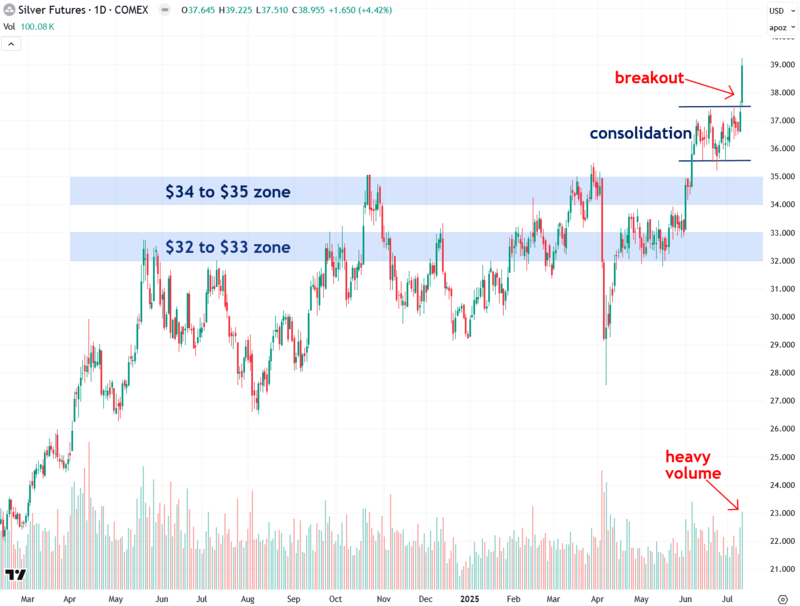
While gold soared over the past year, silver lagged behind, repeatedly held back by two major resistance zones — $32 to $33 and $34 to $35 — which stopped multiple breakout attempts and kept it in a prolonged consolidation phase.
That finally changed a month ago when silver decisively broke through these critical levels. Although it paused in recent weeks, this was simply a healthy consolidation before the next big surge.
This past Friday, that surge finally arrived, marking a true breakout and the official start of silver’s bull market. In this update, I’ll discuss where silver stands now and share what I expect to happen next.
The chart below shows COMEX silver futures, which I follow closely because they tend to respect key $1 increments, often creating clear support and resistance levels.
Over the past month, silver has finally broken through the heavy resistance cluster between $32 and $35, a major technical victory underscored by Friday’s powerful 4.42% surge on strong volume that pushed prices right to the doorstep of $39 an ounce.
This is a highly positive development signaling that silver’s bull market is just getting underway. With this strong momentum, silver is likely to make a rapid run at $40 next — and then $50 soon after.
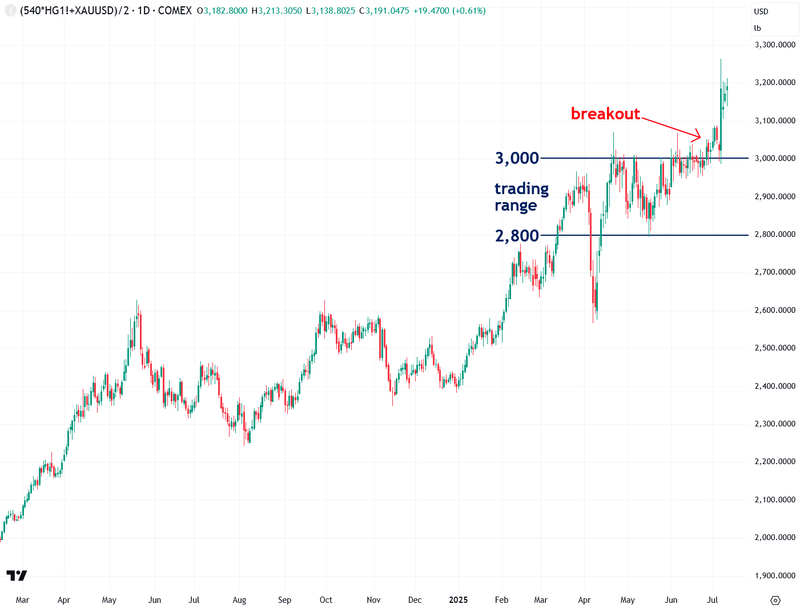
I’ve also developed a proprietary indicator called the Synthetic Silver Price Index (SSPI), designed to help validate silver’s price action and filter out potential false breakouts.
The SSPI is calculated as the average of gold and copper prices, with copper scaled by a factor of 540 to prevent gold from dominating the index. Interestingly, even though silver isn’t part of the calculation, the SSPI closely tracks its movements.
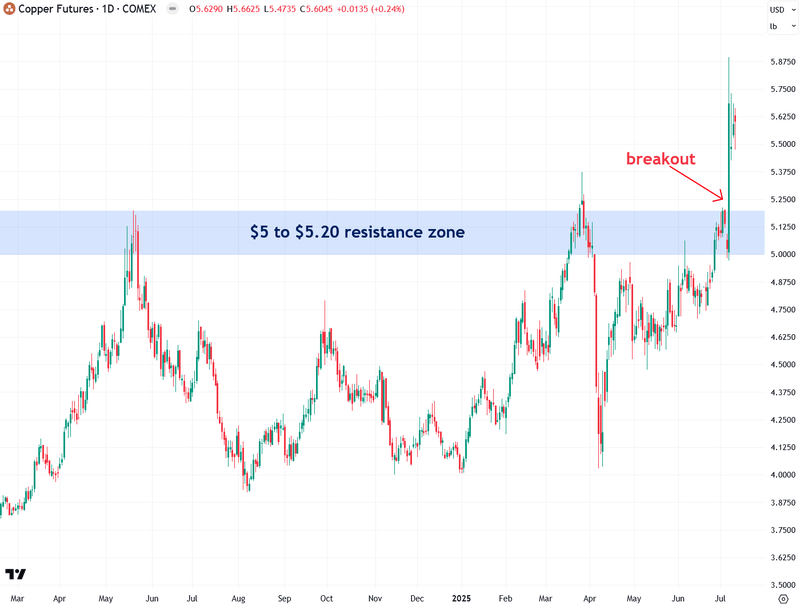
The SSPI finally broke out of its 2,800–3,000 trading range over the past couple of weeks, after being stuck there since March — a promising sign that foreshadowed the silver breakout I had been anticipating. Copper’s surge and breakout on Tuesday gave the SSPI a major boost and likely played a key role in silver’s move on Friday, as strong performances in both gold and copper often put pressure on arbitrage algorithms to buy silver in sympathy.
This breakout in the SSPI was one of the crucial confirmations I had been waiting for, along with a breakout in silver priced in euros.
As the copper futures chart below shows, copper has finally broken above the $5 to $5.20 resistance zone that had held firm for several years.
This decisive breakout confirms that copper is now officially in a bull market of its own, and this new bull market should also serve as a strong tailwind for silver.
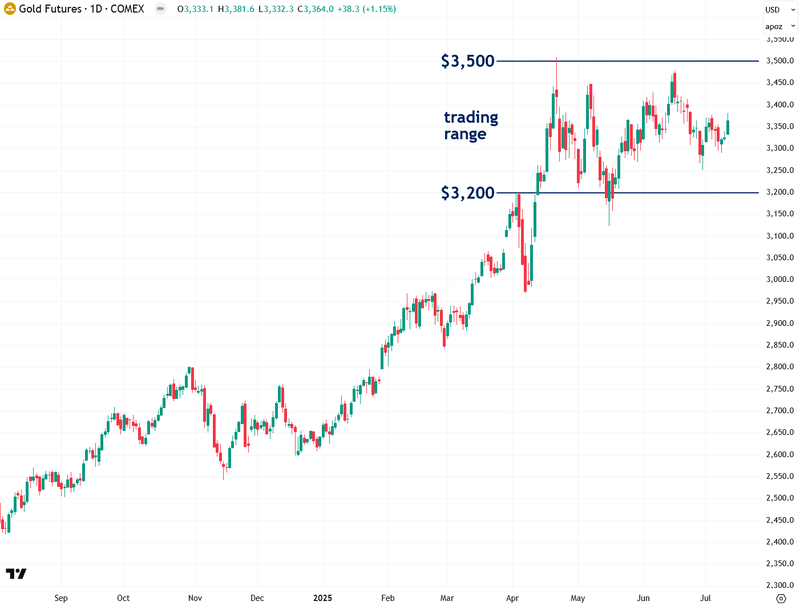
Although gold has been relatively quiet since mid-April, it has simply been undergoing a healthy consolidation between the $3,200 support and $3,500 resistance levels, working off its overbought condition after strong gains earlier in the spring.
This pattern is very similar to last summer’s consolidation, which was followed by a sharp rally once fall began and trading volume returned.
I’m now closely watching for a breakout above the $3,500 resistance, which would signal that gold is ready to resume its bull market. Such a breakout would also give silver an additional boost.
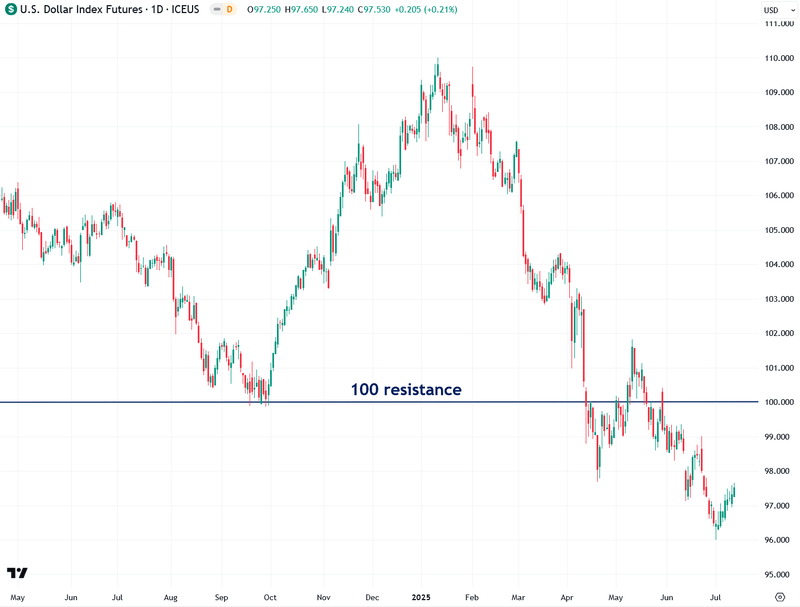
One factor fueling silver’s bull market is the weakening U.S. dollar, which recently broke below the key 100 level on the U.S. Dollar Index — a major technical breakdown. This breakdown indicates further weakness ahead, which is bullish for commodities — including precious metals — given their long-standing inverse relationship with the dollar.
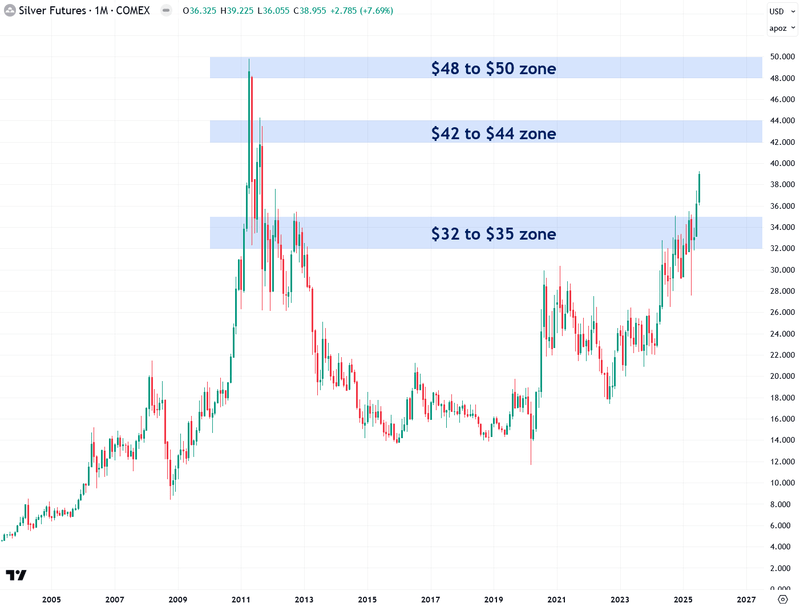
Now let’s take a look at silver’s long-term monthly chart to identify past resistance clusters that are likely to serve as price targets during this new bull run. These resistance zones were formed during periods of price congestion, most notably during silver’s surge and peak in 2011 and 2012.
The two most prominent levels that stand out to me are the $42–$44 zone and, ultimately, the $48–$50 zone. There is a strong probability that silver will aim for the most obvious target — $50 — during this rally.
And while it will likely pause to consolidate once it gets there, there’s no reason it has to stop at that level.
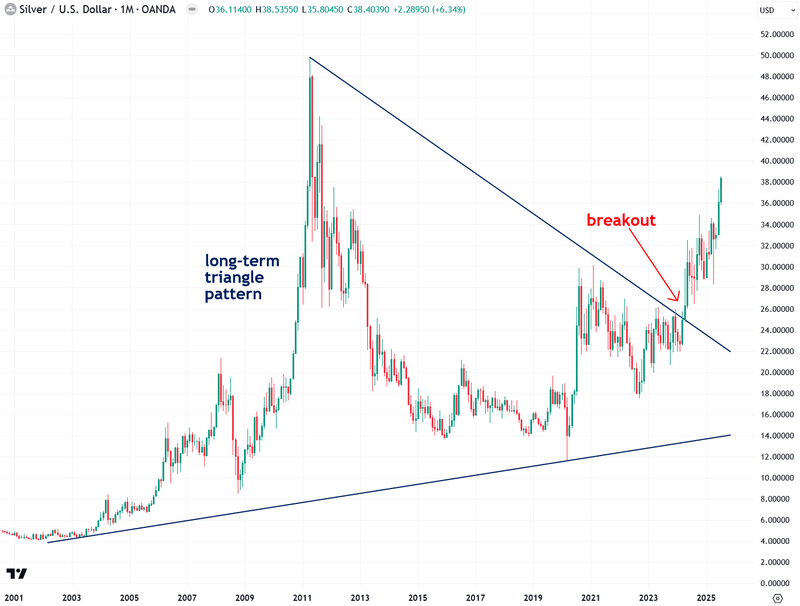
What first signaled to me back in April 2024 that silver was on the verge of a powerful bull market was its breakout from a two-decade-long triangle pattern:
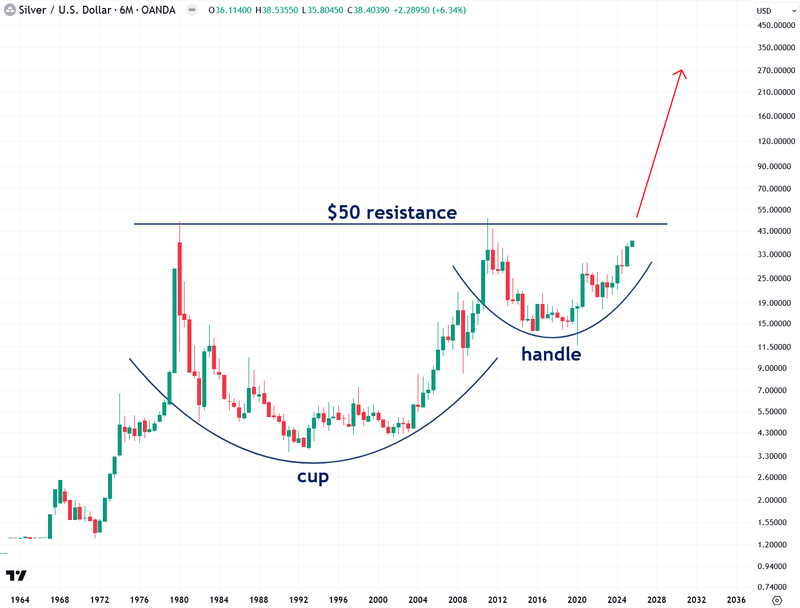
Even more exciting is the fact that silver’s logarithmic chart, dating back to the 1960s, reveals a cup-and-handle pattern, indicating the potential for silver to reach several hundred dollars per ounce during this bull market.
In order to confirm this particular scenario, silver needs to close decisively above the $50 resistance level.
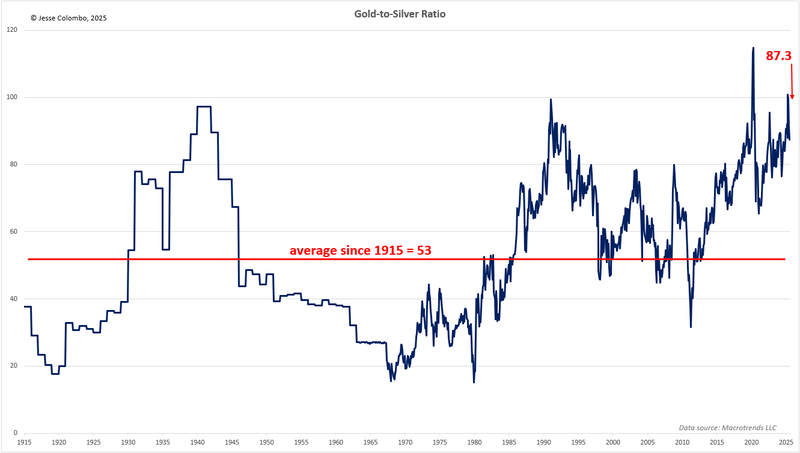
Despite silver’s recent strong performance, it still has substantial upside potential. Several valuation metrics — including the long-term gold-to-silver ratio — indicate that silver remains significantly undervalued.
The current gold-to-silver ratio stands at 87.3, but if it were to revert to its historical average of 53 (dating back to 1915) — without any increase in gold’s price — silver would be valued at approximately $63.30 per ounce, representing a healthy 65% gain from its current price of $38.40.
Naturally, as silver rises to close this gap, the ratio would decline accordingly.
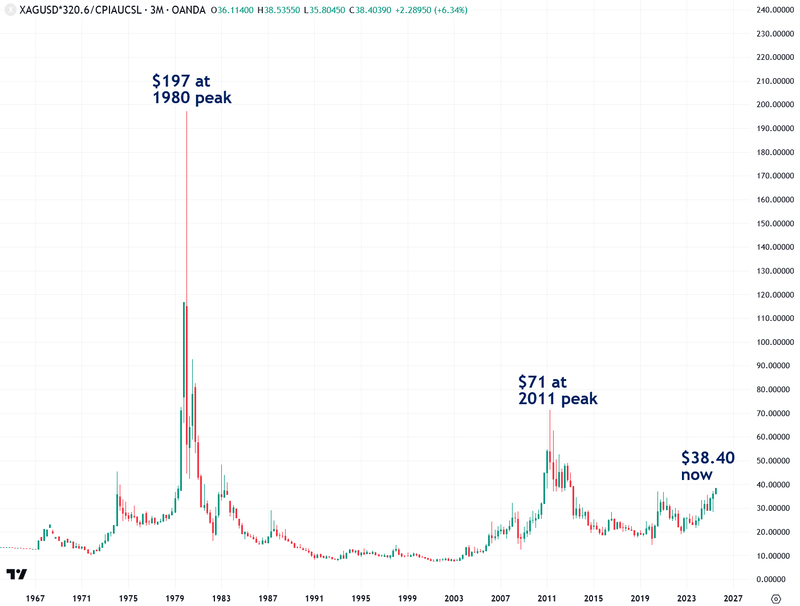
Adjusting silver’s price for inflation further highlights how undervalued it is by historical standards.
During the Hunt brothers-induced spike in 1980, silver reached an inflation-adjusted price of $197. In the 2011 bull market, driven by quantitative easing, it hit $71.
Currently trading at just $38.40, silver has significant room to rise if it’s to catch up with these previous inflation-adjusted peaks.
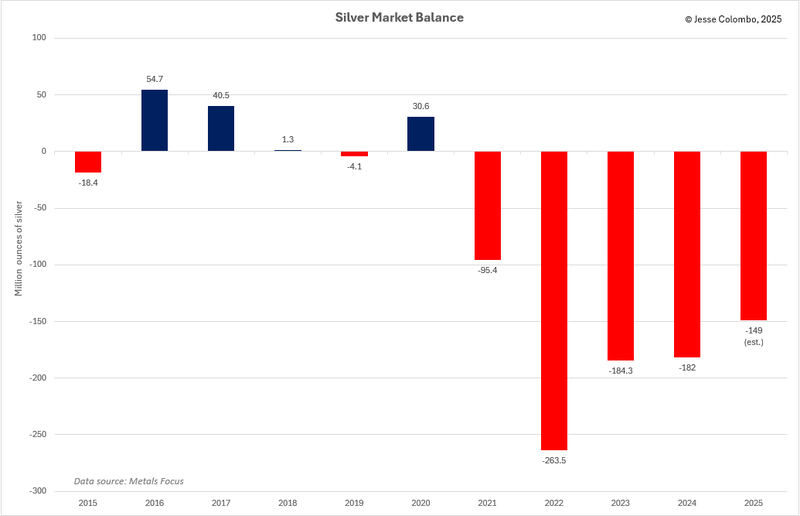
One key reason I believe silver will soon rally higher comes down to basic Economics 101: supply and demand. Over the past five years, silver demand has consistently exceeded supply, resulting in a persistent deficit—as shown in the chart below.
In 2024 alone, the shortfall reached 182 million ounces, with an estimated additional 117.6 million ounces this year—and deficits are expected to continue for the foreseeable future.
As a result, above-ground silver stocks are dwindling rapidly. While bullion banks can create unlimited amounts of paper silver to suppress prices, they can’t manufacture the real physical silver that is crucial for a wide range of industries, alongside growing investment demand.
The persistent silver deficit stems from both dwindling supply and surging demand—a combination that, in an unmanipulated market, would naturally drive prices higher.
That’s why I described silver as a beach ball held underwater over the past year — the pressure kept building, and it was only a matter of time before it burst upward.
On the supply side, global silver mine production has peaked and declined over the past decade as economically viable deposits become depleted—something the bullion banks have absolutely no control over. And as time goes on, this supply crunch is only likely to worsen.
At the same time, demand for physical silver has skyrocketed across multiple sectors, with the biggest driver being the surge in solar panel manufacturing.
As the world shifts away from fossil fuels toward renewable energy, this trend is only in its early stages. Silver demand for photovoltaic (solar panel) applications alone has nearly tripled over the past four years, increasing by an astonishing 143.1 million ounces.
With global efforts to expand clean energy accelerating, this demand is set to grow even further.
In addition to the most obvious and straightforward approach — owning physical silver bullion — I also look to silver mining stocks for their amplified upside potential, especially as someone with a higher-than-average risk tolerance.
These stocks are leveraged to the price of silver and tend to move more dramatically—both up and down—so they’re not for the faint of heart. While riskier than holding bullion, they can offer explosive returns as silver truly takes off.
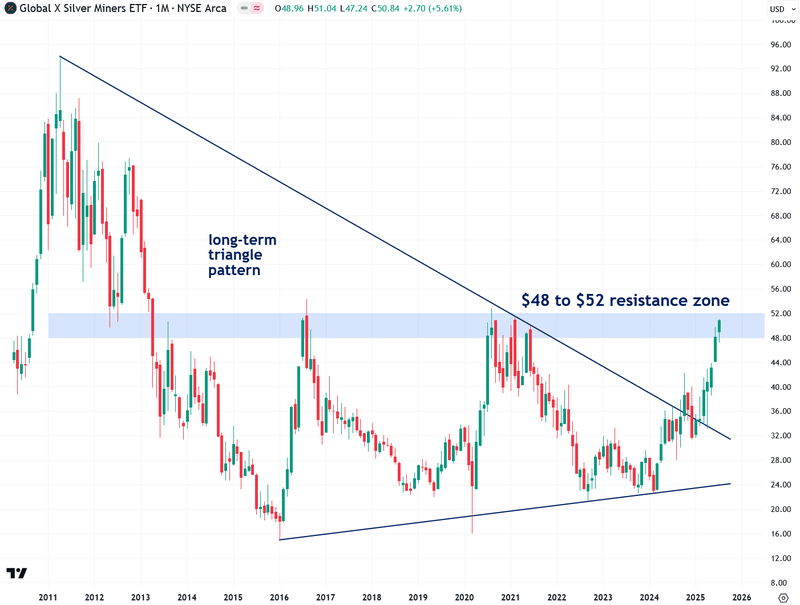
I use the Global X Silver Miners ETF (SIL) as a useful proxy to track the performance of silver mining stocks. SIL broke out of a long-term triangle pattern a few months ago, which is a bullish development.
However, a decisive close above the key $48–$52 resistance zone is still needed to fully confirm that the bull market in silver mining stocks is truly underway — and we’re getting very close.
To summarize: the moment I have been waiting for is finally here. Silver’s bull market has officially kicked off, and all systems are go. Now, I’m looking for continued follow-through on this breakout, which is highly likely given silver’s strong momentum.
Of course, it’s important that this breakout holds for my bullish tactical thesis to remain intact — but so far, the setup looks excellent, and I’m feeling very optimistic.
If you found this report valuable, click here to subscribe to The Bubble Bubble Report for more content like it.
Jesse Colombo is a financial analyst and investor writing on macro-economics and precious metals markets. Recognized by The Times of London, he has built a reputation for warning about economic bubbles and future financial crises. An advocate for free markets and sound money, Colombo was also named one of LinkedIn’s Top Voices in Economy & Finance. His Substack can be accessed here.