Headline Geopolitics: The War State Rolls On Under Trump

(José Niño, Headline USA) From Gaza to Donbas, McAdams explains how U.S. foreign policy has remained unchanged—despite Trump’s promises to end endless wars.

Follow Daniel McAdam’s work:

Twitter: https://x.com/DanielLMcAdams

Website: https://ronpaulinstitute.org/author/daniel-mcadams/


WATCH: Jill Biden Aide Pleads the 5th in Response to House GOP Investigation

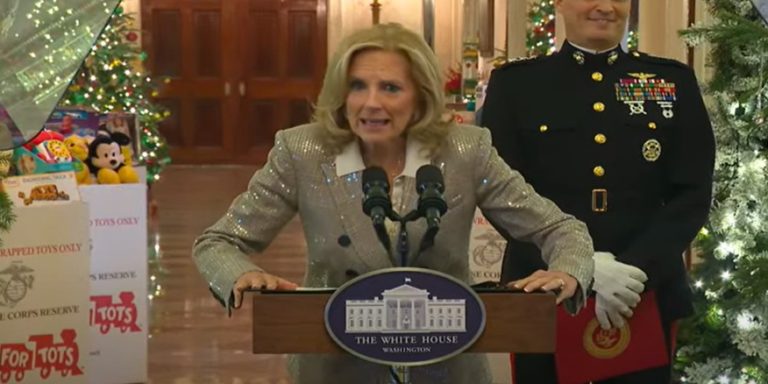
(Headline USAA former senior aide to Jill Biden on Wednesday became the second person to invoke the Fifth Amendment and decline to answer questions from House Republicans who are investigating President Joe Biden’s mental state and use of the autopen while in office.

Anthony Bernal, who previously served as chief of staff to former first lady Jill Biden, was subpoenaed for his testimony by the House Oversight Committee. He declined to answer questions, invoking the protections that prevent people from being forced to testify against themselves in government proceedings.

“Well, unfortunately, that was quick,” said Rep. James Comer, chair of the House Oversight Committee, after the deposition ended. “I believe the American people are concerned. They’re concerned that there were people making decisions in the White House that were not only unelected but no one to this day knows who they were.”

Bernal ignored questions from reporters as he entered and exited the House Oversight Committee’s hearing room on Capitol Hill. He was accompanied by his lawyer, Jonathan Su, who was a deputy White House counsel to the former president. Su in a statement provided to the committee noted that pleading the Fifth is not evidence of wrongdoing.

The former president has dismissed the inquiries as legally spurious. In a recent interview with the New York Times, Biden admitted that he had his aides sign pardons on his behalf with an electronic autopen. Biden says he orally directed them to do so.

Comer has has sought testimony from nearly a dozen former Biden aides as he conducts his investigation, including former White House chiefs of staff Ron Klain and Jeff Zients; former senior advisers Mike Donilon and Anita Dunn; former deputy chief of staff Bruce Reed, former counselor to the president Steve Ricchetti, former deputy chief of staff Annie Tomasini and a former assistant to the president, Ashley Williams.

On Tuesday, Comer also subpoenaed Annie Tomasini, a former White House deputy chief of staff, to appear before the committee on July 18. She is the third former official to be subpoenaed by the committee.

Adapted from reporting by the Associated Press

How Realistic Are Goldman & JPMorgan’s $4,000 Gold Targets?

(Jesse Colombo, Money Metals News Service) JPMorgan and Goldman Sachs’s $4,000 price targets are not only realistic but could even be achieved sooner than they expect.

Despite gold’s strong price gains over the past fifteen months, Goldman Sachs on Monday reaffirmed its forecast for gold to reach $3,700 per ounce by the end of 2025 and $4,000 by mid-2026. If they’re correct—and I believe this projection is quite realistic—that would represent additional gains of approximately 11% and 20% from the current price of $3,331.

This is especially impressive given that gold has historically been a relatively low-volatility, slow-moving asset compared to stocks, cryptocurrencies, and other commodities.

Goldman’s main bullish case for gold centers on continued strong central bank and institutional buying. Between January and May 2025, central banks and institutions purchased an average of 77 tonnes of gold per month — just slightly below Goldman’s earlier projection of 80 tonnes per month by mid-2026 in the London OTC market. In May alone, total purchases reached 31 tonnes (excluding the U.S.), with China standing out as the most prominent buyer, adding 15 tonnes. Additionally, Goldman notes that fund net positions in gold have eased from their April highs, creating more room for sustained buying from ETFs and central banks going forward.

JPMorgan agrees with Goldman and last week predicted that gold will average $3,675 an ounce in the fourth quarter of this year, rising to $4,000 in the third quarter of 2026.

Previously, the firm didn’t expect gold to reach $4,000 at all next year. Natasha Kaneva, head of global commodities strategy at JPMorgan, explained that the risk of a recession and global trade tensions make the $4,000 target even more achievable. “We remain deeply convinced of a continued structural bull case for gold and raise our price targets accordingly,” Kaneva said.

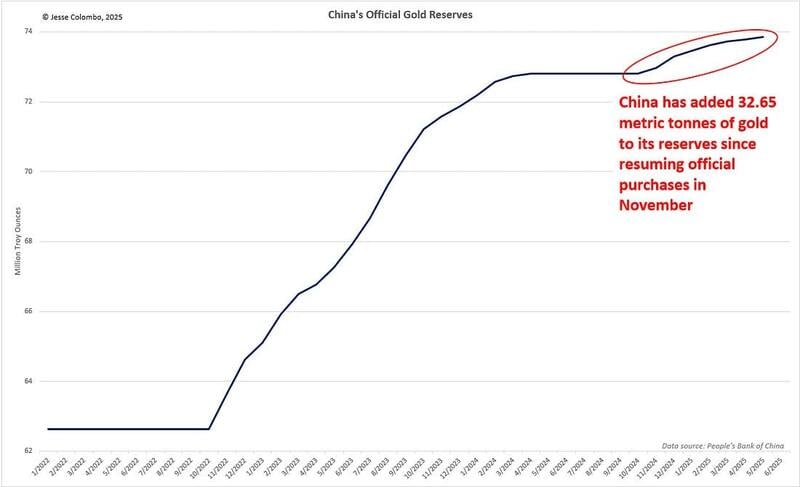
As I have written before, China has been one of the most prominent buyers of gold in recent years, adding 32.65 metric tonnes to its official reserves since November. In reality, China is likely purchasing even more gold than it officially reports, using various discreet channels.

The fact that it has been openly reporting increased purchases is likely intended to signal to its citizens and institutions to continue steadily accumulating gold — a sharp contrast to the West, which remains largely indifferent to gold despite its strong gains since early 2024.

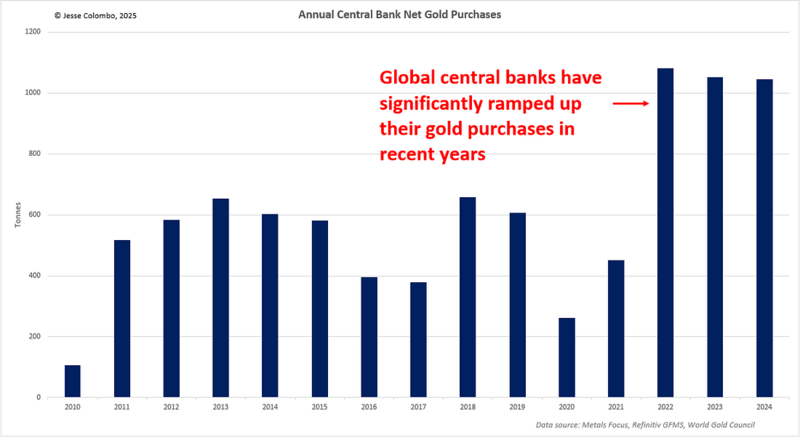
Since the pandemic and the ensuing surge in global debt, money supply, and inflation, central banks around the world have significantly ramped up their gold purchases, averaging just over 1,000 tonnes per year in 2022, 2023, and 2024.

This marks a dramatic increase — roughly double the annual average of about 500 tonnes in the preceding decade.

This trend is expected to continue, supporting higher gold prices as central banks increasingly diversify their reserves into hard assets to safeguard against inflation and the growing economic risks posed by massive global debt levels.

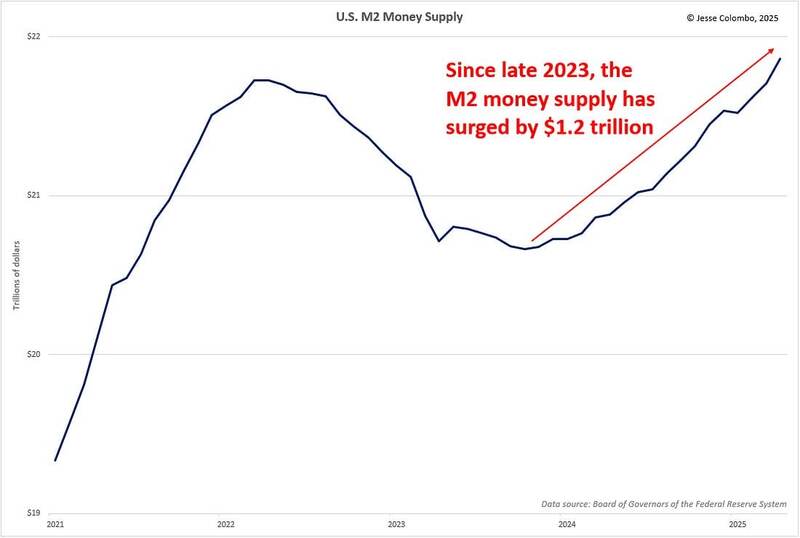
Speaking of rising money supply, the U.S. money supply began expanding again in late 2023 after a rare contraction in 2022 and 2023. This renewed growth is a major driver behind the precious metals bull market that kicked off just a few months later in March 2024. Since late 2023, the U.S. money supply has surged by $1.2 trillion.

A rising money supply is the fundamental cause of inflation — the erosion of a currency’s purchasing power — which is precisely why gold and silver tend to rise and serve as effective hedges during such periods. To learn more, read my recent report, “Gold Isn’t Going Up—Your Money is Just Losing Value.”

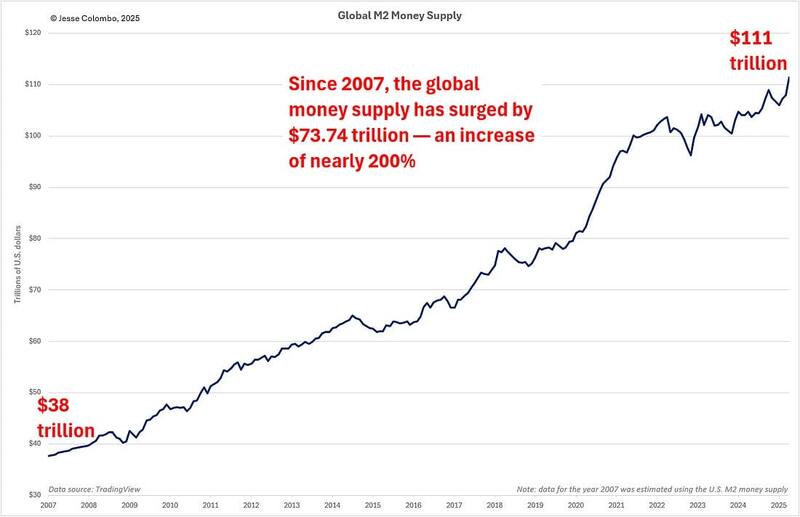
And lest you think this is just a U.S. issue — it’s not. This is a truly global problem, as the global M2 money supply has soared by an astonishing $73.74 trillion since 2007, representing an increase of nearly 200%:

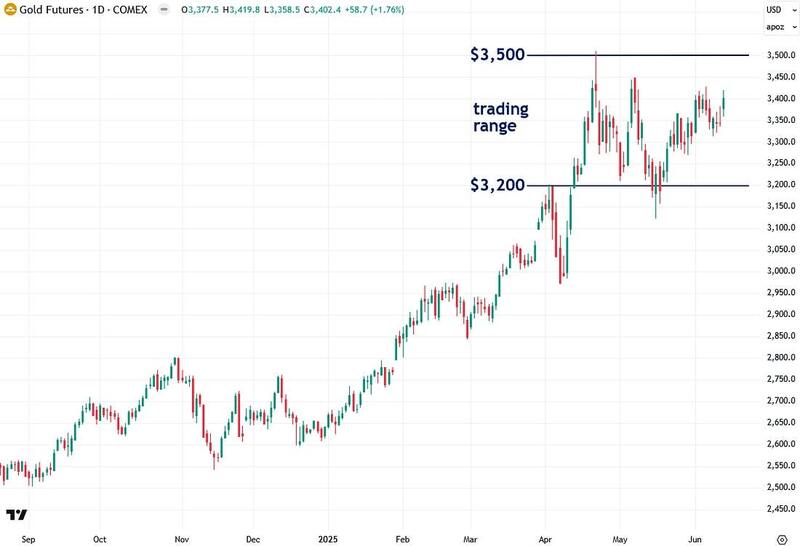
Now, let’s delve into the technicals to assess how feasible Goldman and JPMorgan’s $4,000 gold price targets really are. As I’ve been explaining over the past couple of months, gold — in the form of COMEX futures — has been consolidating in a trading range between $3,200 and $3,500.

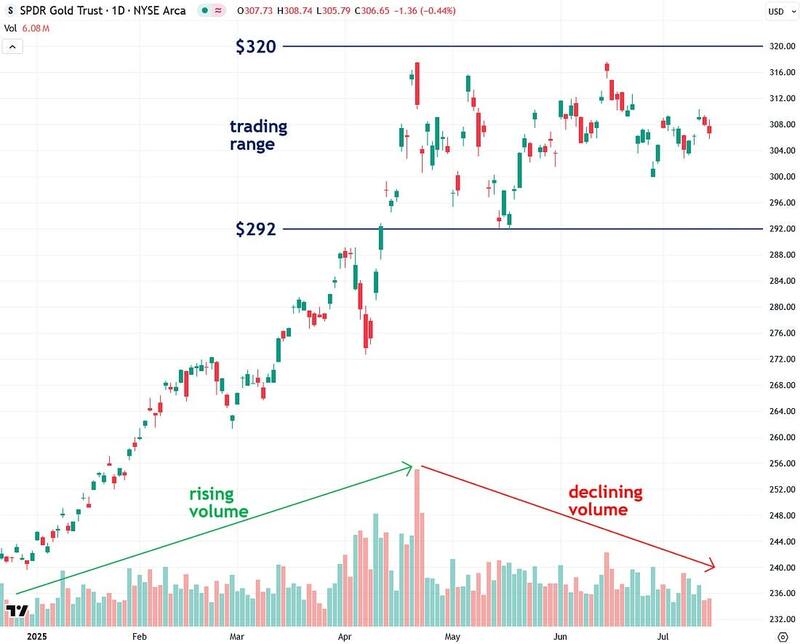
This is normal, healthy behavior and is typical during the summer months when news flow and trading volume decline as traders head off on vacation. You can clearly see this pattern of lower volume in the chart below.

The same thing happened last summer: gold peaked in mid-April, then moved sideways throughout the summer, before surging again when traders returned to their desks in September.

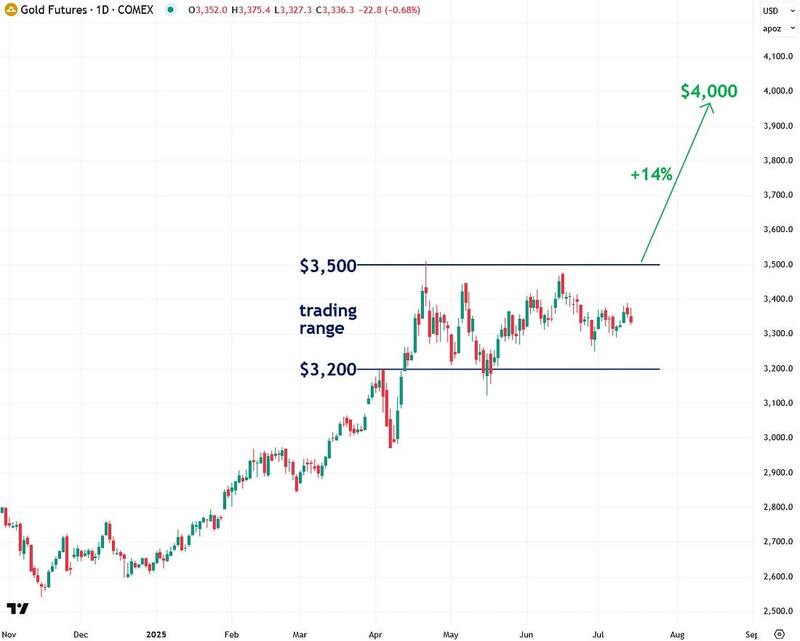
With gold currently in a trading range, I’m waiting for a decisive, high-volume breakout to confirm the next move. My bias remains to the upside, which would set the stage for a powerful rally toward $4,000:

The chart below shows COMEX gold futures, with a $4,000 price projection added. This target is just 20% above the current price and only 14% above the $3,500 breakout level — an outcome that is both realistic and attainable if/when gold breaks strongly out of its multi-month summer trading range.

Returning to the topic of trading volume, I also want to examine other gold proxies beyond COMEX futures to see if they’ve experienced similar seasonal declines — and sure enough, they have.

Take, for example, the popular SPDR Gold Trust ETF (GLD):

To summarize: although gold has been moving sideways for the past few months, this is perfectly normal — especially after such strong gains earlier this year and given the typical summer slowdown in trading volume and news flow.

However, assuming gold breaks out of its current trading range to the upside, I believe JPMorgan and Goldman Sachs’s $4,000 price targets are not only realistic but could even be achieved sooner than they expect — possibly by the end of this year, without having to wait until 2026.

If you found this report valuable, click here to subscribe to The Bubble Bubble Report for more content like it.


Jesse Colombo is a financial analyst and investor writing on macro-economics and precious metals markets. Recognized by The Times of London, he has built a reputation for warning about economic bubbles and future financial crises. An advocate for free markets and sound money, Colombo was also named one of LinkedIn’s Top Voices in Economy & Finance. His Substack can be accessed here.

FBI Confiscated Murdered Firefighter’s Phone for 7.5 Months after Butler Trump Shooting

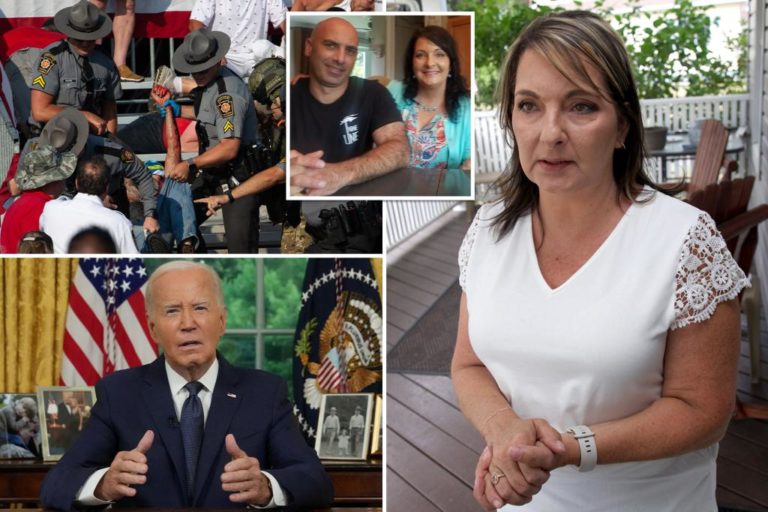
(Ken Silva, Headline USA) Helen Comperatore, whose husband, Corey, was murdered at the July 13, 2024, Trump shooting in Butler, Pennsylvania, revealed in a recently released documentary that the FBI took Corey’s phone—and didn’t give it back to her for nearly eight months.

“I finally received Corey’s phone back from the FBI. I had to wait 7.5 months to get this phone back, and it’s all I wanted. I even asked the President to get his phone back,” Comperatore said in the documentary, Butler Under Fire – Part 2: The Search for Justice, which is available on Fox Nation.

“His phone was sitting in a room full of evidence from that day. It was in an envelope with nothing on it. It didn’t even have Corey’s name on it. It was just sitting with a bunch of other evidence. It was never looked at. They never looked at it.”

The documentary—which features exclusive records obtained by Headline USA, as well as comments from this writer—also shows never-seen-before footage from Corey’s phone. Corey was filming when he and Trump were shot.

“You see Corey duck down and he gets shot. His phone falls to a slight angle, and there’s a blood splatter and you can hear everything for 3.5 minutes,” Helen said.

Helen was briefed by FBI Deputy Director Dan Bongino last month about the Butler shooting. According to her, Bongino said that alleged would-be assassin Thomas Crooks acted alone when he shot at Donald Trump—killing Corey and seriously wounding at least two others in the process.

“They’re going to come out in a couple weeks to the public and basically … It’s the shooter and nothing else,” she said.

Helen’s remarks echo what Bongino and FBI Director Kash Patel have been saying publicly in recent weeks. Patel said on a Fox News interview that there’s not much more to know about what happened at Butler.

Bongino also defended the Biden FBI’s investigation, including the decision to hose down the AGR rooftop and to release Crooks’s body for cremation before Congress or anyone else could examine it. Bongino told Helen he couldn’t speak about the Secret Service’s action—even though Bongino is a former Secret Service agent who was blasted the agency for Butler just about every day on his radio show last year.

Helen said last month that the FBI is going to release a report on its Butler investigation in the coming weeks.

Since then, the FBI and the Trump administration has been embroiled in controversy over the “Epstein files,” and Bongino has gone AWOL—making it unclear when the bureau might release more Butler records. Judicial Watch is suing the Justice Department to force disclosure.

Ken Silva is the editor of Headline USA. Follow him at x.com/jd_cashless.

Feds Charge 3 Current or Former Louisiana Police Chiefs in an Alleged Visa Fraud Scheme

(Headline USA) Federal authorities have charged three current or former Louisiana police chiefs with taking bribes in exchange for filing false police reports that would allow noncitizens to seek a visa that allows certain crime victims to stay in the U.S.

The false police reports would indicate that the immigrant was a victim of a crime that would qualify them to apply for a so-called U-visa, U.S. Attorney Alexander C. Van Hook said Wednesday at a news conference in Lafayette. He said the police officials were paid $5,000 for each name they provided falsified reports for, and that there were hundreds of names.

There had been “an unusual concentration of armed robberies of people who were not from Louisiana,” Van Hook said, noting that two other people were also charged in the alleged scheme.

“In fact, the armed robberies never took place,” he said.

Earlier this month, a federal grand jury in Shreveport returned a 62 count indictment charging the five defendants with crimes including conspiracy to commit visa fraud, visa fraud, bribery, mail fraud and money laundering, Van Hook said.

Those charged are Oakdale Police Chief Chad Doyle, Forest Hill Police Chief Glynn Dixon, former Glenmora Police Chief Tebo Onishea, Michael “Freck” Slaney, a marshal in Oakdale, and Chandrakant “Lala” Patel, an Oakdale businessman.

If convicted, the defendants could face years or even decades of jail time.

According to investigators, people seeking special visas would reach out to Patel, who would contact the lawmen and offer them a payment in exchange for falsified police reports that named the migrants as victims of armed robberies that never occurred.

The scheme went on for nearly a decade, Van Hook said.

Getting a U-visa can give some crime victims and their families a pathway to U.S. citizenship. About 10,000 people got them in the 12-month period that ended Sept. 30, 2022, which was the most recent period for which the Homeland Security Department has published data.

These special visas, which were created by Congress in 2000, are specifically for victims of certain crimes “who have suffered mental or physical abuse” and are “helpful to law enforcement or government officials in the investigation or prosecution of criminal activity,” based on a description of the program published by the U.S. Citizenship and Immigration Services.

“These visas are designed to help law enforcement and prosecutors prosecute crimes where you need the victim or the witness there, ” Van Hook said. “U-visas serve a valuable purpose, and this is a case where they were abused.”

When asked about the extent of the fraud, Van Hook said there “hundreds of names” —- specifically for visas that were approved.

At least two of the police chiefs had been arrested as of the Wednesday morning news conference, authorities said.

Lester Duhé, a spokesperson for the Louisiana attorney general’s office, said that office was assisting federal agents with “court-authorized activities” when asked about its role in the case.

The current or former police chiefs are from small central Louisiana municipalities that are near each other. They’re in a part of the state that is home to multiple immigration detention facilities. Although Louisiana doesn’t share a border with a foreign country, there are nine ICE detention facilities in the state — holding nearly 7,000 people.

Local news outlets reported seeing ICE and FBI agents entering the homes of two of the chiefs. Van Hook said authorities searched multiple police departments and a Subway sandwich shop that Patel operated.

Van Hook and others said at the news conference that the arrests do not mean the indicted chiefs’ departments are corrupt.

In 2021, the USCIS warned that the U-visa program was susceptible to fraud after an audit from the Office of Inspector General found that administrators hadn’t addressed deficiencies in their process.

The audit found that USCIS approved a handful of suspicious law enforcement signatures that were not cross-referenced with a database of authorized signatures, according to the OIG report. They were also not closely tracking fraud case outcomes, the total number of U-visas granted per year, and were not effectively managing the backlog, which led to crime victims waiting for nearly 10 years before receiving a U-visa

Adapted from reporting by the Associated Press.

RFK Jr. and Other Trump Officials Embrace Psychedelics After FDA Setback

(Headline USA) For decades, proponents of psychedelic drugs have come to Washington with a provocative message: Illegal, mind-altering substances like LSD and ecstasy should be approved for Americans grappling with depressiontrauma and other hard-to-treat conditions.

A presidential administration finally seems to agree.

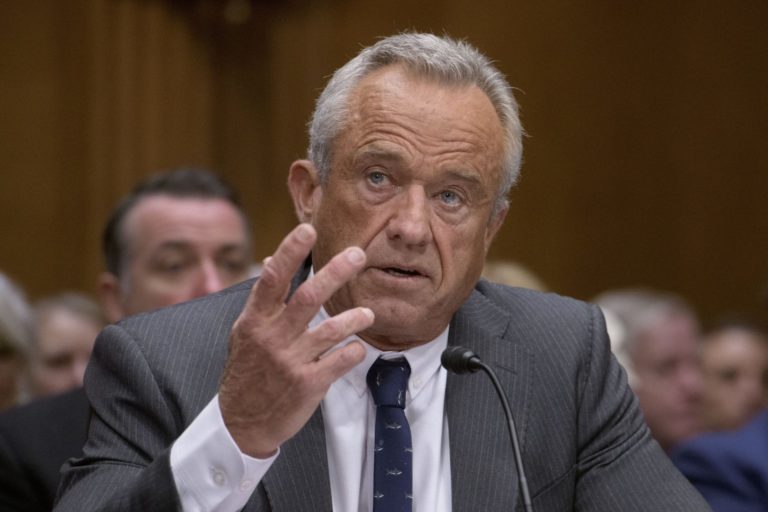
“This line of therapeutics has tremendous advantage if given in a clinical setting and we are working very hard to make sure that happens within 12 months,” Health Secretary Robert F. Kennedy Jr. recently told members of Congress.

His suggested timeline for green-lighting psychedelic therapy surprised even the most bullish supporters of the drugs. And it comes as psychedelics are making inroads in deep red states like Texas, where former Trump cabinet secretary and ex-governor Rick Perry has thrown his full support behind the effort.

The administration’s embrace of psychedelics has sparked both excitement as well as concern from those in the field, who worry the drugs might be discredited if they appear to be rushed onto the market.

“I’m quite optimistic,” says Rick Doblin, whose organization has pursued the medical use of MDMA (or ecstasy) since the 1980s. “But I’m also worried that the message the public might get is ‘Well, RFK likes psychedelics and now it’s approved.’”

FDA may reconsider MDMA

Under President Joe Biden, the FDA rejected MDMA as a treatment for post-traumatic stress disorder, citing flawed data and questionable research. Regulators called for a new study, likely taking several years. It was a major setback for Doblin and other advocates hoping to see the first U.S. approval of a psychedelic for medical use.

But the agency appears ready to reconsider. FDA chief Marty Makary, who reports to Kennedy, has called the evaluation of MDMA and other psychedelics “a top priority,” announcing a slate of initiatives that could be used to accelerate their approval.

One new program promises to expedite drugs that serve “the health interests of Americans,” by slashing their review time from six months or more to as little as one month. Makary has also suggested greater flexibility on requirements for certain drugs, potentially waiving rigorous controlled studies that compare patients to a placebo group.

That approach, considered essential for high-quality research, has long been a stumbling point for psychedelic studies, in which patients can almost always correctly guess whether they’ve received the drug or a dummy pill.

The U.S. Department of Health and Human Services and FDA also recently hired several new staffers with ties to the psychedelic movement.

“These are all very promising signs that the administration is aware of the potential of psychedelics and is trying to make overtures that they’re ready to approve them,” said Greg Ferenstein, a fellow at the libertarian Reason Foundation, who also consults for psychedelic companies. “We didn’t hear anything about that in the Biden administration”

A spokesperson for HHS did not respond to a request for comment.

As a presidential candidate, Kennedy discussed how his son and several close friends benefited from using psychedelics to deal with grief and other issues.

A number of veterans lobbying for psychedelic access have already met with Trump’s Secretary of Veterans Affairs, Doug Collins.

“What we’re seeing so far is positive,” Collins told House lawmakers in May.

But some experts worry the hope and hype surrounding psychedelics has gotten ahead of the science.

Philip Corlett, a psychiatric researcher at Yale University, says bypassing rigorous clinical trials could set back the field and jeopardize patients.

“If RFK and the new administration are serious about this work, there are things they could do to shepherd it into reality by meeting the benchmarks of medical science,” Corlett said. “I just don’t think that’s going to happen.”

Texas goes all-in on ibogaine research

As officials in Washington weigh the future of psychedelics, some states are moving ahead with their own projects in hopes of nudging the federal government. Oregon and Colorado have legalized psychedelic therapy.

And last month, Texas approved $50 million to study ibogaine, a potent psychedelic made from a shrub that’s native to West Africa, as a treatment for opioid addiction, PTSD and other conditions. The research grant — the largest of its kind by any government — passed with support from the state’s former GOP governor, Perry, and combat veterans, some who have traveled to clinics in Mexico that offer ibogaine.

Ibogaine is on the U.S. government’s ultra-restrictive list of illegal, Schedule 1 drugs, which also includes heroin. So advocates in Texas are hoping to build a national movement to ease restrictions on researching its use.

“Governmental systems move slowly and inefficiently,” said Bryan Hubbard of Americans for Ibogaine, a group formed with Perry. “Sometimes you find yourself constrained in terms of the progress you can make from within.”

Ibogaine is unique among psychedelics in both its purported benefits and risks. Small studies and anecdotal reports suggest the drug may be able to dramatically ease addiction and trauma. It was sold for medical use in France for several decades starting in the 1930s, but the drug can also cause dangerous irregular heart rhythms, which can be fatal if left untreated.

Some veterans who have taken the drug say the risks can be managed and ibogaine’s healing properties go far beyond antidepressants, mood stabilizers, counseling and other standard treatments.

Marcus Capone struggled with anger, insomnia and mood swings after 13 years as a Navy Seal. In 2017, at the urging of his wife Amber, he agreed to try ibogaine as a last resort. He described his first ibogaine session as “a complete purge of everything.”

“But afterward I felt the weight just completely off my shoulders,” he said. “No more anxiety, no more depression, life made sense all of a sudden.”

A nonprofit founded by the Capones, Veterans Exploring Treatment Solutions, or VETS, has helped over 1,000 veterans travel abroad to receive ibogaine and other psychedelics.

But federal scientists have looked at the drug before — three decades ago, when the National Institute on Drug Abuse funded preliminary studies on using it as an addiction treatment. The research was discontinued after it identified “cardiovascular toxicity.”

“It would be dead in the water,” in terms of winning FDA approval, longtime NIDA director Nora Volkow said.

But Volkow said her agency remains interested in psychedelics, including ibogaine, and is funding an American drugmaker that’s working to develop a safer, synthetic version of the drug.

“I am very intrigued by their pharmacological properties and how they are influencing the brain,” Volkow said. “But you also have to be very mindful not to fall into the hype and to be objective and rigorous in evaluating them.”

Adapted from reporting by the Associated Press.

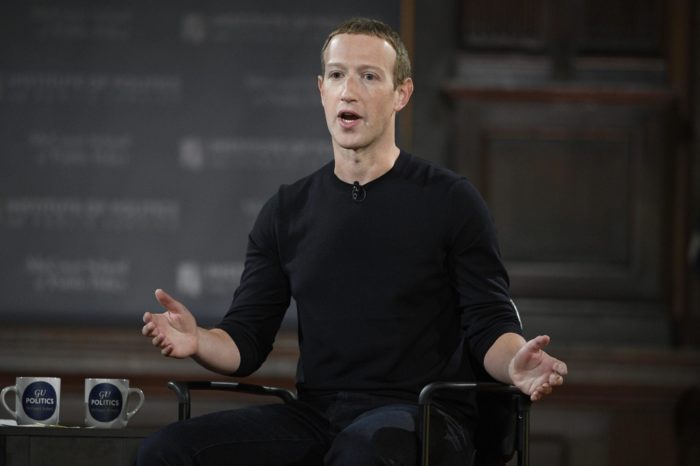
Meta CEO Mark Zuckerberg Expected to Testify in $8 Billion Facebook Privacy Lawsuit

(Headline USA) A $8 billion class action investors’ lawsuit against Meta CEO Mark Zuckerberg and company leaders — current and former — begins Wednesday, with claims stemming from the 2018 privacy scandal involving the Cambridge Analytica political consulting firm.

Investors allege in their lawsuit that Meta did not fully disclose the risks that Facebook users’ personal information would be misused by Cambridge Analytica, a firm that supported Donald Trump’s successful Republican presidential campaign in 2016. Shareholders say Facebook officials repeatedly and continually violated a 2012 consent order with the Federal Trade Commission under which Facebook agreed to stop collecting and sharing personal data on platform users and friends without their consent.

Facebook later sold user data to commercial partners in direct violation of the consent order and removed disclosures from privacy settings that were required under consent order, the lawsuit alleges.

The fallout led to Facebook agreeing to pay a $5.1 billion penalty to settle FTC charges. The social media giant also faced significant fines in Europe and reached a $725 million privacy settlement with users. Now shareholders want Zuckerberg and others to reimburse Meta for the FTC fine and other legal costs, which the plaintiffs estimate total more than $8 billion.

The first trial witness, privacy expert Neil Richards, testified Monday morning for the shareholders.

“Facebook’s privacy disclosures were misleading,” said Richards, a professor at Washington University Law School.

On cross-examination by a lawyer for the board of directors, he said he could not say whether the company had violated a 2012 consent order with the FTC. However, when asked about a PricewaterhouseCoopers report published in 2015 that found Facebook’s privacy controls to be sufficient, Richards called such reviews “of limited value” because they are based on information provided by the firm itself.

The eight-day case will feature testimony from Zuckerberg and former Chief Operating Officer Sheryl Sandberg. Others expected to appear on the stand include board member Marc Andreessen and former board member Peter Thiel. It takes place in Delaware Chancery Court, where Facebook parent Meta Platforms Inc. is incorporated. A judge is expected to rule in the months after the trial wraps up.

Meta took the case all the way to the Supreme Court to try to get it dismissed. Justices heard arguments in November and decided that it was wrong to take up the case in the first place. The high court dismissed the company’s appeal, leaving in place an appellate ruling allowing the case to go forward.

Adapted from reporting by the Associated Press.

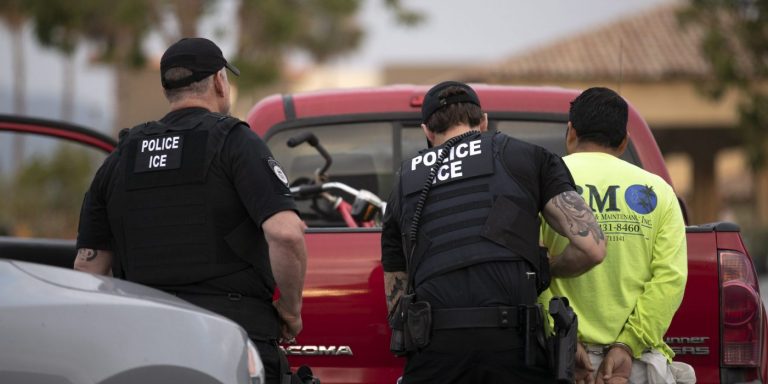
Democratic Attorneys General Call for Demasking ICE Agents

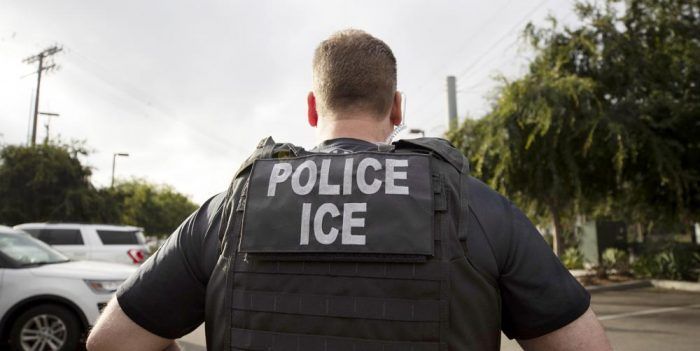
(Jamie Parsons, The Center Square) California, Arizona, Colorado and Nevada joined a coalition that asked Congress to prohibit U.S. Immigration and Customs Enforcement agents from wearing masks.

The states also want Congress to require the federal agents to show their identity and wear agency insignia.

In making the request, the coalition is citing public safety concerns.

But U.S. Department of Homeland Security officials say the agents need the masks for the sake of their and their families’ safety.

The coalition seeking to demask the agents consists of Democratic attorneys general from 20 states and the District of Columbia. The coalition said it believes masked ICE agents pose a threat to public safety, civil liberties and the reputation and effectiveness of law enforcement. Therefore, the coalition asked members of Congress in a letter Tuesday to establish laws that will force agents to show their identity, claiming it will showcase transparency and accountability in law enforcement and better protect the public.

“Transparency and accountability are the foundation of good law enforcement, yet in recent weeks, ICE agents have begun the shocking and unacceptable practice of deploying masked agents to carry out immigration enforcement operations,” California Attorney General Rob Bonta said in a press release Tuesday. “We call upon Congress to advance legislation to ensure that federal agents properly identify themselves and uphold the principles of transparency and accountability that are crucial for public safety and trust.”

The coalition of attorneys general claim when ICE agents wear masks to carry out arrests, they’re terrorizing communities instead of protecting them. The attorneys general said the public doesn’t know the arrests are being done by law enforcement.

The coalition said witnesses might think the ICE arrests are kidnappings and call local law enforcement to help.

The coalition also said that without identification and a uniform, ICE agents make it easy for criminals to impersonate them.

“Officers across Arizona do their jobs safely in uniform without masks daily,” Arizona Attorney General Kris Mayes said in a press release Tuesday. “ICE agents should too. Secret police tactics like this erode trust in law enforcement and allow criminals to dangerously impersonate officers – which is already happening.”

Similarly to what Mayes said, Colorado Attorney General Phil Weiser said law enforcement in his state promotes trust and transparency too. Weiser also said to maintain trust, people need to be able to identify who their law enforcement officers are.

“In Colorado, we promote responsible and trustworthy law enforcement through transparency and well-trained professionals subject to appropriate oversight,” Weiser in a press release Tuesday. “By contrast, secretive enforcement tactics, other than in exceptional situations, undermine public trust, threaten public safety, and violate the principle that law enforcement officers must be identifiable and accountable to the people they serve.”

ICE Acting Director Todd Lyons said ICE agents wear masks to protect their lives and the lives of their families, in a Boston press conference June 2.

“People are out there taking photos of their [ICE officer’s] names, faces and posting them online with death threats to their families and to them,” Lyons said. “So I am sorry if people are offended by them wearing masks, but I am not going to let my officers and agents go out there and put their life on the line and their family on line because people don’t like what immigration enforcement is.”

Tricia McLaughlin, Homeland Security’s assistant secretary for public affairs, told The Center Square Tuesday that ICE agents wear masks to protect themselves from being targeted by gangs such as Tren de Aragua and MS-13, and other malicious people. McLaughlin added that recent attacks on the character of ICE agents have led to an increase in ICE officer assaults.

“Attacks and demonization of our brave law enforcement is contributing to our officers now facing a nearly 700% increase in assaults,” Mclaughlin said.

The coalition of attorneys general mentioned Lyons’ concerns for the safety of his agents in their letter, but claimed Lyons is ignoring the “severe risks posed to public safety and civil liberties” by the presence of masks.

Trump Slams His ‘Weakling’ Supporters Who Believe in ‘Jeffrey Epstein Hoax’

(Headline USAPresident Donald Trump is lashing out at his own supporters as he tries to clamp down on criticism over his administration’s handling of records in the Jeffrey Epstein sex trafficking investigation, which Trump now calls a “Hoax.”

“Their new SCAM is what we will forever call the Jeffrey Epstein Hoax, and my PAST supporters have bought into this “bull——,” hook, line, and sinker,” Trump wrote Wednesday on his Truth Social site, using an expletive in his post. “They haven’t learned their lesson, and probably never will, even after being conned by the Lunatic Left for 8 long years.”

“Let these weaklings continue forward and do the Democrats work, don’t even think about talking of our incredible and unprecedented success, because I don’t want their support anymore! Thank you for your attention to this matter,” he went on.

The schism between the Republican president and some of his most loyal supporters centers on his administration’s handling of the Epstein case. Last week, the Justice Department and the FBI claimed that Epstein did not maintain a “client list” and they said no more files related to the wealthy financier’s sex trafficking investigation would be made public despite promises from Attorney General Pam Bondi that had raised the expectations of conservative influencers and conspiracy theorists.

The DOJ also released a manipulated video of Epstein’s prison floor in an attempt to prove that he killed himself. However, as Headline USA has explained, the footage does not provide evidence that Epstein killed himself. The camera only showed a tiny sliver of a staircase leading to Epstein’s cell. The camera in Epstein’s cell block, which had at least three other inmates, wasn’t recording. Nor was the camera covering one of the elevator bays that led to Epstein’s floor.

Trump has since defended Bondi and chided a reporter for asking about the documents.

Trump and many figures in his administration, including FBI Director Kash Patel and his deputy, Dan Bongino, have spent years calling for complete disclosure of the Epstein files.

Adapted from reporting by the Associated Press


Former US Marine Involved in Antifa-Style Terrorist Attack on ICE Facility

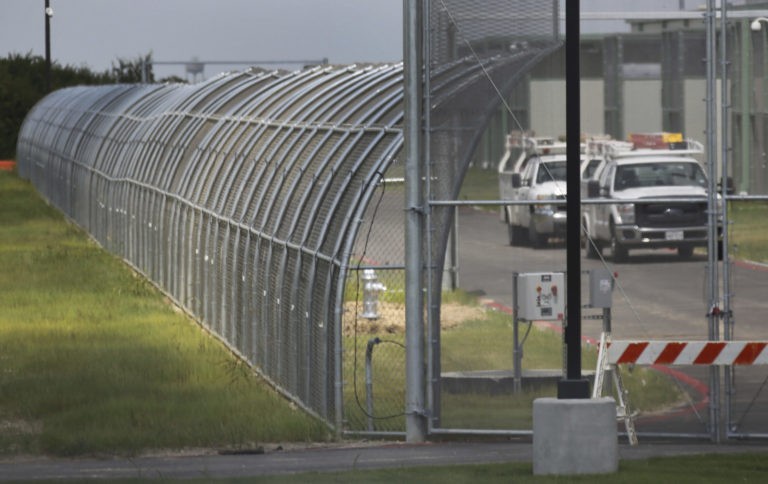
(Headline USA) A former U.S. Marine Corps reservist has been arrested and charged with attempted murder in connection with an attack at a Texas immigration detention center in which a police officer was shot in the neck, federal prosecutors said Tuesday.

Benjamin Hanil Song, 32, is the latest person charged in the Fourth of July assault in which attackers dressed in black military-style clothing opened fire outside the Prairieland Detention Center in Alvarado, southwest of Dallas, according to the U.S. Attorney’s Office for the Northern District of Texas.

Song, from Dallas, was arrested after a weeklong search and has been charged with three counts of attempted murder of federal agents and three counts of discharging a firearm in relation to a crime of violence, the office said in a statement. He is accused of purchasing four of the guns linked to the attack, it said.

U.S. District Court records do not list names of attorneys representing Song or scheduled court appearances. U.S. Attorney’s Office for the Northern District of Texas did not immediately respond to an email asking whether Song has an attorney.

The officer wounded in the attack has since been released from the hospital.

Ten people, most of them from the Dallas-Fort Worth area, have previously been charged with attempted murder of a federal officer and discharging a firearm in relation to a crime of violence. Another person has been charged with obstruction of justice for concealing evidence, while two others were charged with accessory after the fact for allegedly helping Song get away.

If convicted, most of the defendants could face up to life imprisonment, while those charged with obstruction of justice and accessory after the fact would face lesser penalties if convicted, according to federal prosecutors.

The shooting took place as President Donald Trump’s administration ramps up deportations.

The attackers initially set off fireworks and spray-painted vehicles and a guard structure, including the words “Ice Pig,” according to a criminal complaint. This was “designed to lure correctional officers outside the facility,” according to U.S. Attorney’s Office. Correctional officers called 911 and an Alvarado police officer responded and someone in the woods opened fire.

Another person across the street fired 20 to 30 rounds at correctional officers who were unarmed after they walked out of the facility, according to the office’s statement.

After the group fled, sheriff’s deputies stopped seven people about 300 yards (275 meters) from where the officer was shot, according to a criminal complaint.

“They were dressed in black, military-style clothing, some had on body armor, some were covered in mud, some were armed, and some had radios,” the complaint said.

A sheriff’s office detective also stopped a van leaving the area and found two AR-style rifles and a pistol, along with ballistic-style vests and a helmet, the complaint said.

The driver, the only person in the van, said he had been at the detention center. He said he had met some people online and drove some of them to the detention center from Dallas to “make some noise,” according to the complaint.

Song’s cellphone’s location data shows it was near the detention center from about 11:30 p.m. on July 4 and throughout the day on July 5, according to a criminal complaint.

“Though Song escaped by hiding overnight after the attack, we were confident he would not remain hidden for long,” Acting United States Attorney for the Northern District of Texas Nancy E. Larson said in a statement. “The fourteen individuals who planned and participated in these heinous acts will be prosecuted, and we expect justice will be swift.”

Adapted from reporting by the Associated Press