Silver’s Bull Market Has Officially Begun

(Jesse Colombo, Money Metals News Service) Silver has officially broken out in a big way, kicking off its bull market. Multiple confirmations I was watching for have now been fulfilled, and silver still has plenty of fuel left in the tank.

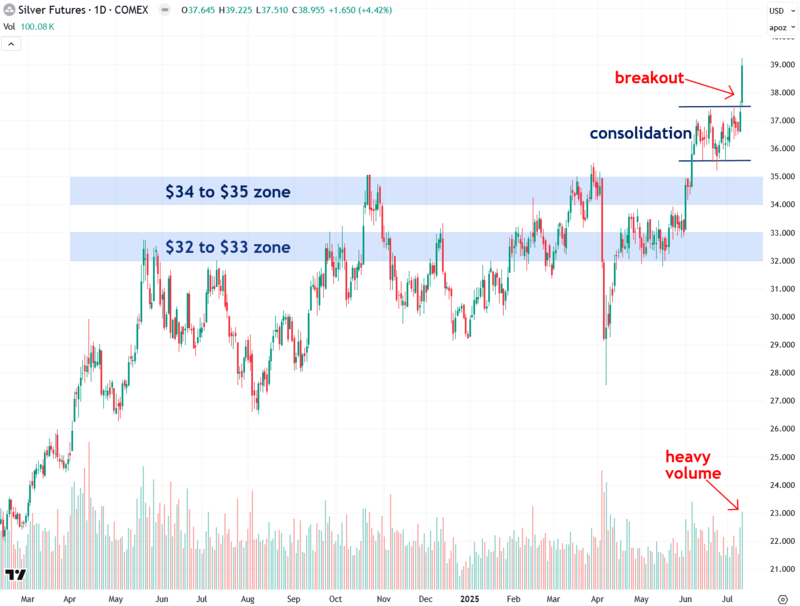
While gold soared over the past year, silver lagged behind, repeatedly held back by two major resistance zones — $32 to $33 and $34 to $35 — which stopped multiple breakout attempts and kept it in a prolonged consolidation phase.

That finally changed a month ago when silver decisively broke through these critical levels. Although it paused in recent weeks, this was simply a healthy consolidation before the next big surge.

This past Friday, that surge finally arrived, marking a true breakout and the official start of silver’s bull market. In this update, I’ll discuss where silver stands now and share what I expect to happen next.

The chart below shows COMEX silver futures, which I follow closely because they tend to respect key $1 increments, often creating clear support and resistance levels.

Over the past month, silver has finally broken through the heavy resistance cluster between $32 and $35, a major technical victory underscored by Friday’s powerful 4.42% surge on strong volume that pushed prices right to the doorstep of $39 an ounce.

This is a highly positive development signaling that silver’s bull market is just getting underway. With this strong momentum, silver is likely to make a rapid run at $40 next — and then $50 soon after.
alt_here

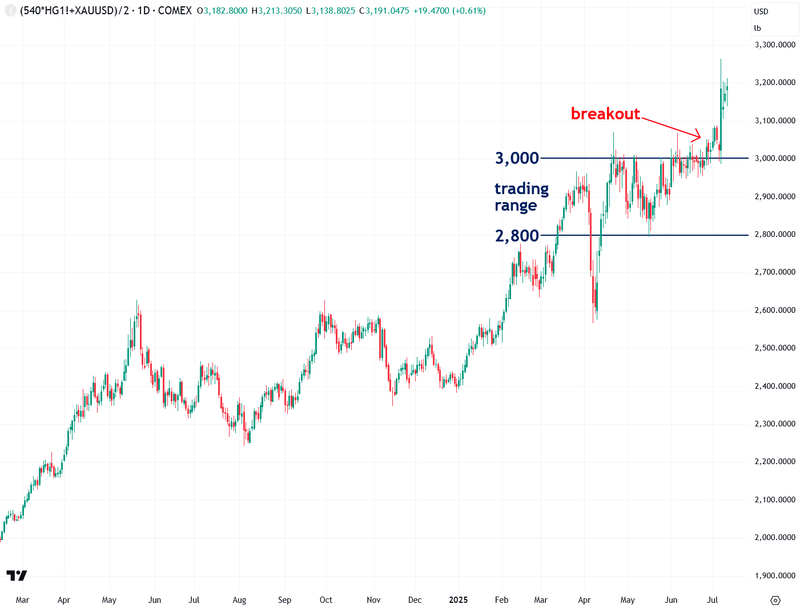
I’ve also developed a proprietary indicator called the Synthetic Silver Price Index (SSPI), designed to help validate silver’s price action and filter out potential false breakouts.

The SSPI is calculated as the average of gold and copper prices, with copper scaled by a factor of 540 to prevent gold from dominating the index. Interestingly, even though silver isn’t part of the calculation, the SSPI closely tracks its movements.

The SSPI finally broke out of its 2,800–3,000 trading range over the past couple of weeks, after being stuck there since March — a promising sign that foreshadowed the silver breakout I had been anticipating. Copper’s surge and breakout on Tuesday gave the SSPI a major boost and likely played a key role in silver’s move on Friday, as strong performances in both gold and copper often put pressure on arbitrage algorithms to buy silver in sympathy.

This breakout in the SSPI was one of the crucial confirmations I had been waiting for, along with a breakout in silver priced in euros.
alt_here

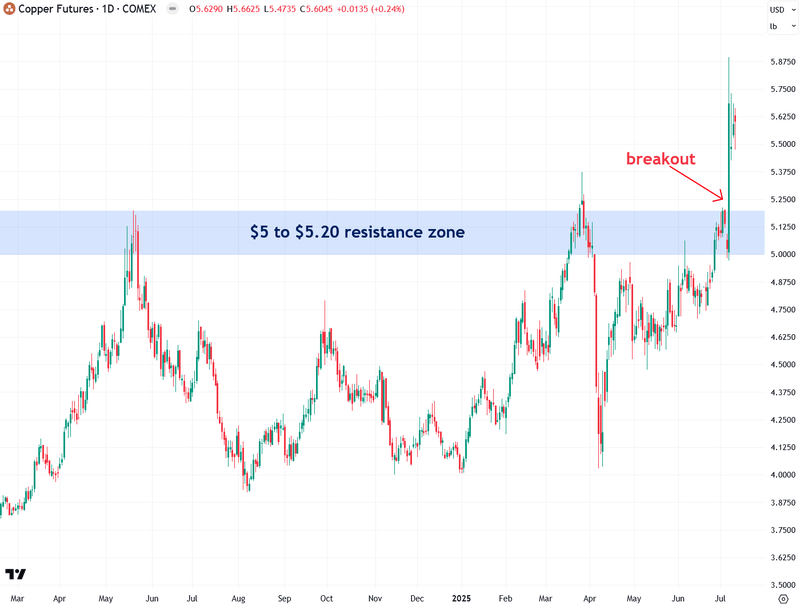
As the copper futures chart below shows, copper has finally broken above the $5 to $5.20 resistance zone that had held firm for several years.

This decisive breakout confirms that copper is now officially in a bull market of its own, and this new bull market should also serve as a strong tailwind for silver.
alt_here

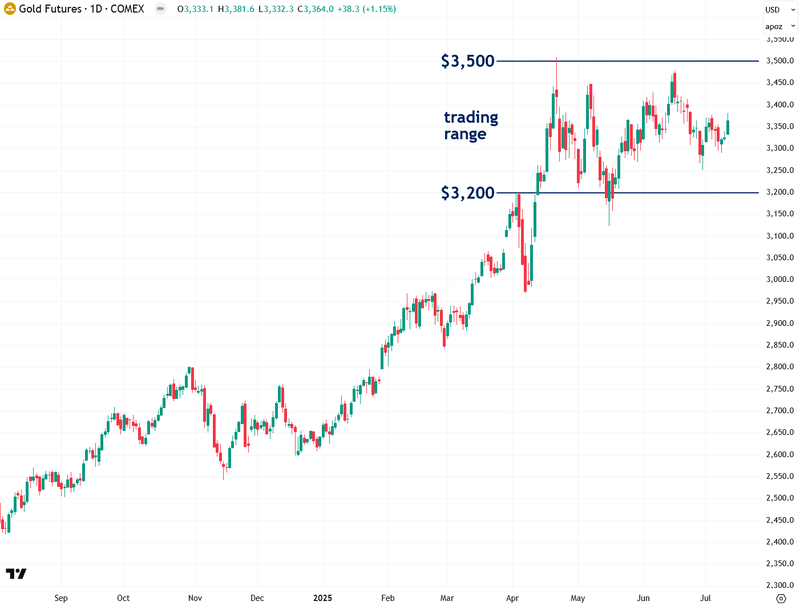
Although gold has been relatively quiet since mid-April, it has simply been undergoing a healthy consolidation between the $3,200 support and $3,500 resistance levels, working off its overbought condition after strong gains earlier in the spring.

This pattern is very similar to last summer’s consolidation, which was followed by a sharp rally once fall began and trading volume returned.

I’m now closely watching for a breakout above the $3,500 resistance, which would signal that gold is ready to resume its bull market. Such a breakout would also give silver an additional boost.
alt_here

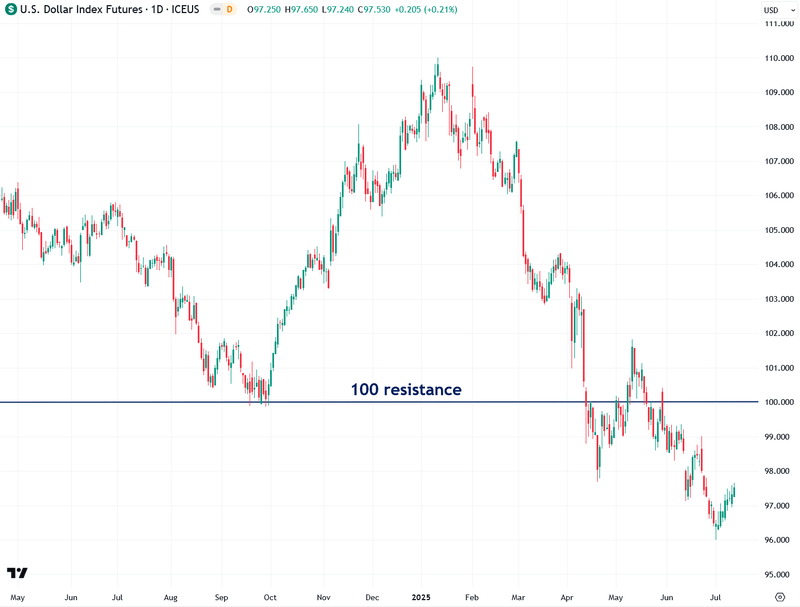
One factor fueling silver’s bull market is the weakening U.S. dollar, which recently broke below the key 100 level on the U.S. Dollar Index — a major technical breakdown. This breakdown indicates further weakness ahead, which is bullish for commodities — including precious metals — given their long-standing inverse relationship with the dollar.
alt_here

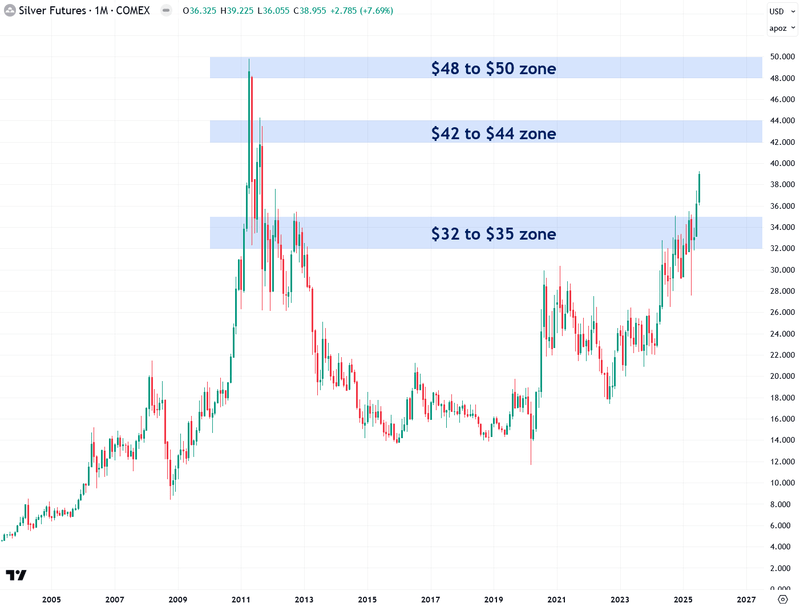
Now let’s take a look at silver’s long-term monthly chart to identify past resistance clusters that are likely to serve as price targets during this new bull run. These resistance zones were formed during periods of price congestion, most notably during silver’s surge and peak in 2011 and 2012.

The two most prominent levels that stand out to me are the $42–$44 zone and, ultimately, the $48–$50 zone. There is a strong probability that silver will aim for the most obvious target — $50 — during this rally.

And while it will likely pause to consolidate once it gets there, there’s no reason it has to stop at that level.
alt_here

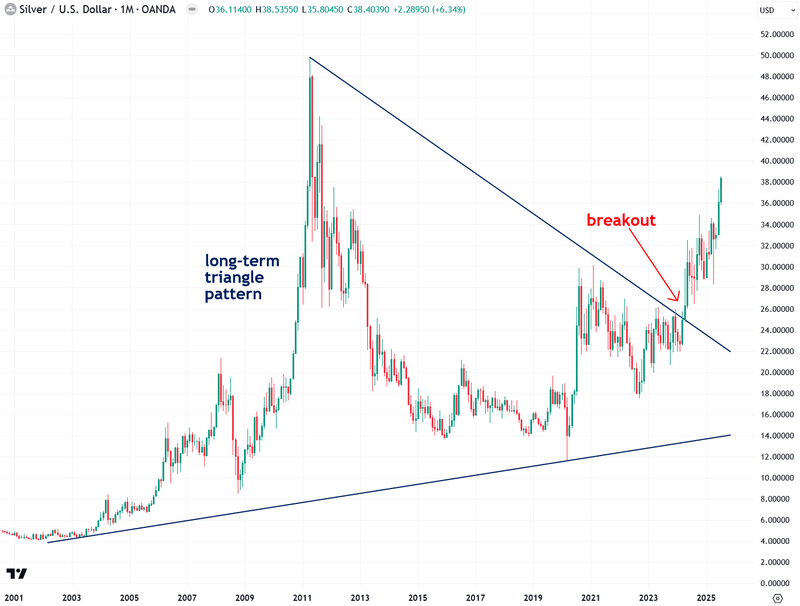
What first signaled to me back in April 2024 that silver was on the verge of a powerful bull market was its breakout from a two-decade-long triangle pattern:
alt_here

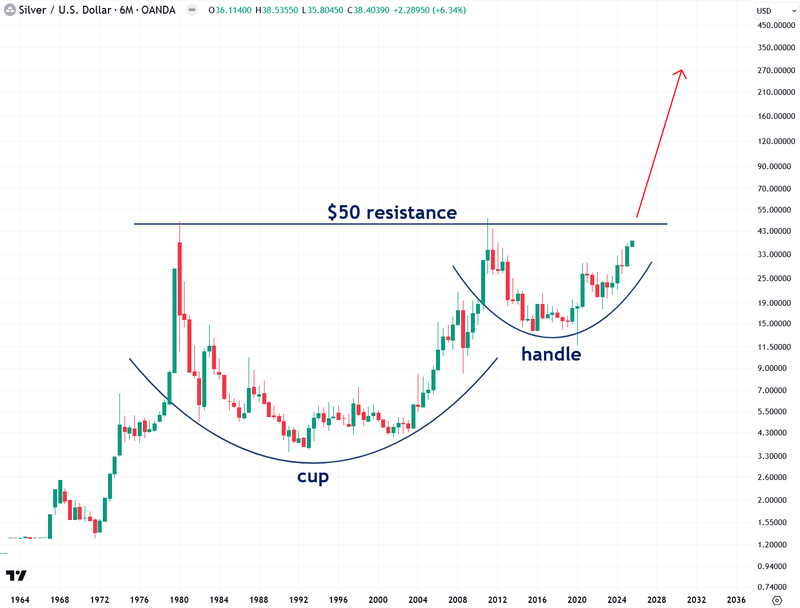
Even more exciting is the fact that silver’s logarithmic chart, dating back to the 1960s, reveals a cup-and-handle pattern, indicating the potential for silver to reach several hundred dollars per ounce during this bull market.

In order to confirm this particular scenario, silver needs to close decisively above the $50 resistance level.
alt_here

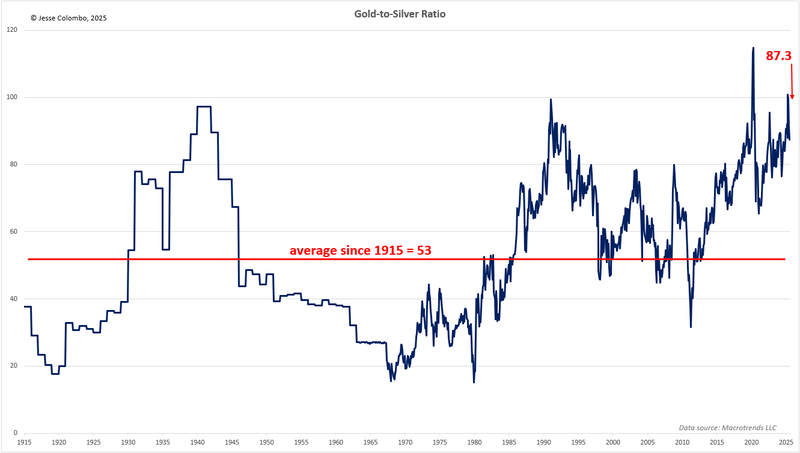
Despite silver’s recent strong performance, it still has substantial upside potential. Several valuation metrics — including the long-term gold-to-silver ratio — indicate that silver remains significantly undervalued.

The current gold-to-silver ratio stands at 87.3, but if it were to revert to its historical average of 53 (dating back to 1915) — without any increase in gold’s price — silver would be valued at approximately $63.30 per ounce, representing a healthy 65% gain from its current price of $38.40.

Naturally, as silver rises to close this gap, the ratio would decline accordingly.
alt_here

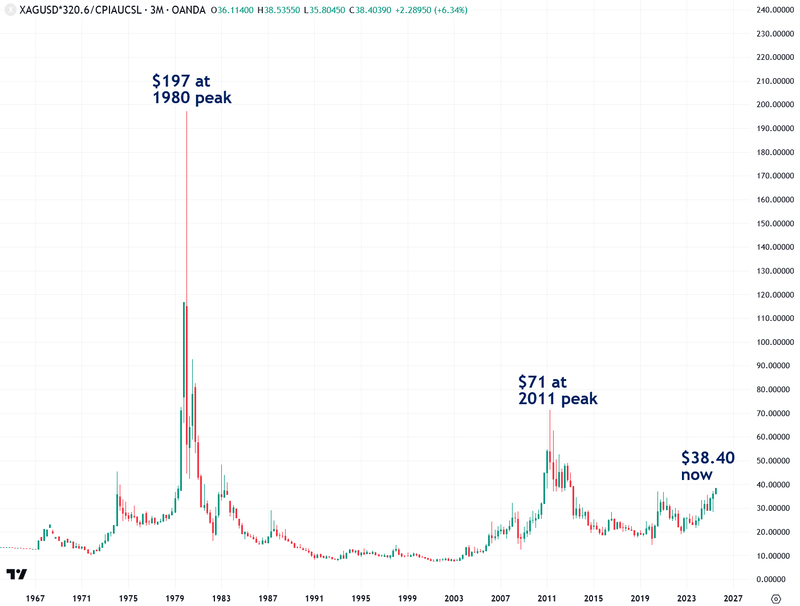
Adjusting silver’s price for inflation further highlights how undervalued it is by historical standards.

During the Hunt brothers-induced spike in 1980, silver reached an inflation-adjusted price of $197. In the 2011 bull market, driven by quantitative easing, it hit $71.

Currently trading at just $38.40, silver has significant room to rise if it’s to catch up with these previous inflation-adjusted peaks.
alt_here

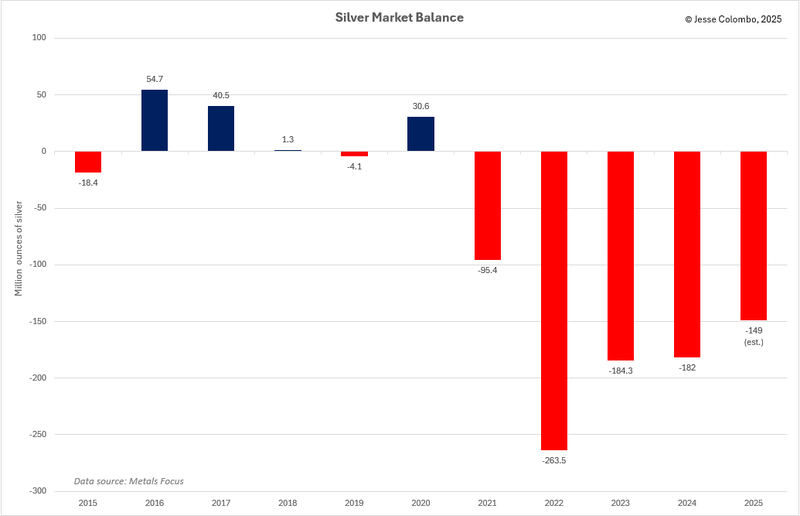
One key reason I believe silver will soon rally higher comes down to basic Economics 101: supply and demand. Over the past five years, silver demand has consistently exceeded supply, resulting in a persistent deficit—as shown in the chart below.

In 2024 alone, the shortfall reached 182 million ounces, with an estimated additional 117.6 million ounces this year—and deficits are expected to continue for the foreseeable future.

As a result, above-ground silver stocks are dwindling rapidly. While bullion banks can create unlimited amounts of paper silver to suppress prices, they can’t manufacture the real physical silver that is crucial for a wide range of industries, alongside growing investment demand.
alt_here

The persistent silver deficit stems from both dwindling supply and surging demand—a combination that, in an unmanipulated market, would naturally drive prices higher.

That’s why I described silver as a beach ball held underwater over the past year — the pressure kept building, and it was only a matter of time before it burst upward.

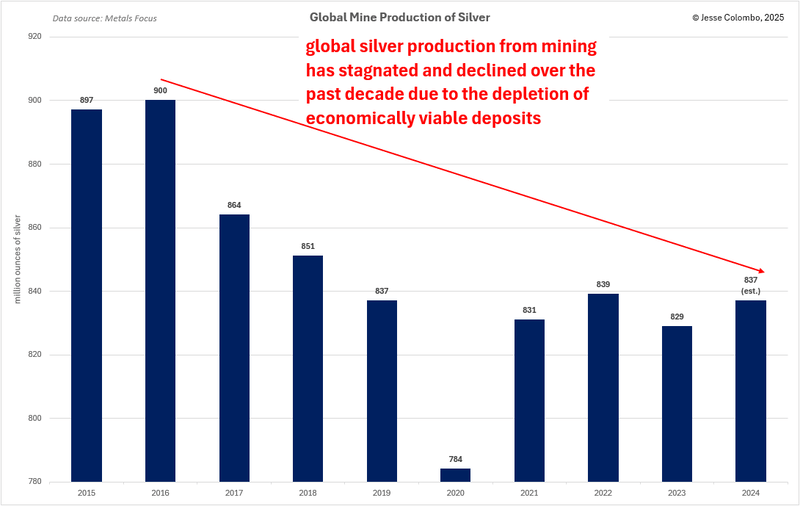
On the supply side, global silver mine production has peaked and declined over the past decade as economically viable deposits become depleted—something the bullion banks have absolutely no control over. And as time goes on, this supply crunch is only likely to worsen.
alt_here

At the same time, demand for physical silver has skyrocketed across multiple sectors, with the biggest driver being the surge in solar panel manufacturing.

As the world shifts away from fossil fuels toward renewable energy, this trend is only in its early stages. Silver demand for photovoltaic (solar panel) applications alone has nearly tripled over the past four years, increasing by an astonishing 143.1 million ounces.

With global efforts to expand clean energy accelerating, this demand is set to grow even further.

alt_here

In addition to the most obvious and straightforward approach — owning physical silver bullion — I also look to silver mining stocks for their amplified upside potential, especially as someone with a higher-than-average risk tolerance.

These stocks are leveraged to the price of silver and tend to move more dramatically—both up and down—so they’re not for the faint of heart. While riskier than holding bullion, they can offer explosive returns as silver truly takes off.

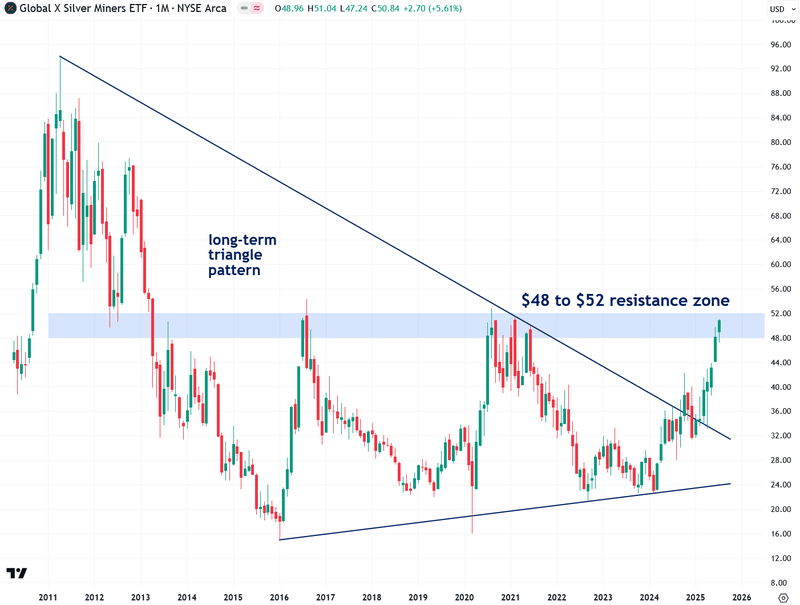
I use the Global X Silver Miners ETF (SIL) as a useful proxy to track the performance of silver mining stocks. SIL broke out of a long-term triangle pattern a few months ago, which is a bullish development.

However, a decisive close above the key $48–$52 resistance zone is still needed to fully confirm that the bull market in silver mining stocks is truly underway — and we’re getting very close.
alt_here

To summarize: the moment I have been waiting for is finally here. Silver’s bull market has officially kicked off, and all systems are go. Now, I’m looking for continued follow-through on this breakout, which is highly likely given silver’s strong momentum.

Of course, it’s important that this breakout holds for my bullish tactical thesis to remain intact — but so far, the setup looks excellent, and I’m feeling very optimistic.

If you found this report valuable, click here to subscribe to The Bubble Bubble Report for more content like it.


Jesse Colombo is a financial analyst and investor writing on macro-economics and precious metals markets. Recognized by The Times of London, he has built a reputation for warning about economic bubbles and future financial crises. An advocate for free markets and sound money, Colombo was also named one of LinkedIn’s Top Voices in Economy & Finance. His Substack can be accessed here.
Jamie Dimon Warns Trump on Federal Reserve Independence

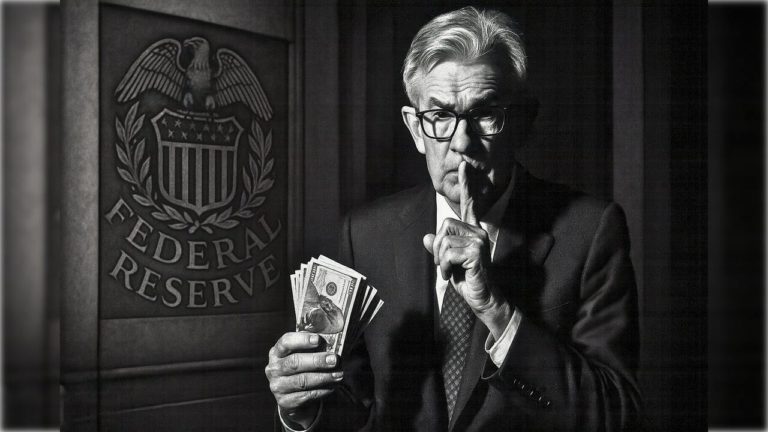
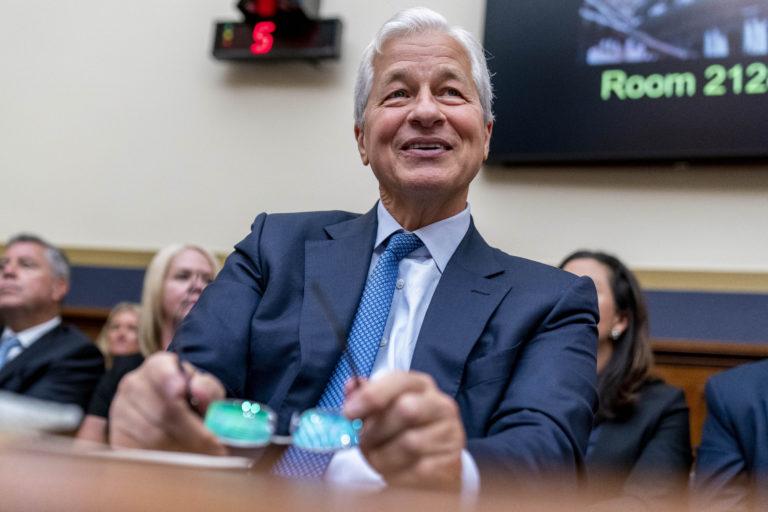
(Brett Rowland, The Center Square) JPMorgan Chase boss Jamie Dimon warned President Donald Trump on Tuesday about attacks against Federal Reserve Chairman Jerome Powell, noting the importance of the Fed’s independence.

“Playing around with the Fed could have adverse consequences, the absolute opposite of what you might be hoping for,” Dimon said during an earnings call. “It is important that they be independent.”

Trump has repeatedly pushed Powell to lower interest rates, but the Fed has kept rates flat.

Trump has nicknamed the Fed Chairman “Too Late Powell” and said he’s not smart, among other insults and name-calling. The president has even suggested appointing himself chairman of the Federal Reserve.

Trump has called for aggressive cuts.

“Europe has had 10 cuts, we have had none,” Trump recently said. “We should be 2.5 points lower.”

Powell and the Federal Open Market Committee, which sets rates, have taken a wait-and-see approach on interest rates, partly due to concerns about how Trump’s tariffs will affect the U.S. economy and the Fed’s mission for stable prices and maximum employment.

Powell has repeatedly dodged questions about Trump’s criticism and said the Fed will follow the data.

The president has limited authority over the Federal Reserve, despite getting to nominate members.

The president nominates members to the seven-member Board of Governors of the Federal Reserve System. The Senate confirms nominees. Members serve 14-year terms with one term beginning every two years, on Feb. 1 of even-numbered years.

Trump nominated Powell as chair in 2017 and the U.S. Senate confirmed him in 2018. Former President Joe Biden reappointed Powell in 2022 to a second four-year term.

ICE Arrests 1,361 Criminal Foreign Nationals in Houston Area in June

(Bethany Blankley, The Center Square) U.S. Immigration and Customs Enforcement officers arrested 1,361 foreign nationals, all in the country illegally, with current felony charges or convictions who were living in the Houston area in June.

Among them were 32 convicted of child sex offenses, nine convicted of homicide-related offenses, 16 documented members of a transnational gang or drug cartel, and one convicted of hijacking an airplane, ICE said.

“Despite attempts by some to undermine our mission by spreading false and malicious rumors, the brave men and women of ICE continue to work tirelessly around the clock targeting dangerous criminal aliens to restore integrity to our nation’s immigration system and bolster public safety in our communities,” ICE Enforcement and Removal Operations (ERO) Houston acting Field Office Director Gabriel Martinez said. “The number of dangerous criminal aliens that they removed from local communities across Southeast Texas last month is just another example of their selfless and unyielding efforts to return our local communities to places where we can all raise our families without having to worry about child predators, gang members, or other violent criminal aliens preying on our loved ones.”

The arrests were part of ICE ERO-Houston field office’s routine immigration enforcement activities conducted throughout southeast Texas in cooperation with federal, state and local law enforcement partners.

ICE highlighted the most egregious offenders arrested, including 52-year-old Cuban national Adermis Wilson-Gonzalez, who was convicted in 2003 of hijacking an airplane traveling from Cuba to Key West, Florida.

Others highlighted are Mexican nationals in the country illegally. One arrest was of Arnulfo Olivares Cervantes, 47, a former Los Mexicles gang member. The gang, based in Ciudad Juárez, Chihuahua, Mexico, is allied with the Sinaloa Cartel, a designated foreign terrorist organization. Cervantes previously illegally entered the U.S. six times, was twice convicted of trafficking cocaine, and also convicted for attempted murder, evading arrest, illegal entry and drug possession, ICE said.

Others arrested include: Luis Pablo Vasquez-Estolano, 29, previously deported six times, convicted of homicide, aggravated robbery, burglary of a vehicle, and drug possession; Jose Meza, 40, illegally entered the U.S. four times, was convicted of sexual assault of a minor and theft; Javier Escobar Gonzalez, 51, was convicted of sexual indecency with a minor, criminal trespass with a deadly weapon, driving while intoxicated, and unauthorized use of a firearm.

They are the latest of hundreds of Mexican nationals arrested in the Houston area with hundreds of felony convictions. In June, ICE ERO Houston officers deported 142 to Mexico with 473 convictions, including gang members, child sex offenders, human traffickers, The Center Square reported.

ICE ERO Houston officers are also regularly busting drug trafficking schemes in the Houston area, including those using taco trucks and the U.S. Postal Service, The Center Square reported.

They’re also continuing to arrest some of the most dangerous criminal foreign nationals, including alleged terrorists, Chinese spies, those from countries of foreign concern and state sponsors of terrorism like Iran.

Two Iranians recently arrested include one with a 2019 removal order from an immigration judge who was previously arrested for assault, had his student visa terminated and was illegally carrying a loaded handgun when he was arrested. Another had a 2005 removal order whose criminal history includes two convictions for drug crimes and one for driving on a suspended license for which he served time in prison, The Center Square reported.

Federal charter flights also first left Houston in May, removing illegal foreign nationals who choose to self-deport to Honduras and Colombia, The Center Square reported.

Republicans Vote against Resolution to Disclose the ‘Epstein Files’

(Ken Silva, Headline USA) The Trump administration continues to push against public calls to release all the government’s records on notorious sex-trafficker Jeffrey Epstein—and apparently Republicans in Congress aren’t eager for disclosure, either.

While it may be a cynical plot to divide the GOP, Democrats have introduced three resolutions in the last 24 hours to encourage disclosure of Epstein records. Rep. Marc Veasey, D-Texas, reportedly introduced a nonbinding resolution on Monday that’s unlikely to make it to a vote, Rep. Ro Khanna, D-Calif., introduced a similar resolution that was voted down, and House Democrats unsuccessfully attempted to cast a procedural vote over the matter on Tuesday.

“I think most of us believe what’s appropriate will be released when it’s time for the President to release it,” Rep. Virginia Foxx, R-NC, said when she cast her “no” vote on Monday.

The congressional votes come as President Donald Trump continues to try to quash public interest over the Epstein files. On Tuesday, he claimed that “these files were made up by Comey, they were made up by Obama, they were made up by Biden.”

Numerous polls show the approval ratings for the Trump administration is plummeting as the stonewalling continues.

Because of Epstein’s extensive fraternization with high-profile politicians and celebrities such as Bill Clinton, former Israeli PM Ehud Barak, Prince Andrew and Bill Gates and many more, some claim that Epstein’s mysterious August 2019 death in prison was actually a hit job to silence him. Proponents of that theory include Maxwell, who’s serving a 20-year prison sentence for sex trafficking.

“I believe that he was murdered. I was shocked, and I wondered, ‘How did this happen?’ Because I was sure he was going to appeal, and I was sure he was covered by the non-prosecution agreement,” Maxwell told British reporter Jeremy Kyle of TalkTV in 2023.

The non-prosecution agreement referenced by Maxwell was a sweetheart deal Epstein signed with the Department of Justice in 2008, in which he pleaded guilty to a state charge of procuring for prostitution a girl below the age of 18. Epstein was housed in a private wing of the Palm Beach County Stockade, and was reportedly allowed to leave the jail on “work release” for up to 12 hours a day.

After the Miami Herald published an expose on Epstein and his non-prosecution agreement in late 2018, Epstein was arrested again on July 6, 2019, on federal charges for the sex trafficking of minors in Florida and New York.

Ken Silva is the editor of Headline USA. Follow him at x.com/jd_cashless.

The Myth of Fed Independence

(Peter St Onge, Money Metals News Service) Donald Trump is threatening to replace Jerome Powell — or even appoint himself Fed chair.

So it’s a fruitful moment to ask: Should central banks be independent?

More importantly, can they be independent?

Or will a central bank inevitably serve their banking masters and the permanent bureaucracy — the Deep State?

Trump vs Powell

Donald Trump has been burning up the mean tweets over Jerome Powell’s strangling interest rates. He’s variously called Powell, very dumb, very stupid, low IQ, numbskull, major loser, and Mr. Too Late.

The issue is Powell keeping interest rates at some of the highest in 30 years despite inflation running a measly 1% since Trump took office.

High rates strangle jobs, growth, and consumer debt, and keep housing on the edge of catastrophe.

And Powell’s methadone clinic stands in contrast to 112 years of the Fed cutting whenever inflation drops below 2%.

Now, some economists are uneasy with the pressure campaign. Because academic studies in monetary economics say central bank independence is a good thing.

As in keeping politicians — and their voters — away from central banks leads to lower inflation.

Of course, it’s important to note most monetary economists are literally paid by the Fed — estimates range around 60-70%. And having worked in academia, that money will go to the prestigious professors. Which the rest follow along like dogs.

While some economic journals are literally run by the Fed.

So, yes, studies would say the Fed should be an economic dictatorship. You get what you pay for.

The Myth of Fed Independence

Even if we ignore potential corruption, the problem is we don’t actually have an independent Fed.

In the Fed’s 112 years, average rates under Republican presidents are much higher than Democrats — 4.9% vs 3.8%.

FDR got sweetheart 1.5% rates. Reagan got 10.2%.

It’s even worse adjusting for inflation: 0.7% real rates for Dems — money’s almost free. 3.1% for Republicans.

So all-you-can-eat for Democrat Presidents, 4 years of Nurse Ratched for Republicans.

If we focus on the period since the Nixon Shock, when the gold standard was replaced with money-printers gone wild, it’s actually negative 0.1% real rates under Democrats — literally free money.

And fully 2 points higher for Republicans.

The only time the Fed breaks character is when it’s time to bail out Wall Street. So, 2008, 2001, or 1987.

A Tale of Two Powells

This all brings us to Powell.

Under Joe Biden, he kept real rates less than a tenth of a percent. In fact, they were negative 58% of the time — 28 months.

Joe Biden was even the lucky beneficiary of a rate cut just 48 days before the election — the first since 2019.

Compare this to Trump’s current term, where real rates have averaged 3.2% — higher than all but five Democrat years in the past 112.

Powell’s excuse is tariffs could raise inflation.

But there’s been zero tariff inflation — foreigners are eating tariffs like in Trump’s first term.

And even the Fed admits the worst-case scenario on tariffs could be 2 to 3 percent one-time inflation. Twenty times less than the Biden-era inflation, Powell obediently midwifed.

What’s Next

Central bank independence is fundamentally undemocratic — it hands our life’s work to a cartel of bankers who, in practice, deliver inflation, recession, and bailouts.

Moreover, true central bank independence is impossible. A central bank will always serve the bankers and the permanent government bureaucracy who do them favors, from millions of dollars in speaking fees to cushy golden parachutes at NGO’s, the IMF, or ambassadorships.

The Fed, like all central banks, is a key hub of the Deep State. So-called independence is a smokescreen to give that cabal total control. But so far, Trump hasn’t shown an appetite to rock the boat — it’s just tweets.

Suggesting he’ll likely wait Powell out and appoint an easy-money Chair.

And pray the Fed doesn’t turn on him again.

Originally Published on ProfStOnge.


Peter St. Onge writes articles about Economics and Freedom. He’s an economist at the Heritage Foundation, a Fellow at the Mises Institute, and a former professor at Taiwan’s Feng Chia University.

Leftist Who Infiltrated Patriot Front Seeks to Dismiss Doxxing Lawsuit

(Ken Silva, Headline USA) A left-wing activist who infiltrated white nationalist group Patriot Front and doxxed some of its members in 2021 is now seeking to dismiss a lawsuit over the matter—arguing that his activities were legal and justified.

David Capito, who apparently changed his name to Vyacheslav Arkadyevich Arkhangelskiy in 2022, joined Patriot Front in July 2021 under the false name “Vincent Washington.” Later that hear, Capito allegedly worked with left-wing hackers to download a trove of internal Patriot Front communications, videos and other records. The data appeared on the left-wing site Unicorn Riot.

As a result of the public doxxing, some Patriot Front plaintiffs lost their jobs. Five members—Paul Gancarz, Daniel Turetchi, Colton Brown, James Johnson and his wife, Amelia Johnson—sued Capito in 2023. They accused Capito of violating the federal Computer Fraud and Abuse Act—which prohibits the unauthorized use of computers—as well as a variety of state laws.

For nearly the next two years, the Patriot Front members were unable to serve Capito with their lawsuit. They accused the leftist, who is allegedly a member of the Antifa-affiliated Puget Sound John Brown Gun Club, of going underground in an attempt to avoid legal accountability.

“Mr. Capito has concealed himself within the state with an intent to avoid service … Mr. Capito has a pattern of using false identities and aliases such as ‘Nick Vasiliy’ and ‘Vincent Washington’ and also frequently changes his name to avoid recognition and discovery of his whereabouts,” the Patriot Front members’ lawyers said last September.

At one point, the Patriot Front even reported Capito to the FBI, according to the New Yorker.

“The exposed Patriot Front members were furious at Vincent [after he doxed the group]. To strike back, they appear to have enlisted an unlikely ally: the F.B.I.,” the New Yorker reported last August.

Finally, last month a judge allowed the lawsuit to move forward after the plaintiffs published numerous notices in the Seattle Times, which covers the region where Capito is believed to be.

It didn’t take long for Capito to lawyer up. He retained the services of the left-wing “Civil Liberties Defense Center,” which filed a motion to dismiss on June 27.

According to the motion to dismiss, it was in the “public interest” for Capito to infiltrate the Patriot Front—a mostly peaceful group that’s been involved in a few skirmishes, but never any terroristic activity.

“The membership of Patriot Front is newsworthy information of legitimate public interest, as evidenced by the frequent coverage of their membership and operations by major news outlets,” the motion states, adding: “Due to its familiarity with doxing, both as a target and as a catalyst thereof, any member in Patriot Front should have a reasonable expectation that the organization’s membership is under scrutiny.”

Ken Silva is the editor of Headline USA. Follow him at x.com/jd_cashless.

Price Inflation Heating Up Based on June CPI

(Mike Maharrey, Money Metals News Service) Based on the latest Consumer Price Index (CPI) data, prices showed signs of creeping higher in June. However, there were enough dovish points in the data to support those pushing for looser monetary policy.

The headline annual CPI spiked from 2.4 percent in May to 2.7 percent in June, according to the latest data from the BLS. That was slightly above the 2.6 percent expectation.

On a monthly basis, prices rose 0.3 percent in June, in line with projections. That follows a 0.1 percent rise in prices in May. That monthly CPI number annualizes to 3.6 percent.

Stripping out more volatile food and energy prices, core CPI came in better than expected, rising 0.2 percent month-on-month. The projection was for a 0.3 percent rise. On an annual basis, core CPI was 2.9 percent, in line with expectations and the same as the May number.

As you parse the data, keep in mind that the CPI doesn’t tell the entire story of inflation. The government revised the CPI formula in the 1990s so that it understated the actual rise in prices. Based on the formula used in the 1970s, CPI is closer to double the official numbers. So, if the BLS used the old formula, we’d be looking at CPI closer to 6 percent. And using an honest formula, it would probably be worse than that.

However, this is the formula the government uses, and it drives decision-making.

It is also important to note that a federal government hiring freeze has reportedly stretched the BLS thin, and the agency recently reduced data collection and expanded a process known as “imputation,” which uses modeling to fill in incomplete data. In April, the BLS announced it was “reducing sample in areas across the country” and suspended data collection in Lincoln, Nebraska; Provo, Utah; and Buffalo, New York.

Looking deeper into the May BLS data, food prices rose 0.3 percent in June. On an annual basis, food prices are up 3 percent for the year.

Tariff-sensitive apparel prices spiked by 0.4 percent, indicating some price pressure from the trade war. Household furnishing prices also surged, rising by 1 percent month-on-month. However, new vehicle prices fell by -0.3 percent.

Service prices, which are less impacted by tariffs, were also up, rising 0.3 percent month-on-month. Service prices have risen by 3.6 percent in the past year.

Energy prices rose 0.9 percent month-on-month, driven by a 1 percent hike in gasoline prices, driven at least in part by a surge in oil prices during the brief hostilities between Israel and Iran.

Shelter costs continued to moderate as the weak housing market drove down home prices. However, shelter costs still rose 0.2 percent month-on-month in June.

How Do They Spin This?

How you interpret the data will likely depend on your political bent.

The financial media called it a “mixed” report. CNBC led its report writing, “Consumer prices rose in June as President Donald Trump’s tariffs began to slowly work their way through the U.S. economy.” Most mainstream headlines emphasized tariffs and their impact on prices.

However, while tariffs can raise a lot of prices, and that will show up in CPI, customs duties do not cause “inflation” properly defined. Only one thing raises the general price level (all prices) in an economy – that is, an expansion of money and credit.

Henry Hazlitt is best known for his brilliant book Economics in One Lesson. In another essay titled “Inflation in One Page,” he explained why using a more precise definition of inflation is crucial.

“Inflation is an increase in the quantity of money and credit. Its chief consequence is soaring prices.

“Therefore inflation—if we misuse the term to mean the rising prices themselves—is caused solely by printing more money. For this, the government’s monetary policies are entirely responsible.” (Emphasis added)

While the Federal Reserve tightened monetary policy enough to rein in rising prices, it never did enough to slay the inflation dragon. In fact, inflation (properly defined as an increase in the money supply) has been going up for over a year.

On the other side of the coin, President Trump and those pushing for rate cuts can point to the core CPI data and plausibly argue that price inflation remains muted. While there are signs that price inflation is heating up, it remains cool compared to the numbers were were seeing a year ago.

Even if one can make a plausible argument for rate cuts based on the CPI, it’s important to remember that it is actually a push to increase inflation.

Given the fact that the money supply is expanding, and financial conditions are loose from a historical standpoint, caution in cutting is warranted. Just taking the CPI at face value should signal caution. After all, none of the metrics are at the mythical 2 percent target.

However, President Trump and others pushing for rate cuts aren’t wrong either.

A higher interest rate environment will eventually crack the debt-riddled economy and pop the bubbles. The economy needs its easy money drug. However, a few good CPI reports notwithstanding, inflation is far from dead.

So, the central bank needs to simultaneously keep rates higher for longer and cut rates. That’s quite a Catch-22, and this CPI report won’t make the decision-making any easier.


Mike Maharrey is a journalist and market analyst for Money Metals with over a decade of experience in precious metals. He holds a BS in accounting from the University of Kentucky and a BA in journalism from the University of South Florida.

Space Force Conducts Largest Ever ‘Orbital Warfare’ Drills

(Kyle Anzalone, Libertarian Institute) The newest branch of the US military, the Space Force, is conducting its largest war games to date.

Dubbed Resolute Space 25, the drills will involve 700 members of the Space Force stationed across the globe. The exercise will be integrated with the US Air Force’s Resolute Force Pacific (REFORPAC) drill.

A statement from the Space Force explains, “The intent of this Space Force-led exercise is to incorporate, at scale, space-based and space-enabled capabilities to include, but not limited to, space electromagnetic warfare, space domain awareness, orbital warfare, and navigational warfare.”

A high-ranking “guardian” – the Space Force’s pretentious equivalent of “airman” or “marine” – said the drills were intended to establish the branch’s readiness to wage war in space. “Resolute Space sends a clear message: Guardians are prepared to fight and win in space shoulder to shoulder with our joint and allied partners,” said Chief of Space Operations Gen. Chance Saltzman. “By training at this unprecedented scale, we’re sharpening warfighter instincts, strengthening combat credibility, and proving our commitment to deliver peace through strength in the face of any challenge.”

The Space Force has seen rapid budget spikes since it was established in 2019. The “Big Beautiful Bill” that was recently signed into law by President Donald Trump further ramped up the Space Force’s funding to $40 billion, a 30% increase.

This article originally appeared at The Libertarian Institute.

Senate NDAA Would Add $32 Billion to Trump’s $1 Trillion 2026 Military Budget

(Dave DeCamp, Antiwar.comThe Senate Armed Services Committee (SASC) has approved its version of the 2026 National Defense Authorization Act (NDAA), which would add approximately $32 billion to President Trump’s planned military budget of $1.01 trillion.

The SASC’s NDAA would provide $924.7 billion in military spending, including $878.7 billion for the Pentagon, $35.2 billion for the Energy Department’s nuclear programs, and $10.8 billion for other military-related spending. The additional $32 billion would go toward shipbuilding, munitions, and investments in the F-35 fighter jet.

The White House requested a $896.2 billion NDAA and plans to supplement it with $113 billion from the recently passed budget reconciliation bill, which Trump dubbed the “Big Beautiful Bill,” bringing the total military budget for 2026 to $1.01 trillion. Adding the $32 billion from the Senate’s NDAA would bring the total to approximately $1.033 trillion.

So far, the House Armed Services Committee’s version of the NDAA reflects President Trump’s request. The committee will be marking up the bill this week, and once approved, the House and Senate will negotiate the final version of the military spending bill.

Last year, the SASC also approved an NDAA that was significantly higher than what President Biden requested and went against budget caps, but the increase was ultimately stripped out of the final version of the bill.

The US has never officially had a $1 trillion military budget, but the actual cost of US military spending has exceeded $1 trillion for years. According to veteran defense analyst Winslow Wheeler, based on a $895 billion National Defense Authorization Act, US national security spending for 2025 was expected to reach about $1.77 trillion.

Wheeler’s estimate accounts for military-related spending from other government agencies not funded by the NDAA, such as the Department of Veterans Affairs and Homeland Security. It also includes the national security share of the interest accrued on the US debt, as well as other factors.

This article originally appeared at Antiwar.com.

Report: Epstein Hired Private Goons to Harass FBI Agents

(Ken Silva, Headline USA) Rolling Stone reported Monday that notorious sex trafficker Jeffrey Epstein hired private investigators to follow, intimidate and spy on FBI agents who were investigating him in the mid- to late-2000s.

“They put surveillance on them, they tailed them, pulled their trash, they hired private PIs to investigate the investigators,” one official, who wasn’t named, told the magazine. The official added that a special agent eventually moved to a gated community in an effort to reduce the constant harassment.

The tactics described by the official were similar to what happened to Palm Beach police officers.

“Police reports show that Epstein’s private investigators attempted to conduct interviews while posing as cops; that they picked through Reiter’s trash in search of dirt to discredit him; and that the private investigators were accused of following the girls and their families,” the Herald reported in 2018. “In one case, the father of one girl claimed he had been run off the road by a private investigator, police and court reports show.”

The Rolling Stone report follows last week’s two-page statement from the Justice Department and the FBI, which concluded that Epstein had no clients. The conclusion has outraged Trump supporters, who pointed to past statements from several administration officials that the list ought to be revealed.

Attorney General Pam Bondi had suggested in February that Epstein’s “client list” was sitting on her desk waiting for review, though last week she said she had been referring generally to the Epstein case file and not a specific client list.

Conservative influencers have since demanded to see all the files related to Epstein’s crimes, even as Trump has tried to put the issue to bed.

Over a decade after the FBI’s first investigation, Epstein was arrested again on July 6, 2019, on federal charges for the sex trafficking of minors in Florida and New York.

Epstein’s death was ruled a suicide by hanging after he was found dead in his jail cell on August 10, 2019. But his lawyers contested that claim. Skeptics point to malfunctioning surveillance cameras, sleeping guards, and broken bones in Epstein’s neck as indications that his death was something other than suicide.

Because of Epstein’s extensive fraternization with high-profile politicians and celebrities such as Bill Clinton, former Israeli PM Ehud Barak, Prince Andrew and Bill Gates and many more, some claim that Epstein’s death was actually a hit job to silence him. Proponents of that theory include Maxwell, who’s serving a 20-year prison sentence for sex trafficking.

“I believe that he was murdered. I was shocked, and I wondered, ‘How did this happen?’ Because I was sure he was going to appeal, and I was sure he was covered by the non-prosecution agreement,” Maxwell told British reporter Jeremy Kyle of TalkTV in 2023.

The non-prosecution agreement referenced by Maxwell was a sweetheart deal Epstein signed with the Department of Justice in 2008, in which he pleaded guilty to a state charge of procuring for prostitution a girl below the age of 18. Epstein was housed in a private wing of the Palm Beach County Stockade, and was reportedly allowed to leave the jail on “work release” for up to 12 hours a day.

Ken Silva is the editor of Headline USA. Follow him at x.com/jd_cashless.