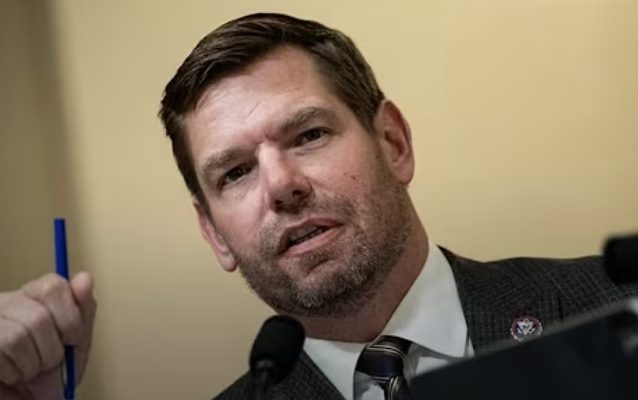
(José Niño, Headline USA) During a Wednesday appearance onMS NOW, Rep. Eric Swalwell, D-CA, issued a stark warning to federal immigration enforcement personnel: reveal your identity or lose your ability to drive legally in the state.
The congressman, currently vying for California’s governorship in the November election, announced he would leverage the state’s licensing authority to crack down on Immigration and Customs Enforcement agents who wear face coverings during operations.
“If the president is going to send ICE agents to chase immigrants through the fields where they work, what I’m going to do is make them take off their masks and show their faces, show their identification, and if they commit crimes, that they’re going to be charged with crimes,” Swalwell declared.
He continued: “If the governor has the ability to issue driver’s licenses to people in California, if you’re going to wear a mask and not identify yourself, you’re not going to be eligible to drive a vehicle in California.”
The proposal emerges amid ongoing legal battles over California’s attempt to prohibit law enforcement officers from concealing their faces. Just the News reported that Governor Gavin Newsomsigned legislation last September that would have banned such practices, with the law scheduled to take effect this Thursday. However, the Trump administration filed suit against the measure, securing a temporary hold on its implementation.
The Department of Homeland Security has flatly refused to comply with California’s mandate. Republican critics maintain that federal immigration agents require facial concealment to protect against doxxing and potential retaliation. Constitutional scholars have also questioned whether states possess the authority to regulate federal law enforcement operations.
Swalwell faces a crowded field ofprominent Democrats competing to succeed the term-limited Newsom. Former Health and Human Services Secretary Xavier Becerra and former Representative Katie Porter are both seeking their party’s nomination. On the Republican side, Riverside County Sheriff Chad Bianco has emerged as the leading candidate.
José Niño is the deputy editor of Headline USA. Follow him at x.com/JoseAlNino
(Ben Sellers, Headline USA) The capture of alleged narco-terrorist Nicolas Maduro at his fortress in Caracas early Saturday may have massive implications to both foreign and domestic policy — including the long-awaited evidence to expose the stolen 2020 election.
On the day he captured the head of the Venezuelan cartel that gave us Smartmatic voting systems, @realDonaldTrump posts that the CIA in conjunction with Dominion Voting Systems (which uses the Smartmatic backbone) stole the 2020 election by stealing millions of votes nationwide… pic.twitter.com/6Dmue9crIU
Even those reticent to speak out due to past threats of libel suits and other lawfare were emboldened to do so after President Donald Trump added fuel to the fire with a series of Truth Social posts linking Venezuela to vote-rigging operations in the U.S.
You’re about to see 1,000 media outlets and 1,000 influencers talk about Smartmatic and Dominion and our rigged voting machines now that’s it’s safe.
Don’t be fooled.
All of these people were too scared to tell the truth the last 5 years.
Maduro, the former Venezuelan president who refused to relinquish his office following his own election defeat in a rigged race, ironically could make the case for why Trump should not have conceded his defeat to former President Joe Biden.
Several top conservative thought-leaders, including Human Events host Jack Posobiec and InfoWars host Alex Jones, suggested that Maduro may now turn state’s evidence against suspected U.S. election conspirators to reduce his own sentence.
BREAKING: Alex Jones says the Venezuela operation is possibly a set up meant to lead to Maduro making a deal to expose “the election fraud & drug dealing that the Democrats, the Pelosis, the Clinton’s & the Bush’s are involved in” pic.twitter.com/kwoSemD050
Venezuela is believed to have been a base of operations for Smartmatic — a company that, along with Dominion Voting Systems — provided the election infrastructure used in many of the highly contested and suspicious 2020 tabulations in places like Georgia, Arizona, Nevada and Pennsylvania.
Following the Electoral College vote in favor of Biden, many of the lawsuits contesting the outcome were dismissed over technicalities such as lack of standing, although suspicions of foul play were never categorically disproved. Indeed, Trump and his allies won many of the cases argued on their merit.
To silence the dissent, well-heeled left-wing activists waged an aggressive lawfare campaign to target Trump and his defenders, accusing them of insurrection, racketeering conspiracies and a litany of other bogus charges that carried both criminal and civil penalties.
Smartmatic and Dominion both levied lawsuits against media outlets for reporting doubts about the integrity of their systems, even though such questions had long been raised by critics on both sides of the aisle.
Fox News was forced into settling a $787 million lawsuit with Dominion for being unable to substantiate the claims of its guests, including Trump attorney Sidney Powell.
“I can hardly wait to present all the evidence we’ve collected on Dominion. It was created to produce and alter voting results in Venezuela for Hugo Chávez, and then shipped internationally to manipulate votes for purchase in other countries, including this one…” pic.twitter.com/BwW5kGwDR9
But at least one social-media influencer, under the name @KAGdrogo, claimed recently that testimony from a “Venezuelan Military Intelligence” whistleblower may validate Powell’s allegations.
A Venezuelan Military Intelligence whistleblower confirmed the CIA outsources election rigging technology like Smartmatic from Venezuela.
This is about a lot more than narco trafficking. It’s not about oil or Israel, contrary to what you see online from clickbait doomer slop.… pic.twitter.com/zZj7gfYly6
“Smartmatic was born as an electoral tool of the Venezuelan regime … I know this because I placed the head of IT of the National Electoral Council (CNE) in his position, and he reported directly to me,” said the whistleblower, identified as Hugo Carvajal Barrios.
“The Smartmatic system can be altered—this is a fact,” he added. “This technology was later exported abroad, including to the United States. Regime operatives maintain relationships with election officials and voting-machine companies inside your country.”
Others accused Democrats of attempting to register voters living in Venezuela to support failed 2024 presidential nominee Kamala Harris.
This is real reason why Democrats are outraged over Donald Trump capturing Nicolas Maduro
Democrats were sending emails to Venezuelan citizens, in Venezuela, to register them to vote for Kamala Harris in the 2024 election
Venezuela was another Democrat voter fraud operation
Whether the viral social-media posts could be verified in a court of law remains to be determined.
However, a filing from the Justice Department confirmed that the case against Maduro and his wife was likely to involve several high-level cooperating witnesses.
If Maduro thought the seizure operation was scary, wait until he reads this superseding indictment. https://t.co/XHpeL6rPOs He is not just facing documented allegations of his facilitating drug transits, but also potential high-level cooperating witnesses…
Meanwhile, foreign policy experts and conspiracy theorists alike hinted that testimony from Maduro himself may be the game-changer.
Some said that it had the potential to unravel an even larger conspiracy for which the stolen election was merely an after-thought, implicating far-left non-governmental organizations, deep-state intelligence agencies and the Bush family in a vast conspiracy to control both the U.S. drug supply and its dynastic power structure.
One thing no one is talking about- with capture of Maduro & bringing him back to USA to face trial. He obviously faces life in super max prison, or federal death penalty for drug trafficking. BUT…what if he gets reduced sentence for telling everything he knows about stolen 2020…
— Wayne Root – Wayne Allyn Root – TV & Radio Host (@RealWayneRoot) January 3, 2026
Two things are immediately obvious:
1) Trump has been patiently waiting for a chance to capture Maduro alive, and 2) Maduro’s capture is effectively doomsday for the far-Left.
In the very near future, we’re going to see Maduro publicly admit to everything – election…
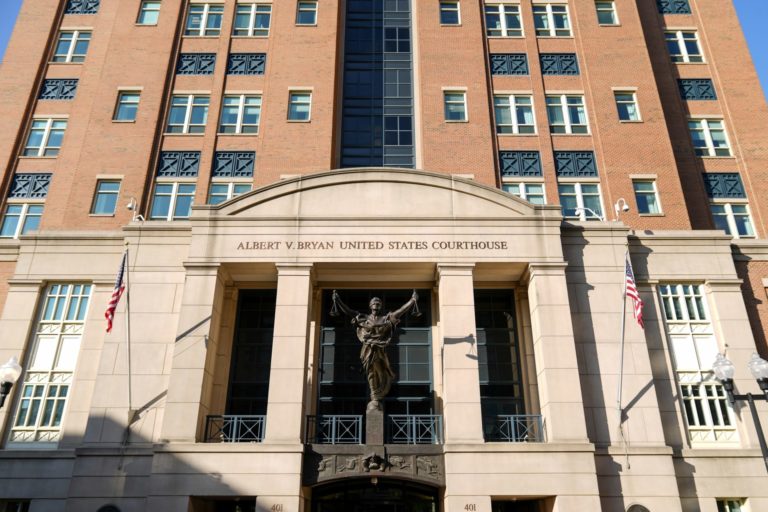
(José Niño, Headline USA) A Virginia federal judge has denied a motion to force a journalist to disclose his tax info and a trove of information related to all the electronic devices he’s used over the last five years.
The sweeping request came from Yaacov Apelbaum, a former Israel Defense Forces intelligence officer and cybersecurity executive who founded the firm XRVision. Apelbaum sued independent journalist Jordan Arthur Bloom for characterizing him as “an Israeli spy” in a January 2024 Substack article about his role in analyzing Hunter Biden’s laptop data before the 2020 election.
Apelbaum said Bloom maliciously wrote the article to harm him and his company, while Bloom has defended his reporting on the grounds that it’s true, and that it highlights Israel’s involvement in the conservative movement.
As part of the lawsuit, Apelbaum asked a judge last month to compel Bloom to “produce all documents and communications related to any computer or electronic device [Bloom] owned at any point in the past 5 years.” Apelbaum also sought all of Bloom’s tax returns for each of the past seven years.
On Friday, US Magistrate Judge William Porter denied Apelbaum’s demands on the grounds that they were served on Bloom too soon before the end of discovery.
However, Judge Porter granted one of the other contentious elements of Apelbaum’s motion: to compel Bloom to identify a source who told him that Apelbaum served inSayeret Matkal, the IDF’s elite reconnaissance unit often compared to Delta Force. The judge ordered Bloom to disclose his source even though that information didn’t appear in his article (it came up during a deposition, and Apelbaum later clarified that he, in fact, served in the IDF’s 35th Paratroopers Brigade).
Bloom has characterized these requests asfishing expeditions designed to burden and intimidate rather than to gather evidence relevant to the defamation claims. However, he said that he will comply with the judge’s order to disclose his source, because the source wasn’t speaking under anonymity and because he won’t suffer any harm as a result of the disclosure.
Bloom has also characterized Apelbaum’s demand as a “two-faced farce”: while Apelbaum uses federal litigation to compel source identification from an independent journalist, he simultaneously serves as a research provider to Laura Loomer, a Zionist activist who gainedPentagon press credentials in November 2025.
According to reporting inThe Wall Street Journal, Apelbaum has worked closely with Loomer, providing research for her attacks on national security officials she labels “Muslim sympathizers.” Loomer gained access to the Pentagon press room after dozens of mainstream journalistswalked out rather than sign Defense Secretary Pete Hegseth’s restrictive coverage rules.
The case, Apelbaum et al v. Bloom, can be found here.
Ken Silva contributed to this report.
José Niño is the deputy editor of Headline USA. Follow him at x.com/JoseAlNino
However, some argue that the de-facto money-laundering scheme to funnel tax dollars to Somali immigrants for phony childcare services, which upstart journalist Nick Shirley shed a spotlight on last month, may be a small part of a much larger conspiracy.
Additional scrutiny has now befallen Waltz and his cohorts regarding the assassination last June of state lawmaker Melissa Hortman and her husband, with some re-upping allegations that Kamala Harris’s 2024 running mate was at the center of a sinister cover-up plot.
In a Truth Social post on Saturday, President Donald Trump seemed to lend credence to those theories.
The post referenced an earlier X post from Ohio-based social-media influencer Bridgett Fertig, who said alleged assassin Vance Boelter, a former Waltz political appointee, had sent a letter to FBI officials implicating Waltz.
“Was Melissa Hortman unalived because she voted against a multi-billion dollar money laundering fraud?” Fertig said. “The fraud that she voted against that heavily implicated illegal aliens, specifically Somalians, who have been racketeering this kind of child care, health care rackets and cooperating with our corrupt government?”
President Trump re-Truthed my 𝕏 post asking if Minnesota State Rep Melissa Hortman murdered by a hit from Governor Tim Walz because she voted against and was exposing a multi-billion dollar money laundering fraud going to illegal immigrants in Minnesota.
Leftists frequently have invoked the Hortmans’ murders as the lone counterpoint to criticism that a surge in political violence has been largely one-sided.
Boelter reportedly expressed pro-life Christian views and voted in the 2024 Republican primary, although the state’s open primaries allow anyone to choose which one to vote in.
Yet, despite a trove of evidence and public comments from the accused, the assassination plot remains shrouded in mystery, with mainstream media showing little interest in a deeper investigation of Boelter’s motives.
The Hortmans’ children quickly denounced Trump’s post and called on him to take it down.
“I am asking President Trump to remove the video that he shared and apologize to me and my family for posting this misinformation and for using my mother’s own words to dishonor her memory,” said their son, Colin, in a statement on Sunday.
Waltz also reacted to the video, while stopping short of answering the allegations against him.
“Dangerous, depraved behavior from the sitting president of the United States,” he wrote in an X post. “In covering for an actual serial killer, he is going to get more innocent people killed. America is better than this.”
Dangerous, depraved behavior from the sitting president of the United States. In covering for an actual serial killer, he is going to get more innocent people killed.
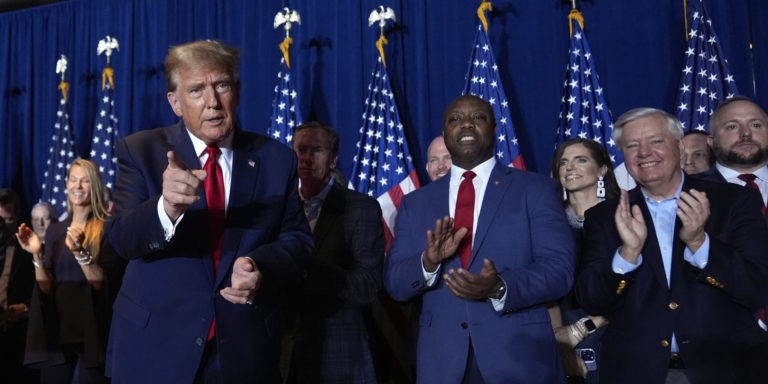
“Another great day with [President Trump], who has brought America back, stronger than ever, at home and abroad. God bless our Commander in Chief and all of the brave men and women who serve under him,” wrote Graham, who traveled back to Washington from Florida with the president aboard Air Force One.
“I’m proud to be an American. God bless and protect the brave people of Iran who are standing up to tyranny,” Graham added.
During the 12-day US-Israeli war on Iran, appeared to threaten Iran with regime change. “It’s not politically correct to use the term, ‘Regime Change,’ but if the current Iranian Regime is unable to MAKE IRAN GREAT AGAIN, why wouldn’t there be a Regime change??? MIGA!!!” he wrote on Truth Social on June 22.
Graham’s post comes amid protests in Iran that President Trump has suggested he may use as a pretext to attack the country. “If Iran shots and violently kills peaceful protesters, which is their custom, the United States of America will come to their rescue,” Trump wrote on Truth Social on Friday, not long before his military bombed and invaded Venezuela to kidnap President Nicolas Maduro.
Maduro described himself as a “decent man,” claiming to be the president of Venezuela, despite the U.S. and dozens of countries contradicting him as a legitimate leader.
“I am not guilty … I am a decent man. I am still the president of my country,” Maduro told the court. “I am the president of Venezuela. I was captured at my home in Caracas, Venezuela.”
Maduro is being represented by attorney Barry Pollack, whose notable clients include Julian Assange, founder of WikiLeaks. Pollack told the court that Maduro isn’t currently seeking release, but left the door open at a later time.
Cilia Flores, the former first lady of Venezuela, retained Mark Donnelly. She also entered a not guilty plea.
Judge Alvin Hellerstein, 92, who was appointed to the United States District Court for the Southern District of New York in 1998 by former Democratic President Bill Clinton, will be presiding over the case. He is no stranger to high-profile cases, presiding over cases involving the Sept. 11, 2001, terror attack and a lawsuit against Hollywood producer Harvey Weinstein.
Maduro and Flores face a slew of charges dating back decades, prompting the U.S. to issue a $50 million reward leading to the arrest of Maduro.
The arraignment marks the first time the former dictator and his wife, Cilia Flores, appear in a U.S. court following their capture carried out by elite U.S. military forces in the early hours of Saturday.
In a social media post Saturday morning, Attorney General Pam Bondi promptly confirmed that Maduro and Flores have been indicted, charged with “narco-terrorism conspiracy, cocaine importation conspiracy, possession of machine guns and destructive devices, and conspiracy to possess machine guns and destructive devices against the United States.”
The attorney general underscored that the couple would “face the full wrath of American justice on American soil in American courts.”
(Money Metals News Service) Money Metals’ well-stocked silver inventory situation is attracting new attention at a time when intense retail demand has wiped out many other precious metals dealers’ inventories.
Commenters all over social media have been chirping about the fact that major online dealers (other than Money Metals) are completely sold out of common silver products — or are quoting multi-week delays for all sizes of silver bars and even many silver rounds.
In all fairness, demand for minted silver products in the U.S. has been very high over the past several weeks, thanks to wild silver price moves and a global supply crunch. And even the most well-capitalized and well-run company will encounter logistical and restocking challenges when demand goes off the charts.
But scenarios like we see today help to highlight and differentiate the weak from the strong in our industry.
Silver rallied $4 higher again since last night, and continues to trade at a premium in London and especially Asia, with China (the second largest producer of silver) restricting exports of the “poor man’s gold” as of January 1, 2026.
The steep silver premiums in Asia have the effect of drawing in physical silver from other parts of the world like a magnet, fueling overall price gains.
Thanks to Money Metals’ robust inventory management system and strong balance sheet, virtually all products remain in stock at Money Metals. But despite hiring 25 employees since Christmas, it’s been tough to keep up with the overwhelming call volume and order fulfillment throughput.
Premiums in the market have risen on most items, but there are still a few tremendous values — even by historical standards. For example, pre-1965 silver dimes and quarters, available at Money Metals for $1 BELOW SPOT!
(Sound Money Defense League, Money Metals News Service) Three pro-gold and silver groups have teamed up to present the inaugural Sound Money Review, a new, one-of-a-kind collection of writings dedicated solely to immortalizing and advancing principles of sound money.
The Review, presented by Money Metals Exchange, Sound Money Defense League, and Sound Money Foundation, aims to curate and highlight compelling and relevant research, past and present, pertaining to sound money. These three groups comprise the nation’s leaders in sound money policy advocacy as well as publishers of the Sound Money Index, the nation’s leading resource ranking all 50 states by their state laws pertaining to precious metals.
This new journal highlights relevant, prescient writings from economists, legal scholars, philosophers, historians, and other relevant backgrounds. The new compendium is comprised of writings by Sound Money Fellow Joakim Book, as well as writings by Lawrence W. Reed, Hans F. Sennholz, Kristoffer M. Hansen, Edwin Vieira, Jr., and Joshua D. Glawson.
The collection includes writings on topics such as how government money incentivizes debt, the resurrection of savings under a sound money standard, the origins of money, the abuse of monetary power by central bankers, the populist case for a gold standard, and observations on the legality of “alternative currencies” in the United States.
Stefan Gleason, president and CEO of Money Metals, said, “We entered this sector 15 years ago because we believe in our product and the philosophical reasons why precious metals serve as an effective check against inflation and runaway government. We are excited to provide yet another resource for individuals and investors who wish to further their understanding of whysound money matters.“
The Sound Money Defense League is responsible for more than 32 successful sound money legislative victories across the nation since 2014. In 2025 alone, more than 30 states considered more than 60 different pieces of sound money legislation. The League also honored KY state Rep. TJ Roberts and WY state Sen. Bob Ide for their commitment to sound money principles.
Jp Cortez, executive director of the League and Editor-in-Chief of the Sound Money Review, said, “In addition to enacting meaningful policy changes across the nation, we are thrilled to pioneer this collection, adding yet another resource that inspires further research, debate, and actionable solutions in search of a better monetary system.”
The Sound Money Review is one of the many resources on topics pertaining to gold and silver produced by these groups. These groups also offer scholarships, paid fellowships, and publish the Sound Money Index yearly. Please click the links for more information about the Sound Money Scholarship or the Sound Money Fellowship.
Sound Money Defense League is a non-partisan public policy group working nationally since 2014 to restore gold and silver as sound money – America’s constitutional money. The League, in partnership with Money Metals, also publishes the annual Sound Money Index.
(Mike Maharrey, Money Metals News Service) Repo operations at the Fed on the last day of 2025 signal growing stress in the financial system, similar to the setup we saw in 2019.
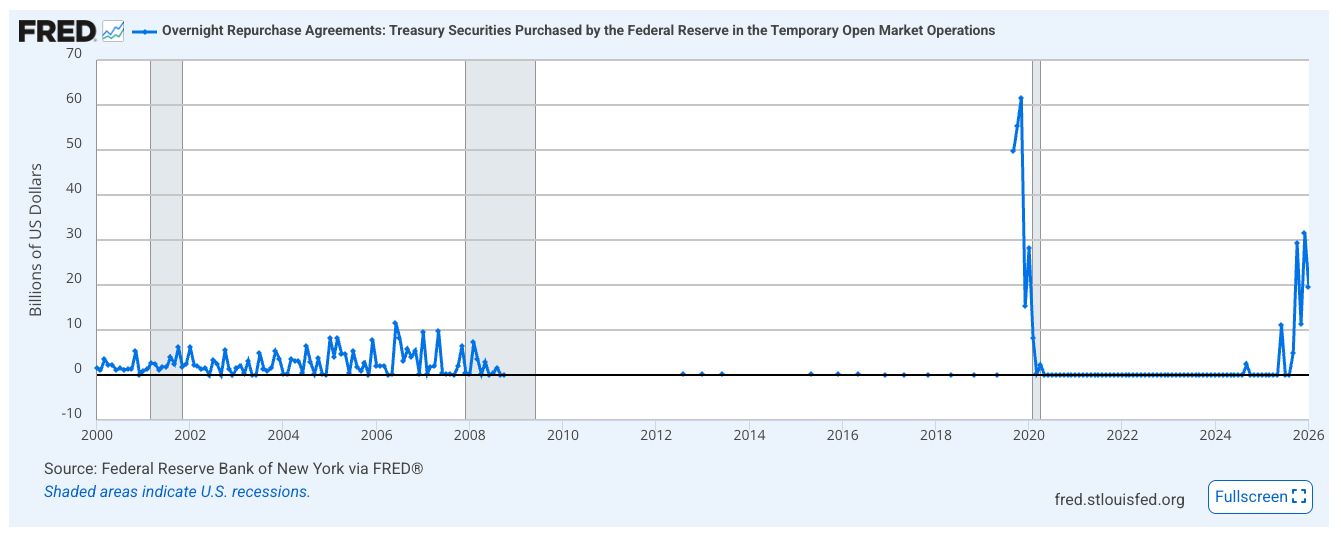
Banks and other financial institutions borrowed $74.6 billion from the New York Fed’s Standing Overnight Repurchase (repo) Facility on the final day of 2025. The last time we saw this kind of a spike in repo operations was in the months before the COVID-19 pandemic, as the stock market was tanking and the economy was going into spasms after the central bank began trying to “normalize” interest rates in the wake of the Great Recession.
Repurchase operations are an important aspect of the banking system. The repo market enables banks to borrow cash for a very short term to maintain liquidity and meet daily financing needs. In a repo trade, a financial firm puts up Treasurys and other “high-quality” securities as collateral for a short-term loan. The firm repurchases the bonds paying a nominal rate of interest, usually within 24 hours.
On Dec. 31, banks and other financial institutions put up $31.5 billion in Treasuries, along with an additional $43.1 billion in mortgage-backed securities to secure overnight loans.
Repo operations typically occur among private entities based on the market interest rate. A rise in the repo rate implies a shortage of available short-term cash.
According to Reuters, the general collateral (GC) repo rate on the open market was about 3.9 percent early Wednesday. That was higher than the Fed repo rate of 3.75 percent. This spread incentivized firms to borrow from the Fed at a cheaper rate.
In effect, the Fed’s repo facility functions as a liquidity backstop.
Between May 2020 and August 2024, the Fed’s repo facility was scarcely used. That doesn’t mean there were no repo operations. They were just facilitated through private lenders. When repo volumes at the Fed facility spike, it usually implies that the private repo supply isn’t meeting the market’s needs at reasonable interest rates.
There was a small spike in the use of the Fed’s repo facility in September 2024, before it began to climb in June ’25 as the second quarter ended.
Repo activity often jumps at the close of a quarter because the big banks and dealers that normallyintermediate operations temporarily becomebalance-sheet-constrained as they make their financial position look as strong as possible. Meanwhile, other financial entities still need access to short-term.
This year-end spike in repo operations is notable due to its high volume. As noted, we haven’t seen this much activity in the Fed repo facility since September 2019.
The mainstream financial media downplayed the Fed repo spike. Reuters reported, “Most expect Wednesday’s borrowing surge will dissipate over the coming days as more normal trading conditions reassert themselves.”
However, firms had already posted $19.5 billion in Treasuries at the facility as of January 3, 2026.
QE Is Back
Meanwhile, the Federal Reserve fulfilled its promise to restart quantitative easing (QE). Of course, they’re not calling it quantitative easing, but the effect is the same.
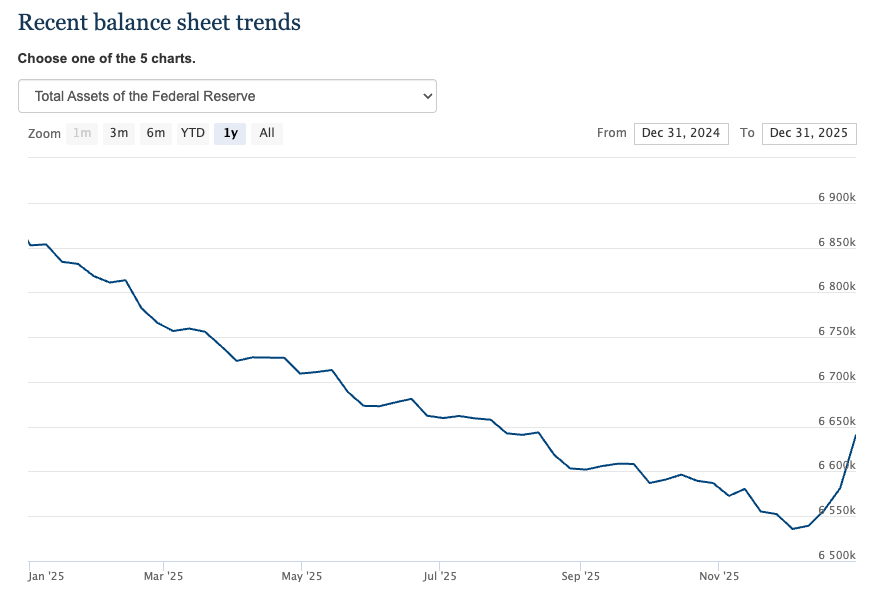
The Fed’s balance sheet bottomed on December 3 at $6.54 trillion. At its December meeting on Wednesday, December 10, the Fed announced that it would purchase $40 million in Treasury Bills on Friday (Bills are short-term Treasuries that mature in one year or less). From that point, purchases will “remain elevated for a few months” before they are “significantly reduced.”
Since then, the balance sheet has increased by $104.8 billion.
What Are These Fed Monetary Mechanizations Telling Us?
While the mainstream generally insists that these operations are only meant to keep the financial system’s “plumbing” clear, and that it’s no big deal, it more likely signals deep stress in the system due to higher interest rates.
Simply put, an economy and financial system addicted to easy money can’t function in a higher-rate environment. Especially when that monetary policy has incentivized a Debt Black Hole. That’s why so many people are desperate for rate cuts despite persistently high inflation.
We’ve seen this show before.
In the wake of the 2008 financial crisis, the Fed bought more than $3.5 trillion in bonds via QE, and banks built up massive cash reserves at the Fed. That level peaked at around $2.8 trillion and began to drop in 2015, when the Fed started raising interest rates. The decline in reserves accelerated when the central bank began its balance sheet reduction operation in October 2017, and more aggressively hiked rates.
In the fall of 2018, the economy began to crack under the Fed’s monetary tightening. The stock market tanked, and the economy got wobbly. The Fed was forced to cut rates three times in 2019 and resume QE, just like today.
The pandemic bailed the Fed out in 2020, allowing the central bank to slash rates to zero and take QE to unprecedented levels. This kicked the can down the road, giving the easy money-addicted economy a surge of its preferred drug, and keeping the inevitable crash at bay.
Now, we’re starting to see the same pattern playing out once again.
Analysts have noted that as the balance sheet shrank in March 2022, with quantitative tightening, repo volatility reappeared, first on month/quarter-ends and then more broadly. This signals that reserves are getting closer to “less-than-ample.”
This is exactly why the Fed has pivoted back to QE.
It remains unclear if these modest moves can stabilize the financial system, and if so, for how long. Thanks to the pandemic, the scenario never played out in 2020. Were it not for the massive monetary injection during COVID, the economy would have likely gone into a deep recession to cleanse the monetary excesses of the Great Recession. Instead, the pandemic allowed the central bank and the government to double down with stimulus, delaying the inevitable.
In other words, the economy never reckoned with the monetary malfeasance of the Great Recession era. Instead, the Federal Reserve and the government doubled down and added more fuel for the inevitable fire.
The reality is that the economy has to have its easy money drug. Without it, the addict goes into painful withdrawals.
The Fed (the pusher) has begun to dribble the monetary heroin into the addict’s veins. The problem is, over time, it takes more and more of the drug to maintain the high. Eventually, the druggie will OD.
No matter how this plays out, we’re looking at an increasingly inflationary environment. The money supply is already growing at the fastest rate since July 2022, in the early stages of the tightening cycle, and the pace of money creation will increase as the Fed continues QE (without calling it QE). We will also likely see additional rate cuts. That means you can look forward to the purchasing power of your dollar declining even more rapidly.
Plan accordingly.
Mike Maharrey is a journalist and market analyst for Money Metals with over a decade of experience in precious metals. He holds a BS in accounting from the University of Kentucky and a BA in journalism from the University of South Florida.
(Mike Maharrey, Money Metals News Service) We’ve seen some sharp price swings in the gold market over the last couple of months. Should this diminish gold’s investment appeal?
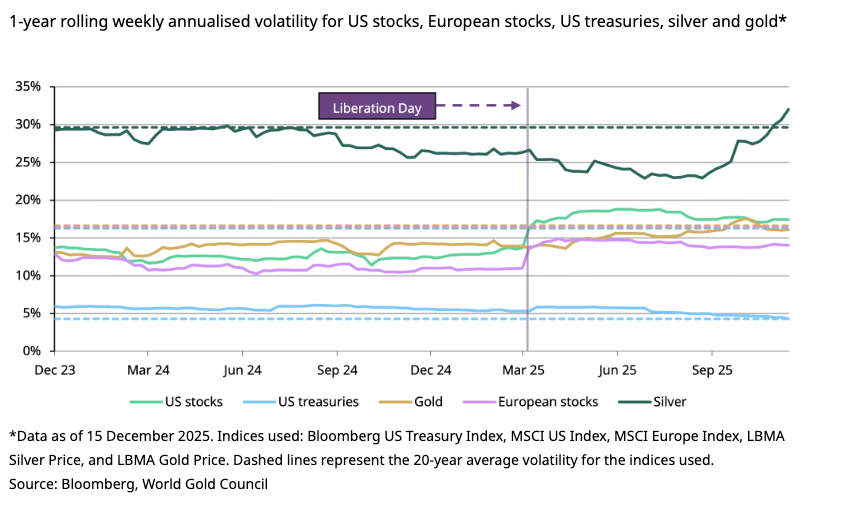
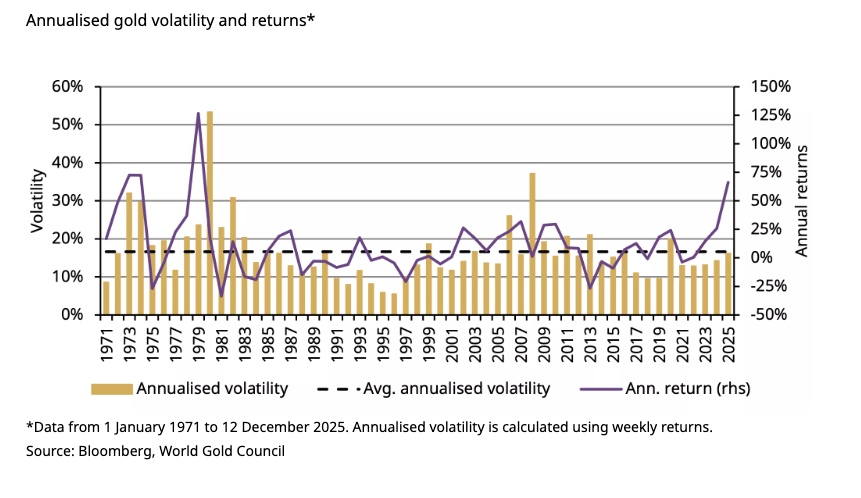
Volatility has increased without a doubt, but it’s important to put it into context. Based on analysis by the World Gold Council, we find that gold’s volatility is up from a low base and is broadly in line with other assets and long-term averages.
Volatility measures the speed and depth of price movements over time. Economists calculate volatility by computing the standard deviation of returns (daily or monthly) over a specified time period. When volatility is high, you will observe larger and more frequent price swings (as we’ve seen with gold recently). In a low volatility environment, price movements tend to be smaller, steadier, and easier to predict.
Uncertainty and high levels of risk tend to drive volatility higher. There was no shortage of those factors impacting the markets in 2025, from tariffs to geopolitical tensions to inflationary pressure.
Gold isn’t the only asset impacted by volatility. Equities also charted significant price swings over the last year. Meanwhile, U.S. Treasury volatility has dropped.
According to the World Gold Council, “On the whole, all asset class volatilities remain broadly in line with their long-term averages.”
While gold’s volatility rose along with its 64 percent gain in 2025, it remained well below levels seen during previous periods of similar strong price performance. According to the World Gold Council, “This suggests that, despite recent price strength, gold has moved in an orderly manner.”
Furthermore, when gold hit periods of high volatility last year, the brief spikes quickly normalized. This underscores gold’s resilience as a strategic asset.
Gold in Your Investment Portfolio
Even with the modest increase in volatility last year, gold still reduces overall risk in a diversified portfolio. This is especially true given that there is a growing correlation between bonds and equities. In the past, these assets tended to counterbalance each other, with equities climbing in a more risk-on environment with strong economic tailwinds, and bonds seeing gains when the economy gets wobbly, and investors become more risk-averse. However, bonds have been behaving more like risk assets in recent months.
As stocks and bonds correlate more closely, it is increasingly important to include an asset in your portfolio that tends to move in the opposite direction. Gold fits that bill. This is why Morgan Stanley CIO Michael Wilson recently came out with an investment strategy that includes a 20 percent allocation to gold. Most American investors have little to no exposure to precious metals.
As the World Gold Council pointed out, “We know that gold has been an efficient source of portfolio diversification with its low correlation to equities and fixed income assets.”
“In this current environment, adding gold to our hypothetical portfolio1 reduces the overall portfolio risk. In fact, adding 5 percent of gold reduces the portfolio risk by nearly 5 percent while its contribution to overall portfolio risk is negligible at 1.9 percent.”
In summary, there was increased volatility on the gold market last year, driven by heightened geopolitical and macroeconomic risks. However, as the World Gold Council noted, gold’s long-term behavior remained broadly consistent, comparable to that of other growth assets.
“Against a backdrop where traditional diversification benefits are waning, gold continues to play a valuable role in reducing overall portfolio risk, reinforcing its importance for investors seeking stability amid uncertainty.”
Mike Maharrey is a journalist and market analyst for Money Metals with over a decade of experience in precious metals. He holds a BS in accounting from the University of Kentucky and a BA in journalism from the University of South Florida.