(Ken Silva, Headline USA) Last October, FBI Director Kashyap Patel claimed to cut ties with the Anti-Defamation League over it including Turning Point USA in its “Glossary of Extremism and Hate.” But ADL Director Jonathan Greenblatt recently said otherwise.
Speaking earlier this month at a Los Angeles synagogue, Greenblatt said the ADL is still working with the FBI.
“I have 40 analysts working full-time 7 days a week, 24 hours a day monitoring extremists,” he said. “We monitor these people, and we share the intelligence with the FBI.”
ADL CEO Jonathan Greenblatt reveals the ADL is *still* working with the FBI.
"I have 40 analysts working full-time 7 days a week, 24 hours a day monitoring extremists," he tells an LA synagogue. "We monitor these people, and we share the intelligence with the FBI."
Greenblatt cited the case of the Turtle Island Liberation Front, a left-wing group charged last month with a New Year’s Eve bomb plot. Greenblatt said the ADL briefed the FBI on the group about five days before the FBI arrested several of its members for allegedly planning to bomb businesses on New Year’s Eve.
Greenblatt did not mention the fact that the an FBI informant and an undercover agent were already embedded in the Turtle Island Liberation Front.
The FBI did not immediately respond to a request to comment on the nature of its relationship with the ADL. Patel reportedly said in October that “this FBI formally rejects [former director James] Comey’s policies and any partnership with the ADL.”
However, the FBI’s relationship with the ADL goes all the way back to J. Edgar Hoover, who was the first and longest-tenured director in the bureau’s history. In 1968, he ordered the FBI’s field offices to establish liaisons with the ADL’s regional counterparts.
“This organization, like the Bureau, is opposed to groups and individuals espousing bigotry, prejudice and extremism,” Hoover wrote in a January 1968 directive.
“The Anti-Defamation League receives considerable information of interest to this Bureau and has been very cooperative in the past in referring such data to us,” he added.
The FBI’s relationship with the ADL has only strengthened since then, with the bureau often using ADL undercover informants to spy on groups—a tactic that the FBI uses to circumvent the Constitution.
This would be big if Kashyap were telling the truth, but I don't believe it for a second. The FBI's relationship with the ADL long predates Comey. It goes all the way back to Hoover, who in 1968 ordered all his field offices to work with the ADL. https://t.co/UeAMjfV8W3pic.twitter.com/D4H8viNX03
Headline USA also reported revealed year that the ADL honored an undercover FBI bomb tech who infiltrated the Outlaw bikers in Florda—helping entrap the Outlaws in a dubious bomb plot. That bomb tech, Kelly Boaz, was honored despite a scandal-plagued career with the Orange County Sheriff’s Office, where he was the subject of more than a dozen internal investigations since joining in 1989, several involving allegations of excessive force.
Boaz also caused the FBI to arrest the wrong person in the undercover operation against the Outlaws, which resulted in a $30,000 civil lawsuit. That saga can be read about here.
One of the more recent examples of an FBI-ADL partnership is related to the bureau’s investigation into the right-wing group Patriot Front. A 2018 FBI report shows that agents relied on information from the ADL in a report about the Patriot Front.
Ken Silva is the editor of Headline USA. Follow him at x.com/jd_cashless.
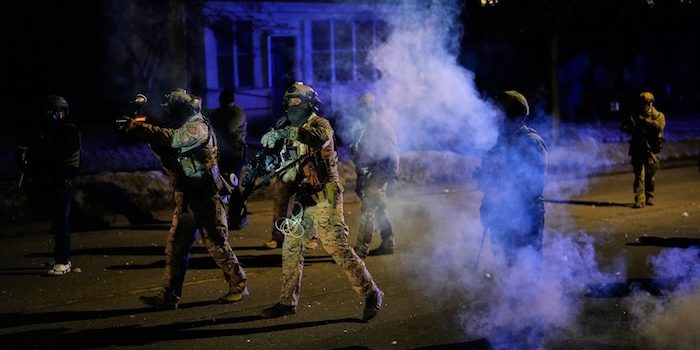
(Andrew Rice, The Center Square) President Donald Trump said on Thursday he would invoke the Insurrection Act in Minnesota if attacks on Immigration and Customs Enforcement officers continue.
“If the corrupt politicians of Minnesota don’t obey the law and stop the professional agitators and insurrectionists from attacking the Patriots of I.C.E., who are only trying to do their job, I will institute the INSURRECTION ACT, which many Presidents have done before me, and quickly put an end to the travesty that is taking place in that once great State,” Trump wrote on socialmedia Thursday morning.
The Insurrection Act is a law that allows the president to deploy the National Guard and active duty forces inside the United States. Protests have erupted throughout Minnesota after the fatal shooting of Renee Good by an ICE agent.
The Insurrection Act was used by Presidents Dwight Eisenhower and John F. Kennedy to enforce school desegregation. President George H.W. Bush invoked the act in response to the 1992 Los Angeles riots.
In June, Trump deployed almost 5,000 National Guard troops and Marines to respond to anti-deportation protests in Los Angeles. However, he did not formally invoke the Insurrection Act. Expenses related to the deployments totaled almost $134 million, according to the Pentagon.
On Wednesday night, a federal law enforcement agent shot a Venezuelan national in the leg, according to the Department of Homeland Security.
The shooting occurred after a federal agent conducted a “targeted traffic stop” in Minneapolis. Shortly after the subject fled the scene, a federal officer caught up.
While in a struggle with the original subject, two additional subjects came out of a nearby apartment and attacked the law enforcement officer.
“Fearing for his life and safety as he was being ambushed by three individuals, the officer fired a defensive shot to defend his life,” DHS wrote. “The initial subject was hit in the leg.”
Minneapolis Mayor Jacob Frey criticized the officer’s actions and said he has seen conduct from ICE that is “intolerable.”
“No matter what led up to this incident, the situation we are seeing in our city is not sustainable,” Frey said.
Minnesota Gov. Tim Walz condemned Trump’s actions and called for Minnesotans to remain peaceful.
“What Donald Trump wants is violence in the streets,” Walz wrote. “Minnesota will remain an island of decency, of justice, of community, and of peace.” Don’t give him what he wants.”
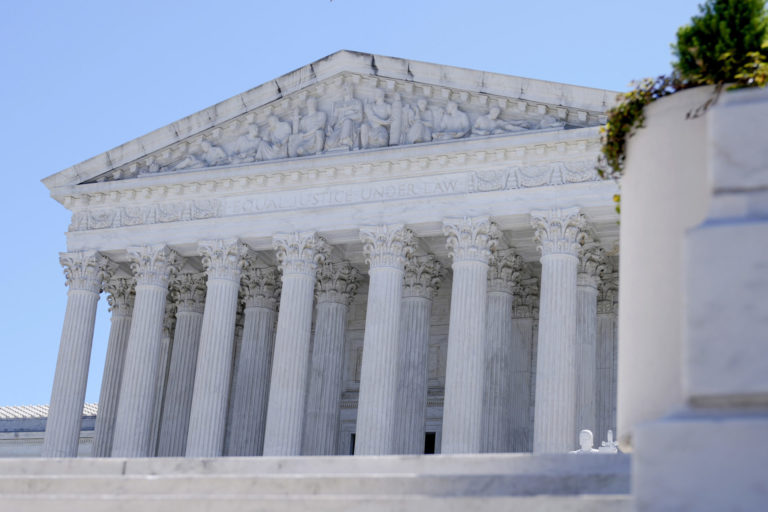
(Andrew Rice, The Center Square) The U.S. Supreme Court decided three cases Wednesday about political candidates’ standing to sue, warrantless searches, and double convictions.
The justices marked Jan. 14 as the first day in 2026 where they released multiple opinions.
Here are summaries of those opinions.
Case v. Montana
In a 9-0 decision, the court upheld the conviction of a Montana man for assaulting a police officer.
In 2021, police officers entered the home of William Case after a credible report that he was threatening suicide. While searching the home, one officer approached a bedroom closet in which Case was hiding.
Case threw open the closet curtain while holding an object that looked like a gun, according to court documents. The officer shot and injured Case.
Case argued the officers violated his Fourth Amendment right by entering his home without a warrant.
In a the majority opinion for the court, Justice Elena Kagan said the officers has reason to believe Case intended to take his own life or may already have shot himself.
“The officers may enter if, and only if, they have an ‘objectively reasonable basis for believing’ that an occupant faces serious danger,” Kagan wrote.
Kagan pointed to several other examples in the Supreme Court’s precedent where the justices upheld warrantless entries.
“We repeat today what we have held before: An officer may enter a home without a warrant if he has ‘an objectively reasonable basis for believing that an occupant is seriously injured or imminently threatened with such injury,'” Kagan wrote.
Barrett v. U.S.
In another opinion, the court clarified procedures for obtaining multiple criminal convictions for an individual act.
The case focused on Dwayne Barnett, an individual who committed a series of robberies between August 2011 and January 2012. In one robbery, Barrett’s accomplice shot and killed Gamar Dafalla, according to court documents.
Prosecutors sought to charge Barrett with two separate convictions: unlawful possession of a gun during a crime of violence and causing death while committing an offense.
In the court’s majority opinion, Justice Ketanji Brown Jackson said Congress does not allow an individual to be dually punished for the separate crimes when it stems from a single action.
“At the very least, Congress did not clearly manifest a contrary intention, as it would have to do if it wished to authorize two convictions in these circumstances,” Jackson wrote.
Bost v. Illinois State Board of Elections
In a 7-2 decision, justices on the court said an Illinois congressman has the right to sue the state over counting federal election ballots beyond Election Day.
U.S. Rep. Mike Bost, R-Murphysboro, filed a lawsuit against the state in 2022 for counting ballots postmarked on Election Day up to two weeks later. The court affirmed Bost had legal standing to sue without addressing whether states could allow mail-in ballots received after Election Day to be counted.
Chief Justice John Roberts, in a majority opinion for the court, said individuals who sue must display a personal stake in a case to have standing. As a candidate for office, Roberts said, Bost had that standing.
“Candidates are not common competitors in the economic marketplace. They seek to represent the people,” Roberts wrote. “And their interest in that prize cannot be severed from their interest in the electoral process.”
In their dissent, Justices Sonia Sotomayor and Ketanji Brown Jackson took issue with Roberts’ claim that candidates have a special interest in the fair elections process that gives special standing to sue.
“In a democratic society like ours, the interest in a fair electoral process is common to all members of the voting public,” Jackson wrote. “The Court thus ignores a core constitutional requirement while unnecessarily thrusting the Judiciary into the political arena.”
(Tate Miller, The Center Square) Following oral arguments in the U.S. Supreme Court Tuesday on whether males should participate in female sports, a medical group is “optimistic” that biological sex will be affirmed by the court in upcoming days.
Dr. Stanley Goldfarb, chairman of Do No Harm, told The Center Square that Tuesday’s “oral arguments were about protecting girls’ safety in women’s sports and confronting the biological truth: sex is binary.”
Do No Harm is a group of “physicians, nurses, medical students, patients, and policymakers focused on keeping identity politics out of medical education, research, and clinical practice,” as stated on its website.
Goldfarb told The Center Square that “hundreds of activists, students, doctors, and athletes showed up in droves to the Supreme Court [Tuesday] to support the common sense protections put in place by Idaho and West Virginia.”
The Supreme Court will rule on challenges to Idaho’s and West Virginia’s bans on biological males playing in girls’ and women’s sports.
“We are optimistic that the Court will affirm the reality of sex differences, reject the myths of the gender cult, and ensure athletics and locker rooms remain safe for girls,” Goldfarb said.
“Scientific evidence proves that, even before puberty, boys have a physical advantage in strength and speed over girls of the same age,” he said. “No amount of medical interventions or cultural pressure can change that fact.
“The ACLU’s claim that puberty blockers eliminate a prepubescent boy’s competitive advantage has been repeatedly disproven,” Goldfarb said. “In fact, when asked by Justice [Samuel] Alito, the ACLU couldn’t even define the difference between a man and woman.”
“Continuing to push the lie that cross-sex hormones mitigate the physical advantages boys have over girls is to ignore the truth of biology,” Goldfarb said.
Arizona Senate President Warren Petersen likewise told The Center Square he is “optimistic” that “we’re going to win this thing.”
As The Center Square previously reported, the U.S. Supreme Court on Tuesday heard arguments from two cases – Little v. Hecox and B.P.J. v. West Virginia –t hat concerned “whether biological males can participate in women’s and girls’ sports.”
“The justices weighed whether the sports bans violate the Constitution or Title IX, a federal law that prohibits sex discrimination,” The Center Square reported.
Kathleen Hartnett, a lawyer representing a transgender athlete in Idaho’s case, said there is not a competitive advantage between cisgender and transgender people in sports when hormones are controlled.
“The testosterone is the advantage on this record,” Hartnett said. “This person had mitigated testosterone.”
Do No Harm has an extensive history working to protect children from transgenderism, especially by disproving various beliefs associated with the ideology.
For instance, in June 2025 Do No Harm released a report debunking the idea that gender-affirming care for minors improves quality of life and mental health or that it decreases suicides, as The Center Square reported.
The HHS released a review in May 2025 with similar findings, namely that “the science and evidence do not support [the use of puberty blockers, cross-sex hormones, and surgeries], and the risks cannot be ignored.”
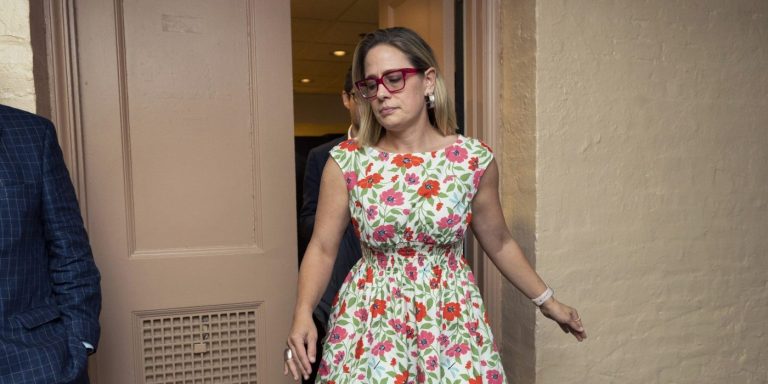
(Ken Silva, Headline USA) Former U.S. Sen. Kyrsten Sinema has been accused in a lawsuit of having sex with her security guards and breaking up the family of one of them in the process.
The lawsuit against Sinema was filed Monday in North Carolina federal court by Heather Ammel, who was married to Matthew Ammel, one of the guards with whom the ex-senator allegedly had an affair. Heather said her marriage with Matthew was destroyed as a result.
According to the lawsuit, Matthew Ammel suffers from PTSD due to his time in the U.S. Army. He retired from there in 2022, and was hired the same year by then-Sen. Sinema’s security team.
In the fall of 2023, the head of Sinema’s security team resigned and expressed concerns that her boss was having sexual relations with other security members. The security boss encouraged Matthew Ammel to leave, too, but he stayed for financial reasons, according to the lawsuit.
That’s apparently when things became spicy between Ammel and the then-senator.
According to the lawsuit, Heather Ammel found that Sinema was messaging her husband salacious photos, including one of her wrapped in a towel. Sinema also encouraged the husband to bring MDMA drugs—commonly known as ecstasy—on work trips “so that she could guide him through a psychedelic experience.”
In 2024, Matthew Ammel flew to San Francisco and stayed in Sinema’s hotel “for hours.” Later that year, he stayed at her home in Arizona.
Matthew also took their kids to see Sinema, attending a Green Day concert at one point, according to the lawsuit.
Sinema and Matthew remain in a relationship, the lawsuit added.
Heather is suing Sinema for “alienation of affection”—a North Carolina law that says someone can be held financially liable for initiating an affair—and seeks over $25,000 in damages.
Sinema’s attorney didn’t immediately respond to a request for comment.
Ken Silva is the editor of Headline USA. Follow him at x.com/jd_cashless.
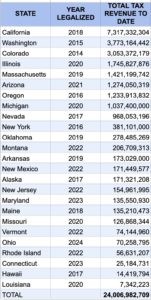
(Mark E. Johnson, Contributor) Since Colorado and Washington became the first of 25 states to date to allow the sale of cannabis, tax collections on recreational marijuana have been a boon for state treasuries, reports The Motley Fool.
California alone now rakes in more than $1 billion per year in marijuana tax cash. Seven more states have hauled in a cool billion or more each since legalization [see chart]. Meanwhile, the catastrophic health and social impacts of marijuana use are beyond dispute:
Smoking marijuana may be associated with an increased risk of lung cancer. [Mayo Clinic]
Cannabis can be addictive and potentially cause harm when taken with other substances such as alcohol or other drugs. [Florida Atlantic University]
Using marijuana may raise your chances of clinical depression or worsen the symptoms of a mental health condition that you already have. [WebMD]
Marijuana use may trigger schizophrenia or detachment from reality (psychosis) in people who are at higher risk of psychosis. [Mayo Clinic]
Acute clinical effects of cannabis use include vomiting, headache, chest pain, and hypertension or hypotension [high or low blood pressure]. Heart attacks and strokes, have also been reported. [Cleveland Clinic]
People who drive under the influence of marijuana can experience dangerous effects: slower reactions, lane weaving, decreased coordination, and difficulty reacting to signals and sounds on the road. [Substance Abuse and Mental Health Services Administration (SAMHSA)]
Post-legalization, self-reported marijuana usage increased 28 percent, while substance use disorders also increased significantly … Moreover, chronic homelessness, though just outside of statistical significance, increased by 35 percent, consistent with frequent anecdotes from residents and policymakers in states with legalized marijuana. [Federal Reserve Bank of Kansas City]
Combined, states have reported $24 billion in tax revenue from recreational and medical cannabis sales so far while reefer damages the mental and physical health of its users.
CHART: STATES WITH OVER $1 BILLION IN TAX REVENUE SINCE LEGALIZATION
NARCONON – People who support marijuana over other drugs often point to a number of different arguments that they believe prove it to be safe or at least less harmful.
Many of these center on the fact that marijuana is a naturally occurring substance, hence its names including “herb,” “grass” or “weed.”
While it may be true that cannabis can be found in nature, this does not by any means make it safe. There are many “natural” substances and plants that are also toxic. There are, in fact, many different reasons why you should avoid using marijuana:
Marijuana Smoke Contains Carcinogens
Smoking is not the only way in which marijuana users consume the drug, but it is certainly the most common. Whether it is in joints or a bong, the smoke released by marijuana contains many of the same carcinogens — chemical substances that cause cancer — as cigarette smoke.
Marijuana Can Cause Lung Damage
People who smoke weed are more at risk of suffering lung damage. In fact, a study conducted in New Zealand demonstrated that the respiratory system damage caused by smoking cannabis is actually equivalent to the damage associated with smoking as many as five cigarettes. There are also many other long-term effects of weed that a lot of people are not aware of:
You Might Get Hooked
The issue of addiction is one of the reasons that many advocates of marijuana argue that it is safer since it is not necessarily as addictive as certain other drugs like heroin. Many people, however, do get hooked on marijuana, with estimates commonly stating that the number is around one in six pot smokers ending up addicted to the drug.
Weed Can Destroy Your Ambition
Smoking pot one time tends to make a person feel “hazed” or “baked,” and the high associated with cannabis is typically described as being relaxing, rather than stimulating.
People who consume marijuana on a regular basis naturally experience these sensations far more often, and with prolonged usage, most pot smokers end up failing to pursue their life goals …
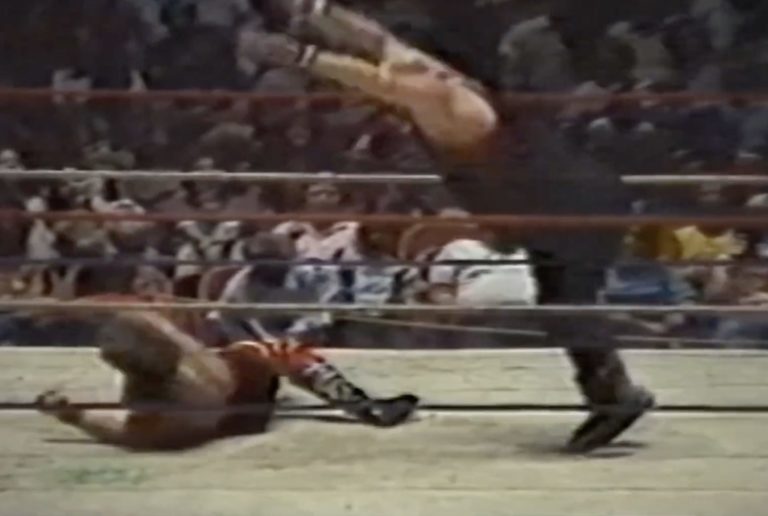
PENN LIVE – Pro wrestling legend Rick Link has died. He was 66.
Link was a native of North Carolina, and PWI noted that he made a name for himself throughout the 1970s and 1980s wrestling in the NWA territories and overseas. The site said that Link made his pro wrestling debut a day after he turned 16.
“If you’ve been around wrestling a long time … you already know what kind of loss this is,” Steve Stasiak of Book Pro Wrestlers shared on Facebook.
“Rick wasn’t just a name. Rick wasn’t just a big man from another era. Rick was one of the boys. A true locker room guy. A tough, old-school worker who gave a lifetime to this business and earned respect everywhere he went.
“He was part of the era where the miles mattered, the rings were smaller, and the work was harder. He fought for everything he got, and he belonged in the business because he lived it” … READ MORE.
Richard Link (February 28, 1959 – January 14, 2026)
Richard Link was an American professional wrestler, trainer and promoter.
He wrestled throughout Canada and the United States for the National Wrestling Alliance during the 1970s and 1980s under a number of ring names, most notably, as M.E.B. (Man Eating Beast) in NWA Central States and as Man Mountain Link in the Continental Wrestling Association where he was among the “monster heels” who challenged AWA Southern Heavyweight Champion Jerry “The King” Lawler and was involved in the ongoing feud between Lawler and Andy Kaufman.
Other promotions Link competed in included Georgia Championship Wrestling, International Championship Wrestling, the International Wrestling Association, Jim Crockett Promotions, and Stampede Wrestling.
He was also part of the NWA’s 1983 visit to New Zealand, frequently appearing on the country’s long-running wrestling programme On the Mat, and remained undefeated throughout the tour.
A North Carolina native, Rick Link became a fan of professional wrestling at a young age and was the president of the Ron Garvin Fan Club in his teens. One Man Gang was also one of his childhood friends while growing up in the Carolinas. Link started training to become a pro wrestler at the age of 15.
He was taught by Johnny Hunter, an older NWA veteran who also trained Ken Spence and George South, who set up a ring in Link’s backyard and worked out with the teenager 7 days a week unless Hunter was on the road. The training conditions, according to Link, were “brutal” as the two wrestled “stiff” and regardless of “whether it was freezing or it was in 100 degree heat”.
The lessons learned from Hunter, that hardship would teach students to have a love and old-school respect for the business, would carry over as a trainer years later … READ MORE AT WIKIPEDIA
(Headline USA) A federal officer shot a man in the leg in Minneapolis after being attacked with a shovel and broom handle while trying to make an arrest Wednesday, officials said.
The Department of Homeland Security said in a statement on the social media platform X that federal law enforcement officers stopped a person from Venezuela who was in the U.S. illegally. The person drove away and crashed into a parked car before taking off on foot, DHS said.
At 6:50 PM CT, federal law enforcement officers were conducting a targeted traffic stop in Minneapolis of an illegal alien from Venezuela who was released into the country by Joe Biden in 2022.
In an attempt to evade arrest, the subject fled the scene in his vehicle and crashed…
THE NEW YORK TIMES – Jim McBride, a former postal worker from Alabama whose ability to write catchy country songs inflected with honky-tonk flair resulted in a long string of hits for artists like Alan Jackson, Waylon Jennings and Conway Twitty, died on Jan. 7 in Huntsville, Ala. He was 78.
His death, at a hospital, was from complications of a fall at his home in Hazel Green, a community north of Huntsville, his son Brent said.
Mr. McBride was a leading figure on Nashville’s Music Row in the 1980s and early ’90s, when musicians like Mr. Jackson, Dwight Yoakam and the Judds rejected the pop influences of the late 1970s and ’80s in favor of traditional country styles and instruments.
His biggest hit, “Chattahoochee,” which he wrote with Mr. Jackson in 1992, is a case in point.
A throwback to the honky-tonk sounds of the 1950s, it is propelled forward by an onslaught of piano, fiddle, steel guitar, an irresistible drumbeat and lyrics that hark back to rural adolescence:
Well, way down yonder on the Chattahoochee It gets hotter than a hoochie coochie.
We laid rubber on the Georgia asphalt We got a little crazy but we never got caught.
The song was Mr. Jackson’s first No. 1 hit on the Billboard U.S. Hot Country Songs chart; it was also Billboard’s top country song of 1993. It won a brace of awards, including Song of the Year from the Country Music Association.
By then, Mr. McBride was a Nashville veteran, having written hit songs for Mr. Twitty, Johnny Lee and the band Alabama. Over his career, more than 80 acts recorded his songs …
(Money Metals News Service) In a recent episode of Money Metals’ Midweek Memo podcast, host Mike Maharrey argues that the most important economic warnings rarely arrive with flashing lights. They show up first in markets, and right now, he says, precious metals are doing the talking.
Maharrey opens by comparing forecasting to seeing “in a mirror dimly,” borrowing from St. Paul to explain why he refuses to attach dates to predictions. He believes gold will crack $5,000 in the relatively near future, but says too many moving parts make precise timelines unreliable.
That uncertainty is not a reason to ignore what is happening. Maharrey frames the bigger story as what gold and silver are already signaling about debt, monetary policy, and confidence in the dollar as the world moves deeper into 2026.
The Danger of Confident Narratives
Maharrey uses Larry Kudlow as an example of how mainstream economic storytelling can be misleading. Kudlow, a Fox Business host and former Director of the National Economic Council in the first Trump administration, recently praised the stock market, tax cuts, deregulation, and falling energy prices, calling the economy “the greatest story never told.”
Maharrey notes Kudlow used the same phrase before the 2008 financial crisis. He cites a National Review column dated December 7, 2007, where Kudlow dismissed recession warnings, insisted “there’s no recession coming,” and suggested pessimists would end up with “egg on their faces.” Less than a year later, the crisis arrived.
The point, Maharrey argues, is not to single out one commentator. It is to show how political narratives often shape the interpretation of data, while major economic fractures can remain hidden until they suddenly become unavoidable.
Why He Thinks a Cliff Is Still Ahead
Maharrey says he expects serious problems not because today’s economic data is screaming “crash,” but because the underlying setup looks familiar. He ties today’s fragility to decades of easy money, the asset bubbles it fueled, and the failure to unwind extraordinary policy after prior crises.
He points to 2019 as a moment when the economy was already straining under higher rates, forcing the Federal Reserve to pivot toward rate cuts and quantitative easing even before the pandemic. He describes the pandemic as a convenient justification for unprecedented monetary and fiscal stimulus that delayed a reckoning.
At the center of his argument is a “giant debt black hole” that makes normal interest rates nearly impossible. He says this is why policymakers clamor for cuts even with persistent inflation. The Fed, in his view, is walking a tightrope between recession and runaway price pressure.
This is where the title’s warning comes into focus. Maharrey argues that gold and silver repeatedly printing record highs is not simply a story about metals rising. It is a story about the dollar weakening, confidence eroding, and de-dollarization advancing in real time.
He does not claim certainty about timing or outcomes. He leans toward a crash or recession, but allows the economy to slide into inflationary stagnation similar to Japan in the 1990s. Either way, he says, monetary malfeasance has consequences that cannot be dodged forever.
A Historic Run in Metals
Maharrey says a late-year correction does not end a bull market, and he calls the prior year’s performance exceptional. He reports gold gained 64% and set 53 new record highs. He says silver gained just under 148%, platinum rose 125.9%, and palladium was up just over 80%.
He doubts those kinds of percentage gains repeat every year, but believes the broader bull trend still has momentum. In his view, the market action fits the bigger backdrop of debt, monetary easing, and rising uncertainty.
Metals Focus Outlook for 2026
Maharrey bases much of his outlook on analysis from Metals Focus, a London-based consultancy covering gold, silver, platinum, palladium, and rhodium. He says their framework aligns with the themes he has emphasized on the show.
He lists the main drivers as persistent inflation, US trade and foreign policy uncertainty, long-term debt concerns, weaponization of the dollar, shaky labor-market signals, and de-dollarization. Metals Focus expects those forces to persist into 2026, supporting continued demand for precious metals as portfolio insurance.
Gold and the Push Above $5,000
Maharrey describes gold’s volatility around year-end, including a correction from over $4,500 per ounce to about $4,330, then a rebound toward the $4,550 high hit on December 26, 2025. He notes gold breaking through $4,600 per ounce “yesterday,” calling the move wild.
He says Metals Focus expects gold highs “well above” $5,000. He highlights US “regime uncertainty,” meaning abrupt or unpredictable policy shifts, as one driver of safe-haven demand. He also stresses monetary easing. He says the Fed has cut rates multiple times despite elevated inflation and has pivoted back to quantitative easing, which he characterizes as inherently inflationary.
Maharrey adds that President Trump is expected to choose a new Federal Reserve chair in the coming months and suggests the replacement could be even more favorable to loose policy than Jerome Powell. He emphasizes persistent fiscal deficits and the rapid accumulation of US debt as a growing source of doubt about long-term debt sustainability and the dollar’s reserve role.
He also highlights central bank buying as a foundational support. He reports central banks increased gold reserves by over 1,000 tons for three straight years, and that the World Gold Council expects 2025 to likely be a fourth year above 1,000 tons. He notes 2022 was the highest net central bank buying on record, dating back to 1950, compared with an average of 473 tons annually from 2010 through 2021.
Maharrey acknowledges that record prices can reduce jewelry demand while increasing recycling and mine output. Even so, he says Metals Focus expects institutional investment to absorb surplus supply. He also references a “60/20/20” portfolio concept, where some bond exposure shifts into alternatives like precious metals, arguing even small adoption could drive major new demand because many investors hold little or no gold.
Silver and the Deficit That Won’t Quit
Maharrey says silver benefits from the same macro forces as gold, but its larger industrial role makes it more volatile. Metals Focus expects early-year selling pressure from profit taking and index rebalancing, and even sees a possible correction toward $50, but expects it to be brief.
They anticipate silver recovering to new all-time highs above $80. Maharrey says the bigger story is not a short-term pullback, but the supply squeeze underneath the entire market.
He says silver demand has exceeded supply for four straight years, and the Silver Institute projects 2025 will be the fifth straight deficit. He cites a 2024 structural deficit of 148.9 million ounces and says the four-year shortfall totals 678 million ounces, with an estimated additional 100 million ounces for 2025. He frames that cumulative deficit as roughly equal to one year of global mine supply.
He describes squeeze dynamics driven by metal shifting from London to New York in April due to tariff worries, plus strong Indian demand. He says this helped push silver above $50 in October, and a later “silver squeeze 2.0” briefly drove prices above $80. Metals Focus expects tight physical liquidity in London, citing investment demand, tariff uncertainty, US-held stocks, refining bottlenecks, and the structural deficit. Maharrey says they see a three-digit peak as likely, pointing directly at the “silver $100” half of the warning.
He acknowledges industrial substitution efforts, especially in solar, but argues retooling takes time, and silver is difficult to replace because it is the best electrical conductor at room temperature.
Under-Spot Junk Silver and the Takeaway
Maharrey notes Money Metals is selling junk silver under spot, defining it as pre-1965 dimes, quarters, and half dollars that are 90% silver. He says the melt value of a single silver quarter has been over $12 recently, illustrating how far silver has moved.
He closes by urging listeners to own a precious metals portfolio and echoes Money Metals CEO Stefan Gleason’s view that ignoring gold and silver is “professional malfeasance” for advisors at this stage. He directs listeners to call 1-800-800-1865 or visit MoneyMetals.com, and mentions a monthly program that allows building a portfolio with as little as $100 per month.