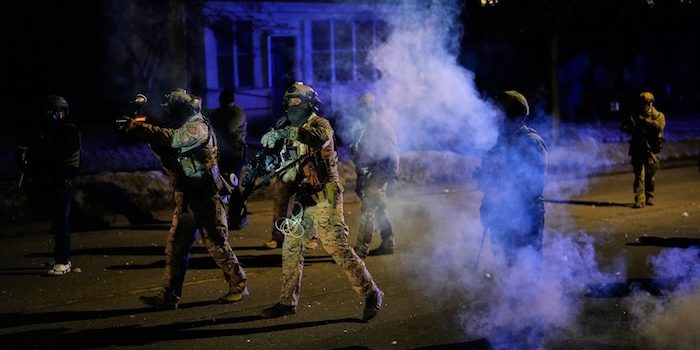
(Headline USA) A federal officer shot a man in the leg in Minneapolis after being attacked with a shovel and broom handle while trying to make an arrest Wednesday, officials said.
The Department of Homeland Security said in a statement on the social media platform X that federal law enforcement officers stopped a person from Venezuela who was in the U.S. illegally. The person drove away and crashed into a parked car before taking off on foot, DHS said.
At 6:50 PM CT, federal law enforcement officers were conducting a targeted traffic stop in Minneapolis of an illegal alien from Venezuela who was released into the country by Joe Biden in 2022.
In an attempt to evade arrest, the subject fled the scene in his vehicle and crashed…
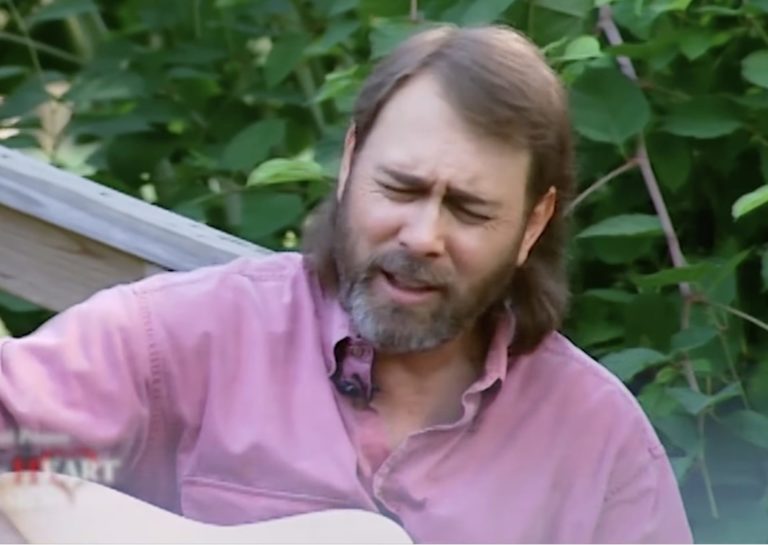
THE NEW YORK TIMES – Jim McBride, a former postal worker from Alabama whose ability to write catchy country songs inflected with honky-tonk flair resulted in a long string of hits for artists like Alan Jackson, Waylon Jennings and Conway Twitty, died on Jan. 7 in Huntsville, Ala. He was 78.
His death, at a hospital, was from complications of a fall at his home in Hazel Green, a community north of Huntsville, his son Brent said.
Mr. McBride was a leading figure on Nashville’s Music Row in the 1980s and early ’90s, when musicians like Mr. Jackson, Dwight Yoakam and the Judds rejected the pop influences of the late 1970s and ’80s in favor of traditional country styles and instruments.
His biggest hit, “Chattahoochee,” which he wrote with Mr. Jackson in 1992, is a case in point.
A throwback to the honky-tonk sounds of the 1950s, it is propelled forward by an onslaught of piano, fiddle, steel guitar, an irresistible drumbeat and lyrics that hark back to rural adolescence:
Well, way down yonder on the Chattahoochee It gets hotter than a hoochie coochie.
We laid rubber on the Georgia asphalt We got a little crazy but we never got caught.
The song was Mr. Jackson’s first No. 1 hit on the Billboard U.S. Hot Country Songs chart; it was also Billboard’s top country song of 1993. It won a brace of awards, including Song of the Year from the Country Music Association.
By then, Mr. McBride was a Nashville veteran, having written hit songs for Mr. Twitty, Johnny Lee and the band Alabama. Over his career, more than 80 acts recorded his songs …
(Money Metals News Service) In a recent episode of Money Metals’ Midweek Memo podcast, host Mike Maharrey argues that the most important economic warnings rarely arrive with flashing lights. They show up first in markets, and right now, he says, precious metals are doing the talking.
Maharrey opens by comparing forecasting to seeing “in a mirror dimly,” borrowing from St. Paul to explain why he refuses to attach dates to predictions. He believes gold will crack $5,000 in the relatively near future, but says too many moving parts make precise timelines unreliable.
That uncertainty is not a reason to ignore what is happening. Maharrey frames the bigger story as what gold and silver are already signaling about debt, monetary policy, and confidence in the dollar as the world moves deeper into 2026.
The Danger of Confident Narratives
Maharrey uses Larry Kudlow as an example of how mainstream economic storytelling can be misleading. Kudlow, a Fox Business host and former Director of the National Economic Council in the first Trump administration, recently praised the stock market, tax cuts, deregulation, and falling energy prices, calling the economy “the greatest story never told.”
Maharrey notes Kudlow used the same phrase before the 2008 financial crisis. He cites a National Review column dated December 7, 2007, where Kudlow dismissed recession warnings, insisted “there’s no recession coming,” and suggested pessimists would end up with “egg on their faces.” Less than a year later, the crisis arrived.
The point, Maharrey argues, is not to single out one commentator. It is to show how political narratives often shape the interpretation of data, while major economic fractures can remain hidden until they suddenly become unavoidable.
Why He Thinks a Cliff Is Still Ahead
Maharrey says he expects serious problems not because today’s economic data is screaming “crash,” but because the underlying setup looks familiar. He ties today’s fragility to decades of easy money, the asset bubbles it fueled, and the failure to unwind extraordinary policy after prior crises.
He points to 2019 as a moment when the economy was already straining under higher rates, forcing the Federal Reserve to pivot toward rate cuts and quantitative easing even before the pandemic. He describes the pandemic as a convenient justification for unprecedented monetary and fiscal stimulus that delayed a reckoning.
At the center of his argument is a “giant debt black hole” that makes normal interest rates nearly impossible. He says this is why policymakers clamor for cuts even with persistent inflation. The Fed, in his view, is walking a tightrope between recession and runaway price pressure.
This is where the title’s warning comes into focus. Maharrey argues that gold and silver repeatedly printing record highs is not simply a story about metals rising. It is a story about the dollar weakening, confidence eroding, and de-dollarization advancing in real time.
He does not claim certainty about timing or outcomes. He leans toward a crash or recession, but allows the economy to slide into inflationary stagnation similar to Japan in the 1990s. Either way, he says, monetary malfeasance has consequences that cannot be dodged forever.
A Historic Run in Metals
Maharrey says a late-year correction does not end a bull market, and he calls the prior year’s performance exceptional. He reports gold gained 64% and set 53 new record highs. He says silver gained just under 148%, platinum rose 125.9%, and palladium was up just over 80%.
He doubts those kinds of percentage gains repeat every year, but believes the broader bull trend still has momentum. In his view, the market action fits the bigger backdrop of debt, monetary easing, and rising uncertainty.
Metals Focus Outlook for 2026
Maharrey bases much of his outlook on analysis from Metals Focus, a London-based consultancy covering gold, silver, platinum, palladium, and rhodium. He says their framework aligns with the themes he has emphasized on the show.
He lists the main drivers as persistent inflation, US trade and foreign policy uncertainty, long-term debt concerns, weaponization of the dollar, shaky labor-market signals, and de-dollarization. Metals Focus expects those forces to persist into 2026, supporting continued demand for precious metals as portfolio insurance.
Gold and the Push Above $5,000
Maharrey describes gold’s volatility around year-end, including a correction from over $4,500 per ounce to about $4,330, then a rebound toward the $4,550 high hit on December 26, 2025. He notes gold breaking through $4,600 per ounce “yesterday,” calling the move wild.
He says Metals Focus expects gold highs “well above” $5,000. He highlights US “regime uncertainty,” meaning abrupt or unpredictable policy shifts, as one driver of safe-haven demand. He also stresses monetary easing. He says the Fed has cut rates multiple times despite elevated inflation and has pivoted back to quantitative easing, which he characterizes as inherently inflationary.
Maharrey adds that President Trump is expected to choose a new Federal Reserve chair in the coming months and suggests the replacement could be even more favorable to loose policy than Jerome Powell. He emphasizes persistent fiscal deficits and the rapid accumulation of US debt as a growing source of doubt about long-term debt sustainability and the dollar’s reserve role.
He also highlights central bank buying as a foundational support. He reports central banks increased gold reserves by over 1,000 tons for three straight years, and that the World Gold Council expects 2025 to likely be a fourth year above 1,000 tons. He notes 2022 was the highest net central bank buying on record, dating back to 1950, compared with an average of 473 tons annually from 2010 through 2021.
Maharrey acknowledges that record prices can reduce jewelry demand while increasing recycling and mine output. Even so, he says Metals Focus expects institutional investment to absorb surplus supply. He also references a “60/20/20” portfolio concept, where some bond exposure shifts into alternatives like precious metals, arguing even small adoption could drive major new demand because many investors hold little or no gold.
Silver and the Deficit That Won’t Quit
Maharrey says silver benefits from the same macro forces as gold, but its larger industrial role makes it more volatile. Metals Focus expects early-year selling pressure from profit taking and index rebalancing, and even sees a possible correction toward $50, but expects it to be brief.
They anticipate silver recovering to new all-time highs above $80. Maharrey says the bigger story is not a short-term pullback, but the supply squeeze underneath the entire market.
He says silver demand has exceeded supply for four straight years, and the Silver Institute projects 2025 will be the fifth straight deficit. He cites a 2024 structural deficit of 148.9 million ounces and says the four-year shortfall totals 678 million ounces, with an estimated additional 100 million ounces for 2025. He frames that cumulative deficit as roughly equal to one year of global mine supply.
He describes squeeze dynamics driven by metal shifting from London to New York in April due to tariff worries, plus strong Indian demand. He says this helped push silver above $50 in October, and a later “silver squeeze 2.0” briefly drove prices above $80. Metals Focus expects tight physical liquidity in London, citing investment demand, tariff uncertainty, US-held stocks, refining bottlenecks, and the structural deficit. Maharrey says they see a three-digit peak as likely, pointing directly at the “silver $100” half of the warning.
He acknowledges industrial substitution efforts, especially in solar, but argues retooling takes time, and silver is difficult to replace because it is the best electrical conductor at room temperature.
Under-Spot Junk Silver and the Takeaway
Maharrey notes Money Metals is selling junk silver under spot, defining it as pre-1965 dimes, quarters, and half dollars that are 90% silver. He says the melt value of a single silver quarter has been over $12 recently, illustrating how far silver has moved.
He closes by urging listeners to own a precious metals portfolio and echoes Money Metals CEO Stefan Gleason’s view that ignoring gold and silver is “professional malfeasance” for advisors at this stage. He directs listeners to call 1-800-800-1865 or visit MoneyMetals.com, and mentions a monthly program that allows building a portfolio with as little as $100 per month.
The Senate was deadlocked at 50-50 on a point of order vote to strip the War Powers Resolution of its privileged status to block a final vote. President Trump and his top officials put significant pressure on five Republicans who voted to advance the legislation last week, and two of the GOP senators — Josh Hawley (MO) and Todd Young (IN) — flipped and voted against the bill.
Republican Senators Rand Paul (KY), Lisa Murkowski (AK), and Susan Collins (ME) maintained their support for the bill and joined Democrats in voting in favor despite the pressure from the Trump administration.
Hawley said last week that he voted to advance the bill because of concerns that Trump might send troops to Venezuela. “With regard to Venezuela, my read of the Constitution is that if the President feels the need to put boots on the ground there in the future, Congress would need to vote on it,” wrote on X.
Before the vote on Wednesday, Hawley said that Secretary of State Marco Rubio assured him that the administration would consult Congress if the “security situation” regarding Venezuela changes. “Secretary Rubio has said directly to me: ‘There are absolutely no plans or intentions of occupying Venezuela. But if something crazy should happen, they will follow the Constitution and statutes in working through this with Congress,” Hawley said.
However, back in November, Rubio and other Trump administration officials assured Congress that they didn’t plan to directly attack Venezuela in an effort to kill another War Powers Resolution. The Washington Postreported at the time that Rubio and Secretary of War Pete Hegseth “provided a classified briefing for select members of Congress where they indicated the administration is not currently preparing to target Venezuela directly and didn’t have a proper legal argument for doing so.” About two months later, the US bombed Caracas and kidnapped Venezuelan President Nicolas Maduro.
(Mark E. Johnson, Contributor) A pro-liberty couple in New Hampshire has secured their second free speech victory against the leftist-controlled municipalities that now dominate much of the once-conservative state, due in large part to the influx of liberals from deep blue Massachusetts.
A federal appeals court ruled that Beth and Stephen Scaer’s First Amendment rights were violated when the City of Nashua refused to fly three of their flags on the “Citizen Flag Pole” in City Hall Plaza on ideological grounds.
Two of the Scaers’ flags – the Detrans Awareness flag and the Save Women’s Sports flag – protest the inclusion of so-called trans athletes in school sports that do not align with the athletes’ biological sex.
The third was the Appeal to Heaven flag, a historic American Revolutionary War banner that expresses reliance upon God, particularly in the face of tyranny.
Despite the flag’s 250-year history, woke leftists and their sympathizers in the mainstream media have attempted to associate it with J6, with mixed results.
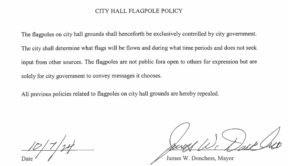
Mayor Donchess’s City Hall Flagpole Policy did not go over well in federal court. It’s since been repealed.
A federal court initially rejected the Scaers’ argument, saying that access to the city’s flag pole is not protected by First Amendment free speech rights.
The Scaers appealed. Beth Scaer called the court ruling a win for people of all viewpoints:
“[The Appeal to Heaven flag] is a free speech issue. We shouldn’t be censored by the government. That’s right there in the Bill of Rights.”
Nashua’s Citizen Flag Pole was intended for community members to fly a flag to support their cultural heritage or a worthy cause. Appealing to Heaven is apparently not deemed a worthy cause by the powers-that-be in Nashua City Hall. The city eliminated the Citizen Flag Pole shortly after the Scaers filed suit in 2024.
Earlier last year, Beth Scaer and her attorneys from the Institute for Free Speech settled a First Amendment free speech lawsuit against the Kearsarge School District for $33,000.
In that case, Scaer was banned from speaking after referring to a ‘trans’ student who is male but masquerades as a female in order to play girls’ sports as a ‘tall boy.’ The chairperson of the school board deemed Scaer’s choice of words to be ‘derogatory.’
Based in part on reporting by New Hampshire Public Radio.
Mark E. Johnson is the former editor of Headline Health and was a New Hampshire resident for 25 years. He now lives in South Carolina.
(Dave DeCamp, Antiwar.com) The US is pulling some troops from several of its bases in the Middle East, as European officials told Reuters on Wednesday evening that a US attack on Iran could come within the next 24 hours. The US pulled forces from bases in the region before the start of the 12-day US-Israeli war against Iran in June 2025.
One of the bases the US is pulling troops from is the Al Udeid Air Base in Qatar, which Iran attacked in June in retaliation for the US bombing its nuclear facilities. Iran gave the US advanced warning ahead of the attack, giving the US military time to evacuate its forces and prepare to intercept the missiles.
Iranian officials have been warning they will strike US bases and ships in the region in response to any attack, and it’s likely this time they won’t give advanced notice.
“The President of #America, who repeatedly mentions the futile story of aggression against #Iran’s nuclear facilities, would do better to also mention the plowing of the American #AlUdeid base by Iranian missiles,” Ali Shamkhani, an aide to Iranian Supreme Leader Ayatollah Ali Khamenei, wrote on X on Wednesday.
“It will certainly help in creating a real understanding of Iran’s will and capability to respond to any aggression,” added Shamkhani, who Israel tried to kill during the 12-Day War.
On Tuesday, President Donald Trump brushed off Iran’s warnings, saying, “Iran said that the last time I blew them up.” He also held a meeting with his senior advisors at the White House on Tuesday evening to discuss the situation in Iran.
US officials told The New York Times that US intelligence has assessed that if Trump orders strikes on Iran, Tehran would likely retaliate with missile strikes on Al Udeid and possibly US bases in Iraq and Syria, an assessment that was discussed at the White House on Tuesday.
The Washington Post cited a US official who said the Trump administration “just doesn’t have the assets in the region to do a full kinetic strike without risking retaliation” since it pulled assets out of the Middle East for the attack on Venezuela. But the US does have at least three US Navy guided-missile destroyers in the region, and the B-2 bombers that it used to attack Iran back in June were flown from bases in the US.
Denmark’s leaders have said the semi-autonomous Danish territory isn’t for sale. So have Greenland’s leaders, who depend on fishing and subsidies from Copenhagen. Denmark’s central bank noted in a recent report that Greenland’s “economy is slowing down, with modest growth and serious challenges for public finances.”
Trump said U.S. ownership of Greenland is vital to national security, citing concerns that the island could otherwise be controlled by China or Russia. He has said his preference is to buy Greenland.
“I would like to make a deal the easy way, but if we don’t do it the easy way, we’re going to do it the hard way,” Trump said Friday.
Buying the nation could cost billions or trillions, depending on how the Arctic island of population 57,000 is valued. Because the market for buying and selling nations is extremely limited, there’s no universally accepted formula for determining a nation’s worth. That hasn’t stopped people from trying to devise one.
One analysis of Greenland’s potential cost comes from the American Action Forum, a Washington, D.C.-based think tank. The group’s estimates range from $186 billion to $4.4 trillion.
That high-end figure represents the value of Greenland’s total critical mineral and energy assets, which are worth approximately $4.4 trillion. However, the American Action Forum analysis notes that Greenland stopped issuing oil and gas exploration licenses in 2021 due to cost and climate concerns.
That would knock the value down to about $2.7 trillion.
On the low end, $186 billion is the value for Greenland’s mineral reserves considered economically viable for extraction.
“Basically valuing Greenland as a giant mineral mine is one approach that we took,” American Action Forum Trade Policy Analyst Jacob Jensen told The Center Square.
Based on the value of land in Iceland, buying all the land in Greenland would cost about $2.76 trillion.
Others have taken different approaches.
In 2019, Financial Times’ Alphaville estimated Greenland was worth $1.1 trillion. Former New York Federal Reserve economist David Barker estimated Greenland was worth between $12.5 billion and $77 billion, the New York Times reported. On Wednesday, NBC News reported an estimated value of $500 billion to $700 billion, citing unnamed sources close to the matter.
However, even getting started could cost U.S. taxpayers because Greenlanders don’t want to become part of America either as U.S. citizens – like those in the territories of Puerto Rico, Guam, U.S. Virgin Islands, and Northern Mariana Islands – or U.S. nationals, such as those in America Somoa.
An independent poll done in 2025 found that about 85% of Greenlanders don’t want to join America.
U.S. officials have discussed sending direct payments to Greenland residents to convince them to leave Denmark and join the U.S., Reuters reported. U.S. officials discussed figures from $10,000 to $100,000 per person, according to anonymous sources cited by the news agency.
At $100,000 per person, the cost to open the door could be as much as $5.7 billion for the nation’s 57,000 residents.
Earlier this month, Denmark’s central bank found Greenland faces “challenges for public finances in the form of large deficits and a long-term sustainability problem.” That report noted that investment in Greenland is expensive and supported by taxpayers in Denmark. Total investments amounted to 36% of gross domestic product in 2023. Gross domestic product is a measure of total economic activity for a nation.
“Few countries in the world had a similarly high level of investment activity in relation to production output,” the central bank said.
Trump said Wednesday morning that the North Atlantic Treaty Organization, a 32-nation military and political alliance, should be leading discussions for the U.S. to annex Greenland.
In a social media post, he wrote in part, “The United States needs Greenland for the purpose of National Security. It is vital for the Golden Dome that we are building. NATO should be leading the way for us to get it.”
He cited his concerns about Russia or China if not the United States. He said NATO would be more formidable and effective with Greenland in the hands of America.
Trump added: “Anything less than that is unacceptable.”
Trump also said Greenland can’t defend itself.
“Two dogsleds won’t do it! Only the USA can!!!” the president wrote in a another post.
NATO was founded on the principle of collective defense, meaning that an attack on one nation would be considered an attack on all. That collective defense provision has only been used once, after the Sept. 11, 2001, terrorists attacks on the U.S.
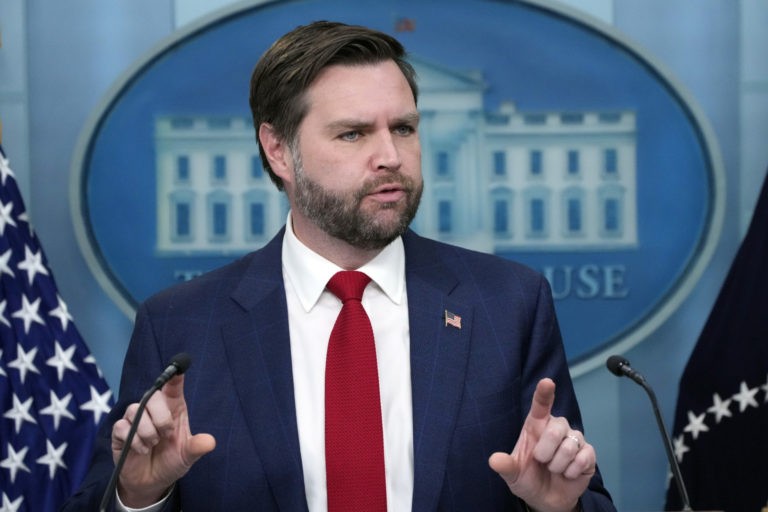
Trump’s comments come ahead of a planned meeting between U.S. Vice President J.D. Vance, Secretary of State Marco Rubio and officials from Greenland and Denmark on Wednesday at the White House.
Last year, Trump outlined plans for a $175 billion missile defense shield, which he dubbed the Golden Dome. The system Trump envisions would protect the U.S. and Canada using multiple layers of defense against diverse potential attacks, making it much more complex than previous proposals.
The Golden Dome would also include space-based sensors and interceptors, as the president stated, which would be capable of intercepting missiles launched from space.
(Chris Woodward, The Center Square) Los Angeles County is considering designating ICE-free zones as a response to the Trump administration’s crackdown on illegal immigration.
The proposal comes from Los Angeles County Supervisors Lindsey Horvath and Hilda Solis, who sit on a board that governs the county. The plan is for an ordinance to be drafted and brought before the board in 30 days.
Speaking during Tuesday’s Board of Supervisors meeting, Horvath said, “Our federal government is killing its own citizens” in broad daylight and in front of witnesses and cameras.
“People have been shot; people have been killed; families have been shattered,” said Horvath.
One of those people was Renee Good, a mother of three who was shot and killed last week by an ICE agent in Minnesota.
The Trump administration says Good hit the ICE agent with her vehicle and that the agent acted in self-defense. The same agent had been dragged by a car in a June 2025 incident. Still, Horvath claimed Good was “acting within her full rights as a legal observer,” adding that Good was one of several people to die in ICE operations around the country.
“This motion creates ICE-free zones by drawing a clear boundary,” said Horvath, who represents the 3rd District of Los Angeles County. “LA County will not allow its property to be used as a staging ground for violence caused by the Trump administration.”
According to Horvath, the county’s public spaces “should be places of care and safety,” not fear.
“We may not control federal enforcement everywhere, but we do control our own property, and we have a responsibility to act when lives are at stake,” said Horvath.
Solis, who represents the county’s 1st District, followed Horvath’s remarks by saying that news reports have been full of ICE-related raids, shootings and deaths. Solis called that an outrage.
“You do not have the right to come in and harass people without a warrant,” said Solis.
Supervisor Janice Hahn represents the county’s 4th District. Hahn said it is “disturbing that we’ve come to this point,” adding the county cannot allow its property to be a “tool” for the work that ICE is doing.
“I hope this sends a message,” said Hahn.
The Center Square sought comment from the U.S. Department of Homeland Security, which questioned how the new ordinance would benefit the people of Los Angeles.
“This is illegally illiterate. Enforcing federal immigration laws is a clear federal responsibility under Article I, Article II and the Supremacy Clause,” a department spokesperson told The Center Square late Tuesday afternoon in an email.
“While Los Angeles sanctuary politicians continue to release pedophiles, rapists, gang members, and murderers onto the city’s streets, our brave law enforcement will continue to risk their lives to arrest these heinous criminals and make Los Angeles safe again,” the spokesperson added.
(Ken Silva, Headline USA) Secret Service Director Sean Curran launched an undercover operation involving agents posing as journalists in an attempt to catch agents leaking information, according to Real Clear Politics reporter Susan Crabtree.
Crabtree, who frequently breaks stories about the Secret Service, revealed the operation on Twitter/X on Tuesday—alleging that the operation targeted some of her own sources.
“In a plan authorized by Secret Service Director Sean Curran himself, I’m told agents posed as journalists fishing for derogatory information on the USSS to try to find out who is leaking to me,” she said.
“The effort failed and provided a lesson for most Secret Service sources inside and outside the agency. They know I would go to jail to protect them—and that I have not and would never give up their identities.”
🚨🚨 EXCLUSIVE: SECRET SERVICE DIRECTOR SEAN CURRAN RECENTLY USED STING OPERATION TO TRY TO FIND MY SOURCES — NOW USSS LEADERS CRY FOUL WHEN JAMES O'KEEFE USES THE SAME 'TARGETED AND MANIPULATIVE' TACTIC AGAINST AN AGENT
The Secret Service did not respond to Headline USA’s request for comment on Crabtree’s allegations. Crabtree made them in response to the Secret Service complaining about an undercover journalist tricking an agent into leaking sensitive information about Vice President JD Vance’s travel plans.
Crabtree noted the irony that the Secret Service has agents posing as fake journalists at a time when other agents are leaking to legitimate ones.
“The funniest thing about the Secret Service decrying James O’Keefe’s honeypot sting tactics—as ‘targeted and manipulated’ is that sources tell me that Secret Service leaders recently launched their own attempted yet failed sting operation to try to uncover my sources within the agency,” she said.
Federal agents posing as journalists is something that is controversial—but not totally unheard of. One of the most infamous cases of this occurred in 2014, when the FBI created a fake documentary crew to trick Cliven Bundy’s family and their supporters into giving interviews during the first “Bundy standoff” at his Nevada ranch.
The operation didn’t gain any valuable evidence, and was widely criticized by the media.
Ken Silva is the editor of Headline USA. Follow him at x.com/jd_cashless.
(Headline USA) While President Donald Trump says he will take action on Greenland whether its people “ like it or not, ” his newly handpicked U.S. special envoy is setting off on his own approach.
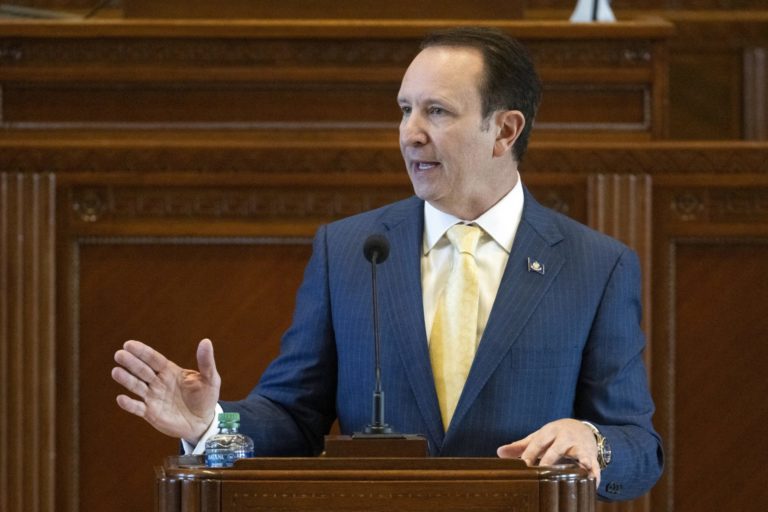
Louisiana Gov. Jeff Landry, appointed in December, has said he is not interested in meeting diplomats. The Republican has not visited the Arctic island but plans to attend a dogsled race there in March. He has suggested Greenlanders would feel right at home in Louisiana, saying he heard they like to hunt, fish and “have a good time.”
As Trump threatens seizing control of Greenland, a semiautonomous territory of NATO ally Denmark, Landry has elevated his national profile on a mission that has showcased his ties to the president and rattled partners in the military alliance.
Landry’s debut has not escaped Denmark’s attention. The Danish ambassador to the United States pushed back on Sunday when Landry posted on X that the U.S. had protected Greenland during World War II “when Denmark couldn’t.”
Landry’s “brand fits the political moment and fits neatly with this president’s goal,” said Mary-Patricia Wray, a Louisiana political consultant who has worked with Landry.
Supporters say Landry’s charisma and negotiating chops are a boost to Trump’s aims. But the scope of Landry’s role as special envoy and extent of his early outreach are unclear as Trump revives his argument that to ensure its own security, the United States needs to control Greenland.
Landry declined an interview request and his office did not respond to questions about his actions so far as envoy. The White House said Landry’s experience as a governor makes him a strong asset.
“He understands that Greenland is essential to our national security, vital to deterring our adversaries, and that Greenlanders would be better served by U.S. protection in the region,” White House spokeswoman Anna Kelly said.
Greenland’s party leaders have firmly rejected U.S. overtures and Danish officials warn that an American takeover of Greenland would end the NATO alliance that has served as the backbone of European security since World War II.
The White House has not ruled out military action in pursuit of Greenland.
Landry, in an interview on the “Brian Kilmeade Show” on Fox News Radio this month, said he wants to provide Greenland’s roughly 56,000 residents opportunities to “improve the quality of life” in exchange for expanded U.S. military presence and rare-earth mineral mining access. Drawing on Louisiana’s famed cuisine, Landry described his approach to forging ties as “culinary diplomacy.”
In the interview with Fox News, Landry said he planned to attend a dogsledding event on the island in March after receiving an invite from “a Greenlander.” He did not say which event, but the possibility of Landry making an appearance rattled organizers of Greenland’s national dogsledding championship.