US Surging Military Assets to Prepare for War With Iran

(Dave DeCamp, Antiwar.com) The US military is planning to surge military assets to the Middle East to prepare for a potential war with Iran after President Donald Trump backed down from bombing the country, according to a report from The New York Times.

US officials told the paper that the aircraft carrier USS Abraham Lincoln and some warships from its strike group were on their way to the Middle East from the South China Sea, a roughly week-long trip. The US is also planning to send an array of warplanes to the Middle East, including fighter jets and refueling aircraft, and additional air defenses.

According to other media reports, the US military’s message to Trump amid his threats to bomb Iran is that there weren’t enough US assets in the region to face a potential counterattack, which could target the many US bases in the region. Trump was also reportedly told that US strikes likely wouldn’t result in regime change and could lead to a prolonged war.

The Times report also said that Israeli Prime Minister Benjamin Netanyahu asked Trump to postpone his plans to attack Iran, and Axios reported the same thing later, saying that Netanyahu wants more time to prepare for Iranian retaliation.

If the reports about Netanyahu’s request are true, it’s likely that he also wants more US military assets in the region since Israel relied on US forces to intercept Iranian missiles during the war back in June 2025, and many still got through and struck Israeli territory, which is what led to Israel agreeing to a ceasefire after 12 days.

On the other hand, the leaks and delays could be meant to keep Iran off guard as the US and Israel engaged in a deception campaign before Israel launched the opening salvo of the 12-Day War.

The White House has claimed that Iran has postponed planned executions due to Trump’s threats and warned that if the “killing” in Iran continues, there will be consequences. However, the unrest in Iran is just the latest pretext for war with Iran.

Iran’s nuclear program was the pretext for launching the 12-Day War, and while meeting with Netanyahu at Mar-a-Lago back in December, Trump said he would back an Israeli attack on Iran if Tehran “continues” its conventional missile program. There’s no sign that Iran would even consider limiting its ballistic missiles since they are the Islamic Republic’s only form of deterrence.

This article originally appeared at Antiwar.com.  

Report: DOJ Launched Federal Reserve Probe in Response to Central Bank’s Stonewalling

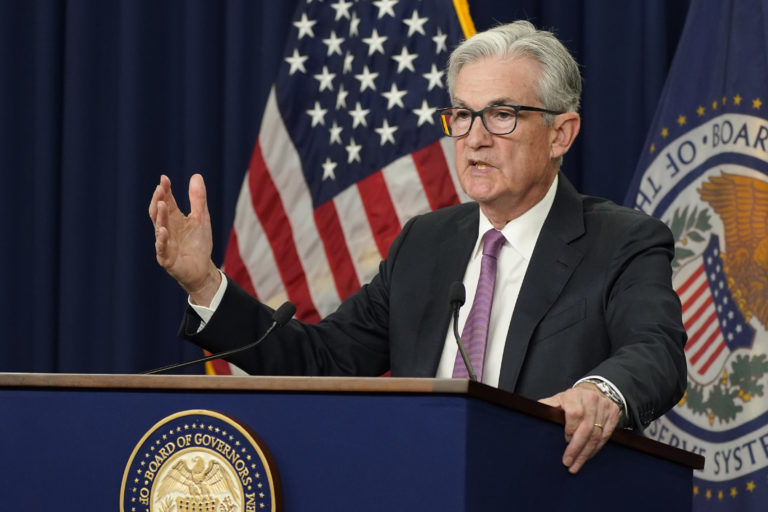
(Ken Silva, Headline USA) When Federal Reserve Char Jerome Powell announced Sunday that the Justice Department had served the central bank with subpoenas, he portrayed the DOJ’s actions as a “threat” intended to undermine the Fed’s independence when it comes to setting interest rates.

But according to the Washington Post, the DOJ’s investigation was only launched after the Fed ignored emails in a non-criminal probe.

Citing six anonymous sources with knowledge of the matter, the Post reported Friday that the DOJ sent two emails to the Federal Reserve in December as part of a non-criminal inquiry launched the month prior.

“The messages sought a meeting or phone call to discuss renovations at the central bank’s headquarters,” the Post reported. “Fed officials opted not to respond to [the emails], choosing to avoid informal engagement on a matter that could carry criminal implications.”

The Fed’s silence reportedly led Jeanine Pirro, the U.S. attorney in Washington, to believe that the Fed was hiding something. That’s when she decided to issue subpoenas, according to the Post.

“The claim that, ‘Oh, they didn’t think it was a big deal’ is naive and almost malpractice,” a DOJ official told the Post. “We gave them a deadline. We said the first week of January.”

Powell has retained outside counsel at the law firm Williams & Connolly—a firm that’s represented former presidents Bill Clinton, Barack Obama and George W. Bush, as well as a slew of other powerful characters. The FBI is reportedly not involved in the investigation.

The subpoenas relate to Powell’s testimony before the Senate Banking Committee in June, when he spoke about the Fed’s $2.5 billion renovation of two office buildings—a project that President Donald Trump has criticized as excessive.

At that hearing, Senate Banking Committee Chair Tim Scott, R-SC, said the Fed’s building renovation included “rooftop terraces, custom elevators that open into VIP dining rooms, white marble finishes, and even a private art collection.”

Powell disputed those details in his testimony, saying “there’s no new marble. … there are no special elevators” and added that some of the controversial items are “not in the current plan.” In July, Russell Vought, director of the Office of Management and Budget, said in a letter to Powell that his testimony about changes to the building plans “raises serious questions about the project’s compliance” with previous plans approved by a planning commission.

Still, later that month, Trump visited the building site and, while standing next to Powell, overstated the cost of the renovation. Later that day, Trump, speaking to reporters, downplayed any concerns with the renovation. He said, “they have to get it done” and added, “Look, there’s always Monday morning quarterbacks. I don’t want to be that. I want to help them get it finished.”

When asked if it was a firing offense, Trump said, “I don’t want to put that in this category.”

The Associated Press contributed to this report.

Ken Silva is the editor of Headline USA. Follow him at x.com/jd_cashless.

The Debt Black Hole Claims Another Victim

(Mike Maharrey, Money Metals News Service) The Debt Black Hole has claimed another victim.

Saks Global Holdings, the parent company of Saks Fifth Avenue, Neiman Marcus, and Bergdorf Goodman, recently filed for Chapter 11 bankruptcy. The company couldn’t dig itself out from under $2.5 billion in debt.

This is a story illustrating how government policy, coupled with central bank mechanizations, incentivized bad decisions.

The story starts five years ago with the COVID-19 pandemic. Federal and state government policies virtually shut down the U.S. economy. At the same time, the Federal Reserve slashed interest rates to zero and launched a quantitative easing program that ultimately created nearly $5 trillion out of thin air. Meanwhile, millions of Americans were out of work and stuck in their homes. To relieve some of the pain caused by its own policies, the federal government showered the American population with stimulus money.

This was a recipe for massive price inflation.

Millions of people were sitting at home, flush with cash. Many paid off credit cards. Some people beefed up their savings accounts. And a lot of consumers sat on their couches and shopped online.

As the country emerged from the pandemic, the luxury sector boomed. Consumers were flush with cash. Many were still reluctant to travel, so they went shopping. Luxury sales boomed in 2021.

And then the inflation hit.

In March 2021, CPI began to reflect the monetary malfeasance of the COVID era. For a while, Jerome Powell and his minions at the Federal Reserve tried to convince us that inflation was “transitory.” We knew better because we actually went to the grocery store.

It didn’t take long for consumers to blow through the accumulated pandemic-era savings and start making ends meet using credit cards.

The inflationary era was particularly tough on the luxury retail sector. For a brief moment, the middle class could afford to shop at Saks. But when grocery prices went through the roof, the luxury spree came to a screeching halt. It didn’t take long before Sak’s clientele was squeezed down to the very wealthy.

Other dynamics were pressuring the luxury retail sector at the same time. Department store traffic was hit hard as consumers shifted more shopping online. Meanwhile, a lot of fashion houses were cutting out middlemen by opening their own boutiques and websites.

Struggling under the weight of a luxury recession, Saks’ management made a fatal mistake. They decided to expand. The company borrowed billions to acquire rival Neiman Marcus for $2.7 billion in December 2024.

What else was happening in late 2024?

The Federal Reserve pivoted and began cutting interest rates. By the December meeting, the central bank had trimmed a full percentage point from the federal fund rate.

Did falling interest rates incentivize Saks management to go out on a limb and borrow billions for the Neiman takeover?

We can’t know what was going on in management’s heads. But we do know that the purpose of slashing interest rates is to incentivize more borrowing to stimulate economic activity. Well, rates fell, and Saks borrowed.

Of course, they may have done the deal anyway. Desperation often leads to bad decisions. However, it is hard to believe that a falling interest rate environment didn’t make the deal more appealing.

This is what Austrian School economists mean when they say artificially low interest rates incentivize malinvestment. Managers and investors make decisions they wouldn’t have made in a “normal” interest rate environment. Sometimes the gamble works, but most often it doesn’t. Eventually, these malinvestments have to be cleaned up. That’s what’s happening to Saks right now. When enough malinvestments start unwinding, you end up with an economic crash.

As an article on Seeking Alpha explained, there were funding problems at the start. Saks and Neiman were pulling from the same small customer pool. This overlap left little room for growth. As Seeking Alpha summarized it, “Their integration was ultimately a failure, as well as a plan to split physical and digital properties, and it was only a matter of time before both inventory and continued financing based on its real estate dried up.

Reuters reported that the company had about $3.4 billion in funded debt obligations ‌before the bankruptcy filing. This included term loan credit agreements and notes issued. Around $275 ​million of that debt was related to the Neiman Marcus acquisition and was set to mature in February.

Keep in mind, it wasn’t just the rate cuts. The COVID policies set the stage, creating the luxury boom and loading up consumers with stimmy money.

There are a lot of companies deep in debt for the same reasons. Many loaded up on cheap debt during the decade following the Great Recession. Others took on debt during the low-interest rate period during the pandemic. When this debt comes due, it must be refinanced at higher rates. This is precisely why so many people want the Federal Reserve to continue cutting interest rates despite sticky price inflation. Of course, that’s a double-edged sword. By increasing liquidity, the Fed is likely incentivizing the creation of even more Saks.

The reason analyst Greg Weldon coined the term “Debt Black Hole” is that the gravity from a black hole in space bends everything around it. This debt black hole is bending everything in the economy. How long the central bankers and policymakers can fight against its pull remains to be seen, but one thing is certain – every boom comes with a bust. We’ve had one heck of a Fed-induced boom over the last 20 years or so. Don’t think the bust isn’t coming. I’m sure the folks at Saks thought everything was going to be fine, too.


Mike Maharrey is a journalist and market analyst for Money Metals with over a decade of experience in precious metals. He holds a BS in accounting from the University of Kentucky and a BA in journalism from the University of South Florida.

Debt Data Continues to Signal Deep Consumer Stress

(Mike Maharrey, Money Metals News Service) Consumer borrowing cratered further in November, likely reflecting growing consumer stress, as price inflation persists and credit cards become maxed out.

That’s bad news for a U.S. economy that depends on consumers buying stuff. Persistent price inflation forced Americans to blow through their savings and then turn to credit cards to make ends meet. However, consumer borrowing has slowed significantly this year, indicating Americans may be maxing out the plastic.

The slowdown in borrowing also reveals why so many people are pushing for further interest rate cuts despite price inflation still well above the Fed’s stated target. They want to pump up borrowing to stimulate the economy.

After climbing at a tepid 2.2 percent rate in October, consumer debt grew at an even slower pace of 1 percent in October, according to the latest data from the Federal Reserve.

The 4.1 billion increase pushed total consumer debt to $5.08 trillion.

The Federal Reserve consumer debt figures include credit card debt, student loans, and auto loans, but do not factor in mortgage debt. When you include mortgages, U.S. households are buried under a record $18.59 trillion in debt.

Over the last several months, the growth of revolving credit, primarily reflecting credit card balances, has slowed significantly. After climbing modestly in October, credit card spending cratered in November. Revolving debt fell by $2.1 billion.

KPMG recently reported that the slowing growth of revolving credit likely reflects a drop in borrowing and spending by the bottom 80 percent of U.S. households “that are increasingly stressed.”

“The top 20 percent now account for nearly two-thirds of all consumption. The top 3.3 percent have increased spending the most. Spending has stagnated, adjusting for inflation, among the bottom 80 percent.”

The double whammy of rising debt and interest rates exacerbates the debt problem. The average annual percentage rate (APR) currently stands at 19.64 percent, with some companies still charging rates as high as 28 percent. The average is only slightly down from the record high of 20.79 percent set in August 2024, despite Fed rate cuts.

High debt levels have created elevated levels of consumer stress.

LegalShield’s Consumer Stress Index (CSLI) increased by 3 points in the third quarter and was at the highest level since March 2020, when the economy was shut down during the pandemic.

The source of this stress: debt.

According to LegalShield, “The index has now increased for seven consecutive months, up 8.2 percent in 2025, signaling continued financial strain among American households. Legal inquiries related to bankruptcy rose sharply, while foreclosure and consumer finance issues remain elevated.”

Meanwhile, the New York Fed reported that overall delinquency rates remained “elevated” in the third quarter, with 4.5 percent of all debt in some stage of delinquency. Credit card and student loan delinquencies have increased at the fastest rate.

Overall debt flow into serious delinquency was 3.03 percent in the third quarter, up from 1.68 percent year-on-year.

Credit card delinquencies are rising, even among consumers with strong credit scores. According to VantageScore, there was a 47 percent year-on-year increase in late payments by people in the prime segment.

Meanwhile, non-revolving debt growth, primarily reflecting outstanding auto loans, student loans, and loans for other big-ticket durable goods, has been stagnant for months. In October, it collapsed, growing by just 1.2 percent. Non-revolving credit rebounded modestly in November, but still only grew by 2 percent, around the average we’ve seen over the last year-plus.

Before the pandemic, revolving credit growth averaged 5 percent.

It appears consumers are opting not to finance big-ticket items, as more and more of their income is necessary just to pay daily expenses.

Borrowers are also struggling to keep up with their non-revolving loans – particularly their student debt. Seriously delinquent student loans surged to 10.2 percent in the second quarter as the government began requiring payments after years of forbearance in the wake of the pandemic.

Transitions of student loans into serious delinquency rose to 14.3 percent in the third quarter. That was up from 12.9 percent in the second, 8 percent in the first, and 0.8 percent in the fourth quarter of last year. It has been the fastest transition rate into serious delinquency since the data have been collected, going back to 2000.

The bottom line is that Americans have blown through the savings they accumulated during the pandemic and have run their credit cards close to the limit. An economy run on Visa and Mastercard simply isn’t sustainable. When Americans finally hit their credit limit, it will have major implications for economic growth.


Mike Maharrey is a journalist and market analyst for Money Metals with over a decade of experience in precious metals. He holds a BS in accounting from the University of Kentucky and a BA in journalism from the University of South Florida.

U.S. Government Still Running Massive Deficit Despite Tariff Revenue

(Mike Maharrey, Money Metals News Service) Despite the influx of tariff revenue, the federal government continues to run a massive budget deficit.

The December budget shortfall came in at $144.75 billion, a record for the month. That was 68 percent higher than December 2024.

However, looking at just one month gives a bit of a skewed picture. Calendar effects and delayed payments stemming from the government shutdown last year continue to muddle the accounting. Calendar effects pushed some January payments into December.

We get a better picture of the government’s fiscal trajectory when we look at the last three months (the first three months of fiscal 2026).

Looking at the three-month data, we find tariff receipts are modestly narrowing the budget gap. The deficit is down around 15 percent through the first three months of fiscal 2026 compared to the same period last year.

That may sound like great news until you realize that even with the modest decline, the three-month deficit is still $602.38 billion.

Has Tariff Revenue Plateaued?

Through the first three months of fiscal 2026, the U.S. Treasury collected $90 billion in tariffs. That compares to $20.8 billion through the same period in fiscal 2025. However, it appears tariff revenue may have peaked.

Customs receipts dropped slightly to $27.9 billion in December. That compares to $30.76 billion in November, which was down modestly from a record $31.4 billion in October.

In total, the Treasury collected $484.38 billion in December, a 6.6 percent increase over last year. Through the first three months of fiscal ’26, the federal government has collected $1.23 trillion, up 13 percent over the first three months of fiscal 2025.

It should be clear that claims that the federal government is going to use tariff revenue to pay a “dividend” to poor and middle-class taxpayers and pay down the national debt are nothing but political rhetoric. Math is the great enemy of this ambitious plan. Even with triple-digit percent increases in tariff revenue, the federal government is still running a huge deficit.

The Spending Problem

Surging tariff revenue has helped paper over the real problem. The federal government keeps spending more and more money.

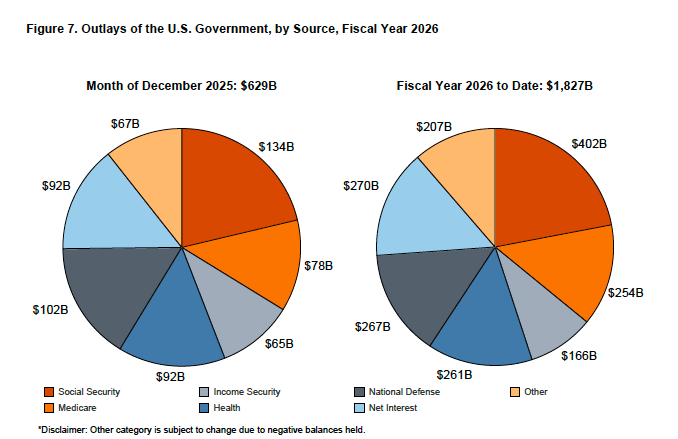
In December, the federal government spent $629.13 billion, bringing the three-month spending total to $1.83 trillion. That’s up about 2 percent over the same period last year.

The increased spending comes despite cuts to the EPA and the Department of Education budget that are now showing up in the data. Lower disaster spending also helped moderate spending levels through the first two months of fiscal ’26.

Looking at the big picture, the spending trajectory is up. Even with all the hype about DOGE and some lip service to cutting spending during the early days of the Trump administration, the U.S. government spent just over $7 trillion last year. That’s an average of $583.3 billion per month or $19.2 billion per day.

Despite some non-specific talk about “spending cuts,” there seems to be little to no commitment to dealing with the runaway spending in a substantial way.

The Big Beautiful Bill trimmed some spending but increased it in other areas. Furthermore, those “cuts” were from projected spending increases. Actual expenditures will still go up, just not as fast as originally planned. The bottom line is that even with the Big Beautiful Bill, spending will increase on an absolute basis. We’re seeing it now.

And all that waste uncovered by DOGE? Virtually none of it was removed from the budget.

This is par for the course.

You might recall that President Biden promised that the [pretend] spending cuts would save “hundreds of billions” with the debt ceiling deal (aka the [misnamed] Fiscal Responsibility Act).

That never happened.

Supporters of the Big Beautiful Bill expect economic growth stimulated by tax cuts to boost revenue and narrow the deficit. However, history casts significant doubt on this claim.

The ugly truth is the government isn’t committed to cutting spending in any meaningful way, and it always finds new reasons to spend even more, whether for “crises” at home or wars overseas.

Debt Is Expensive

On October 21, the national debt surged to over $38 trillion. Less than two months later, the debt stands at $38.4 trillion.

Uncle Sam must pay interest on all that debt. Interest expense has grown into the second-largest spending category in the federal budget behind only Social Security.

In December, the Treasury forked out $153.92 billion on interest expense alone. That pushed interest expense to $354.58 billion through the first three months of fiscal 2026.

Interest on the national debt cost $1.2 trillion in fiscal 2025. That was up 7.3 percent over 2024.

Net interest (interest expense – interest receipts) was $92 billion in December.

Last month, the federal government spent more on interest on the debt than it did on national defense ($102 billion) or Medicare ($78 billion). The only higher spending category is Social Security ($134 billion).

Much of the debt currently on the books was financed at very low rates before the Federal Reserve started its hiking cycle. Every month, some of that super-low-yielding paper matures and must be replaced by bonds yielding much higher rates. And even after the Federal Reserve cut rates, Treasury yields have pushed upward as demand for U.S. debt sags.


Mike Maharrey is a journalist and market analyst for Money Metals with over a decade of experience in precious metals. He holds a BS in accounting from the University of Kentucky and a BA in journalism from the University of South Florida.

Impact of New Chinese Silver Export Regulations Overstated

(Mike Maharrey, Money Metals News Service) The impact of Chinese silver export rules won’t be as significant as many initially thought.

Last week, I reported that China was attempting to control the silver market using more restrictive export rules and that it could exacerbate global silver shortages. China has used a similar strategy to control the markets for other rare earth metals. However, analysis by Metals Focus reveals that the practical impact of the new rules will likely prove minimal.

As I explained it, under the new policy, only large, licensed, state-approved companies with an annual silver production capacity of 80 tonnes and a credit line exceeding $30 million can legally export silver. When Chinese officials rolled out the rules, which went into effect Jan. 1, many analysts said it would lock hundreds of small and mid-sized exporters out of the system.

However, these analysts failed to realize that the Chinese government was already regulating and licensing silver exports. These small and mid-sized exporters were already locked out of the system. The new rules were essentially tweaks in an existing framework. It’s not really an import restriction; it’s simply a transition to stricter export licensing management.

The Shanghai team at Metals Focus analyzed the list of approved companies that the Chinese government released as the new rules went into effect. They compared the names on the approved list with the previous version and found that there were only a few changes.

In fact, there are now 44 approved silver exporters for 2026-2027, up from 42 in 2025-2026.

It’s also important to note that China removed export quota restrictions on silver a few years ago.

In a statement, Metals Focus said, “This announcement should have little impact on global silver trade flows or on market tightness. However, there seems to have been a misunderstanding that led to this being interpreted as a positive signal for the price.

Guilty.

Given China’s history of controlling rare earth metals, it wasn’t unreasonable to think the Chinese government was hoping to apply the strategy for silver. However, the nuts and bolts of the policy shift don’t support this conclusion.

For my part, I simply followed many others who reported the policy change as a new regulatory scheme as opposed to a tweak in an existing system. Mia culpa.

This doesn’t change the underlying realities in the silver market. There still isn’t enough metal to go around – no matter what the Chinese do.

Silver demand has outstripped supply for five straight years. The structural market deficit came in at 148.9 million ounces last year. That drove the four-year market shortfall to 678 million ounces. While the official numbers for 2025 aren’t in yet, the shortfall is expected to push the market deficit over 800 million ounces, the equivalent of an entire year of global silver mine output.

This means silver users must source metal from existing above-ground stocks. People who already hold silver are reluctant to give it up at the current price, which is one of the dynamics driving silver higher.

And of course, there could still be political influence in the silver market, and not just from China. The U.S. Geological Survey recently designated silver a “critical mineral.” The USGS critical mineral list was established in 2017, and it guides federal strategy, investment, and mine permitting decisions.

It’s important to keep an eye on government policy and how it might shape the market, but it’s also important not to overstate the impact of a given policy, especially before all the information is in.


Mike Maharrey is a journalist and market analyst for Money Metals with over a decade of experience in precious metals. He holds a BS in accounting from the University of Kentucky and a BA in journalism from the University of South Florida.

Alleged Kirk Assassin’s Roommate Moved from Utah, Doesn’t Have FBI Protection, Family Member Says

(Ken Silva, Headline USA) A family member of alleged Charlie Kirk assassin Tyler Robinson’s transgender roommate, Lance Twiggs, has given an interview to News Nation—revealing that Twiggs has moved out of Utah and no longer has FBI protection.

The family member, who spoke under the condition of anonymity, also reportedly said she wasn’t sure if Twiggs, who has an attorney, is still cooperating with law enforcement’s investigation. She added that she’s sure that Robinson is guilty.

“When I first found out about how he was taken in and talked to by the police, I know that they said that he was very cooperative,” she said. “But they had to go get him and bring him in. He didn’t voluntarily go in and say, hey, I heard about this and I have some knowledge. He handed over things when they asked for them, but he didn’t give up any information until he had to.”

Twiggs shared a $1,800-a-month townhouse with Robinson. After Robinson’s arrest, Washington County Sheriff Nate Brooksby said Twiggs was in a “safe space very far away from St. George,” though he offered no specifics.

Twiggs was 22 at the time of the shooting, and was quickly revealed to be a “wannabe professional gamer” who was reportedly considering a sex change.

“In November 2024, Twiggs posted about his anxiety with injecting cross-sex hormones. Replying to a thread on injection pain, he wrote: ‘seriously. sometimes it’s just muscle memory, sometimes i gotta get buzzed on something so i’m not too anxious about it,’” independent journalist Andy Ngo reported last September.

A purported neighbor also said the two were in a romantic relationship. The neighbor said he saw them holding hands and kissing.

Ken Silva is the editor of Headline USA. Follow him at x.com/jd_cashless.

President Trump Tells Iran He Won’t Attack the Country: Iranian Envoy

(Dave DeCamp, Antiwar.com) An Iranian official said on Thursday that President Donald Trump has informed Iran he doesn’t plan to attack the country and asked Tehran to exercise restraint.

The comment about Trump’s message was made by Reza Amiri Moghadam, Iran’s envoy to Pakistan, according to the Pakistani newspaper DAWN, as the anti-government protests in Iran appear to have largely stopped.

Sen. Lindsey Graham (R-SC), a close ally of President Trump, claimed in a post on X that Moghadam’s remarks weren’t true. “The circumstances around the necessary, decisive action to be taken against the evil Iranian regime have nothing to do with President Trump’s will or determination,” Graham said. “Nothing could be further from the truth. Quite the opposite. Stay tuned.”

Trump said on Wednesday that he was told the “killing” and “executions” inside Iran would stop, and he made similar comments in a post on Truth Social on Thursday. “FoxNews: ‘Iranian protester will no longer be sentenced to death after President Trump’s warnings. Likewise others.’ This is good news. Hopefully, it will continue!” he wrote.

However, Trump has a history of being purposely deceptive and did suggest that the US had no plans for war with Iran back in June, right before Israel launched a major attack on the country, starting the 12-Day War. As Israeli jets were getting in the air to bomb Iran, the president wrote on Truth Social that he was committed to a diplomatic solution with Tehran.

A US attack on Iran in the coming weeks or months is still likely, as President Trump has also recently threatened to bomb the country or support an Israeli attack over Tehran’s conventional missile program. The US has also ordered the aircraft carrier USS Abraham Lincoln to head to the Middle East from the South China Sea, which is expected to take about a week.

According to media reports, the US military told the Trump administration that it needed to “consolidate US military positions and prepare defenses” before bombing Iran, as an Iranian counterattack against US bases is expected. Iranian officials have repeatedly warned that US bases would be struck in retaliation, and US intelligence assessed Iranian missiles could target the Al Udeid Air Base in Qatar, as well as US bases in Syria and Iraq.

Another factor that could have played into Trump’s decision not to attack was opposition from the US’s Arab allies in the region. According to a report from the AFP, officials in Saudi Arabia, Qatar, and Oman led the effort to persuade Trump not to bomb Iran.

Trump’s goal for a potential attack was likely regime change, and according to NBC News, his advisors weren’t able to guarantee that US strikes on Iran would have collapsed the government. The report also said that the US may not have enough assets in the region to face an Iranian counterattack, and that these factors could lead to Trump approving a more limited attack with options to escalate.

This article originally appeared at Antiwar.com.  

Despite Promises, MN Dems Kept Some of their Fraud-Linked Somali Donations

(Jared Strong, The Center Square) In an attempt to distance themselves from the Feeding Our Future fraud, Minnesota politicians vowed to return their tainted donations, but an investigation by The Center Square found that some did not follow through with their promises.

Others, including the state’s Attorney General Keith Ellison — the state’s top law-enforcement official — and several lawmakers and candidates who failed to win office, took a significant amount of time to return the money or refused to provide documentation that the money was returned or donated elsewhere.

The returned donations, which were all to Democrats, were mostly tied to an initial wave of indictments for the fraud scheme in September 2022. Since then, the number of people accused of stealing about $300 million of federal aid money has nearly doubled.

State Sen. John Hoffman, who received eight questionable donations that totaled about $3,300, sent all of the money to the U.S. Marshals Service because the donated money might have been obtained through fraud.

“It was the right thing to do,” he told The Center Square.

But the newer indictments did not garner the same expeditious response from other politicians who received fraud-linked donations, The Center Square found.

Minnesota is flush with fraud accusations that have extended beyond the now-defunct Feeding Our Future, an organization that facilitated the theft of federal money that was meant to provide food to children. Last year, federal prosecutors also accused more than a dozen people of stealing aid for housing and autism services.

The scandal put a spotlight on the state’s large Somali community because its members constitute the bulk of those who have been accused of and convicted for the fraud.

President Donald Trump last month referred to Somali immigrants in Minnesota as “garbage.” His administration recently sent more than 2,000 federal agents to the state to arrest certain immigrants for deportation, and the administration has cut off funds for programs that had significant fraud.

“There’s strong ties between the attorney general and members of the legislature and the Somali community,” Minnesota state Rep. Kristin Robbins, a Republican who leads a committee of legislators that is investigating the fraud, told The Center Square. “We felt, at a minimum, that anyone who has been indicted for fraud, those donations should be returned.”

The Center Square scoured five years of campaign contribution data for donations from people connected to the fraud and is reporting campaign contributions for donors only where names could be verified with some combination of ages, addresses and/or employment.

Last year, Robbins pressed Ellison about potentially spurious donations he had received.

Ellison had already returned a $2,500 campaign contribution to a donor who was indicted in September 2022 for the food aid fraud. The donor, Liban Alishire, later pleaded guilty to wire fraud and money laundering and awaits sentencing, court records show. He has agreed to repay more than $700,000 of stolen aid.

But Ellison rejected Robbins’ scrutiny of donations Ellison received after meeting with people connect to the fraud schemes in December 2021. A recording of that meeting was published last year by the Center of the American Experiment, a group that advocates for conservative policies in Minnesota.

In a letter to Robbins in June 2025, Ellison said he “rejected offers of campaign support” in that meeting.

But shortly after the 2021 meeting Ellison’s campaign received four donations on the same day of $2,500 apiece. One of the donors was Gandi Mohamed, who was charged with several crimes in 2024 for allegedly participating in the fraud scheme and laundering money from it.

As a result of the fraud committee’s scrutiny, Ellison returned the donation from Mohamed in recent months, Robbins said.

A spokesperson for Ellison said all four donations were given by the campaign “to a fund administered by the federal government,” but he declined to say when or provide documentation that supports the statement.

Ellison’s campaign finance records for last year that might document the transfers are not yet available.

Other campaign disclosures show that Mohamed also contributed $1,000 to the campaign of Farhio Khalif, who lost a state Senate election in 2022. Additionally, Khalif received a donation from Ikram Mohamed, a sibling of Gandi Mohamed who faces numerous charges related to the fraud, court records show.

Ikram Mohamed attended the 2021 meeting with Ellison, the Center of the American Experiment reported.

Campaign finance records for Khalif do not indicate the contributions were returned. Khalif did not respond to a request to comment for this article.

In January 2022, when federal search warrant documents related to the Feeding Our Future scandal became publicly available, state Sen. Omar Fateh moved quickly to return donations from people who were explicitly named in the documents or who were otherwise linked to the fraud, campaign disclosures show.

His campaign committee indicated in an annual finance report that it sent back 11 contributions from 2021 worth $11,000, or about a quarter of his total donations that year.

But there were two other $1,000 donations he did not return, records show: One from Ikram Mohamed and one from her husband Shakur Abdisalam, who both were indicted for the fraud scheme in 2024.

Fateh did not respond to requests to comment for this article. Communications between his campaign and the state’s Campaign Finance and Public Disclosure Board indicate Fateh intended to return the donations by check to the donors, and it’s unclear whether those checks were cashed.

Former state Rep. John Thompson received two donations from Hanna Marekegn in 2022, who was among the first people charged with crimes for the Feeding Our Future scheme. He lost a primary election that year and did not submit a year-end campaign finance report, so it’s unclear whether he returned the donations. He couldn’t not be reached to comment.

Senate candidate Sahra Odowa received a $1,000 contribution in 2020 from Abdiaziz Farah, who was sentenced to 28 years in prison for his role in the fraud scheme. Campaign disclosure records do not indicate Odowa returned any contributions.

State Rep. Mohamud Noor returned a $320 contribution directly to Liban Alishire not long after Alishire was indicted in 2022.

Robbins said she and other lawmakers are uncovering new avenues of fraud — related to services for adults and non-emergency medical transportation — and that the investigations in her state are likely to help uncover similar crimes elsewhere.

“Minnesota is the canary in the coal mine, and we are starting to see connections and similar patterns in other states,” she said.


Dem Rep. Goodlander Faces Federal Probe Over ‘Illegal Orders’ Video

(Chris Wade, The Center Square) Democratic New Hampshire Rep. Maggie Goodlander says she is being investigated by federal prosecutors for participating in a video message urging service members to refuse “illegal” orders.  

In a video posted Wednesday night, Goodlander acknowledged that she is among other Democrats being investigated by the Justice Department for their video post in November, which encouraged U.S. military service members to “defy” orders from their superiors if they believe it violates the Constitution.

“No matter the threats, I’m not backing down,” Goodlander said in Wednesday’s video. “It is sad, telling and downright dangerous that simply stating a bedrock principle of American law caused the President, our Commander in Chief, to threaten violence against me and to weaponize the Department of Justice against me.”

Goodlander, a former Navy intelligence officer, posted the video with five other Senate and House Democrats who have served in the military or worked as intelligence officers, including Sens. Mark Kelly of Arizona and Elissa Slotkin of Michigan. It was posted as the Trump administration was considering the deployment of National Guard to several U.S. cities to help enforce immigration policy.

“No one has to carry out orders that violate the law or our Constitution,” the lawmakers said in the video. Like us, you all swore an oath to protect and defend this Constitution. Right now, the threats to our Constitution aren’t just coming from abroad, but from right here at home. You must refuse illegal orders.”

Trump blasted the video in social posts that accused the lawmakers who participated in it of “seditious behavior” and called for their arrest and prosecution by federal authorities. 

“Each one of these traitors to our Country should be ARRESTED AND PUT ON TRIAL,” Trump posted on Truth Social. “Their words cannot be allowed to stand. An example MUST BE SET.” 

Earlier this week, Defense Secretary Pete Hegseth announced that the Pentagon would censure one of the lawmakers who appeared in the video, Sen. Mark Kelly, a retired Navy combat pilot. 

In response, Kelly sued Hegseth and the Pentagon, claiming the government is retaliating against him for speech protected by the First Amendment. 

Several media outlets have reported this week that besides Goodlander, Reps. Jason Crow, of Colorado and Chrissy Houlahan, of Pennsylvania, have also received inquiries from U.S. Attorney for the District of Columbia Jeanine Pirro asking for an interview with them or their attorneys. Pirro’s office hasn’t confirmed or denied any ongoing investigations.