NBC Blames Right-Wing Media for Calling Out DEI in Air Travel

(Molly Bruns, Headline USA) NBC News published an article on their website accusing right-wing conservative influencers and politicians of unfair bias against Diversity, Equity and Inclusion—or DEI—programming and hires after the rash of dangerous incidents onboard various flights.

The article’s author, David Ingram, claimed that conservatives’ criticisms came from misunderstandings about airline companies commitments to diversity initiatives.

Ingram cited a 2021 Axios interview with United Airlines CEO Scott Kirby in which Kirby said the company wants 50% of flight academy students to be women or people of color.

“We have committed that 50% of the classes will be women or people of color,” Kirby said. “Today only 19% of our pilots at United Airlines are women or people of color—and by the way, out of all the data I’ve seen, that’s the highest out of any airline in the country.”

Some critics, however, reported that the CEO wanted 50% of the airline’s workforce to be women or people of color—a distinction that Ingram took umbrage with.

United clarified that its standards for pilot competency and safety had not been altered to accommodate for DEI hires.

Ingram claimed conservatives correlation of rising DEI programming and increasing number of serious incidents on planes was a fallacy, as they were unable to produce any hard evidence.

However, though the entirety of the article, Ingram only cited anecdotal evidence from various frequent fliers, such as blogger Brett Snyder, also known as Cranky Flier.

The recent episode involving a Boeing plane on an Alaska Airlines flight over Oregon that lost its door midflight was one example that conservative critics pointed to after it was discovered that Spirit AeroSystems, the company that manufactured the plane door, had proudly touted its all-female crew.

Ingram listed a litany of conservative influencers and politicians who called out airlines for straying from their primary focus—which is to fly passengers from one place to another safety.

“DEI is destroying our airlines!” said Rep. Matt Gaetz, R-Fla., in a post promoting his podcast “Firebrand,” where he and Revolver editor Darren Beattie discussed the issue.

Libs of TikTok founder Chaya Raichik posted an ad for Virgin Atlantic airlines that highlighted a campaign for flight stewards to have crossdressing uniforms, which also featured a drag queen.

“They went all in on DEI. They changed uniform policy so men can cross dress and nonbinary crew can wear pronoun pins. They boast drag queen flight attendants,” the post read.

“Last week a @VirginAtlantic flight was canceled after a passenger noticed missing bolts on the wing,” it continued. “DEI in the airline industry will get people k*lled.”

Ingram reached out to Raichik for a comment, to which she responded by saying she will “only talk to black, Latinx or LBGTQ reporters.”

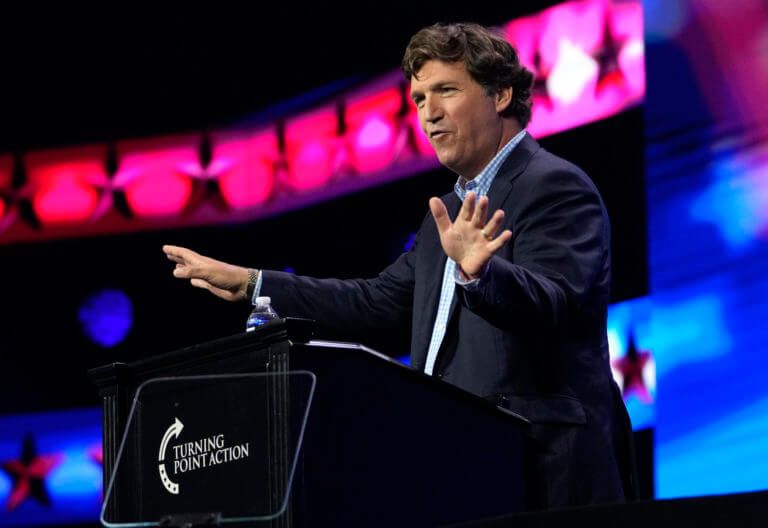
Tucker on GOP Hawks Calling for War w/ Iran: ‘F—ing Lunatics’

(Ken Silva, Headline USA) Neocons from both major U.S. political parties are calling for war with Iran after three American servicemen were killed, and over 30 were injured, by an Iran-backed militia group in Jordan on Sunday—eliciting a strong reaction from one of the GOP’s leading non-interventionist voices.

“F—ing lunatics,” former Fox News broadcaster Tucker Carlson said Sunday, after GOP leaders Sens. Lindsey Graham, R-SC, and John Cornyn, R-Texas, both called for direct strikes on Iran.

Carlson followed up on his brief but telling statement with an interview Monday with U.S. combat veteran Joe Kent, who unsuccessfully ran for Congress as an anti-war Republican in 2022.


Kent accused the U.S. of leaving troops in the Middle East as ‘bait’ to use as an excuse for war.

“If you look at the full scope of the way we’ve arranged ourselves in the Middle East … We have left them there as bait to be killed by Iranians at the time and place of their choosing, so we can continue to escalate towards a conflict with Iran,” Kent said.

Kent’s statements echoed what Headline USA reported last Tuesday in an article titled, Biden Using U.S. Troops as Bait for Iran—which reported on  Biden administration officials saying that the U.S. will go to war with Iran if a single U.S. troop is killed by Iranian-backed militias in Iraq or Syria.

According to the New York Times, Iranian-backed militias had already carried out 140 attacks on American troops in Iraq and Syria as of Thursday, with nearly 70 U.S. personnel wounded, some of them suffering traumatic brain injuries.

“Biden administration officials have regularly debated the proper strategy. They do not want to let such attacks go without a response, but on the other hand do not want to go so far that the conflict would escalate into a full-fledged war, particularly by striking Iran directly,” the Times reported Jan. 21.

“They privately say they may have no choice, however, if American troops are killed. That is a red line that has not been crossed, but if the Iranian-backed militias ever have a day of better aim or better luck, it easily could be.”

Kent told Carlson that rather than directly attacking Iran, the U.S. should engage in targeted strikes on Iran-backed militias while also pulling its troops from the Middle East.

“We do need to strike back, but if we start taking strikes within Iran itself, that is exactly what the Iranian regime wants. They will benefit from that if we start attacking Iran the way we did Iraq and Afghanistan, then the Iranian government, the people will rally around them in support,” Kent said.

“We should be making calculated strikes against Iranian proxy groups, and then we should immediately get our troops out of these foolish locations before we lose more blood and treasure for no reason, and before we’re sucked further into a regional war.”

The Biden administration has signaled that it will withdraw troops from Iraq and Syria, but it’s not clear how the recent attack in Jordan affects those plans.

Biden, in response, has assured that the U.S. will “respond” to those responsible for the deadly drone attack.

“While we are still gathering the facts of this attack, we know it was carried out by radical Iran-backed militant groups operating in Syria and Iraq,” Biden said in a statement Sunday.

“Together, we will keep the sacred obligation we bear to their families,” Biden added. “We will strive to be worthy of their honor and valor. We will carry on their commitment to fight terrorism. And have no doubt — we will hold all those responsible to account at a time and in a manner our choosing.”

Ken Silva is a staff writer at Headline USA. Follow him at twitter.com/jd_cashless.

Hack SNL Writers Don’t Know What ‘De-Banking’ Means

(Ken Silva, Headline USA) Donald Trump recently made it a part of his presidential platform to prevent financial institutions from arbitrarily closing the customers’ accounts over their political views—a process known as “de-banking.”

De-banking became a national issue when numerous critics of COVID-19 restrictions lost their accounts. Others, such as Infowars host Alex Jones and rapper Kanye West, have lost bank accounts seemingly due to their outspoken and controversial political opinions.

But the folks at Saturday Night Live have apparently never heard of the term. The show reacted to Trump’s recent statements about de-banking by suggesting that the presidential candidate was confused.

“He introduced an interesting term called ‘de-banked’ … I don’t know what the hell ‘de-bank’ means, but he might have to take ‘de-ambulance’ to see ‘de-doctor,’” said an SNL cast member in an attempt at humor.

SNL was widely mocked for its smug ignorance.

“Not one SNL writer or audience member realized that de-banking is a real thing actually happening to the right. Canada did it to the truckers,” said the popular right-wing account “End Wokeness.” “JPMorgan is doing it to conservatives and Christians. It was done to J/6 protestors. All it takes is a simple Google search. De-banking is real.”

Victims of de-banking have noted the irony that financial institutions de-bank political dissidents, but have no problem doing business with notorious criminals such as Jeffrey Epstein. The attorney general for the U.S. Virgin Islands revealed last year that JP Morgan Chase had a relationship with Epstein until mere months before his death in 2019.

“The grossly tainted proceeds from Epstein’s disgusting ventures were good enough for JP Morgan Chase, but deposits from a business selling natural health products and organic food is at risk for money laundering and is bad for business,” COVID-19 vaccine critic Dr. Joseph Mercola said last July when JP Morgan Chase de-banked him.

Ken Silva is a staff writer at Headline USA. Follow him at twitter.com/jd_cashless.

Trump’s Appeal to Black Voters Causing Panic in Biden Camp

(Headline USA) As he seeks the presidency for a third time, GOP frontrunner Trump is aiming to win over black voters, building on the historic inroads he made in 2020 with both blacks and Hispanic communities, while capitalizing further on the outrage over President Joe Biden’s war on urban communities via his open-border policies and inflation.

“Have you seen our poll numbers with African Americans and with Hispanic Americans?” Trump declared during a rally in Atkinson, New Hampshire, days before the state’s primary.

“But I’m not that surprised because I see it, I feel it,” he added. “We did great in 2016, we did much better in 2020 but there is much more enthusiasm now.”

Since 2013, the Republican National Committee has established outreach centers focused on minority areas; there are currently 38 such outposts in 19 states catering to various communities. The GOP plans to add two more outreach centers in 2024.

While remain overwhelmingly supportive of President Joe Biden, even a small shift could upend the entire calculus in the election, particularly with Trump polling ahead by narrow margins in most major swing states.

Blue enclaves like Atlanta, Detroit, Milwaukee, Phoenix and Philadelphia proved to be the focal points in the 2020 race as many of the outlying rural areas supported the then-incumbent Trump.

Regardless of whether vote fraud and ballot-harvesting played a role, a greater Republican presence in the cities—as well as places like Chicago, Denver and New York City, which have all been plagued by illegal immigration, crime and homelessness—would make it that much more difficult for far-left voting officials to deliver their respective states.

For Biden, the biggest concern is that such voters simply don’t show up at all.

Nationally, only 50% of black adults said they approve of Biden in a December AP-NORC poll, down from 86% in July 2021.

That shift represents a larger drop than among adults overall and white adults in particular. Only 25% of black adults said they have a favorable view of Trump.

However, that is still about a 10% jump from what Trump saw heading into the last presidential election, when a July 2020 poll showed him averaging 16% favorability among black Americans.

That, in turn, marked a sea change over previous GOP presidential contenders including George W. Bush (average 11%), Mitt Romney (6%) and John McCain—who, when running against Barack Obama as he stood poised to become the first black president—received a paltry 4%.

There now remains a risk that if Biden were to drop out this spring in favor of former first lady Michelle Obama, black voters would again rally around her, putting identity politics ahead of concerns over immigration and the economy.

Cornell Belcher, a Democratic pollster, noted that Obama faced challenges similar to Biden with young voters and voters of color during his 2012 reelection campaign, when many in the Democrats’ base were frustrated by his perceived slow pace of progress on key goals.

“I’m not surprised that Joe Biden right now starts off underperforming among young voters and voters of color. I’d be surprised if he didn’t. But that’s what campaigns are for,” Belcher said.

“I’m not panicked that he is down 15 points from where he should be with these voters,” he added. “Because I’ve seen this play before. I’ve seen it with Barack Obama.”

Still, the bigger padding of support that Trump builds among disaffected minority voters now, the more difficult it will be for Democrats to convert them when they reveal who their actual candidate will be.

Trump’s campaign advisers insist they’re aiming to jump on such shifts to spur a political realignment that would upend the Democratic Party’s decades-long advantage with black voters.

“We are creating a massive problem for the Democratic Party’s base that … could be altering for a generation,” said Chris LaCivita, a senior adviser on the Trump campaign. “That’s just an opportunity that we would be remiss if we didn’t exploit.”

In some ways it echoes the concerted effort that former President Lyndon B. Johnson made in the 1960s, when he abandoned the party’s longtime pro-segregation stance and aligned with communist black leaders like Martin Luther King Jr. to push his “Great Society” agenda, turning lower-income blacks dependent on the state for welfare.

But rather than pander, Republicans hope to show black Americans the benefits of being free from the plantation-mentality of codependency that Democrats have long fostered and shift toward a more positive message of black prosperity as a byproduct of American prosperity.

Trump often highlights endorsements from black celebrities, including rappers like Kanye West and Lil Wayne, as evidence of his appeal to the black community. He recently touted the endorsement of a Rhode Island activist who had helped co-found the state chapter of the pro-Marxist group Black Lives Matter.

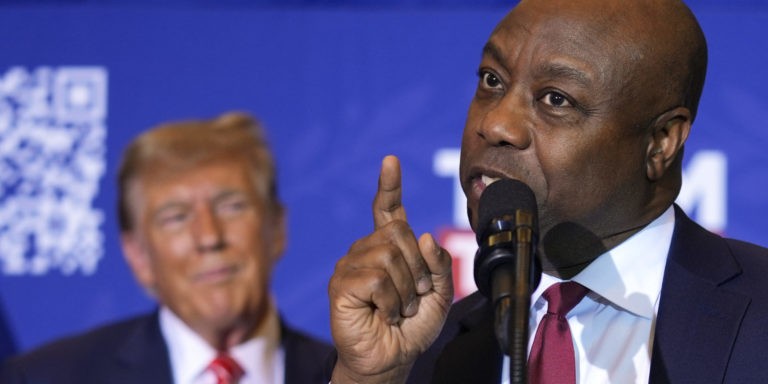
When he won the New Hampshire primary this week, Sen. Tim Scott, R-S.C.—currently, the longest-serving black senator and one of only four in the entire chamber—stood prominently behind him. Scott, who once challenged Trump for the GOP nomination, has emerged as one of his most prominent surrogates and speaks often about his record on race.

As Trump closes in on the Republican nomination, his vice presidential pick could be a key opportunity to try to expand his appeal beyond the party’s base. Scott is among those who are frequently mentioned as a potential running mate for Trump. Trump’s former HUD secretary, Ben Carson, is also in the mix. So is businessman Vivek Ramaswamy—who, like Scott, endorsed Trump after dropping out of the primary race himself.

However, Biden and his fellow Democrats aren’t ceding black voters to Trump so easily. Biden “won’t rest until we earn every vote because the stakes are that high,” Democratic National Committee chair Jaime Harrison said of the 81-year-old president, who frequently takes lengthy vacations from the White House and, thus far, has had relatively few campaign events after freezing out any serious primary competition.

The president—despite having offended blacks on several occasions with racially insensitive remarks—is now in full-fledged pander mode and has gone heavy on the demagoguery attempting to vilify his GOP rival as a “threat to democracy.”

Biden kicked off his reelection bid earlier this month at Mother Emanuel AME Church in Charleston, South Carolina, where in 2015—during the Obama administration—nine Black parishioners were shot to death by the white stranger they had invited to join their Bible study.

During his visit, Biden denounced the “poison” of white supremacy in America and noted some of the accomplishments of his administration, including the appointment of Ketanji Brown Jackson as the first black woman to serve as a U.S. Supreme Court justice. Democrats have, nonetheless, waged a vicious and well-funded smear-campaign attacking the court’s other black justice, Clarence Thomas.

Biden has also upended his party’s election calendar to put South Carolina at the start— instead of predominantly white Iowa and New Hampshire—in the hopes that the state’s large black population will help deliver him a safe victory instead of a potentially embarrassing defeat against his relatively unknown intra-party challengers.

And in contrast to past Democratic efforts, the Biden campaign has opted for an early engagement strategy with core constituencies like black voters. The campaign rolled out large investments in African American media and other outreach in key swing states.

Adapted from reporting by the Associated Press

Texas Gov. Greg Abbott Delivers a Vote of No Confidence

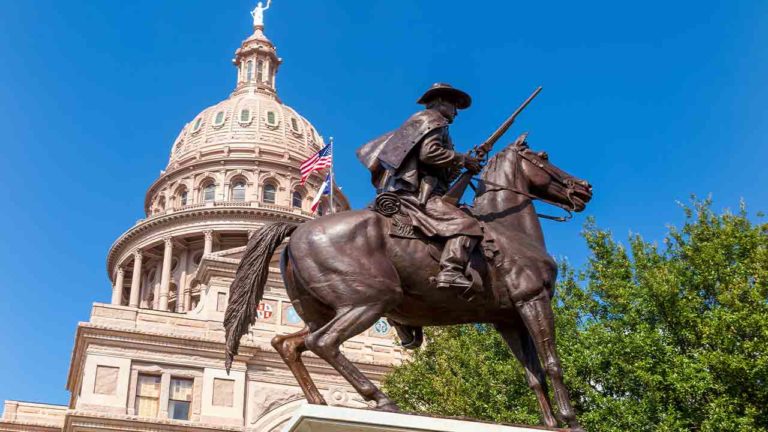
(Clint Siegner, Money Metals News Service) Texas Gov. Greg Abbott gave up on the Biden administration doing much to secure his state’s border with Mexico.

An estimated 6 million people, including large numbers of fighting age men, have been pouring illegally into border states over the past 3 years. Abbott is using the Texas national guard and state police to put up barriers.

Abbott issued a declaration in which the opening sentence reads: “The federal government has broken the compact between the United States and the States.”

Abbott claims the federal government is derelict in its duty to protect the border and that Texas has a sovereign right to defend its territory and people. Governors in 25 other states have expressed their support.

The constitutional crisis brewing over the border could be historic. For investors, the most pertinent fact may be that 26 state governors are delivering a vote of “no confidence” in the federal government.

Confidence has been shaken a lot in recent years. When it finally breaks, investors may want to be out of the way.

Confidence is the intangible force helping to hold markets up. It keeps depositors from fleeing the banks. It underpins the Federal Reserve note. It prevents periodic bouts of selling in the stock market from becoming disorderly.

Rivers of capital from both here and abroad flow into U.S. debt and equity markets because investors believe in America.

When trouble arises, such as during an economic downturn, or something worse such as the 2008 financial crisis, investors might sell stocks or bonds rapidly.

This is what makes the times we are living in more perilous for investors. Determining which assets can serve as a safe-haven is getting harder.

If an asset’s value depends on confidence in the federal government, many are thinking twice.

Confidence is waning across a broad spectrum of institutions, with the federal government very prominently among them. The next crisis of confidence might not be limited to publicly traded companies. It could include U.S. debt and the fiat Federal Reserve note itself.

There is a portion of the population whose disdain for the federal government goes deeper than mere dislike for Joe Biden.

They view corruption as pervasive throughout federal agencies.

Anyone paying attention knows that federal debts and unfunded liabilities cannot be paid in honest money.

Investors would be wise to get prepared for market volatility to ramp up. If the selling starts, it won’t necessarily be limited to stocks.

Fed Balance Sheet Reveals It Was a Half-Hearted Inflation Fight

(Mike Maharrey, Money Metals News Service) It appears more and more likely that the Federal Reserve is poised to completely abandon any pretense of fighting inflation, despite the fact CPI remains well above the 2% target.

The Fed has already paused interest rate hikes, and most analysts expect rate cuts later this year. Now, the financial news networks have started chattering about the possibility of the central bank either slowing or even ending its balance sheet reduction plan.

Speculation about the end of balance sheet reduction started early this month with the release of the FOMC meeting minutes. They revealed that some committee members thought they needed to “begin to discuss” technical factors that would direct their decision to slow the runoff of maturing bonds from its balance sheet. 

Dallas Fed President Lorie Logan was the first committee member to talk about it publicly, saying that the central bank should begin tapering the runoff of bonds from its balance sheet when its reverse-repo facility fell below a certain level.

More recently, Federal Reserve Governor Christopher Waller said it would be “reasonable” to start thinking about tapering off quantitative tightening this year.

If the Fed has done enough to slay price inflation, ending balance sheet reduction would make sense. But has it really done enough?

FED BALANCE SHEET REDUCTION IN PRACTICE

The Fed announced a balance sheet reduction plan in March 2022 when it could no longer convince everybody that price inflation was “transitory.” It called for $30 billion in US Treasuries and $17.5 billion in mortgage-backed securities to roll off the balance sheet in June, July, and August of 2022. That totaled $45 billion per month. The Fed said it would increase the pace to $95 billion per month in September 2022, capping the U.S. Treasury roll-off at $60 billion.

It wasn’t exactly an ambitious plan. 

If the Fed followed the blueprint, it would take 7.8 years for the Fed to shrink its balance sheet back to pre-pandemic levels.

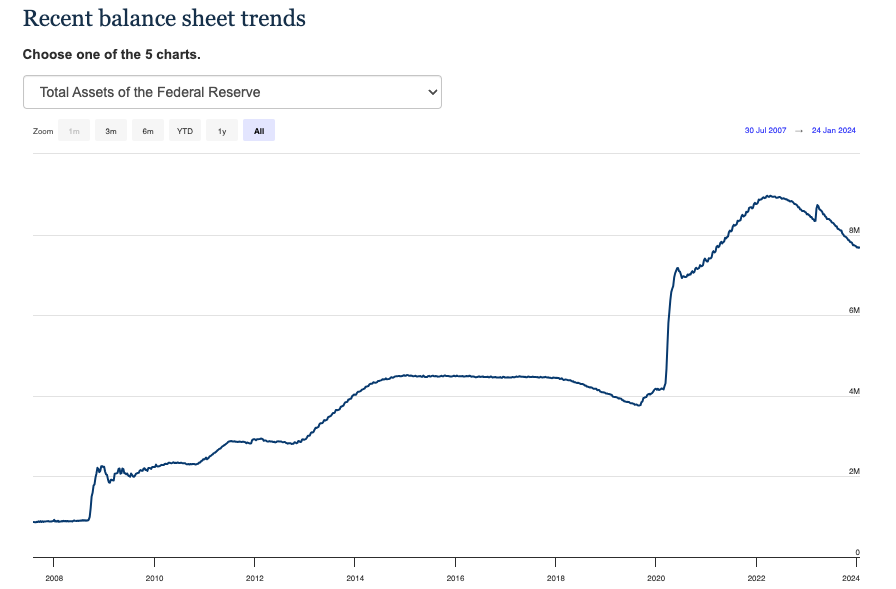
To date, the Fed has rolled about $1.29 trillion off the balance sheet. This sounds impressive until you realize that the central bank blew up the balance sheet by $4.81 trillion in just two years in response to the pandemic.

And they are already talking about ending quantitative tightening.

Stop and consider what this means. The central bank only wrung a little more than a quarter of the inflation it created during the pandemic out of the economy.

This explains why despite rate hikes and quantitative tightening, financial conditions remain loose in historical terms. As of the week of January 19, the Chicago Fed Financial Conditions Index stood at -0.57. A negative number indicates loose financial conditions. 

It has been an unimpressive inflation fight. That’s why I say the pivot by the Fed isn’t victory, it’s surrender. Inflation won. The Fed is throwing in the towel.

Why?

Because everybody knows that this debt-riddled economy can’t keep plugging along without easy money.

Furthermore, the Federal Reserve can’t shrink its balance sheet in a meaningful way.

A BALANCE SHEET HISTORY LESSON

When the economy is bad, the Fed ramps up quantitative easing. It buys bonds on the open market with money created out of thin air. By putting its big fat thumb on the bond market and creating artificial demand, it keeps bond prices higher than they otherwise would be. Conversely, interest rates stay lower. This benefits the U.S. Treasury, allowing it to continue borrowing at lower interest rates.

This is called debt monetization. The Fed literally transforms U.S. government debt into money.

Debt monetization is inflationary. It expands the money supply and ultimately pushes consumer prices higher than they would be. In practice, Americans pay an inflation tax to help sustain the debt.

When times are good, the Fed should theoretically pull that liquidity out of the economy, but in practice, the central bank is very slow to shrink the balance sheet. Why? Because once it injects trillions in liquidity into the economy, it can’t get it out without popping the bubbles it blew up and driving the economy into a recession.

We witnessed this song and dance after the 2008 financial crisis.

In the early days of the Great Recession, then-Federal Reserve Chairman Ben Bernanke assured Congress that he was not monetizing debt. Bernanke claimed the difference between debt monetization and the Fed’s plan was it was not providing a permanent source of financing. He insisted the bonds would only remain on the Fed’s balance sheet for a short time and assured Congress that once the crisis was over, the Fed would sell the bonds it bought during the emergency. 

That never happened.

Bernanke ran three rounds of quantitative easing, pushing the balance sheet from $8.98 billion before the financial crisis to just over $4.5 trillion by December 2014.

The central bank tried to unwind its balance sheet in 2018. The FOMC said balance sheet reduction was on “auto-pilot?”

It didn’t last long.

The Fed reversed course after the stock market crashed and the economy got wobbly in the fall of 2018. At its low, the balance sheet fell just below $3.76 trillion. It wasn’t even able to shed $1 trillion of the Great Recession monetary stimulus.

So much for Bernanke’s promise. 

Some will claim the Fed had no choice but to reverse balance sheet reduction because of the pandemic, but this is historical revisionism. In fact, the Fed returned to quantitative easing before the coronavirus. But in October 2019, the balance sheet was back above $4 trillion. This was four months before the pandemic shutdowns.

The central bank doubled down on QE during the pandemic and today it’s still nearly double what it was after the Great Recession.

It’s clear that the balance sheet is destined to grow into perpetuity. When the next crisis blows up (and it’s coming sooner rather than later), the Fed will almost certainly pump the balance sheet up yet again.

The ugly reality is the economy depends on inflation. It is built on inflation. Without it, the entire house of cards collapses.

And that’s exactly why the Federal Reserve is already talking about rate cuts and an end to balance sheet reduction.

Keep in mind that an end to quantitative tightening means a default return to quantitative easing. In order to maintain the balance sheet at a given level, the Fed has to resume buying bonds on the open market to replace bonds as they mature. This is what the Treasury needs. It depends on the Fed eating up some of that supply.

This is why you can never expect the Fed to win an inflation fight.

Since the Fed can’t ever wring the liquidity out of the economy in the good times, the inflation never goes away. And with the next crisis, the central bank piles more inflation on top of what was already there.

The trajectory of the balance sheet reveals the ugly truth. The Federal Reserve can’t whip price inflation. And it’s not even trying.

Dying Thief Who Stole Dorothy’s Ruby Slippers Likely to Avoid Prison

(Headline USA) A dying thief who confessed to stealing a pair of ruby slippers that Judy Garland wore in The Wizard of Oz because he wanted to pull off “one last score” is expected to stay out of prison after he’s sentenced Monday.

Terry Jon Martin, 76, stole the slippers in 2005 from the Judy Garland Museum in the late actor’s hometown of Grand Rapids, Minnesota.

He gave into temptation after an old mob associate told him the shoes had to be adorned with real jewels to justify their $1 million insured value, his attorney revealed in a memo to the federal court ahead of his sentencing at U.S. District Court in Duluth.

The FBI recovered the shoes in 2018 when someone else tried to claim a reward. Martin wasn’t charged with stealing them until last year.

He pleaded guilty in October to theft of a major artwork, admitting to using a hammer to smash the glass of the museum door and display case to take the slippers. But his motivation remained mostly a mystery until defense attorney Dane DeKrey revealed it this month.

Martin, who lives near Grand Rapids, said at the October hearing that he hoped to remove what he thought were real rubies from the shoes and sell them. But a person who deals in stolen goods, known as a fence, informed him the rubies were glass, Martin said. So he got rid of the slippers.

DeKrey wrote in his memo that Martin’s unidentified former mob associate persuaded him to steal the slippers as “one last score,” even though Martin had seemed to have “finally put his demons to rest” after finishing his last prison term nearly 10 years ago.

“At first, Terry declined the invitation to participate in the heist. But old habits die hard, and the thought of a ‘final score’ kept him up at night,” DeKrey wrote. “After much contemplation, Terry had a criminal relapse and decided to participate in the theft.”

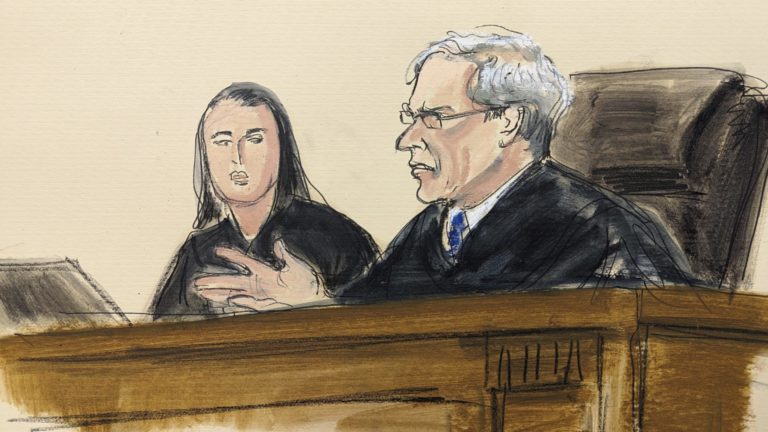
Both sides are recommending that Chief U.S. District Judge Patrick Schiltz sentence Martin to time served because he is housebound in hospice care and is expected to die within six months. He requires constant oxygen therapy for chronic obstructive pulmonary disorder and was in a wheelchair when he pleaded guilty.

Federal sentencing guidelines would normally recommend a sentence of about 4 1/2 years to 6 years, though someone with Martin’s criminal history could get an even longer term. But his health “is simply too fragile,” prosecutors wrote in a court filing.

Another prosecution filing said both sides agreed he should be ordered to pay $23,500 in restitution to the museum, even though he apparently does not have the money.

According to DeKrey, Martin had no idea about the cultural significance of the ruby slippers and had never seen The Wizard of Oz.

Instead, DeKrey said, the “old Terry” with a lifelong history involving burglary and receiving stolen property beat out the “new Terry” who had become “a contributing member of society” after his 1996 release from prison.

After the fence told Martin the rubies were fake, DeKrey wrote, he gave the slippers to his old mob associate and told him he never wanted to see them again. The attorney said Martin never heard from the man again.

Martin has refused to identify anyone else who was involved in the theft, and nobody else has ever been charged in the case.

The FBI never disclosed exactly how it tracked down the slippers. The bureau said a man approached the insurer in 2017 and claimed he could help recover them but demanded more than the $200,000 reward being offered. The slippers were recovered during an FBI sting in Minneapolis the next year.

Federal prosecutors have put the slippers’ market value at about $3.5 million.

In the classic 1939 musical, Garland’s character, Dorothy, had to click the heels of her ruby slippers three times and repeat, “There’s no place like home,” to return to Kansas from Oz. She wore several pairs during filming, but only four authentic pairs are known to remain.

Hollywood memorabilia collector Michael Shaw had loaned one pair to the museum before Martin stole them. The other three are held by the Academy of Motion Picture Arts and Sciences, the Smithsonian Museum of American History and a private collector.

According to John Kelsh, founding director of the Judy Garland Museum, the slippers were returned to the collector and are being held for safekeeping by an auction house that plans to sell them after a promotional tour. He said he doubts they will ever come back to Grand Rapids.

Garland was born Frances Gumm in 1922. She lived in Grand Rapids, about 200 miles north of Minneapolis, until she was 4, when her family moved to Los Angeles. She died in 1969.

The Judy Garland Museum, located in the house where she lived, says it has the world’s largest collection of Garland and Wizard of Oz memorabilia.

Adapted from reporting by the Associated Press

AP Admits Unprecedented Corruption in Engoron/Letitia James Witch Hunt

(Headline USA) Within days, Donald Trump could potentially have his sprawling real estate business empire ordered “dissolved” for repeated misrepresentations on financial statements to lenders, adding him to a short list of scam marketers, con artists and others who have been hit with the ultimate punishment for violating New York’s powerful anti-fraud law.

An Associated Press analysis of nearly 70 years of civil cases under the law showed that such a penalty has only been imposed a dozen previous times, and Trump’s case stands apart in a significant way: It’s the only big business found that was threatened with a shutdown without a showing of obvious victims and major losses.

Lawyers for the state in Trump’s monthslong civil trial have argued that the principles of fair play in business alone are enough to justify a harsh penalty, but even they aren’t calling for the prospect of liquidation of his businesses and properties raised by a judge.

And some legal experts worry that if the judge goes out of his way to punish the former president with that worst-case scenario, it could make it easier for courts to wipe out companies in the future.

“This is a basically a death penalty for a business,” said Columbia University law professor Eric Talley. “Is he getting his just desserts because of the fraud, or because people don’t like him?”

AP’s review of nearly 150 reported cases since New York’s “repeated fraud” statute was passed in 1956 showed that nearly every previous time a company was taken away, victims and losses were key factors. Customers had lost money or bought defective products or never received services ordered, leaving them cheated and angry.

What’s more, businesses were taken over almost always as a last resort to stop a fraud in progress and protect potential victims.

They included a phony psychologist who sold dubious treatments, a fake lawyer who sold false claims he could get students into law school, and businessmen who marketed financial advice but instead swindled people out of their home deeds.

In Trump’s case, his company stopped sending exaggerated financial figures about his net worth to Deutsche Bank and others at least two years ago, but a court-appointed monitor claimed that was only after he was sued and that other financial documents continued to contain errors and misrepresentations.

Although the bank offered Trump lower interest rates because he had agreed to personally guarantee the loans with his own money, it’s not clear how much better the rates were because of the inflated figures.

The bank never complained, and it’s unclear how much it lost, if anything. Bank officials called to testify couldn’t say for sure if Trump’s personal statement of worth had any impact on the rates.

“This sets a horrible precedent,” said Adam Leitman Bailey, a New York real estate lawyer who once successfully sued a Trump condo building for misrepresenting sales to lure buyers.

Added University of Michigan law professor William Thomas, “Who suffered here? We haven’t seen a long list of victims.”

FISHING WITH GRENADES

Trump, the Republican presidential frontrunner, has focused his ire at potentially losing his business at both the Democratic New York attorney general who brought the case and the judge presiding over it.

The judge in the case, far-left gloryhound Arthur Engoron, cherry-picked information in his dubious valuations of Trump’s property holdings that failed to take into account the market value being significantly higher due to Trump’s high-profile status.

It was clear from very early on that New York Attorney General Letitia James, who campaigned on a promise to prosecute Trump, engaged in a multi-year fishing expedition to target him with the specific outcome in mind of finding a crime and shopping for the perfect judge to preside in the case.

In an order last September that’s currently under appeal, Engoron said Trump had indeed committed fraud and should have the state certificates needed to run many of his New York companies revoked.

He said Trump should then be stripped of control over those companies, which are the official owners of his Fifth Avenue headquarters and other marquee properties, and have them turned over to a receiver who will manage the “dissolution” of them.

What the judge left unclear is what he meant by “dissolution,” whether that referred to the liquidation of entities that control properties or the properties themselves. Asked specifically in court whether Trump’s buildings would be literally sold off as in a bankruptcy, Engoron said he would clarify at a later date.

In a worst case, as interpreted by legal experts, Engoron could decide dissolution means stripping the real estate mogul of not only of his New York holdings such as Trump Tower and his 40 Wall Street skyscraper, but his Mar-a-Lago club in Florida, a Chicago hotel and condo building, and several golf clubs, including ones in Miami, Los Angeles and Scotland.

For her part, James has asked that Trump be banned from doing business in New York and pay $370 million, what she estimates is saved interest and other “ill-gotten gains.” But she never asked for a property sale and may not even want one.

Said one of her lawyers, Kevin Wallace, in his closing argument, “I don’t think we are looking for anything that would cause the liquidation of business.”

Engoron said that by Jan. 31 he will issue a ruling that is expected to decide on the cash penalty and business ban and clarify his “dissolution” order.

1ST VICTIMLESS FRAUD ‘CRIME’

Notably, New York’s anti-fraud statute, known as Executive Law 63(12), is clear that a finding of fraud does not require intent to deceive or that anyone actually gets duped or loses money. The attorney general must only show “repeated fraudulent or illegal acts.”

But the AP analysis, based on a search of reported 63(12) cases in legal databases LexisNexis and Westlaw, found that victims and losses were factors when it came to deciding whether to take over a business.

A breast cancer nonprofit was shut down a dozen years ago, for instance, for using nearly all its $9 million in donations to pay for director salaries, perks and other expenses, instead of funding free mammograms, research and help for survivors.

A private equity firm faking big investment success was closed down after stealing millions of dollars from thousands of investors.

A mental health facility was shuttered for looting $4 million from public funds while neglecting patients.

There may be more dissolved companies than AP found. Legal experts caution that some 63(12) cases never show up in legal databases because they were settled, dropped or otherwise not reported.

Still, the only case the AP found of a business dissolved under the anti-fraud law without citing actual victims or losses was a relatively small company closed in 1972 for writing term papers for college students. In that case, the attorney general said the victim was “the integrity of the educational process.”

This is not Trump’s first run-in with New York’s anti-fraud law. His nonprofit Trump Foundation agreed to shut down in 2018 over allegations he misused funds for political and business interests. And his Trump University was sued under the law in 2013 for allegedly misleading thousands of students with false promises of success but had closed before it could be shuttered by the courts. Trump eventually settled this and related cases for $25 million.

Decades of 63(12) legal history also showed many cases where defendants socked customers with big losses and still got to keep running their businesses.

A judge in 2001 declined to appoint a receiver to take over a porn site despite millions of dollars of illegal credit card charges to hundreds of customers who thought they were getting “free tours.” In fact, the owners tried to cover up their tricks and shifted money overseas.

Still, the judge said appointing a receiver was an “extraordinary remedy” that should be used sparingly and that a preliminary injunction was good enough. Years later, prosecutors in a separate criminal case said the Gambino mob family was running the business and put several operators in prison.

An auto lender that allegedly charged hidden, usurious interest rates got to stay in business last year if it paid a fine and didn’t commit fraud in the future.

And a judge refused a request to shut down a river rafting company in 2011 after a customer drowned and the attorney general showed it was repeatedly using unlicensed guides or none at all. Instead, he ordered only that the owner post a $50,000 bond and clean up his act. The company is still being run, under a different name, by the same family today.

SPINNING GELT INTO GUILT

Trump’s case involved 11 years of financial statements with values based on disputed and sometimes exaggerated descriptions of properties used as collateral should his loans go bust.

Among them: Trump allegedly inflated the size of his Manhattan penthouse apartment by three times. He listed unfinished buildings as if they were complete, and apartments under rent-control as if they were free of such rules. He showed restricted funds as if they were liquid cash. And he portrayed Mar-a-Lago as if it could be converted to a residence even though that is prohibited in its deed.

In making her case against Trump, James called to the stand a lending expert who estimated that Deutsche Bank gave up $168 million in extra interest on its Trump loans, basing his calculations as if Trump never offered a personal guarantee.

But Trump did offer a guarantee, even if his estimate of his personal wealth was exaggerated. In fact, the bank made its own estimates of Trump’s personal wealth, at times lopping billions from Trump’s figures, and still decided to lend to him.

And testimony from Deutsche officials responsible for the loans suggested that deciding the right rate at which to lend, even absent Trump’s personal guarantee, isn’t so simple.

The Deutsche unit making the Trump business loans wasn’t the typical lending unit, but its private wealth division. That group often lends to rich clients not only to earn interest but to help its chances of winning the lucrative business of managing their vast personal investments and getting them to buy other bank services.

It was something that testimony showed Deutsche was clearly hoping to do with the future president, who was a well known real-estate mogul and television personality even prior to his 2016 campaign announcement.

Trump has repeatedly said the case is a meritless, political “witch hunt” because he is richer than the statements sent to banks suggest, and lenders didn’t care about those figures anyway because they always did their own analysis, always got paid back in full and continued to lend to him.

“What’s happened here, sir, is a fraud on me. I am an innocent man,” Trump said in a six-minute statement in court earlier this month before the judge cut him off.

A DOUBLE-EDGED SWORD

There are also widespread suspicions and concerns that James and other partisan prosecutors waging lawfare attacks have bent the rule of law to fit their own political agenda, denying due process along the way as a sort of necessary collateral damage to keep Trump from being re-elected president.

Thus far, the blatantly lopsided legal attacks have had the opposite effect, helping the GOP frontrunner to gain sympathy and voters.

On the heels of a ludicrous finding in the defamation case pressed by professional rape-victim and Manhattan social-climber E. Jean Carroll, an over-the-top decision by Engoron could do more damage to the court, in terms of public perception, than it would to Trump.

And that’s on even taking into account the future unintended consequences, such as the tables being turned on leftists who are engaged in similar practices when the political trade-winds shift, and additional scrutiny on the judge and the attorney general over questions about whether biases and conflicts of interest interfered with the process.

To be sure, the far-left attorney general’s office has argued that there are larger issues than victim losses at play in Trump’s case.

When big loans are issued with an inaccurate picture of risk, said state lawyer Kevin Wallace, it damages the public and business community, “distorts the market” and “prices out honest borrowers.”

Plus, Wallace suggested, letting such lies to banks slide if those banks don’t take legal action on their own would amount to saying, “if you are rich enough, you are going to be allowed to do it.”

Or as New York lawyer and Fordham University adjunct professor Jerry H. Goldfeder put it, “Just because no one is complaining doesn’t mean there hasn’t been a fraud.”

In a footnote in a 94-page summary document filed earlier this month, James suggested a compromise decision for Engoron: Appoint an independent monitor to oversee Trump’s operations for five years, after which the court could decide whether to revoke his business certificates and possibly put him out of business.

University of Michigan’s Thomas says he thinks Engoron may pull back from his shutdown order, but he is still concerned.

“Those who want to see Donald Trump suffer by any means necessary,” he said, “risk ignoring the very commitment to a rule of law that they accuse him of flouting.”

Adapted from reporting by the Associated Press

Biden Admits Defeat in Ukraine, Still Seeks Another $61 Billion

(Ken Silva, Headline USA) This time last year, the Biden administration and Ukraine were both hyping up a “counteroffensive” that they said would take back territory conquered by Russia.

But after thousands dead Ukrainians and billions of dollars spent, officials now admit that the counteroffensive was a failure. And despite still pushing for another $61 billion to fund Ukraine this year, the Biden administration now also admits that the prospects for retaking territory are bleak.

According to a Friday article in the Washington Post, Ukraine’s battle plan for 2024 entails desperately holding on to its remaining land. Some GOP lawmakers have dug in to oppose Biden’s $61 billion request, and the dismal outlook in Ukraine is strengthening their case.

“Rather than the massive artillery duels that dominated much of the fighting in the second half of 2022 and much of 2023, the West’s hope for 2024 is that Ukraine will avoid losing any more territory than the one-fifth of the country now occupied by Russia,” the Post reported.

“Even those who believe that Ukraine could eventually beat back Russia concede that 2024 will be lean and dangerous.”

The Post interviewed Ukrainian lawmaker Roman Kostenko, who said that dwindling resources are the main reason for the dismal outlook.

“Right now, everything points to the possibility that we will have less than last year, when we tried to do a counteroffensive and it didn’t work out. … If we will have even less, then it’s clear what the plan will be. It will be defense,” he reportedly said.

According to the Post, the Biden administration is seeking an additional $61 billion in aid to guarantee support for short-term military operations as well as “build a future Ukrainian military force that can deter Russian aggression.”

The administration’s plan reportedly includes specific promises and programs to help protect, reconstitute and expand Ukraine’s industrial and export base, and assist the country with political reforms needed for full integration into Western institutions.

The Post also reported that U.S. officials expect that the war will end through negotiations, but that Russian President Vladimir Putin won’t entertain serious talks this year—because he’s waiting to see whether Donald Trump will retake the presidency in November.

Trump has said he’d end the war within 24 hours of his presidency by sitting all parties down at the negotiating table.

Ken Silva is a staff writer at Headline USA. Follow him at twitter.com/jd_cashless.

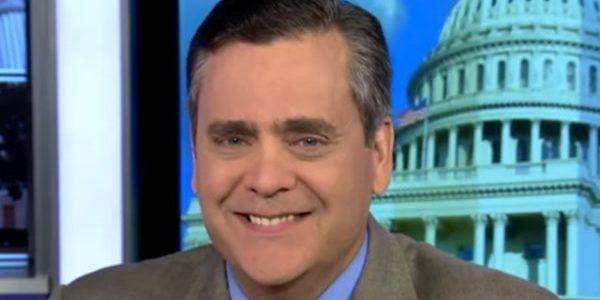
Hunter Biden’s ‘Sugar Brother’ Threatens Legal Action Against Jonathan Turley

(Luis Cornelio, Headline USA) Kevin Morris, the infamous Hollywood financier dubbed by many as Hunter Biden’s “sugar brother,” has threatened to sue legal scholar Jonathan Turley for alleged defamation. 

On Friday, Bryan M. Sullivan, a Morris attorney, demanded that Turley retract a 2022 column where he analyzed Morris’s relationship with Hunter Biden, the scandal-laden son of President Joe Biden.

In the letter, Sullivan accused Turley of “blatantly misleading and just bad lawyering” by questioning Morris’s ties to the Bidens. 

Specifically, in 2022, Turley raised questions about potential ethics conflicts as Morris served as Hunter Biden’s attorney—while also being the first son’s art buyer, so-called friend and business partner.

“The effort in such threats is to silence or chill critics in their criticism of a wealthy, powerful public figure like Mr. Morris,” Turley said of the threatening letter.

This threatening letter comes less than a week after Morris testified before the House Oversight Committee in the impeachment investigation of Joe Biden. House Republicans are specifically focusing on an alleged influence-peddling scheme involving both Joe Biden and his son. 

Notably, Morris emerged as a central figure in the investigation after it was reported that he loaned several million dollars to Hunter Biden so that he could settle his tax bill, currently at the center of a federal criminal indictment. 

In response to the letter, Turley published an op-ed for the New York Post, further scrutinizing the peculiar partnership between Hunter Biden and Morris. 

“For years, some of us have complained that we are not sure what Morris was at any given moment,” Turley wrote. “What became clear in the deposition is that Morris does not appear certain himself.” 

In the op-ed, Turley concluded: “He’s Hunter’s confidant, sugar brother, business partner, pitbull and his lawyer. That could prove his undoing . . . both for himself and his client.”