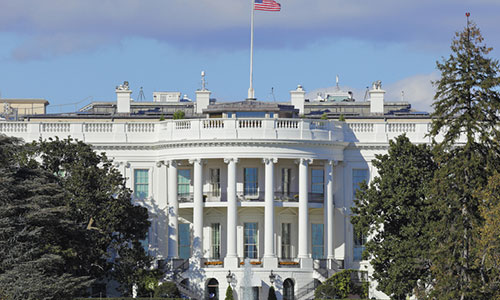
(Headline USA) A person who approached a White House security checkpoint and began firing at officers has died, according to federal officials.
The U.S. Secret Service said in a statement late Saturday that, according to a preliminary investigation, the person approached a checkpoint shortly after 6 p.m. ET “removed a weapon from his bag and began firing at posted officers.”
Officers returned fire and hit the suspect, who was transported to an area hospital, where he later died, according to the Secret Service.
A bystander was struck, but a law enforcement official said it wasn’t clear whether that person was struck by the suspect’s initial bullets or those fired subsequently by officers.
Secret Service said none of its officers were injured, and that President Donald Trump — who was at the White House at the time — was not “impacted.”
I was in the middle of taping on my iPhone for a social video from the White House North Lawn when we heard the shots. It sounded like dozens of gunshots. We were told to sprint to the press briefing room where we are holding now. pic.twitter.com/iqdQwh4soq
Journalists working at the White House on Saturday reported hearing a series of gunshots and were told to seek shelter inside the press briefing room.
On X, the Secret Service said it was “aware of reports of shots fired near 17th Street and Pennsylvania Avenue NW” — one block from the White House — and was “working to corroborate the information with personnel on the ground.” It said it will have an update shortly.
In a social media post, FBI Director Kash Patel said officers were responding to shots fired and said he would “update the public as we’re able.”
President Donald Trump was inside the White House at the time.
Evidence of the shooting was visible on a sidewalk just outside the White House complex, where yellow crime scene tape snaked across the pavement and officers with the U.S. Secret Service placed dozens of orange evidence markers on the ground. Medical material, including what appeared to be purple surgical gloves and kits typically used by emergency medical personnel, were also seen.
In a post shared on X, ABC News senior White House correspondent Selina Wang shared dramatic video of the moment she said she heard what “sounded like dozens of gunshots” and ducked for cover. Writing that she had been performing a routine task that White House reporters do daily — filming themselves on a cellphone for a social media post — Wang’s video shows her speaking for a few seconds about Trump’s statements earlier Saturday about a potential Iran deal.
As the sounds of gunfire are heard in the background, Wang’s eyes grow wider, and she ducks down in the media tent, which is among those situated in a line along the White House driveway where broadcasters film their reports. On X, Wang’s video had been shared thousands of times as of Saturday evening, and viewed at least 3 million times.
The Metropolitan Police Department said on its X Account that the Secret Service was working the scene and cautioned people to avoid the area. The scene is near where a gunman ambushed two members of the West Virginia National Guard last November.
U.S. Army Specialist Sarah Beckstrom, 20, died from her wounds. Andrew Wolfe, then 24, was critically wounded. Rahmanullah Lakanwal has been charged in that incident.
The gunfire Saturday comes nearly a month after what law enforcement authorities said was an attempted assassination of the president on April 25 as he attended the annual White House Correspondents’ Association Dinner at a Washington hotel. Cole Tomas Allen, of Torrance, California, recently pleaded not guilty to charges that he attempted to kill Trump and remains in federal custody.
Following that scare, Secret Service officers shot a suspect they said had fired at officers near the Washington Monument, also near the White House. Michael Marx, 45, of Midland, Texas, was charged in a complaint filed in U.S. District Court in connection with the May 4 shooting. A teenage bystander was wounded in that incident.
(Luis Cornelio, Headline USA) A federal judge dismissed on Friday the federal grand jury indictment against Kilmar Abrego Garcia, a Salvadoran national who has become a de facto poster child for the left-wing resistance to the Trump administration’s immigration enforcement.
U.S. District Judge Waverly D. Crenshaw Jr., first appointed to the bench by former President Barack Obama, wrote in a 32-page opinion that the indictment against Garcia was brought in response to his legal challenges to his deportation.
“The evidence before this Court sadly reflects an abuse of prosecuting power,” Crenshaw Jr. said, later adding: “The Court does not reach its conclusion lightly.” He claimed that “absent Abrego’s successful lawsuit challenging his removal to El Salvador, the Government would not have brought this prosecution.”
Crenshaw’s ruling centers on a two-count grand jury indictment in Tennessee against Garcia on human smuggling allegations.
Garcia was allegedly paid to drive illegal aliens into the U.S. as part of a gang-tied trafficking operation. The charges stemmed from a 2022 traffic stop on a Tennessee highway, where he was found with nine presumed illegal aliens at an interstate traffic stop.
Garcia’s defense attorneys successfully compelled Crenshaw to rule that the charges were brought only after he challenged the Trump administration’s deportation of Garcia to CECOT, the maximum-security prison in his native El Salvador.
Garcia’s deportation stems from what appears to be a complex immigration case involving overlapping court rulings.
His defenders argue the removal was unlawful because of an active federal court order barring his deportation at the time. However, Garcia also had a separate deportation order issued by an immigration judge.
Immigration judges operate within the executive branch under the Department of Justice.
An immigration judge ruled that Garcia had applied for asylum after the statutory deadline and ordered him to be deported.
He entered the United States in or around 2011 but did not apply for asylum until more than a year after his arrival. Garcia, however, was later granted withholding of removal by a federal judge, according to the Center for Immigration Studies. This latter order specifically limited how and where Garcia could be deported.
Garcia was detained and deported to El Salvador in 2025, though a federal judge later ordered the administration to return him given the federal limitations on his removal.
Garcia was returned to the U.S. after the DOJ secured the grand jury indictment.
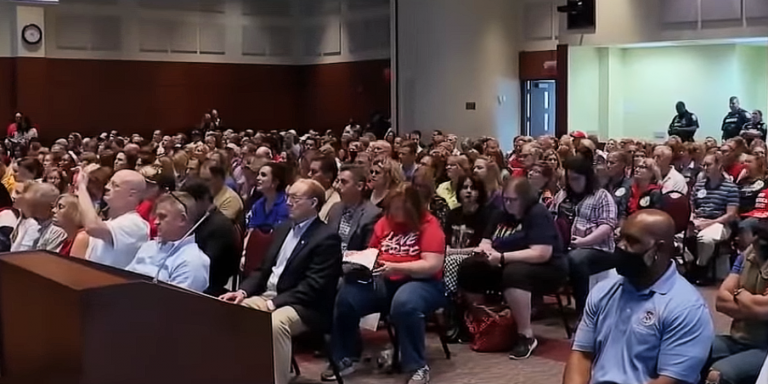
(Luis Cornelio, Headline USA) The sheriff’s office leading the investigation into a reported mass filming scheme allegedly involving a transgender-identifying individual in Virginia announced charges against the suspect shortly after speaking with Headline USA on the matter.
The Loudoun County Sheriff’s Office announced charges against a “juvenile male” in connection with the unlawful filming of other students at Virginia’s Freedom High School. The LCSO warned that the matter remains an active investigation and said investigators have identified a separate location where the unlawful filming may have also taken place.
In exclusive remarks to Headline USA, LCSO spokesperson Thomas Julia confirmed an active criminal investigation and hinted at forthcoming charges Thursday.
Julia’s comments came after Headline USA reached out to inquire about the Trump administration’s intervention in the case.
He said the sheriff’s office was not involved in the Department of Education’s investigation and was not expected to be, as it falls outside the scope of Loudoun County Public Schools.
“Our ongoing communication with LCPS administrators and security personal is in furtherance of the LCSO’s separate criminal investigation of unlawful filming at Freedom involving a suspect and multiple victims,” the spokesperson added.
LCSO said the investigation involves a juvenile suspect and that identifying information will not be released. Those who have not yet spoken with law enforcement were encouraged to speak with detectives.
The filming scandal, first reported by WJLA-TV, involves an accused transgender-identifying individual allegedly secretly filming at least 40 male students in the school’s bathroom.
WJLA reported that Loudoun County Public Schools may have known about the incidents before publicly acknowledging them to parents.
This story is developing and may be updated as more information becomes available.
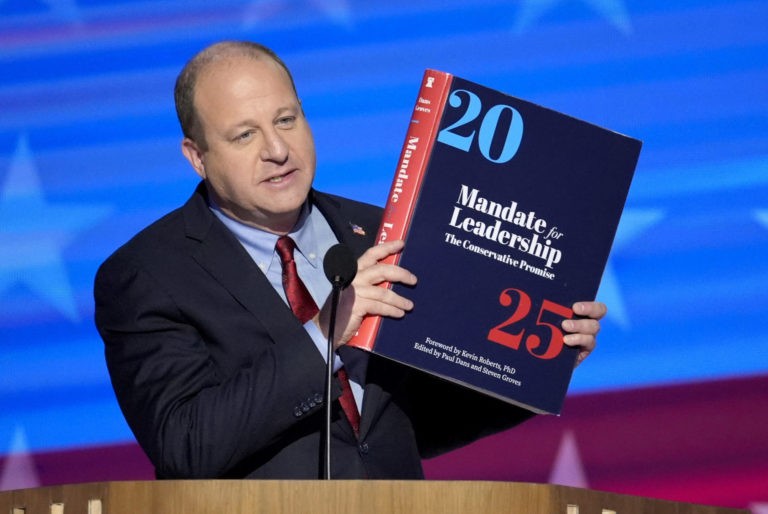
(Zachery Schmidt,, The Center Square) Colorado Democrats voted to censure Gov. Jared Polis this week after he provided clemency to Tina Peters, a former Mesa County clerk.
Peters has been in prison since October 2024 after she was found guilty in 2021 of breaching her own election equipment. Peters’ original sentence had her behind bars for nine years. With the clemency, Peters will get out of prison on June 1.
Peters thanked Polis on social media after he granted her clemency last week. She said she has “made mistakes” and apologized for them.
“Five years ago I misled the Secretary of State when allowing a person to gain access to county voting equipment. That was wrong,” Peters said.
“I have learned and grown during my time in prison and going forward I will make sure that my actions always follow the law, and I will avoid the mistakes of the past,” she added.
Nearly 680 state Democrats who are current lawmakers, former office holders and candidates signed onto the petition asking the state Democratic Party to issue a “formal censure and condemnation of Governor Polis’ clemency decision regarding Tina Peters.”
The petition did not challenge the governor’s authority to issue clemency to people but rather suspends Polis from being an “honored guest, featured speaker or officially recognized participant at Colorado Democratic Party-sponsored events and functions.”
Polis “engaged in ‘conduct detrimental to the interests of the Colorado Democratic Party,’” the petition said.
Eric Maruyama, a spokesperson for Polis, told The Center Square by email that “the governor made this decision based on the facts of the case and what he believed was the right thing to do.”
“Sometimes the right thing isn’t the popular thing with everybody. Democracy is strongest when disagreement is met with debate and dialogue, not censorship,” he added.
In reaction to Peters’ clemency, state Senate Minority Leader Cleave Simpson, R-Durango, told The Center Square via email that “Peters release marks another development in a case that has raised important questions about government transparency, election integrity and equal treatment under the law.”
“As Republicans, we support the rule of law, due process and accountability. We recognize that many Americans remain concerned about election trust and government response. Listening to these concerns is essential,” Simpson noted.
“Our state and nation are strongest when we engage in honest debate, uphold constitutional principles and treat each other with fairness and respect, even during disagreement,” he added.
Eric Grossman, the acting chairman for the Colorado GOP, told The Center Square by email that the Colorado Democrats’ decision to censure Polis “demonstrates the rabid culture [American] society is currently in.”
“The left wing believes its enemy should either die in jail, or be killed by an assassin’s bullet,” Grossman said.
“This censure only adds to the insanity the left can’t walk their base back from,” he added. “History will judge Polis as righting a sentence that went too far, regardless of innocence or guilt.”
According to Peters, when she gets out of prison, she plans to “support election integrity and … elevate the cause of prison reform to help ensure the detention system is more fair and equitable for people of all ages.”
“I am grateful for a second chance and an earlier release, and I look forward to doing good in the world,” she said.
The Center Square reached out to the Colorado Democratic Party, but did not hear back before press time.
(Luis Cornelio, Headline USA) Disgraced former FBI Director James Comey had some revealing thoughts about the infamous preemptive pardons issued by former President Joe Biden: first, that he never asked for one, and that those who accepted them effectively admitted guilt.
Comey, who has been indicted twice by a grand jury, made the comments during a May 14 interview on CNN’s The Arena, with clips of the exchange gaining viral attention earlier this week.
Comey is facing federal charges in connection with his alleged deadly threat against President Donald Trump.
When asked whether he considered asking Biden for a pardon before Trump returned to office in 2025, Comey replied: “Never.”
Comey added that he would not have accepted a pardon even if Biden had offered one, asserting that the Supreme Court has said accepting a pardon is “an admission of guilt.”
“And so, I’m not guilty. I am innocent, so I wouldn’t be accepting any pardons,” Comey continued.
Asked whether he believed the individuals Biden preemptively pardoned were guilty of offenses, Comey appeared to double down: “Well, I’m just telling you what the Supreme Court said by accepting a pardon, it’s an admission of guilt. And so, I hope they thought about it carefully.”
💥NEW: CNN’s Kasie Hunt: “Do you think the people that Biden did preemptively pardon are guilty of crimes?”
Comey’s remarks came over one year after Biden controversially issued sweeping preemptive pardons — the first of their kind in U.S. history — to several allies, relatives and his son, Hunter Biden.
The comments also resurfaced roughly two weeks after a federal grand jury in North Carolina indicted him in connection with a controversial Instagram photo Comey posted showing seashells arranged to display “86 47.” As alleged by the grand jury, “86” referred to killing Trump, while “47” referred to his place as the 47th president.
Comey faced a second two-count grand jury indictment in Virginia tied to alleged false statements made to Congress. Those charges were later dismissed over a technical issue involving the appointment of the lead prosecutor.
(José Niño, Headline USA) The Daily Wire faces yet another change at the executive level. Caleb Robinson has resigned as CEO, and Mike Richards, who previously produced Jeopardy!, will assume command of the conservative media company,Barrett Media reported.
Robinsonreleased a statement attempting to put a positive spin on his exit.
“Stepping down as CEO of Daily Wire. Effective immediately, my new title is ‘guy on the board who still owns a lot of the company.’ Pay cut in stress. Raise in the important things. Handing the keys to Mike Richards … 5x Emmy winner. Hollywood expat. Eats, sleeps, and drinks content. Never makes a deal unless the price is right. Built something special here over a decade. We’re the largest and most impactful digital media company for people who love this amazing country. And now we make it even bigger. Thank you to our audience of millions. Yes, millions.”
Robinson first took on the co-CEO title in 2019 alongside co-founder Jeremy Boreing. He became the sole CEO in 2025.
Richardscame aboard the company precisely one year ago on Wednesday, taking the role of President. His elevation to CEO raises questions about why Robinson chose this moment to leave and whether the company plans to appoint someone to the now vacant President position.
Barrett Media observed that the news will not dispel rumors of dysfunction at the outlet. Robinson’s resignation comes barely a year after Boreing himself departed, meaning two senior leaders have now walked away from the Daily Wire in quick succession.
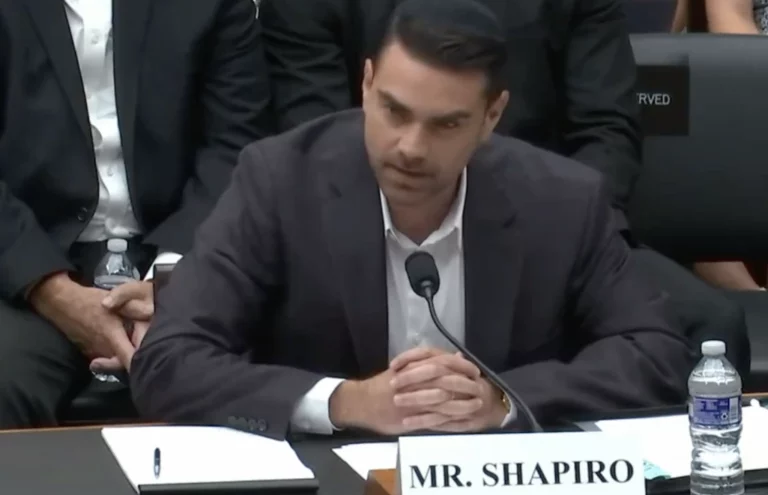
The transition also follows a series of layoffs the company carried out earlier this month. Co-founder Ben Shapiro confirmed that the organization has cut 13 percent of its employees since January.
José Niño is the deputy editor of Headline USA. Follow him at x.com/JoseAlNino
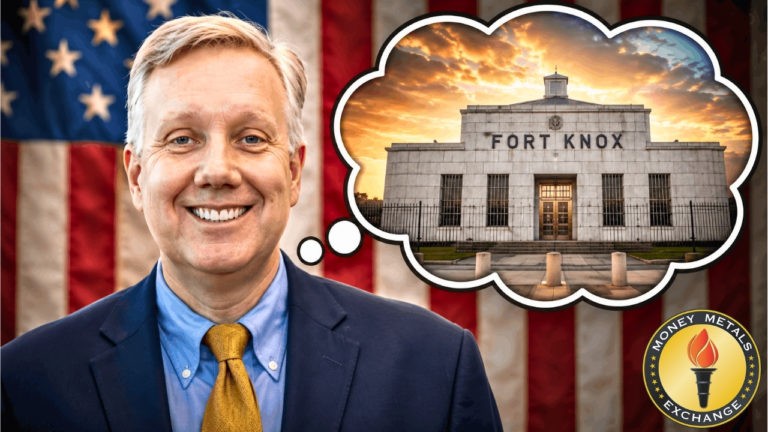
(Money Metals News Service) In a recent episode of Arcadia Economics, host Chris Marcus sat down with Money Metals President and CEO Stefan Gleason to discuss President Donald Trump’s renewed calls for an audit of the U.S. gold reserves at Fort Knox. The conversation ranged from auditing standards and gold reserve transparency to global refining capacity, central bank buying trends, and the current state of the retail precious metals market.
The discussion was sparked by Trump’s May 10 remarks suggesting he wanted to “crack open” the Fort Knox vault to verify that roughly $700 billion worth of U.S. gold remained intact. Gleason argued that while the topic captures public attention, the issue has often been treated too casually by politicians and media figures. He criticized the idea of turning a Fort Knox inspection into a publicity event involving television cameras or political personalities, saying such theatrics would do little to restore real confidence in America’s gold reserves.
Gleason emphasized that a legitimate audit of Fort Knox would be an enormous undertaking that could take years to complete properly. Drawing on his experience operating one of North America’s largest private depositories, he explained that auditing is a rigorous, ongoing process involving controlled environments, multiple independent parties, testing procedures, seals, and continuous verification. According to Gleason, the U.S. government’s past inspections have fallen far short of those standards.
Questions About Past Fort Knox Audits
One of the central themes of the interview was the credibility of previous Fort Knox audits. Gleason referenced research conducted by Money Metals contributor Jan Nieuwenhuijs, who published an open letter outlining major inconsistencies in the historical auditing process. The letter reviewed events from 1974 through 2008 and identified instances where vault seals were broken, gold bars were moved, and seals were reattached without conducting full re-audits afterward.
Gleason argued that once an audited vault seal is broken, the integrity of the audit is effectively destroyed unless the entire compartment is re-audited under strict procedures. In his view, the U.S. Mint’s current process — which he described as largely a paperwork exercise involving “audits of the schedule of seals” — does not constitute a meaningful physical audit of the nation’s gold reserves.
The broader concern, he said, is not merely whether the gold bars physically remain in Fort Knox, but whether some portion of the reserves may already be encumbered through swaps, leases, or other financial transactions. Gleason pointed to legislation introduced by Senator Mike Lee and several House members called the Gold Reserves Transparency Act, which would mandate a comprehensive inventory, assay testing, and accounting of all transactions involving U.S. gold reserves.
America’s Gold May Not Meet Modern Standards
A particularly striking revelation during the interview involved the purity of America’s gold reserves. Gleason explained that most of the approximately 8,000 tons of U.S. gold is not refined to modern “good delivery” standards. Roughly 7,000 tons, he said, consists of bars that are only about 90% pure, rather than the four-nines (.9999) purity standard now favored in global markets.
That creates a potentially serious problem in the event the U.S. government ever needed to mobilize or sell its gold reserves during a financial crisis. Gleason noted that large quantities of lower-purity gold would likely be heavily discounted and would require years of refining before being readily accepted by modern bullion markets.
He revealed that Money Metals recently held discussions with the U.S. Treasury and major refiners regarding this issue. According to Gleason, officials appeared largely unaware of the logistical challenges involved. With only two LBMA good-delivery refineries operating in the United States — both foreign-owned — Gleason estimated it could take between 20 and 30 years to refine the nation’s gold reserves to modern standards without severely disrupting the market or displacing existing refinery customers.
Marcus added that much of the world’s refining capacity now resides in China, raising additional geopolitical concerns if refining became necessary during a global conflict or financial emergency.
Foreign Governments Have Already Adapted
Gleason contrasted America’s situation with actions taken by other countries. He cited France’s recent decision to sell approximately 119 to 129 tons of non-standard gold held at the Federal Reserve Bank of New York and replace it with higher-purity bullion stored domestically. Germany undertook a similar repatriation and refining effort roughly a decade ago.
According to Gleason, many foreign central banks — especially in Asia — are increasingly accumulating four-nines pure gold as part of a broader de-dollarization trend. He argued that the U.S. government has failed to adequately prepare for a world in which gold once again plays a larger role in global finance and sovereign reserve management.
Allegations of U.S. Gold Market Intervention
The interview also revisited longstanding suspicions that the U.S. government may intervene in gold markets through leasing, swaps, or stabilization programs. Gleason recounted a past exchange with Kevin Warsh, whom he identified as a future Federal Reserve chairman candidate, during a New York gold conference.
When Gleason asked whether the U.S. government was involved in gold market transactions, he said Warsh responded that such activity existed “not as much as you would think,” while emphasizing the importance of defending the U.S. dollar through mechanisms like the Exchange Stabilization Fund. Gleason interpreted that response as an implicit acknowledgment that some level of intervention does occur.
He argued that nearly every major central bank engages in gold-related transactions and questioned why the U.S. government would be any different, especially given its acknowledged interventions in bond markets, equities, and energy prices.
Retail Precious Metals Demand Slows After Strong Rally
The conversation later shifted toward current retail demand trends in the precious metals market. Gleason said investor activity surged during January and February following the strong rally in gold and silver prices, but volumes have moderated in recent months as markets moved sideways and investor complacency returned.
He noted that transaction activity remains stronger than it was a year ago, though demand has cooled from earlier highs. Interestingly, Gleason observed a divergence in customer behavior: traditional American investors have been selling silver back into the market, while Asian American buyers have increasingly accumulated gold, sometimes in significant quantities.
Gleason suggested that cultural familiarity with gold ownership, combined with economic stresses emerging in Asian markets, may be contributing to stronger gold demand among those buyers.
Silver Premiums Collapse as Secondary Supply Floods Market
Marcus and Gleason also discussed dramatic changes in silver premiums. Gleason said large amounts of secondary-market silver have been flowing back into dealer inventories over the past six months, driving premiums sharply lower. Certain products, particularly 90% constitutional silver, are now being sold at spot price or even below spot.
While American Silver Eagle premiums remain elevated relative to other products, Gleason said premiums across most silver categories — including 10-ounce bars, 100-ounce bars, one-ounce rounds, and junk silver — have declined substantially. He characterized the current environment as an attractive entry point for silver buyers.
Gold premiums, by contrast, have remained relatively stable because the gold market is far larger and more liquid than silver.
Money Metals Expands Beyond Bullion Sales
Toward the end of the interview, Gleason outlined Money Metals’ broader mission beyond simply selling bullion products. In addition to operating a large depository business, the company also offers lending services backed by gold and silver holdings.
He emphasized that Money Metals has invested heavily in educational content and public policy initiatives aimed at promoting sound money principles. The company actively supports efforts to eliminate taxes on precious metals and encourage states to hold gold as a reserve asset. Gleason said the company’s goal is to expand public understanding of precious metals and advocate policies that benefit both investors and the broader economy.
(Thérèse Boudreaux,,The Center Square) In an epic breakdown of negotiations, Congress is leaving town without voting on Republicans’ roughly $72 billion budget reconciliation bill.
Senate Republicans ultimately deadlocked Thursday over whether to include restrictions on the Department of Justice’s controversial new “anti-weaponization fund” within the party-line bill, which funds federal immigration enforcement agencies for the next three years.
Because both chambers return the first week of June, Republicans will almost certainly miss President Donald Trump’s deadline of June 1 when he wants the legislation on his desk.
The Senate had already delayed a vote on the bill due to its $1 billion earmark for Secret Security to use on White House ballroom security upgrades. Trump had previously said the venue, currently under construction, would be funded only by donor dollars.
Republican leaders eventually decided Wednesday to throw out the provision – much to Trump’s chagrin – due to procedural complications and lack of member support.
Yet some Senate Republicans are still withholding their support unless the bill reins in the unrelated roughly $1.8 billion Anti-Weaponization Fund the DOJ recently announced.
The fund – a politically toxic issue for Republicans – would support individuals making legal claims that the former Biden administration unfairly targeted them for political or ideological reasons.
“Senate Democrats held strong. Senate Republicans are in chaos,” Senate Minority Leader Chuck Schumer, D-N.Y., posted on X. “This is just the beginning – we will keep fighting this bill, filled with Trump vanity projects and billions for his rogue police forces, for as long as it takes.”
Republicans’ unconventional tactic of providing advance annual appropriations via the filibuster-proof budget reconciliation process is a response to Democrats shutting down the Department of Homeland Security for 76 days.
Senate Democrats had refused to support any appropriations bill funding ICE and U.S. Border Patrol for the current fiscal year unless it instituted a laundry list of agency reforms, causing Republicans to eventually walk away.
“If this were about making reforms to how ICE and Border Patrol does business, then Democrats would have accepted the robust package of legislative reforms they were offered by the White House or engaged in serious negotiations to tweak the package – but they didn’t,” Senate Majority Leader John Thune, R-S.D., said Thursday.
Responding to Schumer’s accusations that funding immigration enforcement without including affordability-focused provisions is “totally out of touch with what Americans need,” Thune said the comments “obfuscate what is happening here.”
Republicans have been laser-focused on making life easier for hardworking Americans. But remarkably, it is possible to walk and chew gum at the same time,” Thune said. “And we can protect Americans by protecting our borders and continue to pass legislation that will alleviate some of the pressures facing hardworking Americans.”
(Bethany Blankley, The Center Square) Illegal entries into the U.S. in April remained significantly lower than during the Biden administration but are slightly up from what they were in April 2024 and over the last few months, according to newly released U.S. Customs and Border Protection data.
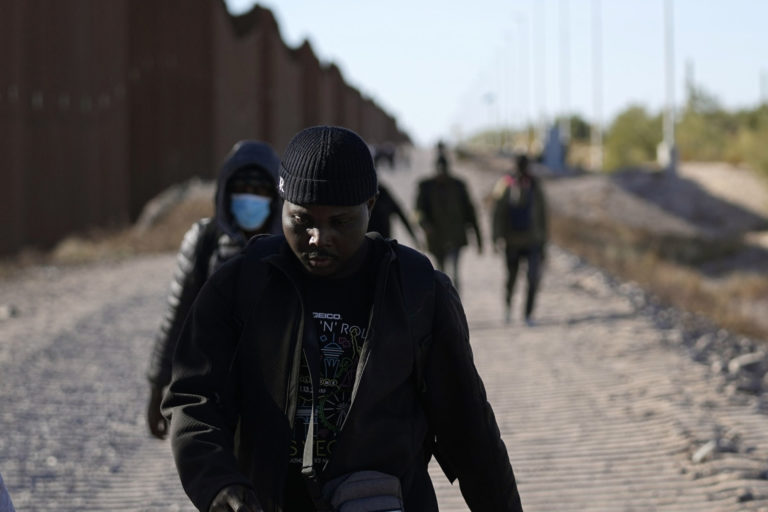
Illegal border crosser apprehensions and encounters nationwide totaled 31,311 in April, excluding gotaways. Gotaways is the official CBP term for foreign nationals who illegally enter between ports of entry and evade capture. CBP does not publicly report this data. The Center Square exclusively reported it at the height of the border crisis after receiving it from Border Patrol agents.
April’s total was significantly less than the high of 276,036 reported in April 2023. It was slightly higher than last April’s total of 29,197.
It’s also higher than totals from last February and March and this February, according to the data.
At the southwest border, 12,836 apprehensions were reported, including at ports of entry by CBP agents and between ports of entry by Border Patrol agents.
The southwest border total is higher than what was reported last April and every month since December. It’s a significant drop from the record 211,992 reported in April 2023.
Illegal crossings at the northern border are declining; 3,803 were reported in April. This is down from last April and the record high of 16,484 reported in April 2024.
Apprehensions and encounters at the northern border have hovered close to 4,000-5,000 a month since January 2025, when they dropped drastically. Under the Biden administration, the greatest number of illegal border crossers were reported in U.S. history at the northern border, The Center Square reported. The peak reached nearly 200,000 in 2024, excluding gotaways, according to the data.
At the southwest border, daily Border Patrol apprehensions between ports of entry in April totaled 8,943 – less than the number apprehended in three days in April 2024.
Illegal border crossings between ports of entry in the first six months of fiscal 2026 were lower than the monthly average over the last 30 years, according to CBP data. The fiscal year began Oct. 1.
Border Patrol apprehensions across the southwest border in the first six months of fiscal 2026 were 37% less than just one month on average from fiscal years 1992 through 2024.
Border Patrol’s average daily apprehensions across the southwest border in four states in April totaled 298, 94% lower than the daily average during the Biden administration.
They also totaled less than those apprehended in a single hour during the height of the border crisis during the Biden administration, averaging 336 an hour in December 2023.
Trump administration officials’ continued claim that zero illegal foreign nationals are being released into the country contradicts CBP data.
“Twelve straight months of ZERO releases at the border,” Department of Homeland Security Secretary Markwayne Mullin said. That’s down from Border Patrol releasing more than 68,000 in April 2024, CBP Commissioner Rodney Scott said.
“With daily apprehensions down 95% from the previous administration and 15 consecutive months of fewer than 9,000 southwest border apprehensions, the border remains more secure than at any point in history,” CBP said.
According to CBP data, CBP officers at ports of entry are releasing illegal foreign nationals into the country. In the first four months of the Trump’s administration, more than 13,000 inadmissible noncitizens were released after arriving at POEs, according to CBP data, The Center Square reported.
Border Patrol agents are also releasing unaccompanied alien children (UACs) to sponsors after illegal entry. In fiscal 2025, 24,500 UACs were released; in the first six months of fiscal 2026, 825 have been, according to federal data.
These totals are also record drops from the highest numbers on record during the Biden administration. The peak year was 2022 when nearly 127,000 UACs were released into the country.
(Dave DeCamp, Antiwar.com) Iran is reconstituting its military capabilities that were degraded by the US-Israeli bombing campaign much faster than expected and is already producing new drones, CNN reported on Thursday, citing sources familiar with US intelligence.
One US official told the outlet that some US intelligence estimates indicate Iran could fully rebuild its drone capabilities within six months. “The Iranians have exceeded all timelines the IC had for reconstitution,” the official said.
The other work Iran has done includes replacing missile sites, launchers, and production capacity for other weapons systems. Other US media reports have said that the United States believes Iran has access to 70% of its missile launchers and maintains about 70% of its pre-war missile stockpile.
A US official told The Washington Post earlier this month that evidence indicates Iran has also been able to repair some damaged missiles and assemble some new missiles that were nearly complete when the US and Israel launched the war.
The reports have painted a starkly different picture from what the Trump administration has claimed publicly, and the continued leaks suggest there is discontent within the Pentagon and elsewhere within the administration over the idea of restarting the bombing campaign, since Iran will have the capability to launch significant counterattacks.
If the United States and Israel do restart airstrikes, Iran would likely respond with major strikes on oil infrastructure in the Gulf Arab states, which would significantly exacerbate the global economic crisis already caused by the war and the rising gas prices in the United States.