


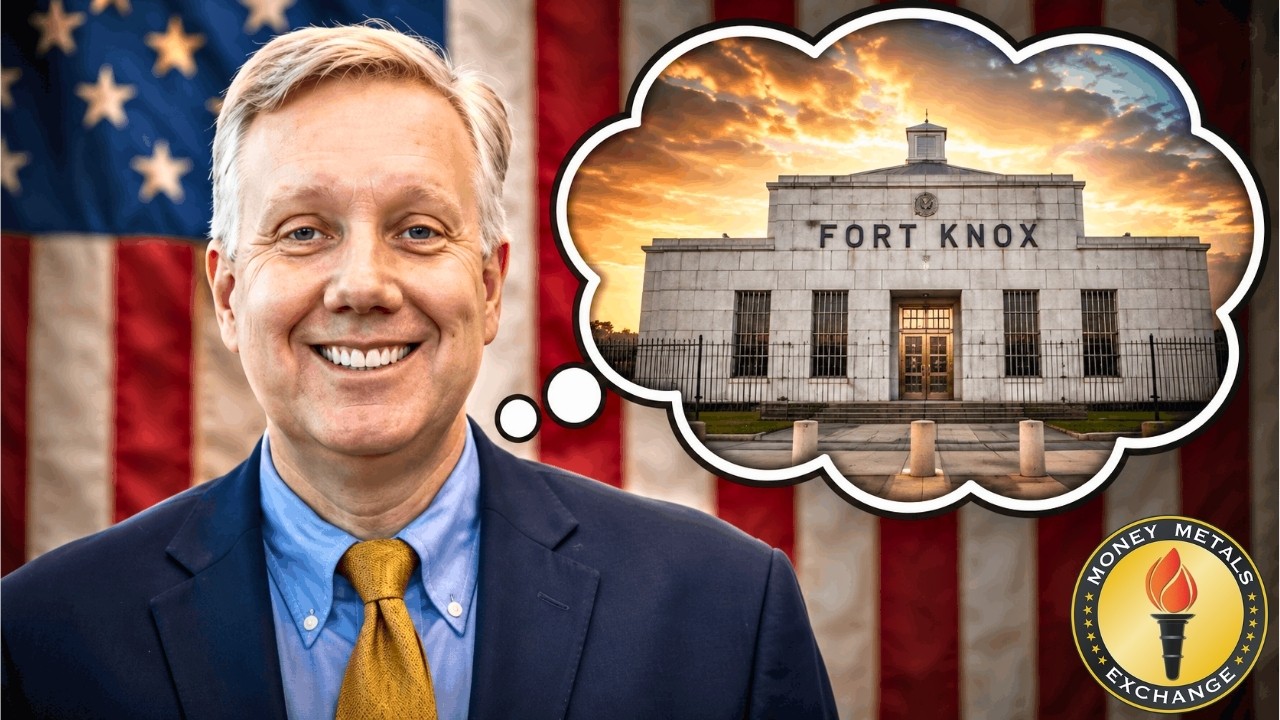
(Money Metals News Service) In a recent episode of Arcadia Economics, host Chris Marcus sat down with Money Metals President and CEO Stefan Gleason to discuss President Donald Trump’s renewed calls for an audit of the U.S. gold reserves at Fort Knox. The conversation ranged from auditing standards and gold reserve transparency to global refining capacity, central bank buying trends, and the current state of the retail precious metals market.
The discussion was sparked by Trump’s May 10 remarks suggesting he wanted to “crack open” the Fort Knox vault to verify that roughly $700 billion worth of U.S. gold remained intact. Gleason argued that while the topic captures public attention, the issue has often been treated too casually by politicians and media figures. He criticized the idea of turning a Fort Knox inspection into a publicity event involving television cameras or political personalities, saying such theatrics would do little to restore real confidence in America’s gold reserves.
Gleason emphasized that a legitimate audit of Fort Knox would be an enormous undertaking that could take years to complete properly. Drawing on his experience operating one of North America’s largest private depositories, he explained that auditing is a rigorous, ongoing process involving controlled environments, multiple independent parties, testing procedures, seals, and continuous verification. According to Gleason, the U.S. government’s past inspections have fallen far short of those standards.
Questions About Past Fort Knox Audits
One of the central themes of the interview was the credibility of previous Fort Knox audits. Gleason referenced research conducted by Money Metals contributor Jan Nieuwenhuijs, who published an open letter outlining major inconsistencies in the historical auditing process. The letter reviewed events from 1974 through 2008 and identified instances where vault seals were broken, gold bars were moved, and seals were reattached without conducting full re-audits afterward.
Gleason argued that once an audited vault seal is broken, the integrity of the audit is effectively destroyed unless the entire compartment is re-audited under strict procedures. In his view, the U.S. Mint’s current process — which he described as largely a paperwork exercise involving “audits of the schedule of seals” — does not constitute a meaningful physical audit of the nation’s gold reserves.
The broader concern, he said, is not merely whether the gold bars physically remain in Fort Knox, but whether some portion of the reserves may already be encumbered through swaps, leases, or other financial transactions. Gleason pointed to legislation introduced by Senator Mike Lee and several House members called the Gold Reserves Transparency Act, which would mandate a comprehensive inventory, assay testing, and accounting of all transactions involving U.S. gold reserves.
America’s Gold May Not Meet Modern Standards
A particularly striking revelation during the interview involved the purity of America’s gold reserves. Gleason explained that most of the approximately 8,000 tons of U.S. gold is not refined to modern “good delivery” standards. Roughly 7,000 tons, he said, consists of bars that are only about 90% pure, rather than the four-nines (.9999) purity standard now favored in global markets.
That creates a potentially serious problem in the event the U.S. government ever needed to mobilize or sell its gold reserves during a financial crisis. Gleason noted that large quantities of lower-purity gold would likely be heavily discounted and would require years of refining before being readily accepted by modern bullion markets.
He revealed that Money Metals recently held discussions with the U.S. Treasury and major refiners regarding this issue. According to Gleason, officials appeared largely unaware of the logistical challenges involved. With only two LBMA good-delivery refineries operating in the United States — both foreign-owned — Gleason estimated it could take between 20 and 30 years to refine the nation’s gold reserves to modern standards without severely disrupting the market or displacing existing refinery customers.
Marcus added that much of the world’s refining capacity now resides in China, raising additional geopolitical concerns if refining became necessary during a global conflict or financial emergency.
Foreign Governments Have Already Adapted
Gleason contrasted America’s situation with actions taken by other countries. He cited France’s recent decision to sell approximately 119 to 129 tons of non-standard gold held at the Federal Reserve Bank of New York and replace it with higher-purity bullion stored domestically. Germany undertook a similar repatriation and refining effort roughly a decade ago.
According to Gleason, many foreign central banks — especially in Asia — are increasingly accumulating four-nines pure gold as part of a broader de-dollarization trend. He argued that the U.S. government has failed to adequately prepare for a world in which gold once again plays a larger role in global finance and sovereign reserve management.
Allegations of U.S. Gold Market Intervention
The interview also revisited longstanding suspicions that the U.S. government may intervene in gold markets through leasing, swaps, or stabilization programs. Gleason recounted a past exchange with Kevin Warsh, whom he identified as a future Federal Reserve chairman candidate, during a New York gold conference.
When Gleason asked whether the U.S. government was involved in gold market transactions, he said Warsh responded that such activity existed “not as much as you would think,” while emphasizing the importance of defending the U.S. dollar through mechanisms like the Exchange Stabilization Fund. Gleason interpreted that response as an implicit acknowledgment that some level of intervention does occur.
He argued that nearly every major central bank engages in gold-related transactions and questioned why the U.S. government would be any different, especially given its acknowledged interventions in bond markets, equities, and energy prices.
Retail Precious Metals Demand Slows After Strong Rally
The conversation later shifted toward current retail demand trends in the precious metals market. Gleason said investor activity surged during January and February following the strong rally in gold and silver prices, but volumes have moderated in recent months as markets moved sideways and investor complacency returned.
He noted that transaction activity remains stronger than it was a year ago, though demand has cooled from earlier highs. Interestingly, Gleason observed a divergence in customer behavior: traditional American investors have been selling silver back into the market, while Asian American buyers have increasingly accumulated gold, sometimes in significant quantities.
Gleason suggested that cultural familiarity with gold ownership, combined with economic stresses emerging in Asian markets, may be contributing to stronger gold demand among those buyers.
Silver Premiums Collapse as Secondary Supply Floods Market
Marcus and Gleason also discussed dramatic changes in silver premiums. Gleason said large amounts of secondary-market silver have been flowing back into dealer inventories over the past six months, driving premiums sharply lower. Certain products, particularly 90% constitutional silver, are now being sold at spot price or even below spot.
While American Silver Eagle premiums remain elevated relative to other products, Gleason said premiums across most silver categories — including 10-ounce bars, 100-ounce bars, one-ounce rounds, and junk silver — have declined substantially. He characterized the current environment as an attractive entry point for silver buyers.
Gold premiums, by contrast, have remained relatively stable because the gold market is far larger and more liquid than silver.
Money Metals Expands Beyond Bullion Sales
Toward the end of the interview, Gleason outlined Money Metals’ broader mission beyond simply selling bullion products. In addition to operating a large depository business, the company also offers lending services backed by gold and silver holdings.
He emphasized that Money Metals has invested heavily in educational content and public policy initiatives aimed at promoting sound money principles. The company actively supports efforts to eliminate taxes on precious metals and encourage states to hold gold as a reserve asset. Gleason said the company’s goal is to expand public understanding of precious metals and advocate policies that benefit both investors and the broader economy.

 Stefan Gleason warns Fort Knox audits are flawed, U.S. gold may not meet modern standards, and America could face major problems if it ever needed to mobilize its reserves.)