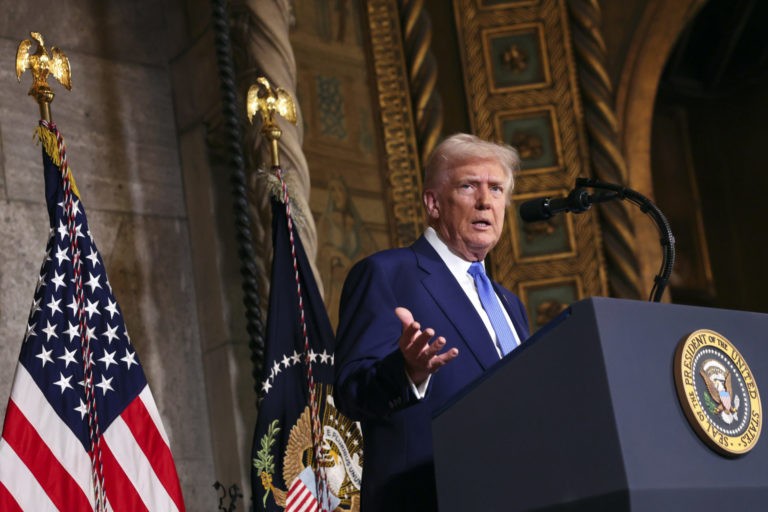
Trump Says He Told US Negotiators Not to ‘Rush Into a Deal’ With Iran

(Dave DeCamp, Antiwar.com) President Donald Trump said in a post on Truth Social on Sunday that he told his negotiators not to “rush into a deal” with Iran, comments that come after a series of reports said that a memorandum of understanding between Washington and Tehran could be reached soon.

“The negotiations are proceeding in an orderly and constructive manner, and I have informed my representatives not to rush into a deal in that time is on our side,” the president wrote.

“The Blockade will remain in full force and effect until an agreement is reached, certified, and signed. Both sides must take their time and get it right. There can be no mistakes! Our relationship with Iran is becoming a much more professional and productive one,” Trump added.

According to media reports, the potential deal that’s on the table would essentially bring the region into a status that was supposed to be achieved under the initial US-Iran ceasefire by ending the US blockade of Iranian ports and opening the Strait of Hormuz to more commercial traffic.

Amjaj Media reported on Saturday that the deal would also release billions in frozen Iranian funds, withdraw American forces from the immediate vicinity of Iran, start a 30-day period for negotiating nuclear issues that could be extended, and bring a real ceasefire in Lebanon, though it’s unlikely Israel will agree to end its occupation of southern Lebanon and attacks in the country.

While both US and Iranian sources spoke positively of the negotiations on Saturday and notable Iran hawks in the US expressed panic, the chances of a deal seemed less likely on Sunday. Ali Hashem, a reporter for Al Jazeera, cited an Iranian source who told him that the US was now backing away from two key tenets of the potential deal: the unfreezing of Iranian assets and a real truce in Lebanon.

“According to the source, the memorandum includes a Lebanon ceasefire framework, but Israel is reportedly uncomfortable with the arrangement and is pushing Washington to include language allowing it to carry out military operations in Lebanon under the justification of responding to ‘any threat.’ Iran is rejecting that formulation and insisting on a sustainable and lasting ceasefire,” Hashem wrote on X.

Hashem added that the “overall picture suggests Tehran increasingly views Washington as backing away from earlier understandings reached through mediators.”

A statement from Israeli Prime Minister Benjamin Netanyahu also cast doubt on a deal, as he said that he and Trump spoke on Saturday night and agreed on certain conditions for an agreement that Tehran would likely reject.

“President Trump and I agreed that any final agreement with Iran must eliminate the nuclear danger. That means dismantling Iran’s nuclear enrichment sites and removing its enriched nuclear material from its territory,” Netanyahu wrote on X. He added that Trump also “reaffirmed Israel’s right to defend itself against threats on every front, including Lebanon.”

US sources also told Axios reporter Barak Ravid that a deal was not expected to be signed on Sunday, as some reports initially suggested, and said that an agreement could still be signed within days, though they expressed that the negotiations could still fall apart. “We are in a very good place — but there are ways in which the deal can be undermined,” a senior Trump official told Ravid.

The threat of a resumption of the full-scale US-Israeli bombing campaign remains, though Trump isn’t expected to do so until after the Hajj, the annual Islamic pilgrimage to Mecca, Saudi Arabia, which will end on May 29. According to a report from Middle East Eye, the US’s Gulf allies warned Trump not to resume the attacks during the pilgrimage.

This article originally appeared at Antiwar.com.  

US Tells Japan To Expect Severe Delays in Delivery of Tomahawk Missiles Due to Iran War

(Dave DeCamp, Antiwar.com) The US has told Japan to expect severe delays in the delivery of 400 Tomahawk missiles due to the US war against Iran, The Financial Times has reported.

Sources told the FT that US Secretary of War Pete Hegseth informed Japanese Defense Minister Shinjiro Koizumi of the delay during a call earlier this month. Tokyo is purchasing 400 Tomahawk missiles under a $2.35 billion deal finalized in 2024, as part of a US-backed Japanese military buildup that breaks with the pacifism outlined in the constitution the United States imposed on Japan after World War II.

Tomahawks would give Japan the ability to strike the Chinese mainland since the missiles have a range of more than 1,000 miles. One aspect of the US strategy and military buildup against China in the Asia-Pacific is to encourage its allies to build up their own military forces, and the US focus on the Middle East and its munitions expenditure against Iran is seen as a blow to that plan.

According to the Center for Strategic and International Studies (CSIS), the US used more than 1,000 Tomahawk missiles in its bombing campaign against Iran, nearly one-third of its estimated pre-war inventory of 3,100. The FT report said Japan had expected to receive two batches of 200 Tomahawk missiles by April 2028, and that the delay could push that timeline back by up to two years.

Tomahawk missiles were used in the February 28 US strike on an elementary school in Minab, southern Iran, which killed at least 156 civilians, including 120 boys and girls. Despite the clear evidence that the US was responsible for the strike, the Trump administration claims it’s still under investigation.

This article originally appeared at Antiwar.com.  
Supreme Court Yet to Decide High Profile Cases

(Andrew Rice, The Center Square) Birthright citizenship, transgender athletes in female sports and federal firing powers are among more than two dozen cases yet to be decided by the U.S. Supreme Court as the term draws to a close.

Traditionally, justices on the nation’s high court finalize decisions in cases by the end of June or the beginning of July, leaving only a few weeks before decisions are expected to be public.

Legal analysts say the past year of the court has been defined by President Donald Trump.

“This is very much a term where Donald Trump is looming over the term,” said Amy Howe, cofounder of the outlet SCOTUSBlog, which reports on the U.S. Supreme Court. “In a couple of the cases he is a named party.”

Here are some of the cases remaining on the high court’s docket.

Birthright Citizenship

In April, justices on the high court heard arguments in Trump v. Barbara, a case challenging Trump’s executive order to end birthright citizenship for children born to noncitizen parents after Feb. 19, 2025.

Trump made history by being the first sitting U.S. president to attend an oral argument by attending this case. During oral arguments, the justices appeared deeply skeptical of the president’s executive order.

The concept of birthright citizenship primarily rests on the Supreme Court’s interpretation of the 14th Amendment to include children born in the U.S. to foreign parents. The 14th Amendment reads: “All persons born or naturalized in the United States, and subject to the jurisdiction thereof, are citizens of the United States and of the State wherein they reside.”

Legal analysts have argued that the clause, “subject to the jurisdiction thereof,” indicates that the citizenship of parents is required to confer birthright citizenship.

Other analysts argue that the tradition of the court has been to confer citizenship for individuals, regardless of their parents’ immigration status.

Federal Firing Power

Trump v. Slaughter and Trump v. Cook also seeks to challenge the president’s authority to fire members of federal executive boards, regarding members of the Federal Trade Commission and Federal Reserve, respectively.

In March 2025, Trump fired Rebecca Slaughter, a member of the Federal Trade Commission. Under federal law, federal trade commissioners can only be fired for a certain cause, but Trump did not include a reason when he fired her.

Slaughter sued and asked to stay in her job while lower courts litigated the issue. The Supreme Court did not allow her to continue in her job while the litigation continued.

In August 2025, Trump sent a letter to Lisa Cook, a member of the Federal Reserve’s board of governors. He attempted to fire Cook, citing allegations of mortgage fraud before she became a member of the Federal Reserve.

Cook sued Trump and he asked the Supreme Court to fire her while the litigation continued. Justices on the court did not allow her to be fired while it continued.

“It’s a question, really of the separation of powers,” Howe said. “Whether or not Congress can have these laws that prevent the president from firing people at will.”

Howe said the high court’s allowing Slaughter to be fired while Cook could remain in her job could indicate how the justices plan to rule. She said the perceived independence of the Federal Reserve could play a key role in the court’s decision-making.

If the court upholds the president’s authority, it could undo an almost 90-year-old precedent that prevented President Franklin Delano Roosevelt from firing members of federal boards like the FTC.

“They could say something along the lines of, ‘the FTC of 1935 was very different from the FTC today. The FTC today serves much more of an executive function than the FTC of 1935,’” Howe said.

Transgender Athletes

A high-profile case on the court’s docket that does not involve Trump focuses on state bans of biological men from women’s and girls’ sports. Idaho and West Virginia banned transgender women and girls from competing in women’s and girls’ sports programs.

The laws focus on Lindsay Hecox, a transgender woman in Idaho, and Becky Pepper Jackson, a transgender girl in West Virginia, who challenged the bans in each state.

Lawyers for the states argued that allowing transgender athletes to compete in girls’ and women’s sports violates the equal protection clause and Title IX. Howe said justices appeared favorable of the state’s bans during the oral arguments.

“I do think the trans athletes have a real uphill battle,” Howe said.

Justices on the high court are expected to make decisions in these and many more cases before the term ends by July.

Government Spending on Seniors’ Benefits Soon to Make Up Majority of Federal Budget

(Thérèse Boudreaux, The Center Square) More than half of the federal budget will go toward benefits for Americans 65 years and older by 2036, and that percentage is set to only grow, a recent congressional report finds.

The Joint Economic Committee’s 2026 report shows that non-interest federal spending on Social Security and Medicare payouts will climb from 45% to 52% over the next decade

“Given long-term demographic forecasts, this increase does not represent a peak, but rather a step in a continued upward trajectory,” the report notes.

In recent years, the U.S. has racked up record-breaking deficits, pushing the national debt past $39 trillion. The federal government is on track to post a $2 trillion deficit for fiscal year 2026, according to the Office of Management and Budget.

Monetary transfers to seniors made up between $350 billion and $520 billion of the federal deficit in 2025, depending on the methodology used to calculate interest payments, JEC found.

“The trajectory of transfers is problematic,” the report adds. “Together, Social Security and Medicare account for roughly two-thirds of the expected nominal growth in non-interest Federal spending over the next three decades.”

Ever-growing federal spending on seniors is not only worsening the nation’s fiscal trajectory but also raises questions regarding the fairness of redistributing the earnings of younger, less established generations to programs supporting retirees, rather than public services for all age demographics.

“Because younger workers generally earn less and rely more heavily on wage income, a larger share of their total tax burden directly funds senior-oriented initiatives,” notes the report. “[O]ver 80 percent of the taxes paid by the bottom 40 percent of households function mostly as direct transfers to seniors.”

Notably, the Social Security Administration has not guaranteed future benefits to Americans who are currently paying into the system.

The amount deducted from workers’ paychecks to subsidize the Social Security and Medicare of current retirees is “a pure and simple tax,” Stephen Goss, former chief actuary of SSA, told U.S. lawmakers in 2024.

Both the Social Security trust fund and Medicare’s hospital insurance trust fund are less than seven years away from insolvency.

Social Security’s depletion will trigger an up to 28% benefit cut across the board, reversing over a decade’s worth of Cost of Living Adjustment increases.

In order for current benefit levels to remain as they are post-insolvency, a median wage earner making $60,000 annually would need to pay an additional $2,600 in annual taxes, according to a Cato Institute analysis.

Both government overspending and demographic trends play a part in hastening the approaching cliff. While U.S. population growth stagnates, America’s 65 years and older population is expected to increase from about 61 million in 2023 to about 77 million by 2035.

By that time, SSA estimates there will be only 2.4 workers contributing to Social Security and Medicare for each beneficiary, “further elevating the level of wealth transferred from younger cohorts to seniors,” per the JEC report.

But if the funding shortfall is not remedied, lower-income seniors will be particularly harmed by the automatic benefit cuts.

“This is an upside-down safety net. When automatic benefit cuts kick in in 2032, the retirees who rely most on Social Security will be hurt the most, while wealthy households will scarcely notice the change,” the Cato Institute’s director of budget policy, Romina Boccia, wrote in a recent piece for the Daily Economy.

“Social Security, if it is to exist at all, should focus on preventing old-age poverty, not provide wealthy retirees with an ever-growing worker-funded annuity layered on top of substantial private savings,” Boccia added.

Rather than increasing taxes on workers or cutting benefits for wealthier seniors, the Republican section of the JEC report posits expanding the contributing workforce as a preferable solution.

“A more immediate approach [to the problem] involves reforming the immigration system to aggressively attract talent in high paying fields experiencing labor shortages,” the authors suggest. “[A]n influx of high-earners would alleviate the mounting pressure on American workers to surrender an ever-increasing share of their income to support seniors.”

Under the current Trump administration, however, increasing immigration of any type is unlikely to happen in the near future.

Tennessee Smuggling Charges Against Kilmar Abrego Garcia Dismissed

(Kim Jarrett, The Center Square)  A federal judge dismissed Tennessee charges against a man who, at one time, was at the center of the immigration debate.

Kilmar Abrego Garcia was charged with human smuggling in connection with a Tennessee traffic stop. Garcia was driving an SUV with eight passengers. One of the police officers believed that he was smuggling them, remarking that he was “hauling these people for money,” according to a video obtained by The Center Square through an open records request.

U.S. District Judge Waverly D. Crenshaw called the charges “vindictive” because Abrego Garcia challenged his deportation to El Salvador

“The objective evidence here shows that, absent Abrego’s successful lawsuit challenging his removal to El Salvador, the Government would not have brought this prosecution,” Crenshaw wrote in his order. “The Executive Branch closed its investigation on the November 2022 traffic stop. Only after Abrego succeeded in vindicating his rights did the Executive Branch reopen that investigation.”

The Trump administration deported Abrego Garcia to El Salvador in March 2025, according to previous reporting from The Center Square. Prior to that, Abrego Garcia was living in Maryland and had been arrested on suspicion of involvement in MS-13 in 2019, after immigrating illegally to the United States as a teenager with his parents around 2011. Officials prepared to deport Abrego Garcia then, but an immigration judge granted him “withholding of removal,” believing his life would be in danger if he were returned to El Salvador. 

The Department of Justice did not immediately return a message from The Center Square about the case. 

Investigators Looking for Cause of Fatal New York Explosion that Also Wounded Over 30 Firefighters

(Headline USA) Investigators were combing through a New York City shipyard on Saturday trying to find the cause of a fire and an explosion that killed one person and injured more than 30 firefighters and other first responders.

Authorities provided no major updates to the incidents that occurred Friday afternoon in the Mariners Harbor neighborhood on the north shore of Staten Island. Besides investigators, some firefighters were at the site as a precaution Saturday, officials said.

Firefighters were called to the shipyard about 3:30 p.m. Friday on reports that there was a fire, heavy smoke and two workers trapped in a basement area, city Fire Commissioner Lillian Bonsignore said. Less than an hour later, as firefighters and emergency medical personnel were working the scene, an explosion rocked the site, officials said.

A civilian died, and another was wounded. Authorities said a fire marshal and a firefighter were seriously injured, while 29 firefighters had minor to moderate injuries and four emergency medical personnel had minor injuries. All were taken to area hospitals.

“We got very lucky this day,” Bonsignore said at a Friday evening news conference. “We got lucky in the sense that none of our people were killed. It’s unfortunate we had one fatality, and they did everything they could to get to that person.”

The name of the person who died had not been released as of Saturday.

The fire marshal who was injured, Christopher Cuccaro, suffered a fractured skull and brain bleed, said the fire department’s chief medical officer Dr. David Prezant. He was in critical but stable condition.

“We will be watching him very carefully over the next 24 hours to make certain there is not subsequent brain swelling. As long as there is not, he should do well,” Prezant said at Friday’s news conference.

Cuccaro and the other firefighter with serious injuries were wounded by the shock wave from the blast, Prezant said. The firefighter was doing “very well,” he said.

“Thankfully both of these firefighters do not have penetrating injuries and do not have blast injury damage to their organs, to their heart, lungs or abdomen,” Prezant said.

The fire and explosion happened in a 150-foot-by-150-foot (46 meters by 46 meters) metal structure at the back of the shipyard, Bonsignore said. Around 200 firefighters and emergency medical personnel responded.

Richard Oviogor, who was in the area, told WABC-TV that he heard two explosions and what seemed like a “big shock wave.”

The area is home to several businesses, including a coffee roasting company and a self-storage facility. The shipyard used to be owned by the Bethlehem Steel Company, which built ships for the U.S. Navy during World War II.

Adapted from reporting by the Associated Press

Bill to Let Felons Vote from Prison Draws Criticism from Republicans

(Sean Reed,, The Center Square)  Some Democrats and electoral rights groups want progress on legislation in Springfield that would give people in prison across the state the ability to vote just weeks after being convicted of a felony or lesser crime.

Some in favor of the bill cite the Illinois Constitution, which says an incarcerated person must have their right to vote restored by the completion of their sentence, leaving room for the legislature to decide when before release that is.

House Bill 5414 would allow felons and other people in prison to have their voting rights restored just 21 days after conviction.

Stevie Valles, executive director of Chicago Votes, told lawmakers that the initiative is a continuation of legislation passed in a previous session, which turned Cook County Jail into a polling site. He further defended the legislation.

“This speaks to how this increases our civic health as a society,” Valles said. “This will restore the voting rights to roughly 55,000 people in Illinois.”

House Minority Floor Leader Rep. Patrick Windhorst, R-Harrisburg, critically questioned the proposal.

“There are some concerns from myself and those opposed to the bill about allowing those who are convicted, serving a prison sentence, having the same rights as those who were the victims in the cases for which they’re serving these sentences,” Windhorst said.

Windhorst went on to say he believes in the concept that when someone is serving a sentence, they are paying their debt to society.

Valles defended the intent of the bill amid the concerns.

“A lot of rights for people who are incarcerated are taken away. This bill is just saying that voting rights shouldn’t be one of those rights,” Valles said.

Valles continued and said that the state leads the nation in exoneration rates, and many incarcerated people are sentenced on plea deals, which he tied to being a result of economic inequality.

Continuing the hearing, proponents explained that the bill would allow convicts to vote in the district they lived before conviction via a mail-in ballot.

Bill sponsor Rep. Justin Slaughter, D-Chicago, said the variety of questions posed by lawmakers on both sides of the bill are valid, and he feels it important to consider the benefits post-release.

“These are still people, and you’re still keeping alive the fact that this particular individual still has an opportunity to be positive and productive,” Slaughter said.

Though the bill has not moved in the legislature aside from an informative hearing, proponents said they are requesting the legislature to consider placing the text within a larger omnibus package – which means the bill could pass without being put through the regular legislative process.

Trump Says a Deal with Iran and Opening of Strait of Hormuz are ‘Largely Negotiated

(Headline USA) President Donald Trump said Saturday that a deal with Iran on the war, including opening the Strait of Hormuz, has been “largely negotiated” after calls with Israel and other allies in the region.

“Final aspects and details of the Deal are currently being discussed, and will be announced shortly,” Trump said on social media, with no details. He said he had spoken with leaders from Saudi Arabia, the United Arab Emirates, Qatar, Pakistan, Turkey, Egypt, Jordan and Bahrain, and separately with Israel.

He described it as a “Memorandum of Understanding pertaining to PEACE” that still must be finalized by the United States, Iran and the other countries that participated in the calls. It capped a week in which the U.S. weighed a new round of attacks on the Islamic Republic that would break a fragile ceasefire.

There was no mention of Iran’s nuclear program and highly enriched uranium, which Iran has sought to discuss later. There was no immediate comment from Iran or Israel. Trump said speaking with Israeli Prime Minister Benjamin Netanyahu, who had pressed the U.S. to go to war, went “very well.”

Earlier on Saturday, a regional official with direct knowledge of the Pakistan-led mediation efforts said the U.S. and Iran were closing in on a deal to end the war.

The official, speaking on condition of anonymity to discuss closed-door deliberations, cautioned that “last-minute disputes” could blow up the efforts. This is not the first time in recent weeks that a deal has been described as close.

The official said the deal would include an official declaration of the war’s end, with two-month negotiations on Iran’s nuclear program. The Strait of Hormuz would be reopened and the U.S. would end its blockade of Iran’s ports.

Iran, meanwhile, had signaled “narrowing differences” in negotiations after Pakistani army chief Asim Munir held more talks in Tehran.

Pakistan Prime Minister Shehbaz Sharif on Sunday welcomed Trump’s efforts to advance peace in the Middle East. He said Pakistan would continue supporting peace efforts “with utmost sincerity” and “we hope to host the next round of talks very soon.”

In a post on X, Sharif congratulated Trump on what he called his “extraordinary efforts to pursue peace” and described discussions among regional leaders as “very useful and productive.”

Twelve weeks have passed since the U.S. and Israel attacked Iran on Feb. 28, killing top Iranian officials including its supreme leader and interrupting nuclear talks between the U.S. and Iran for the second time in less than a year. Iran fired at Israel and at neighbors hosting U.S. forces, shaking Gulf nations that had considered themselves safe havens in a tough region.

A ceasefire has held since April 7. But Iran’s decision to effectively close the Strait of Hormuz for ships carrying regional oil, natural gas and other critical supplies has been a focal point of global concern and economic pain.

Iran described it as a ‘framework agreement’ for more talks

Iran state TV earlier quoted Foreign Ministry spokesperson Esmail Baghaei as describing the draft as a “framework agreement” and adding: “We want this to include the main issues required for ending the imposed war and other issues of essential importance to us. Then, over a reasonable time span, between 30 to 60 days, details are discussed and ultimately a final agreement is reached.”

He said the Strait of Hormuz is among the topics discussed.

But Baghaei told Iran’s official IRNA news agency that nuclear issues are not part of current negotiations.

“Our focus at this stage is on ending the war on all fronts, including Lebanon,” he said, adding that lifting sanctions on Tehran “has explicitly been included in the text and remains our fixed position.”

The Iranian-backed Hezbollah’s Al-Manar TV reported that the Lebanese militant group’s leader received a letter from Iranian Foreign Minister Abbas Araghchi saying Tehran will not abandon its allies. There is a fragile, U.S.-brokered ceasefire in the Israel-Hezbollah war in Lebanon, a conflict that began two days after the Iran war started.

Trump earlier said he was holding off on a military strike against Iran because “serious negotiations” were underway, and at the request of allies in the Middle East. Trump has repeatedly set deadlines for Tehran and then backed off.

Iran’s parliament speaker, Mohammad Bagher Qalibaf, the lead negotiator in historic face-to-face talks with the U.S. last month in Islamabad, said Saturday that Iran has rebuilt its military assets and if Trump resumed attacks, the result would be “more crushing and more bitter” than at the start of the war.

State TV said he spoke after meeting with Pakistan’s army chief, who also met with Araghchi, President Masoud Pezeshkian and other senior officials. Qatar sent a senior official to Tehran to support Pakistan’s efforts.

The war’s stated aims have not been achieved. Iran still has its enriched uranium and a missile program it says is being rebuilt. It continues to express support for armed proxies in the region. The new supreme leader, though still unseen publicly since the war began, is the son of the previous one and close to the powerful Revolutionary Guard.

And the Iranian people have not revolted against the government as both Trump and Netanyahu had predicted after nationwide protests early this year.

Adapted from reporting by the Associated Press

Southern California Chemical Tank at Risk of Exploding as 40,000 Residents are Ordered to Evacuate

(Headline USA) Authorities braced for the possibility that a damaged chemical tank in Southern California could leak or explode as an evacuation order continued into the Memorial Day weekend for 40,000 residents with no timeline on when they can return.

No injuries were reported after the pressurized tank overheated Thursday and began venting vapors at a company site in Garden Grove, about 40 miles (60 kilometers) south of downtown Los Angeles, according to the Orange County Fire Authority.

But officials said the valves on the tank are broken or “gummed up,” which prevented crews from removing the chemical or relieving the pressure on the tank, said Craig Covey, Orange County Fire Authority division chief.

Firefighters’ first hope is to find a way to cool off the chemical inside the tank so it won’t leak or explode. If that is not possible, Purdue University engineering professor Andrew Whelton said it would be best if the tank sprang a leak so the chemical could be mostly contained. An explosion that could spread the chemical over a broad area and send shrapnel flying would be the worst-case scenario.

If the temperature inside the tank continues to increase, the pressure will continue to build as the methyl methacrylate converts from a liquid to a gas, because officials said the pressure relief valves on the tank were no longer working. Whelton said it’s unlikely that firefighters would consider creating a hole in the tank because of fears that could create a spark that might ignite the volatile and flammable gas.

Drones were monitoring temperatures at 10-minute intervals to watch for any spikes and planning was underway to ensure a possible leak could quickly be prevented from spreading into waterways or the ocean, Covey said in an early evening post on social media platform X.

“Sitting back and allowing these tanks to fail is unacceptable,” Covey said, adding there was no guarantee tanks will not breach and leak. “Our goal is to protect your homes — no damage to them — and protect the environment.”

Efforts to cool the tank appeared to be working Friday, but Covey backtracked the following day, saying a reading conducted by drones actually showed the temperature on the outside of the tank, not the inside.

“Unfortunately I do have to report that the temperature was 90 degrees,” Covey said, up from 77 Fahrenheit (25 Celsius) the previous morning.

Cooling the tank is important because the liquid chemical’s flashpoint is 50 Fahrenheit (10 Celsius), according to the National Institute for Occupational Safety and Health.

Initially people in Garden Grove were ordered to leave. Evacuation orders were then expanded to some parts of five other Orange County cities including Cypress, Stanton, Anaheim, Buena Park and Westminster. Some people with pets planned to sleep in their cars.

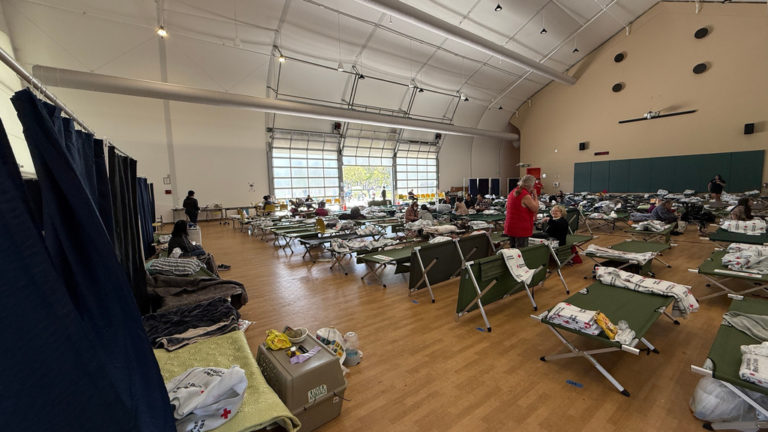
Several shelters remained open Saturday, including at three high schools.

Marco Solano, 32, spent Friday night at his parents’ home, frustrated by the situation and monitoring the news to see if he could go home.

“I don’t think that they should have dangerous chemicals in a neighborhood area, especially that dangerous that they have to evacuate people,” Solano said. “But again, it’s not up to me. I don’t make the laws. I don’t make the rules. We just have to do what is best I guess.”

Solano, who has multiple jobs, said he felt very tired and weak and believed the stress of the chemical leak was exacerbating his anemia and ulcerative colitis.

“This has been affecting me quite a bit,” he said.

Solano also said he went to his apartment after work Friday to grab belongings and saw other residents who had not evacuated, and he was worried for them.

The damaged tank is located at GKN Aerospace, which makes parts for commercial and military aircraft. It holds 6,000 to 7,000 gallons (22,700 and 26,500 liters) of methyl methacrylate, used to make plastic parts.

Exposure to methyl methacrylate can cause serious respiratory problems and even render someone unconscious. It can also cause neurological problems and irritate the skin, eyes and throat, according to fact sheets about the chemical. But Orange County health officials said the chemical is easy to smell and residents may notice it over a large area without being harmed.

Whelton said the volume of chemical in the tank is much smaller than in the disastrous 2023 train derailment in East Palestine, Ohio, which he studied when more than 115,000 gallons (435,000 liters) of vinyl chloride was released after officials blew open five tank cars and burned the chemical.

“Many of these are acute, fast-acting effects. But the longer somebody stays in contact with it, the more potential for significant damage that occurs,” Whelton said.

If there is an explosion, officials said they expect “severe structural damage and significant harm” in the blast zone closest to the tank.

If an explosion releases the chemical into the air, Whelton said, it will be crucial to conduct detailed air monitoring specifically for methyl methacrylate and not just generic tests for volatile organic compounds as officials did in East Palestine. General tests, often completed with handheld detectors, may not be capable of detecting the chemical. Indoor tests of buildings and homes may also be needed before residents return home.

The weather will be an important factor in determining where a plume of chemicals would go in the event of an explosion. Officials were developing maps to predict different scenarios about which areas would be most affected.

Meanwhile containment barriers have been set up to prevent the chemical from getting into storm drains or reaching creeks or the nearby ocean in the event of a spill, Covey said.

Gov. Gavin Newsom declared a state of emergency in Orange County, making state resources available to local agencies and letting state-owned properties and fairgrounds be used for shelters if necessary.

Garden Grove is next to Anaheim, home to Disneyland’s two theme parks, which were not under evacuation orders. Park officials said they were monitoring the incident and supporting employees impacted by evacuations.

GKN agreed to pay state regulators more than $900,000 in 2025 to settle violations involving recordkeeping, permitting issues and nitrogen oxide emissions, according to a report on the South Coast Air Quality Management District website.

Adapted from reporting by the Associated Press


Trump Pushed Gabbard From Intelligence Post, Source Says

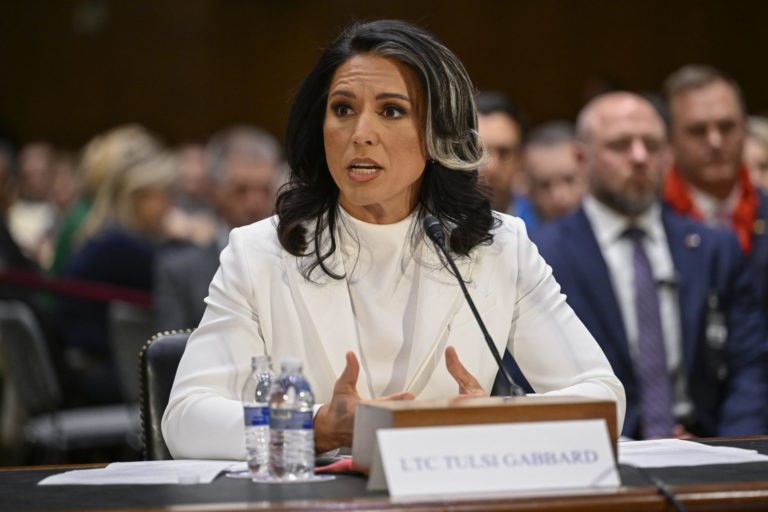
(José Niño, Headline USA) Tulsi Gabbard stepped down as Director of National Intelligence on Friday, with the resignation effective June 30, publicly attributing her exit to her husband’s cancer battle. However, a source familiar with the matter told Reuters that the White House had forced her out following months of mounting dissatisfaction.

“A source familiar with the matter said that Gabbard had been forced out by the White House,” Reuters reported. Gabbard’s chief of staff Alexa Henning disputed this account directly, posting on X: “This is false. Her husband, who is an absolutely incredible human being, has been diagnosed with a rare bone cancer.”

Gabbard offered her own explanation in her resignation letter, which she shared on X. She expressed gratitude to President Donald Trump and disclosed that her husband Abraham Williams had recently been diagnosed with an extremely rare form of bone cancer. “I cannot in good conscience ask him to face this fight alone while I continue in this demanding and time-consuming post,” she wrote.

Trump reinforced this account on Truth Social, praising Gabbard for having done “a great job” and adding that “she, rightfully, wants to be with him, bringing him back to good health as they currently fight a tough battle together.” He named Principal Deputy Director Aaron Lukas as her interim replacement. 

But the narrative of a forced departure did not materialize overnight. Reuters had reported weeks earlier last month that Gabbard risked losing her position amid a wider cabinet overhaul, with sources indicating Trump had voiced unhappiness with her and had solicited opinions from allies about potential replacements.

Evidence of her diminishing standing had been piling up for some time. Bloomberg disclosed in January that officials barred Gabbard from participating in White House strategy sessions on Venezuela due to her history of opposing military intervention, and that staffers had taken to quipping that “DNI” meant “Do Not Invite.” The Wall Street Journal observed that she found herself “increasingly sidelined” from key decisions over her tenure, and NBC News documented as far back as June 2025 that she had been shut out of internal deliberations concerning Iran and Israel.

According to Reuters, Trump publicly signaled tension with Gabbard over Iran policy in March 2026, remarking that she was “softer” than him when it came to restraining Tehran’s nuclear program. On another occasion he openly contradicted her testimony to Congress, suggesting she had misjudged whether Iran was pursuing a nuclear weapon.

José Niño is the deputy editor of Headline USA. Follow him at x.com/JoseAlNino