Students Read Fewer Books in English Class as Woke Schools Prioritize Edutainment

(Headline USA) Chris Stanislawski didn’t read much in his middle school English classes, but it never felt necessary. Students were given detailed chapter summaries for every novel they discussed, and teachers played audio of the books during class.

Much of the reading material at Garden City Middle School in Long Island was either abridged books, or online texts and printouts, he said.

“When you’re given a summary of the book telling you what you’re about to read in baby form, it kind of just ruins the whole story for you,” said Chris, 14. “Like, what’s the point of actually reading?”

At Garden City Middle School, students are required to read several books in their entirety each year, including John Steinbeck’s Of Mice and Men and William Shakespeare’s Romeo and Juliet, Principal Matthew Samuelson said. Audio versions and summaries are provided as extra resources, he said.

For Chris, who says he has dyslexia, the audio didn’t make the reading feel more accessible. He just felt bored. He switched this fall to a Catholic school, which his mother feels will prepare him better for college.

A DYING ART

In many English classrooms across America, assignments to read full-length novels are becoming less common. Some teachers focus instead on selected passages—a concession to perceptions of shorter attention spans, pressure to prepare for standardized tests and a sense that short-form content will prepare students for the modern, digital world.

Administrators are also pushing novel pedagogical practices—such as differentiation of classroom assignments according to the unique needs and interests of each individual student—that tend to cater education to the lowest common denominator rather than to challenge students to hit a higher mark by fostering competition.

That leaves the option for those who wish to read the full book to pursue it as extra work; few do.

Even the act of reading to one’s own children has become a point of controversy, since it is considered to give them an unfair advantage over their less literate peers, according to a University of Warwick professor recently profiled by the National Review.

Indeed, in the politically correct and reactive world of public education (and in many private schools, as well), teachers struggle to navigate the precarious waters on either end of the ideological spectrum.

On one hand, the cancel-culture movement is alive and well in academia, where Marxist mentality has set its sights on attacking and eradicating the Western, “white male” literary canon.

On the other, conservative leaning groups like Moms for Liberty remain apprehensive about indoctrination and grooming in the classroom—even if the books involved are classic literature such as Romeo and Juliet, which includes several scenes involving sexual innuendo and a love affair between a 14-year-old and an 18-year-old.

In fairness, many teachers have been complicit in pushing inappropriate and indoctrinating texts as substitutions for classic Western literature, in part under the pretense that it may contain similar themes in more accessible language.

But those who are simply proceeding in good faith to try to challenge students as guardians of what pedagogist E. D. Hirsch called “cultural literacy,” and to promote higher-level reading-comprehension and critical-thinking skills, find themselves punished for their efforts.

Lower grade averages, students who are unmotivated and discontented by what they regard as excessive demands (which, in the worst-case scenarios, may lead to chronic disciplinary issues), and consequently, declining test scores due to an emphasis on what are now deemed obsolete skills all ultimately factor into the teacher’s end-of-year performance evaluation.

‘DECENTERING’ THE DULL AND DIFFICULT

The National Council of Teachers of English acknowledged the shift in a 2022 statement on media education, saying: “The time has come to decenter book reading and essay-writing as the pinnacles of English language arts education.”

The idea is not to remove books but to teach media literacy and add other texts that feel relevant to students, claimed Seth French, one of the statement’s co-authors.

Like a growing number of classroom instructors, particularly in humanities-related fields (where many may harbor ambitions for higher-paying administrative jobs), French got his three degrees not in the content field but in educational practice, including a master’s degree specializing in English as a second language. However, he now finds himself influencing curricular changes not only for ESL students but for all students.

In the English class he taught before becoming a dean last year at Bentonville High School in Arkansas, students engaged with plays, poetry and articles but read just one book together as a class.

“At the end of the day, a lot of our students are not interested in some of these texts that they didn’t have a choice in,” he claimed, although many of the students may never have been given the option to challenge themselves in an environment where doing so would not put them at a disadvantage. And in some cases, as with French, teachers may lack the background knowledge to go deeper into the subject material.

The emphasis on shorter, digital texts does not sit well with everyone.

Deep reading is essential to strengthen circuits in the brain tied to critical thinking skills, background knowledge—and, most of all, empathy, said Maryanne Wolf, a cognitive neuroscientist at UCLA specializing in dyslexia research.

“We must give our young an opportunity to understand who others are, not through little snapshots, but through immersion into the lives and thoughts and feelings of others,” Wolf said.

DUMBER AND LAZIER BY DESIGN

There’s little data on how many books are assigned by schools. But in general, students are reading less. Federal data from last year showed only 14% of young teens say they read for fun daily, compared with 27% in 2012.

Teachers now claim the slide had its roots in the COVID-19 crisis, although it was the highly politicized teachers unions that led the demands for school shutdowns, even as evidence emerged that young people had minimal risk of transmitting or suffering severe reactions to the virus without preexisting risk factors.

“There was a trend, it happened when COVID hit, to stop reading full-length novels because students were in trauma; we were in a pandemic,” said Kristy Acevedo, who teaches English at a vocational high school in New Bedford, Massachusetts. “The problem is we haven’t quite come back from that.”

In truth, though, the “literacy” field of education-school pedagogy has been subtly pushing to phase out of classic literature for more than a decade, with COVID becoming just the latest in a long line of excuses for teachers unwilling to do the legwork in school environments where there is greater risk than incentive to challenge students above and beyond the baseline expectations.

This year, Acevedo said she won’t accept that students are too distracted to read. She plans to teach time-management strategies and to use only paper and pencils for most of class time.

Other teachers say the trend stems from standardized testing and the influence of education technology. Digital platforms can deliver a complete English curriculum, with thousands of short passages aligned to state standards—all without having to assign an actual book.

“If admins and school districts are judged by their test scores, how are they going to improve their test scores? They’re going to mirror the test as much as possible,” said Karl Ubelhoer, a middle school special-education teacher in Tabernacle, New Jersey.

For some students, it’s a struggle to read at all. Only around a third of fourth and eighth graders reached reading proficiency in the 2022 National Assessment of Educational Progress, down significantly from 2019.

The influx of new illegal immigrants in the school system under the Biden administration is likely to drive those numbers down even farther, adding a surge of new non-English speakers who must somehow be accommodated and drawing resources earmarked for other students who must negotiate larger and noisier classrooms.

While the in past, there was an assumption that each generation of American students would continue to build on its predecessors, the inverse is also true when it is the schools promoting a lack of personal accountability and responsibility.

Parents who grew up feeling a sense of entitlement in the classroom will convey that to their children and expect the schools to solve whatever problems may arise—assuring that those problems get swiftly brushed under the rug of a bureaucratic jungle with blame shifted to some abstract, politically convenient scapegoat.

Leah van Belle, a literacy advocate in Detroit, said when her son read J.M. Barrie’s Peter Pan in late elementary school, it was too hard for most kids in the class. She lamented that Detroit felt like “a book desert.” Her son’s school doesn’t even have a library.

Still, she said it makes sense for English classes to focus on shorter texts.

“As an adult, if I want to learn about a topic and research it, be it personal or professional, I’m using interactive digital text to do that,” she said.

‘SPINNING PLATES’ AND THE EDUTAINMENT INDUSTRY

Even in well-resourced schools, one thing is always in short supply: time.

Terri White, a teacher at South Windsor High School in Connecticut, no longer makes her honors ninth-grade English class read all of Harper Lee’s To Kill a Mockingbird. She assigns about a third of the book and a synopsis of the rest. They have to move on quickly because of pressure for teachers to cram more into the curriculum, she said.

“It’s like spinning plates, you know what I mean? Like it’s a circus,” she said.

She also assigns less homework because kids’ schedules are so packed with sports, clubs and other activities.

“I maintain rigor. But I’m more about helping students become stronger and more critical readers, writers and thinkers, while taking their social-emotional well-being into account,” she said.

In the long run, the synopsis approach harms students’ critical thinking skills, said Alden Jones, a literature professor at Emerson College in Boston. She assigns fewer books than she once did and gives more quizzes to make sure students do the reading.

“We don’t value the thinking time that we used to have. It’s all time we could be on our phone accomplishing tasks,” she said.

Will Higgins, an English teacher at Dartmouth High School in Massachusetts, said he still believes in teaching the classics, but demands on students’ time have made it necessary to cut back.

“We haven’t given up on Jane Eyre and Pride and Prejudice. We haven’t given up on Hamlet or The Great Gatsby,″ Higgins said.

But he said they have given up assigning others deemed to lack the same literary merit and level of interest, such as Charles Dickens’s dense and depressing take on the French revolution, A Tale of Two Cities.

His school has had success encouraging reading through student-directed book clubs, where small groups pick a book and discuss it together. Contemporary authors like John Green and Jason Reynolds have been a big hit.

“It’s funny,” he said. “Many students are saying that it’s the first time in a long time they’ve read a full book.”

Adapted from reporting by the Associated Press
Embattled Boeing Considers Temporary Layoffs as Worker Strike Piles on Struggles

(Headline USA) Boeing told employees Monday that it planned to freeze hiring and reduce travel and was considering temporary layoffs to save cash during a factory workers’ strike that began last week.

The troubled company said the moves, which include reduced spending on suppliers, were necessary because “our business is in a difficult period.”

The strike comes as Boeing already faces a public-relations and regulatory nightmare stemming from the alarming malfunction that caused one of its doors to blow off mid-flight in January.

The publicity and subsequent investigations by the Federal Aviation Administration, which demanded that the company implement serious procedural reforms in its manufacturing process, led to a major dip in the stock for the aviation heavyhitter.

Adding insult to injury, in June a pilot flight as part of the company’s new spacecraft project left two astronauts stranded at the International Space Station.

With their shuttle having left without them for safety reasons, the Starliner crew will need to hitch a ride home on one of Elon Musk’s SpaceX flights, although it is unclear if they will be able to do so before next February.

In Monday’s memo to employees, Boeing Chief Financial Officer Brian West detailed 10 immediate cutbacks resulting from the strike. They include a freeze on hiring across all levels, pausing pay increases for managers and executives who get promoted, and stopping all travel that isn’t critical.

“We are also considering the difficult step of temporary furloughs for many employees, managers and executives in the coming weeks,” West said.

Boeing’s business is in a difficult spot, he said, adding: “This strike jeopardizes our recovery in a significant way.”

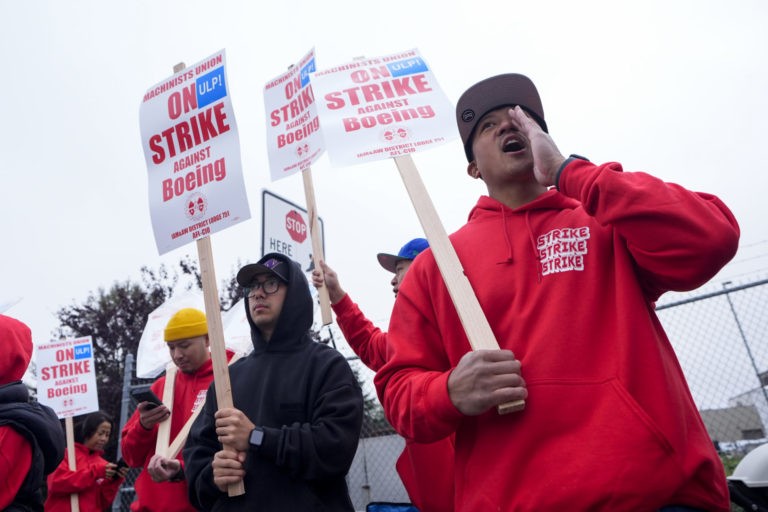
About 33,000 workers represented by the International Association of Machinists and Aerospace Workers began a strike early Friday. The walkout came after workers rejected an offer of a 25% increase in pay over four years. The union originally sought a pay hike of at least 40%.

Representatives of the company and the union were scheduled to meet Tuesday with federal mediators. The union has started to survey its members to learn what they want most in a new contract.

Striking workers are picketing at several locations around Washington state, Oregon and California.

Outside Boeing’s huge factory in Everett, Washington, Nancie Browning, a materials-management specialist at Boeing for more than 17 years, said last week’s offer was worse than the one that prompted a two-month strike in 2008. She said that without annual bonuses that workers have come to depend on, the proposed pay increase was more like 9%, not 25%.

“We just want a piece of the pie like everybody else,” she said. “Why should we work all this overtime and bust our backs while these guys [Boeing executives] are sitting sitting up in their suites just raking in the cash?”

The bonuses have emerged as a flash point for union members. Workers say they range from $3,000 to $5,000 a year.

Boeing says it is hard to calculate bonuses in a way that is fair to 33,000 people who perform different jobs. So instead, the company proposes to ditch the payouts and replace them with automatic contributions of $4,160 per year to each employee’s 401(k) retirement account.

Workers are bitter that in contract extensions over the past 16 years, Boeing ended its traditional pension plan and lowered health care benefits.

“We want our pension back,” said Jacob Bustad, a machinist with Boeing for 14 years who was also on the picket line in Everett. “We just keep losing and we never gain, while the people at the top just get more and more money. Boeing has done really good for me and my family, but these last years have been hard.”

Boeing has lost more than $25 billion since the start of 2019, and burned through $4.3 billion in the second quarter of 2024 alone as it stood poised to post another money-losing year. The strike will delay deliveries of new planes, which are an important source of cash for the company.

Stephanie Pope, the head of Boeing’s commercial-airplanes division, cited the company’s $60 billion in total debt in urging blue-collar workers to accept the contract offer last week. She called it the best offer Boeing had ever made—and endorsed by the union’s local president and negotiators.

But workers rejected the recommendation of their own leaders, which had not happened since 1995.

Additional cost-cutting moves spelled out in the chief financial officer’s memo included eliminating first- and business-class service for anyone on travel that is deemed critical, and stopping spending on outside consultants.

West also said Boeing planned to make “significant reductions in supplier expenditures” and will stop most supplier purchase orders related to the 737, 767 and 777 airplane models.

After the strike started, Moody’s put Boeing on review for a possible credit downgrade, and Fitch said a strike longer than two weeks would make a downgrade more likely. Both agencies rate Boeing debt one notch above non-investment or junk status.

Adapted from reporting by the Associated Press

Trump Shooting Task Force Requests All the FBI’s Evidence Collected So Far

(Ken Silva, Headline USA) The House Task Force investigating the July 13 Trump assassination attempt has requested the evidence that the FBI has gathered so far in its investigation.

In a Tuesday letter to FBI Director Christopher Wray and Attorney General Merrick Garland, the Task Force also asked to interview all Justice Department and bureau officials involved in the Trump shooting investigation.

The Task Force’s letter shows what the FBI may have collected since July 13. It seeks all reports from agents’ interviews with the local, state and federal law enforcement involved with July 13; with alleged shooter Thomas Matthew Crooks’ immediate family; with both the Allegheny and Butler County coroners; with the company where Crooks bought his weapon and the gun range where he trained; and with Trump himself.

The Task Force also seeks all documents relating to Crooks’ use of encrypted messaging accounts.

As for physical evidence, the Task Force wants to examine Crooks’ rifle, his backpack as recovered, the improvised explosive devices discovered in the trunk of the shooter’s car, and the vehicle(s) impounded in the investigation.

That includes the lead FBI agent; the FBI Pittsburgh Field Office agents who communicated with the Secret Service about July 13; the FBI agents who observed, participated in, or contributed to the shooter Crooks’ autopsy and coroner’s report; and the agents responsible for analyzing intelligence related to foreign threats against Donald Trump.

The Task Force requested the documents be provided by next Tuesday. In addition, lawmakers requested another briefing by the end of this week.

The House Task Force’s letter follows its request last week for similar items from the Pennsylvania State Police.

The Task Force also requested—and has apparently received—Crooks’ autopsy records. However, lawmakers haven’t committed to releasing those records.

“I don’t know that it’s revealing in any sort of way, because you’re not going to find out much about his past, or what was his thinking the day he did all that,” Task Force Chairman Mike Kelly said last week, downplaying the significance of the autopsy results.

Ken Silva is a staff writer at Headline USA. Follow him at twitter.com/jd_cashless.

Abbott Designates Venezuelan Gang as Terrorist Organization

(Headline USA) Texas Gov. Greg Abbott announced this week that his state is designating a violent Venezuelan gang, Tren de Aragua, as a terrorist organization.

“We will bring the full weight of the government against the [Tren de Aragua],” Abbott said. “By declaring TdA a foreign terrorist organization, Texas will use the courts to halt their operations, use civil asset forfeiture to take the property and use enhanced criminal penalties to keep them in jail behind bars for longer periods of time.”

Texas will also establish a database to verify whether illegal immigrants who are arrested in the state are a part of TdA.

“Our goal among law enforcement in the state of Texas is to defend our state from the growing threat of TdA,” he said in a statement. “We are not going to allow them to use Texas as a base of operations to terrorize our citizens. Texas is a law and order state, and I will ensure that law enforcement has every tool they need to keep our community safe.”

Abbott’s designation of TdA as a foreign terrorist organization also allows the state to increase penalties for gang members charged with crimes.

The Biden administration has designated TdA as a transnational criminal organization but not a foreign terrorist organization. Biden officials have also claimed they are treating TdA as a priority, especially in light of reports that the gang has given its members the “green light” to fire on or attack law enforcement.

However, Abbott said Texas has largely had to take steps on its own to crack down on the gang’s activity.

Just last week, for example, Texas authorities shut down a hotel in El Paso after discovering TdA was using it as a base for criminal activity.

“In the last few months, DPS special agents worked with the El Paso Police Department gang units to arrest criminal activity at and around El Paso’s Gateway Hotel,” Abbott said. “More than 20 arrests were made, many of whom were suspected TdA members for charges that include human smuggling, prostitution, possession of illegal drugs, as well as other crimes.”

The gang notoriously took over an entire apartment complex in the city of Aurora, Colorado, holding tenants hostage after forcing out the actual landlords.

ABC Debate Moderator Claims Outrage over Collusion w/ Kamala Campaign Is Just ‘Noise’

(Headline USA) ABC News anchor David Muir dismissed widespread criticism of his debate moderation last week, calling it “noise,” despite serious allegations that the network colluded with Vice President Kamala Harris’s campaign to avoid delicate questions for her while ambushing former President Donald Trump with spurious fact-checks.

Prior to the Sept. 10 debate, an anonymous whistleblower within ABC issued a notorized affidavit that accused the network of secretly coordinating with Harris’s campaign.

It said ABC conducted multiple secret telephone meetings with Harris’s handlers to discuss topics and questions.

“It was agreed that Donald Trump would be subjected to fact-checking during the debate, while Kamala Harris would not face comparable scrutiny,” the whistleblower alleged.

Muir and his co-moderator, Linsey Davis, have since come under fire for their biased questions and refusal to fact-check Harris on blatant falsehoods, while doing so five times to Trump—in some cases wrongly.

However, Muir insisted the two did not display any partiality toward Harris, according to the Daily Beast. 

During an interview Monday on Live With Kelly and Mark, Muir claimed he and Davis did their “duty” by asking questions about the economy, the border crisis, abortion, the Afghanistan withdrawal and the peaceful transfer of power after the election.

“These are all really important issues, the issues of our time, really,” he claimed.

“And I always say as a moderator, what the candidates decide to do with that time—you can ask the questions, but they’ll answer with whatever they choose to answer with,” he contined. “And you have to be ready for whatever might come your way, even the most unexpected of moments.”


When asked about Trump’s argument that he ended up having to debate three people—Harris, Muir and Davis—Muir dismissed the allegation.

“All of the noise that you hear afterward about, you know, ‘Which candidate won the debate, did the moderators win or lose?’—that’s just noise,” Muir said. “You all know that.”

In a separate interview with the Los Angeles Times, Davis admitted that ABC’s motivation in aggressively fact-checking Trump but not Harris came after Trump dominated his debate against President Joe Biden earlier this summer.

“People were concerned that statements were allowed to just hang and not [be] disputed by the candidate Biden, at the time, or the moderators,” said Davis, who has previously boasted of being in the same sorority as Harris and has posed for pictures with the Democrat nominee.

Crimes Skyrocketed in Infamous Ohio Town When Haitians Moved There

(Dmytro “Henry” Aleksandrov, Headline USA) After thousands of immigrants from Haiti arrived in Springfield, Ohio, the reports of shoplifting and vehicle theft in the town skyrocketed.

The Daily Caller reported that the now-infamous town, which had a population of 58,622 in 2020, accepted somewhere between 12,000 and 20,000 Haitian immigrants over the past three years, resulting in a population increase of between 20.4% and 34.1%.

According to data that the Springfield Police Division provided to the Caller, the town also saw a 51.5% jump in motor vehicle theft reports and a 112.8% spike in reports of shoplifting from 2021 to 2023.

The town’s residents previously told the news source that the de-facto invasion of Haitians resulted in increased car accidents and housing prices, as well as other problems, such as public services that became less accessible because of the influx of thousands of new people.

Bryan Heck, Springfield’s city manager, wrote to Sens. Sherrod Brown, D-Ohio, J.D. Vance, R-Ohio, and Tim Scott, R-S.C., this July, asking the federal government to help them with the pressure Haitians have placed on the housing supply.

The residents also told the Caller that Haitians had been having sex in public.

It was also reported that after Haitians moved to the town in large numbers, Springfield’s crime rates skyrocketed. According to the FBI’s data, Springfield had a violent crime rate of 493.8 per 100,000 residents in 2019. In comparison, the United States has a rate of 366.7 per 100,000.

Local police also revealed that the number of motor vehicle thefts reported in the town increased from 324 in 2021 to 491 in 2023. Shoplifting also became increasingly common in the town, with reports indicating that the crime jumped from 295 cases in 2021 to 628 in 2023.

One of the town’s residents, who also happens to be a pastor, stated that Springfield started having car accidents every day after Haitians flooded the town, with a local towing employee confirming that there had been an uptick in wrecks.

According to the police, there were just two reported cases of animal cruelty in 2021 and none in 2022 or 2023, even though the town’s residents have been constantly confirming that Haitians are eating wild animals and household pets.

“We’re tired — help. Send us help. Help us fix this,” one of the Springfield residents said.

Hillary Wants to Jail People Who Post ‘Misinformation’

(Headline USA) Steele Dossier promoter Hillary Clinton suggested this week that Americans who shared “misinformation” should face criminal charges.

Clinton made the comment during an interview with MSNBC’s Rachel Maddow on Monday, after Maddow asked whether the U.S. government was taking seriously efforts by foreign governments to spread propaganda ahead of November’s election.

Clinton—who is herself an expert at spreading Russian disinformation, specifically in regard to former President Donald Trump—claimed the Biden administration needed to crack down on foreign propaganda by punishing people for it here at home.

“Americans who are engaged in this kind of propaganda, and whether they should civilly, or even in some cases criminally charged, is something that would be a better deterrent,” Clinton told Maddow. “Because the Russians are unlikely, except in a very few cases, to stand trial in the United States.”

Even Americans who spread misinformation “unwitting[ly]” should have to face potential consequences for “parrot[ing] Kremlin propaganda,” Clinton continued. “You can vote however you want, but we are not going to let adversaries—whether it is Russia, China, Iran or anybody else—basically try to influence Americans as to how we should vote in picking our leaders.”

Among the many political targets of the Biden Justice Department, one was Florida prankster Douglass Mackey, who was arrested in 2021 for a meme he posted five years prior, under a fake identity, telling Democrats to vote via text message.

Clinton appears to have blamed Mackey and his 58,000 followers for her stunning loss to Trump.

Later in the MSNBC interview, which took place just a day after a second assassination attempt on Trump, Clinton went on to blast her 2016 GOP rival as a “danger to our country and the world.”

She then doubled down on the spread of dangerous propaganda that Democrats had been using to falsely characterize Trump as the reincarnation of Hitler.

“His desire to be a dictator, at least on Day 1—all of that is in the public record,” Clinton claimed.

Most Democrats have abandoned the reckless and dishonest rhetoric casting Trump as a “dictator” since a bullet came millimeters from killing him on July 13.

Clinton, who has seen an uncanny number of suspicious deaths befall those in her orbit, seemed to shrug off the grim prospect that her words might inspire another attempt.

Unlike Clinton, Trump has not suggested jailing Americans who share information with which he disagrees—the true hallmark of a dictatorship.

In fact, Trump’s running mate, Sen. JD Vance of Ohio, wrote an op-ed for The Blaze on Monday urging Americans to reject any attempt at censorship, especially from the Left.

“When you reject censorship, you reject political violence,” Vance wrote.

“Embrace censorship, and you will inevitably embrace violence on its behalf,” he continued. “The reason is simple. The logic of censorship leads directly to one place, for there is only one sure way to silence a human being permanently: Put a bullet in his brain.”

Chris Cuomo Apologizes to Trump after Left Celebrates Assassination Attempt

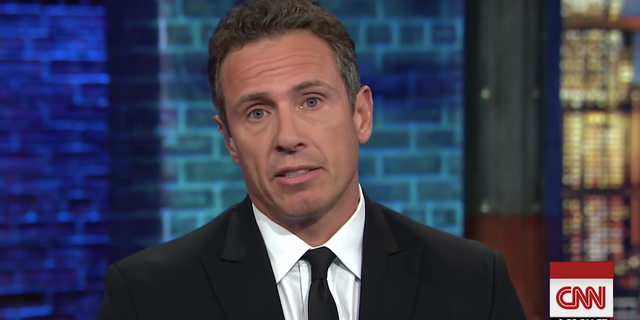
(Luis Cornelio, Headline USA) NewsNation anchor and former CNN personality Chris Cuomo announced he reached out to offer a message of solidarity to Donald Trump after the former president survived an alleged assassination attempt on Sunday. 

Cuomo made this announcement during his eponymous show on Monday, where he scolded the left for dismissing, and even celebrating, threats against Trump’s life. 

“I just wanted to say, ‘Listen. I’m really sorry that this is going on and it’s being dealt this way,’” Cuomo said, referring to the dangerous rhetoric targeting Trump ahead of the November presidential election.

“He doesn’t deserve this,” Cuomo added, emphasizing his disagreement with Trump over policy matters. “A guy points an AK-47 at him while he’s playing golf, and we take solace in the fact that the guy didn’t get any rounds off. That does not work for me.” 

Cuomo’s remarks followed what authorities have described as an apparent assassination attempt against Trump, the second in less than a month.

Trump’s supporters suggest that these attacks are fueled by leftist rhetoric labeling Trump as an imminent “threat” to democracy. 

The left, however, has bafflingly suggested that the attacks are a result of Trump’s own rhetoric. NBC News anchor Lester Holt, for instance, claimed on Sunday that the attempted assassination followed Trump’s incitement of bomb threats against Haitian nationals in Ohio. 

Despite Holt’s claims, Ohio Gov. Mike DeWine announced on Monday that there have been no credible threats against anyone in the state. 

During his passionate remarks, Cuomo reminded the left that Trump has a family who cares for him. Former First Lady Melania Trump faced backlash from the left after she questioned public information about the July 13 shooting targeting Trump. 

“Now, the silence around it feels heavy. I can’t help but wonder why didn’t law enforcement officials arrest the shooter before the speech? There is definitely more to this story. And we need to uncover the truth,” Melania said in a video shared on her social media.

Cuomo defended the former first lady’s right to question what transpired that day. “People giving crap to Melania Trump worrying about whether or not there was a plot around her husband? How could she not? I don’t think she’s right, but I totally get why she feels that way and people mock her?”

Top Senate Dem.: DHS ‘Derelict’ in Duty to Provide Info on Trump Assassination Attempts

(Headline USA) A top Senate Democrat blasted the Biden administration this week for refusing to hand over information regarding the two assassination attempts on former President Donald Trump in a timely manner.

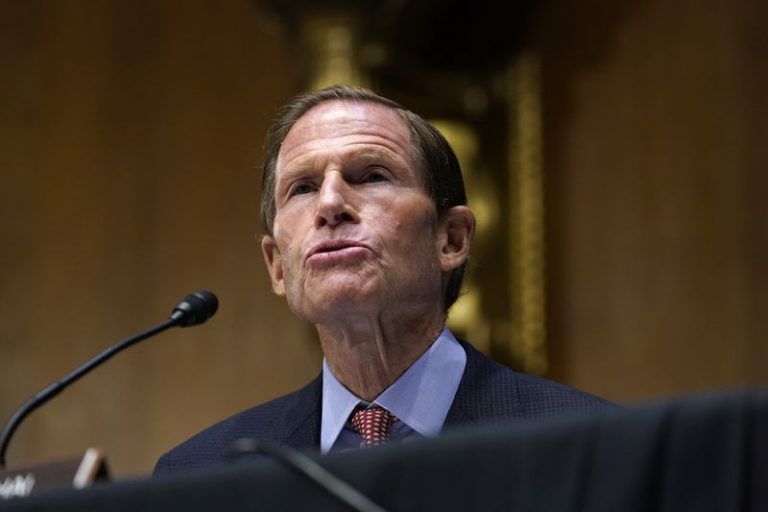
Sen. Richard Blumenthal, D-Conn., chairman of the Permanent Subcommittee on Investigations, said the Department of Homeland Security, which oversees the U.S. Secret Service, has been “almost derelict in its duty by resisting our requests for documents, evidence, and information that are necessary to investigate.”

The Democrat added that he has become “angry” that Biden officials have not been more “forthcoming,” especially in light of the second failed assassination attempt against Trump on Sunday.

According to reports, several authorities—including the FBI—were alerted last year about would-be assassin Ryan Routh’s desire to kill former President Donald Trump.

Blumenthal—who voted with his 47 fellow Senate Democrats and three independents to dismiss House impeachment articles against Homeland Security Secretary Alejandro Mayorkas in April—appeared to be having buyer’s remorse.

“We may need to require more cooperation from them,” he said. “And we have the power to do so through the compulsory process—in other words, the subpoena power.”

Blumenthal hinted last week, following a closed-door briefing, that Americans will be “appalled” by some of the failures he and his colleagues had discovered throughout the course of their recent investigation into the Secret Service.

The report is expected to be publicly released later this week.

Sen. Ron Johnson, R-Wisc., the ranking minority member on the Permanent Subcommittee on Investigations, suggested that one of the reasons Blumenthal and other Senate Democrats were so upset was because they expected Biden’s team to be more willing to work with them.

“I wrote a letter that it took us a couple weeks for all four offices to sign onto … We sent it to Secret Service and DHS,” Johnson said.

“We got a response in four hours, and the response was pretty disrespectful,” he added. “And I think that fired up [Sen. Gary] Peters and Chairman Blumenthal… I think that’s the reaction you heard last week. They’re not happy with the way [the Biden administration is] treating them.”

In a statement, a DHS spokesperson denied that the agency had been “stonewalling” lawmakers’ investigation into the initial assassination attempt.

“[DHS] remains committed to working in good faith and making every effort to cooperate with the appropriate and relevant investigations into July 13th to identify how this happened and how to prevent it from happening again,” the spokesperson claimed.

SHOCKING: Veep Debate Host CBS News’ Leadership Is Full of Dem. Donors

(Dmytro “Henry” Aleksandrov, Headline USA) Federal Election Commission records indicated that the leadership of CBS News, the network that will host the only vice presidential debate this year between Sen. J.D. Vance, R–Ohio, and Gov. Tim Walz, D–Minn., is full of leftists who previously donated to Democrats.

The Daily Caller reported that the network’s leadership and CBS News’ parent company, Paramount, previously donated to many Democrats, including Joe Biden and Kamala Harris.

FEC records showed that Charles E. Phillips Jr., a member of Paramount’s board of directors, donated $100,000 each to Biden, Harris, and Nancy Pelosi’s victory fund between 2020 and 2023.

According to public records, another member of Paramount’s board, Judith A. McHale, donated $47,900 to the Biden Victory Fund in May 2023, $50,000 to the Biden Victory Fund in 2020 and more than $150,000 to the Democratic National Committee.

Linda Griego, a member of the Paramount board of directors and the compensation and governance committees, was another Democrat who previously gave thousands of dollars to the Democratic Party, including more than $10,000 to the Biden Victory Fund. FEC records revealed that the donor is a retired executive. Griego said she moved to Santa Fe, N.M., in early 2020.

George Cheeks, the CEO of Paramount Global and president and CEO of CBS, also donated $400 to Biden’s campaign, $200 to the Biden Victory Fund, $100 to the Pennsylvania Democratic party and to Sen. Jon Ossoff, D-Ga., in 2020.

Public records additionally showed that Wendy McMahon, the president and CEO of CBS News and Television Stations, donated $3,050 to Biden for President and $3,050 to the Biden Victory Fund in 2020. McMahon was working at ABC News at the time of making these donations.

According to FEC records, Justin Dini, executive vice president and head of communications of Paramount, actively gave away her money during the 2024 election season, donating at least $535 to Harris for President, $335 to the Harris Victory Fund and $800 to the Democratic Congressional Campaign Committee.