Here’s What to Watch After Silver’s Big Breakout…

(Jesse Colombo, Money Metals News Service) After silver broke through the key technical levels I had been monitoring and writing about on Friday, surging 7% in a single day, I released an in-depth report on the upcoming silver bull market and why it would likely evolve into a silver squeeze.

In this update, I’ll highlight several key factors that everyone should watch to track silver’s progress, confirm the ongoing validity of its breakout, and identify important price targets to keep an eye on.

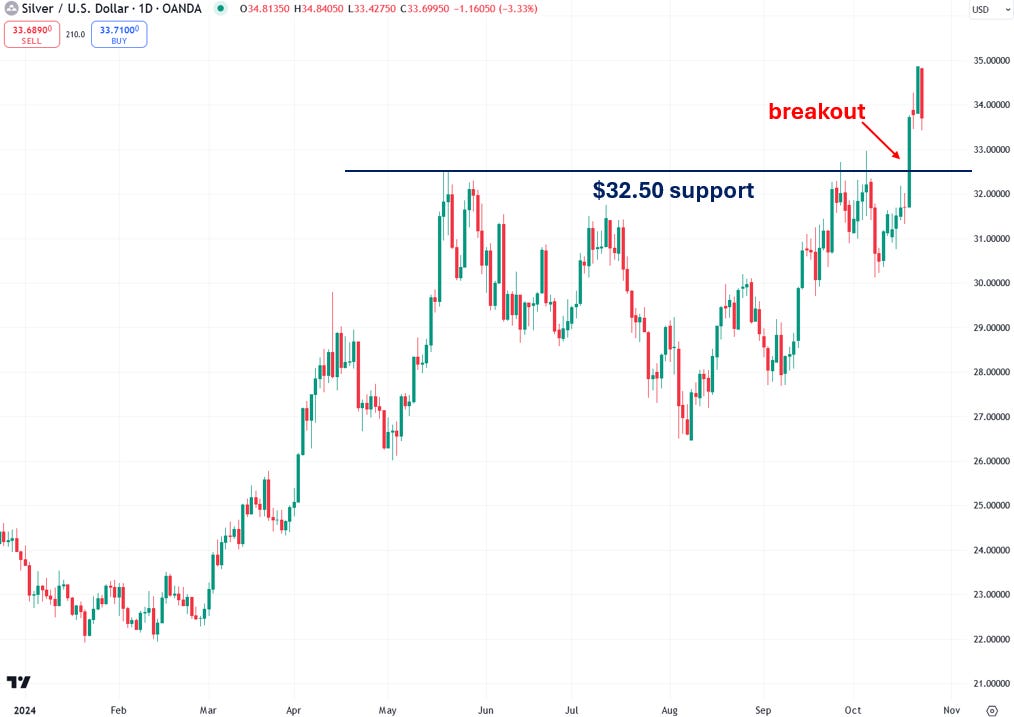
Let’s start with the most rudimentary chart of all: spot silver priced in U.S. dollars.

As you may know, I’ve been emphasizing the importance of the $32.50 level for several months, stating that silver’s bull market would be triggered once it decisively closed above it with strong volume. On Friday, silver knocked it out of the park with a 7% surge on volume that was 50% above the average of the prior week.

Now that silver has broken above that level, it’s in a confirmed uptrend. Today’s 3.33% pullback doesn’t worry me, as silver remains above $32.50, which is now a support or a floor. After such a sharp surge, a pullback is normal and expected. We may see continued bouncing around for a few more days before silver is ready to head even higher.
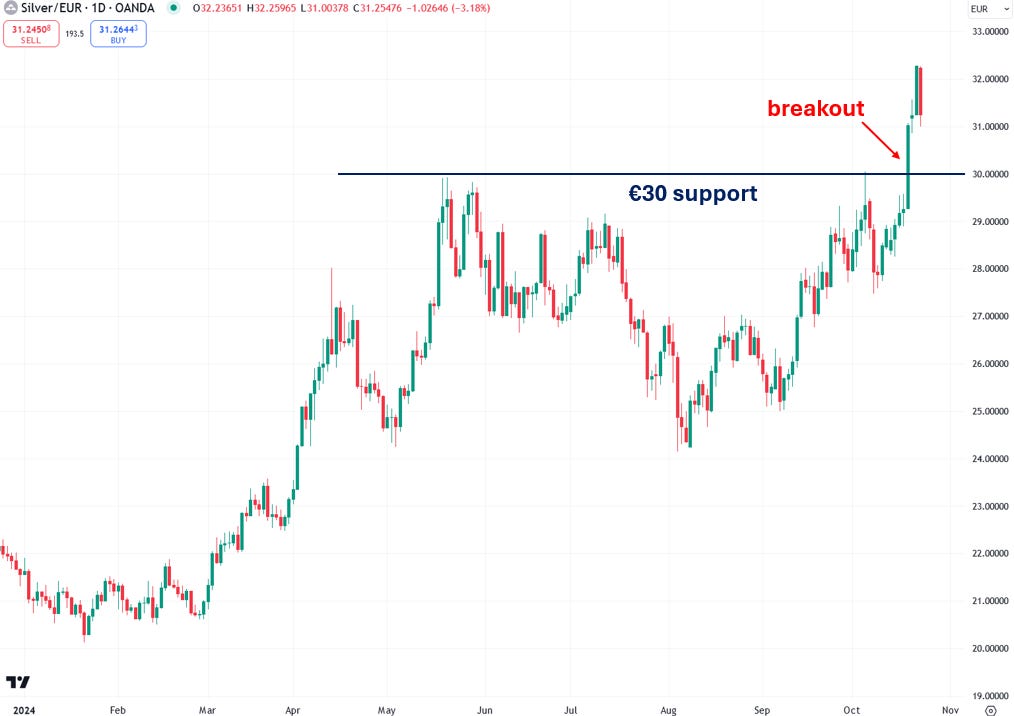
The other key level I’ve been discussing for months is €30 when silver is priced in euros. I closely monitor silver priced in euros because this approach removes the impact of U.S. dollar fluctuations, offering a clearer view of silver’s intrinsic strength or weakness.

Notably, silver priced in euros often respects round numbers like €26, €27, and €28, frequently establishing key support and resistance levels at these points.

On Friday, silver surged above the €30 level with gusto, and that level is now the new floor. As long as silver stays above that level, it can fluctuate all it wants—I won’t be concerned.
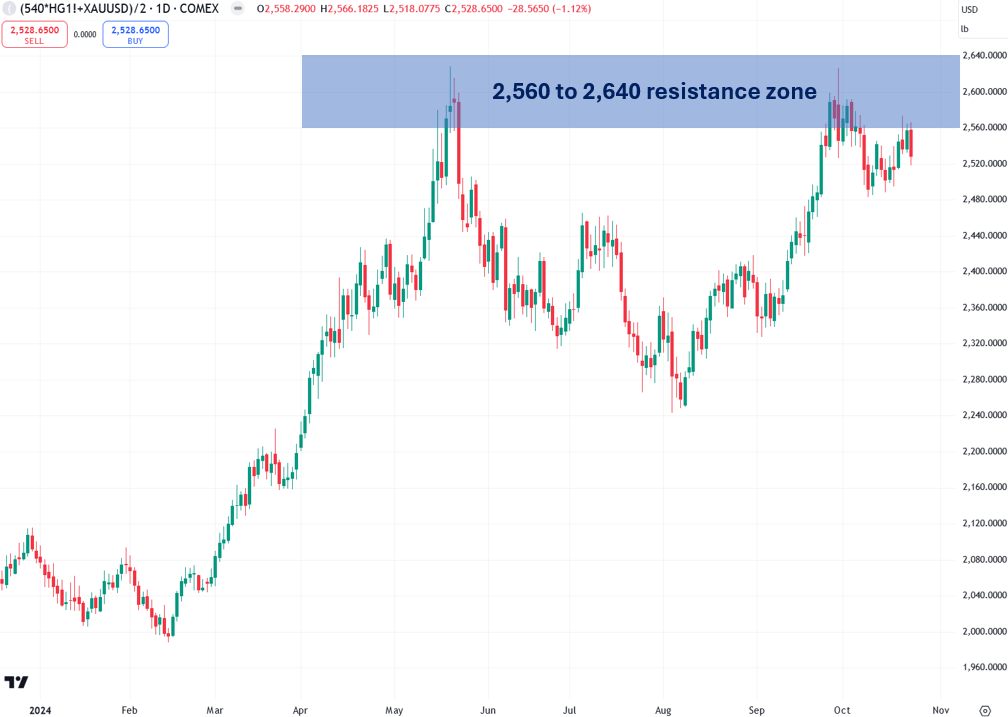
I’ve been discussing my proprietary Synthetic Silver Price Index (SSPI) for some time, which is the average of copper and gold prices. I closely monitor this index due to its strong correlation with silver, making it a valuable tool for confirming silver’s moves, especially breakouts.

I’ve highlighted the index’s key resistance zone between 2,560 and 2,640, noting that a close above this range would help confirm a silver breakout. While this breakout hasn’t happened yet, I believe it’s only a matter of time.

Until the SSPI finally breaks out, however, I see silver’s rally as lacking full staying power. It’s like a car with eight cylinders running on only six—it’s moving but not at its full potential. That partly explains pullback days like today.
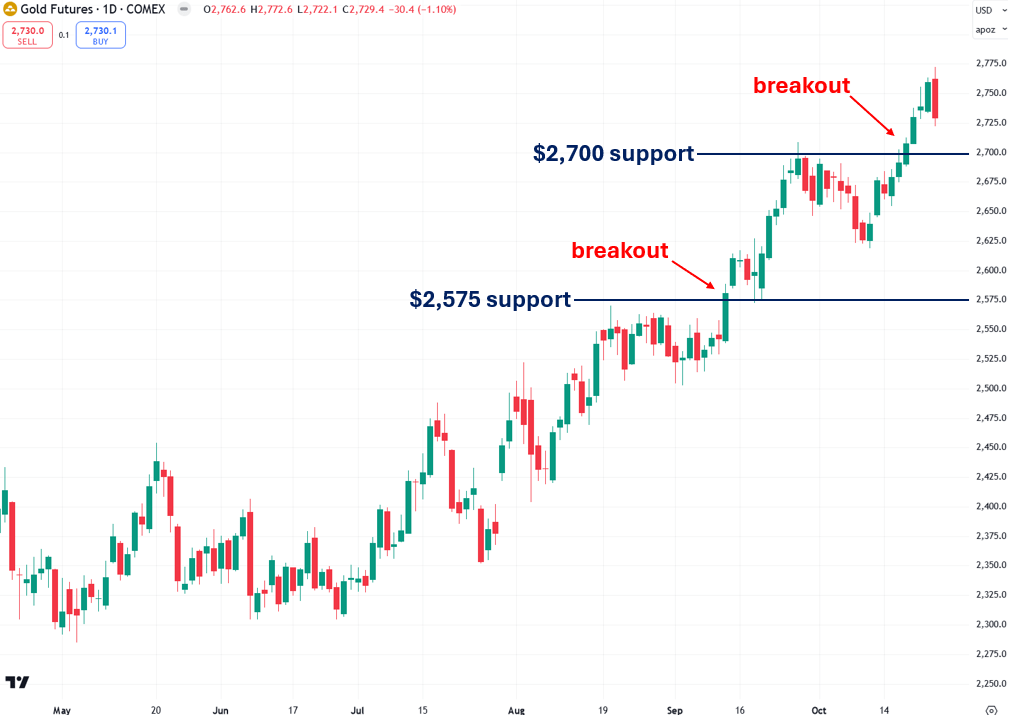
Gold, a major influence on silver prices and a component of the Synthetic Silver Price Index has performed exceptionally well over the past few months, recently breaking above the key $2,700 resistance level (in COMEX gold futures), which now serves as a new support.

Despite yesterday’s 1.1% pullback, gold remains in a confirmed uptrend, which should continue to support silver’s rise. I expect gold to reach $3,000 in the coming months.
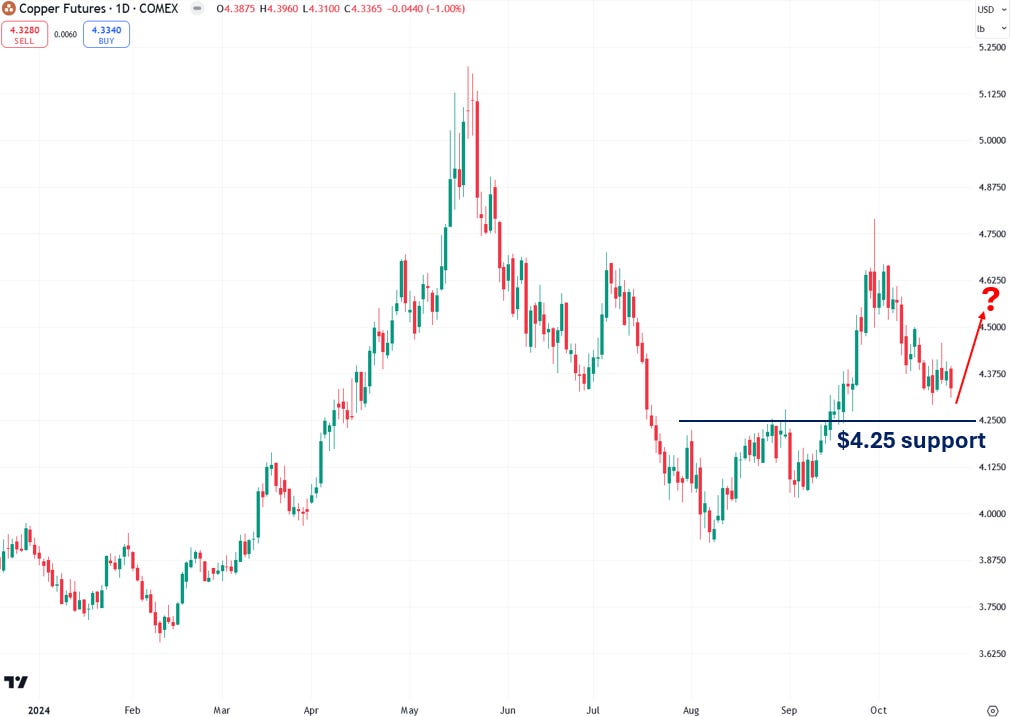
Copper, another key driver of silver prices (learn more), has been sluggish recently, putting pressure on both silver and the Synthetic Silver Price Index.

The good news is that copper is nearing its $4.25 support level and is likely to bounce and rally from there, which should help lift both silver and the SSPI. A rebound in copper is the crucial element needed to spark the SSPI breakout, especially since the other key component, gold, has already been performing strongly.
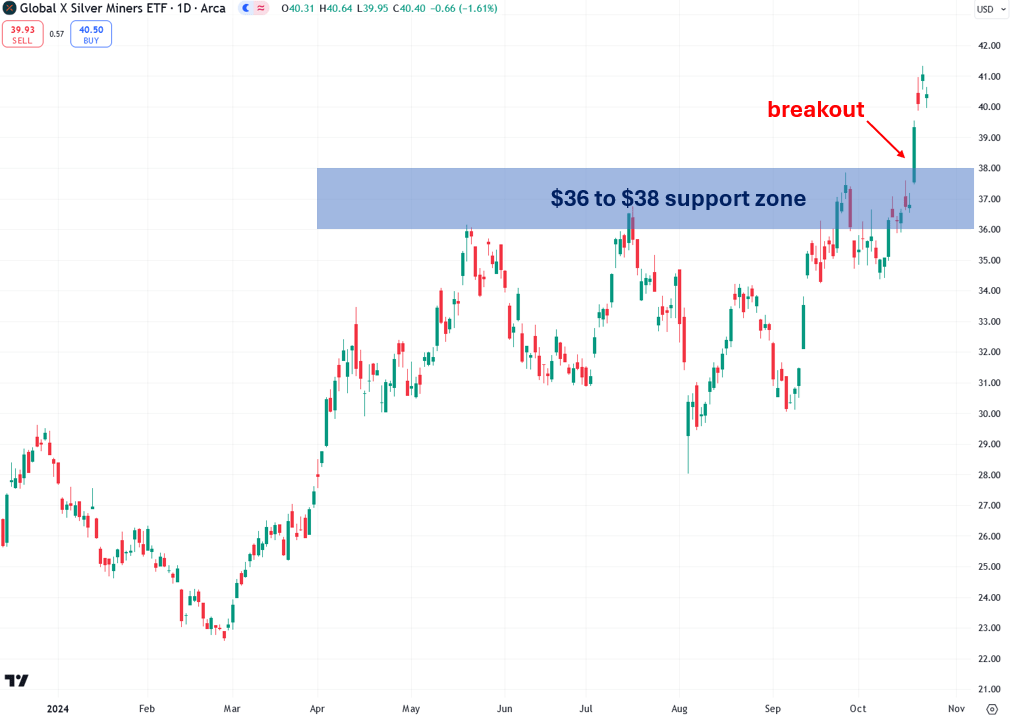
I watch silver mining stocks to confirm moves in the price of silver—particularly the popular Global X Silver Miners ETF (symbol: SIL).

On Friday, SIL closed above the $36 to $38 resistance zone on heavy volume, delivering a strong bullish signal for both silver mining stocks and silver itself. As long as SIL stays above the $36 to $38 zone, it remains in a confirmed uptrend.

While silver pulled back 3.33% today, SIL only dipped 1.61%, indicating high relative strength. Overall, this chart looks excellent to me.
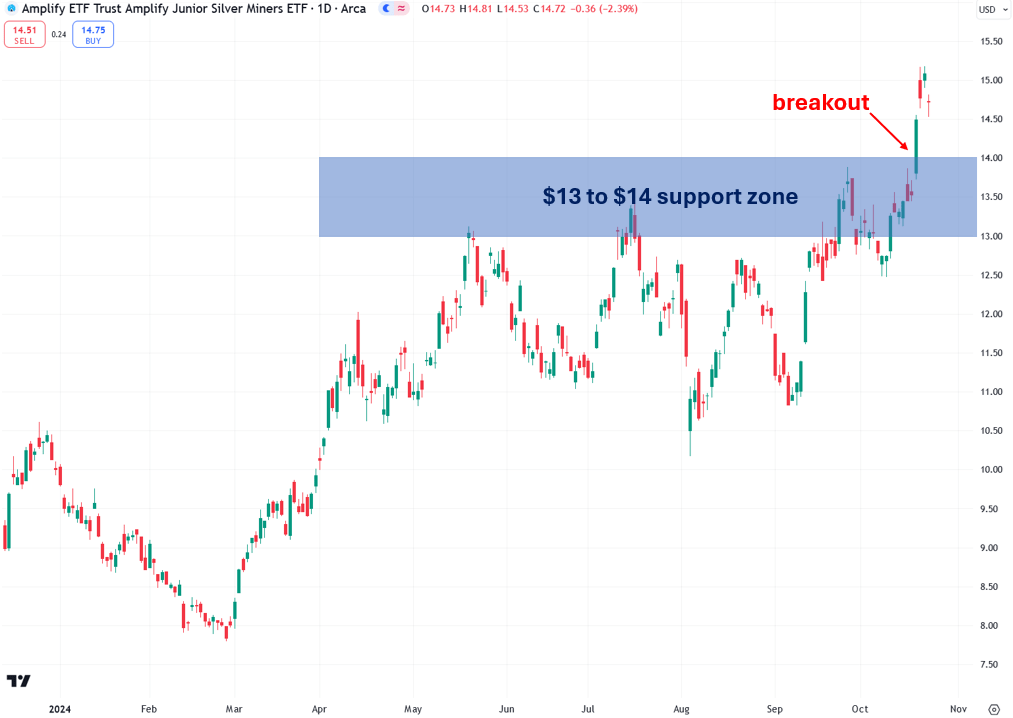
In addition to SIL, I monitor the Amplify Junior Silver Miners ETF (symbol: SILJ), which is the main proxy for junior silver mining shares.

On Friday, SILJ closed above its $13 to $14 resistance zone on heavy volume, issuing a significant bullish signal. As long as SILJ holds above this zone, it remains in a confirmed uptrend.
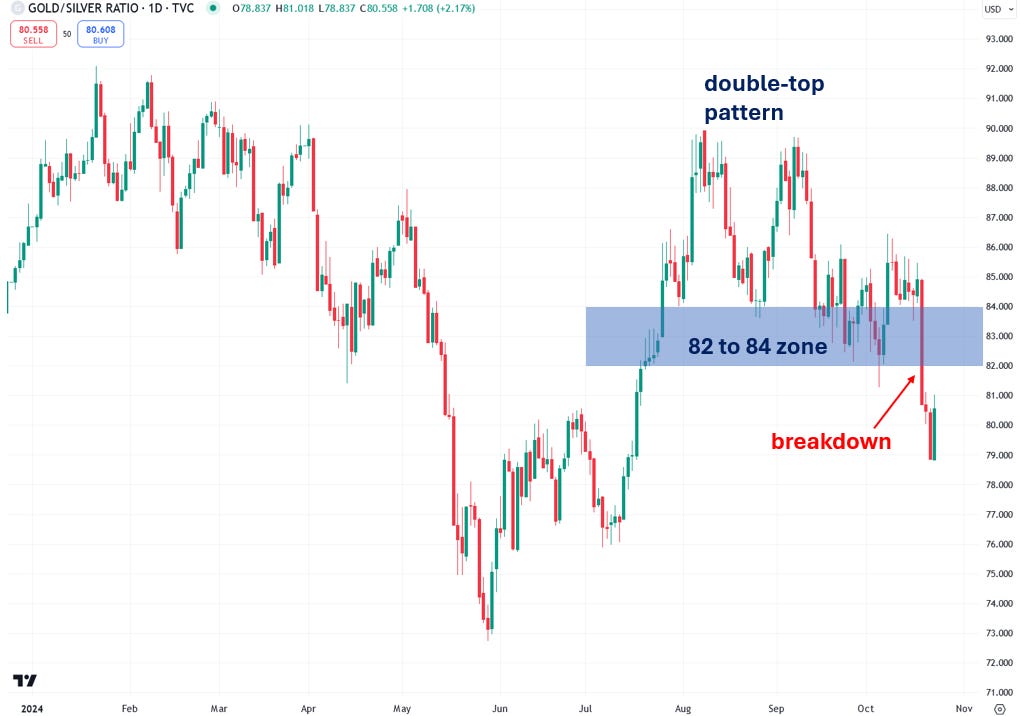
I pay close attention to the gold-to-silver ratio, as it reveals whether silver is outperforming gold or vice versa. A falling ratio indicates that silver is outperforming gold, which is exactly what you want to see to confirm a silver bull run.

On Friday, the ratio closed below the 82 to 84 support zone, which gives further credence to silver’s breakout. Though the index rebounded slightly today, it’s still in a downtrend as long as it remains below the 82 to 84 support zone.
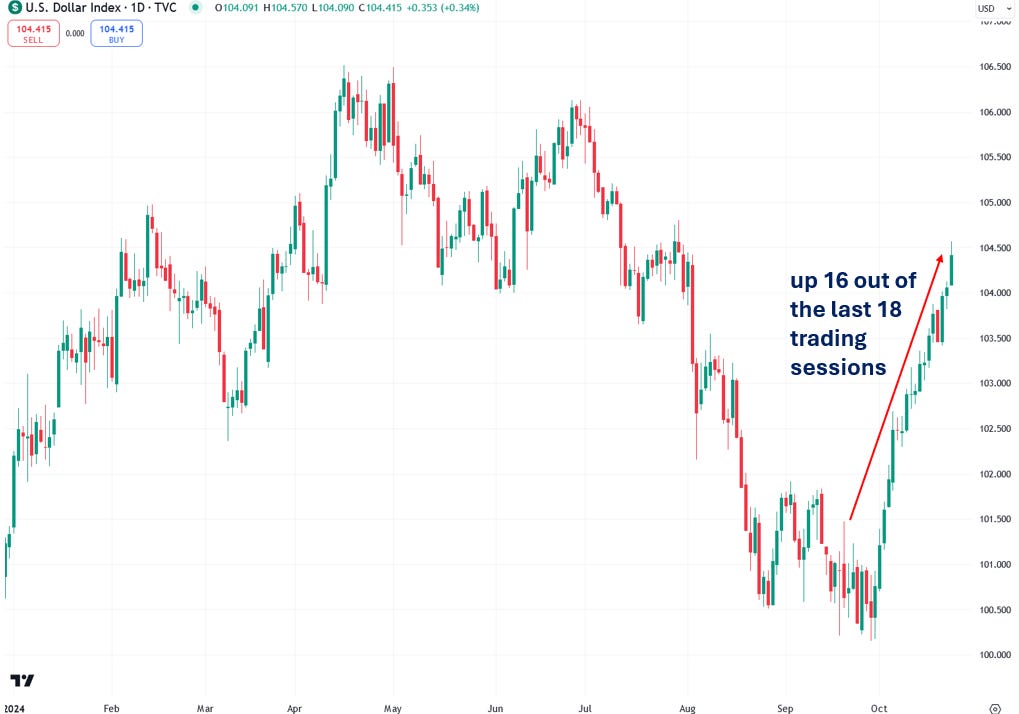
Since the beginning of October, the U.S. Dollar Index has experienced one of its sharpest rallies in recent memory, rising in 16 of the last 18 trading sessions.

Commodities like gold, silver, and copper generally have an inverse relationship with the dollar, so you’d expect them to drop sharply, given the dollar’s strength. However, the fact that they’ve held steady is a strong indication of their resilience.

There’s a good chance that the dollar’s rebound will run its course soon, which should provide support for commodities—particularly copper, which has been struggling due to the strong dollar.
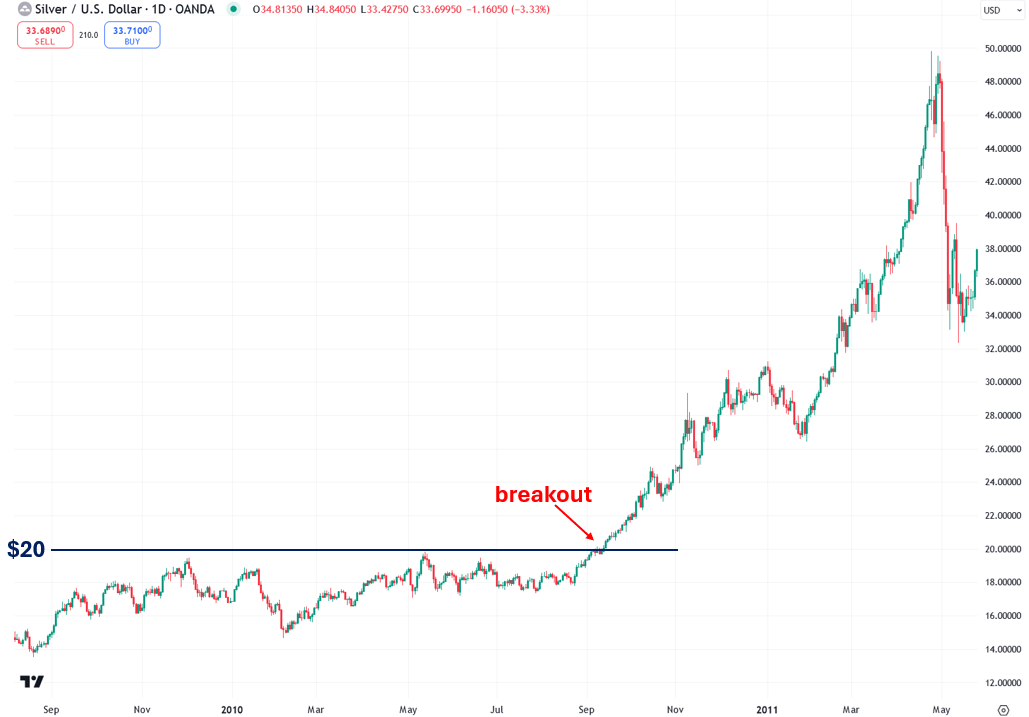
A valuable chart I’d like to highlight is silver’s 2010 chart, just before its explosive breakout, when prices surged from $20 to $50 in just four months.

There are key similarities between silver then and now, including the breakout above $20, which parallels today’s breakout above the $32.50 level. I traded silver during its breakout above $20 back then, and today’s breakout feels similar to that moment.
Another valuable chart to consider is silver’s monthly chart, which helps identify potential resistance areas as the bull market unfolds. I analyze previous congestion zones to determine where silver might face temporary challenges.

Each zone acts like a hurdle that silver needs to overcome. Once it does, that level becomes a new floor, and we then focus on the next resistance level, continuing this pattern as the bull market progresses.

Now that silver has broken above the key $32.50 level, the next step is a strong volume close above the $34 to $36 resistance zone, which served as a critical barrier throughout much of 2011.
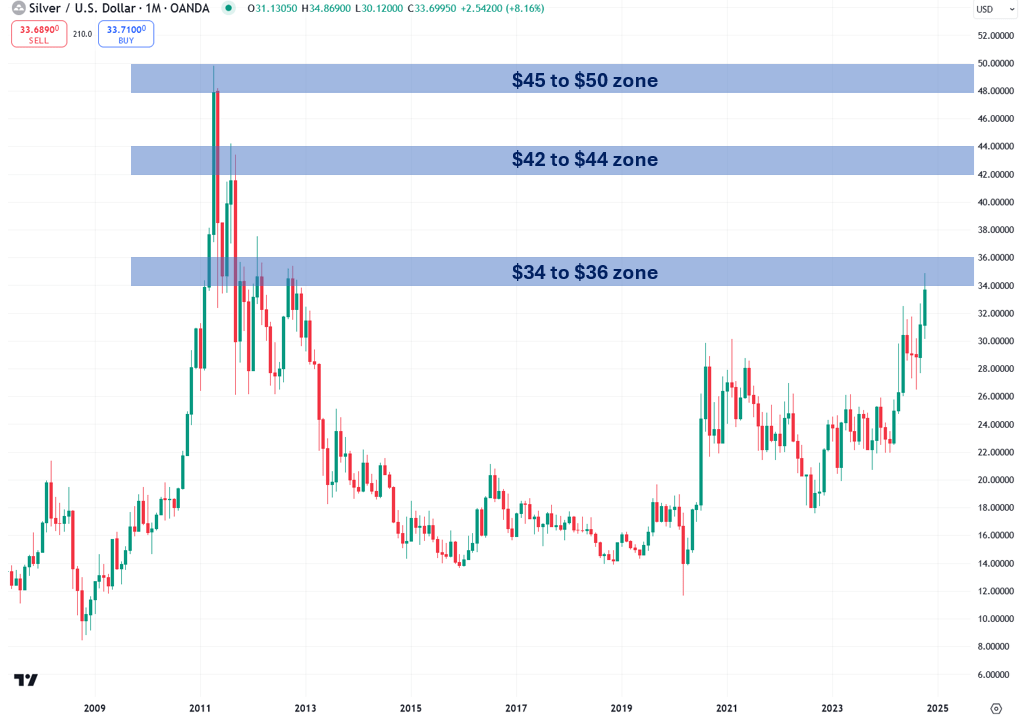
In conclusion, silver’s recent breakout above $32.50 appears to be the beginning of a major bull run, but there are several key factors to watch moving forward. While silver is in a confirmed uptrend, the breakout will gain more strength if copper rebounds and the Synthetic Silver Price Index follows suit. Gold’s strong performance is already providing support, and silver mining stocks like SIL and SILJ are confirming the move with their own bullish signals.

The next critical step is a strong close above the $34 to $36 resistance zone, which will open the door for much higher prices, paralleling silver’s 2010 breakout. All eyes should remain on these key levels and indicators as the market progresses.

U.S. Debt Nears $36 Trillion As Asset Inflation Keeps Economy Afloat

(Money Metals News Service) In the latest Money Metals Midweek Memo, host Mike Maharrey highlights the growing U.S. national debt, which now exceeds $35.7 trillion.

Maharrey begins the episode with a reference to the Apollo 13 mission, saying, “Washington, we have a problem.” He draws parallels between the crisis faced by astronauts and the fiscal disaster Washington is ignoring.

Unlike the Apollo 13 team, Maharrey argues that government officials are pretending everything is fine, despite mounting financial problems.

The Fiscal Deficit Breakdown

Maharrey doesn’t hold back in critiquing the size of the fiscal 2024 deficit, stating that “the Biden administration ran the third-largest budget deficit in history,” a troubling reality when paired with the first-ever $1 trillion spent on interest payments alone.

“It’s the first time that’s ever happened,” he emphasizes, underscoring the gravity of the situation.

The final numbers are staggering: the federal government spent $1.83 trillion more than it took in, and the budget deficit for 2024 was 8% higher than the previous year’s.

Mike Maharrey explains that this deficit represents “6.4% of GDP, up from 6.2% in fiscal 2023.”

Borrowing During Prosperity

The fiscal irresponsibility is even more concerning given that these deficits are happening during supposed economic prosperity.

Maharrey quips, “Here we are in what is supposed to be a robust economy…yet we still have these crisis-like budget deficits.”

He posits that the only thing keeping the economy from crumbling is “government deficit spending,” calling into question the strength of the economy as presented by politicians.

He suggests that the appearance of a booming economy might be “an illusion created by government deficit spending,” stating bluntly, “I’m pretty convinced that’s the only thing that’s keeping it from completely going under.”

Government Spending and Tax Receipts

Contrary to popular political narratives, Maharrey argues that the U.S. doesn’t have a revenue problem but a spending problem:

“Federal tax receipts came in at a record $4.92 trillion, an 11% increase over fiscal 2023.” He continues, “The federal government doesn’t have a revenue problem; it simply spends too much money.”

Despite promises of spending cuts during the debt ceiling deal, Maharrey is skeptical:

“Remember how the Biden administration promised that the pretend spending cuts would save hundreds of billions of dollars?” Instead, federal spending surged by “$6.75 trillion, a 10% increase over 2023.”

Bipartisan Fiscal Irresponsibility

Maharrey is clear that the blame isn’t solely on the current administration:

“It’s not just Democrats spending like drunken sailors—and I say that with all due respect to any drunken sailors out there.”

Both parties have contributed to the deficit issue. He points out that the Trump administration was on pace for a $1 trillion deficit in fiscal 2020 before the pandemic hit.

Borrowing and spending, Maharrey notes, is a “bipartisan sport.” He adds, “The Trump administration almost hit the $1 trillion mark in 2019, and it was on pace to run a trillion-dollar deficit in fiscal 2020 before the pandemic.”

The Rising Interest Problem

One of the most alarming trends Maharrey highlights is the rise in interest payments. In fiscal 2024, the U.S. government paid “$1.13 trillion in interest expense,” marking the first time this figure has eclipsed $1 trillion.

“Interest payments were up 28.6% over fiscal 2023,” Maharrey notes. The government now spends more on interest than on national defense and Medicare, and the only expenditure larger than interest is Social Security, which totaled $1.46 trillion.

Maharrey warns that this interest burden is only going to grow: “Every month, some of that super low-yielding paper matures, and it has to be replaced…with bonds that yield much higher rates.”

Inflation and Monetary Policy

Despite the Federal Reserve’s recent rate cut, long-term bond yields have spiked. Maharrey reports that after the rate cut, “the yield on the 10-year treasury was around 3.7%, [but] we’re just over 4.2% now.”

Meanwhile, the 30-year yield jumped from 4% to “4.5%.” He argues that this is a sign of a deeper problem, one that can’t be fixed by the Fed’s short-term policy changes.

Maharrey explains that the Fed has limited control over long-term interest rates: “The Fed can manipulate short-term interest rates by dictate, but it doesn’t have the same kind of control over long-term interest rates.”

This loss of control is troubling given the U.S. government’s increasing borrowing costs.

Global Reaction and De-dollarization

Global Reaction and De-dollarization

As the U.S. fiscal situation worsens, global confidence in the dollar wanes. Maharrey notes that de-dollarization is accelerating as countries seek alternatives to the U.S. dollar.

“This is one of the forces that is driving de-dollarization,” he says. “The rest of the world is watching the fiscal chaos here in the United States, and they’re wondering, ‘Why would I want dollars?’”

Maharrey links this trend to the rising demand for gold and silver, noting that “many central banks are buying gold,” which has led to rising prices for precious metals. “Silver is over $35 an ounce,” he says, referencing analysts like Jesse Colombo, who believes we may be in the early stages of a silver squeeze.

Conclusion: The Road Ahead

Maharrey ends with a sobering reminder that Washington’s fiscal irresponsibility is unsustainable:

“Eventually, kicking the can down the road is going to run out of road.” He warns that both Democrats and Republicans are unwilling to tackle the issue, concluding, “Whether Trump wins or Harris wins in four years, the government will be bigger, deeper in debt, and we’ll have less liberty.”

He encourages listeners to consider gold and silver as a hedge against this economic uncertainty. “This is why people are buying gold,” Maharrey says. “You may want to think about getting some gold and silver now.”

As always, Maharrey closes with a call to action:

“It’s a great time to call and talk to a Money Metals precious metal specialist.” He stresses that it’s better to be prepared now, as financial instability looms large on the horizon.

Brien Lundin: It’s Getting Scary

(Brien Lundin, Money Metals News Service) Forget Halloween — what’s happening in the markets right now is what should really frighten you.

There’s been red all over the screen as the global bond sell-off continues…

If you’ve been listening to the major financial media this week, you’ve noticed the concern in the voices of the talking heads. Treasury yields, and indeed yields across the globe, have been surging despite central banks’ efforts to send rates lower.

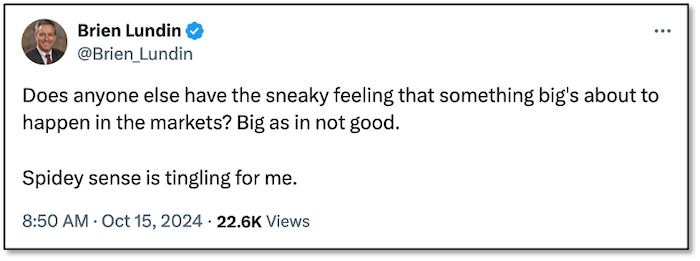
I sensed something was up last week, and it prompted me to post this on X:https://x.com/Brien_Lundin/status/1846186990158442585

I got a lot of responses from that tweet, running the gamut from giant meteors to any number of conspiracy theories.

But none of that was what I was sensing. Which is, a growing skepticism that global debts will be paid back in currencies worth anything close to today’s values…that sovereign yields are currently commensurate with the risks…and that the rickety house of cards that is the global financial system is teetering.

Most market pundits view falling Treasury yields as a sign of “safe haven” investing. But, as I’ve said, sometimes rising yields are a sign that investors are rushing for safety…because they’re viewing Treasurys as the source of the risk.

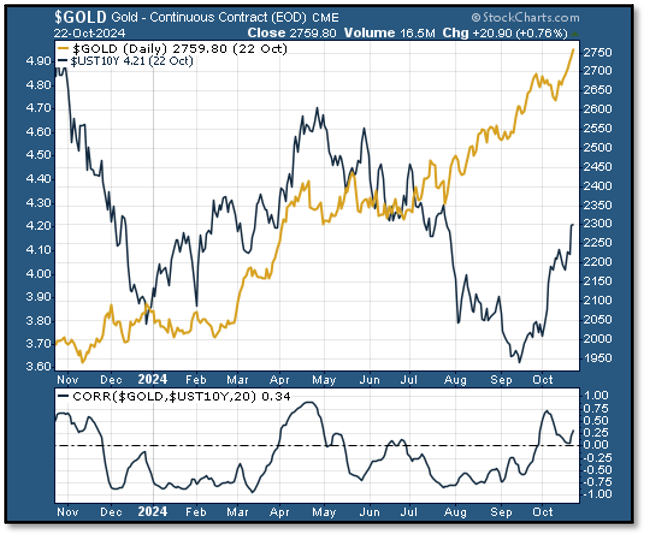
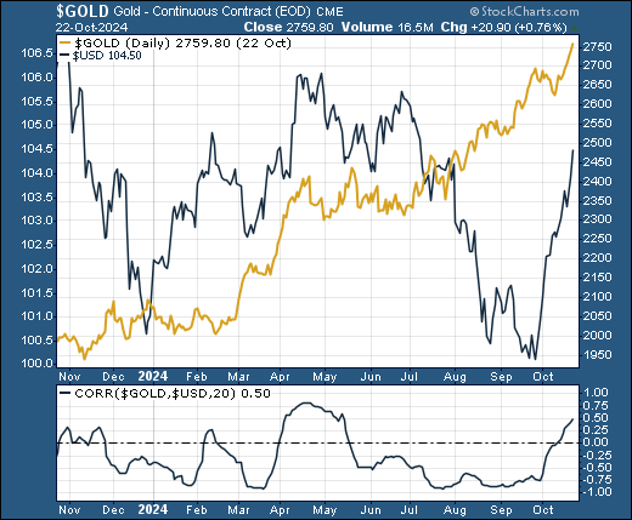
Consider two charts I’ve been featuring in my presentations…

The first chart shows the gold price plotted alongside 10-year Treasury yields, while the second plots gold against the Dollar Index.

The bottom panels in each show the rolling 20-day correlations. When the correlation line is below zero, there is an inverse relationship; when the line is above zero, there is a positive correlation wherein the two assets are moving together.

Gold should have an inverse correlation with Treasury yields and the dollar. But, as you can see, that correlation has been positive a number of times over the past year.

I first commented on this in my presentation at last year’s New Orleans Conference, when I noted that the phenomenon was a sign of emerging skepticism over the U.S. federal debt.

Now that’s become one of the dominant themes in mainstream financial media, as the markets are trembling in response to a future of high deficits and unmanageable interest expense.

As I said, Halloween isn’t for a few days… but things are already getting scary.

To get Brien Lundin’s ongoing commentary on the markets at no charge, click here to subscribe to his free Golden Opportunities newsletter.

BRICS, State Gold Initiatives, and De-dollarization: Sound Money on Arcadia Economics

(Money Metals News Service) Jp Cortez, executive director of the Sound Money Defense League, joined Chris Marcus from Arcadia Economics to discuss sound money legislation at the state level, de-dollarization, and what the global monetary system might look like 20 years from now.

Summary of the Interview Between Jp Cortez and Chris Marcus

In this interview, Chris Marcus from Arcadia Economics talks with Jp Cortez, the executive director of the Sound Money Defense League, about the growing movement for the remonetization of gold and silver in the United States.

They discuss Money Metals’ strong advocacy for removing taxes on precious metals and the increasing number of U.S. states that are introducing legislation to support sound money policies. Key topics include the role of the BRICS nations in de-dollarization, the importance of state-level initiatives, and how individual states are starting to invest in physical gold.

Cortez shares the successes in passing sound money legislation, such as eliminating sales and income taxes on precious metals in multiple states, and he highlights how Money Metals and the Sound Money Defense League continue to push for legislative reforms. The interview also explores the challenges in using gold and silver as money, including Gresham’s Law and the friction created by taxation.

Key Questions and Answers

  1. What is the Sound Money Defense League?
    • Jp Cortez explains that it is an advocacy group owned by Money Metals Exchange, focused on removing regulatory and tax barriers that prevent people from using gold and silver as money.
  2. Why is removing taxes on precious metals important?
    • Jp highlights that sales and income taxes on precious metals create friction that discourages their use as money. The Sound Money Defense League has helped pass legislation in several states to eliminate these taxes.
  3. Which states have introduced sound money legislation?
    • Jp shares that 27 states have introduced pro- gold and silver legislation, and in 2024, seven pieces of legislation have been signed into law.
  4. What are some notable legislative successes?
    • Recent wins include eliminating income taxes on precious metals in Nebraska and adding protections against Central Bank Digital Currencies (CBDCs) in other states. New Jersey and Wisconsin became the 44th and 45th state in the country to end sales taxes on purchases of gold and silver. Alabama passed its third pro- sound money bill in as many years by removing income tax on precious metals.
  5. How are states like Texas and Utah advancing sound money?
    • States like Texas are establishing bullion depositories, while Utah is moving forward with investing state funds in physical gold, showcasing how states are acting as custodians of sound money.
  6. What challenges remain in promoting sound money?
    • Jp points out that Gresham’s Law (bad money driving out good money) and people’s reluctance to spend gold and silver, as they believe its value will increase, are ongoing challenges.
  7. What does the future of sound money look like?
    • Jp believes that the current U.S. dollar system is unsustainable and that the shift toward sound money is inevitable, driven by rising inflation and the decline of the dollar.

This interview dives into the rising movement toward sound money in the U.S., where Jp Cortez discusses recent legislative successes in removing taxes on precious metals. Key topics include how BRICS nations and individual U.S. states are moving toward gold-backed assets, challenges in using gold and silver as money, and what the future may hold for the U.S. dollar.

Gold Has Finally Broken a ‘Real’ Record

(Mike Maharrey, Money Metals News Service) Just last week, gold finally broke a “real” record that’s been in place since 1980.

“Now, wait a minute,” you might be thinking. “I’ve been hearing about new record gold prices since last spring. What in the world are you talking about?”

Well, you’re right. In nominal dollar terms, gold has been breaking records seemingly week after week for months. However, when you adjust the price of gold for price inflation, it was more expensive once in history – back in January 1980.

That record has finally tumbled.

When we talk about the “real” price of an asset, we’re simply referring to the price adjusted for price inflation as measured by the CPI.

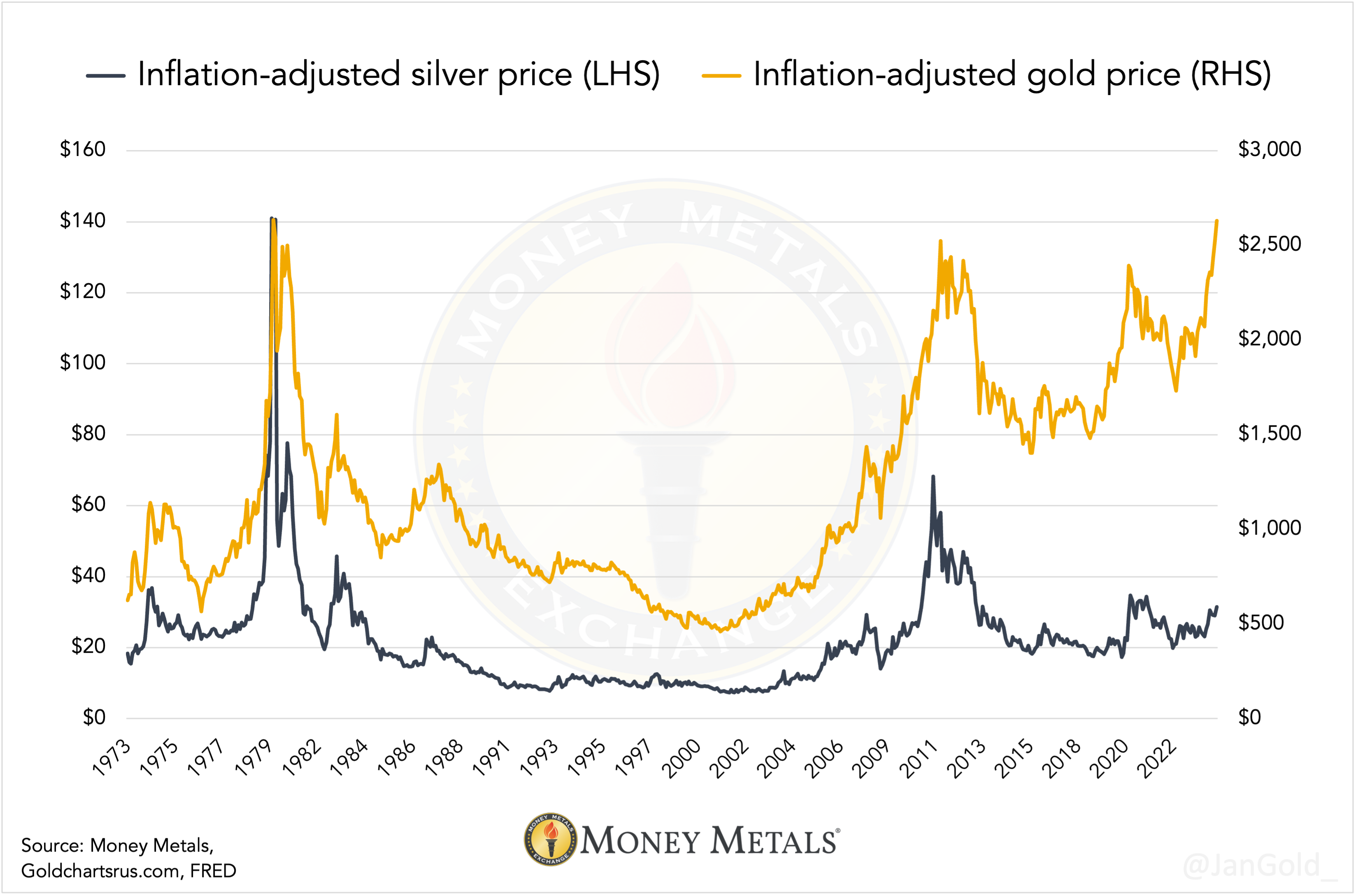
As price inflation peaked in the late 1970s, the price of gold spiked to $850 an ounce. In 2024 inflation-adjusted dollars, gold was around $2,689 per ounce at its 1980 high.

As I type this, gold is over $2,700!

Gold didn’t stay at that 1980 record level for very long. At the time Federal Reserve Chairman Paul Volcker was aggressively raising interest rates to battle price inflation. In February 1980, the Fed pushed interest rates to 15 percent and in March drove them all the way up to 20 percent. (This is what a real inflation fight looks like.)

Gold quickly fell off the January 1980 high. By the end of the year, it was back below $600 an ounce in nominal terms and it continued to trend downward for several years as Volcker’s inflation fight bore fruit.

Gold approached its real (inflation-adjusted) record high again in 2011 in the aftermath of the Great Recession and the Federal Reserve’s historic easy money policies in response to the downturn.

And here we are again.

An Extremely Bullish Chart 

Interestingly, if you look closely at a chart of the real gold price, you will notice a very distinct cup and handle pattern. The twin highs in 1980 and 2011 form the cup’s two rims. After 2011, we see another shallower decline and the recent rally forming a handle.

This is a very bullish technical chart. Historically, the handle pattern precedes a significant breakout.

This cup-and-handle pattern has played out over an extremely long timeframe. Historically, longer patterns portend bigger breakouts with a broader base signaling a bigger upside case.

Gold’s nominal price followed a similar long-term pattern, resolving with a breakout to new all-time highs last year.

Yes, Gold Is and Has Been an Inflation Hedge

The fact that gold has traded below its 1980 real price high for decades doesn’t mean the yellow metal “hasn’t kept up with inflation,” as some people claim. That year was an anomaly. Through most periods, the price of gold has outpaced inflation as measured by the CPI and has served as an excellent inflation hedge.

In other words, if you bought gold virtually any time after 1980 and held it until today have been well ahead of inflation. And now, you’re on pace with price inflation even if you bought at the peak in 1980.

For instance, if you bought an ounce of gold in 2000, you paid around $285 an ounce – well below the 1980 high in both real and nominal terms. Since then, gold is up over 847 percent while the price inflation rate over that time comes in at around 81 percent.

Of course, the return on any investment depends on exactly when you buy and when you sell.  If you happen to buy gold at the peak of a bull cycle and sell at the bottom of a bear run, you will likely lose money in both real and inflation-adjusted terms. There is always an inherent risk in investing. That means one can select arbitrary dates to “prove” that gold failed as an inflation hedge. That’s why one must always look at longer trends.

Silver Has a Long Way to Go 

Silver has followed a similar pattern hitting record highs just below $50 an ounce twice in 1980 and 2011. But to date, silver remains well below the record, even in nominal terms. (As I’m writing this, silver is trading at $34.39). That means we’re still $15 below the record price in nominal terms.

To crack its “real” price record, silver needs to surge to around $144 an ounce.

That’s not to say that silver has done “poorly.” The white metal is up 43 percent on the year. Nevertheless, it does appear to be significantly underpriced compared to gold.

But note that the chart is also bullish for silver. It’s not as deep, but there is a definite cup and handle pattern when you chart the real price of silver over time. That pattern becomes more pronounced when you look at it in nominal terms.

Other dynamics indicate that silver is historically underpriced compared to gold. The gold-silver ratio is over 80-1. That means it takes 80 ounces of silver to buy an ounce of gold.  The average in the modern era has been between 40:1 and 60:1.

You can clearly see the wider gap between the real gold and silver prices in the “handle” for both on the chart.

Historically, the ratio has always returned to the mean. And it has done so with a vengeance, overshooting that mean. The ratio fell to 30:1 in 2011 and below 20:1 in 1979.

On the supply side, we’ve seen silver market deficits for the past three years, and Metals Focus projects demand to outstrip production again this year.

Furthermore, silver tends to outperform gold in a gold bull market. If you are bullish gold, you should probably be even more bullish silver.

When you put the technical factors together with the fundamentals, there appears to be an extremely strong bullish case for silver with significant upside.

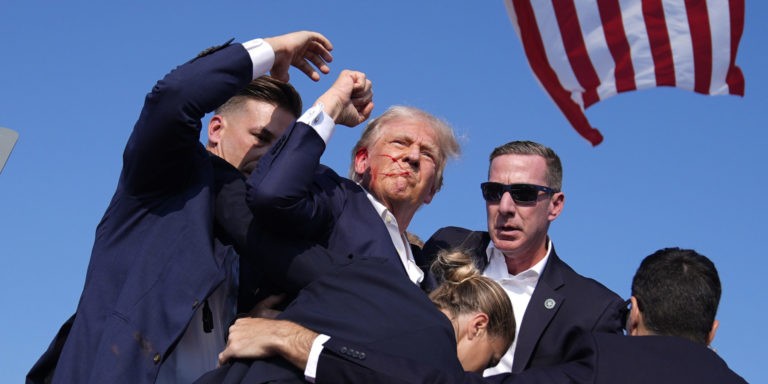
EXCLUSIVE: Pittsburgh Motorcycle Unit Disbanded after Trump Shooting, Official Says

(Ken Silva, Headline USA) Headline USA has exclusively obtained a trove of records that detail the Pittsburgh Police Bureau’s unanticipated major role in the deadly July 13 Trump rally in Butler, Pennsylvania.

The records, which were obtained via a Right to Know Law request, reveal the identities of the Pittsburgh motorcycle cops at the Butler rally, including those who were injured when alleged gunman Thomas Crooks attempted to assassinate Donald Trump. According to the records, the motorcycle cops performed their duties competently—with an Allegheny hospital official raving about their “very professional job” in assisting the shooting victims.

However, after Headline USA obtained the Pittsburgh police records, Pittsburgh Citizen Police Review Board director Beth Pittinger revealed that the bureau’s motorcycle unit was disbanded over controversy stemming from the rally.

As has been previously reported, there remains an outstanding question as to whether the Pittsburgh motorcycle cops were actually approved to help with the Trump rally. Instead, some reports indicate that they should have been available to help with First Lady Jill Biden’s visit to Pittsburgh at the same time.

“As a result of that, the motorcycle unit was broken up, it was busted up. There’s no supervisor assigned to it, as I understand it, now. They assigned them all to the downtown unit or dispersed them to the zones So, where we used to have a discrete motorcycle unit, we don’t anymore. They’re all over the place. A lot of things happened,” Pittinger said Wednesday night.

Pittinger’s board is investigating the issues she raised. She said the investigation focuses on the supervisory level: “Who said they can go and who said they can stay?” she asked.

Responding to Pittinger’s remarks, on Thursday the police bureau’s spokesperson, Cara Cruz, denied that disbanding the motorcycle unit was related to the Butler rally.

“The decentralization of the Bureau’s motorcycle unit was an operational decision unrelated to the Butler rally. The thirteen full-time riders are now distributed throughout the city’s six police zones with two in each zone, and three in Zone 2, which encompasses the downtown core as well as the Hill and Strip Districts,” Cruz said in an email.

“This provides more efficient and nimble coverage throughout the city. The thirteen full-time riders and five ancillary riders can be deployed from the zones when and where they are needed for traffic control, special events, and dignitary protection, etc.”

This reporter contacted several motorcycle cops involved in the Butler Trump rally, but they either declined to comment or didn’t respond to emails.

Thanks to the records provided by Pittsburgh police, this publication was able to identify three of the four cops injured by shrapnel: officer Vincent Gelpi, who was hit in the arm; officer Nicholas Devault, who was hit in an undisclosed location; and Sgt. Jeffrey Tagmyer, who was hit in the forearm. Another officer was hit in the face, but that officer’s identity has yet to be publicly determined. None of the injuries were serious.

After the chaotic day in Butler, an Allegheny General Hospital police officer sent an email to the Pittsburgh police, thanking them for their help.

“Just wanted to make sure you commend Sgt Emily MYERS and all your officers at Zone One. They assisted us with the shooting victims who were injured in the TRUMP assassination attempt,” Highmark Health Police Department Rich Yochus wrote to Pittsburgh Police Commander Shawn Malloy on July 16.

At the time of the shooting, Malloy apparently didn’t know Trump or Jill Biden were in town.

“We also got word from Commander Rippole, the cycle escort lead, that TRUMP might be coming to AGH / Emergency Room for his injuries. We the Presidential Hospital and all former and current President come to our hospital when injured. But I had no idea TRUMP was here or the First Lady. We made it work though. We got it done,” he said.

“We locked down the hospital from 1845 Hours until around 2200 hours, after Commander Rippole gave me the okay, that TRUMP was wheels up and out of Pittsburgh. Just wanted you to know that Emily and your guys from Zone One did a very professional job and handled the situation smoothly,” he added.

Along with the records about the aftermath of the rally, Pittsburgh police also provided emails indicating that there was some pre-planning confusion among law enforcement about when and where the rallies would be happening.

Following a Secret Service meeting held on July 8 with local law enforcement, Pittsburgh police Lt. Charles Henderson wrote that he still didn’t know anything about the First Lady’s plans.

“We have FLOTUS & Trump coming in on the same day. Trumps schedule is complete. FLOTUS is the wild card. The USSS said she’s coming, but they don’t know what time, what airport, or where she’s going. If it works the way it usually does, we won’t know anything until Wednesday or Thursday,” Henderson wrote to his officers on July 8, immediately after the Secret Service meeting.

Headline USA is still working to obtain more records about the matter.

Ken Silva is a staff writer at Headline USA. Follow him at x.com/jd_cashless.

Video Surfaces of Kamala Ally Jeff Jackson Cozying Up to Convicted Sex Offender

(Luis Cornelio, Headline USA) A top Democrat aiming to become North Carolina’s attorney general is under fire after being caught red-handed in a cozy embrace with a registered sex offender. His opponent quickly called out his poor judgment in a hard-hitting campaign ad. 

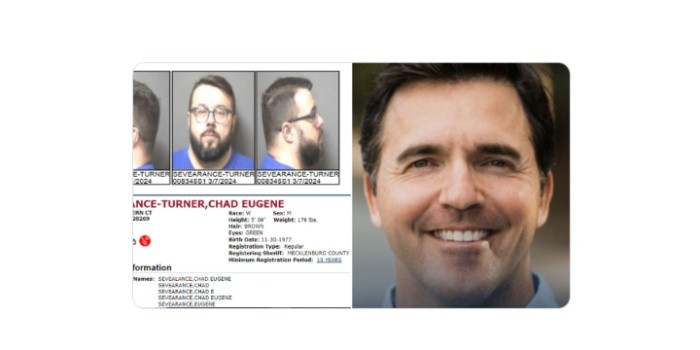
Meet Democrat Rep. Jeff Jackson, seen in a 2022 video accepting an LGBTQ award from Chad Turner, a registered sex offender and the head of the Charlotte LGBT Chamber of Commerce.  

In 1998, Turner (then 19) was busted after committing three lewd acts on a child under the age of 16. He was sentenced to 10 years in prison but released after two years.  

The 2022 video, which resurfaced by the Daily Wire on Oct. 10, 2024, showed Jackson praising Turner’s leadership as a gay activist, despite Turner’s conviction for sex crimes. 

Jackson, a close ally of Kamala Harris, is set to face Republican Rep. Dan Bishop in the November election for the Old North State’s top law enforcement job. This race is one of the most closely watched. 


Bishop launched an ad featuring several women criticizing Jackson’s connection to Turner despite his criminal record. 

“Child molester Chad Turner became one of Charlotte’s most notorious sex offenders. A few years later, Jeff Jackson accepted an award from him, and embraced Chad Turner,” the ad’s narrator stated, as footage from the Daily Wire showed Jackson and Turner together. 

“This is wrong,” one woman said, seemingly reacting to the footage of Jackson embracing the sex offender. 

“It’s awful,” another woman added, later stating, “How can a mom of any child trust Jeff Jackson.” 

“Everyone knew about this guy,” the first woman emphasized. 

“I voted for Democrats before, I can’t vote for Jeff Jackson,” a woman concluded the ad.

According to a Headline USA review of Turner’s sex offender registry, his conviction occurred on July 17, 1998, with his release following on Aug. 23, 2002. 

In 2016, Turner temporarily stepped down as president of the Charlotte LGBT Chamber of Commerce after his past sex crime resurfaced.

It isn’t immediately clear when Turner returned to this position, as his LinkedIn showed that he worked for the chamber intermittently from 2013 to 2020.

“What I didn’t want to do was allow the right to continue to detract and to continue throwing stones at an organization that has done absolutely nothing but help individuals and our community in our city,” Turner told Qnotes Carolinas, an LGBT news outlet, in 2016.

Giuliani Must Give House, Watches in Bizarre Defamation Ruling

(Luis Cornelio, Headline USA) Rudy Giuliani has been ordered to hand over his Manhattan apartment, cash, watches, and other assets to two Georgia election workers he allegedly defamed after the 2020 presidential election.

On Tuesday, U.S. District Court Judge Lewis Liman directed Giuliani to comply with the “immediate turnover” of his Upper East Side apartment and to place additional assets into a receivership within seven days. The receivership will include an appointed manager who will decide how to utilize these assets to comply with the judgment. 

Additionally, the judge instructed Giuliani to initiate steps allowing election workers Ruby Freeman and Shaye Moss to collect $2 million that the Trump campaign allegedly owes him. 

Items included in the order ranged from watches gifted to Giuliani after the September 11, 2001, terrorist attacks to a signed Joe DiMaggio jersey, a 1980 Mercedes, his television and even furniture. Liberal outlets CNN and The Washington Post were the first to report the order. 

The order followed a $148 million default judgment awarded to Freeman and Moss over Giuliani’s remarks concerning them after the 2020 presidential election. The two women counted votes in Georgia. 

The judgment consisted of $75 million in punitive damages, $33 million for defamation and $40 million for infliction of emotional distress. 

The lawsuits were funded by Project Democracy, a leftist nonprofit, in collaboration with law firms Willkie Farr & Gallagher LLP and DuBose Miller LLC. 

Giuliani once owned a condominium in Palm Beach, Florida, though the judge has not yet decided whether it will be included in the settlement for Moss and Freeman, CNN reported. 

Ted Goodman, a Giuliani spokesperson, rebuked the order, affirming that the mayor is “being unfairly punished by partisan, political activities who are trying to make an example out of him.” 

He added, “They’ve restricted his access to his personal bank accounts and his credit cards, and they’ve blocked him from his business accounts in a failed effort to crush his highly successful two-hour livestream program on X and his other social media platforms.” 

Goodman said that the mayor is hopeful that “that justice will ultimately prevail.” 

On X, several conservative commentators criticized what they perceived as an overreaching ruling against Giuliani, once celebrated as “America’s Mayor.” 

“It’s disgusting what they’re doing to Rudy Giuliani,” wrote Rogan O’Handley, known as DC Draino, on X. “Bankrupting him for calling out Georgia election fraud. Brad Raffensberger should be the one getting bankrupted!” 

Journalist Kyle Becker echoed O’Handley’s stance, writing, “This is another travesty of justice against a Trump supporter that has been committed by our weaponized justice system.” 

Tech expert Mike Benz also condemned the case, highlighting what he called the politicization of defamation lawsuits: “The uncapped damages in this style of purely political ‘defamation’ lawfare is fast becoming the single most insane judicial assassination trick in the book.”

Kamala Wants Amnesty for Illegals

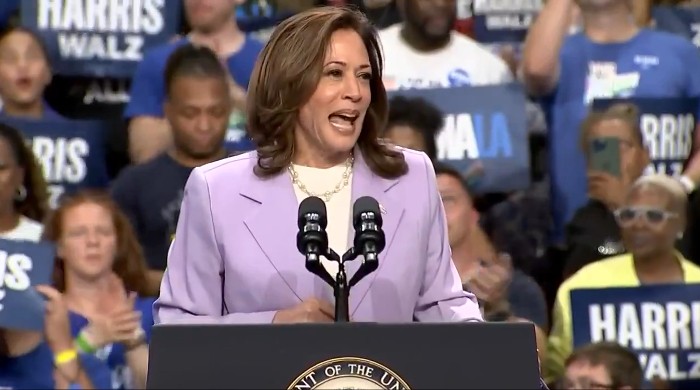
(Dmytro “Henry” Aleksandrov, Headline USA) Democratic presidential nominee Kamala Harris recently admitted during an interview with MSNBC that she fully supports amnesty for illegal aliens.

“Right now, we’re talking about border security, and there’s nobody, no Democrat, talking about a pathway to citizenship, immigration relief, benefits that migrants bring to this country,” Telemundo host Julio Vaqueiro told Harris during the interview.

Harris responded by saying that she supports all of that.

“I am. I am talking about it … There’s no question that … migrants bring — America is a country that was built in part by immigrants… We need smart, humane immigration policy that includes a pathway to citizenship,” she said.

Conservatives on Twitter quickly responded to Harris’s recent remarks.

“This is enraging. Mass amnesty for the 20+ MILLION illegals Kamala imported would permanently turn America into a Democrat-controlled hellscape, and that’s the ultimate goal. THAT is why this is the most important election of our lifetimes. This is our last chance. We must elect Trump in 13 days, or we’ll no longer have a country,” independent journalist Nick Sortor said.

Conservative political commentator Rogan O’Handley also responded to the recent news, telling his audience how shocked he was when he heard her saying that.

“Holy c**p, she said the quiet part out loud,” he wrote.

“They want to turn us into a third-world country and control Americans. The upcoming election is absolutely crucial, and they are trying to steal it,” @LarryDJonesJr wrote.

Laura Loomer also responded to the recent news on Twitter, adding that Republican presidential nominee Donald Trump has been right all along when he was saying that Harris wants to flood the country with illegals all over the world.

“Even worse is the fact that all battleground state Senate Dems @SenateDems want to empower Border Czar Harris’s open borders. Democrat Pennsylvania Senator Bob Casey … runs away every time [I] and @TheCharlesDowns [ask] him about Kamala’s open borders,” she wrote.

However, it wasn’t the first time when Harris pushed for amnesty of illegals. Headline USA and other conservatives on Twitter reported many times on how radical Harris’s immigration agenda is.

Kamala Wants to Force Christians to Perform Abortions

(Dmytro “Henry” Aleksandrov, Headline USA) Democratic presidential nominee Kamala Harris recently showed American Christian doctors that she would force them to abandon their religious beliefs to perform abortions.

During a recent interview, Harris admitted that she believes there should be zero compromises or limits to abortions in the United States after Hallie Jackson of NBC News asked her what concessions, such as religious exemptions, would be on the table.

“I don’t think we should be making concessions when we’re talking about a fundamental freedom to make decisions about your own body,” she said. “Let’s just start with the fundamental fact. A basic freedom has been taken from the women of America: the freedom to make decisions about their own [bodies]. And that cannot be negotiable, which is that we need to put back in the protections of Roe v. Wade, and that is it.”

Conservatives and Christians quickly sounded the alarm by pointing out that if Harris became president, Christians would be forced to abandon their faith on the governmental level constantly.

“[Harris] promises ‘freedom’ but then pledges to federally steamroll Americans into taking part in abortions against their will. Docs must perform them. Taxpayers must pay for them, for any reason, in all 50 states, no exceptions,” SBA Pro-Life America wrote.

Ben Domenech of the Spectator World also criticized Harris.

“Forcing Catholic hospitals, which supply care to some of the most vulnerable populations, to perform abortions or shut their doors is literally the most vile thing a major party candidate has ever endorsed,” he wrote.

Catholic Vote, a politically conservative Catholic organization, also responded to the recent news by asking a rhetorical question.

“Why would any Christian vote for her?” Catholic Vote wrote.

Trump War Room also told American Christians that they should remember what Harris said during the interview when they were going to vote.

“Absolutely chilling,” the Center for Baptist Leadership wrote. “It would be the end of the First Amendment and religious liberty as we know it.”

Independent journalist Kyle Becker agreed with the sentiment.

“Kamala Harris is the most anti-Christian candidate in U.S. history,” he wrote. “2024 is the Good vs. Evil election.”

However, Harris became infamous for her pro-abortion rhetoric even before that, with her going as far as to promote the murder of unborn babies while innocent Americans were dying because of Hurricane Helene.

Her hatred of Christians, in general, and Catholics, in particular, was also well–documented. One of the most recent examples of her anti-Christian hatred happened during one of her latest rallies when she told some Christian protesters who were there that they were “at the wrong rally” because of their religious beliefs.