(Luis Cornelio, Headline USA) At a CNN town hall with Anderson Cooper and Sen. Bernie Sanders, I-Vt., a leftist audience member asked why Democrats are losing support among young male voters—and inadvertently answered the very question by correcting Cooper on preferred pronouns.
The attendee had been introduced as “Grace,” with Cooper assuming she used she/her pronouns: “I want to introduce Grace Thomas, she’s a local civil rights attorney, she’s a Democrat. Grace?”
Before posing the question, Thomas corrected Cooper: “It’s they/them pronouns actually, thank you.”
Calling for Anderson Cooper's immediate resignation for believing what his eyes were telling him he saw
Ironically, Thomas then turned aimed at Sanders, asking why the Democratic Party has lost support among men, including white men, in the wake of the 2024 election.
“Polling and turnout data indicate that men of all racial demographics are turning away from the Democratic Party. But of course, white men in particular, do not feel that the DNC messaging targets them in the issues that they care about,” Thomas began.
The attendee continued, “Should progressive campaigns craft policies and messaging to better encapsulate these voters? And if the answer is yes, how do they do so without abandoning marginalized voters of color and gender?”
In a lengthy response, Sanders attributed the Democratic loss among this voting bloc to the party’s failure to be “aggressive in standing up to powerful corporate interests” and “implementing an agenda that speaks to the needs of the working class.”
Thomas’s puzzling question and fixation on gender pronouns came on the heels of President Donald Trump’s sweeping victory in the 2024 election, when he garnered support from nearly all racial demographics nationwide.
Tellingly, Trump defeated former Vice President Kamala Harris—a California leftist known for emphasizing identity politics.
Throughout her campaign, Harris rallied leftist groups, presented her preferred pronouns at select events and highlighted her racial diversity and gender identity. However, voters ultimately rejected her at the polls.
This was unsurprising, as a PRRI national poll revealed that 65 percent of Americans believe there are only two genders. The same poll showed that only 35 percent of respondents said they’d be comfortable with friends using gender-neutral pronouns—while 40 percent disagreed and 23 percent had no strong opinion.
(Luis Cornelio, Headline USA) President Donald Trump is rolling back the Biden-era parole granted to thousands of foreign individuals with criminal records or those in the FBI’s Terrorist Screening Center watchlist, the Daily Caller reported Thursday.
Parole was one of the many tools the Biden administration used to expedite the processing and release of illegal aliens into the U.S. Some of these individuals were admitted despite having criminal records.
Moreover, they were granted Social Security numbers, with several hundred of them receiving taxpayers’ money through unemployment benefits.
In total, the Trump administration will revoke the parole of 6,300 individuals admitted to the U.S. since 2023. These individuals either appear on the FBI Terrorist Screening Center watchlist or have criminal records, a government official told the Caller anonymously.
“Among the 6.3k paroled aliens with criminal or terrorist records, 905 were collecting Medicaid (including 4 on the terrorist watch list). $276,000 was paid out,” the official said. “41 were collecting Unemployment Insurance, receiving $42,000 in benefits. 22 received federal student loans totaling $280,000.”
The Daily Caller noted that another group of foreign individuals—particularly those in the CHNV—have had their parole benefits removed by the Trump administration.
Hundreds of thousands of them received notice informing their admissions to the U.S. were revoked. CHNV was a Biden-era program that benefited half a million people from Cuba, Haiti, Nicaragua and Venezuela.
Those who remain in the U.S. despite their admissions being revoked are considered illegal aliens and are subject to removal proceedings.
In response to this program, a DHS official said, “They allowed more than half a million loosely vetted aliens from Cuba, Haiti, Nicaragua, and Venezuela and their immediate family members to enter the United States through these disastrous parole programs.”
These officials added these individuals were granted “opportunities to compete for American jobs and undercut American workers; forced career civil servants to promote the programs even when fraud was identified; and then blamed Republicans in Congress for the chaos that ensued and the crime that followed.”
(Ken Silva, Headline USA) A DC woman is suing the FBI and an agent who plowed into her vehicle the day after the Jan. 6, 2021, Capitol Hill uprising.
FBI agent Krancle Envieh was driving his bureau-issued vehicle on Jan. 7, 2021, when he crashed into DC resident Marquita Hart, who was passing through a green light on 12th Street in Washington DC.
“The force of the collision caused serious and permanent injury to the Plaintiff, Marquita Hart,” states her lawsuit, which was first reported by CourtWatch.news.
Hart said she was transported to George Washington University Hospital by D.C. Fire and EMS. There, she was reported to have “mild TTP” in the left lateral aspect of her neck and “circumstantial TTP” of the left knee.
When she did a follow-up visit four days later, a doctor said she suffered a sprain of ligaments of the cervical and lumbar spine, contusion of her left knee, constructure of muscles, post-traumatic headache, dizziness, and pain in both her wrists.
This week, a DC woman sued an FBI agent for crashing into her on Jan. 7, 2021. There's hardly any info on this agent, Krancle Envieh, but a LinkedIn profile w/ that name does list him as working counterterrorism in DC during that time. I wonder if he was involved in Jan. 6 at… pic.twitter.com/V8JddeqNQn
The provider explained that “this patient did receive this injury as a result of the traumatic forces experienced during the accident,” according to her lawsuit.
Hart said her total medical bills were about $17,000, and that she lost some $4,500 in wages.
She now seeks $500,000 in damages.
There isn’t much information online about the defendant, Envieh. There is a LinkedIn profile with that name, which states that he’s worked nearly 17 years in the intelligence community. His resume doesn’t mention the FBI, but says he was working in DC in 2021 as a program manager for counterterrorism issues.
According to Hart, Envieh has a “history of negligent driving or a propensity to drive negligently, which created an unreasonable risk of harm to others.”
Envieh did not immediately return a message seeking comment. He did delete the LinkedIn profile, however.
I messaged him for comment and he deleted his LinkedIn lol
(Sound Money Defense League, Money Metals News Service) Alabama Gov. Kay Ivey has signed Senate Bill 130 into law, reaffirming gold and silver as legal tender. This symbolic victory marks Alabama’s latest step toward promoting constitutional sound money in the state.
Sponsored by Sen. Tim Melson and Rep. Jamie Kiel, the Alabama Legal Tender Act recognizes “any refined gold or silver bullion, specie, or coin that has been stamped, marked, or imprinted with its weight and purity” as legal tender in the Yellowhammer State.
The law ensures that no one is obligated to accept gold and silver for transactions unless specified by a contract or required by law.
The measure, backed by Money Metals Exchange and the Sound Money Defense League, sailed through the state legislature with unanimous support, receiving no negative votes in committee or floor votes in either chamber.
Article 1 Section 10 of the U.S. Constitution reads: “No state shall… coin Money; emit Bills of Credit; [or] make any Thing but gold and silver Coin a Tender in Payment of Debts…” Senate Bill 130 aligns with this constitutional mandate.
“I’m proud to sponsor this legislation reaffirming gold and silver as legal tender in Alabama,” said Senator Melson in an exclusive interview with the Sound Money Defense League.
“While inflation continues to erode the purchasing power of the U.S. Dollar, encouraging stable, time-tested, and constitutional alternatives like gold and silver is a commonsense step. This bill upholds their constitutional status and supports sound money for our citizens across the state,” he concluded.
This marks the fifth pro-sound money law enacted in 2025, a national trend driven by the Sound Money Defense League and Money Metals Exchange for over a decade. Alabama joins Kentucky, Wyoming, and Idaho in passing related laws this year.
So far this year, Wyoming has established a $10 million physical gold reserve, Idaho passed bills eliminating capital gains taxes on gold and silver and reaffirming the two precious metals as legal tender, and Kentucky became one of the dozens of states to end sales taxes on purchases of precious metals.
After President Nixon “temporarily suspended” the convertibility of dollars into gold, America’s 54-year experiment with a purely fiat currency system has fueled high inflation, ballooning deficits, and unchecked government spending.
When savers, wage earners, and investors seek ways to protect their savings from the ravages of inflation, they often choose precious metals over fiat currency because precious metals have preserved purchasing power over time.
Since 2018, Senator Melson has advocated for several sound money bills alongside the Sound Money Defense League to expand tax exemptions and remove barriers to using gold and silver in Alabama. Senate Bill 130 offers symbolic support to Alabama citizens making this choice, and it is a modest next step toward continuing to promote sound money legislation in the state.
This year’s legislative success builds on the passage of seven sound money bills in 2024, five in 2023, and three in 2022 – each of which enjoyed strong support from the Sound Money Defense League.
With SB 130 passed, Alabama, currently ranked 9th on the Sound Money Index, is expected to rise in the 2026 edition.
Sound Money Defense League is a non-partisan public policy group working nationally since 2014 to restore gold and silver as sound money – America’s constitutional money. The League, in partnership with Money Metals, also publishes the annual Sound Money Index.
(Mike Maharrey, Money Metals News Service) The Federal Reserve just got the green light to crank up the inflation machine.
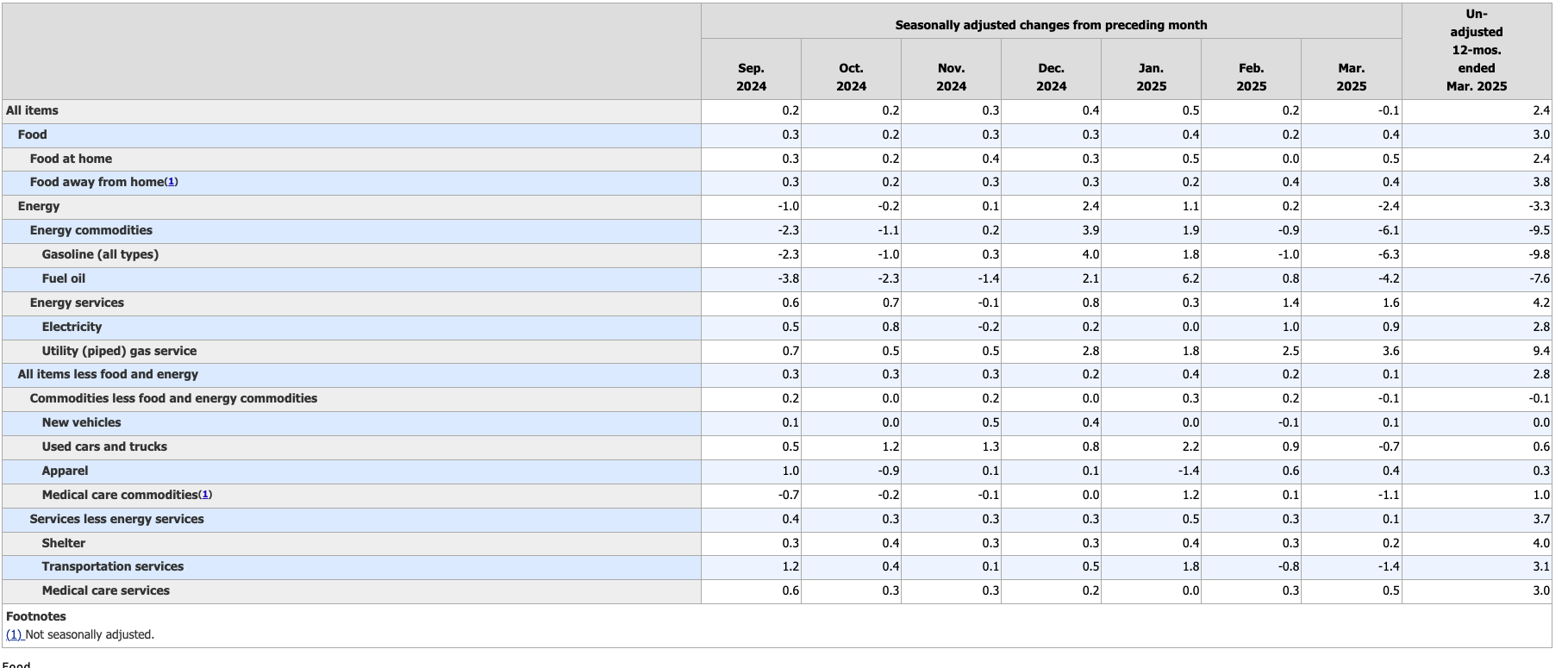
The Consumer Price Index (CPI) moderated in February and turned downright cool in March. Prices fell month-on-month, driven by much lower energy costs.
That cracks the door for the Fed to plausibly cut interest rates again sooner rather than later. And that open door could come in handy for the Fed with markets in chaos and recession worries heating up.
The March CPI Data
On an annual basis, the CPI came in at 2.4 percent, according to data from the BLS. That was down from 2.8 percent in February. The forecast was for a 2.6 percent annual price gain.
Month-on-month, prices contracted by -0.1 percent. We had a couple of months when prices didn’t rise in the spring of 2024, but this is the first drop in prices since 2020.
Stripping out more volatile food and energy prices, core CPI rose by a modest 0.1 percent month-on-month. On an annual basis, core CPI fell to 2.8 percent. This is the first time core CPI has dropped below 3 percent since March 2021. The forecast was for core CPI to come in at 3 percent.
As you parse the data, keep in mind that the CPI doesn’t tell the entire story of inflation. The government revised the CPI formula in the 1990s so that it understated the actual rise in prices. Based on the formula used in the 1970s, CPI is closer to double the official numbers. So, if the BLS was using the old formula, we’re looking at CPI closer to 6 percent. And using an honest formula, it would probably be worse than that.
However, this is the formula the government uses, and it drives decision-making.
Looking deeper into the data, we find that gasoline prices fell -6.1 percent month-on-month, pulling the broader energy index down by -2.4 percent.
Shelter prices also moderated, rising by 0.2 percent.
However, all the news wasn’t good. Food prices climbed 0.4 percent.
Reaction
The mainstream wasn’t in the mood for good news.
Despite the rosy CPI data, stocks sold off sharply on Thursday, and tariff worries continue to dominate.
As CNBC pointed out, “If Thursday’s consumer price index report, which showed prices actually dipping month on month and core inflation dropping to the lowest since 2021, had been released prior to the tariff chaos unleashed by U.S. President Donald Trump, stocks would probably have shot up.”
Most of the commentary on the price inflation data centered around tariffs and worries that falling prices are the calm before the storm. An economist for Navy Federal Credit Union compared this CPI report to a “before and after snapshot.”
“This is before. We may be whistling past the graveyard right now, because we know that costs are going to increase.”
Even as the Trump administration announced a 90-day pause on tariffs for “non-retaliating” countries, China will still feel the weight of tariff policy, and quite frankly, nobody really knows what tomorrow will bring.
“Today’s softer-than-expected CPI release feels backward-looking given the large changes to trade policy seen in recent days,” global co-head of fixed income and liquidity solutions at Goldman Sachs Asset Management Kay Haigh told CNBC. “Going forward, the Fed is likely to face a difficult trade-off as tariff-driven price increases start to feed through to the inflation data and activity remains soft.”
A former Fed economist told Yahoo Finance, “This could easily be the last really good CPI day for a while,” adding that it would take a while for the impact of tariffs to show up in the data.”
A Green Light for the Fed
Regardless, the cooling CPI is good news for Federal Reserve officials who may need the cover of improving inflation to cut interest rates if the economy deteriorates and the stock market continues to tank.
Right now, the Fed is taking a cautious tone – a “wait and see” mentality, as one analyst put it. However, we know that the Fed’s response to a crisis is easy money. If the markets continue to flounder and we begin seeing signs of a recession, it’s almost certain the central banker will ride on a white horse to save the day.
That means more inflation – not less.
Rate cuts encourage borrowing. In turn, this boosts the money supply. This is, by definition, inflation. One of the symptoms of this monetary inflation is price inflation. In other words, any victory over price inflation opens the door for the Fed to resume the very policy that gave us higher price inflation to begin with.
We’re already seeing this inflationary pressure manifest after the first round of rate cuts and the slowdown of balance sheet reduction.
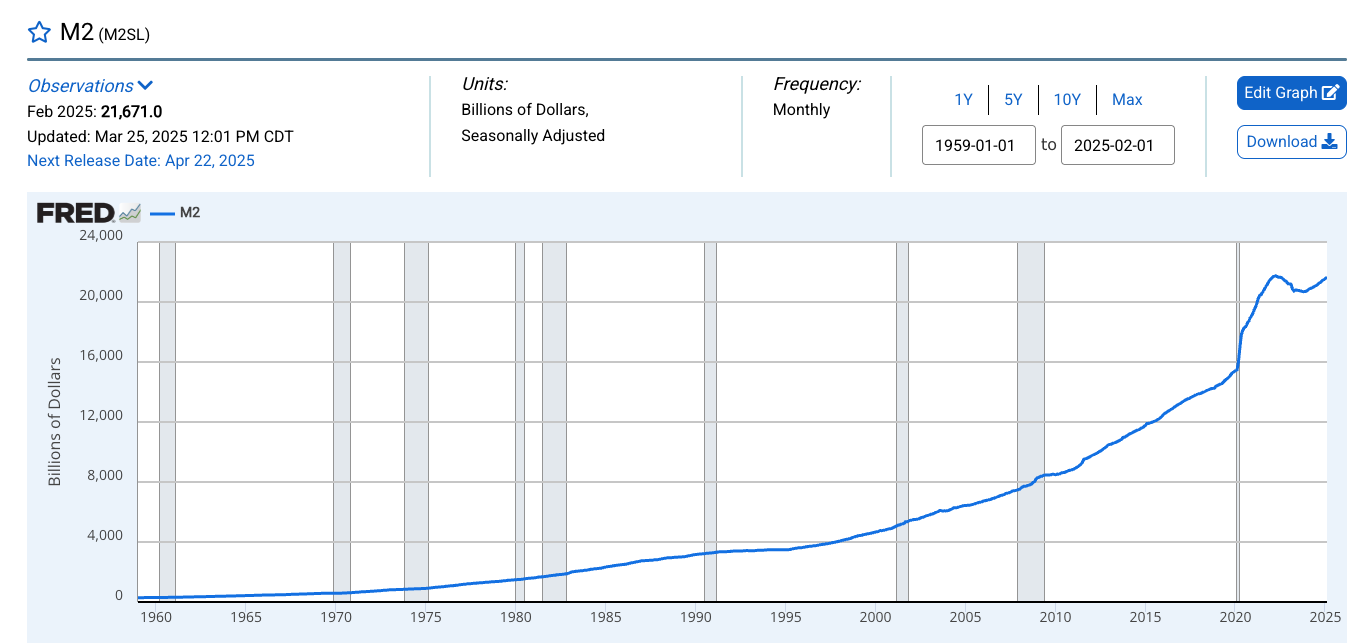
The M2 money supply bottomed a little over a year ago at $20.60 trillion. Since then, it has crept upward. As of February, it was at $21.67 trillion. That’s the highest level since June 2022 and approaching the all-time high of $21.72 trillion hit in the spring of that year.
The Chicago Fed National Financial Conditions Index also reflects this increasingly inflationary environment. As of the week ending March 7, the NFCI stood at -0.61. A negative number reflects historically loose financial conditions.
And the markets want even more looseness!
The fact is they’ve already gotten it.
Even though the Fed held interest rates steady during the March FOMC meeting, the central bank loosened its monetary policy, announcing a significant slowdown in its balance sheet reduction scheme.
This is a significant loosening of monetary policy. In fact, I would argue it is far more significant than a quarter-percent rate cut. As one analyst told CNBC, “The Fed indirectly cut rates today by taking action to reduce the pace of runoff of its Treasury holdings.” [Emphasis added]
With an even cooler CPI report in March, the Fed can plausibly loosen even more if they need to.
And they’ll probably need to.
It’s not even so much about tariffs. Nearly two decades of loose monetary policy blew the economy into a big, fat, ugly bubble waiting for a pin. Tariffs may be that pin. But even if they’re not, the pin is out there.
This underscores the problem facing the central bankers over at the Fed.
On the other hand, the central bank needs to cut rates because the economy is addicted to easy money. Given the levels of debt and the amount of malinvestment, the economy can’t function in this higher interest rate environment. It needs its easy money drug.
How Powell & Company will navigate this remains to be seen, but they can now plausibly crank up the inflation machine to try to keep the bubbles inflated.
Mike Maharrey is a journalist and market analyst for Money Metals with over a decade of experience in precious metals. He holds a BS in accounting from the University of Kentucky and a BA in journalism from the University of South Florida.
(Thérèse Boudreaux, The Center Square) President Donald Trump’s tax cuts are set for permanent extension after the House narrowly passed a $5.8 trillion over ten years concurrent budget resolution that seemed poised to fail.
If the Trump tax cuts expire, as they are set to do at the end of this year, the average taxpayer will see a 22% tax hike as well as their guaranteed deduction slashed in half. The child tax credit would also reduce from $2,000 per child to $1,000 per child, The Center Square previously reported.
House Speaker Mike Johnson, R-La., had to postpone the Wednesday night vote after too many Republicans balked around supporting the bill, which authorizes a $5 trillion debt ceiling increase.
The 216-214 vote held Thursday morning saw only two Republicans present voting no, Reps. Thomas Massie, R-Ky., and Victoria Spartz, R-Ind.
Johnson was able to convince all other hardliners to vote yes with promises of deeper spending cuts than the bill requires.
To do so, it changes the way the costs of extending the 2017 Tax Cuts and Jobs Act are calculated. By using a current policy baseline, which treats the extension as a continuation of current law rather than new policy, the Senate-revised resolution would theoretically subtract $3.8 trillion from the budget’s price tag.
The resolution also gives Senate committees an extra $1.5 trillion to spend and make Trump’s tax cuts permanent since it puts the costs of extension at zero.
Normally, the chambers adopt identical budget resolutions giving House and Senate committees the same savings targets before moving forward in the budget reconciliation process. But Thune and Johnson decided the quickest way to enact Trump’s priorities was by taking a two-tier approach that saves the alignment and other details for later.
Critics have called the use of current policy baseline a “gimmick.” The Congressional Budget Office has estimated the Senate’s plan will in reality add at least $37 trillion to the national debt over the next 30 years, a more than 100% increase from the current level.
The Committee for a Responsible Federal Budget warned that the Senate’s plan will add at least $5.8 trillion to the federal deficitover the next ten years, costing as much as the 2017 TCJA, CARES Act, American Rescue Plan, and Bipartisan Infrastructure Law combined.
“The Senate’s excuses – that they need flexibility, that this is just a step to unlock the process, that they promise they will come up with trillions of spending cuts – don’t hold water,” CRFB President Maya McGuineas said. “And their use of the egregious ‘current policy’ gimmick should show plainly to every fiscal hawk that they have no intention of actually coming up with the savings necessary.”
Democrats are saying that the concurrent resolution necessitates future cuts to Medicaid since it requires the House Energy and Commerce Committee to find $880 billion in spending cuts.
The passage of the resolution kicks off the budget reconciliation process in earnest, as House and Senate committees will begin crafting program-specific legislation fulfilling the spending and saving requirements to enact Trump’s tax, border, and energy agenda.
Houthi military spokesman Yahya Saree said on Wednesday that Yemeni forces were “able to shoot down an American MQ-9 drone while it was carrying out hostile missions in the airspace of Al-Jawf Governorate, using a suitable, locally manufactured missile.”
Fox News reporter Jennifer Griffin, who has sources in the Pentagon, confirmed that the drone was shot down. “This is the fourth MQ-9 Reaper drone shot down by the Houthis since March 3rd, and the fourth shot down under the Trump administration,” she wrote on X.
NEW: Another U.S. MQ-9 Reaper drone was shot down by the Houthis in Yemen, sources tell Fox News. This is the fourth MQ-9 Reaper drone shot down by the Houthis since March 3rd, and the fourth shot down under the Trump administration. It is the third U.S. MQ-9 drone shot down over…
Griffin recently reported that the US has been bombing Yemen using heavy B-2 bombers deployed to the US base on Diego Garcia in the Indian Ocean. “The US military has carried out 25 straight days of bombing, including with B-2 stealth bombers dropping bunker buster bombs, and yet the Houthis continue to fire missiles to shoot these expensive US assets down,” she said on Wednesday.
Saree said the incident marked the 18th American MQ-9 Reaper drone shot down by the Houthis since October 2023. At $30 million per MQ-9, that means $540 million worth of US drones have been lost if the Houthi number is accurate. The New York Times recently reported that the bombing campaign launched by President Trump on March 15 will soon have cost over $1 billion.
Saree also claimed more attacks on Israel and on US warships in the region and reaffirmed the Houthis would only back down if there were a ceasefire in Gaza and an end to the Israeli blockade on the country.
“The armed forces, as they fight this battle with valor, defiance, and faith, reaffirm, as they have affirmed over the past years, that great Yemen is resilient and will not back down from supporting and backing the oppressed Palestinian people,” Saree said. “It will not surrender to the American aggression, and will remain, as it was, and will always be a graveyard for invaders.”
(Luis Cornelio, Headline USA) Law enforcement authorities have released the arrest report of Karmelo Anthony, the black man accused of fatally stabbing Austin Metcalf—a white college teen with a 4.0 GPA—over a seat dispute at a California track meet earlier this month.
The report, released by the Frisco Police Department and shared Monday on X by journalist Sarah Fields, contradicts the left’s casting of Anthony as the real victim of the seat dispute on April 2. According to the report, Anthony threatened Metcalf before fatally stabbing.
I am literally receiving death threats for doing my job as a journalist and releasing an arrest report.
As Metcalf approached Anthony after seating in the wrong tent, Anthony “grabbed his bag, opened it and reached inside and proceeded to tell Austin, ‘Touch me and see what happens.’”
The report noted that no one “thought Anthony really had any weapons in his bag.” When Metcalf touched him, Anthony then allegedly escalated the dispute further by challenging him to punch him.
Shortly thereafter, Metcalf told Anthony to move again. However, the suspect produced what one witness described as a “black knife and stabbed Austin once in the chest and then ran away.”
Metcalf pleaded for help as he was critically wounded before succumbing to his injuries. He died in the arms of his twin brother, Hunter Metcalf. Anthony now faces a charge of first-degree murder.
Despite these stark details, Anthony’s family insists that the narrative around Metcalf’s death is “false, unjust, and harmful.”
“As a family of faith, we are deeply grateful for all of your support during this trying period. Your prayers and assistance mean more to us now more than ever,” the family wrote in a GiveSendGo fundraiser, asking for $350,000 in donations.
Thus far, the Anthony family has collected more than $293,000.
In contrast, a GoFoundMe to pay for Metcalf’s funeral arrangement has raised more than $150,000. Find the page below.
(Luis Cornelio, Headline USA) The DOJ allegedly continues to stonewall the Jeffrey Epstein files — even after President Trump ordered them released. Now, a GOP congresswoman wants answers.
Rep. Anna Paulina Luna, R-Fla., said in a Monday interview with former Rep. Matt Gaetz on his eponymous OANN show that the DOJ is blocking files that could expose years of abuse by Epstein, the late financier and convicted sex offender. The FBI and other agencies allowed Epstein to operate for decades with impunity, raising questions about whether he was a government asset.
“The one thing I’ve been very frustrated with, Matt, is that I have tried very hard to obtain the Jeffrey Epstein files. I have been contacting the Department of Justice. I’ve even chased down the FBI and I keep getting the same thing: ‘We are reviewing documents,’” Luna said.
The congresswoman criticized the DOJ for failing to release the documents at the same pace as records related to President John F. Kennedy and civil rights leader Martin Luther King Jr.
“I’m going to continue to put pressure on the DOJ to release that information,” Luna added. “Look, there’s bad people that haven’t been charged for doing really horrible things with underage people.”
When Gaetz asked Luna whether the DOJ has given her any timeline for the full release of the Epstein files, Luna said. “In fact, I haven’t really gotten any communication from the DOJ,” she added.
Luna also revealed that the DOJ has stalled her criminal referrals against the mayors of four sanctuary cities—Eric Adams of New York City, Michelle Wu of Boston, Brandon Johnson of Chicago and Mike Johnston of Denver. Luna said the DOJ acknowledged receipt of the referrals but has not responded on whether they will pursue criminal charges.
I just referred the sanctuary city mayors to the Department of Justice for CRIMINAL investigations based on evidence from their own comments and policies, proving that they were breaking federal law.
Open borders ideologies hurt people on both sides. If you hold federal office… pic.twitter.com/wt2swTOnru
The DOJ’s slow-walk is especially surprising given Trump’s clear calls for transparency, though he has acknowledged the need for procedural steps.In March, Trump defended Attorney General Pam Bondi, who herself criticized the agency’s delays in releasing the documents.
“Well, Pam Bondi has done a phenomenal job in every respect and there could have been some holdback. I haven’t heard too much about it, but there could have been. But the bottom line is the records are getting out,” Trump said, referring to the Epstein, JFK, and MLK files.
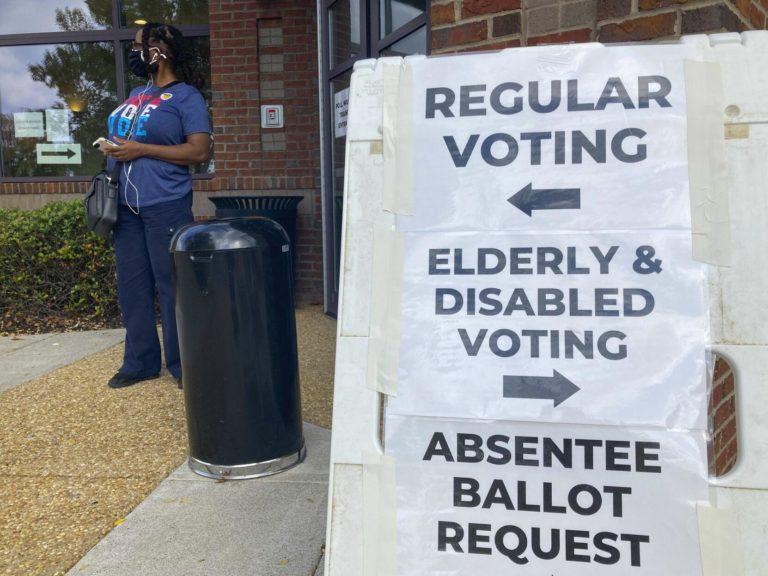
(Headline USA) The House passed one of Republicans’ signature issues for the year on Thursday, approving legislation to require proof of U.S. citizenship when registering to vote for federal elections, one of President Donald Trump’s top election-related priorities.
Nearly all Democrats lined up against the bill.
Trump has long signaled a desire to change how elections are run in the U.S. and last month issued a sweeping executive order that included a citizenship requirement among other election-related changes.
Republicans argued the legislation, known as the Safeguard American Voter Eligibility Act, is necessary to ensure only citizens vote in U.S. elections and would cement Trump’s order into law.
U.S. Rep. Bryan Steil, a Wisconsin Republican who chairs the House committee that handles election legislation, said during Thursday’s debate that the bill is meant to “restore Americans’ confidence in our elections” and prevent noncitizens from voting.
This marks Republicans’ second attempt at passing the SAVE Act. It passed the House last year but failed in the Senate amid Democratic opposition.
It’s unlikely to fare any better this year. While Republicans won control of the Senate last fall, they have a narrow majority that falls short of the 60 votes they would need to overcome a filibuster.
Republicans hammered on the issue during last year’s presidential election
The SAVE Act would require all applicants using the federal voter registration form to provide documentary proof of citizenship in person at their local election office. Among the acceptable documents are a valid U.S. passport and a government-issued photo ID card presented alongside a certified birth certificate.
Four Democrats voted in favor of the legislation: Reps. Ed Case of Hawaii, Henry Cuellar of Texas, Jared Golden of Maine and Marie Perez of Washington.
“The truth is, those who were registered to vote would still be able to vote under their current registration,” said Rep. Chip Roy, a Texas Republican who sponsored the bill. “We have mechanisms giving the state fairly significant deference to make determinations as to how to structure the situation where an individual does have a name change, which of course is often women.”