(Dave DeCamp, Antiwar.com) A new Pew survey has found that the majority of American adults — 53% — have an unfavorable view of Israel, a figure that has risen in recent years.
In March 2022, Pew conducted a similar poll that found 42% of US adults viewed Israel unfavorably. The rise in the negative view of Israel comes in the wake of Hamas’s October 7 attack and Israel’s unleashing of its genocidal war on the Gaza Strip, which Americans have been able to follow closely on social media.
Both polls showed that Democrats are more likely to have a negative view of Israel than Republicans. In the new survey, Pew found that 69% of Democrats view Israel unfavorably, while only 37% of Republicans do.
However, a negative view of Israel is much more common among younger Republicans. The poll found that 50% of Republicans aged 18-49 have a negative view of Israel, while only 23% of Republicans over 50 view Israel unfavorably.
The poll also found that 52% of American adults have little or no confidence in Israeli Prime Minister Benjamin Netanyahu’s ability to “do the right thing regarding world affairs,” while only 32% have confidence in him.
The increase of an unfavorable view of Israel among Americans could mean Israel is in trouble when it comes to long-term support from the US, and Israel’s military is extremely reliant on US assistance. A senior Israeli Air Force official said last year that without US support, the Israeli military could only sustain operations in Gaza for a few months.
The USCIS, which falls under the Department of Homeland Security (DHS), said it would start considering “aliens’ antisemitic activity on social media and the physical harassment of Jewish individuals as grounds for denying immigration benefit requests.”
The USCIS said it would immediately impact “aliens applying for lawful permanent resident status, foreign students, and aliens affiliated with educational institutions linked to antisemitic activity.”
The “antisemitic activity” is a reference to pro-Palestine protests on college campuses that have been labeled “antisemitic” despite the fact that Jewish students and organizations have been involved in the demonstrations.
When screening social media activity, the Trump administration is likely using a definition of antisemitism that includes criticism of Israel. In a 2019 executive order, which was referenced in the USCIS statement, President Trump directed all federal agencies to consider the International Holocaust Remembrance Alliance’s (IHRA) definition of antisemitism and the organization’s list of examples of “contemporary antisemitism” when enforcing Title VI of the Civil Rights Act.
The IHRA’s examples of “contemporary antisemitism” includes “drawing comparisons of contemporary Israeli policy to that of the Nazis.” It also lists applying “double standards” to Israel by “requiring of it a behavior not expected or demanded of any other democratic nation” and “denying the Jewish people their right to self-determination” by “claiming that the existence of a State of Israel is a racist endeavor.”
DHS Secretary Kristi Noem is a proponent of the IHRA definition. Last year, when she was still South Dakota’s governor, she signed a bill into law that required the IHRA definition of antisemitism to be considered in investigations of unfair or discriminatory practices within the state.
Critics of the Trump administration’s announcement pointed out that even if some social media activity was considered antisemitic under a traditional definition of the word, it would still be protected speech under the First Amendment.
“As of today, DHS is making it official policy to surveil social media for ‘antisemitic’ sentiment and deport noncitizens accordingly,” Jenin Younes, a civil liberties attorney, wrote on X. “Keep in mind that the Trump Admin has re-defined antisemitism to include criticism of Israel and Zionism, but anyway true antisemitic speech, just like racist, sexist, homophobic, transphobic & Islamophobic speech is 1A protected.”
Younes added that the US government “should have no role in policing social media for such speech & punishing the speakers.”
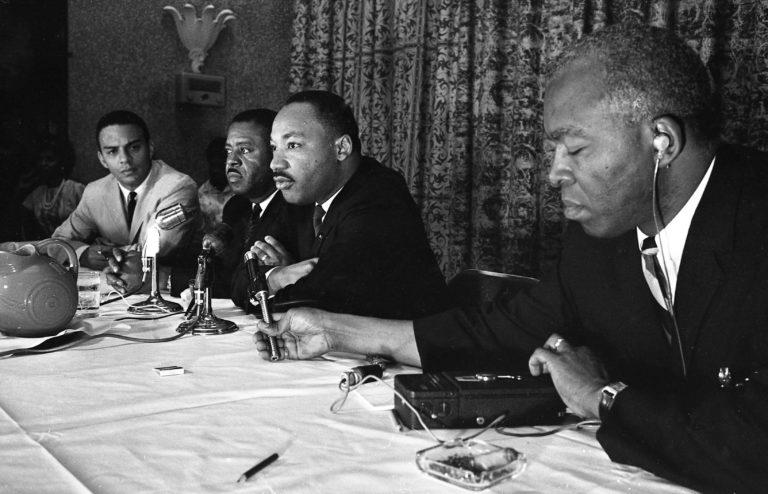
(Ken Silva, Headline USA) Last month, the U.S. government filed a motion to unseal FBI surveillance records of Martin Luther King Jr.—part of what the Trump administration touted as its commitment to government transparency.
However, earlier this month, the Southern Christian Leadership Conference—the organization founded by MLK Jr.—filed a response in opposition to the Justice Department’s to unseal. The SCLC says it is worried that revelations about King’s personal affairs could be used to damage his reputation.
The SCLC may have reason to be concerned. FBI records have been released in the past that accuse King of sexual misconduct.
But according to the SCLC, some of the FBI’s recordings “may be fake.” In its April 2 reply to the DOJ’s motion to unseal, the SCLC attached a sworn declaration from MLK Jr.’s eldest son, Martin Luther King III, raising concerns about potentially doctored recordings.
🚨UPDATE: MLK Jr's eldest son has filed a sworn declaration that the FBI's secret recordings of his father "may be fake." MLK III's declaration was made in the family's opposition to unsealing the recordings. Trump's DOJ recently moved to unseal, but the family is worried King's… https://t.co/q7FZarxRJgpic.twitter.com/TY8ujMjPvL
“We understand that the purpose of these recordings was to discredit our father and harm the civil rights cause that he championed. Some, perhaps many, of the recordings may be fake,” King III said in his sworn declaration.
“The FBI’s purpose in creating the documents the government seeks to unseal was to misinform the public and irreparably damage our father’s reputation and most importantly destroy the civil rights movement. Such an effort against a private citizen is unprecedented,” he said.
“In fact, such surveillance has not been perpetrated even against military or elected officials, even those residing in government property. Notably, my father did not hold elected office.”
SCLC and King’s family seek a hearing to argue over whether the FBI recordings should be unsealed. The DOJ has yet to reply to their response.
The DOJ’s motion to unseal the FBI recordings was made in a lawsuit filed by King associate Bernard Lee and the Southern Christian Leadership Conference all the way back in June 1976.
The lawsuit stems from allegations that the FBI unconstitutionally monitored the conversations of King and other Conference members. In 1977, U.S. judge dismissed the lawsuit, but ordered the FBI to provide surveillance tapes and related documents to the National Archives as a “compromise.”
Those recordings and documents were sealed by court order in 1977 for 50 years, and were set to remain classified until January 31, 2027.
In its motion, the U.S. government referenced a January executive order issued by President Donald Trump. The order called for a review and release of documents connected to the assassinations of prominent figures, including MLK.
The government said it believes there is strong public interest in understanding MLK’s assassination and sufficient time has passed since the records’ creation for the government to come clean about the FBI’s role in spying on the civil rights leader.
“The Court should unseal the tapes and documents about the FBI’s surveillance and wiretapping of the Reverend King and the Conference so that the Attorney General may review them, identify any records about the assassination of the Reverend King, and release those records in compliance with the President’s executive order,” DOJ lawyers said.
(Mike Maharrey, Money Metals News Service) Significant amounts of gold flowed into gold ETFs for the fourth straight month in March, driving assets under management (AUM) to a new month-end record.
Funds in every region reported inflows of gold, with North American ETFs leading the way.
Globally, gold-backed funds added 92 tonnes of gold to their reserves last month. That drove total ETF holdings to 3,445 tonnes. This was the highest month-end level since May 2023 and just 470 tonnes shy of the record of 3,915 tonnes set in October 2020.
Through the first quarter, gold ETFs reported a 226-tonne increase in gold holdings totaling $24 billion. It was the second-highest quarterly increase in dollar terms.
North American funds added 67.4 tonnes of gold in March, totaling $6.5 billion. According to the World Gold Council, strong price momentum driving gold to over $3,000 an ounce, rangebound yields, a weaker dollar, tariff war uncertainty, equity pullbacks, and concern about economic growth all drove gold investment last month.
European ETFs reported inflows of 13.7 tonnes of gold in March. Funds based in the UK, Switzerland, and Germany led the way. According to the World Gold Council, “A cloudy growth outlook further weighed by U.S. tariff concerns, weak stock market performance, and the gold price surge drove demand higher in the UK.” Concerns about a massive government spending plan in Germany drove a safe haven bid there. Another European Central Bank rate cut also provided tailwinds for gold.
Gold flowed into Asian funds for the fourth straight month, with holdings increasing by 9.5 tonnes. China and Japan dominated demand in March. Rocketing gold price performance dwarfed other assets last month, sparking investor interest in gold. Inflation worries in Japan also contributed to demand. Indian-based fund reported modest outflows, likely due to profit-taking.
Funds in other regions, including Australia and Africa, report gold inflows of 1.3 tonnes.
ETFs are relatively liquid. You can buy or sell an ETF with a couple of mouse clicks. You don’t have to worry about transporting or storing metal. In a nutshell, it allows investors to play the gold market without buying full ounces of metal at the spot price.
Since you are just buying a number in a computer, you can easily trade your ETF shares for another stock or cash whenever you want, even multiple times on the same day. Many speculative investors take advantage of this liquidity.
But while a gold ETF is a convenient way to play the price of gold on the market, you don’t actually possess any gold. You have paper. And you don’t know for sure that the fund has all the gold either, especially when the fund sees inflows. In such a scenario, there have been difficulties or delays in obtaining physical metal.
Mike Maharrey is a journalist and market analyst for Money Metals with over a decade of experience in precious metals. He holds a BS in accounting from the University of Kentucky and a BA in journalism from the University of South Florida.
(Mike Maharrey, Money Metals News Service) Talk about a roller coaster. After plunging for several days, stocks soared Wednesday afternoon after President Trump announced a tariff pause. The S&P 500 rocketed 9 percent, charting its third-largest single-day gain since World War II.
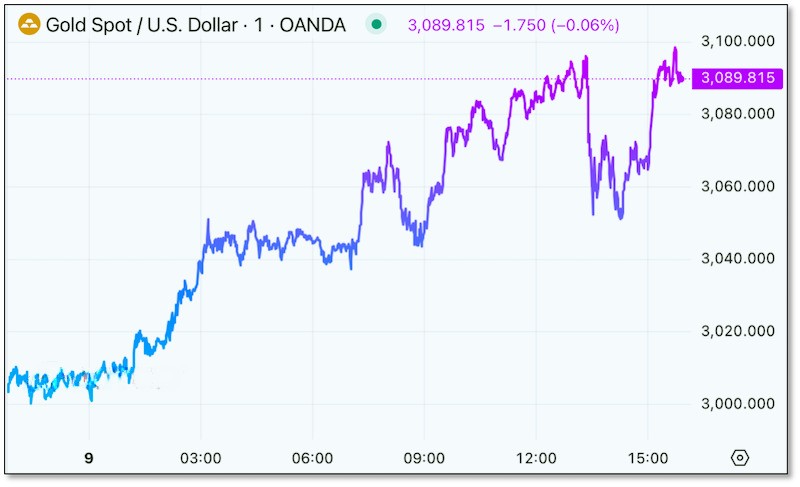
Gold also whipsawed, having dipped below $3,000 an ounce, the yellow metal regained much of its loss and closed over $3,100.
It’s hard to get a handle on what will happen next.
The only thing that seems certain is uncertainty.
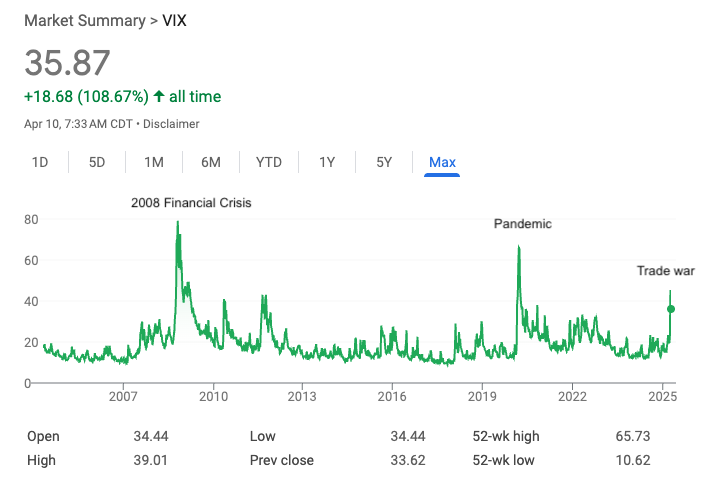
Market volatility skyrocketed with the launch of the trade war. The VIX volatility index spiked to 57.85 on April 9. For perspective, it rose to 66 during the early days of the pandemic and 79 in October of 2008.
While the volatility index cooled somewhat after the announcement of the tariff pause, there is still plenty of uncertainty and jitteriness in the market. We’re just one announcement away from another round of market chaos.
Do you know what markets and businesses don’t like?
Uncertainty.
What Is Regime Uncertainty
We are in a period of extreme regime uncertainty. Whether you’re an investor, a business owner, or an entrepreneur, it’s extremely difficult to plan for the future under these conditions.
Regime uncertainty describes a lack of confidence in the direction of a government’s future policies regarding taxes, regulations, and, in more extreme situations, the protection of property rights and the consistent application of the rule of law.
When people become unsure about what the government will do next, or if they fear a sudden shift in rules, it discourages long-term investment and economic activity.
Regime uncertainty tends to foster “analysis paralysis.” People fixate on trying to figure out what might happen next and end up doing nothing, instead taking a “wait and see” attitude.
For instance, during the Great Depression, President Franklin D. Roosevelt created a great deal of regime uncertainty as he implemented the New Deal. Regulations and policies turned on a dime. Businesses became unsure about the federal government’s increasing intervention in the economy through price controls, taxes, labor laws, and other economic policies.
Economist Robert Higgs argued that this “regime uncertainty” prolonged the Great Depression by discouraging private investment. As he put it, “Between 1935 and 1940, this matter attained prime importance. So many businessmen and investors lost confidence in their ability to forecast the future property-rights regime that few were willing to venture their money in long-term investments.”
The bottom line is that long-term economic growth depends on predictable rules. Sudden shifts in taxation, regulation, or property rights make businesses defensive.
While not rising to the level of FDR, Trump’s negotiating tactics are a breeding ground for regime uncertainty. Will the 90-day pause really last 90 days? Will exceptions be introduced? What happens in 90 days?
Nobody knows.
Navigating Regime Uncertainty
How do you navigate this kind of uncertainty?
If you’re running a business, especially one that relies on imports, I don’t know what to tell you.
But investors can weather this storm by keeping a few things in mind.
Don’t panic. You’re going to see big swings in the market. Resist the temptation to react knee-jerk to the daily roller coaster ride. It’s easy to get caught up in emotion. Don’t.
Focus on fundamentals. The trade war is happening within a broader context. Those fundamentals remain in place. We still have an inflation problem. We still have de-dollarization. We still have a lot of bubbles in the market. We still have massive amounts of debt. The laws of supply and demand remain firmly in place. It’s important to focus on the big picture and not get too caught up in the latest headline.
Gold and silver are a beacon of stability. That’s not to say that the price won’t swing wildly from day to day. But gold and silver are fundamentally money. They have been money for over 5,000 years, and they will continue to be money when the trade war is a distant memory. Gold and silver are the ultimate safe haven bids. They are generally insulated from regime uncertainty because there is no counterparty risk.
There is no telling what tomorrow will bring. But you can be sure that gold and silver will still be valued and desired around the world.
Mike Maharrey is a journalist and market analyst for Money Metals with over a decade of experience in precious metals. He holds a BS in accounting from the University of Kentucky and a BA in journalism from the University of South Florida.
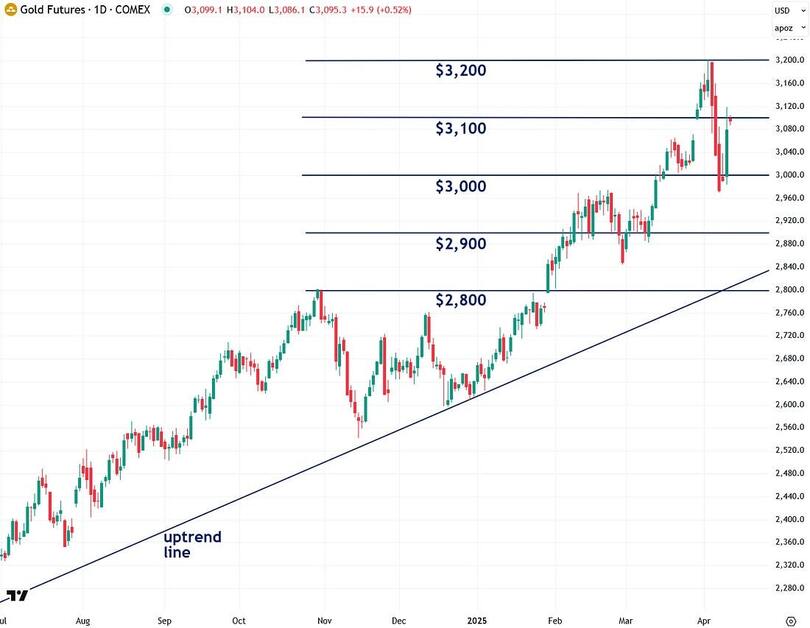
(Jesse Colombo, Money Metals News Service) As the wild ride continues in all markets, let’s take a look at COMEX gold futures to assess where things stand. I focus on COMEX futures because key support and resistance levels tend to form cleanly at $100 intervals—$3,000, $3,100, $3,200, and so on.
I’m pleased to see that gold surged nearly $100 per ounce yesterday, bouncing directly off the $3,000 support level. Gold is looking strong here, now trading only $80 below its all-time high.
My view is that it will likely consolidate in this area for a bit, gathering strength. Ideally, I’d like to see it make a strong move toward its record high around $3,200—and eventually break through it. From there, the upside potential should be explosive, especially as the broader economic picture continues to deteriorate, regardless of how the tariff drama plays out.
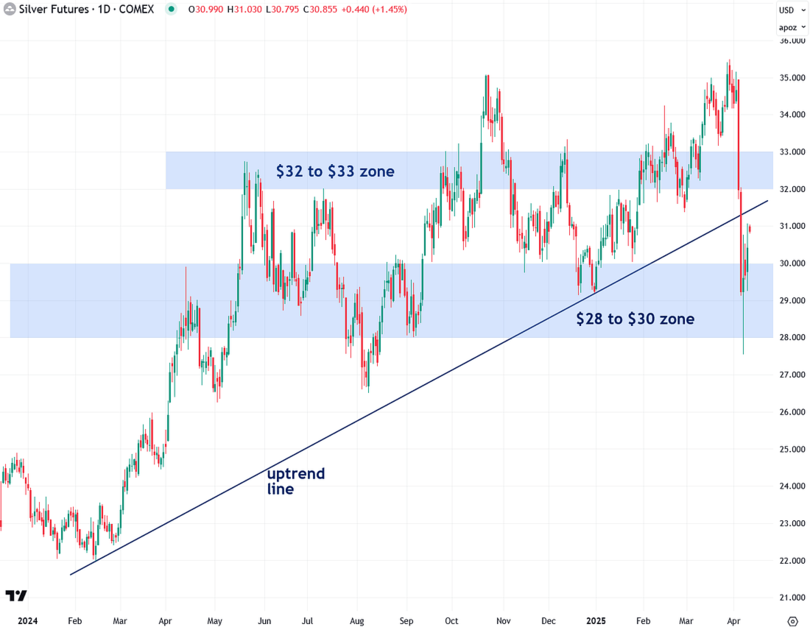
I’m encouraged to see COMEX silver futures bounce off the $28–$30 support zone I highlighted in my most recent precious metals update. Ideally, I want to see that support hold firmly from here.
The next key test is whether silver can reclaim the uptrend line it broke below on Friday and resume the bullish path it was on before being aggressively knocked down by bullion banks. That said, I still firmly believe silver will soon break free from this suppression and follow gold’s lead.
I’m pleasantly surprised by the resilience and strength the mining stock sector has shown despite the recent brutal precious metals ambush.
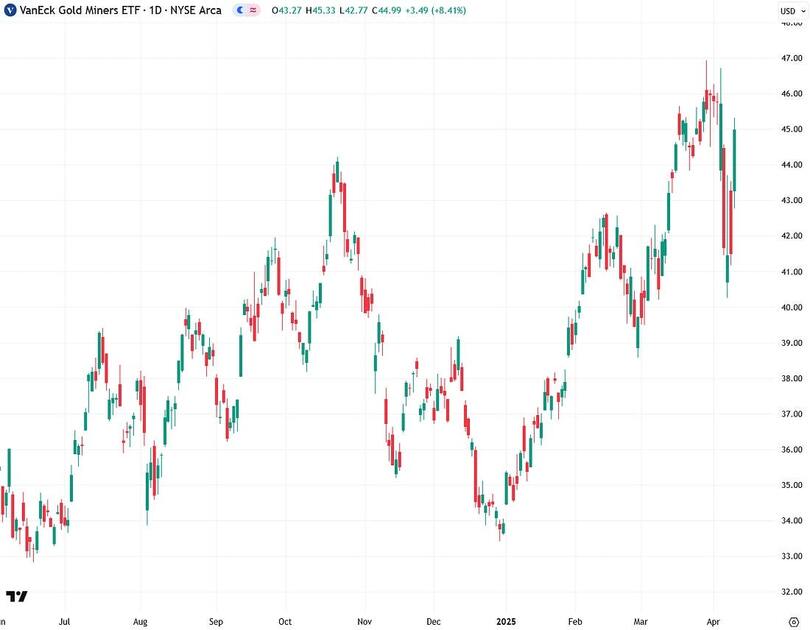
Take the large-cap VanEck Gold Miners ETF (GDX), for example—it’s already rebounding sharply and is now approaching the same levels it held before the downturn.
It looks poised to challenge the key $42–$46 horizontal resistance zone. If GDX can break through that zone, I see it launching into a powerful bull market from there. I’ll definitely be watching that scenario closely.
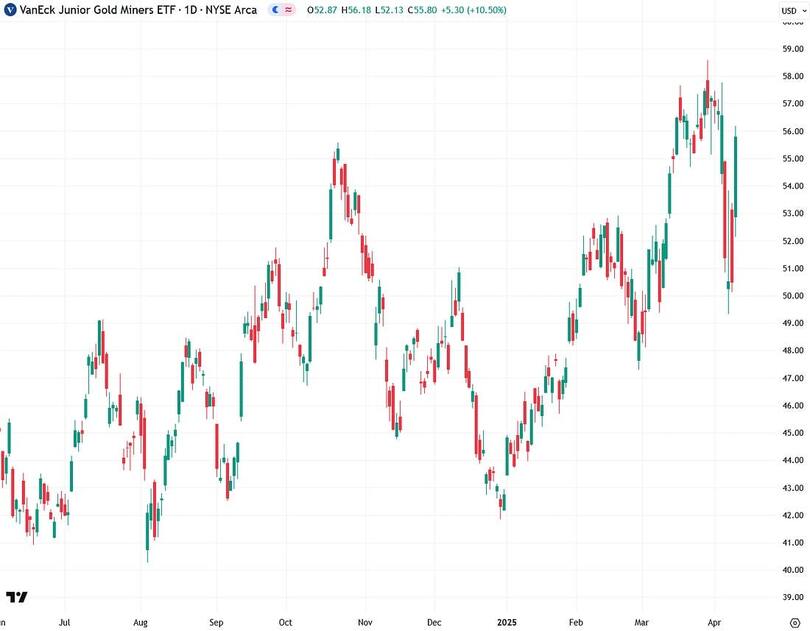
The VanEck Junior Gold Miners ETF (GDXJ) is also rebounding strongly, now trading near its recent highs and testing the key $50–$60 resistance zone. A breakout above this level would open the door to significantly more upside.
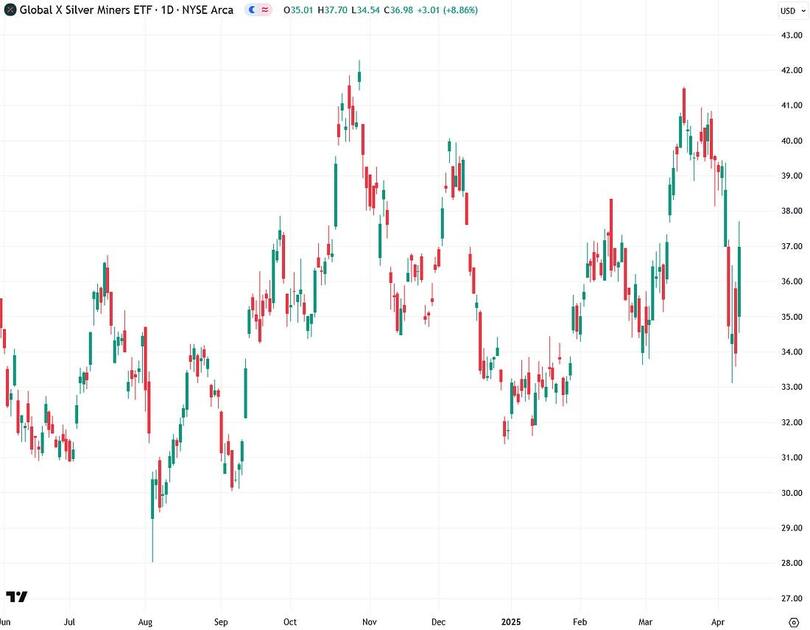
The flagship Global X Silver Miners ETF (SIL) is also recovering nicely. If it can close above the key $48–$52 resistance zone, I believe it will mark the beginning of a full-blown bull market.
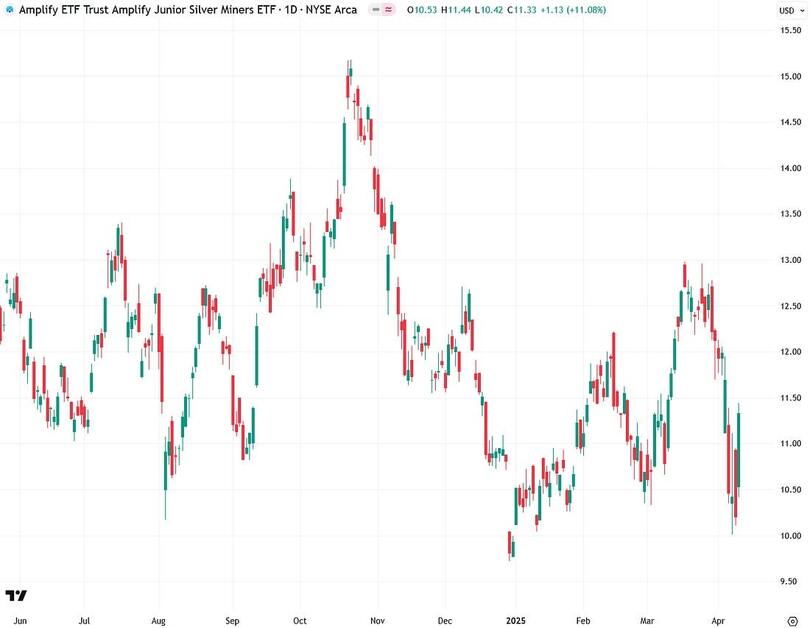
The Amplify Junior Silver Miners ETF (SILJ) also saw a strong rebound yesterday and appears poised to make another attempt at breaking out of a long-term triangle. A successful breakout would signal the start of a major bull market.
In summary, yesterday was another wild and volatile day—this time to the upside—but it leaves me with an uneasy feeling.
Beneath the surface, the same serious issues remain: a looming recession, unprecedented levels of debt, and massively inflated asset bubbles hanging over us like the Sword of Damocles. The ongoing back-and-forth over tariffs ensures that market volatility is here to stay for the foreseeable future.
In times like these, I’m grateful to take refuge in physical gold and silver. They’re proving their worth while most other assets are revealing their true nature as anything but safe havens. I believe we’re only beginning to see gold and silver step into their rightful role in this shifting financial landscape.
Jesse Colombo is a financial analyst and investor writing on macro-economics and precious metals markets. Recognized by The Times of London, he has built a reputation for warning about economic bubbles and future financial crises. An advocate for free markets and sound money, Colombo was also named one of LinkedIn’s Top Voices in Economy & Finance. His Substack can be accessed here.
(Money Metals News Service) As global markets react to trade tensions and tariff rumors, the real story may lie beneath the headlines.
In the latest Money Metals Midweek Memo, host Mike Maharrey argues that while tariffs dominate the financial news cycle, they’re just a subplot in a much deeper economic drama—one driven by monetary malfeasance and the long-term consequences of easy money.
On Monday, gold dipped below $3,000/oz, then rebounded to $3,083/oz by Tuesday morning. The VIX volatility index surged to 57.85, approaching levels seen in the early days of the pandemic (66) and the 2008 financial crisis (79).
A fleeting rumor that President Trump would pause tariffs for 90 days sparked a stock market rally—only to be quashed within 30 minutes. Maharrey emphasized that this level of uncertainty paralyzes entrepreneurs, investors, and businesses alike.
“Uncertainty is almost worse than a bad policy,” Maharrey notes. “It’s impossible to make smart decisions when you don’t know what the rules will be in two days.”
The Bigger Picture: Monetary Policy, Not Just Tariffs
Though tariffs have sparked recent market turmoil, Maharrey warns they may be merely the pin that pops a much larger stock market bubble—a bubble decades in the making.
At the heart of the issue? The U.S. economy’s addiction to easy money. Since the 2008 financial crisis, the Federal Reserve has inflated asset prices through low interest rates and quantitative easing (QE). Maharrey suggests that without these artificial policies, the market would have faced a full-blown crisis years ago.
“It’s a bubble economy fueled by monetary malfeasance,” Maharrey explains. “Every bubble needs a pin—and tariffs might just be it.”
Current ratio: ~12.5:1 (i.e., 12.5 oz of gold to buy the Dow).
Historical low: 1:1 in 1980, during gold’s last historic bull run.
Peak in 2000: 43:1, fueled by the dot-com bubble.
Maharrey explains that when this ratio falls, it often precedes or coincides with a financial crisis or major correction. A return to 5:1 could imply $7,500/oz gold, even if the Dow holds steady. If the Dow falls to 20,000, the gold price could still reach $4,000/oz.
“A breakdown in this ratio might signal a major opportunity: it could be time to rotate out of stocks and into gold.”
Silver: Historically Undervalued and Set for Gains
The Gold-to-Silver Ratio is currently over 100:1, far above its modern historical average of 40:1 to 60:1. Maharrey points out that during previous gold bull markets, silver has outperformed, especially in the later stages.
“Silver is significantly undervalued compared to gold. Based on historical metrics, it’s a bargain right now.”
Easy Money: The True Driver of Market Bubbles
Tracing the last several decades, Maharrey outlines a repeating cycle:
The Fed loosens monetary policy (low rates, Quantitative Easing).
Asset prices inflate (stocks, real estate, etc.).
The Fed tightens policy.
Markets crash.
The Fed loosens again—this time with even more stimulus.
This pattern has repeated through the dot-com crash, 2008 financial crisis, and COVID-19 pandemic. The pandemic, he argues, gave the Fed cover to “go nuclear” with QE, artificially inflating markets once more.
“It takes more and more of the easy money drug to keep the economy high. And it always shows up somewhere—stocks, real estate, even Bitcoin.”
“When dollars are rejected, gold still buys,” he says.
Final Thoughts: Prepare Before the Next Crisis
Whether or not tariffs subside, Maharrey believes a larger reckoning is inevitable. The stock market remains overvalued, easy money policies are unsustainable, and the Dow-to-Gold Ratio is flashing warning signs.
Investors, he argues, should take steps now:
Consider rotating out of overvalued equities.
Increase exposure to gold—and especially silver.
Don’t wait for the next crisis to get your lifeline in place.
“It’s not too late. But when chaos hits, you’ll wish you had real money in hand.”
Call to Action
For personalized guidance, contact a Money Metals precious metals specialist at 1-800-800-1865, or visit MoneyMetals.com to shop, chat online, or learn more.
Stay informed. Subscribe to the Midweek Memo and the Friday Market Wrap Podcast for weekly insights and interviews from the world of sound money, gold, and investing.
But that’s precisely what greeted me as I switched on CNBC this morning.
Shades of October 2008… and March 2020!
Over the past week, we’ve seen similarities with those two previous crises in that gold and silver have been alternately sold off as investors desperately raised cash for margin calls, and then bouncing higher as traders bet on more mayhem and easier money.
Today (or rather, last night) we got another throwback — the feeling that the global financial system was in danger.
That’s because, contrary to the wishes and the strategy of the Trump administration, Treasury yields spiked overnight.
As our friend (and New Orleans Conference alum) Jim Bianco posted on X this morning:
Something has broken tonight in the bond market. We are seeing a disorderly liquidation.
If I had to GUESS, the basis trade is in full unwind.
Since Friday’s close to now … the 30-year yield is up 56 bps, in three trading days.
The last time this yield rose this much in 3 days (close to close) was January 7, 1982, when the yield was 14%.
This kind of historic move is caused by a forced liquidation, not human managers making decisions about the outlook for rates at midnight ET.
The “basis trade” has been a darling of hedge funds, which bet on the arbitrage between spot Treasury yields and futures, using massive leverage on this tiny spread to get enough torque to make it worthwhile.
It’s the kind of trade that emerges when there are vast oceans of liquidity sloshing around the markets looking for any advantage. And those oceans are the result, as I’ve been writing ad nauseam, of decades of ever-easier monetary policies.
It’s also the kind of trade that can go radically south on an unexpected turn in the markets, as will happen when the rest of the world decides to sell anything associated with the U.S. and its currency.
What Alan Greenspan Warned Me Of…
It reminds me of a conversation I had with Alan Greenspan about a decade ago.
I was sharing my concern over the expanding federal debt, which was at that time just a fraction of today’s level, but still worrisome to me.
Greenspan shared my worries about the federal debt but then confided that what really concerned him was the derivative exposure of the “too big to fail” institutions. Nominally, that exposure is denominated not in trillions, but somewhere above a quintillion.
As Greenspan pointed out to me, even those institutions couldn’t get a handle on their liabilities, since their derivatives were interconnected with those held by other institutions…and all their exposure was now backed by Uncle Sam!
The crack-up of the Treasury basis trade, along with nations and global investors shedding their U.S. exposure to equities, Treasurys, and the dollar, directly impacts that derivative market.
After trading off of its morning highs for a while, gold is now rocketing higher again. And so are U.S. equities, as the Trump administration has announced a 90-day pause in the reciprocal tariffs…although China is still in the crosshairs thanks to their retaliatory responses.
The rally in gold today, as well as over the past year or so, has been nothing short of remarkable. As you know, now and then over this new bull market, I’ve rhetorically pondered, “What is gold telling us?”
Is it seeing stagflation ahead, with the trade war bringing a recession along with higher inflation? Yes.
Is it the Fed’s debt trap, with over $9 trillion of Treasurys that need to be refinanced this year at much higher interest rates? Yes.
Is it the teetering bond market and the risk of contagion endangering the global financial system? Yes.
Is it a global flight from dollar hegemony, not only central banks but investors across the globe? Yes.
In short, gold has been telling us that it’s not one thing. It’s everything.
After decades of ever-easier money, ever-greater financialization and globalization, ever-larger debts, and more, gold remains the only thing that protects against everything.
The good news is that not only are gold and silver soaring, but investors are finally jumping onto the mining stocks to gain exposure to the already high metals prices.
To get Brien Lundin’s ongoing commentary on the markets at no charge, click here to subscribe to his free Golden Opportunities newsletter.
Brien Lundin is the publisher and editor of Gold Newsletter, the publication that has been the cornerstone of precious metals advisories since 1971. Mr. Lundin covers not only resource stocks but also the entire world of investing. He also hosts the annual New Orleans Investment Conference. To get Brien Lundin’s ongoing commentary on the markets at no charge, click here to subscribe to his free Golden Opportunities newsletter.
(Kyle Anzalone, Libertarian Institute) President Donald Trump made ending the war in Ukraine a top talking point on the campaign trail and has worked to bring Kiev and Moscow to the table over the first two months of his second term. However, the talks have not reduced the fighting on the ground.
On Tuesday, the Russian Defense Ministry announced that its forces had driven Ukrainian troops from the village of Guyevo, located in Russia’s Kursk region, which was targeted by a Ukrainian offensive last summer.
The village was Ukraine’s most significant stronghold remaining in Kursk. Over the past month, Russia has made rapid gains in the region.
While Ukrainian forces are being driven from Kursk, President Volodymyr Zelensky said his troops are active in a second Russian border region. “We continue to carry out active operations in the border areas on enemy territory, and that is absolutely just – [the] war must return to where it came from,” he explained on Monday.
Ukrainian sources speaking with CNN said that Russian forces had stepped up attacks across the frontlines. Moscow claims its troops advanced in a number of regions along the front.
Ukrainian soldiers say they are losing territory as they are significantly outnumbered by Russian forces. “Sometimes there are 10 Russian occupiers for one of our infantrymen,” a representative of Ukraine’s 66th Separate Mechanized Brigade told the Kyiv Post. “The Russians are pressing with an incredible amount of infantry, which they simply have a lot of.”
The military official explained that in recent months, his brigade lost two battalion-sized units.
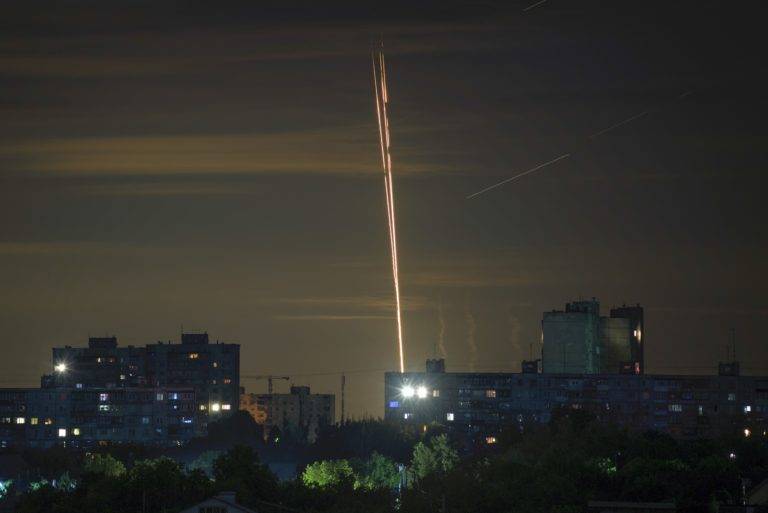
Along with the fighting on the frontlines, Kiev and Moscow continue to trade missile and drone attacks. On Wednesday, the Russian Defense Ministry claimed to have hit 150 Ukrainian targets with drones and missiles in a single day. The ministry reported downing over 150 Ukrainian drones over the same period.
The increase in fighting comes despite Trump’s push to end the war in Ukraine. US mediators have engaged in separate talks with Ukrainian and Russian officials, resulting in agreements to end attacks on energy infrastructure and shipping in the Black Sea. However, Kiev and Moscow have traded accusations of ceasefire violations and the status of the agreement is now unclear.
Russia’s Ambassador to the UN Vasily Nebenzya said the Kremlin remained interested in an agreement with Kiev, but only one that would resolve the conflict permanently. He added that Ukraine must not use any pause in fighting to re-arm.
“We are open to a meaningful and practical dialogue, but we will not allow anyone to deceive us or to use this negotiation process, directly or indirectly, to enhance the military potential of the Kiev regime,” he told the UN Security Council earlier this week. “To achieve this, it is essential to address the root causes, one of which is the influx of Western weapons into Ukraine. As we all know, this flow began long before the start of our special military operation and was facilitated under the cover of the Minsk agreements.”
The US and Russia are set to engage in another round of talks in Turkey on Thursday. According to Russian Foreign Ministry spokeswoman Maria Zakharova, the delegations will be led by Russian Ambassador to the United States Alexander Darchiyev and US Deputy Assistant Secretary of State Sonata Coulter.
Zakharova said the talks would focus on removing any obstacles slowing diplomacy between Russia and the US.
This article originally appeared at The Libertarian Institute.
“If it requires military, we’re going to have military,” Trump told reporters in the Oval Office when asked if the US would attack if a nuclear deal isn’t reached with Iran.
“Israel will obviously be very much involved in that — it’ll be the leader of that. But nobody leads us. We do what we want to do,” he added.
Trump’s latest threat comes ahead of negotiations between the US and Iran that will be held in Oman this Saturday. The talks will be attended by Iranian Foreign Minister Abbas Araghchi and Trump’s Middle East envoy, Steve Witkoff.
Trump has insisted the talks will be direct negotiations, while Aragchi has said they will be indirect, meaning Omani mediators will pass messages between the two sides. Reports have said that Iran would need a goodwill gesture from the US to hold direct talks, such as the removal of some sanctions. But the Trump administration continues to impose sanctions andadded new ones on Wednesday.
Iranian President Masoud Pezeshkian restated Iran’s long-standing pledge in comments on Wednesday. “We are not after a nuclear bomb,” Pezeshkian added. “You have verified it 100 times. Do it 1,000 times again,” he said.
Pezeshkian also said that Iranian Supreme Leader Ayatollah Ali Khamenei was not opposed to US investment in Iran. “His excellency has no opposition to investment by American investors in Iran,” he said. “American investors: Come and invest.”