(Ken Silva, Headline USA) Judge Aileen Cannon is allowing the Justice Department to keep evidence about the assassination attempt against Donald Trump secret on the grounds that it could harm U.S> national security, she said in a Friday order.
Judge Cannon’s ruling came in response to a motion from the DOJ to keep classified evidence hidden in the case of Ryan Routh, who allegedly tried killing Trump at his Florida golf course last September. Routh wasn’t allowed to see the classified evidence at issue, nor was he allowed to even see the DOJ’s motion or to attend a secret hearing on the matter.
Judge Cannon didn’t elaborate in her ruling, saying simply that disclosing classified information in Routh’s case “could cause serious damage or exceptionally grave damages to the national security of the United States.”
🚨NEW: Judge Aileen Cannon has allowed the DOJ to keep evidence in alleged would-be Trump assassin Ryan Routh's case SECRET on the grounds that "its disclosure could cause serious damage or exceptionally grave damages to the national security of the United States." Not even Routh… https://t.co/qGtP9EXN2mpic.twitter.com/wPsPVrJRw8
The classified evidence in Routh’s case could relate to his 2022 trip to Ukraine, where he attempted to recruit volunteers to fight in the U.S. proxy war against Russia. Routh said in his 2023 self-published book that his “best partner” in Ukraine was an Israeli, and the DOJ later accused him of trying to buy a rocket launcher from a purported Ukrainian as part of his plot. In addition, Routh had been communicating with Afghan commandos living illegally in Iran, as well as other Afghans in Mexico.
The DOJ’s secret motion and Judge Cannon’s Friday order are made pursuant to the Classified Information Procedures Act, which allows the U.S. government to keep state secrets just that: secret—even if it negatively impacts the rights of a defendant.
Indeed, Section 4 of the CIPA “authorizes federal district courts to deny, or otherwise restrict, discovery of classified documents and information,” according to the DOJ. Instead of having to provide a defendant with access to the actual classified evidence, the DOJ is allowed to summarize such evidence under Section 4 of CIPA.
In December, the DOJ filed a similar motion to keep classified information secret in the case of Asif Merchant, the Pakistani man who allegedly tried hiring two hitmen in an Iranian-sponsored assassination plot against Trump.
🚨IMPORANT: The DOJ has signaled that it will exercise its "state secrets privilege" to suppress evidence in the case of Asif Merchant, the the Pakistani who tried hiring 2 undercover FBI agents in the so-called Iran assassination plot against Donald Trump.
As Headline USA has detailed, the notion that Iran conspired to assassinate Trump is highly dubious. In the Merchant case, the two hitmen he attempted to hire were undercover FBI agents introduced to him by one of their informants. Merchant appears to have been an unwitting dupe in an FBI sting operation.
However, the evidence that would prove whether Merchant was a legitimate assassin or an FBI patsy may never see the light of day, thanks to CIPA.
Ken Silva is the editor of Headline USA. Follow him at x.com/jd_cashless.
(Thérèse Boudreaux, The Center Square) Newly declassified intelligence documents indicate that Hillary Clinton, her 2016 presidential campaign managers, and a top member of a George Soros group plotted to fabricate the Trump-Russia collusion campaign to distract the public from Clinton’s email scandal.
Declassified by the Senate Judiciary Committee on Thursday, the 29-page “Durham annex” from 2023 chronicles the Office of Special Counsel’s (OSC) investigation into purported efforts by the Clinton campaign and its allies to falsely tie Russia’s cyber interference attempts during election season to Trump.
In its investigation, OSC uncovered emails that appeared to be sent by Leonard Benardo, senior vice president of Soros’ Open Society Foundations, to people involved in Clinton’s campaign. Soros is a billionaire funder of Democratic campaigns.
The emails appear to show that Benardo engaged in discussions with Julianne Smith, one of Clinton’s foreign policy advisors, about how to use reports of Russian interference in the election to Clinton’s advantage and Trump’s detriment. Benardo later told OSC he had no recollection of writing the emails.
In an email dated July 25, 2016, Benardo told an undisclosed person that “politicization is on the table” and that he and Smith had been discussing ways to create a story casting Trump as “an agent of influence” in Russian President Vladimir Putin’s attempts to undermine the election “in the interest of Donald Trump.”
“Julie [Smith] says it will be a long-term affair to demonize Putin and Trump. Now it is good for a post-convention bounce. Later the FBI will put more oil on the fire,” Benardo wrote, indicating that Clinton’s campaign planned to use the FBI to push the story.
While the FBI established early on that Putin ordered “cyber influence operations” to undermine faith in the U.S. democratic process, it found no evidence that Putin interfered on behalf of Trump.
The Clinton campaign’s goal, it appeared, was to divert Americans’ attention away from her email scandal, since “Hillary is hardly good-looking as far as credibility is concerned,” Benardo added.
Clinton served as Secretary of State under the Obama administration from 2009 to 2013, where she used a private email server for official agency communications, putting thousands of emails with sensitive or classified information at risk.
According to a follow-up email by Benardo dated two days later, Clinton personally approved of the plan to fabricate the Trump-Russia collusion.
“HRC approved Julia’s idea about Trump and Russian hackers hampering U.S. elections. That should distract people from her own missing email, especially if the affair goes to the Olympic level,” Benardo wrote.
“The point is making the Russian play a U.S. domestic issue. Say something like a critical infrastructure threat for the election to feel menace since both POTUS and VPOTUS have acknowledged the fact IC would speed up searching for evidence that is regrettably still unavailable,” he clarified.
Upon finding the emails, the Office of Special Council questioned Benardo, who told them he did not know who “Julie” referred to and he did not draft the emails “to the best of his recollection.”
Clinton, when questioned by OSC, said the plan she apparently approved “looked like Russian disinformation.” Campaign Chair John Podesta and other advisors each denied the validity of the emails and each called the emails “ridiculous.”
Smith was also interviewed and said she recalled neither drafting or receiving the emails nor proposing a plan to Clinton or other campaign leadership to try tying Putin to Trump. She also denied enlisting the FBI to further such efforts.
But OSC found that the verified communications between Smith and campaign advisors implied otherwise. The same day Benardo purportedly sent the email about how the FBI “will put oil on the fire,” Smith texted a Clinton campaign advisor and asked them to “see if [Special Assistant to the President and National Security Council member] will tell you if there is a formal fbi or other investigation into the hack?”
The Clinton campaign advisor, whose name is redacted, replied that the person in question “won’t say anything more to me. Sorry. Told me she went as far as she could.”
Ultimately, OSC determined that “it is a logical deduction that [redacted] Smith was, at a minimum, playing a role in the Clinton campaign’s efforts to tie Trump to Russia,” and that available evidence “supports the notion that the campaign might have wanted or expected the FBI or other agencies to aid the effort” via a formal investigation.
“In short, neither the Office nor [redacted] have been able to determine definitively whether the purported Clinton campaign plan [redacted] was entirely genuine, partially true, a composite pulled from multiple sources, exaggerated in certain respects, or fabricated in its entirety,” OSC concluded, adding that regardless, the entire affair was “concerning.”
“Based on the Durham annex, the Obama FBI failed to adequately review and investigate intelligence reports showing the Clinton campaign may have been ginning up the fake Trump-Russia narrative for Clinton’s political gain, which was ultimately done through the Steele Dossier and other means,” U.S. Sen. Chuck Grassley, R-Iowa, said Thursday.
“History will show that the Obama and Biden administration’s law enforcement and intelligence agencies were weaponized against President Trump,” he added. “This political weaponization has caused critical damage to our institutions and is one of the biggest political scandals and cover-ups in American history.”
(Thérèse Boudreaux, The Center Square) Director of National Intelligence Tulsi Gabbard has declassified another report implying the Obama administration and intelligence community embarked on a bad-faith mission to link President Donald Trump with 2016 election interference by Russia.
The 19-page document includes incriminating testimony from a whistleblower who served at the National Intelligence Council from 2015 to 2020 as a Deputy National Intelligence Officer.
The whistleblower claimed they were pressured by intelligence community (IC) higher-ups to espouse the unproven narrative that Russian agents “hacked” cyber infrastructure to help Trump win the 2016 election.
At the behest of then-President Barack Obama and then-Director of National Intelligence James Clapper, the whistleblower led the 2016 Intelligence Community Assessment (ICA) focused on election security. After the election occurred, the whistleblower was told to contribute to another ICA, this time specifically focusing on pre-election Russian cyber influence attempts.
From the beginning, “[s]everal aspects of the 2017 ICA’s drafting were unusual,” the whistleblower noted, including a lack of communication from the team responsible for crafting the 2017 ICA assessment.
Additionally, the “team” omitted crucial material from the whistleblower showing that Russia and multiple other countries had put out media denigrating both U.S. presidential candidates, contradicting the 2017 ICA’s eventual conclusion that Russia was acting on behalf of Trump.
The end product, the whistleblower reported, was “in contradiction” to what his supervisor “had previously implied.” The 2017 ICA relied heavily on the Steele Dossier, which Clapper and the FBI had initially viewed as “non-credible sensationalism, and to my knowledge the material had never been taken seriously by the IC.”
“I had been led to believe that the prior DNI Clapper viewed the ‘Steel [sic] Dossier’ material as untrustworthy, and I had believed it played no role in the 2017 ICA,” the whistleblower wrote, concluding that it “seemed” his supervisor and other national intelligence operatives “had been actively misleading me, and potentially other NIC deputies, for several years.”
Despite previously asserting feeling “uncomfortable” implying that Russia’s cyber interference impacted election results or favored Trump, the FBI “had seemingly altered its position and embraced a judgement of Russian intent to influence the election, seemingly without any new data other than the election’s unexpected result and public speculation that Russia had ‘hacked’ the vote – a scenario that, we in the IC judged, simply did not occur.”
While the whistleblower agreed with the 2017 ICA’s final judgement that Russian President Vladimir Putin sought to undermine faith in the U.S. democratic process, they could not in good faith believe “that this indicated Russian goals were, as the opening sentence of the 2017 ICA states, ‘to influence the 2016 US Presidential election’ itself.”
“As for the 2017 ICA’s judgement of a decisive Russian preference for then-candidate Donald Trump, I could not concur in good conscience based on information available, and my professional analytic judgement,” the whistleblower added.
The whistleblower’s refusal to change their assessment, since they “would not say that I agreed with an analysis that I contested,” landed them in the office of their supervisor, whose name is redacted in the documents. The whistleblower expressed their concerns about the 2017 ICA conclusions to the supervisor, but received a negative response.
“[Redacted] actively pressured me to change my judgements, and stated clearly and directly to me that [redacted] sought my concurrence as a means to persuade the Defense Intelligence Agency (DIA), so that DIA would provide their concurrence with the analytic assessments of the 2017 ICA,” the whistleblower recounted.
According to the whistleblower’s memory, the supervisor became visibly frustrated and said “I need you to say you agree with these judgements so that DIA will go along with them.”
The reaction confirmed to the whistleblower what they had already suspected: that the supervisor “was echoing a public narrative (that the IC ostensibly viewed as false) as a way for me to justify logical contortions needed to arrive at the analytic judgement [redacted] desired me to reach.”
For years, the whistleblower tried to have the issue reported to the Department of Justice engaging with the IC Inspector General from 2019 to 2022, but ultimately receiving no help. Staff told the whistleblower that “no procedure existed to pass information to DOJ investigators, save my taking action in personal capacity.”
Most recently, Gabbard unveiled an investigation showing unverified emails between Clinton campaign staffers and the vice president of a George Soros-affiliated group plotting ways they intended to use Russian hacking rumors to “demonize” Trump, as The Center Square reported.
European Union: Goods with Column 1 Duty Rate[1] > 15% 0%
European Union: Goods with Column 1 Duty Rate < 15% 15% minus Column 1 Duty Rate
Falkland Islands: 10%
Fiji: 15%
Ghana: 15%
Guyana: 15%
Iceland: 15%
India: 25%
Indonesia: 19%
Iraq: 35%
Israel: 15%
Japan: 15%
Jordan: 15%
Kazakhstan: 25%
Laos: 40%
Lesotho: 15%
Libya: 30%
Liechtenstein: 15%
Madagascar: 15%
Malawi: 15%
Malaysia: 19%
Mauritius: 15%
Moldova: 25%
Mozambique: 15%
Myanmar (Burma): 40%
Namibia: 15%
Nauru: 15%
New Zealand: 15%
Nicaragua: 18%
Nigeria: 15%
North Macedonia: 15%
Norway: 15%
Pakistan: 19%
Papua New Guinea: 15%
Philippines: 19%
Serbia: 35%
South Africa: 30%
South Korea: 15%
Sri Lanka: 20%
Switzerland: 39%
Syria: 41%
Taiwan: 20%
Thailand: 19%
Trinidad and Tobago: 15%
Tunisia: 25%
Turkey: 15%
Uganda: 15%
United Kingdom: 10%
Vanuatu: 15%
Venezuela: 15%
Vietnam 20%
Zambia: 15%
Zimbabwe: 15%
[1] For purposes of this Executive Order and its Annexes, “Column 1 Duty Rate” means the ad valorem (or ad valorem equivalent) rate of duty under column 1-General of the Harmonized Tariff Schedule of the United States (HTSUS).
“We can confirm, Ghislaine Maxwell is in the custody of the Bureau of Prisons (BOP) at the Federal Prison Camp (FPC) Bryan in Bryan, Texas,” BOP spokesperson Donald Murphy said in a statement to multiple media outlets.
Despite Murphy’s comment, Maxwell is listed as “not in BOP custody” as of the publication of this article. Inmates in private prisons are often listed as not being in BOP custody—but Murphy specifically said that she was.
The BOP inmate locater specifically says she's not in BOP custody🤔 This comes up when inmates are sent to private facilities, but Maxwell is reported to be in a BOP camp. https://t.co/RNGsO5kTjfpic.twitter.com/8hcxiTSiCm
Bryan FPC is listed as a minimum-security facility. It’s been described as a relatively cushy jail with about 635 inmates, including biotech fraudster Elizabeth Holmes.
Maxwell’s transfer follows an interview she gave to the Justice Department, in which she reportedly discussed about 100 people who were associated with her and Epstein. She has an appeal pending before the Supreme Court, and rumors are swirling that President Donald Trump may pardon her in exchange for information about his political enemies.
Maxwell was previously housed in the “honor dorm” of a low-security prison in Tallahassee, Florida.
“Maxwell’s cushy new digs in D South – the so-called ‘honor dorm’ – are reserved for 30 to 40 of the low-security Florida lockup’s best-behaved prisoners,” the Daily Mail reported in March 2024.
“There are two bunks per cell but so few occupants that the disgraced British socialite, 62, is almost guaranteed to have her own room as well as four times the storage.”
Ken Silva is the editor of Headline USA. Follow him at x.com/jd_cashless.
(Jesse Colombo, Money Metals News Service) Gold and silver remain in consolidation, but their technical setups are still strong—despite the confusing crosscurrents caused by unpredictable tariff developments.
It’s been a volatile and tumultuous week, marked by the Fed meeting, a slew of key economic data—including the U.S. GDP report—and a flood of corporate earnings reports.
On top of that, tariff-related developments and speculation have added to market uncertainty. Low-volume summer trading conditions have further amplified the volatility.
Amid this backdrop, gold has held up well, while silver has experienced a modest pullback. However, both remain in strong technical positions, and my outlook on them is unchanged. In this update, I’ll share what I’m currently seeing in gold and silver, along with updates on copper and the U.S. dollar.
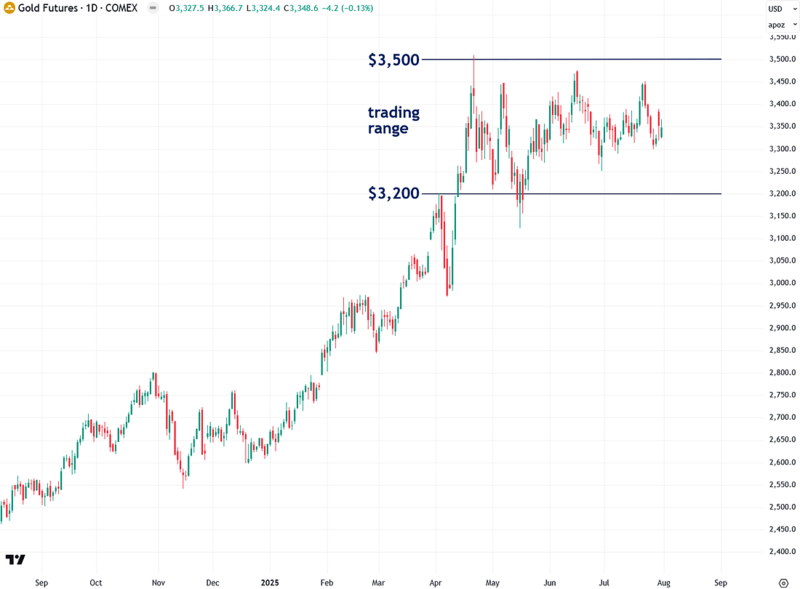
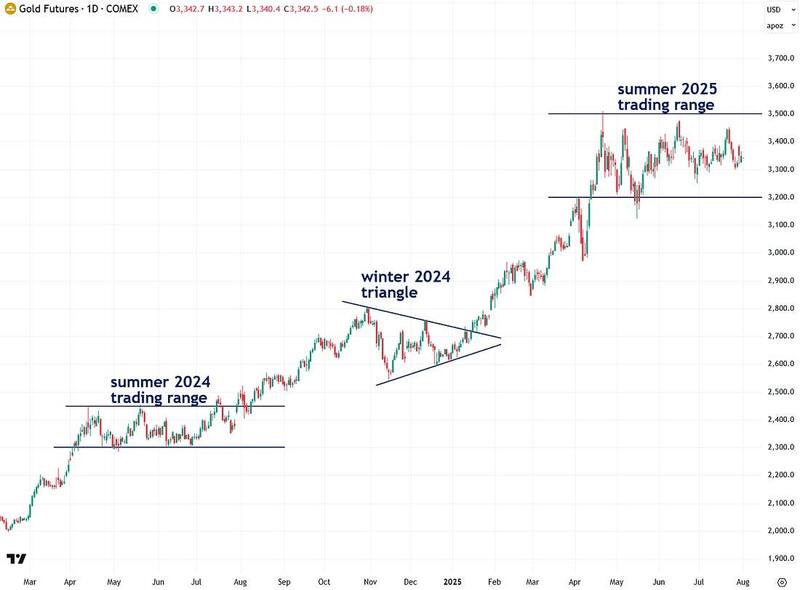
Let’s begin with gold, specifically COMEX gold futures, which I prefer to track due to its tendency to respect key $100 price increments—often forming significant support and resistance levels such as $3,200, $3,300, $3,400, and so on.
As I’ve highlighted in recent updates, gold has been in a consolidation phase or trading range since April.
This is a healthy development, allowing the metal to digest earlier gains and work off its overbought condition.
Such sideways movement is especially common during the “dog days” of summer, when news flow generally slows (this week being an exception) and trading volumes tend to drop as much of the financial world heads into vacation mode. And notably, that’s exactly what happened last summer as well—before gold launched into another powerful leg of its bull market in the fall.
At the moment, I’m watching and waiting for gold to make its next move, with a bias toward an upside breakout above the $3,500 resistance level—at which point I believe the rally will quickly resume. That said, it’s worth noting that gold may continue consolidating through August, as we’re still in the typically slow summer season.
It’s also worth highlighting that these consolidation phases are nothing new. Since the bull market began in early 2024, we’ve already seen three such periods—the first two of which resolved to the upside and led to significant additional gains:
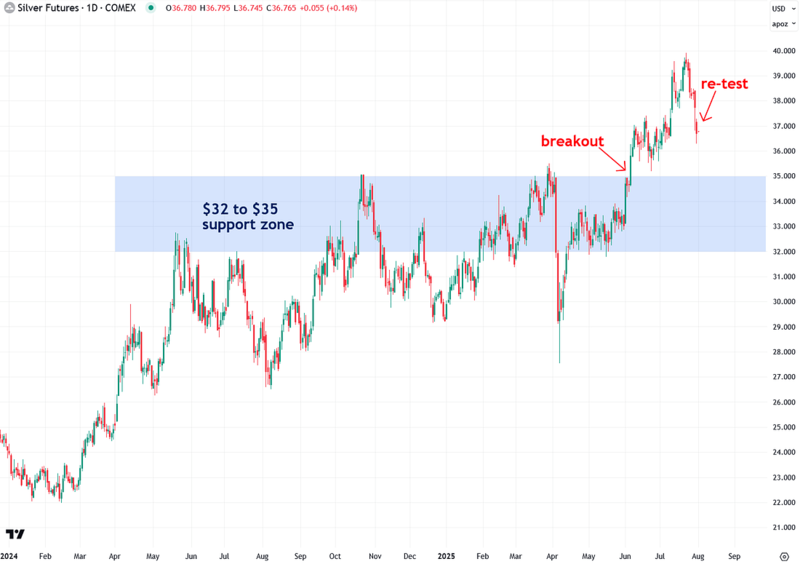
Next, let’s turn to silver, specifically COMEX futures, which I track closely due to its tendency to respect key $1 increments—forming clear support and resistance levels such as $32, $33, $34, and so on. In early June, silver finally broke above its long-standing $32–$35 resistance zone—a ceiling that had held firm for over a year, from May 2024 to June 2025.
In my view, this breakout marked the official beginning of silver’s next major bull market.
As with all financial markets, nothing moves in a straight line. After briefly touching $40, silver has since pulled back—causing concern among less experienced or less confident investors. But not me—I’m not shaken at all. This looks like a routine pullback or re-test of the $32–$35 zone, which now serves as a major support level.
That kind of re-test isn’t surprising, especially during the low-volume summer months—after all, volume is the lifeblood of the markets. Silver’s bull market remains fully intact and should continue as long as it holds above that key support zone.
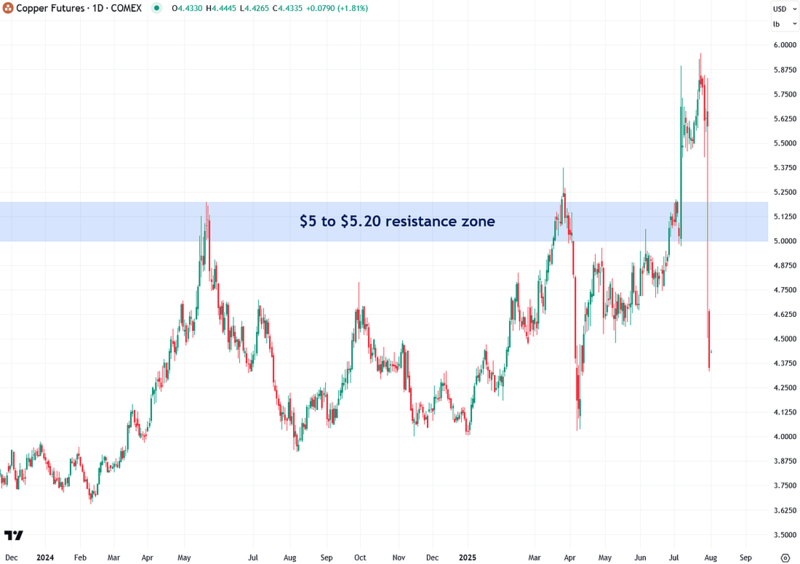
One factor that has recently disrupted silver’s behavior is the highly unusual price action in U.S. domestic copper futures—an asset that, along with gold, strongly influences silver.
It began with a dramatic 13% surge on July 8th, following former President Donald Trump’s announcement that he would impose a 50% tariff on copper imports.
However, the market was blindsided yesterday when prices plunged 22% after Trump confirmed the tariff—but excluded copper ores, concentrates, and refined products like cathodes, which are the basis for the benchmark U.S. COMEX copper futures contract. This unexpected exclusion triggered a sharp reversal and left many traders reeling.
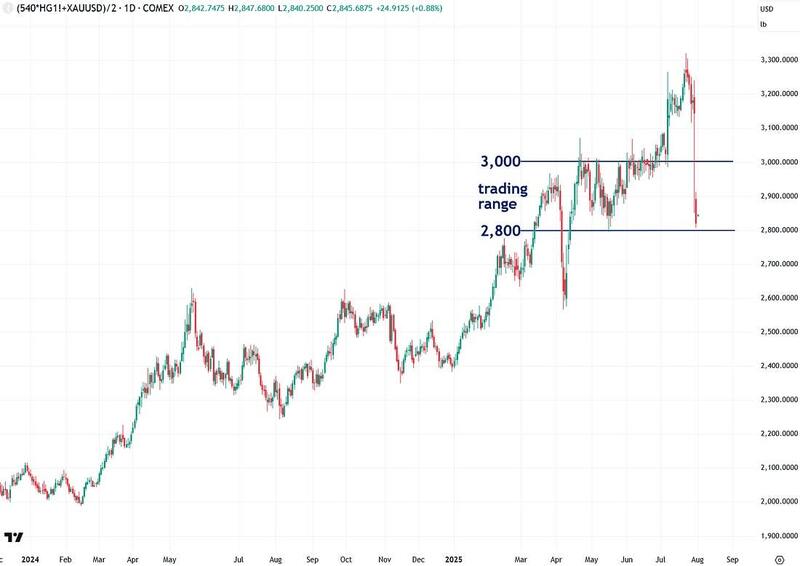
The extreme volatility in U.S. domestic copper futures has significantly distorted the readings of my proprietary Synthetic Silver Price Index (SSPI)—an indicator I developed to help validate silver’s price action and filter out potential false breakouts.
The SSPI is calculated as the average of gold and copper prices, with copper scaled by a factor of 540 to prevent gold from dominating the index. Although silver itself isn’t part of the SSPI’s calculation, the index typically tracks silver’s movements closely—except when disrupted by unexpected government policy shifts.
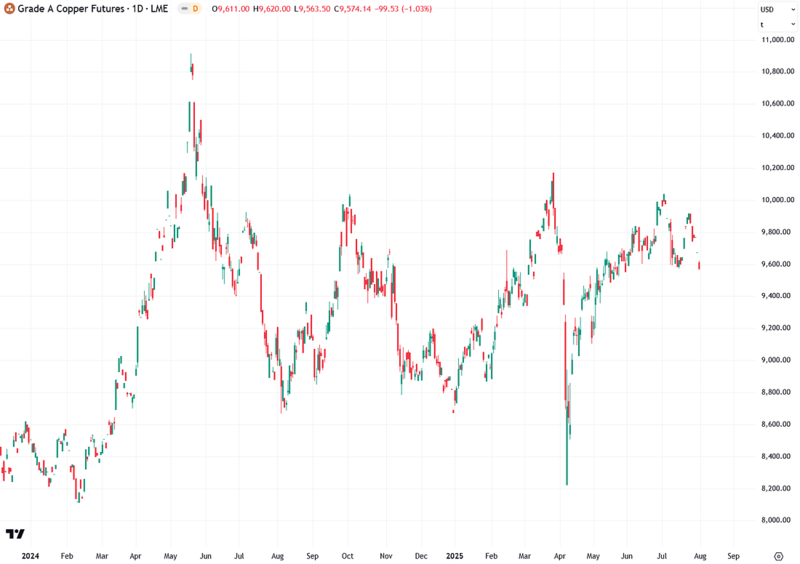
It’s important to note that the recent tariff surprises from the Trump administration have primarily impacted U.S. domestic copper futures, while having a far more limited effect on global copper prices—as evidenced by the relatively stable performance of copper futures on the London Metal Exchange (LME):
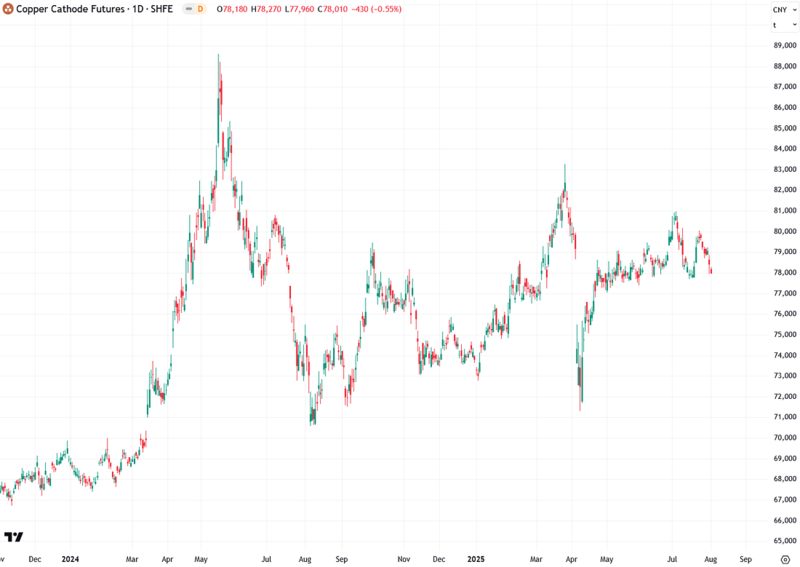
The same holds true for copper futures on China’s Shanghai Futures Exchange (SHFE), which have also remained relatively unaffected by the U.S. tariff news:
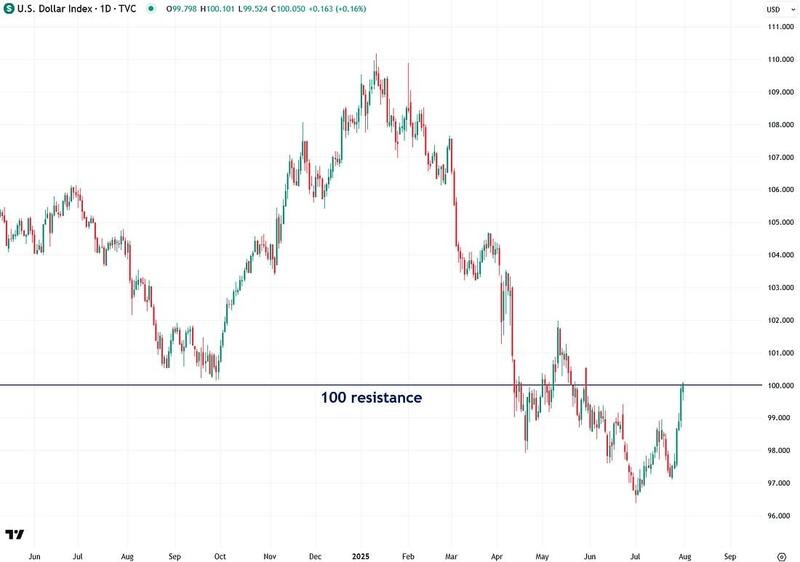
Now let’s turn to the U.S. Dollar Index, which has strengthened recently—driven by renewed trade deal optimism, including a 15% tariff agreement that helped the U.S. and EU avoid a trade war, along with a better-than-expected U.S. GDP report.
Since the dollar typically moves inversely to precious metals, this recent strength has exerted some downward pressure on gold and silver, as is often the case.
At the moment, the U.S. Dollar Index has rebounded to the key 100 resistance level—a critical threshold that has played a significant role over the past few years. Although the index broke below this level in the spring, it’s now attempting to reclaim lost ground.
A confirmed close above 100 would be a key signal to watch—but there’s also a real possibility the Dollar Index could fail at this level and resume its decline. In short, it’s at a pivotal, make-or-break moment. I’ll be closely watching to see how this unfolds.
To summarize, gold and silver remain in consolidation, but that alone is no cause for concern—nor does it undermine the bullish case for either metal.
We’re still in the heart of summer, when trading volume is light and much of the financial world is in vacation mode. Meanwhile, the Trump administration’s rapid and unpredictable tariff announcements have injected fresh volatility and uncertainty into the markets, making short-term movements harder to interpret.
Even so, both gold and silver remain in solid technical uptrends—they’re simply taking a breather. I believe clarity will return soon, and I’ll continue monitoring developments and keeping you updated.
If you found this report valuable, click here to subscribe to The Bubble Bubble Report for more content like it.
Jesse Colombo is a financial analyst and investor writing on macro-economics and precious metals markets. Recognized by The Times of London, he has built a reputation for warning about economic bubbles and future financial crises. An advocate for free markets and sound money, Colombo was also named one of LinkedIn’s Top Voices in Economy & Finance. His Substack can be accessed here.
(Mike Maharrey, Money Metals News Service) The strongest physical investment gold demand since 2013 helped push overall demand up a healthy 3 percent through the first half of 2025, but American investors, by and large, sat on the sidelines.
Including over-the-counter investment (OTC), gold demand totaled 1,249 tonnes in H1, according to data compiled by the World Gold Council.
Central bank gold buying continued to provide steady support for the gold market. Central banks globally bought a net 166 tonnes of gold in the second quarter, bringing the 2025 increase in gold reserves to 378 tonnes.
Central bank purchases have slowed somewhat. The second quarter charted the lowest level of central bank gold buying since the second quarter of 2022. However, it was still 41 percent above the quarterly level typical between 2010 and 2021.
Selling by central banks, such as Uzbekistan, that often shift between buying and selling, also skewed the H1 numbers lower.
The World Gold Council noted that while central banks typically buy gold strategically, they “are not completely insensitive to its price level.”
“As such, gold’s rally so far this year, up 26 percent, to new record levels, has likely contributed to the slowdown in central bank buying. But that they continue to add gold in the face of a higher price underscores their continuing favorable attitudes towards gold as a strategic asset amid such uncertainty.”
The National Bank of Poland was the biggest buyer in the second quarter, adding 19 tonnes of metal to its reserves. That was on top of 49 additional tonnes in Q1.
Investment Demand Robust
Total investment demand was up 78 percent year-on-year. Significant positive flows into gold-backed ETFs and healthy growth in bar and coin demand both contributed to the big pickup.
Bar and coin demand was up by 11 percent in H1, rising to 582 tonnes, with Chinese and Indian investors leading the way.
Chinese bar and coin demand grew by 44 percent year-on-year in H1. Chinese investors snapped up 115 tonnes of gold bars and coins in the second quarter alone. It was the strongest H1 for physical gold buying since 2013.
India bar and coin demand grew by 7 percent through the first half of the year.
Bar and coin demand also grew in Europe, albeit at a slightly slower pace than in Asia. Overall physical investment demand in the EU was up 6 percent. Second quarter bar and coin demand more than doubled to 28 tonnes.
Meanwhile, Americans continued to sell their gold. Year-on-year bar and coin sales plummeted by 53 percent in H1. Demand in the second quarter was only 9 tonnes, the lowest quarterly level since Q4 2019.
According to the World Gold Council, “U.S. net investor demand was again affected by a double whammy of elevated profit taking and subdued levels of new purchases.”
Gold ETF investment was stronger in North America, with funds in the region adding 73 tonnes of gold in Q2.
However, Asian ETFs did even better, nearly matching their North American peers even though their collective holdings are about one-fifth the size. Asia-listed funds reported 70 tonnes of gold inflows.
In total, gold ETFs globally reported 170 tonnes of gold inflows in Q2, bringing the H1 total to 397 tonnes. That was the strongest semi-annual performance since the record-breaking 734 tonnes in H1 2020 at the outset of the pandemic.
According to the World Gold Council, “Uncertain global trade policy, geopolitical turbulence and the rising gold price all fueled inflows.”
More generally, “Anecdotal reports suggest that institutional investment remained healthy, with continued interest from global High Net Worth investors,” according to the WGC.
Jewelry Demand at Pandemic Era Lows
While higher prices have boosted gold investment demand, it has created significant headwinds for the jewelry market.
Second-quarter gold jewelry demand fell 14 percent year-on-year. The total of 341 tonnes was the lowest since Q3 2020.
Quarterly demand was 30 percent below the five-year quarterly average of 487 tonnes.
A 17 percent dip in jewelry demand in India and a 20 percent drop in China drove the overall market lower. China and India’s combined market share fell below 50 percent for only the third time in the last five years.
The only market that reported an increase in gold jewelry demand was Iran. This was likely driven by safe-haven investment jewelry demand in the wake of Israel’s attack on the country’s nuclear program.
Gold in Tech
Gold used in technology and industry charted a modest 2 percent decline in the second quarter.
Tech/industrial gold demand was 78.6 tonnes in Q2, down slightly from 80.2 tonnes in the first quarter.
A two percent drop in the amount of gold used in electronics drove the trend.
According to the World Gold Council, the tariff situation has caused significant uncertainty in the electronics sector, impacting output.
“Many East Asian manufacturers continued to frontload orders ahead of potential tariffs and, in parallel, made significant changes to their supply chain strategies. Challenges remain in the form of export restrictions to China, with companies such as Samsung reporting significantly weakened operating profits during the quarter as a result.”
Other industrial and decorative use of gold (primarily plating and gold thread used in traditional Indian clothing) fell 3 percent annually to 11 tonnes in Q2. According to the World Gold Council, “China’s fragile economic climate has undermined demand in the luxury and plating industries.”
Mike Maharrey is a journalist and market analyst for Money Metals with over a decade of experience in precious metals. He holds a BS in accounting from the University of Kentucky and a BA in journalism from the University of South Florida.
(Mike Maharrey, Money Metals News Service) Do you know what you get if you blow up gold? Gold! Just in a lot smaller pieces.
One of the important characteristics of gold is that it’s virtually impossible to destroy. You can melt a gold bar, but once it cools, it’s the same bar of gold. And if you repeat the process 1,000 times, you still have that same gold bar, no worse for wear.
Now you can, in fact, blow up gold, at least theoretically. But scientists have discovered that doing so will take a lot more heat than originally thought.
In other words, gold is even more indestructible than we imagined.
When researchers recently shot a laser at gold, they initially thought they had broken physics.
You’ll be glad to know, they did not.
But they did end up revising a decades-old model in physical chemistry relating to the fundamental properties of matter. This has some interesting technological ramifications.
Scientists at the SLAC National Accelerator Laboratory used a laser to heat gold to 14 times its melting point! This was thought to have been impossible.
By the way, that’s really hot. Gold melts at 1,948 degrees Fahrenheit.
“The study is based on a two-pronged experiment. First, the scientists used a laser to superheat a sample of gold, suppressing the metal’s natural tendency to expand when heated. Next, they used ultrabright X-rays to zap the gold samples, which scattered off the surface of the gold. By calculating the distortions in the X-ray’s frequency after colliding with the gold particles, the team locked down the speed and temperature of the atoms.”
Prior to the experiment, there was a well-established theory stating structures like gold can only be heated to three times their melting point. Beyond that temperature, an “entropy catastrophe” occurs. In other words, the heated gold blows up.
According to the scientists, they were able to capture gold at a superheated temperature far above (14 times) its melting point. In this state, the metal exists in a “crystalline limbo” between a solid and liquid state. The experiment suggests that gold may not have a superheating limit. The researchers said that if they are correct, this could have a wide range of applications from space travel to nuclear chemistry to astrophysics.
“The new result disproves the conventional theory, but it does so in a big way by far overshooting the theoretical prediction, showing that it’s possible to heat gold up to a jaw-dropping 33,740 degrees F (18,726 degrees C).”
It’s important to note that this superheated state only lasted for several trillionths of a second, but scientists said it was still “long enough to be interesting.”
“If you could prevent it from expanding, [theoretically speaking] you could heat it forever.”
While gold is fundamentally money, it is increasingly being used in technological applications. Demand for gold in industry and tech was up 7 percent in 2024, driven by growth in the electronics and computing sectors.
Gold is one of the most useful metals in the world. Due to its utility, coupled with its scarcity, gold is also one of the most valuable metals in the world. The metal’s inherent physical and chemical properties make it useful in many industrial and technological applications.
This is why we see gold increasingly used in the tech sector. In fact, gold would probably be used even more if it weren’t so rare and expensive.
Gold is even helping unlock mysteries of the universe. The James Webb Space Telescope’s ability to “see” deep into the infrared spectrum allows it to image the distant universe as far back as the first galaxies and even the first stars.
Who knows what new applications researchers may find for gold if this rewrite of the physics playbook pans out!
Mike Maharrey is a journalist and market analyst for Money Metals with over a decade of experience in precious metals. He holds a BS in accounting from the University of Kentucky and a BA in journalism from the University of South Florida.
(Dave DeCamp, Antiwar.com) The US has told the UN Security Council that President Trump wants a deal to be reached to end the war in Ukraine by August 8, as the US leader is threatening to impose tariffs and sanctions targeting Russia and its trading partners.
“Both Russia and Ukraine must negotiate a ceasefire and durable peace. It is time to make a deal. President Trump has made clear this must be done by August 8. The United States is prepared to implement additional measures to secure peace,” US diplomat John Kelley told the UN Security Council, according to Reuters.
The message to the UN came after President Trump said earlier this week that he was shortening his original deadline and that he wanted a deal within “10 or 12 days.” The president initially said he wanted the war to end in 50 days, a deadline that would have fallen on September 2.
Trump has previously threatened to hit Russia’s trading partners with 100% tariffs, and a bill in the Senate that has 84 co-sponsors would add 500% tariffs on any country that “knowingly engages in the exchange of Russian-origin uranium and petroleum products.” Either step would have a significant impact on the US and global economy since China and India are major buyers of Russian oil.
Trump said on Thursday that he would impose 25% tariffs on India and another unspecified “penalty,” a step he said was being taken in response to India’s own trade barriers and its trade relationship with Russia, though he signaled the tariffs could change as Washington and New Delhi engage in negotiations.
For its part, Russia has made clear that it’s not fazed by Trump’s ultimatum and that it’s willing to continue the war until it achieves its goals. Russia and Ukraine are also extremely far apart on their conditions for a peace deal, making Trump’s deadline for an agreement unrealistic.
(José Niño, Headline USA) As tracking accounts online highlight a series of lucrative, well-timed stock trades by former House Speaker Nancy Pelosi’s family. President Donald Trump is demanding she be investigated for insider trading.
Earlier this week, the Senate Homeland Security and Government Affairs Committee narrowly approved a bill, in an 8–7 vote, that would prohibit members of Congress, along with the president and vice president, from purchasing stocks and would require them to divest existing holdings by the start of their next term.
The bill, introduced by Sen. Josh Hawley, R-Mo., drew criticism from President Trump.
Speaking to reporters Wednesday, Trump remarked, “You know, Nancy Pelosi became rich by having inside information.”
He further demanded an investigation into the California Democrat, alleging that she “has the highest return of anybody practically in the history of Wall Street.”
Over the last few years, several social media accounts have monitored Pelosi’s trading activity center on a series of highly profitable transactions that occurred just before major legislative and regulatory developments.
In June 2021, Paul Pelosi exercised call options on 4,000 shares of Google parent company Alphabet, netting $5.3 million in profits just one week before the House Judiciary Committee voted on antitrust legislation targeting big tech companies, according to a report by Fortune. The timing proved fortuitous when the market determined the proposed regulations posed no real threat to tech giants, allowing share prices to continue rising.
More recently, tracking accounts flagged Paul Pelosi’s sale of 2,000 Visa shares worth between $500,000 and $1 million on July 1, 2024, just weeks before the Department of Justice filed a major antitrust lawsuit against the credit card company.
Visa’s stock price dropped 5.5% when the lawsuit was announced, but the Pelosis had already divested their holdings with no public indication that legal action was imminent. Christopher Josephs, who operates the popular “Nancy Pelosi Stock Tracker” account on X, first brought attention to this trade through his monitoring of congressional disclosures.
BREAKING🚨: Pelosi is back on the Trading Desk
She just bought ~$5M of Broadcom $AVGO and another $1.2M of Nvidia $NVDA
— Nancy Pelosi Stock Tracker ♟ (@PelosiTracker_) July 3, 2024
Accounts like Unusual Whales have also documented the couple’s extraordinary investment performance, with Pelosi’s portfolio gaining 70.9% in 2024 compared to the S&P 500’s 24.9% return, beating the market by nearly 200%.
Their success extends beyond individual trades to overall strategy, with Nvidia call options finishing 2024 up 273% and Palo Alto Networks positions gaining 93%. The tracking revealed that the Pelosi family’s combined net worth reached approximately $413 million in 2024, up from $370 million the previous year.
Pelosi has repeatedly maintained that she has no involvement in the trading decisions, with her office stating that “Speaker Pelosi does not own any stocks, and she has no prior knowledge or subsequent involvement in any transactions.”
José Niño is the deputy editor of Headline USA. Follow him at x.com/JoseAlNino