(Luis Cornelio, Headline USA) Leftist talk show The View faced ridicule Tuesday after co-host Joy Behar falsely claimed on air that Republicans are “scared” to appear on the program.
“I think that we should have more Republicans on the show. But they don’t want to come on. They’re scared of us,” Behar declared, as seen in a clip on X shared by the Media Research Center.
However, that claim doesn’t hold up. The MRC previously revealed that The View had featured zero conservative or pro-Trump guests in 2025 as of July 30.
The View claims Republicans don't want to come on the show because "they're scared of us." Alyssa Farah Griffin says she's like to have Ted Cruz on the show again, but the last time he asked to come on they denied him. pic.twitter.com/f4PUfLzQ5W
Behar’s remark quickly drew responses from several Republican and conservative figures who said their offers to appear on the show have been repeatedly rejected.
Among them was former NCAA swimmer Riley Gaines, who gained national prominence for opposing the inclusion of biological males in women’s sports.
“When I was pitched to go on, they said no,” Gaines wrote on X.
Popular YouTuber Amala Ekpunobi said she had also interviewed to appear on The View, but she “never heard back.”
She added, “Republicans and right leaning people are by no means scared to talk to any of these women.”
Karol Markowicz, columnist for the New York Post and Fox News, said she, too, had been pitched to appear on the show but was told “no.”
She quipped, “Looking forward to learning which Republicans are scared of these people.”
Jennifer Sey, founder of pro-women’s rights clothing brand XX-XY, echoed that sentiment. She wrote: “This is hilarious. We aren’t afraid of you. You reject us all when we are pitched to go on your show. I think you’re afraid of us. We’re pretty smart and your silly name calling won’t intimidate us.”
Clay Travis, the founder of OutKick, said his producer had reached out last July and, of course, received no response:
Hey @JoyVBehar here is our producer Ali emailing The View last July offering for us to come on as guests. We’re big fans. Look forward to the invite! pic.twitter.com/c1LQF43Hyl
Rep. Byron Donalds, who is running for Florida governor, reminded the hosts that his earlier offer to appear “still stands,” adding, “I’m ready when you are!”
Dakota Meyer, Marine Medal of Honor recipient and commentator, also called Behar’s statement “a lie,” confirming that his publicist has reached out to the show.
According to Meyer, the show told him they didn’t have “room at the moment.”
Breitbart News senior editor Joel Pollak likewise said The View had declined several offers to appear, despite previously inviting him back in 2017.
This is a lie by @JoyVBehar. When I was invited onto @TheView in 2017, producers told me they had to work hard to convince the show to invite a conservative. The appearance went well, and I reached out several times for a return visit. They declined. They are afraid of dialogue. https://t.co/xLQmgcMgd6
(Sarah Roderick-Fitch, The Center Square) Americans are overwhelmingly concerned about the rising rate of political violence but are divided on how much they think the media bears the responsibility for the rise of violence, according to a new poll.
The Center Square Voters’ Voice Poll shows 82% of registered voters are concerned about political violence following last month’s assassination of conservative activist Charlie Kirk.
The poll found that Republican voters are more concerned, at 91%, compared to Democrats at 74%. Of those who are concerned, 56% say they are very concerned, 26% somewhat concerned, 7% report not being very concerned, and 6% are not concerned at all. Only 5% reported being unsure.
The survey finds that only 20% of Democrats are not concerned about political violence, while 30% say they are somewhat concerned, 11% report not being very concerned, and 9% are not at all concerned, followed by 6% who are unsure.
Despite a majority of voters being concerned about the rise in political violence, there is division on who bears the most responsibility for sparking it.
Twenty percent of voters cite social media influencers with platforms such as TikTok and YouTube, while 18% of voters point to mainstream or legacy media.
Only 8% blame new media sources, such as online news sites, independent news organizations, and podcasts, for the rise in violence.
However, 39% of voters believe the groups are equally responsible, with only 7% thinking none are to blame.
While voters appear to be evenly split among party lines in assigning blame, the largest gap between Republicans and Democrats lies in whether the mainstream or legacy media bears the majority of the responsibility.
Twenty-four percent of Republicans blame the mainstream or legacy media, while only 12% of Democrats share the same view.
The poll comes as the Trump administration vows to crack down on the rise of political violence, with President Donald Trump recommitting to this effort during a ceremony posthumously awarding the Presidential Medal of Freedom to Kirk on Tuesday evening.
The president cited his own brush with death when he was shot during a campaign event in Butler, Pa., in July 2024. In addition, he noted an increase in funding for security to U.S. Supreme Court justices following a foiled plot to assassinate Justice Brett Kavanaugh.
In June, two Minnesota Democratic lawmakers were targeted in early morning shootings at their homes. The Minnesota House Speaker, Melissa Hortman, and her husband, Mark Hortman, were murdered, while state Sen. John Hoffman and his wife were shot and seriously injured.
In addition to targeting attacks on political figures, there has been a rise in violence targeting U.S. Immigration and Customs Enforcement officers and facilities, prompting the Trump administration to deploy the National Guard and surge federal law enforcement to protect ICE facilities and agents.
The Center Square Voters’ Voice Poll was conducted by Noble Predictive Insights between Oct. 2-6, 2025. The poll sample included 2,565 respondents, comprised of 978 Republicans, 948 Democrats, and 639 Independents, of which 262 lean toward neither major party, which Noble Predictive refers to as independents who, when asked if they leaned toward one of the major parties, chose neither.
The poll weighted each party – Republicans, Democrats, and True Independents – independently. It has a margin of error of +/-2.0%.
(Bethany Blankley, The Center Square) Working without pay during a federal shutdown, U.S. Immigration and Customs Enforcement officers continue to arrest violent convicts, including those wanted by authorities.
The Trump administration “will not let the Democrats’ government shutdown prevent our law enforcement officers from securing our nation from the worst of the worst criminal illegal aliens. ICE law enforcement officers – who are working without pay because of the shutdown – will continue these kinds of targeted operations to remove murderers, pedophiles, and violent criminals from our streets to make America safe again,” the U.S. Department of Homeland Security said.
Several key arrests have been made in Texas, including a convicted felon and Asian Boys gang member who was wanted for murders in Texas and California.
ICE agents arrested Cambodian national Savin Seng in Victoria, Texas. Seng who initially entered the country in 1984, racked up convictions for burglary, aggravated assault with a deadly weapon, felon in possession of a firearm and domestic violence over the years, ICE said.
In April 2016, a federal immigration judge ordered his removal, which was never enforced. He remained in the U.S. illegally for nearly a decade and allegedly continued to commit violent crimes, including murder, ICE said. He is wanted for the murder of a woman in Victoria and of a man in North Hills, California, ICE said.
He was arrested after a brief manhunt ensued in Texas. During his arrest, authorities found a loaded firearm and extra 32-round magazine in his possession, ICE said. He faces a state homicide charge in Texas, a federal felony charge for being an illegal alien in possession of a firearm, and a state charge in California where he is wanted on allegations of murdering a man outside a North Hills strip club in 2022.
It wasn’t until the second Trump administration that he was arrested. The Victoria County Sheriff’s Office, U.S. Marshals Service, Texas Rangers, Texas Department of Public Safety and Victoria Police Department assisted with his arrest.
ICE officers continued to arrest violent convicted felons nationwide over the weekend.
In Texas, they arrested Mexican nationals Adrian Alberto Morales-Maldonado, convicted of aggravated robbery in Hidalgo County; and Edgar Ivan Ponce-Aldaco, convicted of conspiracy to possess with the intent to sell or distribute more than 50 kilos of marijuana in Comstock, in Val Verde County, ICE said. They also arrested Mexican national Mario Godinez-Lopez, convicted of theft of property in Georgetown, and Honduran national Omar Andrade-Galvez, convicted of unlawful restraint in Austin, ICE said.
Women they arrested in Texas include Mexican nationals Ruth Gonzalez-Salazar, convicted of smuggling aliens in Brackettville, and Gregoria Salaz-Beltran, convicted four times for DWI in San Antonio, ICE said. She was also twice convicted for kill/poison/serious bodily injury animal cruelty in Waco, ICE said.
They also arrested Venezuelan national Yuliana Fernandez-Ledezma, who was convicted of abandoning or endangering a child in San Antonio, ICE said.
In other states, they arrested Mexican nationals Wenceslao Alvarez-Alvarez, convicted of importing a controlled substance and conspiracy to commit money laundering in Atlanta; Isidro Carrera-Rodriguez, convicted of third-degree assault and offensive touching in New Castle, Delaware; and German Morachel-Lopez, convicted of course sexual conduct against a child in Queens, New York, ICE said.
Also in New York, they arrested Mexican national Silvino Juan Martinez-Montesinos, convicted of course sexual conduct against a child in the first degree; and Russian national Boris Selioutsky, convicted of possession of child pornography transported in interstate commerce, ICE said.
In Florida, they arrested Duzzlie Rigby, from the Bahamas and a national of the Turks and Caicos Islands, who has 17 convictions for armed robbery, assault, battery, and carrying concealed weapon, ICE said. They also arrested Ecuadoran national Victor Rodriguez-Mercado, convicted of conspiracy to distribute and possess, with intent to distribute five kilograms or more of cocaine while onboard a vessel subject to the jurisdiction of the U.S., ICE said
In California, they arrested Mexican national Ruben Garibay Yanez, convicted for lewd lascivious acts with a child under 14; and Honduran national Aroldo Zavala-Murillo, convicted of lewd lascivious acts with a child under 14 or 15, ICE said.
In Virginia, they arrested Mexican national Luis Bautista-Perez, who was wanted by Mexican authorities for aggravated homicide, ICE said. He remains in ICE custody pending removal proceedings. He illegally entered the U.S. as a gotaway, ICE said.
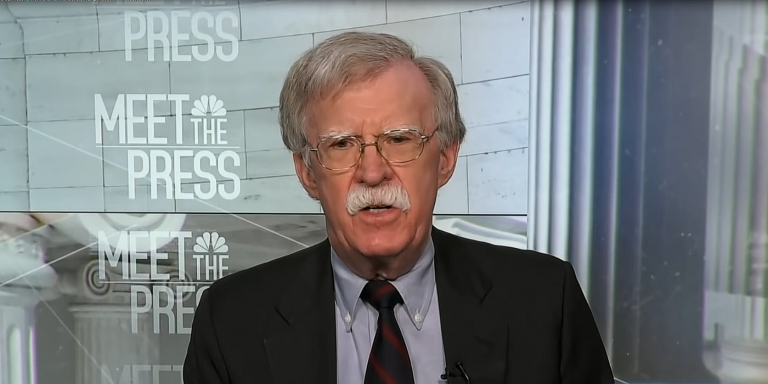
(Headline USA) Former Trump administration national security adviser John Bolton was charged Thursday with illegally storing and transmitting classified information.
The investigation into Bolton, who served for more than a year in President Donald Trump’s first administration before being fired in 2019, burst into public view in August when the FBI searched his home in Maryland and his office in Washington for classified records he may have held onto from his years in government.
The 18-count indictment sets the stage for a closely watched court case centering on a longtime fixture in Republican foreign policy circles who became known for his hawkish views on American power. The investigation that produced the indictment was underway during the Biden administration and began well before Trump’s second term, undermining liberal arguments that his Justice Department is being weaponized to go after his political adversaries.
Agents during the August search seized multiple documents labeled “classified,” “confidential” and “secret” from Bolton’s office, according to previously unsealed court filings. Some of the seized records appeared to concern weapons of mass destruction, national “strategic communication” and the U.S. mission to the United Nations, the filings stated.
It follows separate indictments over the last month accusing former FBI Director James Comey of lying to Congress and New York Attorney General Letitia James of committing bank fraud and making a false statement, charges they both deny.
The Bolton case, by contrast, was filed in Maryland.
Questions about Bolton’s handling of classified information date back years. He faced a lawsuit and a Justice Department investigation after leaving office related to information in a 2020 book he published, “The Room Where it Happened,” that portrayed Trump as grossly uninformed about foreign policy.
The Trump administration asserted that Bolton’s manuscript included classified information that could harm national security if exposed. Bolton’s lawyers have said he moved forward with the book after a White House National Security Council official, with whom Bolton had worked for months, said the manuscript no longer contained classified information.
A search warrant affidavit that was previously unsealed said a National Security Council official had reviewed the book manuscript and told Bolton in 2020 that it appeared to contain “significant amounts” of classified information, some at a top-secret level.
Bolton’s attorney Abbe Lowell has said that many of the documents seized in August had been approved as part of a pre-publication review for Bolton’s book. He said that many were decades old, from Bolton’s long career in the State Department, as an assistant attorney general and as the U.S. ambassador to the United Nations.
The indictment is a dramatic moment in Bolton’s long career in government. He served in the Justice Department during President Ronald Reagan’s administration and was the State Department’s point man on arms control during George W. Bush’s presidency. Bolton was nominated by Bush to serve as U.S. ambassador to the United Nations, but the strong supporter of the Iraq war was unable to win Senate confirmation and resigned after serving 17 months as a Bush recess appointment. That allowed him to hold the job on a temporary basis without Senate confirmation.
In 2018, Bolton was appointed to serve as Trump’s third national security adviser. But his brief tenure was characterized by disputes with the president over North Korea, Iran and Ukraine.
Those rifts ultimately led to Bolton’s departure, with Trump announcing on social media in September 2019 that he had accepted Bolton’s resignation. Bolton subsequently criticized Trump’s approach to foreign policy and government in his 2020 book, including by alleging that Trump directly tied providing military aid to the country’s willingness to conduct investigations into Joe Biden, who was soon to be Trump’s Democratic 2020 election rival, and members of his family.
Trump responded by slamming Bolton as a “washed-up guy” and a “crazy” warmonger who would have led the country into “World War Six.” Trump also said at the time that the book contained “highly classified information” and that Bolton “did not have approval” for publishing it.
(Ken Silva, Headline USA) Two of the 10 people who attacked a Texas immigration detention center and shot a police officer on July 4 have been indicted for supporting terrorism—reportedly the first time such charges have been used against alleged Antifa members in Justice Department history.
Cameron Arnold and Zachary Evetts stand charged with providing material support for terrorism, attempting to murder federal and assisting officers and discharging firearms during attempted murders for their role in the July 4 attack.
The indictment against Arnold and Evetts describe their group as an “Antifa cell” that seeks to overthrow the government.
“The Antifa Cell was heavily armed with over 50 firearms that they purchased in Fort Worth, Grand Prairie, Dallas and elsewhere,” the indictment says.
🚨 FIRST ON FOX: DOJ brings first Antifa-related terrorism charges in Texas ICE attack pic.twitter.com/arRl1862Ey
Arnold, Evetts and eight other people—most of them from the Dallas-Fort Worth area—were previously charged with attempted murder of a federal officer and discharging a firearm in relation to a crime of violence. Another person has been charged with obstruction of justice for concealing evidence, while two others were charged with accessory after the fact.
It’s unclear why Arnold and Evetts are the only ones thus far to be hit with terrorism charges.
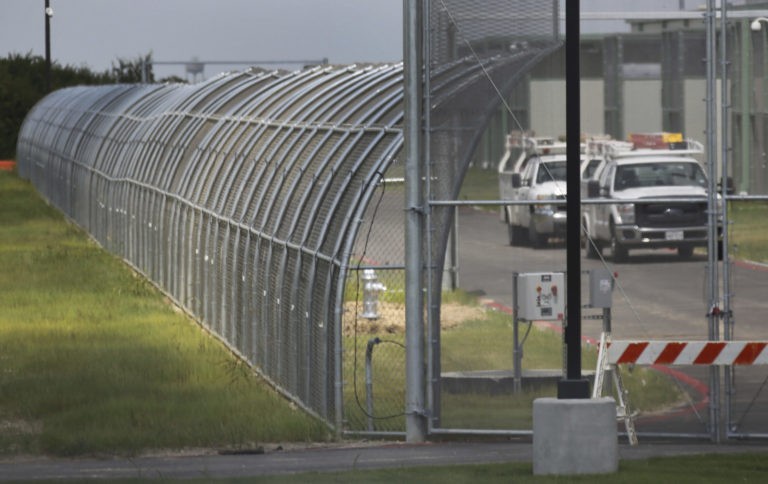
The attackers initially set off fireworks and spray-painted vehicles and a guard structure, including the words “Ice Pig,” according to a criminal complaint. This was “designed to lure correctional officers outside the facility,” according to U.S. Attorney’s Office. Correctional officers called 911 and an Alvarado police officer responded and someone in the woods opened fire.
Another person across the street fired 20 to 30 rounds at correctional officers who were unarmed after they walked out of the facility, according to the office’s statement. The officer wounded in the attack has since been released from the hospital.
After the group fled, sheriff’s deputies stopped seven people about 300 yards from where the officer was shot, according to a criminal complaint.
“They were dressed in black, military-style clothing, some had on body armor, some were covered in mud, some were armed, and some had radios,” the complaint said.
Check out the sophistication of the Antifa-linked terror cell members in Dallas-Fort Worth charged with attempted murder after opening fire on an ICE facility in Alvarado on July 4th. They were heavily armed with military gear, guns, AR-15 style rifles, 12 sets of Kevlar bullet… pic.twitter.com/fOpvMw4ZFn
— Elizabeth MacDonald (@LizMacDonaldFOX) July 8, 2025
A sheriff’s office detective also stopped a van leaving the area and found two AR-style rifles and a pistol, along with ballistic-style vests and a helmet, the complaint said.
The driver, the only person in the van, said he had been at the detention center. He said he had met some people online and drove some of them to the detention center from Dallas to “make some noise,” according to a criminal complaint.
If convicted, most of the defendants could face up to life imprisonment, while those charged with obstruction of justice and accessory after the fact would face lesser penalties.
The Associated Press contributed to this report.
Ken Silva is the editor of Headline USA. Follow him at x.com/jd_cashless.
(Mike Maharrey, Money Metals News Service) Is it a good idea to have gold? Yes. Just ask the Italians.
Italy has the third-largest gold reserves in the world. While other European countries that sold most of their gold are struggling to maintain reserves as the dollar wilts, Italy is sitting pretty.
Italy officially holds 2,452 tonnes of gold. It is now worth around $300 billion. That represents roughly 13 percent of the nation’s 2024 GDP, according to calculations by Reuters.
Gold accounted for nearly 75 percent of Italy’s official reserves at the end of 2024.
Unlike Britain and Spain, Italy resisted the temptation to sell its gold during financial downturns.
In his 2018 book “Oro,” former Bank of Italy Deputy Governor Salvatore Rossi wrote, “Gold is like the family silverware, it’s like grandpa’s precious watch, it’s the last resort in times of crisis, any crisis that undermines international confidence in the country.”
Italy has used its gold reserves during times of crisis. To offset a massive budget deficit caused by capital flight in the 1970s, Italy’s central bank used 41,300 ingots from its gold reserves to back a loan from Germany’s Bundesbank.
According to Reuters, Italy’s wartime experience shaped its modern gold policy. The Nazi’s, aided by the country’s fascist regime, seized 120 tonnes of Italian gold reserves. By the end of World War II, only about 20 tonnes of gold remained in its reserves.
As Italy became an export-driven economy after the war and enjoyed an influx of foreign currency, it used some of that money to buy gold. By 1960, the country owned 1,400 tonnes of the yellow metal.
SDA Bocconi School of Management dean Stefano Caselli told Reuters the Bank of Italy’s decision to hold on to its gold “feels strikingly modern,” with so many central banks currently stockpiling the yellow metal.
On net, central banks officially increased their gold holdings by 1,044.6 tonnes in 2024. It was the 15th consecutive year of expanding gold reserves.
Last year was the third-largest expansion of central bank gold reserves on record, coming in just 6.2 tonnes lower than in 2023 and 91 tonnes lower than the all-time high set in 2022 (1,136 tonnes). 2022 was the highest level of net purchases on record, dating back to 1950, including since the suspension of dollar convertibility into gold in 1971.
To put that into context, central bank gold reserves increased by an average of just 473 tonnes annually between 2010 and 2021.
Some Italian policymakers argue that the central bank should sell some of its gold to address the country’s national debt – now over $3 trillion euros. However, the central bank shows no willingness to sell. Caselli deemed it a good call.
“At a time when the world is being redrawn, market prices have reached unprecedented multiples and (digital assets such as) stablecoins and cryptocurrency are gaining ground, central banks currently hold the hottest asset.”
And that is gold.
Mike Maharrey is a journalist and market analyst for Money Metals with over a decade of experience in precious metals. He holds a BS in accounting from the University of Kentucky and a BA in journalism from the University of South Florida.
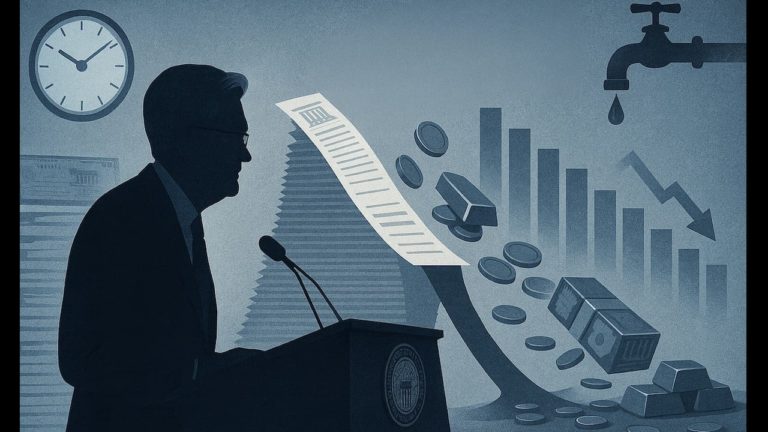
(Mike Maharrey, Money Metals News Service) In another sign that we are entering an era of even looser monetary policy, Federal Reserve Chairman Jerome Powell hinted that balance sheet reduction is about to come to an end.
“Our long-stated plan is to stop balance sheet runoff when reserves are somewhat above the level we judge consistent with ample reserve conditions. We may approach that point in coming months, and we are closely monitoring a wide range of indicators to inform this decision.”
In practice, this means the central bank will stop reducing its holdings of Treasuries and mortgage-backed securities, maintaining the size of its balance sheet at the current level.
Balance sheet reduction, or quantitative tightening (QT), pulls liquidity out of the financial system by reducing bank reserves and shifting government debt financing to the private sector. This tightens funding conditions and market debt. It is effectively deflationary.
Powell said, “Some signs have begun to emerge that liquidity conditions are gradually tightening,” thereby necessitating the end of QT.
More significantly, an end balance sheet reduction would take some pressure off the Treasury market, as the central bank would have to purchase new bonds as the old ones mature. In effect, this would create additional artificial demand in the Treasury market.
Powell didn’t provide a timeline for ending balance sheet runoff.
“If we move too quickly, then we may leave the inflation job unfinished and have to come back later and finish it. If we move too slowly, there may be unnecessary losses, painful losses, in the employment market. So, we’re in the difficult situation of balancing those two things.”
Fed Balance Sheet Operations Explained
Quantitative Easing
Interest rate policy gets the most attention, but the Federal Reserve balance sheet is an important monetary policy tool. In effect, it serves as a direct pipeline to the money supply.
When the Fed buys assets – primarily U.S. Treasuries and mortgage-backed securities – it does so with money created out of thin air. Those assets go on the balance sheet, and the new money gets injected into the financial system and ultimately the broader economy.
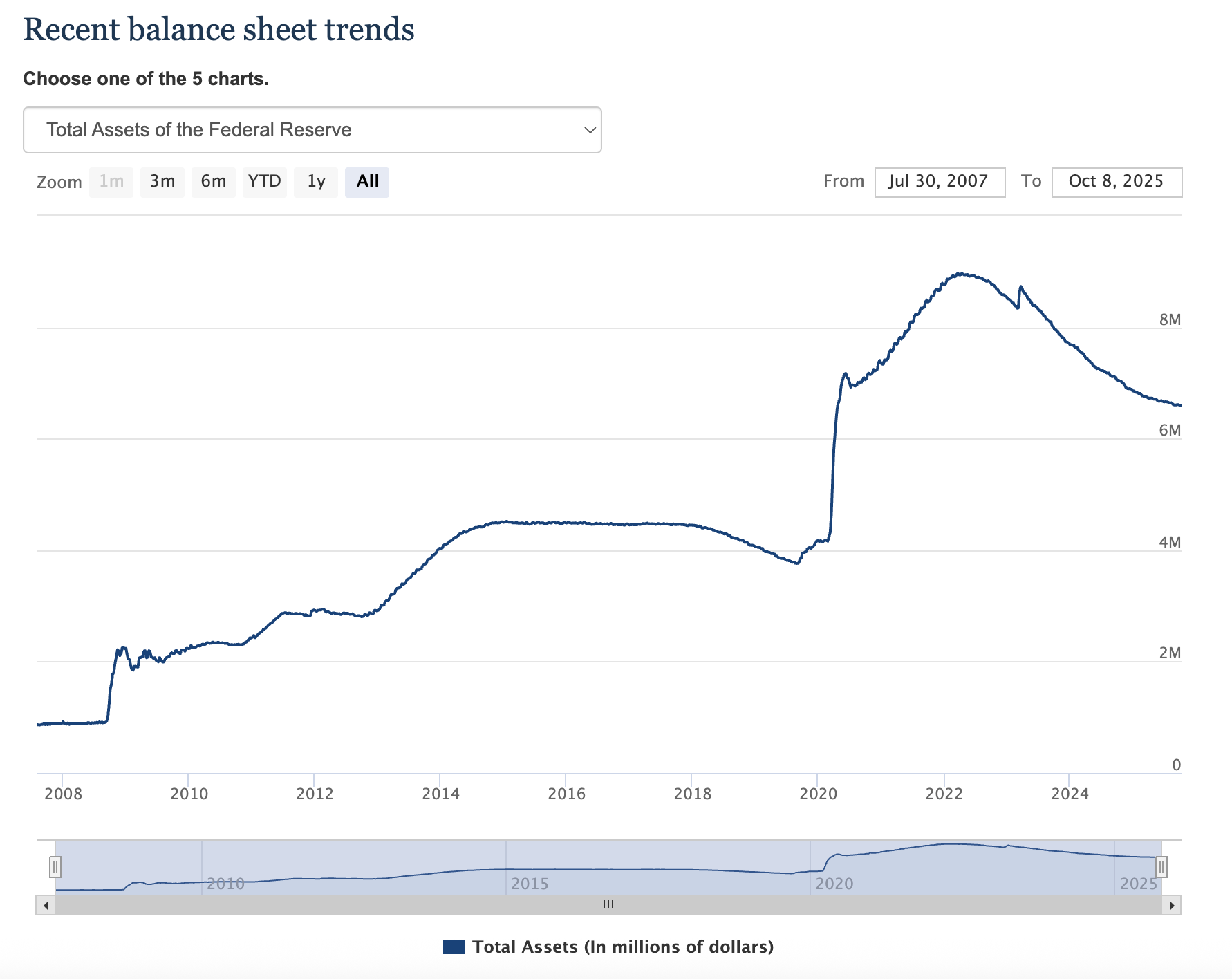
Before the 2008 financial crisis and Great Recession, the balance sheet was just over $900 billion. By the end of the pandemic era, it stood at just under $9 trillion.
In other words, the Fed pumped over $8 trillion into the economy in 14 years through QE.
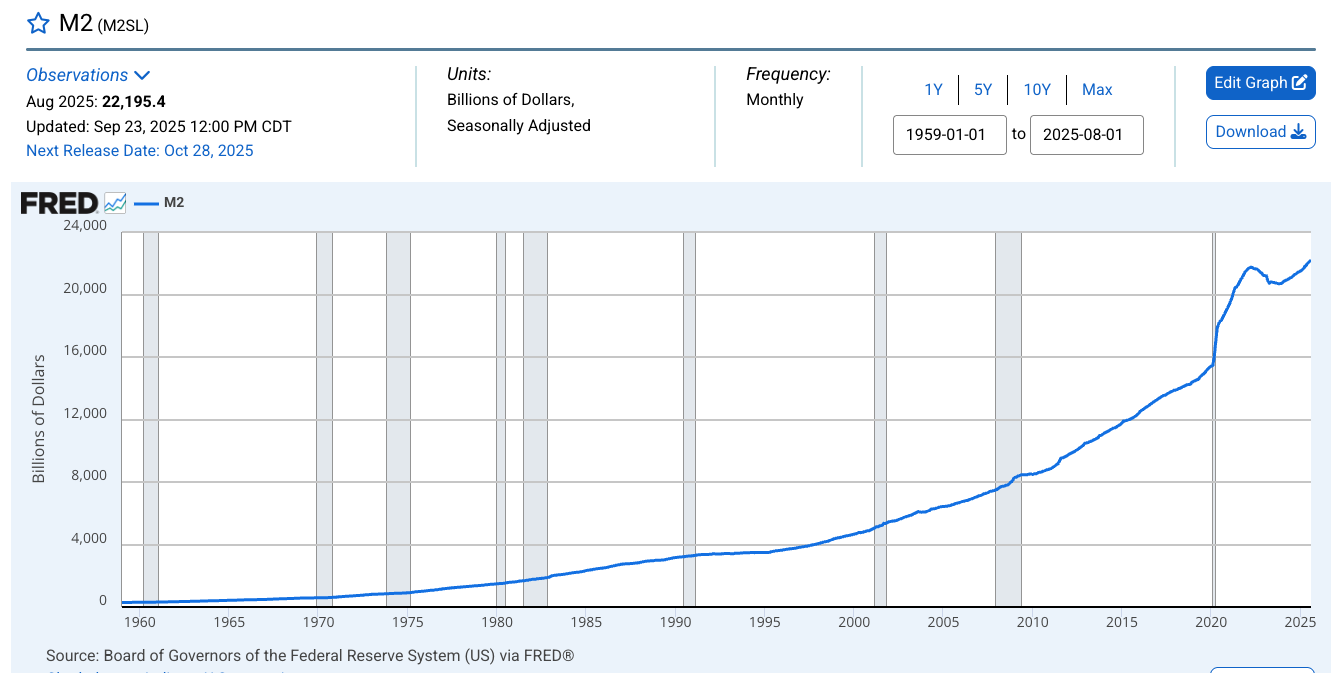
We can see the impact of QE in the trajectory of the money supply. Note that it declined after the Fed began QT and cut interest rates in 2022, but it has since resumed its relentless climb.
When Ben Bernanke launched the first round of QE at the onset of the Great Recession, he assured Congress that the Fed was not monetizing the debt. (When the Fed buys a bond with money created out of thin air, it is effectively turning that debt into money — thus the term “debt monetization.”) He said the difference between debt monetization and the Fed’s policy was that the central bank was not providing a permanent source of financing. He said the Treasuries would only remain on the Fed’s balance sheet temporarily. He assured Congress that once the crisis was over, the Federal Reserve would sell the bonds it bought during the emergency.
That never happened.
And then the Fed doubled down, expanding the balance sheet by nearly $5 trillion during the pandemic.
As former Federal Reserve Governor Kevin Warsh explained in an op-ed published by the Wall Street Journal last year, there is a direct connection between this monetary expansion and price inflation.
“The monetary base is up 60 percent since the pandemic. Another measure of money, M2, is up 36 percent in the past four years. The inflation surge in the same period– cumulatively about 22 percent– shouldn’t have been a surprise.”
As Treasuries and mortgage-backed securities mature, the central bank doesn’t replace them, thereby shrinking the size of the balance sheet over time.
Since the Fed isn’t replacing the bonds, the U.S. Treasury must raise money from the public to redeem the central bank. Of course, Uncle Sam is broke. That means the Treasury Department has to sell a new bond on the open market – essentially borrowing money to pay off the old debt. When a private individual or entity buys a Treasury, they typically use cash, reducing their bank deposit. In effect, this lowers overall financial system reserves and shifts more debt financing to the public.
The Fed announced a balance sheet reduction plan in March 2022 when it could no longer convince everybody that price inflation was “transitory.” The plan wasn’t exactly ambitious, given the amount of inflation it created during the pandemic. If the Fed followed the blueprint (and it didn’t), it would take 7.8 years for the Fed to shrink its balance sheet back to pre-pandemic levels. This doesn’t even account for the trillions added in the wake of the 2008 financial crisis.
And of course, the central bank didn’t stick with the plan. The Fed slowed the pace of balance sheet reduction in May 2024.
From its peak, the Fed has run around $2.4 trillion off the balance sheet. That sounds impressive, but it only represents about half of the increase during the pandemic alone.
Powell said that the Fed has no plans to reduce the balance sheet back to pre-pandemic levels.
So much for Bernanke’s promise.
Why End QT Now?
If expanding the money supply is inflationary, it logically follows that to truly beat down price inflation, the Fed needed to shrink the balance sheet substantially. Theoretically, it should have reduced the size of the balance sheet at least to the neighborhood of pre-crisis levels, as Bernanke promised.
Rate hikes aren’t enough to ring all the liquidity out of the economy. Warsh made this very point in his op-ed, explaining that if the Fed is serious about taming inflation, it needs to significantly reduce the size of the balance sheet. In other words, it needs to undo the money creation of the past decade-plus.
I didn’t.
And it won’t.
So, if inflation isn’t at the 2 percent target, why did the Fed start winding down its balance sheet reduction in June? And why are they talking about ending it altogether today?
Probably because they learned their lesson in 2018.
After the 2008 financial crisis, the Fed maintained its bloated balance sheet until 2017. When it finally made an effort to reduce the balance sheet, it didn’t last very long.
Why?
Because the monetary tightening was about to break the economy and the financial system.
The stock market crashed in the fall of 2018, and there were recession warning signs flashing in the economy. The Fed put rate hikes on hold in December that year and started cutting rates in 2019. In August 2019, the Fed reversed course on balance sheet reduction and launched a new round of quantitative easing as the short-term lending markets went haywire. Fed officials refused to call it QE. They even denied that it was QE. But whatever you want to call it, the result was the same as QE. The balance sheet began to expand again.
The Fed was able to shrink the balance sheet more this time around because the monetary expansion was bigger and faster during the pandemic than it was in 2008. But the central bankers know they’re playing with fire. They know that this economy can’t run without easy money. And that’s exactly why they’ve already slowed their roll even though they continue to claim inflation isn’t dead yet.
The National Debt Problem
While Powell & Company would never admit it, the central bank has no choice but to end balance sheet reduction due to the federal government’s borrowing and spending problem. When Bernanke claimed the central bank wasn’t monetarizing the debt, he was either hopelessly naive or he was lying.
In effect, the Fed supports the government’s borrowing by creating artificial demand for Treasuries. This drives the price higher and yields lower, driving the U.S. government’s borrowing costs down.
If the Fed weren’t holding so much U.S. debt, Treasury interest rates would be substantially higher.
An end to QT makes sense given that the federal government is paying more than $1 trillion in interest expense right now.
While an end to balance sheet reduction won’t inject newly created money into the economy, it will reduce the number of bonds the government has to sell on the open market, thereby easing supply, raising Treasury prices, and putting downward pressure on yields.
Simply ending balance sheet reduction might not be enough. Given falling global demand for Treasuries and persistently high yields, the central bank may well have to launch quantitative easing again in the near future to press its thumb harder on the Treasury market. In effect, this would be a return to money printing.
Mike Maharrey is a journalist and market analyst for Money Metals with over a decade of experience in precious metals. He holds a BS in accounting from the University of Kentucky and a BA in journalism from the University of South Florida.
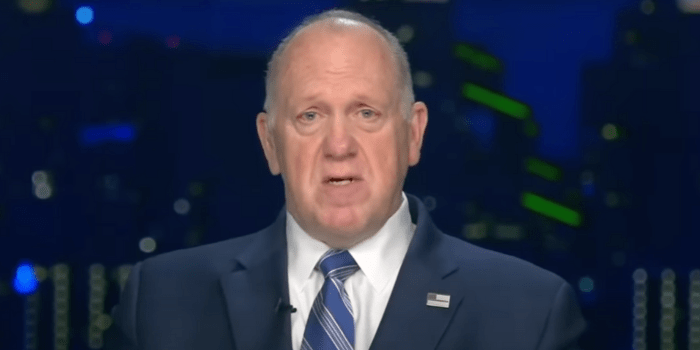
(Ken Silva, Headline USA) Border Czar Tom Homan has denied reports that he accepted $50,000 in cash from undercover FBI agents posing as immigration contractors in September 2024 as part of an unrelated counter-intelligence probe.
“I didn’t take $50,000 from anybody,” Homan told pundit Bill O’Reilly at an event on Wednesday.
Homan didn’t elaborate further, nor did O’Reilly press him on the matter. Homan went on to say that he recused himself from his businesses when he became Border Czar earlier this year.
“Day one I came back, I recused myself from any discussions, of any contact or any monetary decisions like that because I used to have a company that did consulting,” he said.
Bill O’Reilly asked Tom Homan if he wanted to clarify anything about the $50,000 bribe in front of a live audience.
The Border Czar looked O’Reilly dead in the eyes and said:
MSNBC reported last month the FBI targeted Homan in 2024 after a subject in a separate investigation claimed that he was soliciting payments in exchange for awarding contracts should Trump win the presidential election.
According to the Washington Post, the other subject of the FBI’s investigation was a CEO of a firm that focuses on immigration operations and detention management. The CEO told the undercover FBI agents that they should pay Homan $1 million in exchange for a contract. Those agents then met with Homan and gave him $50,000 in a bag.
At the time, Homan didn’t break any laws because he wasn’t a government official. The FBI was apparently waiting to see if Homan would live up to his end of the deal, which would be a blatant case of bribery. However, the FBI shut down the investigation before they could see whether Homan would take the bait.
In response to the reports, the Trump administration said that the Biden DOJ was running a blatantly political investigation.
“This blatantly political investigation, which found no evidence of illegal activity, is yet another example of how the Biden Department of Justice was using its resources to target President Trump’s allies rather than investigate real criminals and the millions of illegal aliens who flooded our country,” White House spokeswoman Abigail Jackson reportedly said in a statement.
However, the Trump administration didn’t deny that Homan accepted the cash.
Earlier this month, Vice President JD Vance said that Homan never accepted a “bribe,” but he dodged questions about whether Homan accepted the cash.
Q: " Tom Homan was recorded on an FBI surveillance tape in September 2024 accepting $50,000 in cash. Did he keep that money or give it back?"
Vance: "You've covered this story ad nauseam. Tom Homan did not take a bribe."
“I don’t know what tape you’re referring to. I saw media reports that Tom Homan accepted a bribe. There’s no evidence of that…I don’t even know the. video that you’re talking about,” Vance said on ABC.
Likewise, Attorney General Pam Bondi dodged questions about the matter at a congressional hearing last week.
Ken Silva is the editor of Headline USA. Follow him at x.com/jd_cashless.
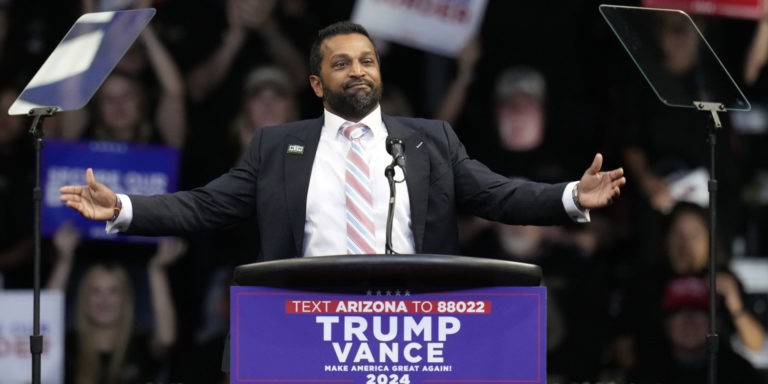
(Sarah Roderick-Fitch, The Center Square) The FBI has overseen the arrests of nearly 8,700 violent criminals as part of Operation Summer Heat, President Donald Trump and FBI Kash Patel said Wednesday.
Trump and Patel touted the numbers as “historic,” claiming record numbers compared to prior administrations.
“Over the past few months, FBI offices in all 50 states made crushing violent crime a top enforcement priority, and that’s what they did – rounding up and arresting thousands of the most violent and dangerous criminals,” the president said during a news conference in the Oval Office.
Since Trump took office in January, the FBI has reported an 86% increase in arrests, with 28,649 arrests in 2024, compared to 15,388 in 2023, 15,771 in 2022, and 16,864 in 2021.
In addition, the FBI has recorded a 27% decrease in homicides compared to 2024. In June 2024, the national homicide count was 1,402, compared to 991 in June 2025.
“In just seven months…these are the best numbers for fighting crime in US history. And it’s only seven months in. And to do that, our vehicle to do it, of choice was Operation Summer Heat, which the FBI architected to go after violent criminals. And in just a three-month span, you had 8,700 arrests of violent criminals,” said Patel.
“You had 2,200 firearms seized off the streets permanently to safeguard our communities. You had 421 kilograms of fentanyl seized. Just to put that in perspective, that’s enough to kill 55 million Americans alone. You had 45,000 kilograms of cocaine seeds, and thanks to our Department of Justice partners, you had 2,100 indictments in three months from June to September alone.”
Patel credited the president for allowing “good cops to be cops” and for putting “the right people in the Department of Justice.”
Patel also touted the 5,400 children that the FBI located, adding that this represents a 30% increase from the previous administration.
He included that gang arrests have risen by 210%, adding that the FBI has also gone after transnational organized crime. The director stated that the bureau has also pursued espionage.
“We have gone after espionage activities against our main counterparts in China, Russia and Iran. In China alone, we’ve had over a 50% increase in espionage arrests alone and prosecutions,” Patel added. “In Iran, we have had a 50% increase again in espionage cases. And in Russia, we’ve had a 33% increase in espionage cases alone. When it comes to counterterrorism, year to date, we have 125 arrests this year versus 100 last year.”
Patel also touted 1900 kilograms of fentanyl that the FBI has seized, adding that the amount is enough to kill 127 million Americans. In addition, 45,000 kilograms of cocaine were seized. The director said that 2,200 firearms have been seized in the last seven months.
In addition to the record number of arrests, the Department of Justice has secured 2,100 indictments.
Trump and Patel were joined by Attorney General Pam Bondi and Deputy Attorney General Todd Blanche during the press conference.
Bondi echoed sentiments from Patel, crediting the administration for empowering law enforcement to do their jobs.
“You have taken the handcuffs off them, and let them do their jobs – and you let cops be cops. That’s why all of this is happening,” said Bondi.
Trump used the press conference to laud the crime crackdown in Washington, D.C. as a success. He indicated that, in addition to Chicago, his administration is also considering going into San Francisco.
The president’s attempts to deploy the National Guard in Chicago have been met with resistance, including legal challenges, by Democrats led by Illinois Gov. JB Pritzker.
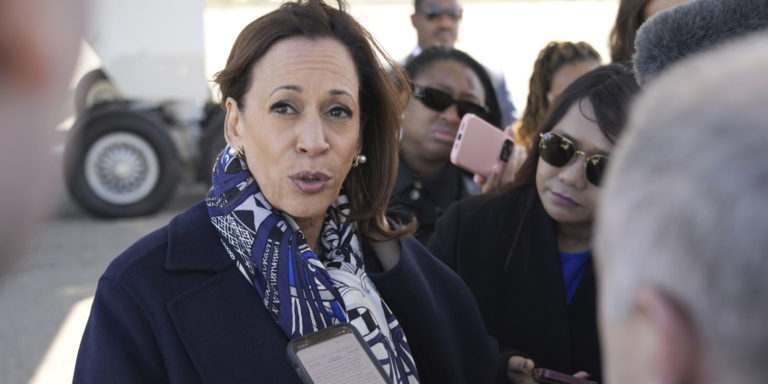
(Luis Cornelio, Headline USA) Embattled former Vice President Kamala Harris recently boasted that she was once called the “most qualified” presidential candidate in U.S. history.
Speaking at an event promoting her new book, Harris told podcast host Kara Swisher that “some people” had made the puzzling comparison.
“Well, some people have actually said I’m, I was the most qualified candidate ever to run for president,” Harris said amid a broad conversation about the 2024 election.
Swisher replied, “I like your … ‘some people say.’ Very nice, but go ahead.”
“I’m just speaking facts,” Harris responded.
Kamala: “Some people have said I was the most qualified candidate ever to run for president."
Harris didn’t name who supposedly made the claim, but the comment echoed a talking point Democrats pushed before her 2024 defeat.
Among the Democrats parroting that claim were Michigan Gov. Gretchen Whitmer, Minnesota Gov. Tim Walz, former First Lady Michelle Obama, and former presidents Joe Biden and Barack Obama.
Still, Harris’s boast implied she considered herself more qualified than past giants of American history, including George Washington, who led the Continental Army in the Revolution, Thomas Jefferson, author of the Declaration of Independence, and Dwight D. Eisenhower, the five-star general who commanded Allied forces in World War II.
Despite what Harris viewed as an impressive résumé, her political career has long been plagued by questions about competence and credibility.
When she was first elected San Francisco district attorney, critics credited Willie Brown, her former lover and influential politician, for jump-starting her political career.
Her 2010 race for California attorney general was one of the closest in the state’s history, with Harris barely defeating Republican Steve Cooley by less than one percentage point.
She later won a Senate seat but quickly launched a failed presidential campaign in 2019, dropping out before early voting began.
She was later tapped as Joe Biden’s running mate after he pledged to choose a woman of color.
Harris’s tenure was vice president was also marred by plummeting approval ratings, gaffes and scandals.
Her political career came to an end when she was defeated by President Donald Trump in the 2024 election despite Trump facing multiple indictments, GOP opposition and relentless attacks from the media.






 When Ben Bernanke launched the first round of QE at the onset of the Great Recession, he assured Congress that the Fed was not monetizing the debt. (When the Fed buys a bond with money created out of thin air, it is effectively turning that debt into money — thus the term “debt monetization.”) He said the difference between debt monetization and the Fed’s policy was that the central bank was not providing a permanent source of financing. He said the Treasuries would only remain on the Fed’s balance sheet temporarily. He assured Congress that once the crisis was over, the Federal Reserve would sell the bonds it bought during the emergency.