Alleged Oct. 7 Attacker Arrested in U.S.; Became Legal Resident During Biden Administration

(Headline USAThe FBI has arrested a Palestinian residing in Louisiana for allegedly participating in the Hamas-led attack on Israel on Oct. 7, 2023, then lying about his past and fraudulently obtaining a visa to live in the U.S.

According to an FBI criminal complaint unsealed this week, Mahmoud Amin Ya’qub Al-Muhtadi armed himself and gathered a group to cross from the Gaza Strip into southern Israel during the attack that left more than 1,200 people dead.

Hamas fighters also kidnapped more than 250 people, including dozens of American citizens, during the raid. This week, Hamas released the 20 remaining living hostages after the two sides agreed to a tenuous ceasefire in the Palestinian territory.

Al-Muhtadi was an operative of the Gaza-based military wing of the Democratic Front for the Liberation of Palestine, according to the complaint prepared by FBI Supervisory Special Agent Alexandria M. Thoman O’Donnell and submitted to a federal judge on Oct. 6. O’Donnell serves on a task force investigating the murder and kidnapping of American citizens during the attack two years ago.

On his U.S. visa application, Al-Muhtadi denied he had ever been involved in terrorist activities, and became a legal permanent resident in 2024, the complaint says.

The complaint says the agent requested an arrest warrant for Al-Muhtadi on Oct. 6, but does not specify when and where he was taken into custody. The complaint says he could face charges for visa fraud and for conspiring to provide support for a foreign terrorist organization.

Inmate records show someone with the same name and age is being held at St. Martin Parish Correctional Center, near Lafayette. He was scheduled to appear in federal court Friday morning.

No attorney was identified for Al-Muhtadi in court filings.

“Justice will be served,” Louisiana Gov. Jeff Landry said in an X post. He added that Al-Muhtadi might be sent to the newly opened immigration detention wing of the state’s maximum security prison, known as “Louisiana Lockup”: “Perhaps this is Louisiana Lockup’s newest resident?”

Al-Muhtadi’s social media and email accounts revealed a yearslong affiliation with a Hamas-aligned paramilitary group, including carrying out firearms training, according to the FBI.

On the morning of Oct. 7, 2023, after Hamas forces attacked Israel, the then-military commander of Hamas, Mohammed Deif, called for “the masses” to join in.

Al-Muhtadi told his associates to “get ready” and “bring the rifles,” and that “there is kidnapping, and it’s a game, which will be a good one,” according to phone calls reviewed by the FBI. He also asked an associate to bring ammunition.

The FBI says Al-Muhtadi coordinated an armed group to travel into Israel and that during the attack his phone pinged a cell tower near Kfar Aza, an Israeli village where dozens of residents were killed and approximately 19 kidnapped.

In June 2024, Al-Muhtadi submitted an electronic U.S. visa application in Cairo. In the application, he denied serving in any paramilitary organization or having ever engaged in terrorist activities. His application said he intended to live in Tulsa, Oklahoma, and work in “car repairs or food services.” He entered the U.S. in September 2024.

Al-Muhtadi lived in Tulsa through May but by early June had relocated to Lafayette, where he worked for a local restaurant, the FBI says. An FBI agent identified as “UC-1”–likely meaning that the agent was undercover—repeatedly met with him in Lafayette from July to September this year, according to the criminal complaint.

An associate advised Al-Muhtadi not to contact anyone from the paramilitary group because he was under surveillance in the U.S. and to avoid posting on social media in support of Hamas. The FBI says Al-Muhtadi responded that he could post whatever he wanted, including pictures of Hamas leaders, and he would be safe.

Adapted from reporting by the Associated Press

 

Researchers Discover Gold Can Enhance the Effectiveness of Antibiotics

(Mike Maharrey, Money Metals News Service) There has been a cool breakthrough using gold. Researchers have discovered that gold nanoparticles can increase the effectiveness of antibiotics against a common deadly bacterium.

Oh? You didn’t know gold had uses like this?

That’s not surprising. People don’t talk much about such things.

If you pay a lot of attention to the precious metals markets, it won’t take you long to realize the mainstream financial networks don’t. When they do mention gold, it’s usually in a negative light. And sometimes they say some really dumb things.

More than once, I’ve heard talking heads and show guests on networks like CNBC and Fox Business say that gold is “useless.”

I’m not kidding.

Just today, I ran across an article on a Bitcoin site talking about investors buying “non-productive gold.”

Even Warren Buffett has made this ludicrous assertion – and he’s not a dummy.

 “Gold gets dug out of the ground in Africa or someplace. Then we melt it down, dig another hole, bury it again, and pay people to stand around guarding it. It has no utility. Anyone watching from Mars would be scratching their head.”

I understand that when Buffett made that comment, he was utilizing hyperbole. Still, people who say stuff like this have to know it’s absurd, right? I mean, most of the people making crazy assertions like this are wearing gold even as they call it useless.

OK, maybe you can make the argument that just because people find gold pretty and decorative doesn’t make it useful in the real sense of the word. I’ll accept that spin just for the sake of argument.

Gold is still useful!

Very useful!

In fact, 79 tonnes of gold were used in tech and industrial applications in the second quarter alone.

The truth is, gold did not become money because it wasn’t useful for anything else. Its role as money evolved because it is so valuable and has so many uses.

Gold is an important input in the electronics sector. The metal is an excellent conductor, efficiently dissipates heat, and, unlike copper or silver, doesn’t oxidize or corrode over time. Gold is also extremely malleable and can easily be formed into very thin wires and sheets.

Gold is also being increasingly used in medical applications.

Antibacterial Gold

In a recent breakthrough, researchers have discovered a way to enhance antibacterial strategies against Streptococcus pneumoniae. This is the pathogen behind pneumonia.

The bacteria have become increasingly resistant to antibiotics. Without getting too technical, the S. pneumoniae bacterium has evolved mechanisms to evade conventional antibiotic treatments.

Enter gold.

I’m going to let Bioengineer.org explain the technical part.

“The centerpiece of this research is a formulation of gold nanoparticles (AuNPs) that have been meticulously functionalized with vancomycin, a well-known antibiotic effective against Gram-positive bacteria.”

Translating that into English as best a Kentucky boy can understand it, tiny particles of gold enhance the antibiotic’s ability to take out S. pneumoniae.

Researchers say, “Not only enhance the antibacterial efficacy but also present a formidable barrier against S. pneumoniae colonization.”

According to Bioengineer.org, this study could lead to further breakthroughs.

“This exciting field of research holds transformative potential not just in treating S. pneumoniae infections but also in combating a variety of other pathogens that have proven resistant to conventional antibiotics. The lessons learned from this study might inspire similar formulations targeting other infectious diseases, heralding a new age of treatment modalities.”

Pretty cool for a “useless” metal, eh?

This is just the latest medical development using gold. The metal’s inherent stability and unique optical properties make it perfect for use in diagnostic testing. The World Gold Council said that gold is “at the heart of the hundreds of millions of Rapid Diagnostic Tests (RDTs) that are used globally every year.

“This well-established and critically important technology has changed the face of disease diagnosis in the developing world over the last decade.”

Gold nanoparticles are used in testing for malaria, HIV, hepatitis, and other illnesses.

Gold has even been used in some exotic applications. In 2018, a team of Chinese researchers partially restored the sight of blind mice by replacing their deteriorated photoreceptors – sensory structures inside the eye that respond to light – with nanowires made of gold and titanium.

The point is that gold is far from useless.

But fundamentally, gold is money. And everybody wants to have money — especially real money.


Mike Maharrey is a journalist and market analyst for Money Metals with over a decade of experience in precious metals. He holds a BS in accounting from the University of Kentucky and a BA in journalism from the University of South Florida.

Report: FBI Informants Aren’t Getting Paid During Government Shutdown

(Ken Silva, Headline USA) The FBI has at least an estimated 15,000 undercover informants, paying them millions of dollars per year.

But during the ongoing government shutdown, those domestic spies aren’t getting paid, according to a report from the publication NOTUS.

“FBI special agents are required to get a supervisor’s approval to pay sources who are embedded in biker gangs, drug cartels and terrorist groups who then receive money as a condition of their cooperation with ongoing investigations. However, one source said agents are being told ‘don’t even submit it because it’s not going to be approved,’” NOTUS reported on Wednesday.

An unnamed source told NOTUS that the situation is “awful.”

“Sources and local law enforcement partnerships are where the FBI makes such an impact. Both are the eyes and ears. And it’s no secret, locals work with us because we have money to pay sources,” the anonymous source said.

Retired FBI agent also told NOTUS that the bureau keeps a “small cash reserve” for emergency, but that it wouldn’t be nearly enough to sustain a nationwide network of spies.

“A second source familiar with the informant cash crunch pointed out that the freeze on payments is also affecting other key elements of investigations because the bureau is unable to pay translators and other staffers who assist agents as they communicate with sources and examine evidence,” the publication added.

FBI informants can range from criminals who want to avoid charges to citizens looking to make some cash. They also span all socioeconomic categories, from extremely poor to ultrarich—billionaire Peter Thiel, for example, was an informant during the Biden administration.

Being an FBI informant can be a lucrative career. Headline USA revealed in March that one informant made $665,638.63 over roughly the last eight years posing as an Iraqi terrorist.

Headline USA has also reported extensively on the malfeasance within the FBI’s informant system, finding that informants have been involved in some of the most prominent right-wing events in recent history. Indeed, an informant created a neo-Nazi group that committed violence during the 2017 Charlottesville Unite the Right event, informants were found to have fomented the 2020 plot to capture Michigan Governor Gretchen Whitmer, and at least 26 informants stormed the Capitol on Jan. 6, 2021, without facing punishment.

According to a 2021 article in Gizmodo, the FBI authorized its informants to commit over 9,000 crimes in 2017 and 2018 alone.

Former FBI informant David Gletty told Headline USA he committed many crimes while on missions to take down other criminals.

“I admit I’ve lied, I’ve cheated, I’ve stole for the FBI. I sold drugs for them; recorded illegally for the FBI,” he said.

Ken Silva is the editor of Headline USA. Follow him at x.com/jd_cashless.

Israeli Forces Kill at Least Three More Palestinians in Gaza Despite Ceasefire

(Dave DeCamp, Antiwar.comIsraeli forces have killed at least three Palestinians in Gaza on Thursday, according to reports from the Strip, despite the ceasefire deal between Israel and Hamas.

The Palestinian news agency WAFA reported on Thursday that two brothers were killed by an Israeli drone to the east of the southern city of Khan Younis. “Ambulance teams were unable to evacuate the bodies due to the danger posed by continued Israeli attacks on civilians,” the report said.

A source in Gaza’s ambulance service told Al Jazeera that at least one person was killed in the Bureij refugee camp in central Gaza.

Gaza’s Health Ministry said in its daily death toll update, which it releases about midday Gaza time, that at least four Palestinians were killed by Israeli forces over the previous 24-hour period. Another three Palestinians died of wounds sustained in previous Israeli attacks, and 22 bodies were recovered from the rubble.

The Health Ministry said that since the ceasefire went into effect on October 11, 23 Palestinians have been killed by Israeli attacks and 122 have been wounded.

The circumstances of all the Israeli attacks are unclear, but Israel has threatened to kill anyone who crosses the so-called “yellow line,” the line IDF forces withdrew to when the truce went into effect.

Several incidents have occurred in Gaza City’s Shujaiya neighborhood, where five Palestinians were killed by the IDF on Monday. Palestinian reports said they were in the neighborhood inspecting their homes while the IDF claimed they crossed the “yellow line” and posed a “threat,” though the IDF did not allege they were armed.

Palestinians have also been killed in clashes between Hamas and an armed clan that occurred on Sunday. According to Al Jazeera, at least 27 people, including eight Hamas members, were killed in the fighting.

Report: US Bombs Another Boat in the Caribbean and There Are Survivors

(Dave DeCamp, Antiwar.comThe US launched another strike against a boat in the Caribbean on Thursday, and for the first time since the US began bombing vessels in the region, there are survivors, according to a report from Reuters.

The report cited an unnamed US official, who did not offer any more details about the strike. So far, there’s been no official confirmation from the Pentagon or President Trump, who has announced previous attacks on vessels in the region in posts on Truth Social.

The Thursday attack marks the sixth boat that the US has bombed since September 2. So far, the US has provided no evidence to back up its claims that the vessels were carrying drugs or that the 27 people extrajudicially executed were drug traffickers.

While most of the strikes have targeted boats that left Venezuela, at least one hit a vessel that left Colombia and killed Colombian nationals, according to a report from CNN. It also appears that a strike the US launched on Tuesday killed two citizens of Trinidad and Tobago, and the family of one of the men says he was a fisherman who was not involved in drug trafficking and was attempting to return home from a visit to Venezuela.

The Intercept has reported that while the US has been releasing videos of boats being hit by one missile strike, many of the attacks have required multiple strikes to sink the vessels and kill everyone onboard. In one of the attacks, a .50 caliber machine gun was used to sink the boat after it was hit by missiles.

US officials have been clear that the real goal of the US military campaign in the Caribbean is to oust Venezuelan President Nicolas Maduro, and combating drug trafficking is just a pretext. A Pentagon official told The Hill that the US has 10,000 troops in the region, with the majority in Puerto Rico, along with eight warships and a submarine. According to The Washington Times, US military planners believe the force is enough to potentially capture strategic ports and airfields inside Venezuela.

The US has been carrying out provocative flights near Venezuela’s coast, which have included sending B-52 bombers to the region and special operations helicopters. President Trump confirmed on Wednesday that he has authorized the CIA to take covert action inside Venezuela and that the US is considering attacks on Venezuelan territory.

This article originally appeared at Antiwar.com.


John Bolton Makes First Court Appearance

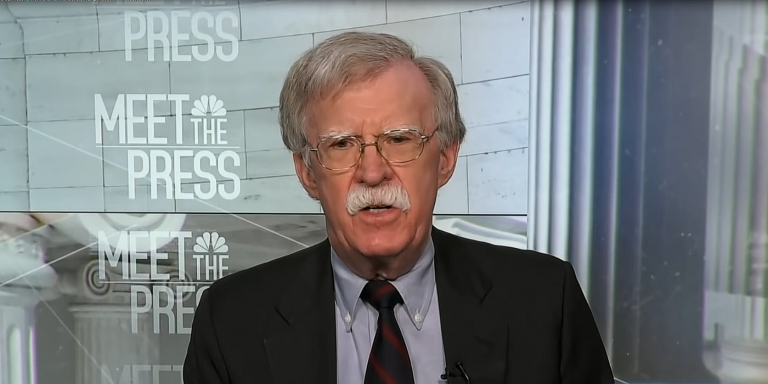
(Headline USAJohn Bolton arrived at a federal courthouse Friday to surrender to authorities on charges accusing the former Trump administration national security adviser turned critic of the president of emailing classified information to family members and keeping top secret documents at his Maryland home.

Bolton did not comment to reporters as he entered the courthouse in Greenbelt, Maryland, where he is expected to make an initial appearance before a judge on the 18-count indictment brought against him on Thursday.

Bolton is accused sharing with his wife and daughter more than 1,000 pages of notes that included sensitive national defense information he had gleaned from meetings with other U.S. government officials and foreign leaders or from intelligence briefings. Authorities say some of the information was exposed when operatives believed to be linked to the Iranian government hacked Bolton’s email account he used to send the diary-like notes about his activities to his relatives.

Bolton, 76, is a longtime fixture in Republican foreign policy circles who became known for his hawkish views on American power and who served for more than a year in Trump’s first administration before being fired in 2019. He later published a book highly critical of Trump.

“There is one tier of justice for all Americans,” Attorney General Pam Bondi said in a statement Thursday. “Anyone who abuses a position of power and jeopardizes our national security will be held accountable. No one is above the law.”

While the Bolton investigation burst into public view in August when the FBI searched his home in Maryland and his office in Washington, the inquiry was well underway by the time Trump had taken office in January.

Sharing of classified secrets

The indictment suggests Bolton was aware of the impropriety of sharing classified information with people not authorized to receive it, citing an April news media interview in which he chastised Trump administration officials for using Signal to discuss sensitive military details. Though the anecdote is meant by prosecutors to show Bolton understood proper protocol for government secrets, Bolton’s legal team may also point to it to argue a double standard in enforcement because the Justice Department is not known to have opened any investigation into the Signal episode.

Authorities say Bolton took meticulous notes about his meetings and briefings as national security adviser and then used a personal email account and messaging platform to share information classified as high as top secret with his family members. After sending one document, Bolton wrote in a message to his relatives, “None of which we talk about!!!” In response, one of his relatives wrote, “Shhhhh,” prosecutors said.

The two family members were not identified in court papers, but a person familiar with the case, who spoke on condition of anonymity to discuss nonpublic details, identified them as Bolton’s wife and daughter.

A Bolton representative told the FBI in July 2021 that his email account had been hacked by operatives believed to be linked to the Iranian government but did not reveal he had shared classified information through the account or that the hackers now had possession of government secrets, according to the indictment.

The indictment also accuses Bolton of storing at his home top secret intelligence about a foreign adversary’s plans to attack U.S. forces overseas, covert action taken by the U.S. government or other information authorities say could put the country’s national security at risk.

Bolton’s attorney, Abbe Lowell, said in a statement that the “underlying facts in this case were investigated and resolved years ago.”

He said the charges stem from portions of Bolton’s personal diaries over his 45-year career in government and included unclassified information that was shared only with his immediate family and was known to the FBI as far back as 2021.

“Like many public officials throughout history,” Lowell said, “Bolton kept diaries — that is not a crime.” He said Bolton “did not unlawfully share or store any information.”

Controversy over a book

Bolton suggested the criminal case was an outgrowth of an unsuccessful Justice Department effort after he left government to block the publication of his 2020 book “The Room Where It Happened,” which portrayed Trump as grossly misinformed about foreign policy.

The Trump administration asserted that Bolton’s manuscript contained classified information that could harm national security if exposed. Bolton’s lawyers have said he moved forward with the book after a White House National Security Council official, with whom Bolton had worked for months, said the manuscript no longer had classified information.

Adapted from reporting by the Associated Press

 

Judge Grants Protective Order against Rep. Cory Mills at Request of Ex-Girlfriend

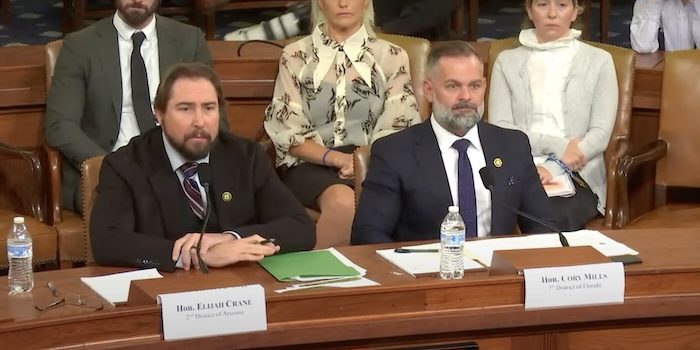
(Headline USAA Florida judge has granted a protective order against Republican U.S. Rep. Cory Mills at the request of a former girlfriend who claimed that he threatened to release nude images of her and physically harm her future boyfriends after she broke up with him.

Under the order issued Tuesday by Circuit Judge Fred Koberlein in Columbia County, Florida, Mills can have no contact with his ex-girlfriend and may not go within 500 feet of her residence or where she works. Mills also is prohibited from referring to her on social media.

The order is in effect through the end of the year, and any violation can result in a fine or imprisonment.

The order was issued following an earlier hearing before the judge in Lake City, about 60 miles east of Jacksonville. After hearing testimony, the judge said he had concluded that the woman was either a victim of dating violence or that she had reason to believe she was in danger of becoming a victim of dating violence.

Mills has previously called the allegations “false” and said they misrepresented the nature of their interactions. His attorney, John Terhune, didn’t respond to an emailed inquiry on Wednesday, and a spokeswoman also didn’t respond to an email asking for comment about the order. In August, when the allegations first surfaced, Mills said they were being pushed by a former political opponent

The 26-year-old woman told Columbia County Sheriff’s Office investigators that she had started a romantic relationship with the 45-year-old Mills in 2021, and it ended in February. During their time together, she lived with him at a home in New Smyrna Beach, Florida, while the congressman traveled back and forth from Washington. At the time they met, Mills was still married but had separated from his wife, and he told her that the divorce was finalized in 2024, she said.

The woman said she moved out of the New Smyrna Beach home earlier this year and moved to Columbia County following news reports about domestic disturbance allegations against Mills from another woman described as his girlfriend in Washington.

Mills was first elected to Congress in 2022, and his district stretches from the Orlando area to the Daytona Beach area.

Adapted from reporting by the Associated Press

 

A 20 Percent Portfolio Allocation to Gold and Silver Is Going Mainstream

(Mike Maharrey, Money Metals News Service) In a seismic shift, Morgan Stanley CIO Michael Wilson recently came out with an investment strategy that includes a 20 percent allocation to gold.

Now a Sprott executive has followed suit, telling a mainstream financial network’s audience that investors should consider shifting from the traditional 60/40 portfolio to a 60/20/20 allocation.

This isn’t typical messaging on mainstream financial networks.

Historically, the conventional wisdom on Wall Street was a 60/40 portfolio, with 60 percent of the holdings in equities and 40 percent in fixed-income investments, primarily bonds. The theory is that these asset classes balance each other, with stocks strengthening in a strong economy and bonds creating a hedge during downturns.

However, bonds have lost their safe-haven status in recent months. Last spring, at the height of tariff uncertainty, gold and silver rallied as bonds sold off. Gold and silver seem to be the last safe havens standing.

Given the changing market dynamics, Wilson said investors should consider a 60/20/20 strategy, swapping half of the bond portfolio for gold to serve as a “more resilient” inflation hedge.

In an interview on CNBC Tuesday (Oct. 14), Sprott director of ETF management Steven Schoffstall echoed Wilson, saying a 20 percent allocation to gold and silver will likely yield a better return than the traditional portfolio.

He noted that the pivot toward a lower interest rate environment with the Federal Reserve now in a cutting mood will likely benefit the metals.

“Gold’s always traditionally been viewed as a safe haven for economic turmoil, geopolitical instability, things that we’re seeing right now, because it doesn’t have a yield. Generally, falling interest rates are beneficial for gold. That’s when we see a lot of investors start to move into gold.”

This has been evident in the surge of money into gold ETFs in North America.

Schoffstall said this reflects growing investor acceptance of gold in the West.

“Typically, it’s been viewed as a fringe or outside metal and allocation tool.”

He noted that “more prominent economists are starting to suggest shifting from a 60/40 model to something closer to a 60/20/20 where it’s 60 percent equities, 20 percent fixed income, 20 percent gold.”

Schoffstall pointed out that gold and silver are the ultimate hedge.

“What you get out of gold is that hedging to the broader investor universe. When you start thinking about things like correlations – how well does gold move versus other aspects of the economy – we tend to see low to moderate correlations across most major asset classes, and an inverse correlation to the U.S. dollar – all aspects of the economy that investors are starting to feel uneasy about at the moment.”

This interview isn’t as surprising as the announcement from the Morgan Stanley CIO, given Sprott’s focus on metals and critical minerals. However, it reinforces a visible shift in mainstream investment strategy in the U.S., and, notably, he had this discussion on CNBC, a mainstream financial network that tends to ignore gold at best and generally dismisses it outright.

Schoffstall said that even with gold at over $4,000, he still sees plenty of upside given persistent geopolitical tensions, trade uncertainty, and high levels of global debt.

“I don’t think those overlaying macro factors are going away anytime soon, and I think that’s something that investors are really latching on to.”

He also noted steady central bank gold buying.

“Over the last three years it’s been about a thousand tons per year. We’re still seeing continued buying from central banks. What that does is allow central banks to de-dollarize their assets. They can move out of Treasuries, move into gold, and at the same time they can actually repatriate that gold back to their home countries for their own self-storage. It gets it out of the way of sanctions that could potentially come from the United States or other countries.”

Pushing precious metals allocations to 20 percent will require a lot of additional buying. Currently, investors with “significant” allocations to gold don’t generally hold more than 5 percent in their portfolio. Schoffstall said investors would be well-positioned with a 5 to 15 percent allocation to physical gold and silver, depending on risk tolerance, along with exposure to gold and silver mining stocks.

“Gold miners, silver miners, they have operational leverage to the underlying price of gold or silver, which typically allows them to outperform over longer periods of time in bull markets.”

In closing, Schoffstall was asked what would convince him that the gold and silver bull markets might be winding down.

“For gold, what it would take is to see some of that risk coming off the table, geopolitical, economic risk. I would think that in the near term, that seems quite unlikely. If you’re looking at silver, [it’s] a little bit different with that industrial component. If you start to see slowdowns in AI investments or a slowdown in the global economy, you could see some pullback in silver prices. But in our view, silver has actually been underinvested in for so long that we think there’s still considerable room to run for silver.”

He cautioned that we could see more volatility in the silver market given the lack of central bank buying to support it. However, he said that volatility could work to the upside.

When the news came out, I argued that a major investment firm like Morgan Stanley abandoning the venerable 60/40 portfolio represented a seismic shift in the investing world.

Seeing this discussion on CNBC supports my conclusion.

It will be interesting to see if other mainstream advisors follow suit. But whether they do or not, you should consider rebalancing your portfolio to include gold if you haven’t already. The policies and economic dynamics driving this gold rally aren’t going away any time soon. This monetary malfeasance can’t be voted away. The best thing you can do is prepare and shield yourself from the inevitable consequences.


Mike Maharrey is a journalist and market analyst for Money Metals with over a decade of experience in precious metals. He holds a BS in accounting from the University of Kentucky and a BA in journalism from the University of South Florida.

Headline Geopolitics: Ray McGovern on America’s Foreign Policy

(José Niño, Headline USA) In this Headline Geopolitics episode, José Niño interviews Ray McGovern, former CIA analyst and co-founder of Veteran Intelligence Professionals for Sanity (VIPS).

McGovern discusses the latest ceasefire in Gaza, the growing risk of an IsraelIran war, the shifting balance in the RussiaUkraine conflict, and Washington’s rising tensions with Venezuela. Drawing on his 27 years inside the CIA, McGovern offers a rare insider’s perspective on how U.S. intelligence and foreign policy have gone off the rails.

Listen now for one of the sharpest reality checks on American power today.

Follow Ray McGovern’s work below:
Twitter: https://x.com/raymcgovern
Website: https://raymcgovern.com

José Niño is the deputy editor of Headline USA. Follow him at x.com/JoseAlNino 

Guv. Whitmer Orders Killing of Blind Baby Deer Named ‘Peanut’

(Luis CornelioHeadline USA) The leftist administration of Michigan Gov. Gretchen Whitmer is facing calls to spare the lives of two rescued animals nicknamed Peanut and Kota. 

Peanut, a blind baby deer, and Kota, a rescued coyote, are both scheduled to be euthanized by the Michigan Department of Natural Resources despite opposition from the nonprofit currently caring for them. 

The nonprofit, Detroit Animal Welfare Group, is a no-kill sanctuary and is working with GOP State Rep. Angela Rigas and a group of bipartisan lawmakers to urge Whitmer to save the rescued animals’ lives. 

“These animals are not threats, they are survivors,” Rigas said in a statement, according to The Midwesterner. “Peanut and Kota have been cared for by licensed professionals and were intended to serve as education ambassadors.”  

Rigas said that Peanut’s and Kota’s lives are threatened by what she described as “arbitrary deadlines and bureaucratic technicalities” and urged Whitmer to “commute the death sentences of these animals.” 

The lawmakers are asking Whitmer to use her powers to grant a reprieve to both animals and direct her agency to allow educational and sanctuary placements. 

The lawmakers also asked the Whitmer administration to stop prosecuting the nonprofit and grant permits for the care of rescued animals. 

“The DAWG case illustrates how state agencies can exercise disproportionate authority, often to the detriment of citizens and organizations acting in good faith,” they wrote. “The lack of transparency, arbitrary deadlines, and aggressive enforcement tactics are deeply troubling and demand immediate attention.” 

They added that Whitmer would have blood on her hands “if she does not act” and that this case was “not just about wildlife, it’s about compassion, common sense, and the proper role of government.”