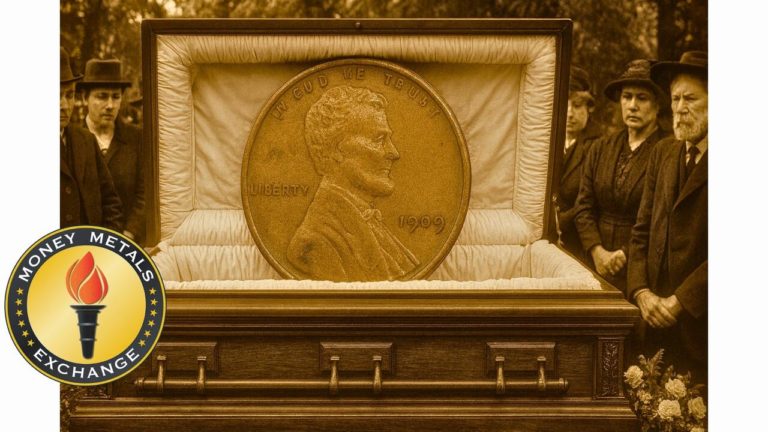
Penny’s Funeral: How Easy Money Broke the Dollar

(Money Metals News Service) In this week’s episode of Money Metals’ Midweek Memo podcast, host Mike Maharrey argues that decades of artificially low interest rates and nearly $9 trillion in quantitative easing, combined with 713% CPI inflation since 1970, have warped investors’ sense of what is “normal.”

He says these policies have produced a debt-addicted bubble economy and destroyed the real value of small denominations like the now-dead penny.

Maharrey says this ongoing fiat currency debasement is baked into the system, so savers should shift wealth into physical gold and silver—especially pre-1965 “junk silver” coins—to preserve purchasing power as the dollar continues to lose value.

Mike Maharrey opens this Midweek Memo with a childhood memory that becomes a metaphor for modern finance.

Blizzard Winters And Broken Market Perception

Growing up in Lexington, Kentucky, Mike Maharrey lived through the brutal winters of 1976–77 and 1977–78. Between December and February of 1977–78, about 32 inches of snow fell, with more than 42 inches over the entire winter. In a typical year, Lexington averages roughly 14.5 inches of snow.

The winter of 1976–77 still brought about 24 inches, around 10 inches above normal. As a 9- to 11-year-old, Maharrey internalized those blizzard seasons as normal. Later, when a winter produced only 5 inches of snow, it felt wrong, as if something had broken in the climate. In reality, the extreme winters were the outliers. The milder years were the true norm.

That misperception is his bridge to markets. Just as he learned to expect 40-inch winters, an entire generation of investors, analysts, and economists has learned to see 0 percent interest rates as normal. In his view, that belief is as mistaken as a kid in Kentucky waiting every year for a once-in-a-generation blizzard.

How 0% Interest Rates Became “Normal”

Maharrey walks through the post-2008 era to show how abnormal it really is. After the financial crisis, the Federal Reserve launched four rounds of quantitative easing and ultimately injected nearly 9 trillion dollars into the economy. It did so by buying US Treasuries and mortgage-backed securities with money created out of thin air, inflating its balance sheet and flooding the financial system.

At the same time, the Fed slashed interest rates to zero for the first time in 2008. Rates did not lift off that floor until December 2015, giving the United States seven straight years of 0 percent interest. Once inflation is factored in, trillions of dollars in bonds around the world carried negative real yields during this period.

When the Fed finally tried to “normalize” policy, it only managed to push the federal funds rate to about 2.5 percent by 2018, a full decade after the crisis. Markets stumbled almost immediately. The stock market sold off in the fall of 2018, and by 2019, the Fed had already cut rates three times and halted its attempt to shrink the balance sheet.

Crucially, all of this happened before COVID-19. The central bank was easing again a year before the pandemic, which later provided convenient cover for another round of zero rates and massive money printing.

Mortgage Shock, Housing Bubbles, And Negative Real Yields

When inflation could no longer be dismissed as “transitory,” the Fed began raising rates in March 2022 and eventually pushed them to about 5.5 percent. Many market participants see this as a punishingly high rate environment. Maharrey counters that 5.5 percent is actually slightly below the historical average for interest rates when you look back to the 1960s and 1970s.

On a long-term chart, he says, you can see a downward ratchet. Each crisis forces the Fed to cut rates lower than before, and it never quite gets them back up before the next downturn hits. Once the policy rate hit zero in 2008 and officials hesitated to go negative as Europe did, the Fed layered massive quantitative easing on top.

The same warped perception shows up in mortgage markets. As of mid-November, the 30-year fixed mortgage rate hovered around 6.3 percent, and has spent months in the 6 to 7 percent band. Today, that feels very high to many potential homebuyers. Historically, Maharrey notes, 6 to 7 percent used to be the low end of normal mortgage rates.

What makes it so painful now is the combination of those rates with a huge surge in home prices. Between mid-2020 and mid-2022, home prices exploded by 50 percent or more. That boom coincided with another 4 to 5 trillion dollars in quantitative easing during the COVID era. He cites commentary from Wolf Street pointing out that the Fed engineered 30-year fixed mortgage rates below 3 percent even as inflation was racing toward roughly 9 percent, creating negative real mortgage rates of minus 3 percent, minus 4 percent, or even worse. In effect, borrowers were being paid in inflation to take on debt.

With money that cheap, buyers’ brains “turn to mush,” as he puts it, and prices cease to matter. That is how you blow a housing bubble, and it looks very similar to what happened in the early 2000s when the Fed cut rates to around 1 to 1.5 percent after the dot-com bust and set the stage for the subprime crisis.

Easy Money Versus Inflation: The Fed’s No-Win Choice

Decades of artificially low rates and repeated rounds of quantitative easing have, in Maharrey’s view, produced an economy addicted to easy money. Like a heroin addict who needs ever larger hits to achieve the same high, the system now requires deeper and longer bursts of cheap credit to survive each downturn.

That is why the Fed is eager to pivot back toward cuts even though price inflation remains stubborn. In a sane world, he argues, central bankers would be holding rates higher or even raising them in the face of persistent inflation. Instead, they are already hinting at an easier policy.

debt-soaked bubble economy cannot function in a genuinely normal interest-rate environment. From a historical standpoint, current rates sit on the low side of normal, but after seven years at 0 percent and another plunge to zero during the pandemic, anything above that feels extreme. Confronted with a choice between maintaining the bubbles or truly killing inflation, Maharrey believes the Fed has chosen the bubbles and surrendered to ongoing devaluation.

He adds that expectations themselves are now part of the problem. As long as investors, politicians, and the public assume low rates and money printing are standard tools with minimal cost, there will be little resistance to continued monetary “malfeasance.” Perception shapes behavior, but it does not erase the economic consequences that are building under the surface.

The Death Of The Penny And 713% Inflation Since 1970

With that macro background, Maharrey zooms in on a small but powerful symbol of devaluation: the US penny. The Philadelphia Mint recently struck the last five pennies, marking them with an omega symbol to signify that they are the final coins of their kind. These five will be auctioned off, and US Treasurer Brandon Beach traveled to Philadelphia to witness the final production.

Earlier in the year, President Donald Trump effectively signed the penny’s death warrant, arguing that it no longer made financial sense. He said the United States had been minting pennies that “literally cost us more than 2 cents.” Maharrey notes that this actually understated the problem. According to the US Mint, it costs about 3.69 cents to mint and distribute a single penny.

In 2024, the Mint produced around 3.2 billion pennies at a cost of roughly 85.3 million dollars. Those pennies made up more than half of all new coins minted that year. Yet a single cent buys almost nothing in today’s economy. The coin has become barely more valuable than the lint in the pocket with it.

Maharrey ties that directly to decades of inflation. Since 1970, based on the official Consumer Price Index, prices have increased by more than 713 percent. That penny gumball from childhood now costs about 8.1 cents. And he stresses that even this 713 percent figure likely understates the true loss of purchasing power because the CPI formula was changed in the 1990s in ways that tend to understate inflation.

At the same time, inflation has driven up the cost of raw materials and production, so the penny is both expensive to mint and nearly worthless in use. Instead of confronting the underlying money printing and deficit spending, he says, the government simply removed the most visible reminder of the dollar’s decay by killing the penny.

Coin Debasement, Junk Silver, And Fiat Lies

The demise of the penny is only the latest chapter in a long history of coin debasement. In 1982, the Mint quietly changed the penny’s composition from 95 percent copper and 5 percent zinc to a core of 97.5 percent zinc with only 2.5 percent copper plating. The coin kept its name but lost most of its intrinsic value.

Nearly two decades earlier, under the Coinage Act of 1965 signed by President Lyndon B. Johnson, the Treasury removed all silver from dimes, quarters, and half dollars. Modern versions are copper-cored clad coins with base-metal faces. Pre-1965 pieces, by contrast, are 90 percent silver. These older coins are now commonly called “junk silver,” a label Maharrey finds ironic. The real junk, he says, is the modern clad coinage. The old silver pieces are still real money.

He recalls that Johnson insisted removing silver would not affect the value of US coins, claiming the Treasury could keep metal prices aligned. A few years later, President Richard Nixon offered similar assurances when he severed the last formal tie to gold, promising that the dollar would be “worth just as much” afterward. Maharrey calls these statements either lies or willful ignorance. In a fiat currency system where money is unbacked, devaluation is not a bug. It is the operating model.

Meanwhile, production costs continue to climb up the denomination scale. According to the Mint’s own data, it costs about 13.8 cents to produce and distribute a single nickel. With pennies already gone and nickels costing more than their face value, he wonders what will be marched to the monetary firing squad next.

Why Gold And Silver Still Win

Throughout the episode, Maharrey returns to a simple conclusion. When money is untethered from anything tangible, depreciation is as certain as death and taxes. The 713 percent CPI rise since 1970, the removal of copper and silver from coins, repeated rounds of quantitative easing totaling nearly 9 trillion dollars, and years of 0 percent interest rates all point in the same direction.

In that environment, he argues, gold and silver serve as real money. As governments devalue their currencies, it takes more dollars to purchase the same ounce of metal. That makes gold and silver look more expensive in nominal terms, but in reality, they are preserving purchasing power while paper currency erodes.

He highlights pre-1965 90 percent silver coins—quarters, dimes, and half dollars often labeled junk silver—as especially useful. They are small, divisible units of real money and a practical way to hold silver. Maharrey notes that, even with silver around 50 dollars an ounce in his example, he still sees it as a bargain when you consider the gold-to-silver ratio and ongoing supply deficits in the silver market.

For listeners who want to respond, he points to Money Metals Exchange as a source for “junk silver” and other bullion. He notes that junk silver is available below spot, making it one of the most economical ways to acquire physical silver. It can even serve as a teaching tool, for example, as a Christmas gift that doubles as a lesson in inflation and sound money.

He closes by urging listeners not to wait for politicians or central bankers to reverse course. The debt load, policy habits, and political incentives all point toward continued devaluation. The rational move, he says, is to shift savings out of depreciating dollars and into real money—physical gold and silver—before the next phase of this long inflationary experiment unfolds.


EXCLUSIVE: Letitia James’s Fugitive Relative Was Arrested for Spitting on a Cop

(Ken Silva, Headline USA) Headline USA has obtained previously unpublished records about New York Attorney General Letitia James’s fugitive grandniece, who has reportedly been living rent-free at her Virginia property since 2020.

The grandniece, Nakia Monique Thompson, 36, is a key player in the Justice Department’s prosecution of James for mortgage fraud. James listed the property where Thompson is living as a secondary residence in her mortgage application, but the New York AG has been allegedly using it as an investment property. James’s false statements on her mortgage application allowed her to illegally save $18,000 in interest, according to the DOJ, which is why she’s facing federal mortgage fraud charges.

Last month, the Daily Mail revealed that Thompson has a lengthy criminal record, and is a wanted fugitive in North Carolina.

Letitia James's fugitive grandniece.
Letitia James’s fugitive grandniece.

The Daily Mail’s report prompted Headline USA to head to the Forsyth County, North Carolina court registry to search for records about Thompson’s crimes, since they weren’t available online. The nearly 20-year-old records weren’t immediately available at the court registry, either—they were on microfilm, not paper—but a court clerk finally made copies and provided them to this publication on Wednesday.

The records provided to Headline USA show that Thompson was indicted with two counts of “malicious conduct by prisoner” and a count of “assault on a government official” in January 2006, when she was just 16 years old. It’s not clear why Thompson was in custody in the first place, but the records show that she landed herself in hot water when she apparently spit on a cop.

According to the records, Thompson “did knowingly emit bodily fluid at Deputy Sheriff T.R. Bartlett, who was performing his duties of ATTEMPTING TO PUT A ‘SPIT HOOD’ ON [THOMPSON].” Thompson also spit on Deputy Sheriff J.G. Presnell and kicked Deputy Bartlett, the records say. A spit hood is a covering to prevent prisoners from spitting on guards and others.

Thompson struck a deal in May 2006 to plea down to three misdemeanor charges. She was required to serve 30 days in a juvenile center and 12 months of supervised release, to attend mental health and substance abuse treatment, and to obtain her GED.

As has been widely reported, Thompson’s run-ins with the law didn’t end there. Her most recent conviction in North Carolina was in 2011, when she was convicted of assault and battery. And according to the Daily Caller, she was charged in Virginia in 2019 with contributing to the delinquency of a minor, possession of burglary tools, grand larceny, petit larceny and two traffic offenses.

Keith Acree, communications director for the North Carolina Department of Corrections, reportedly told Daily Mail that she’s a fugitive because she avoided probation supervision for her latest charges there.

“An absconder is considered a fugitive. Thompson faces arrest if she is located in North Carolina,” he reportedly said, adding that Thompson’s crimes are ‘non-extraditable’ due to their low level.

When contacted by the Daily Mail, Thompson reportedly said “no comment,” adding for some reason that she’s “very much in college, and very much a graduate.”

Meanwhile, James is fighting the charges against her. Her lawyers filed a motion to dismiss on Monday, arguing that the indictment against her is the “product of months of illegal and unethical behavior by government officials, only made possible by the misuse of a federal agency, the disregard of exculpatory evidence, the systematic removal of ethics officials and career prosecutors who stood in the way, and the improper attempt to install an unqualified U.S. Attorney with nothing to offer except undying loyalty.”

James first rose to national prominence during her 2018 campaign for New York attorney general, when she pledged to use her office to go after Trump before seeing any evidence of wrongdoing.

She later brought a civil fraud case against the Trump Organization and two of the president’s sons. That case resulted in a $450 million civil fine against Trump, though most of it was ultimately dismissed by a New York appellate court.

Ken Silva is the editor of Headline USA. Follow him at x.com/jd_cashless.

Ukrainian Military Says It Struck Targets Inside Russia Using US-Supplied ATACMS Missiles

(Dave DeCamp, Antiwar.com) The Ukrainian military said on Tuesday that its forces used US-provided ATACMS missiles in strikes on Russian territory, an attack that would require targeting data provided by the US.

“The Armed Forces of Ukraine have successfully used ATACMS tactical missile systems to deliver a pinpoint strike on military facilities on Russian territory,” the General Staff of the Armed Forces of Ukraine wrote on Telegram. “This is a landmark event that underscores Ukraine’s unwavering commitment to its sovereignty.”

The General Staff added that the “use of long-range strike capabilities, including systems such as ATACMS, will continue.” So far, the use of ATACMS on Russian territory hasn’t been confirmed by Moscow.

ATACMS have a range of about 190 miles, and Ukraine was first given the green light to use the missiles in strikes on Russian territory by the Biden administration toward the end of 2024. While Russia reported Ukraine’s use of ATACMS in attacks on Russian territory at the time, the statement by the General Staff on Tuesday marks the first time the Ukrainian military acknowledged its use of the US-provided missile to strike inside Russia, according to The Kyiv Independent.

According to media reports, the Trump administration had been blocking Ukraine’s use of ATACMS in strikes on Russian territory but recently reversed the policy. Last month, the Ukrainian military said it struck a chemical plant inside Russia using British-provided Storm Shadow missiles, which also require US targeting data.

US-backed missile and drone attacks on Russian territory always risk a major escalation from Moscow. When President Biden first gave Ukraine the green light to fire ATACMS and Storm Shadows into Russia, Moscow responded by altering its nuclear doctrine to lower the threshold for the use of nuclear weapons.

The Ukrainian military’s statement on the use of ATACMS comes as Russian troops continue to advance in both eastern and southern Ukraine.

This article originally appeared at Antiwar.com. 

Trump Designates Saudi Arabia as ‘Major Non-NATO Ally’ During MbS Visit

(Dave DeCamp, Antiwar.com) President Trump announced on Tuesday night that he was designating Saudi Arabia as a “major non-NATO ally” of the US after he and Saudi Crown Prince Mohhamed bin Salman signed a new security pact, dubbed the US-Saudi Strategic Defense Agreement (SDA).

“I’m pleased to announce that we are taking our military cooperation to even greater heights by formally designating Saudi Arabia as a major non-NATO ally, which is something that is very important to them, and I’m just telling you know for the first time because I wanted to keep a little secret for tonight,” the president said at a dinner he hosted for MbS after the two leaders met in the Oval Office earlier in the day.

The MNNA designation gives countries priority access to US military equipment. Under the SDA, Saudi Arabia will purchase F-35 fighter jets and 300 US-made tanks, according to a statement from the White House.

The White House said that the security pact will make it easier for “US defense firms to operate in Saudi Arabia” and affirms that Riyadh “views the United States as its primary strategic partner.” It’s unclear at this point if the SDA includes any sort of mutual defense guarantee for Saudi Arabia, something Riyadh was seeking.

Saudi Arabia has also been seeking US help in establishing a civilian nuclear program, which it appears to have secured. Trump and MbS signed a deal on the conclusion of nuclear negotiations that the White House said set the “legal foundation for a decades-long, multi-billion-dollar nuclear energy partnership with the Kingdom” and “confirms that the United States and American companies will be the Kingdom’s civil nuclear cooperation partners of choice.”

MbS also pledged more Saudi investments in the US and said that he wants to join the “Abraham Accords,” referring to the Arab-Israeli normalization deal, but that it hinges on the creation of a Palestinian state, something the Israeli government has repeatedly rejected.

“We want to be part of the Abraham Accords, but we want also to be sure that we secure a clear path to a two-state solution,” MbS told reporters. “We had a healthy discussion with Mr. President that we’re going to work on that to be sure that we can prepare the right situation as soon as possible.”

Trump stirred controversy during his meeting with MbS by downplaying the murder of Jamal Khashoggi, a US resident and Washington Post columnist who was brutally killed at the Saudi consulate in Istanbul, Turkey, in 2018. The CIA concluded that year that the murder was ordered by MbS himself.

When asked about the murder, Trump told reporters that a lot of people “didn’t like” Khashoggi and claimed MbS “knew nothing about it.”

Trump has received little criticism over the fact that he’s planning to arm a country with F-35s that’s known for brutal airstrikes against civilians in Yemen, which the US supported. In August 2018, about two months before Khashoggi was murdered, the US-backed Saudi coalition bombed a school bus in Yemen, killing 40 children.

President Trump conducted his own brutal bombing campaign in Yemen this year, killing more than 250 civilians in heavy missile strikes that were launched from March 15 to May 6.

This article originally appeared at Antiwar.com. 


Mexico Again Rejects the Idea of US Military Intervention Against Cartels

(Dave DeCamp, Antiwar.com) Mexican President Claudia Sheinbaum on Tuesday again rejected the idea of US military intervention against cartels in Mexico, comments that came a day after President Trump said he was willing to launch strikes on Mexican territory to stem the flow of drugs.

“It’s not going to happen,” Sheinbaum said, according to The Associated Press. “He (Trump) has suggested it on various occasions, or he has said, ‘we offer you a United States military intervention in Mexico, whatever you need to fight the criminal groups.’”

The Mexican leader added that she has told Trump “on every occasion that we can collaborate, that they can help us with information they have, but that we operate in our territory, that we do not accept any intervention by a foreign government.”

Earlier this month, NBC News reported that the Trump administration had started developing detailed plans to send US troops and intelligence officers into Mexico to target cartels in operations that would include drone strikes. The report said that the administration wanted to coordinate the operations with the Mexican government, but was also considering conducting the campaign without Mexico’s approval, which would constitute a serious violation of the country’s sovereignty.

Trump was asked on Monday if he would seek the Mexican government’s permission before launching strikes and said he “wouldn’t answer that question.” He added that he has been “speaking” with Mexico and that they “know how I stand.”

The Trump administration has been increasingly focused on Latin America, with its bombing campaign against alleged boats in the region and the military buildup in the Caribbean that’s aimed at ousting Venezuelan President Nicolas Maduro. US Secretary of War Pete Hegseth announced last week that he was calling the military campaign “Operation Southern Spear,” signaling that it will escalate.

This article originally appeared at Antiwar.com. 

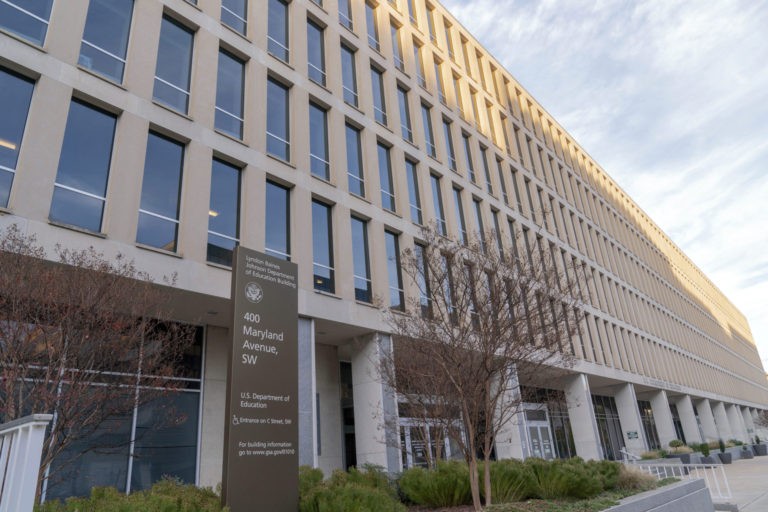
Poll: Americans Support Eliminating Department of Education

(Esther Wickham, The Center Square)  A new national poll reveals strong American voter support for eliminating the U.S. Department of Education.

The survey by the nonprofit Yes. Every Kid Foundation, released earlier this month, found 56% of registered voters support dismantling the agency, compared to 30% opposed.

The poll highlights widespread frustration with federal overreach in education. Voters described the department as “disconnected from classrooms and bureaucratic,” with 87% trusting parents to make the best decisions for their children.

“Voters are telling Washington something unmistakable: Families, not bureaucrats, should be the center of education decision-making,” Matt Frendewey, vice president of strategy, said in an email to The Center Square. “When people learn they can keep every dollar, maintain every protection and still reduce bureaucracy, a majority supports transforming the Department of Education. The appetite for bold, family-first change is larger than D.C. realizes.”

The Trump administration announced Monday that six offices within the Department of Education will be transferred to four partner agencies: Health and Human Services, Labor, Interior and State, according to a news release.

“These new and better ways of getting students what they need in school will not only give parents and teachers more control over their kids’ and students’ education but also streamline getting cash to classrooms,” Paul Runko, director of strategic initiatives at Defending Education, said in a statement to The Center Square. “This shift breaks apart entrenched bureaucracy and clears away red tape so federal support can reach students and schools more quickly and efficiently. We applaud the U.S. Department of Education commitment to America’s children, parents and teachers.”

U.S. Secretary of Education Linda McMahon said the moves are the first steps toward returning education to the states and eliminating layers of bureaucracy.

“As we partner with these agencies to improve federal programs, we will continue to gather best practices in each state through our 50-state tour, empower local leaders in K-12 education, restore excellence to higher education, and work with Congress to codify these reforms,” said McMahon. “Together, we will refocus education on students, families and schools – ensuring federal taxpayer spending is supporting a world-class education system.”

Dismantling the department, created in 1979, has been a top Trump priority. McMahon noted that roughly 70% of eighth graders are not proficient in reading or math, adding, “We are doing something clearly wrong in the way we are educating our students.”

Ecuadorians Vote Against Housing US Military Bases

(Dave DeCamp, Antiwar.com) Ecuadorians voted in a referendum on Sunday and rejected measures that would have allowed the US to establish military bases in Ecuador, a blow to the Pentagon’s plans to increase its military presence in the region.

About 60% of Ecuadorians rejected the return of foreign military bases to the country. 

Ecuadorian President Daniel Noboa, who has aligned himself with the Trump administration, said before the vote that a US military presence was needed to help combat drug trafficking and violent crime, but he said he accepted the results of the referendum.

“These are the results. We consulted the Ecuadorians, and they have spoken. We have fulfilled what we promised: asking them directly. We respect the will of the Ecuadorian people. Our commitment does not change; it strengthens. We will continue to fight tirelessly for the country that you deserve, with the tools that we have,” Noboa wrote on X on Monday.

Ecuador is a major transit hub for cocaine, and Noboa, whose family business has previously been implicated in drug trafficking, has said that 70% of the global supply of cocaine flows through his country, which borders Colombia.

While the US War Department may have hit a snag in Ecuador, it has continued its major military buildup in Latin America, mainly in the Caribbean, as it’s working to revive old bases in Puerto Rico and Panama. The US is threatening to launch a war with Venezuela, with President Trump saying on Monday that he wouldn’t rule out sending troops into the country.

The US has also continued its bombing campaign against alleged drug-running boats in the region, which has involved the killing of at least 82 people, who were extra-judicially executed at sea. The Pentagon has provided no evidence to back up its claims about what the vessels it’s targeting are carrying and has admitted to Congress that it doesn’t know the identities of the people it’s bombing.

This article originally appeared at Antiwar.com. 

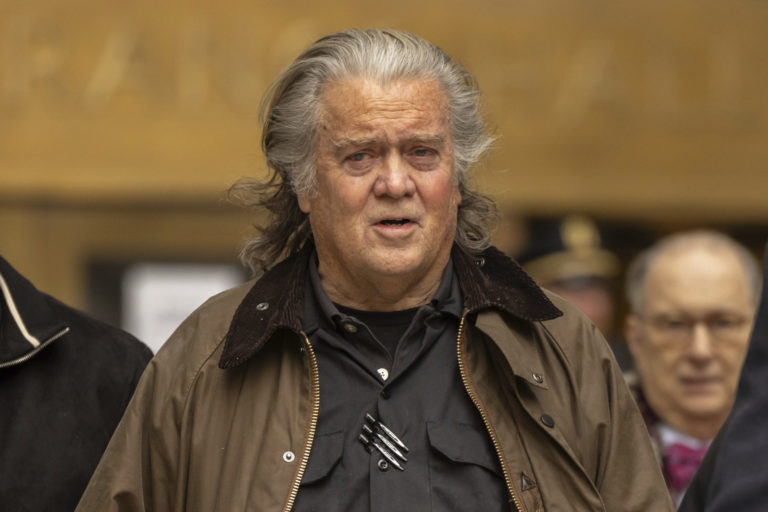
Jeffrey Epstein Advised Steve Bannon on Building MAGA Coalition, Documents Show

(José Niño, Headline USA) Newly released documents show Steve Bannon was receiving political advice, cryptocurrency funding proposals, and introductions to world leaders from convicted sex offender Jeffrey Epstein.

The correspondence between the two men from 2018 to 2019, released by the House Oversight Committee and reviewed by Byline Times, exposes a hidden partnership in which Epstein provided strategic planning, potential cryptocurrency financing, and access to world leaders while Bannon offered something the disgraced financier found irresistible—the creation of a movement that undermined the #MeToo campaign against sexual harassment in the workplace. 

“Populist/Nationalist first. Conservative Christians (catholic/evangelical) next. Reverse Alabama. This coalition staves off ‘Times Up’ for next decade plus,” Bannon wrote to Epstein in February 2018. “Times Up” is a reference to a campaign started in 2018 by women in the entertainment sector to fight sexual harassment and inequality in the workplace.

The emails show Bannon receiving extensive support from Epstein, an American financier and convicted sex offender accused of operating an international sex trafficking ring involving underage girls. At least 45 pieces of correspondence document their collaboration across two years, according to the investigation by journalist Nafeez Ahmed at the Byline Times.

The partnership began taking shape in early 2018. On March 11 of that year, Sean Bannon, an aide and nephew to Steve, sent Epstein a brief message confirming a meeting. “Roger that. Thanks for having us today,” he wrote. Epstein replied the same evening with characteristic confidence. “Spoke to [the] country leader we discussed… I leave Wednesday, back Friday. We should lay out a strategy plan when I’m back.”

Days earlier, the two men had already begun discussing how to build an alternative political funding system. Epstein sent Bannon a set of questions about cryptocurrency and campaign finance regulations. “coin issues: receive coins, distribute coins, pay in coins, coin cooperative, prohibitions foreign donor? i need to understand flow of funds… donor to campaign c’s. does it have to go to campaign first?” he asked.

Bannon replied without hesitation. “On it.”

Minutes later, Epstein pressed further with a suggestion. “should it have a christian component? tithe? if you form a church you may be able to tell mueller you have a confession privelege. :)” The reference was to the special counsel investigation into Russian interference in the 2016 election led by Robert Mueller.

The correspondence reveals Epstein functioning as what the documents describe as an intimate political fixer. He arranged access to world leaders for Bannon, proposed opaque cryptocurrency funding structures, and even offered guidance from the President of the UN General Assembly for what he called Bannon’s EU project.

Ahmed noted that in one email before a March 2018 dinner, Epstein wrote that he would invite the editor in chief of the Wall Street Journal, claimed the President of the United Nations General Assembly would guide the project, announced foreknowledge of a government collapse, and flagged the visit of a Gulf actor. “yes I saw it. 1. I will invite Gerry Baker to our dinner tonight. 2. Miro Lajcak, president of UN, will guide the EU project if you like him. his govt will fall this week — as planned. :)”

By mid 2019, Epstein sent himself a document with the subject line “list for bannon steve” containing a continuous stream of elite names including politicians, oligarchs, Nobel calibre scientists, tech billionaires, editors, bankers, diplomats, former prime ministers, celebrities, and royalty. 

Even as public scrutiny of Epstein accelerated through civil suits and journalistic investigations, Bannon offered reassurance. “there is a crazed jihad against u – ive never seen anything like it – and I’ve seen a lot,” he wrote.

Bannon has since repositioned himself as someone sounding the alarm about what he calls a liberal Epstein cover up. Earlier this year he told a crowd at a Turning Point conference that Epstein was operating as part of a deep state operation against Trump. “Epstein is a key that picks the lock on so many things,” he said. “Not just individuals, but also institutions.”

Bannon was contacted for comment but did not respond.

José Niño is the deputy editor of Headline USA. Follow him at x.com/JoseAlNino

U.S. Trade Deficit Drops 24% in August as Trump’s Tariffs Reduce Imports

(Headline USA) The U.S. trade deficit fell by nearly 24% in August as President Donald Trump’s sweeping global tariffs pushed imports lower.

In a report delayed for more than seven weeks by the federal government shutdown, the Commerce Department said Wednesday that the the gap between what the United States buys from other countries and what it sells them fell to $59.6 billion in August, from $78.2 billion in July.

Imports of goods and services dropped 5% to $340.4 billion in August from July when U.S. companies were stocking up on foreign products before Trump finalized taxes on products from almost every country on earth. Those levies went into effect Aug. 7.

U.S. exports blipped up 0.1% in August to $280.8 billion.

Trump, charging that America’s persistent trade deficits mean that other countries have taken advantage of the U.S., has overturned decades of U.S. policy in favor of free trade, slapping double-digit tariffs on imports from most countries and targeting specific products, including steel, copper and autos, with their own levies.

Still, the U.S. trade deficit is up so far in 2025, coming in at $713.6 billion through August, up 25% from $571.1 billion in January-August 2024.

A drop in imports and the trade deficit is good for economic growth because foreign products are subtracted from the nation’s gross domestic product. GDP is the output of a nation’s goods and services.

“August’s smaller trade deficit will be a tailwind for third quarter real GDP, since it means that more U.S. expenditures were directed toward domestically-produced goods and services rather than foreign ones,” Bill Adams, chief economist at Comerica Bank, wrote in a commentary. “While this release is quite dated because of the government shutdown, it contributes to evidence that the economy was growing briskly in the third quarter.”

Tariffs, which Trump says will protect U.S. industries and lure factories to America, are paid by importers who typically attempt to pass along the higher cost to their customers. Economists say Trump’s tariffs are one reason U.S. inflation remains stubbornly above the Federal Reserve’s 2% target.

After voters’ dissatisfaction with the high cost of living led to big Democratic gains in the Nov. 4 elections, the president relented and dropped tariffs last week on beef, coffee, tea, fruit juice, cocoa, spices, bananas, oranges, tomatoes and certain fertilizers, saying they “may, in some cases” have contributed to higher prices.

His tariffs are also facing a legal challenge that has gone to the Supreme Court. In a Nov. 5, hearing, the justices sounded skeptical that the president had the authority to bypass Congress and slap unlimited tariffs on most imports simply by declaring a national emergency.

Israeli Lobby Pressuring Twitter/X to Squash Free Speech

(José Niño, Headline USA) Is the Israel Lobby preparing a coordinated campaign to pressure Elon Musk and bring Twitter/X back under tighter control of acceptable discourse?

A recent article from Jewish Insider raises that question as it builds a case that Musk’s platform is fueling a rise in right wing antisemitism.

In Elon Musk’s role in the rise of right wing antisemitism, Josh Kraushaar argues that the problem begins with a growing ecosystem of commentators who, in his words, are “mainlining anti Jewish tropes, conspiracy theories and Holocaust revisionism.” He writes that the public conversation has focused too heavily on what he calls the supply side of extremist content. 

The real issue, he says, is demand. As he puts it, “Why are so many people in the independent podcasting ecosystem mimicking the same antisemitic arguments and hosting the same extremist guests” and “is there really a significant audience for this nonsense.”

Kraushaar claims that the current structure of social media rewards fringe communities. In his view, “a small but passionate audience of superfans” can generate more profit than a much larger mainstream readership, which creates a cycle in which extreme content appears more influential than it truly is.

He places Musk at the center of this transformation. According to Kraushaar, “the platform’s algorithm now incentivizes far right discourse” and “creates a marketplace for bigoted and antisemitic influencers.” He argues that this incentive structure affects more established voices. He writes that it “explains why more mainstream figures” such as Megyn Kelly “are increasingly flirting with these extremist narratives.”

Kraushaar reinforces his argument with an anonymous source described only as a former official at a conservative policy institution. The source claims that Musk’s ownership of Twitter has become a problem for the right. “It is not lost on me that there was a great celebration on the right when Elon Musk bought Twitter and now it looks like one of the worst things for the right in a long time” the source says. The individual adds that “the algorithms on X really promote the worst excesses of the post liberal right.”

Kraushaar then highlights a moment he sees as a turning point. “It is not a coincidence that the acceleration of some of the most virulent antisemitism on the right occurred after Musk unblocked Nick Fuentes” he writes. Fuentes remains banned on other major platforms such as Meta and YouTube.

Chris Menahan of Information Liberation, a staunch critic of Israeli influence in U.S. politics,  challenged the framing of the Jewish Insider article. In response to the piece he wrote that “the Israel Lobby is once again targeting Elon Musk.” He argued that these efforts aim to force Musk to “ban Nick Fuentes and stop allowing so much pesky free speech on X.” 

Menahan also questioned the neutrality of Kraushaar’s anonymous source. He remarked, “Wouldn’t shock me if the anon ‘former official at a conservative policy institution’ was one of the Israel Firsters who resigned from Heritage over Kevin Roberts’ statement.

They’ll quote someone like this and act like he’s totally impartial.”


José Niño is the deputy editor of Headline USA. Follow him at x.com/JoseAlNino