

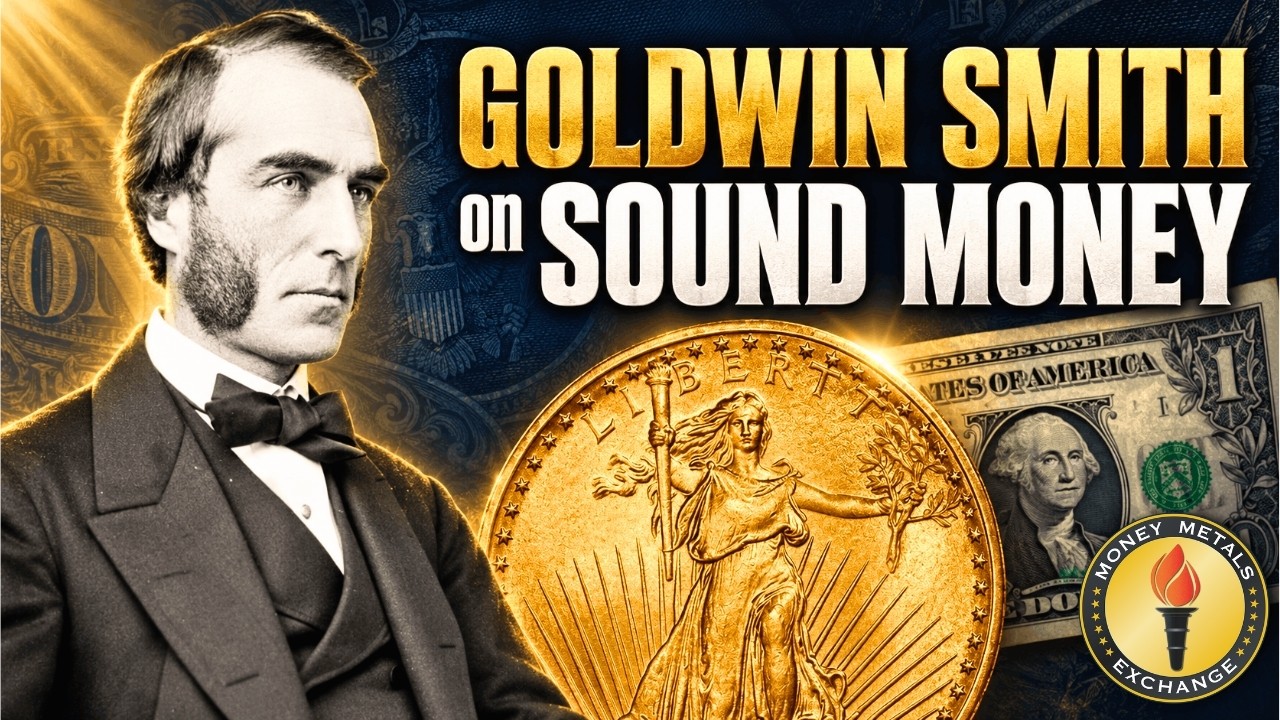
(Joshua D Glawson, Money Metals News Service) In 1883, Goldwin Smith gave an address, later published as False Hopes: Or, Fallacies Socialistic and Semi-Socialistic, Briefly Answered, taking on a number of the political and economic fallacies of his time. His remarks on inconvertible paper money are still worth considering today.
The names have changed, but the impulse behind Greenback advocates has carried right through to modern government deficits and attempts to manipulate the currency.
Smith had some good observations about inflationary policies, not least that “Among the champions of paper currency there are no doubt, knaves, many a one, who know very well what they are about, and whose aim is to defraud the creditor, public and private, by paying off the debt with depreciated paper.”
Most notably, he recognized that inflation tends to favor debtors at the expense of creditors.
That’s why debt-financed deficit spending tends to be popular with the government.
Meanwhile, when it comes to claims of “honest” inflation advocates, Smith noted that there were plenty of “honest enthusiasts” who believed “that a commercial millenium could be opened by merely issuing a flood of promissory notes and refusing payment.”
This reflects one of the central delusions of advocates of fiat money, that increasing the money supply actually increases wealth.
Of course, the mere printing of money does not create goods, services, gold, silver, land, or anything else that people might want to buy.
All it does is devalue the quantity of money and claims on the quantity of money in circulation.
Smith put it this way…
“The bill is a promissory note, and the bank in increasing the number of its bills, like a trader who increases the number of his promissory notes, adds, not to its assets, but to its liabilities.”
That’s a crucial distinction that has been largely lost in the modern world.
Your banknote used to be a promissory note, a promise to pay the bearer in gold or silver. Now all the Federal Reserve note promises is another claim on the Federal Reserve.
That’s a subtle but substantial difference.
What Does a Fiat Dollar Mean?
So what would it actually mean if someone took the inconvertible idea to its logical conclusion?
“Suppose the promissory form to be discarded, and the bill to be simply inscribed ‘one dollar,’ as the Fiat-money men propose, what would ‘dollar’ mean?”
Smith answered that question himself. Advocates of fiat “money” would claim it meant “a certain proportion of the wealth of the country, upon which, as an aggregate, the currency would be based.”
But this raises an obvious question. What proportion?
Smith continued, “The most serious difficulty is that while the coin, which a convertible bank bill represents, is the property of the bank of issue, the aggregate wealth of the country is not the property of the Government, but of a multitude of private owners.”
This is an important insight that goes to the very heart of the proper role of government in the economy and society. The government cannot just print money and spend it on whatever it wants, as if that wealth actually belonged to the State.
Smith explained the problem in direct terms.
“In issuing an order for a loaf of bread, a coat, or a leg of mutton, to be taken from the possessions of the community at large, it would be simply signing a ticket of spoliation.”
So what did he mean by “ticket of spoliation”?
He meant that the devaluation of currency through monetary inflation tends to decrease the amount of goods one can purchase with a given sum of money.
Just like the Cantillon Effect, such fiat-printing inflation favors whoever gets to spend the new money first and makes life harder for those who have to spend it later.
Legal Tender Is Not Consent
Legal-tender laws, meanwhile, tend to undermine private contracts.
“In one sense, of course, government can, by its fiat, put value into paper. It can make the paper Legal Tender for debts, in other words, it can issue licenses of repudiation.”
This means that a government can unilaterally change the terms of a financial contract after the fact. By declaring certain paper money legal tender, it essentially allows itself to evade existing debts by paying them off in currency the government knows will be devalued.
That’s not exactly a ringing endorsement of legal-tender laws.
Smith wrote that “Legal Tender confuses the ideas of the people, shakes commercial morality, and prepares the way for the attempts of the Fiat-money men, and for all the mischief which they breed.”
A free society should not be tied to any particular currency.
If people want to make contracts in gold, silver, dollars, or any other medium of exchange, that should be their business.
Competition between currencies can serve as a useful check on inflation because people can move to alternatives if the issuer of one currency becomes irresponsible.
Legal-tender laws and central banks instead prevent that competition and force everyone to accept a single, depreciating currency.
However, one important note is that gold and silver are still Constitutional money and are still considered “legal tender.” For further details, please see the U.S. Constitution, Article 1, Section 10, Clause 1; and Article 1, Section 8, Clause 5.
It is perfectly legal to buy things with gold or silver sound money as the tender of the transaction; therefore, gold and silver are legal tender by definition.
This is something that Money Metals and the Sound Money Defense League have been actively advocating for well over a decade.
Gold and Silver Were Chosen by the Market
Gold and silver deserve their place as money because of the unique qualities found in the precious metals themselves, rather than any government decree.
“The value is in the gold. It is in exchange for the gold that, whenever a sale takes place, the commodity is given.”
That seems simple enough, but it has huge implications.
It means that gold and silver function as money because people value them as commodities. They are useful as media of exchange precisely because their value can be measured and divided.
Personally, I will simply overlook Smith’s use of “intrinsic value,” while accepting his core argument that gold and silver are implicitly, tacitly, and explicitly more valuable than paper fiat currencies.
Smith observed that precious metals “were felt to have special advantages as mediums of exchange and universal standards of value, on account of their durability, their uniformity, their portability, their capability of receiving a stamp, of being divided with exactness, and of being fused again with ease.”
Gold and silver are valuable materials with convenient properties that allow them to serve as useful media of exchange.
They can be used as money, either as bullion or coins, aka “specie,” if people choose them.
A free market does not need a currency issued and mandated by the government to function. It can operate with a wide variety of media of exchange and standards of value, limited only by people’s capacity to measure and carry them.
The Limits of Monetary Management
When it comes to managing the currency, Smith had one particularly memorable analogy.
“Setting government to settle the circulation of paper, is having the barometer regulated by superior wisdom without reference to atmospheric pressure.”
In other words, governments cannot effectively control the broader economy or set interest rates because they lack the information and flexibility of the marketplace.
Inflation and monetary policy involve a huge number of variables that cannot possibly be understood by any central authority.
Markets are messy, but they have advantages when it comes to incorporating the diverse and often contradictory inputs of millions of individuals.
As for governments that believe they can control the currency to advantage, Smith warned, “Even the least dishonest of such governments, when in want of money, thinks nothing of issuing a flood of legal tender currency, without reference to the state of the money market, a proceeding which is in the nature of a forced loan.”
That’s another way of saying inflation benefits the government by allowing it to spend more than it otherwise could.
The people end up paying the piper, in one fashion or another.
Bimetallism and Currency Competition
When it comes to bimetallism, Smith was entirely correct that “How is it possible for any convention of nations to fix, and to keep fixed, the relation of any two commodities, when, among other determining circumstances, the rate of production varies from year to year?”
He was right to oppose any government-imposed fixed relationship between gold and silver.
Bimetallism is a monetary system in which both gold and silver are officially recognized as money at a government-set exchange rate. For example, the government might declare that 15 ounces of silver equal 1 ounce of gold, as they did in the Coinage Act of 1792. The difficulty is that international and national market values change, so a rigidly fixed legal ratio can cause one metal to be undervalued and disappear from circulation.
The broader lesson is an argument for free markets and limited government.
The best way to counter government interference in currency and markets is to allow competition among currencies. Let people use whatever money they choose, so everyone remains free to make their own decisions about contracts and commerce.
Gold Is Sound Money
Gold has served as money across civilizations because it was not created by government decree. This sound money was chosen in the marketplace.
Smith understood this. The precious metals became preferred media of exchange because of their rarity, durability, uniformity, portability, and divisibility. Those qualities have not disappeared. A gold coin remains gold regardless of the government in power, the central banker at the podium, or the number of new Federal Reserve Notes issued into circulation.
Federal Reserve Notes are fiat currency. Their purchasing power depends on political management, central-bank policy, and public confidence. Gold is a tangible asset with a long monetary history, no counterparty risk, and value recognized around the world.
De-dollarizing does not mean abandoning the dollar for everyday transactions. It means reducing dependence on a currency that can be expanded at will by institutions that have repeatedly shown a willingness to dilute it.
Buying physical gold is one practical way to do that.
Gold offers an opportunity to preserve wealth outside the banking system, outside the Federal Reserve’s printing press, and outside the reach of monetary policy experiments. It is not a promise to pay. It is payment itself.
For those who believe in sound money, free markets, and individual liberty, owning gold is more than an investment decision. It is a declaration of monetary independence.
Joshua D. Glawson is Content Manager for Money Metals and is writer on such topics as politics, economics, philosophy, finance, and personal development. He has a Bachelor’s in Political Science from the University of California Irvine.