All You Do to Me Is Talk Talk!

(Money Metals News Service) In this episode of the Money Metals Midweek Memo, host Mike Maharrey discusses the recent dynamics in the precious metals markets, particularly focusing on the Federal Reserve’s influence and the price movements of gold.

The episode starts with Maharrey expressing his skepticism towards the Federal Reserve, suggesting that their actions and statements significantly impact the financial markets, often overshadowing fundamental economic indicators. He points out a recent dip in the price of gold and the Dow, attributing it to comments made by Fed Governor Chris Waller, who was perceived as hawkish in his speech at The Brookings Institution. Waller’s cautious stance on rate hikes led to market panic, reflecting the market’s sensitivity to the Federal Reserve’s monetary policy.

Maharrey then delves into the intricacies of the market’s reaction to the Federal Reserve’s policies. He argues that the market is overly dependent on the Fed’s actions, particularly regarding interest rate decisions. He highlights that the current market is not driven by fundamentals like company value, supply and demand, or the general state of the economy. Instead, it is largely influenced by expectations about the Fed’s monetary policy.

The discussion includes an analysis of December’s Consumer Price Index (CPI) data, suggesting that price inflation is still high and far from the Fed’s 2% target. Maharrey notes that, despite appearances, monetary conditions are not as tight as they seem, especially when compared to historical standards. He cites the 1970s, when interest rates were much higher, to argue that current rates are not sufficient to control inflation.

Jim Grant’s interview is referenced, where Grant describes inflation as “endemic” and suggests that the economy is heavily reliant on easy money. Maharrey agrees, predicting that despite current hawkish tones, the Fed is likely to cut interest rates in the near future, regardless of whether inflation is under control. He believes this will be due to a potential crisis caused by high interest rates impacting the debt-ridden economy.

The podcast concludes with a call to action, advising listeners to consider adding gold and silver to their portfolios as a secure asset in uncertain economic times. Maharrey emphasizes the importance of being prepared for potential economic downturns and highlights the need to stay informed about financial news and trends.

Report: Anonymous Finder of Jan. 6 Pipe Bomb Was an Undercover Capitol Police Officer

(Ken Silva, Headline USA) For more than three years, the FBI and media referred to the person who discovered a pipe bomb outside the Democratic National Committee headquarters on Jan. 6, 2021, as a mere “passerby.”

But according to a new report from Blaze Media, that passerby was a plainclothes Capitol Police officer.

“Multiple congressional staffers familiar with the investigation confirm to Blaze Media that despite months of the FBI stonewalling congressional committees’ inquiries, they now know the identity of that individual,” Blaze reported.

“Despite congressional aides having given this information to Blaze Media as part of our extensive Capitol CCTV video investigations into the DNC pipe bomb incident, they have not yet revealed the name of the USCP plainclothes officer and how they came to know his identity,” the outlet added.

Blaze Media’s report seems to add credibility to Rep. Thomas Massie’s, R-Ky., earlier suggestions that the Jan. 6 pipe bombers were part of a false-flag operation.

Last July, Massie played video in Congress of the passerby—who now reportedly turns out to be undercover Capitol Police— “miraculously” finding a pipe bomb outside of the DNC headquarters.

Massie suggested at the time that the pipe bombs placed outside the DNC and RNC were distractions to divert law enforcement away from the Capitol, right around the time as the election protests were about to become violent.

“It was specifically at the same precise time to cause maximum distraction from the events going on at the Capitol,” he said last July. “It appears to me that that wasn’t a coincidence.”

However, FBI Director Chris Wray declined to answer any of Massie’s questions about the matter, including whether agents interviewed the person who found the DNC pipe bomb.

“I’m not going to get into that,” Wray said at the time.

The identity of the person who found the DNC pipe bomb is one of the many anomalies of the Jan. 6 pipe bomb case. The person to discover the device outside of the RNC was reportedly an FBI contractor.

An issue ignored by mainstream media, conservative outlets such as Revolver News have shown the improbability that the explosive devices could have been sitting outside the DNC and RNC headquarters for some 17 hours.

Sen. Ron Johnson, R-Wis., is among those who’ve called it “odd” that the Secret Service agents and their bomb-sniffing dogs didn’t detect the devices when sweeping the DNC area ahead of a visit by Vice President-elect Kamala Harris.

And according to FBI whistleblower Kyle Seraphin, the bureau might be suppressing information about the pipe bomb suspect’s identity.

Seraphin, who worked on the Jan. 6 investigation before being suspended from the FBI in April 2022, told the Washington Times earlier this year that investigators linked the suspect to a D.C. MetroRail SmarTrip card. The card indicated the individual got off at a Northern Virginia stop after planting both devices on Jan. 5.

“So they tagged the entrance time and the exit time to that card to that guy. And then they found out who bought the card. And the guy who bought the card was not the guy who was using it,” Seraphin told the Washington Times.

“The card had never been used before. It was bought a year prior by a retired chief master sergeant in the Air Force, and he was a security contractor. So, he held a security clearance,” he reportedly said.

Seraphin reportedly added that the FBI used security camera footage from the Northern Virginia Metro stop to identify the license plate of a car that the individual entered.

Still, the FBI has not publicly identified the subject.

Additionally, Seraphin has alleged that the J6 pipe bombs were built with inert material and were incapable of detonating.

On the No Way, Jose podcast last May, Seraphin explained the implications of his disclosures.

“Here’s why that’s interesting: The feds are never going to give you a real bomb. If they’re going to set you up with something, it’s not going to be real. It’s going to be to set you up,” he said.

“And there’s no reason why we should not have run this person into the ground and found out who it was. And that person should have been charged. The only reasonable thing I can think of is: Somebody doesn’t want that person to be found, and the most likely reason is that person is or was a federal source for some agency at some point,” he said.

Headline USA has previously reported on a security clearance-holding counterterrorism analyst who vanished after claiming to identify the pipe bomber in 2022. That analyst, Jade Parker, has not been heard from publicly since then.

Ken Silva is a staff writer at Headline USA. Follow him at twitter.com/jd_cashless.

Ex-FBI Officials: Obama Judge Harming Nat’l Security

(Ken Silva, Headline USA) Former Fox News reporter Catherine Herridge faces contempt of court charges from Obama-appointed DC District Judge Christopher Cooper for refusing to divulge the identity of a source who fed her information on a Defense Department contractor who has ties to the Chinese Communist Party.

However, two prominent national security officials have warned that Cooper’s actions could threaten national security. Those officials—former National Counterintelligence and Security Center Director William Evanina and the former head of the FBI’s China office, Holden Triplett—have both given sworn declarations in support of Herridge.

The decision of Evanina and Triplett to support Herridge stems from last August, when Judge Cooper ordered Herridge to be deposed about her confidential source. The source had provided confidential information in 2017 about Chinese national Yanping Chen and her U.S.-based University of Management and Technology, which did business with the Pentagon and trained military servicemembers.

Herridge reported in 2017 that Chen and UMT had been under an FBI counterintelligence investigation for their alleged ties to the Chinese Communist Party. The investigation ran from 2010 to 2016, when the Justice Department informed Chen it wouldn’t be filing any charges against her.

After Herridge, who now works for CBS, published her investigation for Fox, Chen sued the FBI, DOD and two other federal agencies for leaking her private affairs that the FBI had collected or generated in the course of its investigation—including photos of her in a People’s Liberation Army uniform.

Following Judge Cooper’s ruling last August, Herridge declined to be deposed—leading the judge to threaten her with contempt charges on Nov. 14. Cooper ordered her to explain why she shouldn’t be held in contempt.

On Jan. 4, Herridge filed her response, arguing that Judge Cooper’s actions risk having a chilling effect on investigative journalism.

Herridge also urged Judge Cooper to consider the national security implications of her reporting on Chen. To support her arguments, she provided sworn declarations of national security officials Evanin and Triplett.

“As they explain, based on their review of record materials, there is a serious risk that [Chen] was involved in making information about U.S. military members available to the CCP, and disclosing the identity of Ms. Herridge’s source(s) to Plaintiff would entail a further national security risk,” Herridge said.

The Reporter’s Committee for Freedom of the Press also seeks to file an amicus brief in support of Herridge. Judge Cooper hasn’t ruled on the group’s request, nor has he indicated when he’ll decide on holding Herridge in contempt.

Appointed by Barack Obama to the DC District Court in March 2014, Cooper has a long history with the Democratic establishment.

He previously served in Bill Clinton’s Justice Department in the mid-90s, and was a member of the Obama/Biden transition team in 2008. His wife, Amy Jeffress, worked as a national security counselor for Attorney General Eric Holder, and she represented disgraced anti-Trump FBI employee Lisa Page in 2018.

Moreover, Jeffress’s connection with the “Crossfire Hurricane” investigation raised questions of a possible conflict of interest when Cooper was the judge assigned to oversee then-special counsel John Durham’s case against former Hillary Clinton lawyer Michael Sussmann—a case that ultimately failed.

Suffice it to say, Cooper has strong ties to the DOJ, and may be sympathetic to trampling on the free press in the name of exposing DOJ and FBI leakers—such as Herridge’s source.

Ken Silva is a staff writer at Headline USA. Follow him at twitter.com/jd_cashless.

Vermont Representatives File Bill to End Sales Tax on Gold and Silver

(Money Metals News Service) Representatives in Vermont realize that their state has become a big outlier, and that it’s high time for the state to end their practice of taxing purchases of gold and silver.

House Bill 295, a measure that removes this taxation from gold and silver coins and bullion and thereby allows Vermont to align with the balance of U.S. states, including all of Vermont’s neighbors who currently enjoy a competitive advantage, was carried over from the 2023 session. Reps. Peterson, Clifford, Demar, Higley, and Smith carry this bill on the heels of the New Jersey legislature voting to end the sales tax on precious metals in their state without a single “no” vote.

Due to dramatically rising federal debt along with the excessive issuance of Federal Reserve note dollars (or their electronic equivalent), Vermont savers have been losing significant purchasing power as inflation rages across America.

Acquiring gold and silver as savings is one way citizens are able to protect themselves from this inflation.

There are strong public policy reasons why so few states still impose a sales tax on precious metals purchases… and why House Bill 295 is good policy:

  • Other types of savings or investment do not carry a sales tax. Gold and silver are held as forms of savings and investment. Vermont does not assess a sales tax on the purchase of stocks, bonds, ETFs, real estate, currencies, and other financial instruments.
  • Levying sales taxes on precious metals makes no sense because they held for resale. Sales taxes are typically levied on final consumer goods. Computers, shirts, and shoes carry sales taxes because the consumer is “consuming” the good. Precious metals are inherently held for resale, not “consumption,” making the imposition of sales taxes on precious metals illogical from the start.
  • Studies have shown that taxing precious metals is an inefficient form of revenue collection. The results of a Michigan study, for example, demonstrated that any sales tax proceeds a state collects on precious metals may be surpassed by the state revenue lost from conventions, businesses, and economic activity that are driven out of the state.

The harm is exacerbated when you consider that ALL of Vermont’s neighbors (Massachusetts, New Hampshire, New York) have already stopped taxing gold and silver.

  • Taxing gold and silver harms in-state businesses. It’s a competitive marketplace, so buyers will take their business to neighboring states (which have all eliminated or reduced sales tax on precious metals), thereby undermining Vermont jobs. Levying sales tax on precious metals harms in-state businesses who will lose business to out-of-state precious metals dealers. Investors can easily avoid paying more than $100 in sales taxes, for example, on a $2,000 purchase of a one-ounce gold bar.
  • Gold and silver are the only money mentioned in the U.S. Constitution. Article 1, Section 10 states that “no state shall make any Thing but Gold and Silver a tender in payment of debts.” It’s illogical to tax the exchange of one form of U.S. money for another.
  • Taxing precious metals is harmful to smalltime savers. Purchasers of precious metals aren’t usually fat-cat investors. Most who buy precious metals do so in small increments as a way of saving money. Precious metals investors are purchasing precious metals as a way to preserve their wealth against the damages of inflation. Inflation harms the poorest among us, including pensioners, Vermonters on fixed incomes, wage earners, savers, and more.

The national backlash against inflation caused by federal spending, debt, and money printing is growing. State legislators this year have already introduced an unprecedented number of bills to remove government impediments to buying, saving, and using gold and silver.

The Green Mountain State is currently ranked 50th, dead last, in the 2024 Sound Money Index. By passing HB 295, Vermont can vastly improve its Sound Money Index ranking, as well as become the 44th state to end sales taxes on precious metals.

More than a dozen states have introduced pro-sound money legislation in 2024 so far, including Alaska, Indiana, Iowa, Georgia, Kansas, Kentucky, Missouri, New Hampshire, New Jersey, Oklahoma, Vermont, West Virginia, and Wisconsin.

Prosecutors: Cocaine Residue Found on Hunter Biden’s Gun Pouch

(The Center Square) – Federal prosecutors asked a judge to deny Hunter Biden’s request to dismiss the gun charges against him, saying “the strength of the evidence against him is overwhelming.”

In their latest court motion, prosecutors filed the first photo of the Colt Cobra revolver at the center of the case. They also detailed some of the evidence they have on the president’s son and pushed back on claims that the prosecution was the result of political pressure.

“The charges in this case are not trumped up or because of former President Trump – they are instead a result of the defendant’s own choices and were brought in spite of, not because of, any outside noise made by politicians,” prosecutors wrote.

Special counsel David Weiss indicted Hunter Biden in September in federal court in Delaware on three counts tied to the possession of a gun while using drugs. Two of the counts involve allegations that he allegedly lied on a form attesting that he was not using illegal drugs when he bought a Colt Cobra 38SPL revolver in October 2018. The third count alleges that he possessed a firearm while using illegal drugs.

The motion included a photo of the speed loader found with the gun and 25 cartridges of ammunition for it.

Prosecutors revealed they had evidence beyond Hunter Biden’s 2022 book: “Beautiful Things: A Memoir.” Investigators even found cocaine on the gun pouch.

“After the defendant’s then-girlfriend discovered and discarded his gun, and after he became aware that local authorities had seized his gun, speed loader, and ammunition, and after the defendant announced his awareness of a federal investigation of him in 2020, the defendant chose to author and sell a book in 2021 in which he made countless incriminating statements about his years-long drug usage, including during the time period he purchased and possessed the gun,” prosecutors wrote.

“He recounted his interaction with a drug dealer who pointed a gun at him during a drug deal before he decided to buy his own gun. Investigators also obtained messages from his Apple iCloud account in which he discussed buying thousands of dollars’ worth of crack while also taking videos of himself weighing crack and smoking it. Furthermore, a chemist was able to confirm the presence of cocaine residue on the brown leather pouch in which defendant stored his firearm.”

Hunter Biden’s attorney has said Republican interference at the Justice Department prompted the gun charges against President Joe Biden’s son.

Hunter Biden’s previous plea deal on gun and tax fraud charges fell apart in July after last-minute disagreements over the degree to which Hunter Biden could face future charges for other alleged crimes still possibly under investigation. That plea deal revolved around alleged tax crimes and a single gun charge. The new indictment includes three separate charges related to Hunter’s possession of the gun.

If convicted, Hunter Biden faces up to 10 years in prison on the first two counts and five years on the third count.

IMF Analysis: Rise of AI to Enhance or Eliminate 60% of Jobs

(Eli Pacheco, Headline USA) A recent report from the International Monetary Fund revealed that artificial intelligence impacts 60% of jobs in nations with advanced economies and poses a threat to eliminating about half of those.

IMF, a lender of last resort to national governments, supports exchange-rate stability. It uses a quota system to offer funds to lend to countries experiencing issues with balance of payments.

AI impacts 40% of jobs in emerging-market countries, the report revealed.

The report said AI can execute tasks that humans do in half of the 60% of jobs in advanced economies. As a result, this trend threatens labor demand, wages, and hiring frequency, and AI could eliminate some of these jobs.

AI boosts productivity in the other half of jobs, mainly automation and information technology. According to the report, AI affects 26% of jobs in low-income nations.

It remains to be seen what the balance of AI’s influence on jobs will wind up, said IMF managing director Kristalina Georgieva. 

“Your job may disappear altogether—not good—or artificial intelligence may enhance your job so you actually will be more productive, and your income level may go up,” she said.

Global experts such as billionaire Elon Musk have warned about AI’s destructive potential in an unregulated state. Additionally, the Biden administration appropriated $140 million to fund seven new AI research groups. 

IMF’s AI Preparedness Index measures readiness in key areas, such as:

  • Digital infrastructure
  • Human-capital and labor-market policies
  • Innovation and economic integration
  • Regulation and ethics

IMF used the index to evaluate how ready 125 countries were for AI’s impact. Affluent economies, including advanced and certain emerging markets, adapted better to AI than poorer economies, although readiness varied by country. Denmark, Singapore, and the United States ranked highest, with top marks in all categories.

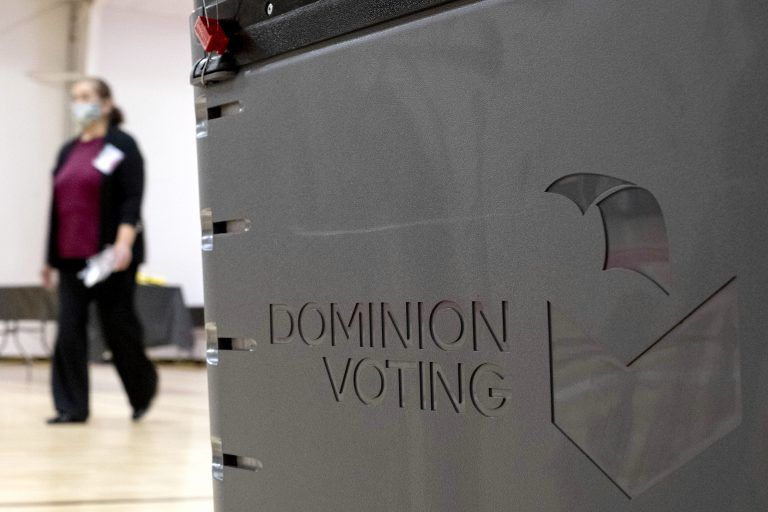
Will Georgia Use Dominion Voting in 2024? Ongoing Trial Could Decide

(Ken Silva, Headline USA) A nearly seven-year legal battle is wrapping up in Georgia, where election integrity activists are in an ongoing trial to get the state to declare that the Dominion Voting Systems touchscreen voting machines are so flawed they are unconstitutional.

Right now, Georgia is set to use Dominion in the upcoming 2024 election, despite a forensic report showing cybersecurity flaws in Dominion’s voting machines. Georgia election officials said that the machines won’t be updated until after the 2024 elections because it’s such a massive undertaking.

But in an ongoing trial that began last week, the Coalition for Good Governance and several voters are making the case that the state should switch to hand-marked paper ballots tallied by scanners.

Presiding U.S. District Judge Amy Totenberg, said in an October order that she cannot order the state to use hand-marked paper ballots. But activists say prohibiting the use of the touchscreen machines would effectively force the use of hand-marked paper ballots because that’s the emergency backup provided for in state law.

The trial is expected to last through this week.

David Cross, a lawyer for some of the individual voters, said the judge has only seen a sliver of their evidence so far. He said he believes she’ll find in their favor, but he doesn’t expect to see any changes before Georgia’s presidential primary in March. He said changes might be possible before the general election in November if Totenberg rules quickly.

“We’re hopeful but we recognize it’s an uphill fight for 2024, just on the timing,” he said, acknowledging the likelihood that the state would appeal any ruling in the activists’ favor.

The activists had planned to call the secretary of state to testify. They wanted to ask why he chose a voting system that uses QR codes that aren’t readable by voters. They also believe his office has failed to investigate or to implement proper safeguards after the Coffee County breach and wanted to ask him about it under oath.

The judge ordered him to appear over the objections of his lawyers. But the 11th U.S. Circuit Court of Appeals on Friday ruled he doesn’t have to testify, citing his status as a top official and saying the plaintiffs didn’t show his testimony was necessary.

The trial stems from a lawsuit that long predates claims about the 2020 election. It was originally filed in 2017 by several individual voters and the Coalition for Good Governance, which advocates for election integrity, and targeted the outdated, paperless voting system used at the time.

Totenberg in August 2019 prohibited the state from using the antiquated machines beyond that year. The state had agreed to purchase new voting machines from Dominion a few weeks earlier and scrambled to deploy them ahead of the 2020 election cycle. Before the machines were distributed statewide, the activists amended their lawsuit to take aim at the new system.

They argued that the system has serious security vulnerabilities that could be exploited without detection and that the state has done little to address those problems. Additionally, voters cannot be sure their votes are accurately recorded because they cannot read the QR code, they argued. And the voting machines’ large, upright screens make it easy to see a voter’s selections, violating the right to ballot secrecy, they added.

Lawyers for Secretary of State Brad Raffensperger wrote in a recent court filing that he “vigorously disputes” the activists’ claims and “strongly believes” their case is “legally and factually meritless.”

The Associated Press contributed to this report.

Ken Silva is a staff writer at Headline USA. Follow him at twitter.com/jd_cashless.

Wisc. Lawmakers Reintroduce Measures to End Sales Tax on Gold, Silver

(Money Metals News Service) A large bipartisan contingent of Wisconsin legislators have reintroduced legislation seeking to end Wisconsin’s outdated practice taxing purchases of gold and silver.

Assembly Bill 29 and Senate Bill 33, primarily sponsored by Rep. Shae Sortwell and Sen. Duey Strobel (R – Saukville), respectively, are cosponsored by almost two dozen other legislators and enjoys wide support – and would align Wisconsin with the policies of 43 other U.S. states.

While Wisconsin lawmakers dithered, New Jersey unanimously passed through both legislative chambers last week a bill that ends sales taxes on purchases of gold and silver in their state. Upon the Governor’s signing, New Jersey will become the 44th state in the country to end this tax.

AB 29/SB 33 would exempt “precious metals bullion,” defined as coins, bars, rounds, and sheets that contain at least 35% gold, silver, copper, platinum, or palladium.

Imposing taxes on the exchange of Federal Reserve notes for monetary metals (i.e. gold and silver) has become an unusual and outmoded practice in the United States… only seven states still engage in it.

Passage of these bills would remove a major disincentive to holding gold and silver — a move that has become especially pertinent at a time when inflation is ripping through the economy and wreaking havoc on family budgets.

Article 1, Section 10 of the U.S. Constitution prescribes that gold and silver are money, and imposing a tax on the exchange of one money for another is inherently illogical.  But there are other strong public policy reasons why so few states still impose sales tax on precious metals purchases:

  • Levying sales taxes on precious metals is inappropriate. Sales taxes are typically levied on final consumer goods. Computers, shirts, and shoes carry sales taxes because the consumer is “consuming” the good. Precious metals are inherently held for resale, not “consumption,” making the application of sales taxes on precious metals inappropriate.
  • Studies have shown that taxing precious metals is an inefficient form of revenue collection. The results of one study involving Michigan show that any sales tax proceeds a state collects on precious metals are likely surpassed by the state revenue lost from conventions, businesses, and economic activity that are driven out of the state.

The harm is exacerbated when you consider that all of Wisconsin’s neighbors (Minnesota, Iowa, Illinois, and Michigan) have already stopped taxing gold and silver. This harms in-state businesses. Most recently, New Jersey ended this tax. Tennessee ended this tax in 2022, and Arkansas and Ohio eliminated this tax in 2021.

  • Taxing precious metals is unfair to certain savers and investors. Gold and silver are held as forms of savings and investment. Wisconsin does not tax the purchase of stocks, bonds, ETFs, currencies, and other financial instruments.
  • Taxing precious metals is harmful to citizens attempting to protect their assets. Purchasers of precious metals aren’t fat-cat investors. Most who buy precious metals do so in small increments as a way of saving money. Precious metals investors are purchasing precious metals as a way to preserve their wealth against the damages of inflation. Inflation harms the poorest among us, including pensioners, Wisconsinites on fixed incomes, wage earners, savers, and more.

More than a dozen states have introduced pro-sound money legislation in 2024 so far, including Alaska, Indiana, Iowa, Georgia, Kansas, Kentucky, Missouri, New Hampshire, New Jersey, Oklahoma, Vermont, and West Virginia.

Currently Wisconsin is tied for 45 out of 50 in the 2023 Sound Money Index. Passage of AB 29/SB 33 would significantly improve Wisconsin’s standing.

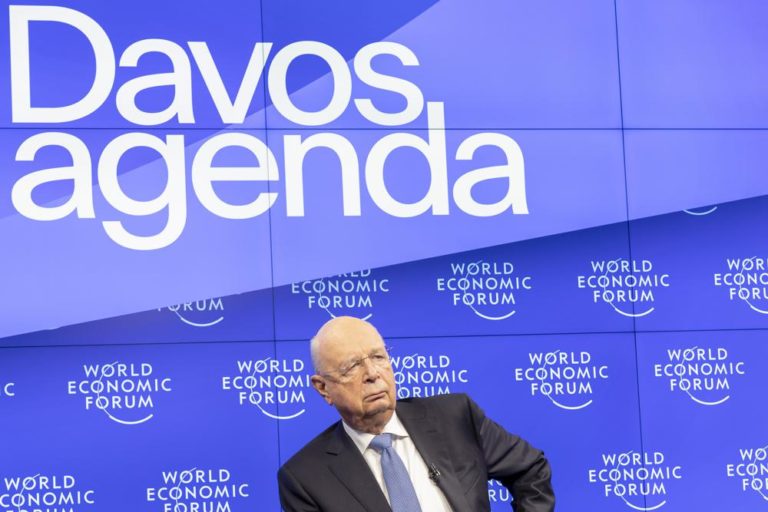
Davos Elites Gorge on Hookers, ‘Shrooms as Theme Focuses on ‘Rebuilding Trust’

(Dmytro “Henry” Aleksandrov, Headline USA) More than 3,000 globalists will be enjoying caviar, gold-leaf desserts, performances by popular musicians and actors, $2,500-per-night hookers and secret dinners while they attend the upcoming World Economic Forum 2024 in Davos, Switzerland.

Ironically, the theme of the upcoming annual event will be “Rebuilding Trust,” according to the New York Post.

Among the celebrities that will perform at private dining and cocktail scenes will be world-famous artists such as Lenny Kravitz, Chris Martin of Coldplay and the Black Eyed Peas.

American financier Anthony Scaramucci—who notoriously lasted 10 days as then-President Donald Trump’s communications director before leaving in a cloud of scandal and turning against his ex-boss—will also be hosting his wine “soirée” once again, this time at the Hotel Europe.

Among the people who previously appeared at Scaramucci’s past parties were Matt Damon, Goldie Hawn, Richard Branson, Andrea Bocelli and Jill Biden.

Back in 2023, in addition to very expensive wine, Scaramucci offered micro-doses of magic mushrooms with the help of a psychedelics company. The drug-obsessed globalist elites would be disappointed this year since Scaramucci won’t be offering the mushrooms during the upcoming event.

In addition to expensive wine, drugs, dinners, parties and performances by popular musicians, sexual degenerates also will be having sex with prostitutes instead of their wives.

It was revealed by the Post that one prostitute who goes by the name “Liana” frequently sells her body to one of the American attendees at the event who either pays $750 per hour or $2,500 per the whole night.

“Liana” was not the only person who confirmed that leftist elites can’t keep it in their pants for a week. A woman who sells bodies of other women for sex in the Swiss town of Aargau, which is located some 100 miles from Davos, confirmed that she received 11 bookings and 25 inquiries, adding that that was just the beginning.

Back in 2020, a Swiss law enforcement official said that at least 100 hookers traveled to Davos to have sex with the members of the globalist elite during the week-long event.

“More back-slapping from the metropolitan elites who brought you wars, a cost of living crisis, woke obsession and public services that no longer work… They offer the world nothing that will improve it,” the organization titled “Anti W.E.F.” said.

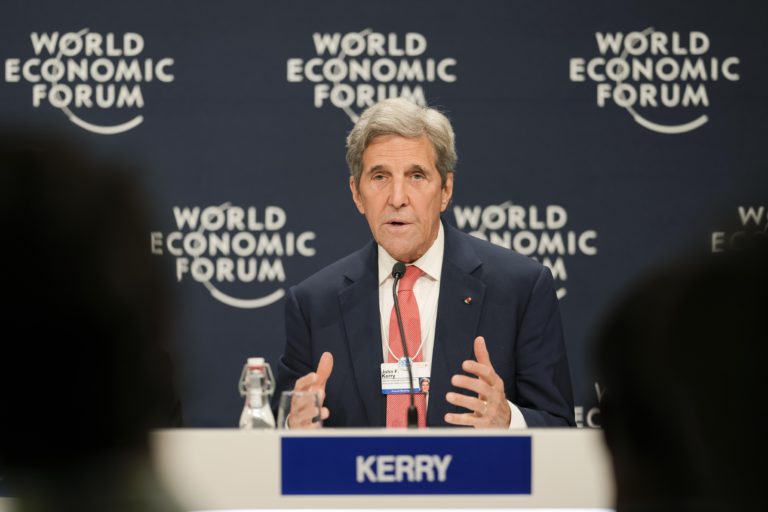
John Kerry Sics Female Goon on Reporter During Davos Scuffle

(Luis Cornelio, Headline USA) U.S. Special Presidential Envoy for Climate John Kerry lashed out at a reporter when questioned about his “carbon footprint” during the 2024 World Economic Forum at Davos, Switzerland.

The questioning escalated into a scuffle, as an apparent security guard intervened and manhandled the reporter, disturbing footage shared on Tuesday revealed.

“What’s the carbon footprint of these events every single year that you come here? Think it’s worth it? Peasants pay for your crimes?” asked Rebel News journalist Avi Yemini. In response, Kerry claimed, “That’s a stupid question.” 

Despite Kerry’s dismissive attitude towards the question, Yemini continued to press. This time, however, he infuriated a female security detail accompanying Kerry who shouted, “We are done now!”

The reporter objected by rebuking the inappropriate physical intervention from the apparent security detail.

He pleaded, “Don’t grab me. You can’t grab us. This is a free society, mate. We have freedom of the press. Why do you think you’re more important? Your carbon footprint doesn’t matter but everybody else around the world…”   

A seemingly agitated Kerry retorted: “I never suggested that. Nobody ever suggested that. Don’t make up stupid questions.”  

As Yemini continued to challenge Kerry, the security detail intervened again, insisting, “Listen… He said, ‘No.'” To which Yemini replied, “Can you not touch me? Can you not touch me?” 

The World Economic Forum has faced criticism for government officials using private planes, contradicting their own calls for carbon footprint reduction. In March 2023, Kerry defended attendees using private jets, claiming they “offset” emissions through green efforts elsewhere. 

“Well, they actually – I’ve talked to them about it. They offset,” Kerry claimed in an interview with Yahoo News. “They buy offsets, they offset. And they are working harder than most people I know to be able to try to effect this transition.” 

Since becoming Biden’s climate envoy, Kerry has faced scrutiny for his family’s past use of private planes. However, Kerry stated during a 2023 congressional hearing that his family sold their private jet in 2022.

Kerry recently announced his departure from the climate envoy role to join the Biden re-election campaign. Moreover, His office drew scrutiny for reportedly spending $4.3 million in taxpayer dollars to fund some of his undisclosed staffers’ salaries.