Florida’s AG Launches Criminal Probe into ChatGPT Over FSU Shooting

(Headline USA) Florida’s attorney general on Tuesday opened a rare criminal investigation into OpenAI’s ChatGPT over whether the artificial intelligence app offered advice to a gunman who killed two people and wounded six others last year at Florida State University.

Attorney General James Uthmeier said that prosecutors had done an initial review of chat logs between ChatGPT and the gunman, Phoenix Ikner, to determine if the AI app aided, abetted or advised the commission of a crime.

Prosecutors believe the chatbot advised Ikner on what type of gun and ammunition to use, whether a gun would be useful at short range, and what time of day and at which location would allow for the most potential victims, Uthmeier said.

“My prosecutors have looked at this, and they’ve told me if it was a person at the other end of that screen, we would be charging them with murder,” Uthmeier said at a news conference in Tampa. “Now, of course, ChatGPT is not a person, but that does not absolve our office and my prosecution team from our duty to investigate whether there is criminal culpability here.”

Florida’s Office of Statewide Prosecution has subpoenaed OpenAI for records of its policies and training materials regarding threats to harm others, and for its policies on reporting “possible past, present, or future crime,” according to the attorney general’s office.

OpenAI spokeswoman Kate Waters called the FSU shooting a tragedy but said the company had no responsibility. The company proactively shared information with law enforcement and continues to cooperate with investigators, she said Tuesday.

“In this case, ChatGPT provided factual responses to questions with information that could be found broadly across public sources on the internet, and it did not encourage or promote illegal or harmful activity,” Waters said in an email.

Uthmeier conceded that his office was venturing into “uncharted territory” by launching a criminal probe into whether a chatbot contributed to the commission of a crime. His office also has initiated a civil probe, he said.

Several civil lawsuits have sought damages from AI and tech companies over the influence of chatbots and social media on loved ones’ mental health. Last month, a jury in Los Angeles found both Meta and YouTube liable for harms to children using their services. In New Mexico, a jury determined that Meta knowingly harmed children’s mental health and concealed what it knew about child sexual exploitation on its platforms.

Also last month, a man sued Google for the wrongful death by suicide of his son and product liability claims, the latest in a growing number of legal challenges against AI developers that have drawn attention to the mental health dangers of chatbot companionship.

Ikner faces two counts of first-degree murder and several counts of attempted first-degree murder in the shooting that terrorized the campus in Florida’s capital city.

Ikner is the stepson of a local sheriff’s deputy, and investigators say he used his stepmother’s former service weapon to carry out the shooting. Prosecutors in the case intend to seek the death penalty.

Uthmeier, a Republican, was named to the position by Florida Gov. Ron DeSantis, after the GOP governor appointed then-Attorney General Ashley Moody to the U.S. Senate seat vacated by Marco Rubio when he became the secretary of state in President Donald Trump’s second administration.

Uthmeier is running in November to be elected to the position on his own.

DeSantis has called a special session for the end of the month to consider an “Artificial Intelligence Bill of Rights,” as well as redraw congressional districts.

Adapted from reporting by the Associated Press

Trump Media Company Replaces Ex-Congressman Nunes as CEO after Stock Plunge

(Headline USA) The Trump business behind Truth Social is replacing a former congressman and big supporter of the U.S. president as the leader of the social media platform after a stock collapse that wiped out billions in investor wealth.

Devin Nunes, a former California congressmen in Donald Trump’s first term, is being replaced temporarily by digital media executive Kevin McGurn as chief executive officer. The company, Trump Media & Technology, didn’t give a reason for Nunes leaving or provide a timeline for his permanent replacement.

After soaring shortly before Trump’s re-election in November 2024, stock in the company plunged 67%, wiping out more than $6 billion in investor wealth.

Trump Media was formed by the Trump family as an alternative to social media giants that had barred him from posting on their platforms after the January 6, 2021 Capitol riots. It said it would not only take on Facebook and Twitter as a “free speech” alternative, but eventually could become a media giant competing with streaming services such as Netflix.

The stock soared, but it never gained traction with a wide audience despite the president’s frequent use of it for major political announcements, slammed by government ethics experts as a conflict of interest with the presidency.

Since it went public two years ago, Trump Media has lost more than $1.1 billion. Nunes got total compensation of $47 million in 2024, the last year for which figures are available.

The new CEO McGurn said in statement that the company was “poised to take off.”

“In carrying President Trump’s unique, singular vision and message, Truth Social stands for the most powerful brand and voice in history of social media and beyond,” he said.

The Trump Organization didn’t immediately responded to a request for comment.

The company has recently branched into cryptocurrency and another hot business, prediction markets. The latter are online betting venues where people can wager on sports, entertainment and political events.

Both cryptocurrencies and prediction markets have gotten boosts from the Trump administration, in terms of lighter regulation and outright promotion. Last year, for instance, the Trump established a national bitcoin reserve, pushing up the value of that currency.

McGurn, has worked at NBC Universal, Hulu and DoubleClick, among other companies, according to his LinkedIn profile. He is also the CEO of a new shell company that Trump’s two oldest sons, Donald Jr. and Eric, joined last year to buy U.S. manufacturers. That company originally stated in regulatory filings that it would be targeting businesses hoping to tap federal contracts, which would be awarded by the same government run by their father.

The Trump Organization and the White House have repeatedly denied that there are conflicts of interest between Trump’s role as president and the family business.

Adapted from reporting by the Associated Press

Trump Postpones Signing Artificial Intelligence Order Out of Concern it Would Hurt the AI Industry

(Headline USA) President Donald Trump called off a signing ceremony Thursday for a new order on artificial intelligence because he worried it could dull America’s edge on AI technology.

Trump said he was postponing the signing because he did not like what he saw in the order’s text. He announced the change hours before the event was scheduled to take place in the Oval Office.

“We’re leading China, we’re leading everybody, and I don’t want to do anything that’s going to get in the way of that lead,” Trump told reporters at an unrelated Oval Office event.

The push for some kind of government action to vet the most powerful AI systems follows growing concern within the banking industry and other institutions about the leaps in AI’s abilities to find cybersecurity vulnerabilities in the world’s software.

Treasury Secretary Scott Bessent and outgoing Federal Reserve Chair Jerome Powell convened an urgent meeting with Wall Street CEOs in April, warning them about the cybersecurity risks posed by Anthropic’s AI model, Claude Mythos.

The meeting, urgently assembled at the Treasury Department’s headquarters, was intended to ensure that banks were aware of the risks associated with the models, Bessent said at CNBC’s “Invest in America Forum” in Washington in April. “This new Anthropic model is very powerful,” he said. “Some banks are doing a better job in cybersecurity than others, and we want to have the ability to convene them and talk about what is best practices and where they should be heading.”

That led some allies of the Republican president to propose better methods for getting those AI tools in the hands of trusted cybersecurity experts.

But an approach that could be perceived as government screening of commercial AI models would have signaled a significant shift in Trump’s pledges coming into his second White House term to undo the AI safety regulations set by Democratic President Joe Biden.

Adapted from reporting by the Associated Press.

Sens. Risch and Cortez Masto Introduce Bipartisan SILVER Act to Derisk U.S. Precious Metals Market Infrastructure

(Money Metals News Service) U.S. Senators Jim Risch (R-ID) and Catherine Cortez Masto (D-NV) today introduced the bipartisan “System Integrity through Licensed Vault Expansion and Resilience Act” (SILVER Act), designed to derisk, modernize, and strengthen America’s precious metals market infrastructure by encouraging greater geographic diversification of approved precious metals depositories.

The Senate bill follows the recent successful introduction of companion legislation in the U.S. House (H.R. 8007) amid growing concerns among lawmakers, regulators, and industry leaders over the national security risks created by geographic concentration of exchange-approved precious metals depositories in the vicinity of New York.

Under exchange practices dating back to the 1970s, depositories used for deliveries on regulated gold, silver, platinum, and palladium futures contracts have been confined to the Greater New York area, creating what supporters describe as a dangerous single-region dependency as to critical financial infrastructure, combined with anti-competitive behavior.

A broad coalition of precious metals industry participants — including several large depositories, mints, and dealers as well as refiners, banks, mining companies, logistics providers, manufacturers, insurers, and investors — has formally endorsed the legislation in a letter to Congress.

The SILVER Act would direct the Commodity Futures Trading Commission (CFTC) to ensure broader depository location options and greater transparency in selection processes.

The legislation has already drawn favorable attention from the CFTC. At a recent House Agriculture Committee oversight hearing, CFTC Chairman Michael Selig publicly praised congressional efforts to address structural concentration risks and pledged to work with lawmakers on the issue.

“We applaud your leadership on this issue, and we’d be happy to work with your office on it,” CFTC Chairman Selig said to House sponsor Rep. Mark Harris after the Congressman pointed out that a single terrorist attack, cyber incident, natural disaster, infrastructure failure, or other disruption affecting the narrow corridor surrounding New York City could impair metals settlement and delivery functions tied to federally regulated futures markets.

Chairman Selig further acknowledged the importance of ensuring adequate deliverable supply and operational resiliency within commodity derivatives markets.

Advocates of the legislation emphasize that current depository selection practices are monopolistic in nature, suppressing competition and increasing costs for investors and businesses. Existing exchange-approved depositories currently charge the maximum storage fees permitted by the exchange, while many qualified facilities elsewhere in the country could provide services at lower cost. Transportation costs are also elevated because market participants outside the Northeast must ship metals long distances to access public markets.

Industry experts also note that precious metals are not only monetary and investment assets, but also strategically important industrial materials essential to electronics, aerospace, medical technologies, energy infrastructure, and defense manufacturing. As a result, maintaining geographically diverse and secure sources of precious metals is increasingly viewed as a national security imperative.

“The current system creates unnecessary vulnerabilities for the nation’s precious metals markets and supply chains – and it arbitrarily excludes major industry players,” said industry coalition member Stefan Gleason, CEO of Money Metals, a large national online dealer, depository, and lender based in Idaho.

“The SILVER Act would promote resiliency, improve competition, lower costs for investors and commercial users, and strengthen America’s financial and critical minerals infrastructure,” Gleason continued.

Now pending in both congressional chambers, the bipartisan legislation does not require approval of any specific depository. Instead, it allows qualified facilities across the United States to receive fair and objective consideration while substantially reducing concentration risks.

“The SILVER Act is a commonsense modernization measure,” said Steven Reiner, EVP at Gold. com, Inc. (NYSE: GOLD), an authorized purchaser of the United States Mint and the owner of Sunshine Minting and SilverTowne Mint, as well as a global network of 15 direct-to-consumer companies, including JM Bullion.

“America’s precious metals infrastructure should reflect the realities of a national marketplace and a modern economy — not outdated geographic restrictions established generations ago,” Reiner continued.

Tarek Saab, CEO of Texas Precious Metals, a prominent dealer and depository located in the Lone Star State, added:

“We thank Senators Risch and Cortez Masto for assisting efforts by our vital industry to address a longstanding problem that hampers the resilience, safety, and competitiveness of the U.S. precious metals markets.”

Foreign Central Banks Dumping U.S. Treasuries

(Mike Maharrey, Money Metals News Service) There is a lot of talk about whether the Federal Reserve should raise interest rates, but in fact, the market is hiking rates with or without central bank cooperation.

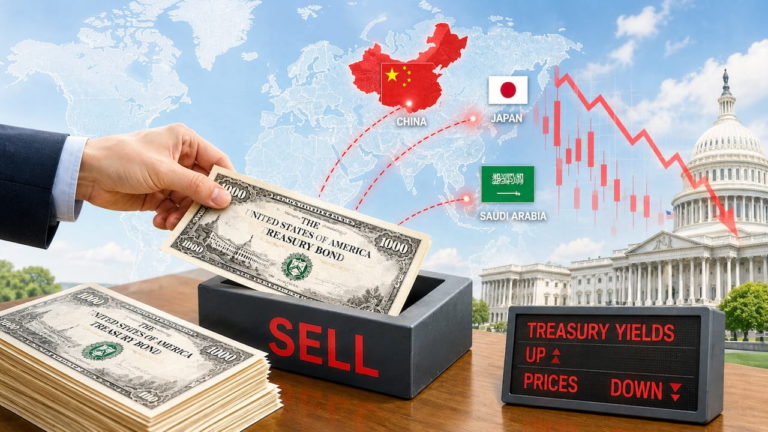
Treasury yields have crept relentlessly higher over the last several months, signaling significant stress in the bond market.

The 10-year Treasury yield was over 4.6 percent Thursday morning (May 21), and the 30-year was north of 5 percent. Meanwhile, rates on the lower end of the curve are also spiking, with the 2-year Treasury note above 4 percent.

Earlier in the week, bond yields hit multi-decade highs.

At an auction last week, the 30-year Treasury sold at a yield of 5.046 percent. While the 30-year has traded above 5 percent on the secondary market a handful of times, it was the first time since 2007 that it sold at auction with a yield that high.

Analyst Brien Lundin noted that the Fed, along with other central banks around the world, finds itself in a “debt trap.”

“It’s essentially the same story I’ve been preaching for the last decade… but it all appears to be coming to a head right now. In short, the inflationary implications of higher oil prices are driving traders away from risk assets (stocks, metals, bonds, etc.) in fear of a hawkish Fed monetary policy in response.”

But there is an even more fundamental dynamic tipping the Treasury market – basic supply and demand. There is a lot of debt out there, and the federal government is creating more every day. Meanwhile, the world is getting wary of holding all that debt.

Foreign Treasury holdings dropped from $9.49 trillion in February to $9.25 trillion, a 2.5 percent decline.

Some of the biggest foreign holders of U.S. debt are shedding Treasuries at an accelerating pace.

In March, China’s Treasury holdings dropped by 6 percent to $652.3 billion.

Japan ranks as the largest foreign creditor. Its Treasury holdings fell by $47 billion to $1.191 trillion.

Why This Bond Market Stress?

This is partly a function of the U.S.-Iran war oil shock. Many countries are selling dollar-denominated assets for cash to pay for oil and to support their own currencies.

HSBC chief Asia economist Frederic Neumann told CNBC the selloff doesn’t come as a shock.

“Given increased financial volatility since the start of the war in the Gulf, and resultant pressure on exchange rates, especially in Asia, it is not a surprise that U.S. Treasury holdings by central banks have fallen. Exchange market intervention to support local currencies will have led some central banks to sell a share of their U.S. Treasury holdings.”

However, softness in the Treasury market predates the conflict. It has been struggling for months because a lot of countries simply don’t want any more exposure to U.S. fiscal malfeasance. The national debt has surged to over $39 trillion.  Meanwhile, the federal government has shown zero interest in reining in spending. On top of that, it is blowing through an additional $1 billion per day to fight the war.

Would you want to lend your drunk uncle, who has maxed out all his credit cards, more money?

If not, you understand how the rest of the world feels about Uncle Sam.

So, it’s not surprising that many countries are anxious to minimize their exposure to the dollar. We see this reflected in accelerating de-dollarization and the fact that gold recently climbed above Treasuries as the world’s biggest foreign reserve asset. When times get tough, you don’t want rapidly devaluing dollars backed by a spend-happy U.S. government. You want real money – gold – backed by nobody.

Ramifications of a Sagging Treasury Market

A sagging Treasury market is bad news for a U.S. government already struggling under the weight of ballooning interest payments.

April interest payments pushed total interest expense to $734.2 billion through the first seven months of fiscal 2026. That was up 7.3 percent compared to the same period in fiscal ’25.

Interest on the national debt cost $1.2 trillion in fiscal 2025. That was up 7.3 percent over 2024.

WolfStreet noted, “There are rising concerns in the bond market about the ballooning U.S. debt, and about the flood of new supply of Treasury securities that the government will have to sell in order to fund the out-of-whack deficits. Treasury buyers and holders are spread far and wide, but higher yields may be necessary to reel in the mass of new buyers needed.

A year ago, analyst Artis Shepherd called the situation in the Treasury market “red lights blinking.”

“The bond market is sending a message to the U.S. government that its spending is out of control and the reserve currency ‘privilege’ it has abused for the last 80 years is running out.”

There is some speculation that the Federal Reserve will have to raise rates to combat price inflation. However, the central bank is already struggling to control the yield curve (especially the long end). It has already restarted quantitative easing (although it will never use that term) to put its big fat thumb on the Treasury market.

While QE can ease the government’s borrowing problem, it will increase inflation. Remember, when the Fed runs QE operations, it buys bonds with money created out of thin air and injects it into the financial system. This is, by definition, inflation.

In a nutshell, the central bank is in a Catch-22.

As Lundin noted, “The Fed will need to raise rates to corral inflation… but it simply can’t because of the debt trap. Investors increasingly recognize this, and are demanding higher returns on Treasurys to compensate for the risk.

The Fed has a choice. It can fight the inflation dragon, or it can surrender to inflation and prop up the bond market. It can’t do both. History tells us the Fed will pick inflation. You should prepare accordingly.


Mike Maharrey is a journalist and market analyst for Money Metals with over a decade of experience in precious metals. He holds a BS in accounting from the University of Kentucky and a BA in journalism from the University of South Florida.

Hong Kong Gold Clearing House Set to Begin Operation as Gold Trade Shifts West to East

(Mike Maharrey, Money Metals News Service) A new Hong Kong-based gold-clearing system will launch in July as part of the Chinese Special Administrative Region’s (HKSAR) push to become a global gold trading hub.

Western markets – London, New York, and Switzerland – have dominated the gold trade for nearly two centuries. However, with gold progressively flowing from West to East, China and other Asian hubs are developing the infrastructure to challenge Western dominance.

According to a Bloomberg report quoting anonymous officials close to the matter, the government-owned clearing system will “mirror” the financial infrastructure used by the LBMA in London. Participants will be able to settle trades through “unallocated” accounts, meaning that the customer can hold a claim against a clearer on a quantity of gold without the need to own specific numbered bars.

In practice, the system is similar to fractional reserve banking. The customer owns the rights to a specific quantity of metal held by a bullion bank. However, the bank does not segregate or earmark specific bars for that customer. Trading through this mechanism is faster and more liquid; however, it increases counterparty risk for the customer because she or he bears the credit risk of the bullion bank.

Most London precious metals trades are facilitated through unallocated accounts.

According to Bloomberg, Hong Kong has invited “a number” of banks friendly to China to participate in the new clearing system.

The HKSAR has also inked a cooperation pact with the Shanghai Gold Exchange to “promote long-term interconnectivity opportunities, with a more integrated renminbi-based Asian gold market in the making.”

Under the cooperative agreement, the Hong Kong Precious Metals Central Clearing Co. (wholly owned by the HKSAR government) will establish “a high-level, collaborative governance structure,” with the Shanghai Gold Exchange providing technical and regulatory input on system design, rulemaking, institutional access, risk management, and operational standards.

Cooperation between the Hong Kong clearing company and the Shanghai Gold Exchange will reportedly include facilitation of physical gold delivery, warehousing, and further enhancing financial connectivity between the two markets.

According to Bloomberg, the new clearing system has attracted “significant interest … particularly from trading houses and financial institutions seeking an alternative for trading gold within Asia, home to two of the world’s major bullion consumers in China and India.

In another move to elevate its status as a gold hub, Hong Kong officials plan to expand the region’s gold storage capacity from 200 to more than 2,000 tonnes over the next three years.

Looking at the bigger picture, it reveals a slow but steady migration of the gold trade from the West to the East.

World Gold Council head of Asia-Pacific and global head of central banks, Shaokai Fan, noted this shift, saying the “center of gravity” of the gold market has shifted to the East, as gold consumption by emerging market economies is rapidly rising and the majority are concentrated in Asia.

Meanwhile, Chinese gold investment has primarily driven the recent bull market. Gold coin and bar demand hit a 12-year high of 1,374.1 tonnes in 2025 with a record-breaking value of $154 billion. More than half of that global coin and bar demand came from two countries – China and India.


Mike Maharrey is a journalist and market analyst for Money Metals with over a decade of experience in precious metals. He holds a BS in accounting from the University of Kentucky and a BA in journalism from the University of South Florida.

DNC Releases Postelection Autopsy that Criticizes Kamala Harris

(Headline USA) Kamala Harris “wrote off rural America” during the 2024 presidential campaign and failed to attack Donald Trump with sufficient “negative firepower,” according to a long-awaited post-election autopsy released on Thursday by the Democratic National Committee.

The committee’s chair, Ken Martin, shared the 192-page report only after facing intense internal pressure from frustrated Democratic operatives concerned with his leadership. Martin had originally promised to release the autopsy, only to keep it under wraps for months because he was concerned it would be a distraction ahead of the midterms as Democrats mobilize to take back control of Congress.

On Tuesday, Martin apologized for his handling of the situation and conceded that the report was withheld because it “was not ready for primetime.”

Although the autopsy criticizes Democrats’ focus on “identity politics,” it sidesteps some of the most controversial elements of the 2024 campaign. The report does not address former President Joe Biden’s decision to seek reelection, the rushed selection of Harris to replace him after he dropped out or the party’s acrimonious divide over the war in Gaza.

“I am not proud of this product; it does not meet my standards, and it won’t meet your standards,” Martin wrote in an essay on Substack on Thursday. “I don’t endorse what’s in this report, or what’s left out of it. I could not in good faith put the DNC’s stamp of approval on it. But transparency is paramount.”

During a conversation with staff on Thursday, Martin announced that the report’s primary author, consultant Paul Rivera, was no longer working with the DNC, according to a person on the call not authorized to speak publicly about the private discussion.

A spokesperson for Harris did not immediately respond to a request for comment.

The initial reaction from Democratic operatives was a mix of bafflement and anger over Martin’s handling of the situation. Some also raised fresh concerns about the impact on the party’s next presidential nomination process, which the DNC is actively coordinating now.

“The execution, the roll out and the coverup are indicative of how Ken Martin is fundamentally not up to the task,” said Amanda Litman, who leads the Democratic-allied organization Run For Something. “He will be incapable of rebuilding the trust necessary to facilitate a Democratic primary in 2027-2028.”

The postelection report calls for “a renewed focus on the voters of Middle America and the South, who have come to believe they are not included in the Democratic vision of a stronger and more dynamic America for everyone.”

“Millions of Americans are suffering from poor access to healthcare, manufacturing and job losses, and a failing infrastructure, yet continue to be persuaded to vote against their best interests because they do not see themselves reflected in the America of the Democratic Party,” the report says.

The autopsy points to a reduction in support and training for Democratic state parties, voter registration shifts and “a persistent inability or unwillingness to listen to all voters.”

Thursday’s release comes as Martin confronts a crisis of confidence among party officials who are increasingly concerned about the health of their political machine barely a year into his term. Some Democratic operatives have had informal discussions about recruiting a new chair, even though most believe that Martin’s job wasn’t in serious jeopardy ahead of the midterm elections.

The report found that Harris and her allies failed to focus enough on Trump’s negatives, especially his felony convictions. This was part of a broader criticism that Democrats’ messaging is too focused on reason and winning arguments, “even in cycles when the electorate is defined by rage.”

“There was a decision in the 2024 Democratic leadership not to engage in negative advertising at the scale required,” the report states. “The Trump campaign and supportive Super PACs went full throttle against Vice President Harris, but there was not sufficient or similar negative firepower directed at Trump by Democrats.”

The report continues: “It was essential to prosecute a more effective case as to why Trump should have been disqualified from ever again taking office. The grounds were there, but the messaging did not make the case.”

Trump’s attack on Harris’ transgender policies were cited as a key contrast.

Specifically, the report suggested the Democratic nominee was “boxed” in by the Trump campaign’s “very effective” ad that highlighted Harris’ previous statement of support for taxpayer-funded gender-affirming surgeries for prison inmates.

Democratic pollsters believed that “if the Vice President would not change her position – and she did not – then there was nothing which would have worked as a response,” the report said.

The report criticized Harris’ outreach to key segments of America while condemning the party’s focus on “identity politics.”

“Harris wrote off rural America, assuming urban/suburban margins would compensate. The math doesn’t work,” the report says. “You can’t lose rural areas by overwhelming margins and make it up elsewhere when rural voters are a significant share of the electorate. If Democrats are to reclaim leadership in the Heartland or the South, candidates must perform well in rural turf. Show up, listen, and then do it again.”

The report also references Democrats’ underperformance with male voters of color.

“Male voters require direct engagement. The gender gap can be narrowed. Deploy male messengers, address economic concerns, and don’t assume identity politics will hold male voters of color,” it says.

Adapted from reporting by the Associated Press

Vanessa Trump Announces Cancer Diagnosis

(Luis CornelioHeadline USA) Vanessa Trump announced on her personal Instagram page on Wednesday that she has been diagnosed with breast cancer.

Vanessa, who was married to Donald Trump Jr. from 2004 to 2018, did not share specific details about her diagnosis and asked for privacy.

“I’ve recently been diagnosed with breast cancer. While this isn’t news anyone expects, I’m working closely with my medical team on a treatment plan,” Vanessa wrote.

“I would like to thank my doctors for performing a procedure earlier this week on me,” she added. “I am staying focused and hopeful while surrounded by the love and support of my family, my kids, and those closest to me.”

She also thanked her followers for their “kindness and support,” adding that “it truly means more than I can express.”

Vanessa’s announcement drew immediate messages of support from family members and friends.

“Praying for your continued strength and a swift recovery. Love you mama,” wrote Ivanka Trump in a comment.

Vanessa’s oldest daughter, Kai, also responded publicly on her own page, writing: “Strongest person I know. Love you,” along with a photo of the two.

Vanessa shares five children with Donald Trump Jr.

She was most recently in the news for her relationship with golf star Tiger Woods, a relationship President Donald Trump publicly supported.

“I love Tiger and Vanessa,” the president said on March 31, adding: “Vanessa and Don had a very good relationship. They have incredible children … all good athletes, all great students. And they broke up quite a while ago, which was, to me, very sad, because I think they’re both right.”

‘764’ Pedophile’s Dad Sentenced to 70 Months in Prison for Tampering w/ Son’s Victim

(Ken Silva, Headline USA) Michael Spitze, the father of admitted child abuser Kyle Spitze, was sentenced to 70 months in prison and three years of supervised release on Wednesday for tampering with one of his son’s victims.

The son, Kyle, was arrested in March 2024 for a slew of child abuse-related crimes, stemming from him convincing minor victims online to take nude selfies, cut themselves, and commit other degrading acts. While in jail, the father, Michael, started talking to one of the victims, who was 15 years old at the time.

The DOJ’s detention memorandum provided more details, revealing that Michael sent money to the victim to communicate with Kyle in prison. At one point, Michael asked the victim for a ‘clean images less than 5mb’ of herself to send to Kyle, which she sent. He also asked her to delete incriminating evidence.

Michael agreed to plead guilty last December, and faced 70 to 87 months in prison. In his sentencing memorandum filed two weeks ago, his lawyers asked for a 70 month sentence. In asking for the lower end, the sentencing memo recounted Michael’s life-long history of drug abuse and mental health problems.

“Mr. Spitze’s health challenges have been significant and ongoing. He has been diagnosed with Hepatitis B, polycythemia, irritable bowel syndrome and high cholesterol. He also suffers from depression. He has received mental health treatment in Rockville, Maryland and currently receives mental health services at the Laural County Correctional Center,” the memorandum says.

“Mr. Spitze has used alcohol since a teenager and has used of marijuana daily since age 13. At 49, he became addicted to opiates.”

The DOJ also asked for 70 months, with the added condition of three years supervised release. The judge granted the DOJ’s request.

Meanwhile, Kyle is set to be sentenced on June 29 after striking a deal with the Justice Department last December—agreeing to plead guilty to four of the eight crimes he was originally charged for. Part of his plea agreement entails him admitting that he committed his crimes with a terroristic purpose in mind.

Headline USA first reported on the Spitzes in February 2024, before Kyle had been arrested. This publication had received information that Kyle—who had recently achieved internet fame when a video of his mom’s boyfriend shooting him went viral—was involved in the Satanic pedophile cult “764.”

At the time, Headline USA interviewed Michael, who defended his son—though he did confim that Kyle was in the Satanic cult “764,” which is an offshoot of the Order of the Nine Angles, or O9A—a Satanic-themed accelerationist group involved in multiple terrorist plots.

Spitze said his son, who was 18 at the time, was groomed by a woman named “Tara,” who was nearly 20 years his senior.

“He was just turning 18, and that woman convinced him to move to Washington state. and she groomed him and taught him how to do all that stuff online. I hate her,” Michael Spitze said at the time. “But no, my son is not a pedophile. He just may be associated with some fucked up people, but he’s definitely not involved in those activities.”

However, the FBI disagreed with Michael’s assessment, arresting Kyle weeks later.

Ken Silva is the editor of Headline USA. Follow him at x.com/jd_cashless.

Red States Quietly Use Content from the SPLC

(José Niño, Headline USA) Parental rights organization Defending Ed published an investigation revealing that nearly 200 school districts and 30 state government entities spread across 42 states and Washington D.C. publicly promote curriculum materials from the Southern Poverty Law Center.

The SPLC currently faces a federal wire fraud indictment. Prior to these charges, the organization became infamous for including mainstream conservative groups on its “hate map.” The Justice Department also opened a criminal investigation into claims the group directed funds to individuals tied to white supremacist movements and allegedly poured millions into efforts to influence Southern elections.

The SPLC’s educational initiative, formerly known as Teaching Tolerance, was rebranded as Learning for Justice in 2021 because “tolerance is not justice,” the organization explained. These materials have spread into “teacher professional development and trainings, classroom lessons, district-wide curriculums, Social Emotional Learning (SEL), social justice standards, and district antiracism and equity policies and resources,” the Defending Ed report states.

Just the News documented how certain school districts employ aggressive tactics to conceal curricula, psychological programs, and information about which adults interact with students. These same districts, however, openly advertise their partnerships with the SPLC.

Conservative states have not escaped this trend. The investigation discovered SPLC resources within education departments in Alaska, Arizona, Arkansas, Idaho, Indiana, Mississippi, Nebraska, and North Dakota. School board associations in Alaska and Oklahoma, along with the Kentucky principals association and Utah PTA, also distribute these materials.

The SPLC’s “hate map” designated groups including the late Charlie Kirk’s Turning Point USA, Defending Ed, multiple Moms for Liberty chapters, Alliance Defending Freedom, Gays Against Groomers, and the Family Research Council. The FRC’s placement on that map motivated a terrorist attack against its Washington headquarters in 2013.

“The content often pushes or reinforces far-left cultural and political ideologies such as left-wing activism, anti-racism, Black Lives Matter, gender ideology and queer theory, white privilege, white supremacy, whiteness, and transgenderism,” according to Defending Ed.

The SPLC’s Social Justice Standards shaped the National Sex Education Standards, now adopted by 41% of school districts. The American School Counselor Association’s “Student Standards” likewise identifies the Social Justice Standards among its primary influences.

Teaching Tolerance and Learning for Justice both receive explicit endorsement for fourth grade instruction in the congressionally chartered Smithsonian Institution’s National Museum of the American Indian.

“To build a multiracial inclusive democracy requires educating for liberation and civic and political participation across the South and the nation,” Learning for Justice declares.

The investigation probably understates the SPLC’s full influence “due to a lack of public access to curriculums, lessons, and textbooks,” the report acknowledges. Individual teachers can weave this content into their own lessons, rendering the organization’s footprint harder to measure.

José Niño is the deputy editor of Headline USA. Follow him at x.com/JoseAlNino