(Mike Maharrey, Money Metals News Service) There is a lot of talk about whether the Federal Reserve should raise interest rates, but in fact, the market is hiking rates with or without central bank cooperation.
Treasury yields have crept relentlessly higher over the last several months, signaling significant stress in the bond market.
The 10-year Treasury yield was over 4.6 percent Thursday morning (May 21), and the 30-year was north of 5 percent. Meanwhile, rates on the lower end of the curve are also spiking, with the 2-year Treasury note above 4 percent.
Earlier in the week, bond yields hit multi-decade highs.
At an auction last week, the 30-year Treasury sold at a yield of 5.046 percent. While the 30-year has traded above 5 percent on the secondary market a handful of times, it was the first time since 2007 that it sold at auction with a yield that high.
Analyst Brien Lundin noted that the Fed, along with other central banks around the world, finds itself in a “debt trap.”
“It’s essentially the same story I’ve been preaching for the last decade… but it all appears to be coming to a head right now. In short, the inflationary implications of higher oil prices are driving traders away from risk assets (stocks, metals, bonds, etc.) in fear of a hawkish Fed monetary policy in response.”
But there is an even more fundamental dynamic tipping the Treasury market – basic supply and demand. There is a lot of debt out there, and the federal government is creating more every day. Meanwhile, the world is getting wary of holding all that debt.
Foreign Treasury holdings dropped from $9.49 trillion in February to $9.25 trillion, a 2.5 percent decline.
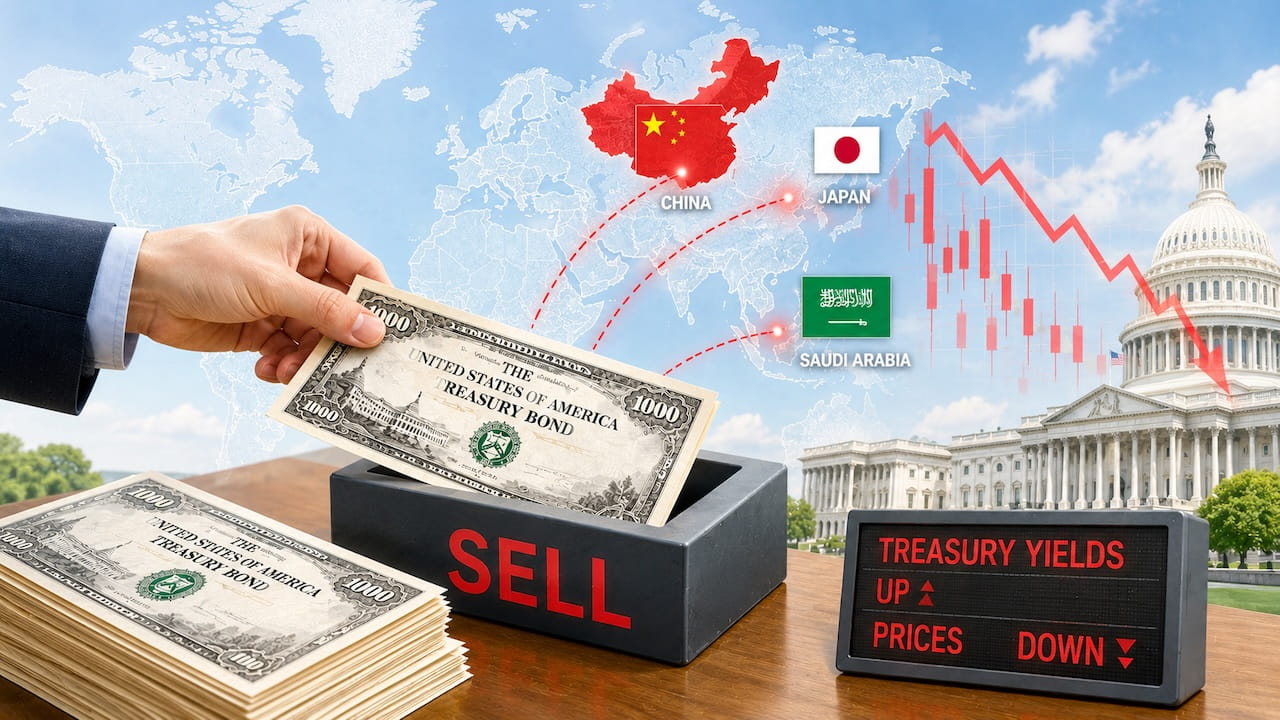
Some of the biggest foreign holders of U.S. debt are shedding Treasuries at an accelerating pace.
In March, China’s Treasury holdings dropped by 6 percent to $652.3 billion.
Japan ranks as the largest foreign creditor. Its Treasury holdings fell by $47 billion to $1.191 trillion.
Why This Bond Market Stress?
This is partly a function of the U.S.-Iran war oil shock. Many countries are selling dollar-denominated assets for cash to pay for oil and to support their own currencies.
HSBC chief Asia economist Frederic Neumann told CNBC the selloff doesn’t come as a shock.
“Given increased financial volatility since the start of the war in the Gulf, and resultant pressure on exchange rates, especially in Asia, it is not a surprise that U.S. Treasury holdings by central banks have fallen. Exchange market intervention to support local currencies will have led some central banks to sell a share of their U.S. Treasury holdings.”
However, softness in the Treasury market predates the conflict. It has been struggling for months because a lot of countries simply don’t want any more exposure to U.S. fiscal malfeasance. The national debt has surged to over $39 trillion. Meanwhile, the federal government has shown zero interest in reining in spending. On top of that, it is blowing through an additional $1 billion per day to fight the war.
Would you want to lend your drunk uncle, who has maxed out all his credit cards, more money?
If not, you understand how the rest of the world feels about Uncle Sam.
So, it’s not surprising that many countries are anxious to minimize their exposure to the dollar. We see this reflected in accelerating de-dollarization and the fact that gold recently climbed above Treasuries as the world’s biggest foreign reserve asset. When times get tough, you don’t want rapidly devaluing dollars backed by a spend-happy U.S. government. You want real money – gold – backed by nobody.
Ramifications of a Sagging Treasury Market
A sagging Treasury market is bad news for a U.S. government already struggling under the weight of ballooning interest payments.
April interest payments pushed total interest expense to $734.2 billion through the first seven months of fiscal 2026. That was up 7.3 percent compared to the same period in fiscal ’25.
Interest on the national debt cost $1.2 trillion in fiscal 2025. That was up 7.3 percent over 2024.
WolfStreet noted, “There are rising concerns in the bond market about the ballooning U.S. debt, and about the flood of new supply of Treasury securities that the government will have to sell in order to fund the out-of-whack deficits. Treasury buyers and holders are spread far and wide, but higher yields may be necessary to reel in the mass of new buyers needed.”
A year ago, analyst Artis Shepherd called the situation in the Treasury market “red lights blinking.”
“The bond market is sending a message to the U.S. government that its spending is out of control and the reserve currency ‘privilege’ it has abused for the last 80 years is running out.”
There is some speculation that the Federal Reserve will have to raise rates to combat price inflation. However, the central bank is already struggling to control the yield curve (especially the long end). It has already restarted quantitative easing (although it will never use that term) to put its big fat thumb on the Treasury market.
While QE can ease the government’s borrowing problem, it will increase inflation. Remember, when the Fed runs QE operations, it buys bonds with money created out of thin air and injects it into the financial system. This is, by definition, inflation.
In a nutshell, the central bank is in a Catch-22.
As Lundin noted, “The Fed will need to raise rates to corral inflation… but it simply can’t because of the debt trap. Investors increasingly recognize this, and are demanding higher returns on Treasurys to compensate for the risk.”
The Fed has a choice. It can fight the inflation dragon, or it can surrender to inflation and prop up the bond market. It can’t do both. History tells us the Fed will pick inflation. You should prepare accordingly.
Mike Maharrey is a journalist and market analyst for Money Metals with over a decade of experience in precious metals. He holds a BS in accounting from the University of Kentucky and a BA in journalism from the University of South Florida.