Hamas Riots Force Columbia Univ. to Cancel Main Commencement

(Headline USA) Columbia University canceled its large university-wide commencement ceremony Monday following weeks of pro-Hamas riots that have roiled its campus and others across the U.S.

However, university officials said students would still be able to celebrate at a series of smaller, school-based ceremonies this week and next.

The decision comes as universities around the country are wranging with how to handle commencements. Another campus shaken by protests, Emory University, announced Monday that it would move its commencement from its campus quadrangle in Atlanta to a suburban arena. But others, including the University of Michigan, Indiana University and Northeastern, have pulled off ceremonies with few disruptions.

Columbia’s decision to cancel its main ceremonies, scheduled for May 15, saves its president, Nemat Shafik, from having to deliver a commencement address in the same part of campus where police dismantled a protest encampment last week.

Noting that the past few weeks have been “incredibly difficult” for the community, the Ivy League school in upper Manhattan said in its announcement that it made the decision after discussions with students.

“Our students emphasized that these smaller-scale, school-based celebrations are most meaningful to them and their families,” officials said. “They are eager to cross the stage to applause and family pride and hear from their school’s invited guest speakers.”

Most of the ceremonies that had been scheduled for the south lawn of the main campus, where encampments were taken down last week, will take place about 5 miles north at Columbia’s sports complex, officials said.

Speakers at some of Columbia’s still-scheduled graduation ceremonies include Pulitzer Prize-winning playwright James Ijames, former CNN anchor Poppy Harlow, political scientist Ian Bremmer and Dr. Monica Bertagnolli, director of the National Institutes of Health.

Also, actor Michael J. Fox is scheduled to receive a medal from Columbia’s Teachers College for distinguished service.

Columbia had already canceled in-person classes. More than 200 pro-Palestinian rioters and insurrectionists who had camped out on Columbia’s green or occupied an academic building were arrested in recent weeks.

Reports indicated that while only about half of those present were affiliated with the university, many brought gas masks, weapons and pamphlets that said “Death to America,” suggesting they were engaged in or intenting to engage in seditious or terrorist activity.

Several media outlets, including the New York Post and Politico have traced direct funding for these operations to billionaire Democrat donors including George Soros and the Rockefeller Foundation.

The University of Southern California earlier canceled its main graduation ceremony while allowing other commencement activities to continue. Students abandoned their camp at USC early Sunday after being surrounded by police and threatened with arrest.

Other universities have held their graduation ceremonies with beefed-up security. The University of Michigan’s ceremony was interrupted by chanting a few times Saturday, while in Boston on Sunday, some students waved small Palestinian or Israeli flags as Northeastern University held its commencement in Fenway Park.

Emory’s 16,000-student university is one of many that has seen repeated protests from the pro-Hamas insurgents.

Ceremonies scheduled for May 13 will now be held at the GasSouth Arena and Convocation Center in Duluth, almost 20 miles northeast of the university’s Atlanta campus, President Gregory Fenves said in an open letter.

“Please know that this decision was not taken lightly,” Fenves wrote. “It was made in close consultation with the Emory Police Department, security advisors and other agencies—each of which advised against holding commencement events on our campuses.”

The university called outside police agencies to arrest 28 people after an encampment was erected on the quad on April 25.

After initially claiming the protesters were outsiders, the university later said 20 were Emory students and three were faculty members. Police used pepper balls and electric stun guns to subdue some of the people who were arrested.

Fenves later apologized.

Protests have continued on the campus since then, including some additional arrests.

Adapted from reporting by the Associated Press

Could Chinese Gold Be the Straw That Breaks the Dollar’s Back?

(Mike Maharrey, Money Metals News Service) There are cracks in the foundation of dollar dominance. Could Chinese gold be the straw that breaks the dollar’s back? 

In a column published by the Telegraph, economist Julian Jessop points out that people have been predicting the dollar’s demise for decades. Eventually, they’ll be right.

“And that day may be drawing much closer.”

It may seem premature to talk about the demise of the dollar. Based on the dollar index, the greenback is stronger than ever. But this doesn’t necessarily reflect the greatness of the dollar. It’s more a function of weakness in other global currencies. As the saying goes, the dollar is the cleanest dirty shirt in the laundry.

And if we look at the fundamentals underpinning the dollar, there are clearly issues. 

The biggest problem is U.S. government borrowing and spending. Uncle Sam runs massive deficits every single month, requiring the Treasury to borrow more and more. The national debt has ballooned to $35.5 trillion and continues to rapidly increase. Constant federal government borrowing floods the global market with U.S. debt and dollars.

Of course, the world needs dollars. But the demand isn’t infinite. At some point, America’s fiscal irresponsibility will catch up with her. 

Then what?

The Dollar Milkshake Theory

You may wonder how the dollar keeps plugging along despite U.S. monetary malfeasance.

Several factors underpin the greenback – chiefly its role as the global reserve economy. 

In 2010, Santiago Capital’s Brent Johnson wrote a white paper that developed the “Dollar Milkshake Theory.” In a nutshell, Johnson argues that the dollar will generally strengthen during times of economic uncertainty because of its role as the reserve currency. Here’s how Medium summarized the theory:

“Imagine a milkshake made with different ingredients, such as milk, chocolate syrup, and vanilla ice cream. The milk represents the US dollar, the chocolate syrup represents other currencies, and the vanilla ice cream represents global liquidity. As the milkshake is blended, the ingredients are mixed together. However, the milk, which is the heaviest ingredient, settles at the bottom of the glass. This is similar to how the US dollar, as the strongest currency, tends to strengthen during times of economic stress.”

The Milkshake Theory assumes that the dollar will always remain the reserve currency and thus serve as a safe haven. But what happens if the world loses faith in the dollar?

Jessop points out three factors that underpin the dollar. Think of these as the milk in the Milkshake Theory…

  1. The U.S. has a strong institutional framework based on property rights and the rule of law. This makes the dollar a “relatively predictable and safe” asset. 
  2. The size of the U.S. economy and the depth of its financial markets create a massive pool of dollar-denominated assets ideally suited as a global store of value. 
  3. The vast majority of global trade takes place using dollars. That means the world needs a lot of dollars.

For these reasons, the world needs dollars and lots of them. But nothing guarantees the status quo will continue into perpetuity.

The Milk Is Getting Sour

Everybody loves a milkshake – unless the milk is sour. And there are signs that the milk in the dollar milkshake is starting to curdle.

The rise of the BRICS economic bloc is positioning itself to challenge the role of the dollar as the reserve currency.

BRICS is an economic cooperation bloc originally made up of Brazil, Russia, India, China, and South Africa. As of Jan. 1, 2024, the bloc expanded to include Saudi Arabia, Egypt, the UAE, Iran, and Ethiopia.

More than 40 other nations have expressed interest in BRICS membership.

The expanded BRICS has a combined population of about 3.5 billion people. The economies of the BRICS nations are worth over $28.5 trillion and make up roughly 28 percent of the global economy. BRICS nations also account for about 42 percent of global crude oil output.

The BRICS countries have expressed a desire to move away from dependence on the dollar. During last year’s BRICS summit, Brazil President Luiz Inacio Lula da Silva called on the bloc to create a common currency for mutual trade and investment. He said a BRICS currency would “increase our payment options and reduce our vulnerabilities.”

This could very well curdle the milk.

Central banks are already moving to diversify their assets and minimize their reliance on dollars. According to IMF data, the dollar made up about 71 percent of foreign reserves in 1999. But by 2020, the percentage had dropped to 59 percent.

De-dollarization is happening for both economic and political reasons. First, other countries don’t want to be overexposed to a rapidly depreciating asset. Second, they don’t want to put themselves in a position where the U.S. can use the dollar as a foreign policy hammer.

Jessop points out that the trend has flattened since the pandemic, but it’s a bit deceiving due to recent dollar strength compared to other currencies. “Beneath the surface, though, the diversification out of US assets has continued,” he said.

We see this in consistent central bank gold buying. According to the World Gold Council, central banks net gold purchases totaled 1,037 tons in 2023. It was the second straight year central banks added more than 1,000 tons to their total reserves.

China has led the way. The People’s Bank of China has increased its gold hoard for 17 straight months. China officially holds 2,262 tons of gold. The Chinese have added over 300 tons of gold to their reserve since they resumed reporting gold purchases in October 2022. And the country likely holds even more gold off the books.

Exchanging dollars for gold represents a significant power shift. Some analysts speculate that the movement of gold from West to East could set the stage for a gold-backed currency that would challenge dollar dominance. 

Jessop concedes there might not be anything sinister going on. It could simply be a function of a shrewd PBOC investment strategy taking advantage of gold’s strength. But he also points out “there may still be a lot more to this story.”

“There are clear strategic advantages to China diversifying out of U.S. assets, largely given rising geopolitical tensions over Taiwan and Beijing’s growing assertiveness in the South China Sea … The switch to gold has helped China build up a war chest safe from U.S. sanctions. Russia has already taken this step, and other states may follow. China’s stockpiling of gold could also be a warning that the country could use its large holdings of U.S. government bonds as a weapon.”

The Telegraph recently published an article headlined “Xi Jinping’s vast gold war chest could let him take Taiwan without a fight.”

In effect, the Chinese have “sanction-proofed” their economy or at least minimized the United States’ ability to use the dollar as a weapon against them.

China has also dumped a large number of U.S. Treasuries. The country’s Treasury holdings have fallen to their current level of $775 billion from around $1.1 trillion in 2021. Chinese investment in U.S. debt hit a 14-year low in October.

Even so, China still holds a large amount of U.S. debt. As Jessop points out, “Any threat to dump these bonds could drive up the cost of borrowing, not just in the US but also in the rest of the Western world.”

And borrowing costs are already straining the U.S. Treasury.

Rising interest rates drove Uncle Sam’s interest payments to over 35 percent as a percentage of total tax receipts in fiscal 2023. In other words, the government is already paying more than a third of the taxes it collects on interest expenses, and those interest payments are rising every month.

The federal government spent $288.01 billion in interest expense to finance the national debt in the first quarter of fiscal 2024. That was more than national defense ($238 billion) and more than Medicare ($168 billion). The only higher spending category was Social Security at $351 billion.

And yet the borrowing and spending continues. As Jessop asserts, the United States is its own worst enemy.

“The recent strength of the economy and markets partly reflects a massive fiscal stimulus begun under President Trump and continued under President Biden. This is something that only a country issuing in the world’s dominant reserve currency could get away with, but the patience of international investors cannot be taken for granted.”

None of this means the U.S. dollar is going to collapse tomorrow. This could play out in a number of ways. We could simply see a further softening of the dollar and diversification of world reserves to other currencies. This would weaken the U.S. economy, but it wouldn’t necessarily lead to a crisis.

But there is a worst-case scenario. Jessop explains it this way:

“A sharp fall in the value of the dollar could have substantial negative effects elsewhere in the West, including spillovers into higher interest rates in the UK and the rest of Europe.”

This would be a disaster for Americans who are already struggling with high price inflation. If the U.S. dollar were to be dethroned from its position as the reserve currency, it could lead to hyperinflation.

As the saying goes, with great power comes great responsibility. It’s pretty clear that the United States government is not behaving responsibly.


Mike Maharrey is a journalist and market analyst for MoneyMetals.com with over a decade of experience in precious metals. He holds a BS in accounting from the University of Kentucky and a BA in journalism from the University of South Florida.


Why Are We Still Listening to the Central Planners?

(Clint Siegner, Money Metals News Service) Confidence in institutions such as the Federal Reserve may be falling, but it hasn’t fallen nearly as far or as fast as it should. Trillions of dollars, yen, euros, and yuan are invested according to central bank policy and propaganda. It isn’t going well.

The U.S. economy is massively distorted, unhealthy, and hopelessly dependent on Fed stimulus. The Finance, Insurance, and Real Estate (FIRE) sectors of the economy have been overwhelming beneficiaries during the modern age of activist central banking.

How the Federal Reserve Operates and Enables Big Government

Those sectors have collectively doubled in size since 1947 as a percentage of gross domestic product, and they now account for just under 21% of the economy. More than one out of every 5 dollars is generated by banks, brokerages, insurers, and realtors – people who produce nothing tangible.

Manufacturing has fallen from 25.6% of GDP in 1947 to just 10.3% in 2023.

Meanwhile, government spending as a percentage of GDP has gone up nearly tenfold since the late 1920’s and the dawning of the big government era, during the Great Depression.

All of this central planning has done wonders for growth in the government sector and for the FIRE economy. The wealthy, with connections to government and Wall Street, have grown wealthier.

But it has been a disaster for most Americans. During this period American households have shifted from needing one income to two incomes.

Housing is completely unaffordable for most Americans. Household debt has risen dramatically, along with every taxpayer’s portion of the public sector debt.

Many Americans seem to be checking out. The rate of employment – the percentage of working age people actually working – is in steady decline and more people are dependent on government assistance.

The worse news is that average Americans will likely still wind up holding the bag for all of the economic and monetary mismanagement.

Financial assets are largely disconnected from economic fundamentals. They are dependent instead on Fed policy.

Last week’s rally in stock prices, based upon surprisingly weak jobs data, is an example. It might have been bad news for businesses and job seekers, but money managers and trading algorithms ignored that and focused on rising odds of interest rate cuts.

Central planners at the Fed have cultivated massive bubbles in stocks and real estate.

Today, much of their efforts are on keeping these bubbles inflated. Which means the U.S. economy, and others, are one or two policy errors away from disaster. If history repeats, it will be Wall Street and the well-connected who receive bailouts, not average Americans.

The trouble is these errors may not be visible except for in hindsight.

Fed officials assured us the U.S. economy was strong and that housing was not in a bubble immediately prior to the 2008 financial collapse. The Japanese economy has languished for decades. Central bankers there have tried one stimulus program after the next for more than 30 years, without success.

Now the yen has collapsed to its lowest levels versus the U.S. dollar since 1990, when the malaise set in.

Anyone who thinks the central planners in the U.S. (or Europe or China) are smarter and more capable than those in Japan are kidding themselves.

American investors who might be counting the FOMC and economic policy advisors in Washington DC to safeguard the U.S. economy should watch this incredible clip and reevaluate.


Clint Siegner is a Director at Money Metals Exchange, a precious metals dealer recently named “Best in the USA” by an independent global ratings group. A graduate of Linfield College in Oregon, Siegner puts his experience in business management along with his passion for personal liberty, limited government, and honest money into the development of Money Metals’ brand and reach. This includes writing extensively on the bullion markets and their intersection with policy and world affairs.

Stagflation Warning: Service Economy Contracts as Prices Rise

(Mike Maharrey, Money Metals News Service) In another stagflation warning sign, the U.S. service sector contracted in April even as service prices rose.

The Institute for Supply Management’s non-manufacturing PMI dropped to 49.4 in April, dipping from 51.4 in March. The expectation was for the index to increase to 52.0.

A PMI reading below 50 signals a contraction in the service economy.

It was the lowest non-manufacturing PMI reading since December 2022. 

Services account for more than two-thirds of U.S. economic activity. 

An index measuring new orders for service businesses dipped to 52.2 in April, falling from a March reading of 54.4. Meanwhile, production in the service sector plunged from 57.4 to 50.9. The last time the services production index fell that low was May 2020, in the early months of the pandemic. 

The survey’s measure of services sector employment also fell, dropping from 48.5 in March to 45.9 in April. 

Even as the service economy contracts, prices are heating up. The survey’s measure of business input prices jumped to 59.2 from 53.4 in March.

This dovetails with CPI data that showed service price inflation increased to 5.27 percent in March. That was up from 4.95 percent in February. Service prices account for 57 percent of the CPI.

There is a word for a combination of rising prices, lagging economic growth, and rising unemployment – stagflation. 

After the Federal Reserve FOMC meeting last week, Fed Chair Jerome Powell insisted there were no signs of stagflation. 

“I don’t really understand where concerns about stagflation are coming from. I don’t see the stag or the ‘flation.”

You can certainly argue that the economic picture is nothing like the stagflationary years of the 1970s. But the warning signs are clearly there – as evidenced by the services PMI report and other recent economic data.

And the macroeconomic foundation has been set for a period of stagflation. We had an unprecedented amount of inflation created during the pandemic. The Federal Reserve alone injected nearly $5 trillion in new money into the economy. This is the definition of inflation. One of the consequences of monetary inflation is price inflation. And despite the Fed’s efforts to quell price inflation, the central bank hasn’t done enough. In fact, monetary policy remains loose by historical standards. That means the Fed continues to create inflation.

But the Fed has hiked interest rates enough to break things in this debt-riddled bubble economy. We’re beginning to see signs of economic stagnation, including the recent non-manufacturing PMI, the first quarter GDP slowdown, and the April labor report. 

Powell’s assurances notwithstanding, stagflation appears to be a very real possibility.


Mike Maharrey is a journalist and market analyst for MoneyMetals.com with over a decade of experience in precious metals. He holds a BS in accounting from the University of Kentucky and a BA in journalism from the University of South Florida.

U.S. Judge Orders Georgia to Provide Trans Inmate w/ ‘Breast and Buttock Padding’

(Ken Silva, Headline USA) A U.S. district judge has ordered the Georgia Department of Corrections to provide one of its inmates with “breast and buttock padding” in a lawsuit over the state’s alleged lack of healthcare for transgender inmates.

U.S. District Judge Michael Brown’s April 17 order stems from a lawsuit by an anonymous Georgia inmate, who’s seeking a sex change, a transfer to a female prison and other amenities for his “gender dysphoria.”

According to the judge’s order, the inmate is a highly violent person serving a life sentence since 1992, who was diagnosed with gender dysphoria in 2015. The inmate has allegedly attempted self-castration in 1992 and suicide in 1998, 1999, and 2017.

The anonymous inmate’s lawsuit was partially supported by the Justice Department, which argued in a January motion that sex changes are an Eighth Amendment right for inmates.

Judge Brown’s April 17 order didn’t address the sex-change issue. According to the order, Georgia is already working to facilitate the inmate’s request for gender-reassignment surgery.

“Plaintiff’s treating physician says her request for surgery ‘is being processed and will be presented to the Wellpath gender dysphoria committee,’ after which Wellpath will make a recommendation ‘to the GDC statewide Medical Director who then will make the decision on the consult requests.’ So, to the extent Plaintiff seeks an injunction requiring Defendants to provide an evaluation, that issue is moot,” the judge said.

“As for her request that the Court order Defendants to provide her gender-affirming surgery, that issue is not yet ripe, as Defendants have not completed the decision-making process and denied her that surgery,” the judge added.

The judge also declined to transfer the inmate to a female prison due to the inmate’s violent history.

Though the inmate hasn’t been identified, the judge noted that he was transferred to Phillips State Prison—a “Special Mission Facility”—in 2022 specifically because that facility was “uniquely situated to manage Plaintiff, given her history of violence both before and during her incarceration, her ability ‘to induce others to commit violence on [her] behalf,’ and her specific medical and mental.”

But while he denied the inmate’s transfer to a female prison and declined to rule on the request for a sex change, Judge Brown did order Phillips State Prison to provide the inmate with breast and buttock padding. This order was in response to the inmate’s lawsuit for more “gender-affirming commissary items” at Phillips—specifically, in inmate sought access to breast and buttock padding, makeup, wigs, and hair removal cream.

In granting the inmate’s request, Judge Brown cited the testimony of a doctor who said the breast and buttock padding were medically necessary.

“Dr. Lowell testified that gender-affirming cosmetic items are medically necessary because ‘they decrease that extreme distress that’s associated with gender dysphoria,’ and advised that … they should provide these items in the meantime to alleviate Plaintiff’s symptoms. She was a credible witness. Her testimony also makes sense,” the judge said.

“If all the parties agree that Plaintiff needs bodily feminization to ease her dysphoria symptoms … it seems they should also agree that she should receive cosmetic items that can provide some level of that relief in the interim,” the judge reasoned.

The Georgia DOC argued that some of the items requested by the inmate posed a security concern. The judge agreed that wigs and makeup could be a security concern, but deemed the other items to be fine.

“The Court ORDERS Defendants to provide Plaintiff access to breast and buttock padding and hair removal cream,” he concluded.

The Georgia DOC has appealed Judge Brown’s order.

The case is also still open while the DOC considers the inmate’s request for a sex change. To that end, an April 24 status report said the matter is still under review.

“The Wellpath Gender Dysphoria Committee convened on February 20, 2024, and again on April 16, 2024, to discuss Plaintiff John Doe. The Committee met again on April 16, 2024, and reports that they have asked Dr. Daniel Miller of Wellpath to locate an appropriate surgeon to schedule an evaluation for Jane Doe. Dr. Miller is in the process of locating a surgeon that could handle this type of surgery to schedule an evaluation,” the status report said—identifying the inmate both as John and Jane Doe.

The parties are set to update the court again by May 24.

Ken Silva is a staff writer at Headline USA. Follow him at twitter.com/jd_cashless.

Biden Blocks Israel Aid Amid Election Worries – Acts for Which Dems. Impeached Trump

(Luis Cornelio, Headline USA) Did President Joe Biden just commit an impeachable offense? Past claims by Democrats against then-President Donald Trump seem to suggest so. 

Last week, Biden halted a shipment of American-made weapons destined for Israel, prompting concerns within Israel about the reasons behind the aid blockade. 

This action, first reported by Axios on Sunday, coincides with Biden facing widespread and violent protests for his previous support of the Jewish state.

The protests, unfolding across multiple universities, present a potential challenge to Biden’s reelection hopes. Many students might choose to protest by abstaining from voting in the 2024 general elections, while others could escalate their demonstrations to the Democratic National Convention, revealing perceived weaknesses in Biden’s leadership.

The blockade also echoes accusations raised by Democrats against Trump in 2019, when they pursued impeachment articles over an alleged plan to withhold U.S. funding from Ukraine unless an investigation into Biden was initiated.

At the time, then-Speaker Nancy Pelosi, D-Calif., criticized Trump’s actions as an act of corruption and abuse of power. 

“I respect the responsibility of the President to engage with foreign leaders as part of his job,” Pelosi wrote in a press statement on Sept. 25, 2019.  

Accusing Trump of using congressionally approved funds for personal political gain, she added, “It is not part of his job to use taxpayer money to shake down other countries for the benefit of his campaign. Either the President does not know the weight of his words or he does not care about ethics or his constitutional responsibilities.” 

Fast forward to 2024, Biden now finds himself facing mounting challenges to his re-election aspirations stemming from his previous support for Israel.  

The recent halt in aid, as reported by Axios, represents the first time the U.S. blocked aid for Israel since Oct. 7—when Hamas terrorists unleashed an inhumane onslaught against Israeli civilians, including the killing of babies and mass rape of women. 

Neither the White House nor the Pentagon, State Department nor the Israeli Prime Minister’s Office has responded to Axios’s requests for comments. 

It is not immediately clear whether the weapons currently withheld were part of the latest batch of U.S. aid approved by Congress just last month.  

In a bipartisan effort, lawmakers approved $95 billion in foreign aid, including $60 billion for Ukraine, $26 billion for Israel and $1 billion for the Hamas-governed Gaza Strip. 

In response to the aid blockade, House Judiciary Chairman Jim Jordan, R-Ohio, accused Biden of abandoning a key U.S. ally. 

“The Biden administration put a hold on a shipment of U.S.-made ammunition to Israel. Abandoning our greatest ally. Disturbing,” Jordan wrote on Twitter. 

Just last Friday, 88 Democratic members of Congress demanded that the U.S. cease aid to Israel. This action stems from allegations that Israel was obstructing U.S. aid to Palestinians in the Hamas-led Gaza. 

Buckle Up: Unveiling Trump’s Plan to Deport 20 Million Illegal Aliens

(Luis Cornelio, Headline USA) With illegal immigration remaining a pressing issue and signs of Donald Trump’s possible return to the White House, Americans may be eager for details on his promise of unprecedented deportation measures.

In a tell-all interview with Time magazine and past rallies, Trump pledged to deport between 15 and 20 million illegal aliens from the U.S.

Trump’s immigration plan is a response to the rampant influx of individuals illegally entering the U.S. during the Biden administration, with former immigration officials affirming its feasibility. 

“There’s probably between 15 and 20 million, given the number of people we’ve seen coming over,” said Erick Ruark, who leads research at immigration non-profit NumbersUSA. Ruark said the deportation of 20 million illegals is “not an unreasonable estimate.” 

Former ICE Acting Director Tom Homan declared that ICE has “systems in place that are very good at identifying people,” but cautioned that such an order would require funding from Congress. 

“A lot of that is going to be up to Congress … We need officers, we need detention beds, we need transportation contracts … because [we would have] more flights heading out of the country and more bus removals down to the border,” Homan added, according to the Post. 

“We would still prioritize criminals and national security threats first, they are the most dangerous for the country.” he continued. “But I would say no one is off the table. If you’re in this country illegally… then we’ll remove you.” 

Former ICE Chief-of-Staff Jon Feere emphasized the necessity of a comprehensive plan, saying, “This will require a whole government approach.” 

He added, “Every part of the government that has a nexus to immigration has a role to play here. From Health and Human Services, to the State Department, to US Citizenship and Immigration Services, every part of the government can assist in reducing illegal immigration.” 

Feere also predicted that ICE could be compelled to unilaterally act in localities that do not cooperate with federal immigration authorities. 

“ICE would prefer that all states and cities cooperate with federal law enforcement,” he said. “But those that choose not to are going to see an increase in operations within their communities. ICE will have no choice but to conduct large operations.” 

Sen. Rubio Breaks Silence on Trump Ticket Rumors, Sidesteps New York Move

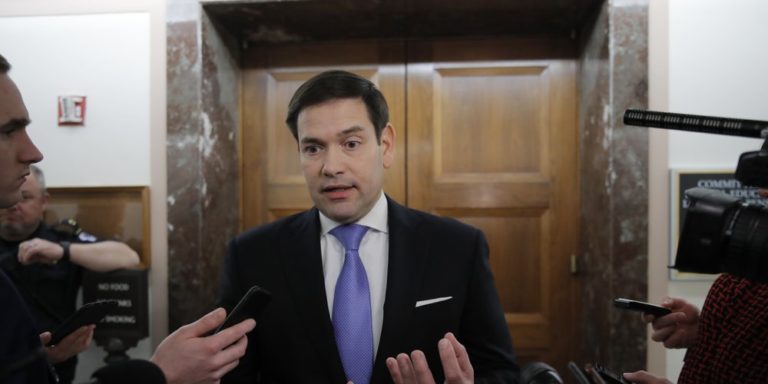
(Luis Cornelio, Headline USA) Sen. Marco Rubio, R-Fla., broke his silence on Sunday regarding rumors suggesting he would relinquish his Florida residency to join former President Donald Trump’s 2024 ticket. 

During an interview on Fox News Sunday, Rubio emphasized that only Trump could determine his running mate but acknowledged the wealth of talent within the Republican field, expressing confidence in their ability to begin work from day one.

The senator’s response came in reaction to queries from host Shannon Bream, who highlighted Rubio’s emergence as a potential vice-presidential candidate.

Highlighting the constitutional restriction limiting presidential and vice-presidential candidates from the same state, Bream asked, “Would you leave the state of Florida or change your residency if you were asked to join the ticket?”

Rubio replied, “First of all, the vice-presidential choice with Donald Trump is going to be made by one person, and that’s Donald Trump, and all this other stuff is just speculation.”

Addressing the speculation further, he added, “I get it, you know political reporters have to cover political topics. The primary is over, the general [election] is six months away, so then we’re going to speculate on the VP thing.”

Later in his response, Rubio lauded the “extraordinary” array of individuals poised to serve in a potential second term under Trump.

“He’s going to have an extremely talented group of people that can serve this country in multiple roles, and that’s a decision he’s going to have to make,” Rubio affirmed.

“I think that before anyone decides to move from their state, you better make sure you don’t move to a state where there’s not some DA that makes a career after going after Republicans,” he continued. 

Injecting humor into the exchange, Bream interjected: “Not to New York, that won’t be your choice.”

Sen. Scott Calls Out Leftist Host’s Bluff on Accepting 2024 Results: Trump Will Win

(Luis Cornelio, Headline USA) A Republican Senator and potential vice-presidential candidate astutely handled a trap question during a Sunday interview regarding the outcome of the 2024 election.

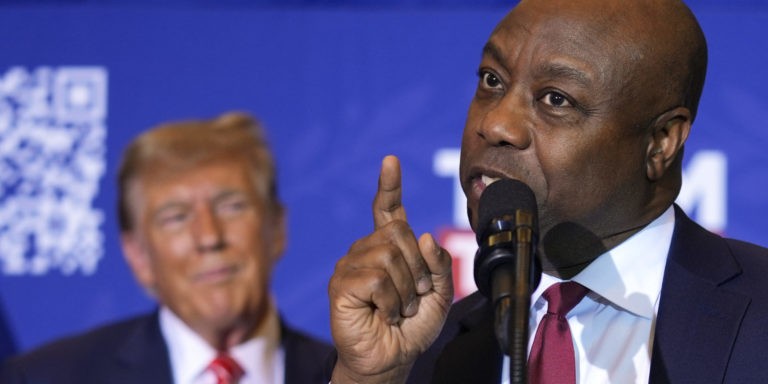
Sen. Tim Scott, R-S.C., suggested on Sunday that preemptively pledging to accept the results of the 2024 election is unnecessary, as he believes former President Donald Trump will emerge victorious.

Scott’s comments were ignited by MSNBC’s Meet the Press host Kristen Welker, who queried the senator about Trump’s stance on accepting the upcoming election’s outcome.

“Will you commit to accepting the election results of 2024, bottom line?” Welker asked Scott during the interview.

“At the end of the day, the 47th president of the United States will be President Donald Trump. I’m excited to get back to lower inflation, low unemployment,” Scott responded. 

A cynical Welker swiftly interjected, asking, “Wait, wait—senator, yes or no? Will you accept the election results of 2024 no matter who wins?”  

In reply, Scott reaffirmed his earlier statement.

Unsatisfied with the response, Welker reiterated her question: “Just yes or no? Will you accept the election results of 2024?” 

Scott did not mince words in his response. “I look forward to President Trump being the 47th president. Kristen, you can ask it multiple times. The American people will make the decision.” 

Further reprimanding Welker, Scott added, “This is why so many Americans believe NBC is an extension of the Democratic Party. At the end of the day, I said what I said. I know that the American people, their voices will be heard. I believe that President Trump will be our next president. It’s that simple.” 

The exchange between Welker and Scott ensued after Trump told the Milwaukee Journal Sentinel on Wednesday that he would accept the results of the 2024 election only if they are determined fairly.

“If everything’s honest, I’ll gladly accept the results. I don’t change on that,” Trump said. “If it’s not, you have to fight for the right of the country.” 

Historically, leftist media outlets have rebuked Republicans who voice concerns about election results but are quick to ignore similar assertions from Democrats.

Twice-failed presidential candidate Hillary Clinton has long alleged that Trump won the 2016 election with Russia’s assistance. Twice-failed Georgia gubernatorial candidate Stacey Abrams vehemently refused to concede the 2018 Georgia election results, which she lost. 

Earlier this year, President Joe Biden called failed Virginia gubernatorial candidate Terry McAuliffe the “real governor.” He is not. McAuliffe lost the 2021 election to Glenn Youngkin.

Lawmakers Question Whether Feds are Still Funding Russian Research

(Casey Harper, The Center Square) – House lawmakers are pressing the National Institutes of Health for answers on whether the agency has continued funding research in Russia.

House Energy and Commerce Committee Chair Cathy McMorris Rodgers is leading the effort along with subcommittee chairs Rep. Brett Guthrie, R-Ky., and Rep. Morgan Griffith, R-Va.

The lawmakers sent a letter to National Institutes of Health Director Monica Bertagnolli raising concerns that currently available data may contradict NIH’s previous statements on the issue.

“We note that in a statement in an April 9, 2023, article in The Washington Times, the NIH’s Office of Extramural Research claimed that the ‘NIH currently does not fund any research in Russia,'” the letter said. “However, the Data Abyss tracker for the OSTP Russia guidance on federal funding agencies indicates that, as of April 5, 2024, the NIH has potentially 240 instances of problematic research collaborations since June 2022 that do not comply with the guidance.”

Funding research overseas, particularly via NIH, has become much more controversial since the COVID-19 pandemic. While the issue is still up for debate, many experts along with the U.S. Department of Energy and the FBI say COVID-19 likely originated in the Wuhan Institute of Virology, a lab that received federal funding.

Other experts and federal agencies say COVID-19 likely began in a Wuhan wet market.

NIH did release millions of dollars in grants for coronavirus-related research to the Wuhan lab in recent years. NIH still currently funds similar research in China.

The committee gave NIH until May 14 to provide the needed information.

“To assist this examination, please review the 240 potentially problematic instances identified by the Data Abyss Tracker, determine which ones have problematic research collaborations, and detail the corrective actions taken,” the letter said. “We also request that the NIH describe any other efforts it has made to comply with the OSTP guidance.”