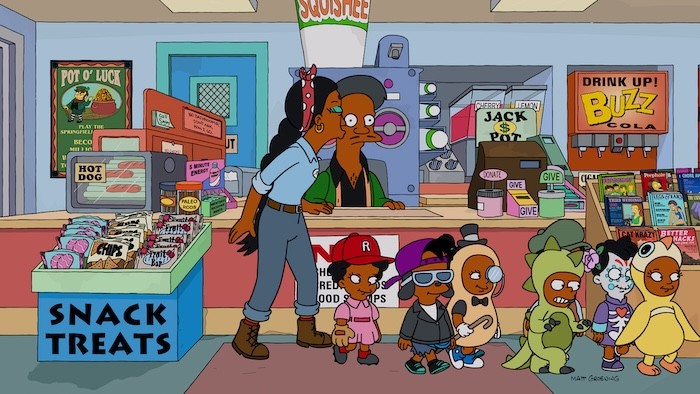
(Headline USA) Across 38 seasons of “The Simpsons,” the Halloween-themed “Treehouse of Horror” episodes have always been a treat of spooky stand-alone storylines. On Sunday, the show surprised viewers with a major resurrection: Apu, the beloved Kwik-E-Mart operator who had not been heard for the better part of a decade, spoke once again in Springfield.
He and his wife, Manjula, were back. However, Hank Azaria, a white actor, voiced Apu, has been replaced by Indian American actor: Sunil Malhotra. Another Indian, Janina Gavankar, is voicing Manjula.
Apu’s unheralded return comes after he was “canceled” amidst what was arguably the peak of the political correctness era.
How a documentary on Apu became a turning point
In “The Problem With Apu,” Kondabolu, a self-described fan of the Fox show, tried to process his misgivings. He interviewed a slew of celebrities of South Asian origin, including Kal Penn, Utkarsh Ambudkar and Hasan Minhaj, about growing up with the character. They shared memories of being bullied and called “Apu” as an insult.
Apu's new voice has been revealed.
It is the first time the character has spoke in almost a decade. pic.twitter.com/HjzHVjaM0S
— DiscussingFilm (@DiscussingFilm) October 19, 2026
In a 2018 episode, “The Simpsons” responded to Kondabolu’s documentary by having Lisa Simpson bemoan how “something that started decades ago and was applauded and inoffensive is now politically incorrect. … What can you do?” The camera then panned to a framed photo of Apu
In a 2020 New York Times interview, Azaria, who by then hadn’t voiced Apu in a few years, announced he would bow out because “it just didn’t feel right.” Later that year, in response to racial reckoning demonstrations, “The Simpsons” announced it would no longer cast white voice actors as characters of color. The show then recast two black characters, Carl Carlson and Dr. Julius Hibbert, with black actors.
Apu was also embraced by South Asians, despite the controversy
A few weeks after “The Simpsons” responded to the documentary, author and producer Amar Shah wrote a series of social media posts and then a Washington Post op-ed on why he felt mostly sentimental toward Apu. When he watched Apu, he thought of his own Indian father hard at work as a convenience store owner and how that shaped his Florida childhood.
“Apu even now is a character that I wouldn’t mind my kids seeing represented because they’ll see aspects of themselves and of their own grandparents,” says Shah, reflecting on his 2018 piece. “I can totally empathize with someone of South Asian origin having a different POV (point of view) than me but this is my childhood. This is my story.”
After watching this latest episode, Shah didn’t sense any significant difference with Malhotra’s performance.
“Obviously, there’s a different voice, tenor, texture and all that. But, the character is always going to be there, his genuine humanity,” Shah says. “I think if they had incorporated this change earlier, it would have been a lot better.”
Adapted from reporting by the Associated Press