(Andrew Rice, The Center Square) The U.S. economy added 172,000 jobs in May’s better-than-expected report while the unemployment rate remained at 4.3%, according to data released Friday by the U.S. Bureau of Labor Statistics.
The unemployment rate has remained steady in the range of 4.3% to 4.5% since July 2025, according to the bureau. The bureau revised its April increase to 179,000 jobs and March increased by 214,000 jobs.
Heather Long, chief economist at Navy Federal, said May’s report outperformed economists expectation that jobs would increase by 88,000.
“Another strong jobs report,” Long said. “There are a lot of encouraging signs for the labor market heading into summer.”
The hospitality sector showed the most growth in May, with an increase of 70,000 jobs throughout the month. Local government followed closely behind with 55,000 jobs.
The average monthly gain for hospitality jobs is 14,000 over the previous 12 months. May’s report greatly exceeds average growth in the hospitality sector.
The health care industry, typically a prime driver of job growth, added 35,000 jobs in May. The industry typically brings in 38,000 each month. The health care industry growth was driven by an increase of 26,000 jobs in ambulatory services and 11,000 jobs in home health care services.
Average monthly job gains in 2026 are 114,000, a steep increase from the 10,000 jobs per month average in 2025.
“Honestly, it looks like the hiring recession is over,” Long said. “Almost every industry is hiring again except tech and finance.”
The finance sector cut 22,000 jobs in May, reflecting a decrease of 107,000 jobs since May 2025. Job losses in finance were pushed by an 11,000 job loss from insurance carriers and a 3,000 job loss in banking.
Social assistance jobs increased by 12,000; Mining gained 5,000 jobs; and employment in transportation and warehousing was essentially unchanged in May.
However, wage growth over the last year ending in May 2026 was 3.4%, the lowest the U.S. economy has seen in the last five years. Long said the wage growth problem will be especially difficult as inflation is expected to be around 4%, due to the ongoing conflict with Iran.
“It’s easier to get a job now, but it’s hard to find a job where your pay will keep up with current inflation,” Long said.
(Headline USA) A judge on Thursday dismissed a murder charge against an Arkansas man who won the GOP nomination for sheriff while awaiting trial for the shooting death of his teenage daughter’s alleged abuser.
The ruling came weeks before Aaron Spencer, who will be on the November ballot, had been set to face a jury on a second-degree murder charge. He won a March primary over the local three-term sheriff whose office had arrested Spencer in Lonoke County, which has roughly 76,000 residents and is heavily Republican.
Spencer’s attorneys do not deny that he shot and killed Michael Fosler in 2024, saying he did so to protect his child. Special Circuit Court Judge Ralph Wilson Jr. granted a motion by Spencer’s attorney to dismiss the charge over a dash camera memory card that may have captured the shooting and was lost by law enforcement.
⚖️ARKANSAS vs Aaron Spencer⚖️ DISMISSED He was facing second-degree murder case the Lonoke County father accused of killing the alleged abuser of his underage daughter. Lonoke County Sheriff's deputies lost a critical SD memory card from a dash camera inside the victim's truck.… pic.twitter.com/KYHgqD2PTJ
— American Crime Stories (@AmericanCrime01) June 4, 2026
“The court finds that conduct by law enforcement was so egregious that dismissal of this case is warranted,” Wilson wrote.
At the time of the shooting, Fosler, 67, was out on bond after being charged with dozens of sexual offenses against Spencer’s then-13-year-old daughter.
Court documents show on the night of the shooting, Spencer had woken up to find his daughter missing, and later found the girl in the passenger seat of a vehicle Fosler was driving. Spencer forced Fosler’s truck off the road and, after an altercation, called 911 to report he had shot the man.
Prosecutors said Spencer planned the killing and that he could have called police while pursuing Fosler. But Spencer pleaded not guilty and maintained he acted to protect his child from a predator.
Spencer’s attorney, Erin Cassinelli, said she is thankful for the court’s decision.
“No member of this family should ever again be forced to walk into a courtroom and relive this horror,” she said in a statement. “This father should have never been charged for protecting his child.”
Spencer said he is grateful this chapter is over and that his focus is now on his family and returning to normal life.
“There’s still work to do in Lonoke County, and I’m more committed to it than ever,” he said in a statement. “Together we can build a safer and stronger Lonoke County.”
Lonoke County Prosecuting Attorney Chuck Graham did not return messages Thursday seeking comment on the decision.
The Associated Press typically does not identify sex abuse victims, but Spencer has made his daughter’s experience with the criminal justice system a central part of his campaign for sheriff, pledging to establish a dedicated team to combat sex crimes against children.
Spencer’s attorneys filed the motion seeking to have the case dismissed, contending that video and audio of the dash camera from Fosler’s truck may have contained evidence that would have cleared Spencer of any wrongdoing. According to court records, a detective with the Lonoke County Sheriff’s Office removed the dash camera from the truck when responding to the scene of the shooting.
But the camera’s internal settings were not preserved and the battery of the camera was allowed to drain, and as a result the camera went back to its default settings. When the camera was sent to the attorney general’s office for a forensic exam, the memory card that was in it when it was collected from the truck was missing. The detective who collected the camera later admitted that it was not logged into evidence right away, but was instead stored in his personal office rather than the evidence room, according to court records.
Wilson replaced the original judge handling the murder case in January after the Arkansas Supreme Court removed Judge Barbara Elmore from the case, finding she had issued an overly broad gag order that violated Spencer’s First Amendment rights.
(Mike Maharrey, Money Metals News Service) Central banks were once again net gold buyers in April, after large sales pushed gold accumulation into negative territory in March.
In March, global central bank gold reserves fell by 27 tonnes, driven by big sales by Turkey and Russia. The tide turned in April, with central banks adding a net 17 tonnes of gold.
The Gold Buyers
Poland continued to lead all buyers, adding another 14 tonnes of gold to its reserves in March. That was on top of an 11-tonne purchase the previous month. So far this year, Poland has increased its gold reserves by 45 tonnes.
These purchases come despite rumors that Poland might liquidate some of its gold holdings to fund increased defense spending.
The National Bank of Poland now holds 595 tonnes of gold, making up about 30 percent of its reserves.
Poland led central bank gold buying in 2025, adding 102 tonnes of gold to its holdings.
The People’s Bank of China bought gold for the 18th straight month and upped the pace of official purchases in April, adding 8 tonnes to its official reserves. That was the biggest official increase in Chinese gold holdings since December 2024.
The purchase pushed China’s official gold reserves to 2,322 tonnes, roughly 9 percent of its total reserves.
Notice the emphasis on “official.”
China is among the central banks that are likely to hold significantly more gold than they publicly disclose. As Jan Nieuwenhuijs has reported, the People’s Bank of China is secretly buying large amounts of gold off the books. According to data parsed by the renowned Money Metals researcher, the Chinese central bank is currently sitting on more than 5,000 tonnes of monetary gold located in Beijing – more than TWICE what has been publicly admitted.
The Czech Republic has been one of the most consistent buyers over the last few years. The trend continued in April with another 2-tonne purchase.
The Czechs have adopted a slow, steady approach, buying gold for 38 straight months. The country added 20 tonnes to its holdings last year, and it now holds 79 tonnes of gold. Czech officials say they plan to increase gold reserves to 100 tonnes by 2028.
The Gold Sellers
Russia continued to tap into its gold reserves in April as its economy struggles to cope with the stresses of war spending and economic sanctions. April net sales totaled 6 tonnes. It was the fourth month of Russian gold selling.
Uzbekistan flipped to a seller in April, decreasing its gold reserves by 1 tonne.
Up until April, the Uzbek central bank had purchased 25 tonnes of gold this year, boosting reserves to 416 tonnes. The country holds most of its reserves in gold, with the yellow metal accounting for around 88 percent of its total reserve assets.
It is not unusual for central banks that buy from domestic sources, such as Uzbekistan and Kazakhstan, to pivot back and forth between buying and selling.
Turkey was the biggest seller in March. In April, the Turkish central bank held its reserves steady.
According to weekly data reported by the World Gold Council, short-term gold/USD swaps matured in April, leaving only longer-term (1-3 month) gold/USD swaps outstanding.
The Big Picture
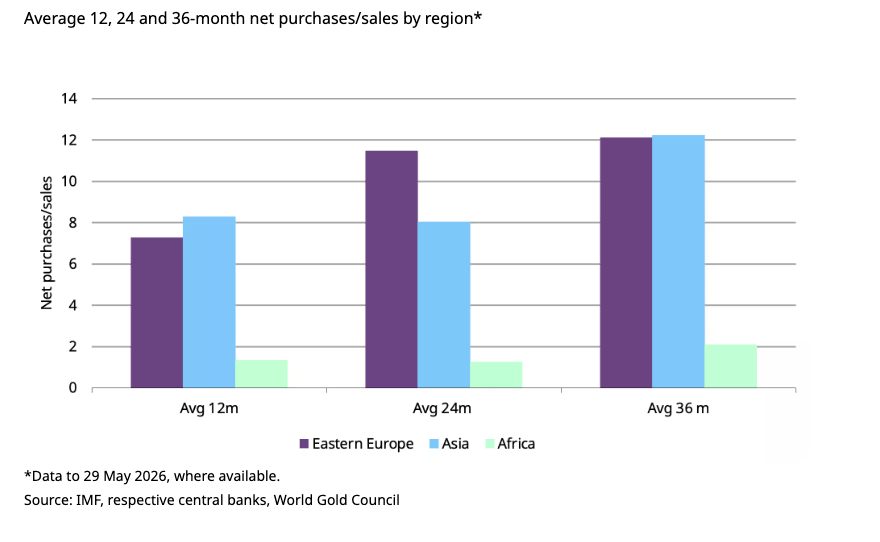
Asian and Eastern European central banks have dominated buying over the last several years. Over the past 36 months, central banks in Asia have added an average of 12 tonnes per month, with central banks in Eastern Europe averaging 11 tonnes per month.
Looking at the broader trend, central bank gold buying moderated in 2025 but remained far above the recent historical average. Official net full-year buying came in at 863.3 tonnes. That was down 21 percent year-on-year, charting the lowest level since 2021.
However, while central bank gold purchases declined last year, they were still well above the 2010-2021 annual average of 473 tonnes.
Last year was the fourth-largest expansion of central bank gold reserves on record. The all-time high was set in 2022 (1,136 tonnes). It was the highest level of net purchases on record, dating back to 1950, including since the suspension of dollar convertibility into gold in 1971.
The surging gold price was likely a factor in slowing central bank gold accumulation. As the World Gold Council put it, the higher price prompted “a more cautious approach.”
“This highlights that central banks are not insensitive to price dynamics, even as their long-term strategic interest in gold remains firmly intact.”
Mike Maharrey is a journalist and market analyst for Money Metals with over a decade of experience in precious metals. He holds a BS in accounting from the University of Kentucky and a BA in journalism from the University of South Florida.
(Mike Maharrey, Money Metals News Service) Americans have run their credit cards to the limit. Now they’ve turned to buy-now-pay-later plans to buy gas and groceries.
Buy-now-pay-later (BNPL) platforms allow users to purchase items by paying several smaller installments (typically around 4) over time.
Block operates the Afterpay BNPL platform. The system was originally set up to provide short-term financing for bigger purchases. But according to company data, usage is expanding into everyday spending categories. The average customer used Afterpay to purchase gas 3.6 times and groceries 2.2 times between Feb. 4 and May 15.
“What we’re seeing with Afterpay on the Cash App card is just everyday spending. We’re really over-indexing toward gas stations and fuel, grocery stores, food,” Block’s head of operations, Owen Jennings, said.
Affirm CEO Max Levchin made a similar observation during a CNBC interview last month.
“The single largest category for us is general merchandise — Affirm is truly the everything product at this point.”
Polling by LendingTree mirrors Block’s data.
Nearly a third (29 percent) of BNPL users said they used the service to buy groceries. That was up 14 percent from two years ago. Thirty-eight percent of Gen Z users said they used BNPL for groceries.
More than half of the BNPL users (54 percent) said they wouldn’t be able to make ends meet without the service. That figure rises to 62 percent among parents with children under 18.
BNPL loans are generally interest-free if the installments are paid on time. BNPL providers make their money on interest and late fees when payments are late.
According to the LendingTree survey, 47 percent of BNPL users said they’ve made at least one late payment in the last year. That was up from 34 percent in 2024.
“When nearly half of users say they’ve paid late, it shows how thin many households’ margins are right now,” LendingTree chief consumer finance analyst Matt Schulz said.
Jennings told MarketWatch that some of the increase in BNPL can be attributed to a shift away from traditional credit cards. However, it’s not like American consumers have put away their credit cards.
The data indicates that Americans are using credit cards to make ends meet. For instance, retail sales soared in March, reflecting rising gasoline prices. That same month, revolving debt also surged, growing by 9.1 percent.
BNPL programs provide a credit option for folks who can’t get a credit card or who have run their plastic to the limit. But they come with a dark side. Purchases can quickly pile up. While the payments might be small, multiple loans can easily balloon into big monthly obligations. As MarketWatch explained, “Managing a dozen different repayment schedules across multiple apps can easily cause shoppers to lose track of their obligations, resulting in missed payments and steep late fees.”
The growing use of BNPL platforms might reflect a shift in preference away from credit cards, but the growing number of people borrowing money to make everyday purchases is not a good sign. An economy built on borrowing money to buy everyday goods isn’t sustainable. At some point, credit cards reach their limit. In fact, that may be why some people are turning to BNPL.
While many mainstream analysts claim continued spending demonstrates the “resiliency” of the American consumer, desperate would probably be a better term.
This goes to show that inflation isn’t just some arcane policy topic. It impacts real people, and it is strangling many Americans. Sadly, inflation is the plan, so consumers will have to continue to figure out how to make ends meet as their dollars buy less and less over time.
Mike Maharrey is a journalist and market analyst for Money Metals with over a decade of experience in precious metals. He holds a BS in accounting from the University of Kentucky and a BA in journalism from the University of South Florida.
It’s also one of the most valuable. It’s made of silver – and a lot of it.
The Stanley Cup Finals kicked off this week. The Las Vegas Knights are battling the Carolina Hurricanes for the NHL championship.
Now, you might be thinking, what’s so great about the Stanley Cup?
Well, in the first place, it’s a hockey trophy. Hockey is the greatest sport. So, the Cup gets a certain amount of cred just by virtue of association.
It’s also one of the most difficult trophies to earn. The Stanley Cup champion must win four seven-game series. That means the winner could play as many as 28 playoff games before hoisting the Cup.
Once the series is over, the team will reveal injuries. I can almost guarantee you will learn that somebody played with a broken bone, and you’ll think – no way.
I’ll give you an example. In 2023, Las Vegas Golden Knights captain Mark Stone broke his wrist in the first period of game five of the Cup final. He played the rest of the game and scored three goals. As a reward, he got to hoist the heavy silver trophy over his head — with that broken wrist.
Now, you might be thinking, ‘You’re wrong, Mike!’ Hockey is dumb.
You’re entitled to your opinion. But be warned – I will fight you on this. And I am a hockey player.
Regardless, the Stanley Cup is a beautiful trophy.
Ask any hockey player, and they’ll tell you that the Cup is priceless. Winning a championship and being immortalized on the iconic trophy is the ultimate dream of every kid who laces up the skates and picks up a hockey stick.
The Stanley Cup is the only trophy that includes the names of every player who won it.
The names are etched into the rings on the bottom 2/3 of the Cup. Obviously, the trophy will grow ridiculously tall if they keep all the rings attached, so the bottom one is removed once the top one is full. The old rings are kept at the Hockey Hall of Fame in Toronto. Nevertheless, nobody will ever forget that Erwin Murph Chamberlain won the 1946 Cup with the Montreal Canadiens. It’s chiseled right into the silver.
But you might be wondering what the cup itself is worth. As it turns out, that’s pretty hard to pin down. But we know it’s valuable enough to have its own bodyguard. Phil Pritchard serves as the “Keeper of the Cup.” He and his cohorts travel everywhere with the trophy to make sure it stays safe.
As far as the monetary value goes, the best estimate is that it’s worth about $650,000. But that figure was basically pulled out of thin air. After all, how do you value sentiment and history?
However, the Cup is valuable in and of itself. As I already mentioned, it’s made from silver.
The Cup on top is pure silver, and the base is formed from a silver-nickel alloy. It weighs in at 34.5 pounds. The NHL has not released the percentage of nickel in the Cup, but the best guess is that the melt value of the silver is between $25,000 and $30,000 at the current price.
The Lombardi is fabricated out of sterling silver, an alloy of silver containing 92.5 percent by weight of silver and 7.5 percent by weight of other metals (alloy), usually copper.
The Lombardi Trophy measures 20.75 inches high and weighs seven pounds (3,175 grams). That means the silver metal melt value of the trophy would be around $7,700.
To put that into perspective, when the Philadelphia Eagles hoisted the Lombardi in 2025, the melt value was just over $2,990.
By the way, the Stanley Cup is the fourth-most expensive trophy in sports.
You might be wondering which trophy in the sporting world is worth the most. Well, to win that, you have to play soccer.
The FIFA World Cup trophy is formed from solid 18-karat gold weighing over 11 pounds. The melt value of the gold itself comes in at well over $100,000, but the estimated value of the trophy is over $20 million.
Who wouldn’t want to get their hands on over $23,000 in silver or over $100 grand in gold? Of course, if you don’t play hockey or soccer, you’re out of luck. But as I already mentioned, there are easier ways to get silver or gold. You don’t even have to break your wrist to do it!
Just call 1-800-800-1865 and talk to a Money Metals’ precious metals specialist!
Mike Maharrey is a journalist and market analyst for Money Metals with over a decade of experience in precious metals. He holds a BS in accounting from the University of Kentucky and a BA in journalism from the University of South Florida.
However, the official government data doesn’t seem to reflect this pain. Sure, there’s some price inflation out there, but it’s not that bad — so we’re told. Jobs are plentiful, so we’re told. And the economy is growing based on GDP — so we’re told.
Why is there a disconnect?
Either people are just imagining their pain, or the data is off.
It’s far more likely that the data is off.
A new AI tool called the Reality Index makes it possible to analyze raw price data without all the adjustments built into government formulas. It provides a more unfiltered look at price movements, and it reveals that things are indeed as bad as people sense.
His analysis encapsulates the broader problem with using government data to analyze the trajectory of the economy.
Pandemic Policy Reality Check
When governments started locking down economies for COVID-19, a few voices expressed concern that the impact of lockdowns would be far worse than the virus. Those voices were quickly shouted down in the name of “safety.”
As it turns out, we should have paid closer attention to those dissenting voices.
It’s been six years since the beginning of the lockdown hysteria, and the economy still hasn’t recovered. Based on calculations by Tucker derived from data parsed through the Reality Index, the economy lost 12 percent of GDP, and the purchasing power of the dollar has been cut in half.
Even the official government data hints at deep and lasting negative impact stemming from pandemic policies in official government data. Based on the CPI, prices have increased by 26 percent since the lockdowns. At the same time, we’ve only seen marginal improvements in personal income.
The pandemic also appears to have driven some structural changes in the economy. For instance, the labor participation rate and worker/population ratio never fully recovered and continue to fall.
But a 2024 Brownstone study revealed it’s even worse than the official data indicates. This isn’t surprising given that the formulas used by government agencies to churn out their data are designed to understate economic problems.
According to that study, the economy has remained in a technical recession since the lockdowns were lifted. According to Tucker, the study’s authors came to this conclusion with some limited adjustments of price data bumped up against output data.
The mainstream denounced the study as “extremism” and fell back on official data, which is bad enough.
“Where does this leave those of us who are looking for a plain index of prices? A veil has been put over that basic question and answer, such that we don’t know for sure. This matters tremendously for issues like raises, examining cost of living increases, taxes, and pension payments. Everything is adjusted for inflation to convert it to real valuations but if we don’t have a clear number, what are we to do?”
To dig deeper, Tucker used the Reality Index. As he explained it, “an independent intellectual in Madrid, Tom Elliott, has deployed tools of AI to wholly reconstruct price indices in a way that is consistent with actual prices. His results are absolutely eye-popping.”
The methodology strips all the hedonic adjustments and suppositions out of the government data and uses raw prices reported by the Bureau of Labor Statistics.
Tucker explained the result:
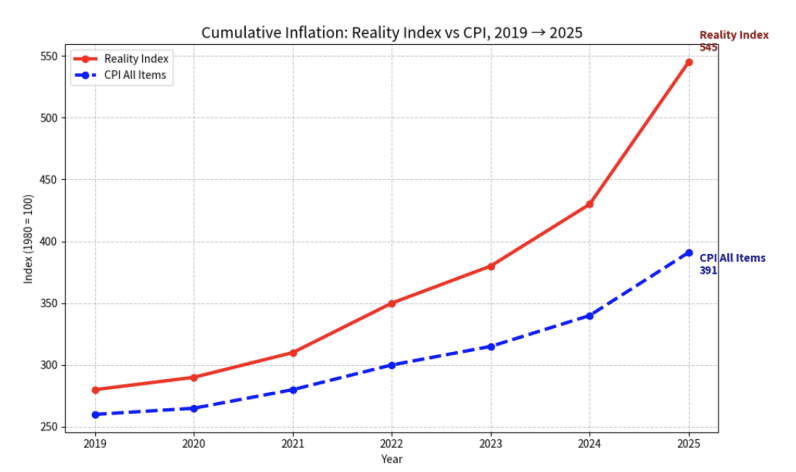
“We find that a basket of goods and services that cost $100 in 1980 costs $515 per the Reality Index in 2025. The official CPI reports only $391. That means that real prices have run 32 percent higher over 45 years than the government reports. Over a 55-year window, the Reality Index ran 54.4 percent faster than CPI.”
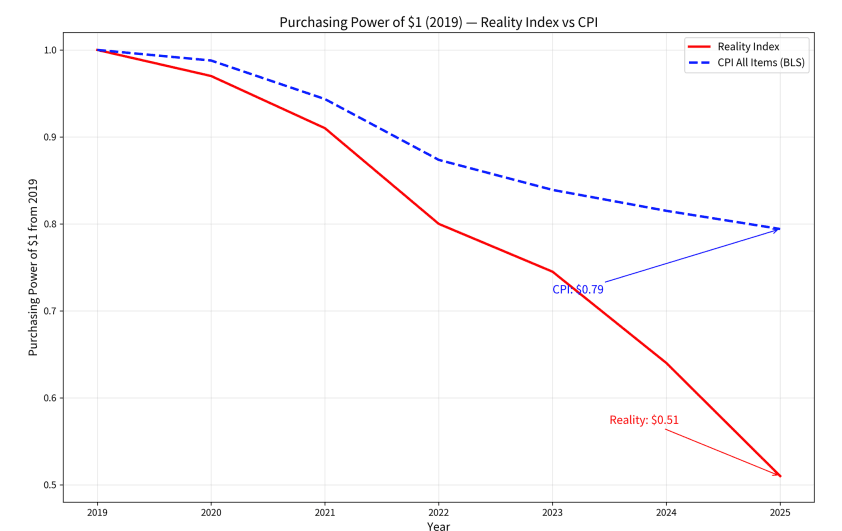
When we zero in on the post-pandemic era, we see that the impact of the lockdowns was even worse than the (already bad) data indicates. Based on the Reality Index, there has been as much as a 50 percent decline in purchasing power since 2019.
Tucker pointed out that, conversely, this means COVID cut the value of the dollar in terms of goods and services to half its former value.
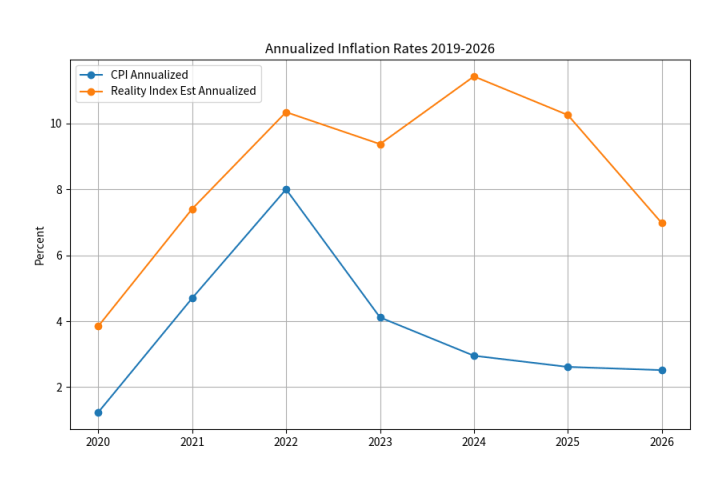
Tucker took this data and asked AI to map it in terms of year-on-year change.
“CPI shows a peak in 2022 followed by a decline in the rate of increase. Reality Index shows that the devaluation actually intensified and never fell below 6 percent. This explains so much about consumer sentiment and political shifts. People feel it even if official data never revealed it. This kind of chart forces a rethinking of the history of the last six years.”
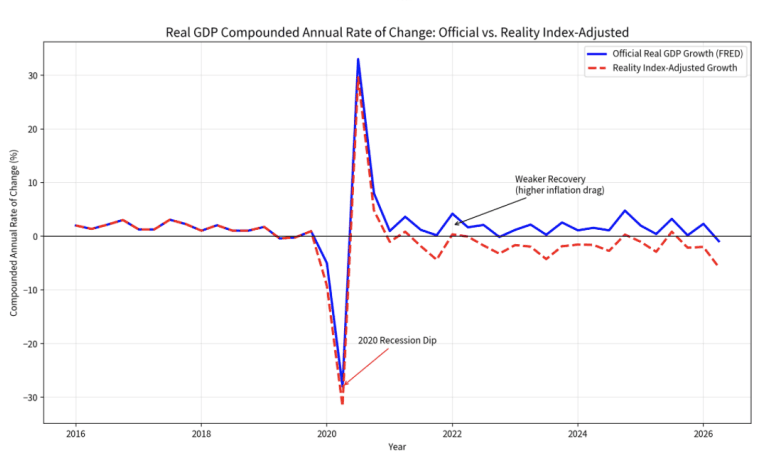
If you take the Reality Index data and plug it into GDP, you find that the 2020 recession never ended.
Note that we see negative GDP in all but three quarters since the summer of 2022. Tucker calls it “a recession without end.”
“Overall, Grok AI estimates a loss of 5-12 percent of GDP from 2019 to present using Reality Index numbers. Sorry, but read that again. Instead of any recovery, we’ve seen as much as double-digit declines in GDP overall since 2020. This is the cumulative loss spread out over six years. That’s roughly half of the losses of the full period of the Great Depression, which was more catastrophic than people know.”
Tucker concedes that anyone can look at the methodology and disagree, as the data is subject to replication.
“Be my guest. From what I can see, the actual picture is far closer to the reality that most people are experiencing.”
The bottom line is we should continue to be skeptical of government data. The people in power have a vested interest in making things seem better than they are. After all, they’re the ones we’ll blame for our pain. As it stands, we can feel the pain and complain about it, but the government people and their enablers in academia and the media will just point at the “official data” and tell us it’s our imagination.
That’s the beauty of independent data crunching. It pulls away the government veil and reflects the reality we’re all experiencing.
Mike Maharrey is a journalist and market analyst for Money Metals with over a decade of experience in precious metals. He holds a BS in accounting from the University of Kentucky and a BA in journalism from the University of South Florida.
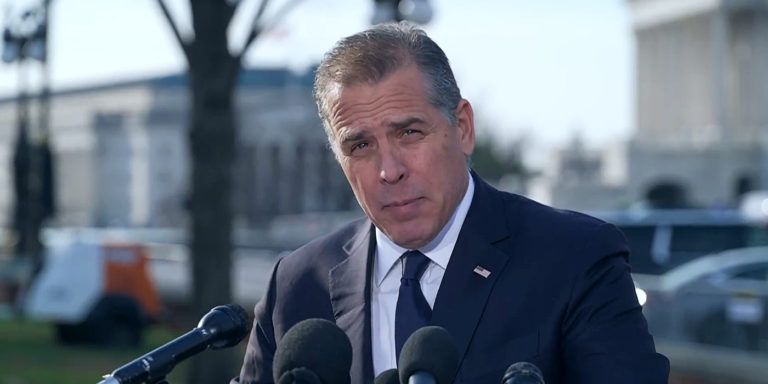
(Luis Cornelio, Headline USA) Hunter Biden for president in 2028? President Donald Trump suggested the idea shouldn’t be ruled out too quickly.
Rumors have swirled about a potential 2028 candidacy by Hunter, the disgraced son of former President Joe Biden, after he hinted at the idea on X.
Hunter has recently taken to X to both joke and respond to critics ever since sitting down for an interview with podcast host Candace Owens.
Fox News correspondent Peter Doocy asked Trump about the rumors during an Oval Office event on Thursday.
In response, Trump pointed to the rise of controversial Democratic figures such as Graham Platner in Maine, using him as a comparison in discussing the hypothetical candidacy.
Doocy specifically asked: “He’s on social media now, and he has suggested – maybe joking, I don’t know – that he could run for president in 2028. How would he do, Hunter Biden, in a 2028 Democratic primary.”
Trump replied, “I would say his past is not the greatest. Hey, if the guy from Maine can do well. Well, I guess Hunter could do well, too, because the guy from Maine is a basket case,” the president added, referring to Platner.
NEW: President Trump reacts to Hunter Biden teasing a potential 2028 presidential run, taking the opportunity to roast other Democrats Graham Platner and James Talarico.
"You would think that, you know, past has something to do with winning an election. And I would say his past… pic.twitter.com/W2c7mmgsIZ
Platner is the presumed Democratic nominee for U.S. Senate in Maine after Gov. Janet Mills dropped out of the race.
Trump’s comments come as Platner continues to face a growing list of scandals. Among the allegations are that he bragged about his Nazi-linked tattoo, made crude remarks about public masturbation and prostitution, downplayed sexual assault and maintained an account on a messaging platform associated with child predators.
Most recently, The New York Times reported that several women shared troubling accounts of their experiences dating him.
Like Platner, Hunter has faced controversies involving drugs, prostitution, influence-peddling and criminal conduct.
Joe Biden ultimately pardoned Hunter for offenses committed over a span of roughly 10 years, issuing one of the broadest presidential pardons in U.S. history.
Hunter appeared to quip in response to Trump’s comments:
(Luis Cornelio, Headline USA) A social media influencer with millions of followers went viral Wednesday, but not for the usual reason. Instead, Jesse Ridgway and his wife drew widespread criticism after announcing they had aborted their unborn child following a Down syndrome diagnosis.
The backlash against Ridgway, also known online as “McJuggerNuggets,” erupted after he posted an oddly written statement on X in which he appeared to compare Down syndrome to “a glitch.”
Many critics were disturbed by Ridgway’s impersonal tone in the statement, which focused largely on his and his wife’s feelings. He offered virtually no reflection on the unborn child’s life.
“This week, my wife and I made the very difficult decision to terminate the pregnancy due to Trisomy 21,” Ridgway wrote. He later said the decision was driven by concerns about the perceived challenges associated with raising a child with Down syndrome.
“Trisomy 21, also known as Down Syndrome, is caused by an extra chromosome. It is caused by an error in cell division, like a glitch. The odds of a baby having it is 1 in 1000,” the YouTuber said.
Ridgway previously announced the diagnosis in a video published May 27.
In a follow-up post on X, Ridgway responded to the backlash by saying he and his wife had been “grieving the loss of their unborn child and making an impossible decision.”
“The last 24 hours have exposed a side of humanity that is deeply disturbing. Being called ‘murderous pieces of shit, evil, compared to Hitler’ and receiving NON-STOP DEATH THREATS,” he added.
I’ve never seen such hate and vitriol for two people grieving the loss of their unborn child and making an impossible decision.
The last 24 hours have exposed a side of humanity that is deeply disturbing. Being called “murderous pieces of shit, evil, compared to Hitler” and…
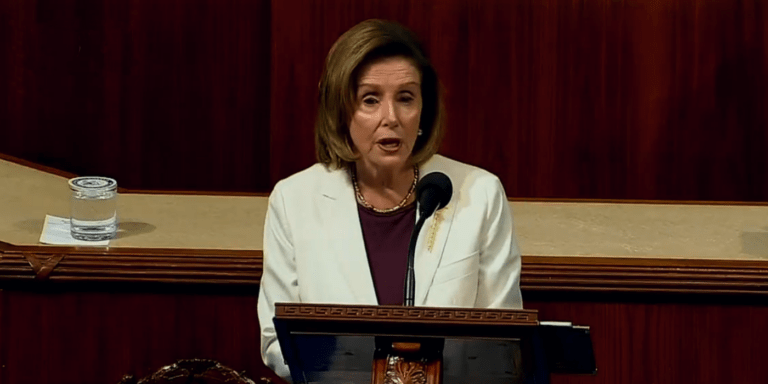
(Luis Cornelio, Headline USA) Nancy Pelosi berated a reporter for a conservative news platform after being asked about her failure to request the deployment of the National Guard ahead of the Jan. 6 protest on the U.S. Capitol.
The target of Pelosi’s verbal attacks was Alison Steinberg, a congressional correspondent for news platform Lindell TV, whom Pelosi encountered inside the U.S. Capitol on Thursday.
“Last time I asked you about January 6, why you turned the National Guard on January 6, you told me to shut up and that I was repeating Republican talking points,” Steinberg asked Pelosi.
“Well, shut up again because you are speaking lies,” Pelosi replied.
🚨 NANCY PELOSI TELLS LINDELLTV REPORTER: “SHUT UP AGAIN” OVER JAN 6 QUESTIONS 🚨
LindellTV's @alisonintheknow confronted @SpeakerPelosi with questions about January 6th, the National Guard, and Pelosi's OWN comments caught on camera following the Capitol breach.
Pelosi’s line of defense stems from her claim that she does not oversee the National Guard. The truth is far more complex.
The Capitol Police Board determines whether to call the National Guard to the U.S. Capitol during certain emergencies. Members of the board are the House and Senate sergeants at arms.
The House Sergeant at Arms, who reported directly to then-House Speaker Pelosi, decided not to call for the Guard before certification of the 2020 presidential election began, according to the Associated Press.
Steinberg appeared to show Pelosi video footage in which the former House speaker discussed why the National Guard was not present on Jan. 6.
“I take responsibility for not having them just prepare for more,” Pelosi said in now-infamous video recorded by her daughter, Christine Pelosi.
🚨 Since January 6, 2021, Nancy Pelosi spent 3+ years and nearly $20 million creating a narrative to blame Donald Trump.
— Oversight Subcommittee (@OversightAdmn) June 10, 2024
At the time, Pelosi was in the back of an SUV while she was transported to a secure location after protesters entered the Capitol.
Pelosi appeared to lose her temper when Steinberg brought up those remarks.
“Why was your daughter filming you on Jan. 6?” Steinberg asked.
“Why don’t you get away?” Pelosi replied, appearing visibly aggravated. She later added: “I don’t even think you’re a real journalist. You work for ‘MyPillow Man?’ … I don’t consider that journalism. ‘MyPillow Man?’ That’s not journalism. I don’t have any reason to talk to you.”
Continuing her attack on Steinberg, Pelosi said: “I want people to know that you’re not a real journalist. You work for ‘MyPillow Man,’ and all you do is spell untruths. Get away from me.”
As Steinberg attempted to ask another question, Pelosi repeatedly shouted, “Get away from me!” while pointing her finger at Steinberg.
A Pelosi aide then stepped between the two as Steinberg walked away.
This marked the second time Pelosi snapped at Steinberg after the journalist pressed her on the same issue in October 2025.
“Shut up! I did not refuse the National Guard. The president didn’t send it! Why are you coming up with Republican talking points as if you’re a serious journalist?” Pelosi said.
Pelosi is set to retire after the upcoming 2026 midterm elections. She served nearly four decades in the House.
BREAKING: Nancy Pelosi SNAPS at OUR Reporter – Points in Her Face and Hurls Insults
When our reporter pressed @SpeakerPelosi on why she refused National Guard support on January 6th, she lost it – pointing in her face, yelling “Shut up,” and accusing her of pushing “Republican… pic.twitter.com/nXxKJaq6Gz
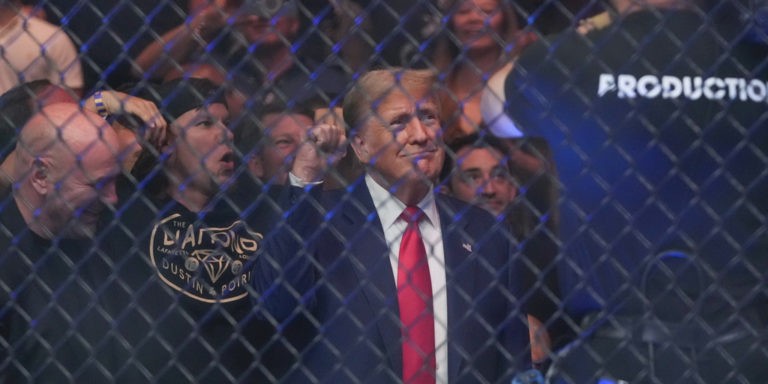
UFC Freedom 250 is scheduled for June 14, 2026, coinciding with Trump’s 80th birthday, on theSouth Lawn of the White House to celebrate the nation’s 250th Independence Day anniversary. The invite-only event will host roughly 5,000 attendees selected by the UFC and Trump administration, including military personnel and VIPs, with no public ticket sales. The main card features UFC Lightweight champion Ilia Topuriadefending against interim champion Justin Gaethje, plus Alex Pereira versus Ciryl Gane for the interim heavyweight championship.
Strickland went public about his exclusion in comments on a UFC Instagram post and thenposted a video, saying: “UFC higher-ups called me… They said, ‘Sean, I got to apologize, but you’re not Israeli enough to go to UFC 250: Israel Edition, per a report by BJPenn.com. The White House didn’t clear you.'” He added: “I already bought my plane ticket, and we’re going. I’m going to bring the belt, and I’ll get a big bullhorn and go right up to the gates. We’re going to do a peaceful protest!”
The championattributes the ban to two factors, according toYahoo Sports. As Middle Easy has reported, Strickland haspublicly criticized Israel and Prime Minister Benjamin Netanyah—posting “Israel ‘jump’ Trump ‘how high’.” He has also made references to the Epstein files in relation to Trump. Former Rep. Marjorie Taylor Greenepublicly backed Strickland on X, writing “Unreal. Here it is. It’s true,” per a report by Newsweek.
Rather than accepting the ban quietly, Stricklandtold Bloody Elbow he already bought a plane ticket to Washington and plans to show up outside the White House gates for what he calls a peaceful protest. “I’ll bring the belt and we’ll stand outside the gate and let them know what we really think about Trump and Israel,” Stricklandstated.
The UFC nor the White House have not publicly confirmed or commented on Strickland’s claims. Nor have they made any statements when Headline USA reached out to them.
José Niño is the deputy editor of Headline USA. Follow him at x.com/JoseAlNino