



(Mike Maharrey, Money Metals News Service) A lot of people are feeling economic pain right now. As I recently wrote, the American consumer is broke, stressed, and buried in debt.
However, the official government data doesn’t seem to reflect this pain. Sure, there’s some price inflation out there, but it’s not that bad — so we’re told. Jobs are plentiful, so we’re told. And the economy is growing based on GDP — so we’re told.
Why is there a disconnect?
Either people are just imagining their pain, or the data is off.
It’s far more likely that the data is off.
A new AI tool called the Reality Index makes it possible to analyze raw price data without all the adjustments built into government formulas. It provides a more unfiltered look at price movements, and it reveals that things are indeed as bad as people sense.
Brownstone Institute President Jeffrey Tucker used the Reality Index to analyze the impact of the pandemic lockdowns and discovered that it was even worse than we thought.
His analysis encapsulates the broader problem with using government data to analyze the trajectory of the economy.
Pandemic Policy Reality Check
When governments started locking down economies for COVID-19, a few voices expressed concern that the impact of lockdowns would be far worse than the virus. Those voices were quickly shouted down in the name of “safety.”
As it turns out, we should have paid closer attention to those dissenting voices.
It’s been six years since the beginning of the lockdown hysteria, and the economy still hasn’t recovered. Based on calculations by Tucker derived from data parsed through the Reality Index, the economy lost 12 percent of GDP, and the purchasing power of the dollar has been cut in half.
Even the official government data hints at deep and lasting negative impact stemming from pandemic policies in official government data. Based on the CPI, prices have increased by 26 percent since the lockdowns. At the same time, we’ve only seen marginal improvements in personal income.
The pandemic also appears to have driven some structural changes in the economy. For instance, the labor participation rate and worker/population ratio never fully recovered and continue to fall.
But a 2024 Brownstone study revealed it’s even worse than the official data indicates. This isn’t surprising given that the formulas used by government agencies to churn out their data are designed to understate economic problems.
According to that study, the economy has remained in a technical recession since the lockdowns were lifted. According to Tucker, the study’s authors came to this conclusion with some limited adjustments of price data bumped up against output data.
The mainstream denounced the study as “extremism” and fell back on official data, which is bad enough.
I’m constantly pointing out that we should take government data with a grain of salt. For instance, the CPI formula was changed in the 90s so that it would understate price inflation. And then there are the constant revisions (almost always down) to the jobs data.
Tucker asked the operative question:
“Where does this leave those of us who are looking for a plain index of prices? A veil has been put over that basic question and answer, such that we don’t know for sure. This matters tremendously for issues like raises, examining cost of living increases, taxes, and pension payments. Everything is adjusted for inflation to convert it to real valuations but if we don’t have a clear number, what are we to do?”
To dig deeper, Tucker used the Reality Index. As he explained it, “an independent intellectual in Madrid, Tom Elliott, has deployed tools of AI to wholly reconstruct price indices in a way that is consistent with actual prices. His results are absolutely eye-popping.”
The methodology strips all the hedonic adjustments and suppositions out of the government data and uses raw prices reported by the Bureau of Labor Statistics.
Tucker explained the result:
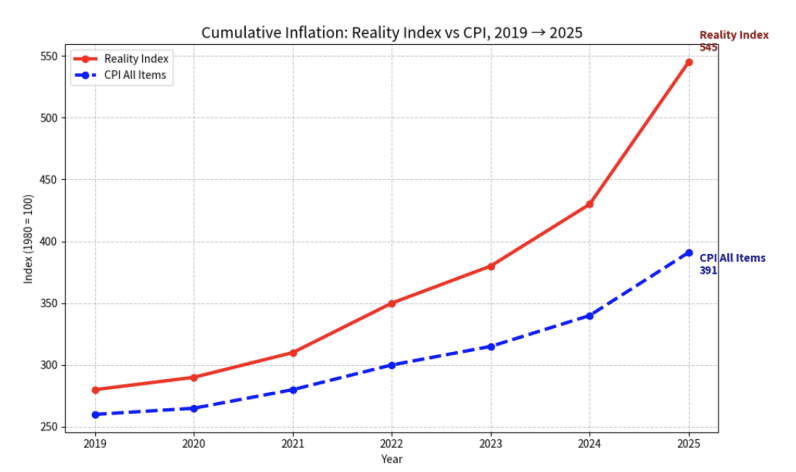
“We find that a basket of goods and services that cost $100 in 1980 costs $515 per the Reality Index in 2025. The official CPI reports only $391. That means that real prices have run 32 percent higher over 45 years than the government reports. Over a 55-year window, the Reality Index ran 54.4 percent faster than CPI.”
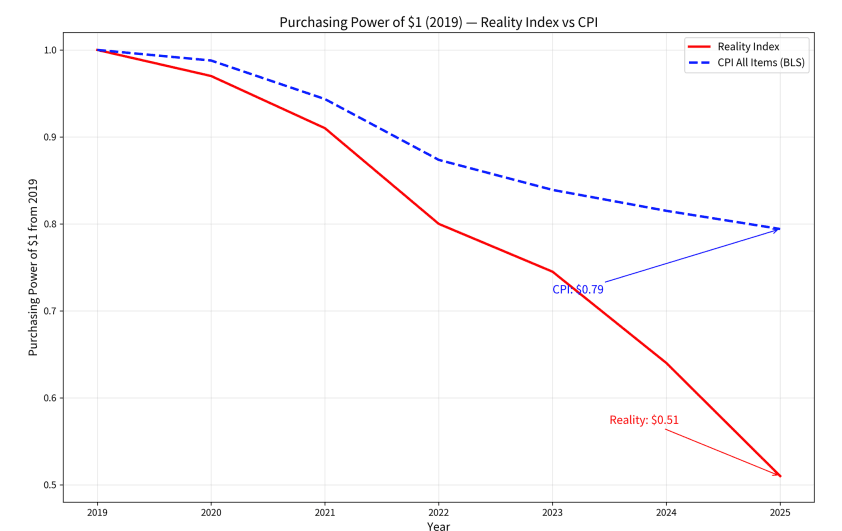
When we zero in on the post-pandemic era, we see that the impact of the lockdowns was even worse than the (already bad) data indicates. Based on the Reality Index, there has been as much as a 50 percent decline in purchasing power since 2019.
Tucker pointed out that, conversely, this means COVID cut the value of the dollar in terms of goods and services to half its former value.
Tucker took this data and asked AI to map it in terms of year-on-year change.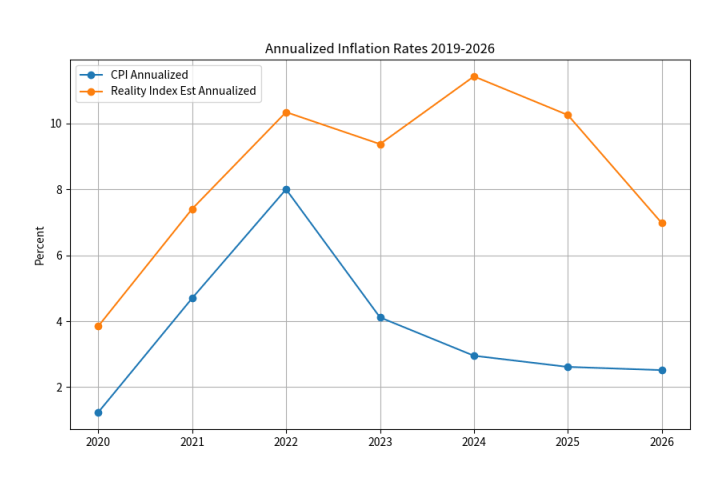
“CPI shows a peak in 2022 followed by a decline in the rate of increase. Reality Index shows that the devaluation actually intensified and never fell below 6 percent. This explains so much about consumer sentiment and political shifts. People feel it even if official data never revealed it. This kind of chart forces a rethinking of the history of the last six years.”
If you take the Reality Index data and plug it into GDP, you find that the 2020 recession never ended.
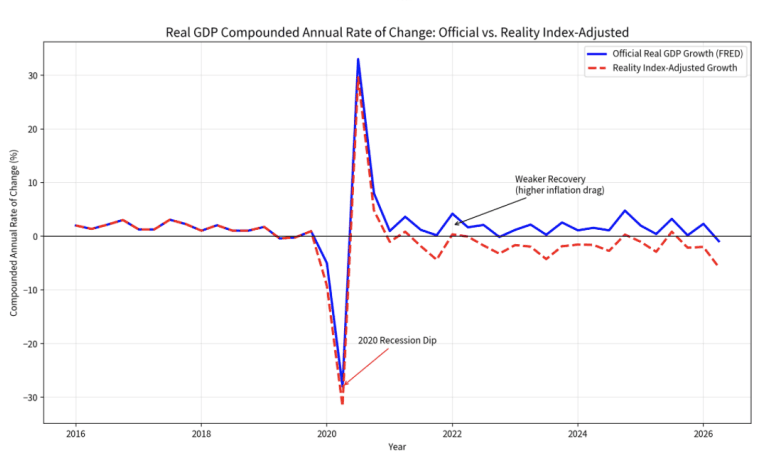
Note that we see negative GDP in all but three quarters since the summer of 2022. Tucker calls it “a recession without end.”
“Overall, Grok AI estimates a loss of 5-12 percent of GDP from 2019 to present using Reality Index numbers. Sorry, but read that again. Instead of any recovery, we’ve seen as much as double-digit declines in GDP overall since 2020. This is the cumulative loss spread out over six years. That’s roughly half of the losses of the full period of the Great Depression, which was more catastrophic than people know.”
Tucker concedes that anyone can look at the methodology and disagree, as the data is subject to replication.
“Be my guest. From what I can see, the actual picture is far closer to the reality that most people are experiencing.”
The bottom line is we should continue to be skeptical of government data. The people in power have a vested interest in making things seem better than they are. After all, they’re the ones we’ll blame for our pain. As it stands, we can feel the pain and complain about it, but the government people and their enablers in academia and the media will just point at the “official data” and tell us it’s our imagination.
That’s the beauty of independent data crunching. It pulls away the government veil and reflects the reality we’re all experiencing.
Mike Maharrey is a journalist and market analyst for Money Metals with over a decade of experience in precious metals. He holds a BS in accounting from the University of Kentucky and a BA in journalism from the University of South Florida.