Holding Gold Yields Better Returns Than Mining for It

(Stefan Gleason, Money Metals News Service) With spot gold prices at record highs, investors might expect that shares of precious metals mining companies are also trading at record highs.

By and large, that is not the case.

Mining stocks, as represented by the HUI Gold BUGS Index, are still underwater by more than 40% compared to their 2011 highs. And that’s despite being pulled up significantly this year by soaring gold and silver prices.

There are a variety of reasons why most mining shares have lagged the metals. First and foremost, mining is a tough business that is fraught with risks. Even when the value of a mine’s end product goes up, the costs of getting it out of the ground can go up even faster.

During periods when market prices for metals fall below a mining company’s all-in sustaining costs, it may choose to sell at a loss. That’s because it would be impractical for a mine to lay off all its workers and let its expensive equipment sit idle while waiting for market conditions to improve.

But there is another option available to precious metals mining companies during times when their product is being undervalued.

If the CEOs of companies that have “gold” (or silver) in their name truly believe in their product – which is money itself – then why don’t they hold some of it on their books as a reserve asset instead of immediately exchanging it for dollars regardless of prevailing price?

Gold is considered by the Bank for International Settlements to be a “Tier 1” asset within the banking system. That means it is globally recognized as a high-quality capital reserve asset.

Central bankers around the world agree.  Despite refusing to make their fiat currencies redeemable in gold, central banks have been accumulating the monetary metal at a blistering pace over the past few years.

But with a few exceptions, large corporations — including major gold and silver producers — have failed to bolster their own finances with sound money backing.

SilverCrest Metals Sets an ExampleOne company that actually does is Canada-based SilverCrest Metals. Under the leadership of President Christopher Ritchie, SilverCrest has added some $30 million in gold and silver bullion to its balance sheet, which represents nearly 30% of its treasury assets.

With the benefit of a fantastic producing mine, SilverCrest began accumulating its precious metal reserves right after paying off all its debts over a year ago. As the nominal price of gold has risen 30% over the past year, this strategy is already looking like a pretty genius move.

Plenty of other publicly traded companies regularly engage in stock buybacks.

CEOs who believe in the underlying strength of their business are happy to have the company buy back its own shares during periods when they are trading at a discount. Share buybacks often do a far better service to shareholders than holding depreciating cash, issuing taxable dividends, or deploying capital into riskier projects.

Last year, Berkshire Hathaway, helmed by legendary value investor Warren Buffett, bought back $9.2 billion of its own shares. Buffett eats his own cooking.

Unfortunately, however, the typical mining industry executive does not.

Gold Holdings Can Buffer a Company’s Ups & DownsMining leaders have overlooked golden opportunities to buy back their own product when it was ridiculously cheap and hold it on their balance sheet.  Instead, they myopically opted to trade it for a relative pittance in dollars that they thought would look better on their quarterly earnings reports.

Throughout its history, the mining industry as a whole has been such a poor steward of investor capital that it has earned a bad reputation on Wall Street. Negative sentiment toward the industry has, in turn, contributed to share price underperformance.

Of course, with gold recently darting to a record high price above $2,500 an ounce, industry executives might feel that now would be a poor time to make such a move.

Given the current momentum and array of bullish factors driving bullion, we doubt that will prove to be the case.

But even if they think the market price of the yellow metal is currently too elevated, at least in nominal terms, what’s their excuse for not retaining its much cheaper cousin, silver?

Even at $30 per ounce, silver remains well below its previous all-time high near the $50 level. Silver is, by many measures, undervalued – especially when considering the potential for rapidly growing sources of industrial demand to outstrip supply.

Taking concrete action that demonstrates a belief in their product will help gold and silver mining industry leaders break the cycle of share underperformance.


Stefan Gleason is President of Money Metals Exchange, the national precious metals company named 2015 “Dealer of the Year” in the United States by an independent global ratings group. A graduate of the University of Florida, Gleason is a seasoned business leader, investor, political strategist, and grassroots activist. Gleason has frequently appeared on national television networks such as CNN, FoxNews, and CNBC, and his writings have appeared in hundreds of publications such as the Wall Street Journal, Detroit News, Washington Times, and National Review.

ST. ONGE: From Price Controls to Mass Starvation

(Peter St. Onge, Money Metals News Service) From taxes to spending, Kamala is the most left-wing major party candidate since George McGovern — who proposed a Universal Basic Income in 1972 and went on to win a single state.

But her most hare-brained scheme — so far — has been price controls, where she’s to the left of McGovern, threatening to punish grocery stores for daring to charge more than their costs.

In fact, grocery stores make 1 to 2 pennies on the dollar. Meaning they have to pass along costs that come straight from the Washington money printer.

That means price controls would, in short, break food.

Price Controls Always Fail

In a recent video I mentioned how price controls have been tried many times, and each time they failed so spectacularly they were repealed. After much pain, suffering, and empty shelves.

When France tried, they got a black market that actually did price gouge. Even Venezuela repealed price controls in 2016 after food shortages and nationwide riots.

But what do price controls look like in reality? For that I go to a great thread by Robert Sterling, a former M&A executive at one of the biggest food producers in America.

Robert walks us through a thirteen step process from grocery price controls to widespread food shortages — something we haven’t seen in this country since the Great Depression, when FDR also imposed price controls.

Stage One: Bankrupt Grocers

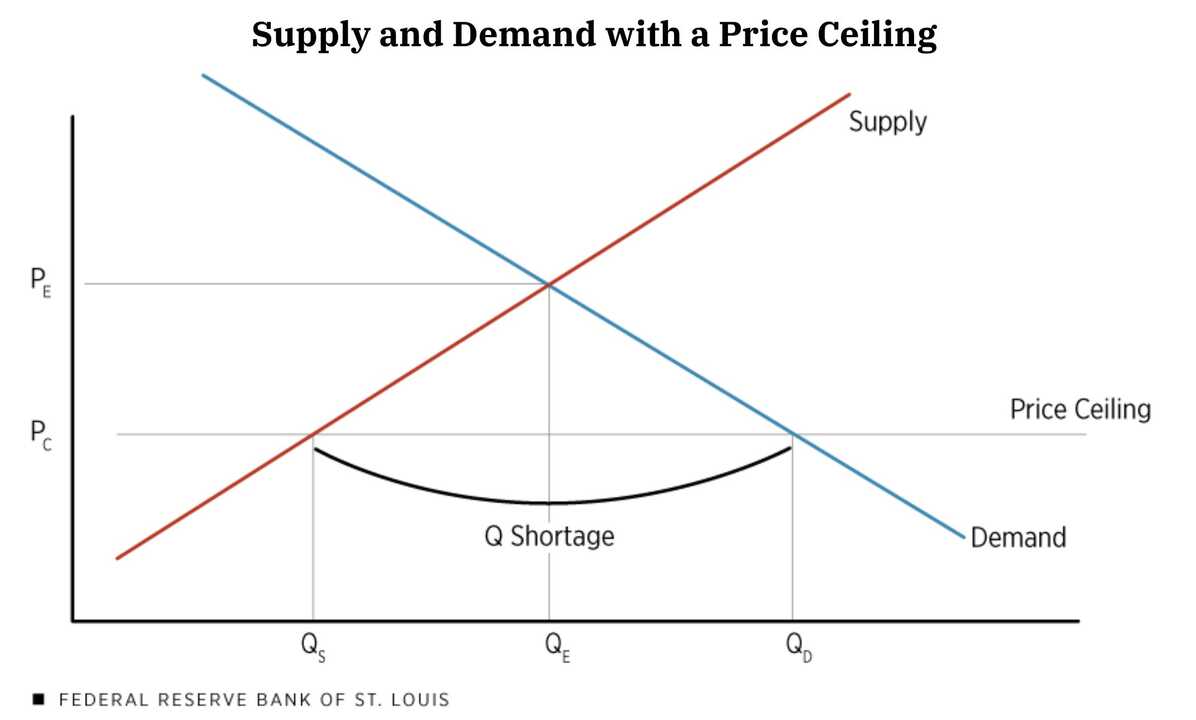
So, first, the government announces grocery stores can’t raise prices even though inflation continues — courtesy of the Fed and Wall Street. That means their costs keep going up, so those pennies of profit turn into losses.

Like any business that’s losing money, they shut down.

Of course, not all grocery stores are created equal — small ones lack economies of scale, and while rich people buy high-margin vegetables and expensive cuts, the poor buy low-margin packaged foods.

So the small stores and the low-income stores go first.

You get food deserts, as people in urban centers or rural areas have to drive miles — or take multiple buses — to find food. And, ironically, you get more concentration, as the little guys drop out.

The survivors increasingly aren’t even selling food. They shift shelf-space to things that aren’t price-controlled. Clothing, furniture, supplements.

Grocery stores start to look more like a Dollar Store, with a little food and a lot of junk.

As cities clear of food, you’d need police patrolling parking lots and armed escorts on delivery trucks — perhaps you could even have government-run groceries like Chicago just announced.

Stage Two: Bankrupt Food Producers

The only way to save any grocery stores is to price-control their costs. Meaning food producers like Kraft, Heinz, Tyson, Hormel.

Of course, again, Kraft’s costs aren’t being controlled — their ingredients, wages, parts and electricity. So now they’re losing money.

Like groceries, they wind down, closing marginal factories and running out equipment then not replacing it.

As food producers downsize or go under, now you start getting actual shortages. And the only solution — once again — is price control the next level down. Farmers.

Stage Three: Bankrupt Farmers

Which brings us to the final stage. Because remember Farmers, too, are now forced to sell at a low price, yet their inputs like fertilizer or tractors are still going up.

They, too, go under.

You are now full Venezuela, with the only alternative to starvation a complete government takeover of the food supply, centrally planned from farmer to grocer.

As Sterling puts it, “The government will struggle to operate one of the most complex industries on the planet. The entire food supply chain starts imploding.”

“Imploding” as in starvation.

What’s Next

It’s very unlikely we’ll get to the point of starvation. For the simple reason that at some point the frog boils and the voters — or rioters — share their thoughts with policymakers.

That’s exactly why price controls fail, from France to Venezuela.

Having said, we managed it before under FDR.

And, unfortunately, if the morons running Kamala’s brain trust are dumb enough for price controls, they’re dumb enough for a whole lot more.

(Article image is Florence Thompson “Migrant Mother,” a migrant pea farmer family by Dorothea Lange in March 1936)


Peter St. Onge writes articles about Economics and Freedom. He’s an economist at the Heritage Foundation, a Fellow at the Mises Institute, and a former professor at Taiwan’s Feng Chia University. His website is www.ProfStOnge.com.

No Kamala! Inflation Isn’t Because of ‘Record’ Grocery Store Profits

(Mike Maharrey, Money Metals News Service) Kamala Harris blames grocery store profits for price inflation. She has even floated a plan to prohibit food “price gouging” that sounds a lot like price controls.

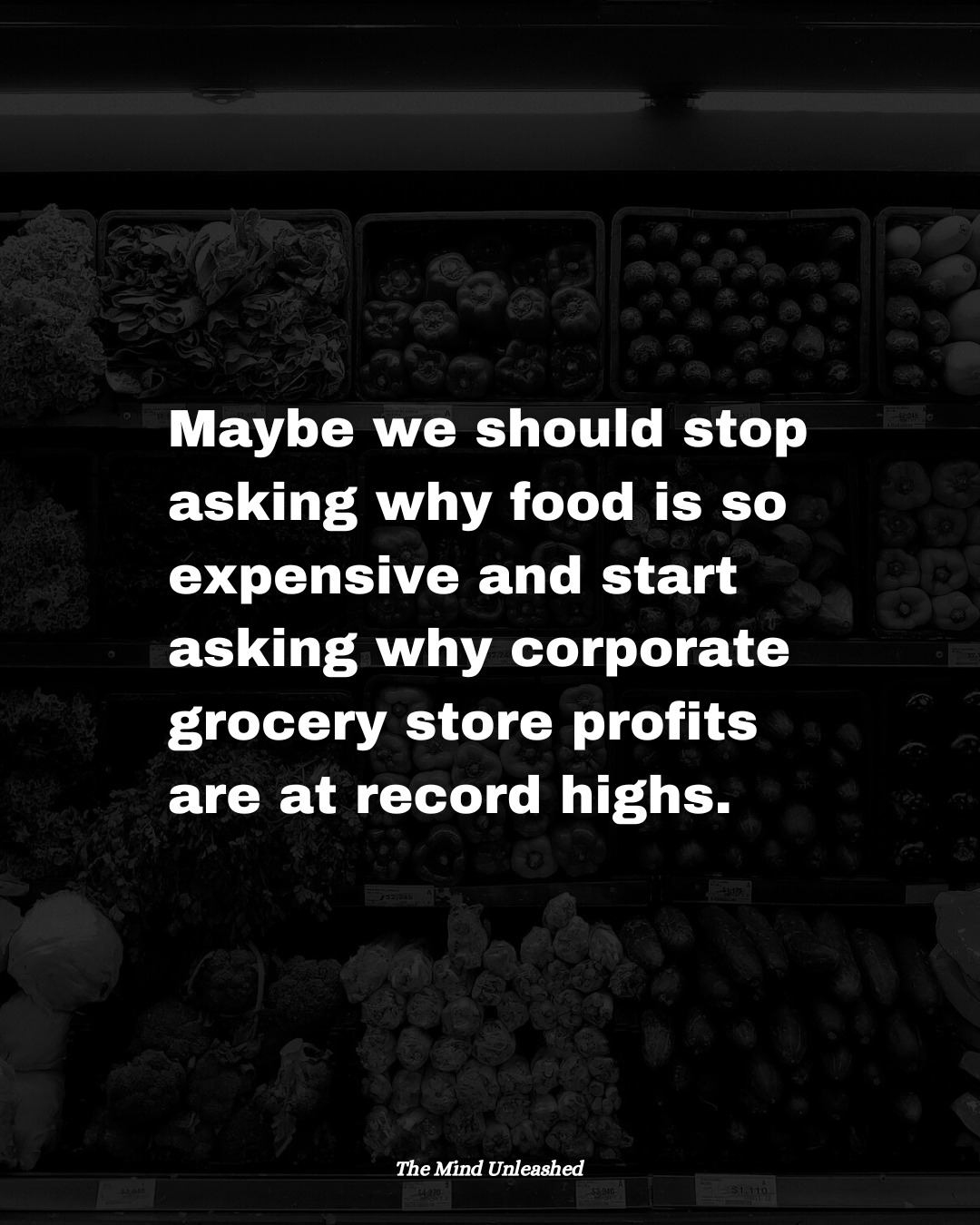
You have to give Harris credit for smart politicking. The “greedy corporations” trope plays well with a lot of Americans. In fact, I frequently see posts about corporate greed and inflation on social media. Here’s the latest grocery store-specific meme making the rounds.

It sounds plausible, especially if you already distrust corporations. The problem is it’s not true.

Make no mistake; it’s definitely solid fodder for people who don’t understand the root causes of price inflation (central bank and government money creation.) And it’s very helpful to government people who don’t want you to know they’re making your life crappier. But this meme has little to no basis in reality.

Inflation Explained

In any discussion about inflation, it’s important to distinguish between price inflation and monetary inflation.

When most people say “inflation,” they mean “prices are going up” – price inflation. All kinds of things can make prices go up – including greedy corporations. But the current bout of rising prices that we’re dealing with has a specific cause that Kamal Harris and the rest of the political class don’t want you to know about.

Monetary inflation (properly defined as the increase of the money supply and credit) causes all prices in the economy to generally rise. In other words, price inflation is a symptom of monetary inflation.

And what causes monetary inflation?

Central banks and governments via fiscal and monetary policy! It’s the money printing!

It’s important to understand that monetary inflation not only causes consumer prices to go up (i.e. groceries), but it also inflates asset prices. So, your home value goes up. The price of oil and other commodities goes up. The stock market goes up.

And guess what — corporate profits go up.

It’s not so much that things are getting more expensive. What’s really happening is the value of a dollar is decreasing. As the Federal Reserve creates more and more dollars to prop up the federal government’s borrowing and spending, each dollar is worth less. That means it takes more dollars to buy the same amount of stuff. So, companies are enjoying bigger dollar profits, but they aren’t better off than they were a couple of years ago.

I don’t doubt that in absolute dollar terms, profits are at record levels, so the meme is technically correct. But that doesn’t mean companies are better off. If you inflation-adjust the record profits, they are no longer records.

Think of it this way. If you get a big raise this year, I could say that you are making “record profits” on your labor. But you’re probably going to tell me that everything is so much more expensive, so, you aren’t really any better off. Your raise is just another inflationary phenomenon.

Are Grocers Making “Record Profits?

A better look at what’s going on is a company’s profit margin. That’s the amount a company keeps after subtracting all direct and indirect costs.

So, are grocery store profit margins at record levels?

Some people have rightly pointed out that grocery store profit margins are historically razor-slim to begin with. They generally run between 0.5 and 3 percent. My wife used to work in the grocery business, and she called it “penny profit.” If a grocer sells a can of peas for a dollar, the profit is about 1 cent.

But that’s not really the point. The question isn’t how high are profits in dollar terms. The question is: are their profit margins expanding? If grocery stores were actually price gouging, then their profit margins would go up.

They aren’t.

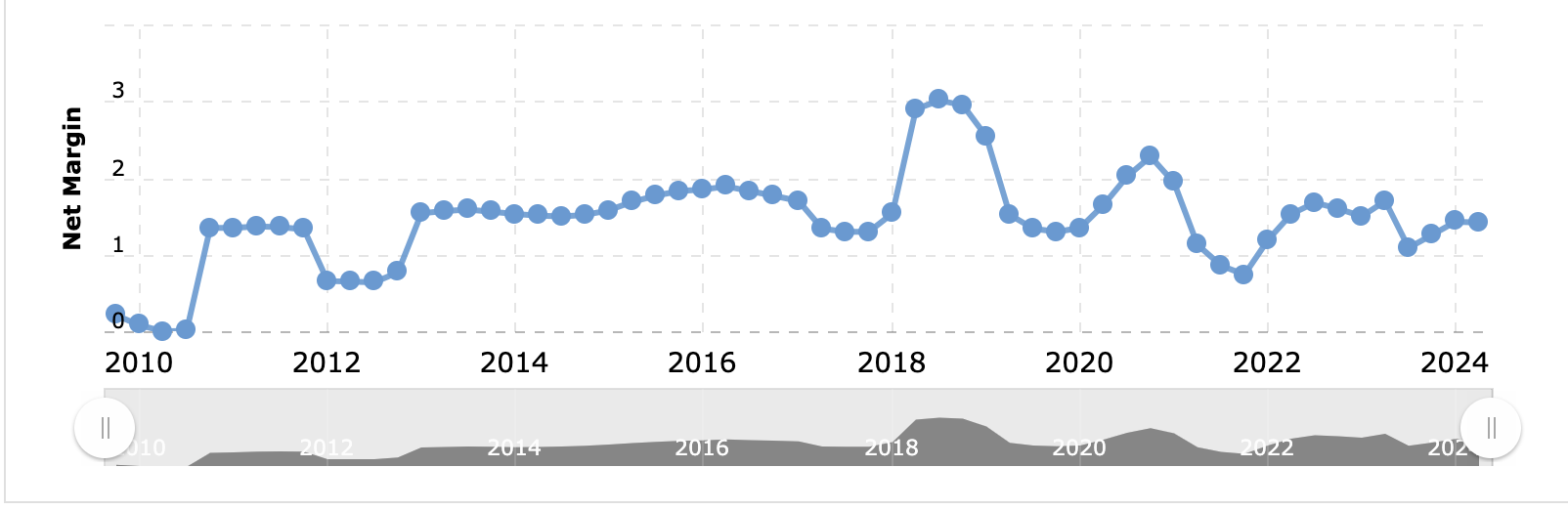
This is Kroger’s profit margin over time. As you can see, margins are currently in line with the historical average and below a long stretch during a relatively quiet economic period in the 2010s.

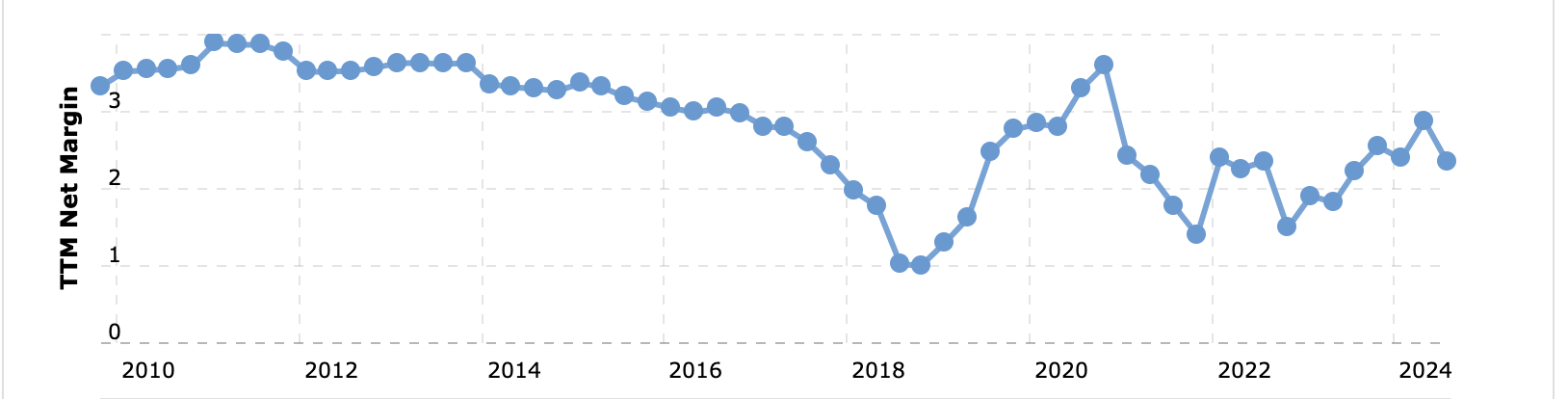
 Here’s Walmart’s profit margin. It runs a little higher than Kroger because it is a hybrid grocer/general retailer. Nevertheless, its profit margin is also currently on the low side of the average.

You’ll notice that both big corporations did quite well during the pandemic era when the government closed down most of the small businesses and forced customers to buy everything from big boys. But profit margins dropped as the inflationary pressures from all the money printing and stimulus hit the economy.

The bottom line is corporate bottom lines in the grocery business aren’t at record levels in real terms. 

So, the real question you should be asking isn’t, “Why are grocery store profits at record highs?” The real question is, “Why is the government constantly stealing the purchasing power of our money and making us poorer?”


Mike Maharrey is a journalist and market analyst for MoneyMetals.com with over a decade of experience in precious metals. He holds a BS in accounting from the University of Kentucky and a BA in journalism from the University of South Florida.

Secret Service Snipers NOT on List of Agents to be Interviewed by Trump Shooting Task Force

(Ken Silva, Headline USA) The House Task Force investigating the Trump assassination attempt wrote to Homeland Security Secretary Alejandro Mayorkas on Wednesday, seeking to interview Secret Service agents involved in the deadly July 13 campaign rally in Butler, Pennsylvania.

In a letter to Mayorkas, Task Force Chairman Mike Kelly, R-Pa., and ranking member Jason Crow, D-Co., asked to start interviewing officials such as Secret Service Pittsburgh boss Timothy Burke, the local field office site agent for the July 13 rally, and the lead advance agent.

However, the Secret Service snipers from July 13 are not included on the list of agents that Kelly and Crow want to interview. Their letter asks to interview the agent “responsible” for “counter sniper capabilities.” However, the letter indicates that would be the official who oversaw the policies, procedures and plans for the snipers to attend the rally—and not the snipers themselves.

Headline USA wrote to the Task Force seeking an explanation for the apparent omission, but did not receive one before the publication of this article.

The Secret Service agent responsible for counter sniper capabilities would presumably be able to tell the Task Force about how and why the July 13 event was the first time snipers were deployed to a 2024 Trump rally—and likely the first time they’ve ever guarded a former president’s event.

However, that agent may not be able to explain the snipers’ actions from July 13—including why they waited minutes before shooting at alleged would-be assassin Thomas Crooks.

Indeed, as Headline USA has thoroughly documented, the Secret Service’s command center was notified by at least 6:09 p.m. that Crooks was on the rooftop. Crooks began firing two minutes after that at 6:11 p.m.

Moreover, snipers were seen watching Crooks at least 20 seconds before he began firing.

Just as inexplicable is that the Secret Service’s snipers didn’t return fire for 15 seconds after Crooks started shooting—and an entire 10 seconds after Crooks had already stopped shooting due to the heroic actions of a local cop, who struck Crooks’s rifle with return fire after he got off eight shots.

House lawmakers have yet to ask why the Secret Service why it waited so long to return fire.

Along with the Task Force’s interview requests, Kelly and Crow also requested a slew of documents, including: All transcripts from interviews conducted by DHS and Secret Service related to the July 13 event, documents referring or related to the Secret Service’s intelligence advance process, documents related to the site selection process, and all communications referring to or between the feds, state and local law enforcement.

The lawmakers set a deadline of this Wednesday for the DHS and Secret Service to fork over the records.

Ken Silva is a staff writer at Headline USA. Follow him at twitter.com/jd_cashless.

Biden Official Who Urged Big Tech Censorship Now Oversees the Harris Campaign

(Luis Cornelio, Headline USA) The former Biden official who viciously pressured Big Tech to censor COVID-19-related posts is now at the helm of Kamala Harris’s campaign.

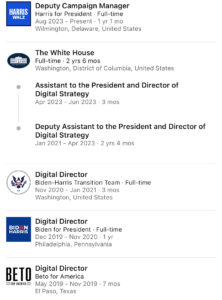
Rob Flaherty, who previously served as the director of digital strategy at the Biden White House, holds the influential position of deputy campaign manager for Harris in Delaware. 

This appointment has sparked significant alarm on X, with critics suggesting that Flaherty has gotten off scot-free for his role in the Biden-Harris censorship efforts. 

Flaherty’s actions, as seen in subpoenaed emails and other communications, prompted widespread condemnation from lawmakers, Republicans and free speech advocates in 2023 and mid-2024.

Specifically, Flaherty was relentless in his efforts to coerce social media platforms into stifling free speech, according to evidence cited in the Murthy v. Missouri case. 

This legal challenge, brought by the attorneys general of Missouri and Louisiana, sought to end the federal government’s role in censorship. 

U.S. District Judge Terry Doughty described the censorship as resembling a “dystopian scenario,” with the federal government acting as an “Orwellian ‘Ministry of Truth.’” 

Doughty’s ruling memo mentioned Flaherty a staggering 79 times. Despite the case eventually reaching the Supreme Court, where Flaherty was cited 68 times, the justices dismissed it on standing issues. 

The evidence was nonetheless strikingly damning, wrote Justice Samuel Alito in his dissent.

“[Former Biden COVID advisor Andy] Slavitt and Flaherty did not simply ask Facebook for information. They browbeat the platform for months and made it clear that if it did not do more to combat what they saw as misinformation, it might be called to account for its shortcomings,” Alito warned. 

Among the content targeted were even memes and jokes, as admitted by Meta CEO Mark Zuckerberg on Monday. 

Despite this intense scrutiny and backlash, Flaherty faced no repercussions. He left the White House in June 2023 to join the Harris campaign (then the Biden campaign). He previously worked as an assistant and deputy assistant to the president, according to his LinkedIn profile.

His long career as a Democratic operative includes communications roles at the Democratic National Committee and the failed presidential campaigns of Hillary Clinton in 2016 and Robert “Beto” O’Rourke in 2019. 

Screenshot of former Biden official Rob Flaherty’s LinkedIn (Headline USA)

Kamala Might Appoint Brother-in-Law as AG… He Works for Uber

(Luis Cornelio, Headline USA) Democrats are speculating about who could replace Attorney General Merrick Garland if Vice President Kamala Harris emerges victorious in the 2024 election—and some are suggesting she might keep it in the family. 

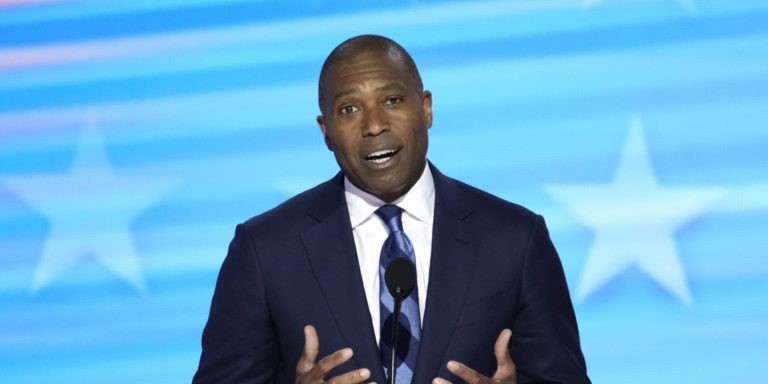
Harris’s allies are naming Tony West, Harris’s brother-in-law, as a potential candidate for the top law enforcement position in a new administration, according to Politico Magazine’s Ankush Khardori.

An Obama-Biden administration alum, West served as assistant attorney general for the DOJ’s Civil Division from 2009 to 2012 and was promoted to assistant attorney general, a position he held from 2012 to 2014.

West currently works as senior vice president of legal affairs at Uber. He took a leave of absence from this high-profile role to assist the Harris campaign after she inherited the Democratic ticket for president in July.

Headline USA’s request for a comment or phone interview sent to West’s Uber email address on Wednesday evening received an automatic reply, informing that he is “on personal leave of absence” until November.

West has been married to Maya Harris since 1998 and is also the stepfather to Meena Harris, a media executive, who has come under scrutiny for allegedly profiting from her family ties to the vice president.

According to a Politico report, Maya unsuccessfully parroted West’s name as a potential candidate for attorney general after the 2020 election.

He was ultimately skipped for Garland, then a federal judge who had been nominated to the Supreme Court by former President Barack Obama in 2016. To his detriment, Senate Republicans refused to consider the nomination until after the 2020 election. 

West’s name first appeared in an Aug. 7 report by Axios, which noted he could be considered for a role as White House counsel or at the DOJ if Harris defeats President Donald Trump this November. 

Axios suggested that West’s family ties to Harris might pose an obstacle in the Senate confirmation process, particularly if Republicans regain the majority. 

West, along with former Attorney General Eric Holder, led the vetting process for Harris’s running mate, ultimately resulting in the selection of Minnesota Gov. Tim Walz. 

If Harris decides against tapping West for the attorney general role, she might turn her eyes to Vanita Gupta, the leftist former associate attorney general who left her position in February.

Heroic Video Captures Texas Rescue of Stranded Family in the Mountains

(Luis Cornelio, Headline USA) Newly released video footage captured the exact moment Texas authorities rescued a distressed family of hikers at Guadalupe Mountains National Park. 

The family of three, including a three-month-old infant, became stranded in the mountains on Aug. 20 after they ran out of water and began experiencing signs of dehydration and heat exhaustion, Texas authorities said in a Wednesday statement.

The parents, both aged 23, had hiked nearly nine miles along the trail, reaching the side of Guadalupe Peak, the highest natural point in Texas. Their hike had begun mid-morning.

At around 4:15 p.m., Guadalupe Mountains National Park Rangers notified the Texas Department of Public Safety’s Aircraft Operations Division (AOD) about the stranded family. The agency swiftly deployed a PC-12 airplane to locate the family and then a helicopter to perform a hoist rescue operation.

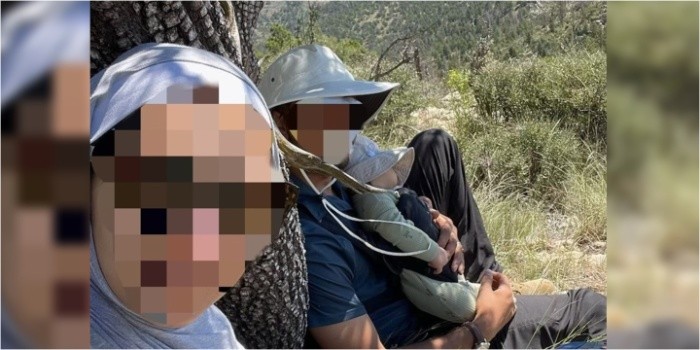
Photo and video footage reviewed by Headline USA of the rescue mission show the mother lying on the ground while holding her three-month-old baby, who is seen wearing a boonie hat, likely to protect him from the unforgiving Texas sun. 

The video of the rescue depicts the parents passing the baby to each other as the rescue helicopter approaches. Authorities are then seen providing medical care to the stranded and dehydrated family. 

The father was lifted first, followed by the mother along with the baby. They were flown down the mountain, where an ambulance awaited them. 

On social media, many praised the Texas authorities for rescuing the family, while some questioned the parents’ decision to take an infant on such a challenging hike. 

Guadalupe Mountains National Park features the four highest peaks in Texas and a diverse collection of flora and fauna across its 86,416 acres, the U.S. National Park Service says on its website.

According to the press release, the AOD performs statewide air patrol, criminal surveillance, and rescue operations across the Lone Star State. It operates from 12 duty stations with 26 aircraft, 350 drone systems and over 100 personnel. 

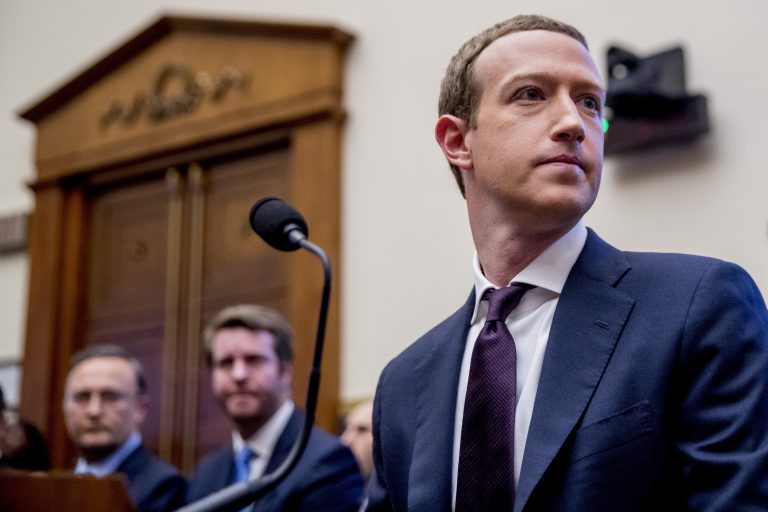
Hot Off Blaming Biden for Censorship, Zuckerberg Resumes Election-Meddling

(Luis Cornelio, Headline USA) Meta CEO Mark Zuckerberg’s financial influence in American elections continues to linger, a new grant program reveals.

Less than two days after Zuckerberg issued a letter promising not to meddle in U.S. elections, a county in Minnesota accepted a $20,000 grant from the Center for Tech and Civic Life (CTCL) as part of a 2024 election funding program. 

CTCL is the notorious leftist nonprofit that managed the $350 million donation from Zuckerberg to fund the infrastructure of the 2020 election in key swing states. The donations-turned-grants were infamously dubbed “Zuckbucks.” 

As first reported by The Federalist, the Nobles County Board of Commissioners approved the grant on Aug. 20, six days after applying for it under a program called the “2024 Rural and Nonmetro Election Infrastructure Grant Program,” proving that the Zuckerberg-funded CTCL is showing no signs of slowing down.

According to the grant application, the county will use the $20,000 check for the installation of cameras and viewing screens to publicly broadcast the activities of the election board. 

“The viewing screens in the halls will also allow us to communicate messages to the public about voting information and upcoming elections,” wrote Joyce Jacobs, the county’s auditor-treasurer, in the application.  

“Installing cameras in the halls and at entrances will also allow us to better serve the public and observe any activities of concern from the safety of our internal office areas,” Jacobs added. 

Neither Jacobs nor CTCL Director Tiana Epps-Johnson, and her communications director Andrea Abbate, replied to Headline USA’s request for comment an hour before publication outside of business hours. 

These revelations come on the heels of Zuckerberg’s infamous letter to House Judiciary Committee Chairman Jim Jordan, R-Ohio, where the tech mogul reiterated his decision not to meddle in elections in the future. 

Zuckerberg claimed that his multi-million-dollar contribution was “designed to be non-partisan – spread across urban, rural, and suburban communities.” However, he acknowledged that “some people believe this work benefited one part over the other.” 

The Meta CEO emphasized his aim to remain “neutral” and pledged that he does not “plan on making a similar contribution this cycle.” 

Beyond his role in censoring Americans during the 2020 election, Zuckerberg’s funding came under intense scrutiny from Republicans, including President Donald Trump, as well as from election integrity experts such as former Kansas Attorney General Phill Kline.

According to the Capitol Research Center, at least 28 states have enacted bans or restrictions on third-party election funding. Similarly, 12 counties—10 in Wisconsin and two in Michigan—have passed legislation prohibiting such external contributions. 

Ex-Fox News Host Pondering Calif. Gubernatorial Run in 2026

(Molly Bruns, Headline USA) Steve Hilton—a Fox News contributor and former director of strategy for then-British Prime Minister David Cameron—may be a contender to replace California Gov. Gavin Newsom when his term ends in two years, according to the National Pulse.

Hilton lost his spot hosting Fox late-night show The Next Revolution in 2023, in the same round of cuts that eliminated top-rated primetime host Tucker Carlson and former Secret Service agent Dan Bongino. However, he continues to be a periodic contributor to the network, according to Fox’s website.

Meanwhile, the British native, who proudly spoke of his 2021 naturalization as a U.S. citizen, has recently increased his public appearances across the Golden State, with a primary focus on public policy.

Though the possibility of his running remains unconfirmed, several top Republican officials stated that he was strongly considering a run on the GOP ticket.

“He is thinking very seriously about running for governor and he is doing it in a very organized way,” said Jim Brulte, the former California Republican Party chair and GOP leader of the state Senate. “I know he’s talking to a lot of the right people because I have heard from a lot of the right people that he’s talking to them.”

Hilton, if elected, would be the first GOP governor since another celebrity office-holder, Arnold Schwarzenegger, left office in 2011.

The role, also held by future U.S. President Ronald Reagan, has been known to attract high-profile candidates hoping to use their celebrity name-recognition to overcome the state’s dominating progressive streak.

For example, a 2021 recall election to oust Newsom garnered participation from well-known radio host Larry Elder and former-Olympic-medalist-turned-transgender-icon Caitlyn Jenner.

Already, Hilton has collected accolades from numerous Silicon Valley executives, who described him as a principled, clear thinker, able to handle complicated problems.

“I think that could be really refreshing at the right moment in California,” said Chamath Palihapitiya, venture capitalist and billionaire with an increasing public presence in California state politics, according to Politico.

Hilton is an outspoken supporter of former President Donald Trump and calls himself a “positive populist,” seeking to give U.S. citizens more control over their lives.

Some have speculated that a win for Trump in November would spell trouble for an insurgent campaign in Califorina, likely mobilizing its leftists to push even harder to the fringes.

However, if Democratic nominee Kamala Harris wins, Hilton may have a chance.

Democratic candidates for the California gubernatorial race include Lt. Gov. Eleni Kounalakis, former Los Angeles Mayor Antonio Billaraigosa, state Sen. Toni Atkins, State Superintendent of Public Instruction Tony Thurmond and former Controller Betty Yee.

Reports have indicated that Health and Human Services Secretary Xavier Becerra has also considered running.

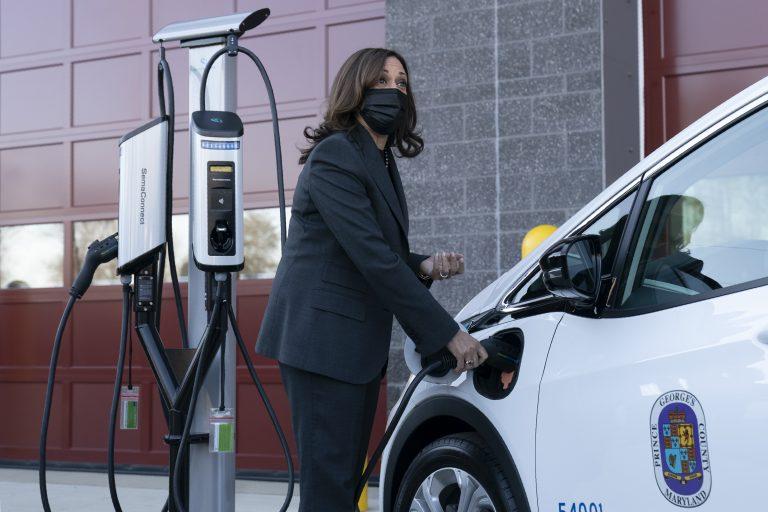
Kamala Flip-Flops on Biden-Harris Admin’s Electric Vehicle Mandates

(Headline USA) Vice President Kamala Harris’s campaign flipped on yet another policy this week, insisting that the newly anointed Democratic nominee for president never supported electric vehicle mandate—despite the Biden administration releasing rules last year requiring car companies to phase out the production of traditional gas-powered vehicles.

In a “fact check” email, Harris campaign rapid response director Ammar Moussa responded to charges made by GOP presidential nominee Donald Trump and his running mate, Sen. JD Vance, R-Ohio. At a recent campaign rally in Michigan, they said that Harris would “force every American to own an electric vehicle.”

Vance cited tailpipe-emissions rules released by the Environmental Protection Agency under Harris and President Joe Biden that require 56% of new vehicles sold in the U.S. to be electric by 2032.

“FACT: Vice President Harris does not support an electric vehicle mandate,” Moussa claimed, insisting that Harris only supports the “ground-breaking” electric vehicle subsidies and “tax credits for electric vehicles” passed as part of the Inflation Reduction Act.

However, the EPA’s recent regulations aren’t the only indication that Harris supports phasing out gas-powered vehicles.

In April 2019, Harris—an original sponsor of the controversial Green New Deal—co-sponsored the Zero-Emission Vehicles Act to transition “the U.S. to 100% zero-emission vehicles.”

The bill would have forced automakers to make zero emission cars 50% of their total sales by 2030. The mandate would ramp up an additional 5% every year until the U.S. was only selling electric vehicles.

And when Harris ran for the Democratic presidential nomination in 2019, her campaign promoted even more aggressive standards, including a total ban on internal combustion engine cars by 2035, according to the Washington Free Beacon.

“Kamala Harris’ radical energy policies such as her EV mandate and the Green New Scam will hurt American workers, help China, and do virtually nothing to help the environment,” Trump campaign spokeswoman Karoline Leavitt said in a statement.

This is just the latest policy flip-flop for the Harris campaign.

The vice president has changed course on a number of issues since entering the 2024 race, including banning fracking, her support for Medicare for All, and finishing construction of the southern border wall.