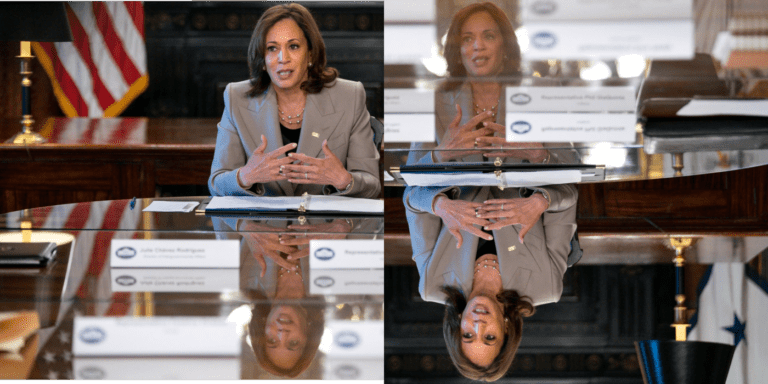
During her sit-down with CNN’s Dana Bash on Thursday, Harris was asked directly about her various policy flip-flops since launching her presidential campaign earlier this summer.
“I think the most important and most significant aspect of my policy perspective and decisions is my values have not changed,” Harris insisted, using the Green New Deal as an example.
“You mentioned the Green New Deal. I have always believed— and I have worked on it—that the climate crisis is real, that it is an urgent matter, to which we should apply metrics that include holding ourselves to deadlines around time. We did that with the Inflation Reduction Act,” Harris added.
Afterwards, NBC’s Yamiche Alcindor, who made headlines during the Trump administration for being virulently anti-Trump, called Harris out for the non-explanation.
“Harris keeps saying ‘my values haven’t changed’ while not explaining why her positions have changed,” Alcindor wrote.
Alcindor noted that Harris also failed to explain her flip-flop on fracking, despite being pressed on it by Bash.
“No, and I made that clear on the debate stage in 2020 that I would not ban fracking,” Harris told Bash. “As vice president. I did not ban fracking. As president, I will not ban fracking.”
CNN’s Daniel Dale similarly hit Harris over her fracking non-answer.
“The fact-check bottom line… is that she did not actually make clear at a 2020 debate that she had changed her previous support for a fracking ban,” he said on Thursday. “I certainly did not hear anywhere in there about Kamala Harris saying that she personally had abandoned her previously expressed 2019 view.”
Conservative commentator Auron MacIntyre said that Harris’s interview went so poorly that even Alcindor and Dale couldn’t help but point it out.
An interview so catastrophic that the regime press has to acknowledge it https://t.co/BuQ8zkxd8t
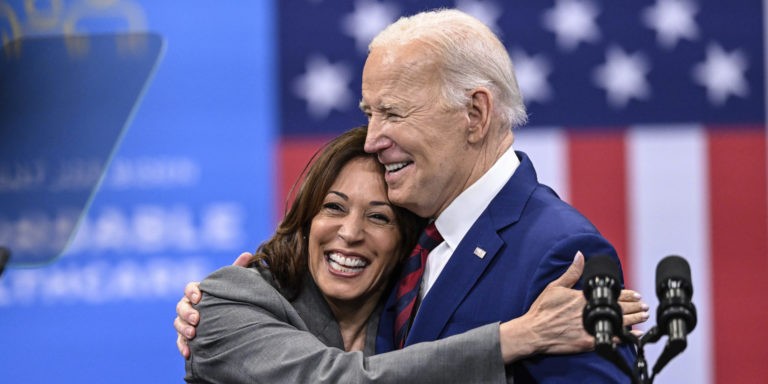
(Headline USA) Vice President Kamala Harris defiantly maintained that she had “no regrets” about defending President Joe Biden’s mental fitness, even though concerns over his ability to serve led to him dropping out of the 2024 race, the New York Times reported.
Harris was asked about her defense of Biden during an interview with CNN’s Dana Bash on Thursday, her first formal sit-down interview since Biden ended his reelection bid and endorsed Harris as his successor.
Even after Biden’s disastrous debate performance against former President Donald Trump in June, Harris insisted that Biden’s age and mental acuity were not a concern.
Asked whether she regrets those comments in light of recent events, Harris said, “No, not at all.”
Biden still “has the intelligence, the commitment and the judgment and disposition that I think the American people rightly deserve in their president,” she continued, adding that she is “so proud” to have served alongside Biden.
Bash then pressed Harris on the unprecedented effort by Democrat leaders to force Biden out of the race, asking whether Harris had to ask Biden for his endorsement.
“He was very clear that he was gonna support me,” Harris responded. “He told me what he had decided to do. I asked him, ‘Are you sure?’ and he said, ‘Yes.’”
Harris went on to praise Biden for being a “transformative” president.
“I think history is gonna show that in so many ways, it was transformative, be it on what we have accomplished around finally investing in America’s infrastructure, investing in new economics, in new industries, what we have done to bring our allies back together, and have confidence in who we are as America,” she claimed.
However, just minutes later, Harris argued Americans were ready to “turn the page” on the last decade—Biden’s four years in office included, as well as the final two years of Barack Obama’s presidency.
When Bash pointed this out, Harris claimed she wasn’t referring to Biden’s presidency.
“I’m talking about an era that started about a decade ago where there is some suggestion, warped I believe it to be, that the measure of the strength of a leader is based on who you beat down instead of where I believe most Americans are, which is to believe that the true measure of the strength of a leader is based on who you lift up,” she said.
(Money Metals News Service) In a recent episode of the Money Metals podcast, host Mike Maharrey sat down with Philip Newman, Managing Director of Metals Focus, to delve into the current state of the global precious metals market.
Newman, with nearly three decades of experience in the field, provided a detailed overview of market trends, statistics, and the factors driving supply and demand across different regions.
(Interview Begins Around 5:30 Mark)
Who is Philip Newman?
Philip Newman
Philip Newman is the Managing Director of Metals Focus, a leading independent precious metals consultancy based in London, England. He is one of the founding partners of the company, which specializes in providing market intelligence on gold, silver, platinum, and other precious metals. With 29+ years of experience in the precious metals industry, Newman has a deep understanding of market trends, supply and demand dynamics, and the factors influencing prices in the global precious metals markets.
Before founding Metals Focus, Newman was the Research Director at GFMS, a prominent precious metals research firm. During his time at GFMS, he was a key contributor to and project manager of major reports and surveys, including those on silver, gold, and platinum group metals (PGMs). Newman holds a Bachelor of Science degree from the University of Surrey. His expertise and insights are highly valued in the industry, making him a sought-after analyst and commentator on precious metals markets.
Overview of Metals Focus
Metals Focus, co-owned by Newman and two other managing directors, is a leading provider of independent market intelligence on precious metals. The company boasts a team of around 30 experts spread across eight global markets, enabling them to offer in-depth insights into the silver, gold, and platinum group metals (PGMs) markets. Metals Focus collaborates with major industry entities such as the Silver Institute, World Gold Council, and World Platinum Investment Council, producing key reports like the World Silver Survey and Gold Demand Trends.
The Silver Market Deficit
One of the central topics of discussion was the ongoing deficit in the silver market. Newman highlighted that silver has been in a significant market deficit for the past few years, with more silver being consumed than produced and recycled. In 2022, the deficit reached a record 260 million ounces, and although Newman doesn’t foresee this record being eclipsed, he expects the deficit to remain substantial, potentially around 190 million ounces in 2023.
The deficit has primarily been driven by soaring demand in the industrial sector. Silver used in industrial applications has seen remarkable growth, rising from 500 million ounces in 2020 to over 650 million ounces in 2022. This demand is expected to exceed 700 million ounces in 2023, driven largely by the green energy movement, particularly in solar panel production. Newman noted that China accounts for about half of the global new solar capacity, with other countries also ramping up their installations.
Addressing the Deficit: Where is the Silver Coming From?
With such a significant deficit, the question arises: where is the silver coming from? Newman explained that the gap is being filled by drawing down existing stocks, particularly large bars held in identifiable stocks such as the London Bullion Market Association (LBMA) vaults, the CME in New York, and locations in China like the Shanghai Gold Exchange and the Shanghai Futures Exchange. However, as these stocks dwindle, the market will need to see higher prices to encourage investors to liquidate their holdings and balance the market.
The Gold-Silver Ratio and Market Dynamics
The conversation also touched on the gold-silver ratio, which has remained elevated at around 85:1, indicating that silver has not kept pace with gold’s price surge. Newman attributed this to a combination of factors, including gold receiving a strong bid due to expectations of dovish actions from the Federal Reserve and macroeconomic uncertainties, while silver has been weighed down by concerns about the Chinese economy, particularly in the property sector.
Additionally, the silver coin and bar market has struggled recently, with demand in major markets like the U.S., Germany, and Australia significantly weaker than in previous years. Newman noted that this has been a contributing factor to the lagging silver price despite the ongoing deficit.
Gold Demand Driven by the East
Newman also discussed the dynamics of the gold market, noting that much of the recent demand has been driven by Eastern markets, particularly China and India. In the first half of 2023, China saw strong demand for gold coins and bars, with premiums remaining high. India also experienced a surge in demand following an unexpected and significant cut in import duties on precious metals in July 2023, which spurred consumers to flock to gold shops despite rising prices.
In contrast, Western markets like the U.S. and Europe have seen mixed results. While there has been notable liquidation of gold by retail investors in the U.S., dealers have managed to turn these liquidations around by selling to other investors. However, the market for small bars and coins has been relatively weak, particularly in Germany and much of Europe.
The Importance of Market Psychology
Throughout the conversation, Newman emphasized the importance of understanding market psychology, particularly in how consumers and investors react to price movements. He pointed out that while analysts may view certain behaviors as irrational, they are often perfectly rational from the perspective of the individuals involved. This understanding is crucial in predicting market movements, particularly in the silver market, where technological advancements in solar panel production are leading to both increased demand and efforts to reduce silver usage through thrifting.
Conclusion
Newman’s insights provided a comprehensive overview of the current state of the precious metals markets, highlighting the complexities and global nature of these markets. As silver continues to experience significant deficits and gold demand shifts towards Eastern markets, the importance of market psychology and the factors driving supply and demand cannot be understated. For investors and analysts alike, staying informed on these dynamics is essential for navigating the ever-evolving landscape of precious metals.
For more detailed insights and data, visit Metals Focus atmetalsfocus.com.
Key Questions & Answers:
Here are the key questions and answers from the episode of the Money Metals podcast featuring Philip Newman, Managing Director of Metals Focus:
Can you give us an overview of what you do at Metals Focus?
Philip Newman explained that Metals Focus is an independent consultancy providing market intelligence on precious metals. The company has a team of about 30 experts across eight global markets. They gather insights through confidential meetings with industry participants, producing reports for organizations like the Silver Institute, World Gold Council, and World Platinum Investment Council.
What is driving the significant silver market deficit we’ve seen in recent years?
Newman noted that the deficit is primarily due to stable supply from mine production and recycling, contrasted with a surge in demand, particularly in industrial applications. He highlighted that industrial silver usage grew from 500 million ounces in 2020 to over 650 million ounces in 2022, with expectations to surpass 700 million ounces in 2023. This increase is largely driven by the green energy sector, especially solar panel production.
Has the green energy movement, particularly solar panel production and electric vehicles, contributed to the silver demand surge?
Newman confirmed that the solar sector has significantly driven silver demand, with record highs in new installations, especially in China. Although the growth in electric vehicles has been slower than anticipated, it still positively contributes to silver demand.
How sustainable is the current silver deficit, and where is the silver coming from to meet demand?
Newman explained that the deficit is being met by drawing down existing silver stocks, particularly large bars held in identifiable vaults like those of the LBMA and CME. However, as these stocks deplete, higher prices may be necessary to encourage investors to liquidate their holdings.
What is holding back the silver market from catching up with gold, and what might drive the gold-silver ratio to narrow?
Newman attributed the high gold-silver ratio to several factors, including the strong bid for gold due to expectations of dovish Federal Reserve actions and macroeconomic uncertainties. In contrast, silver has been weighed down by concerns about the Chinese economy and weak demand in the silver coin and bar markets.
Has gold demand been primarily driven by the East, while Western investors have remained on the sidelines?
Newman confirmed that much of the recent gold demand has come from Eastern markets like China and India. He noted strong coin and bar demand in these regions, especially after India’s significant cut in import duties in July 2023. In contrast, Western markets, particularly the U.S. and Europe, have seen mixed results, with notable liquidations in the U.S. but some buying interest from high-net-worth individuals.
Is there something you’ve noticed in the data that you think a lot of people are missing?
Newman highlighted a few points, including the relatively modest response from scrap gold supply despite high prices and the complex dynamics of consumer behavior in the gold market. He also discussed the ongoing technological advancements in solar panel production that, despite efforts to reduce silver usage, continue to drive record silver demand.
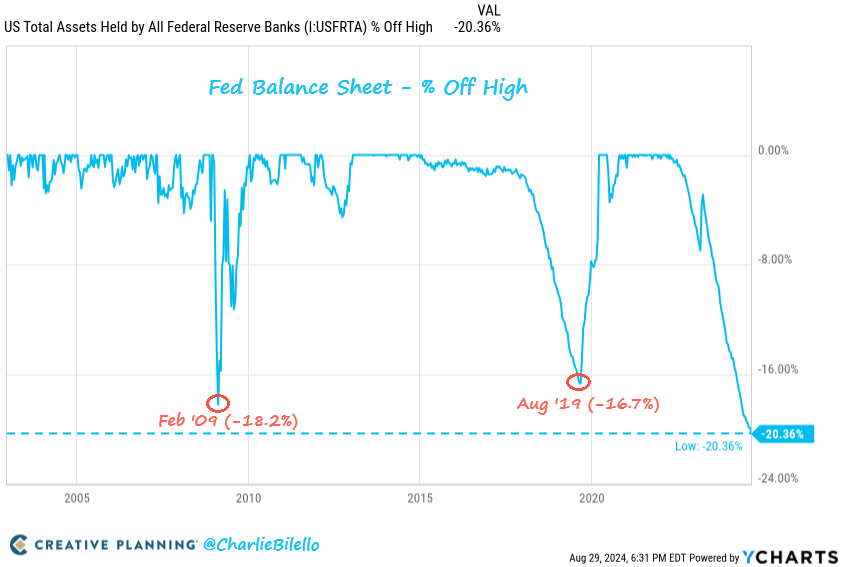
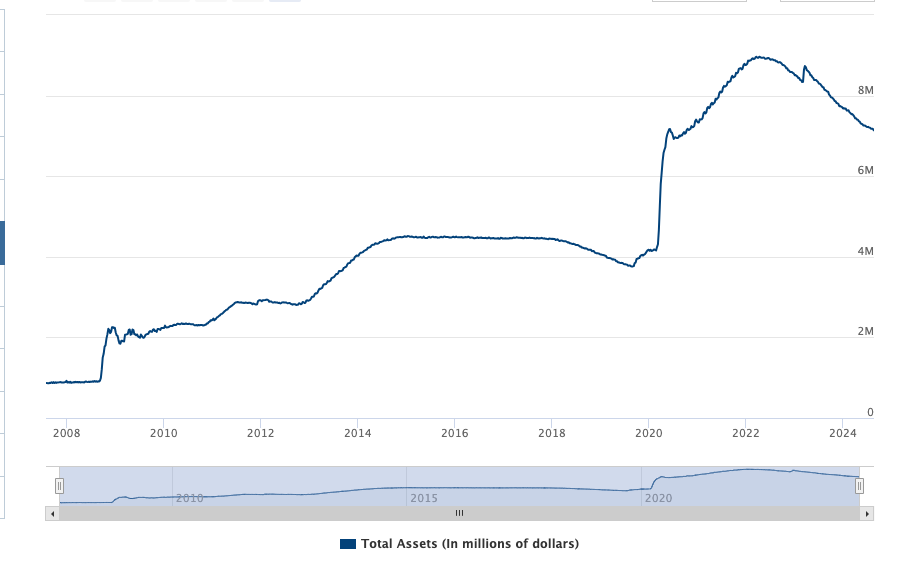
(Mike Maharrey, Money Metals News Service) I ran across a post on X by financial planner Charlie Bilello about the trajectory of the Federal Reserve balance sheet. It pointed out that the balance sheet is 20 percent below its April 2022 peak, “the largest drawdown on record.”
This struck me as a very odd flex, given the context of that drawdown.
To be fair, Bilello didn’t offer any commentary on balance sheet reduction, but I felt like I was supposed to be impressed by the Fed’s efforts.
I’m not.
Why Does the Balance Sheet Matter?
The Federal Reserve’s balance sheet is an important monetary policy tool. The mainstream tends to focus on interest rate policy, but the balance sheet may have an even bigger impact on the money supply and inflation than interest rate manipulation.
Artificially low interest rates drive money supply growth through the expansion of credit. Low rates incentivize borrowing and “stimulate” the economy. Because we have a fractional reserve banking system, banks can loan more money than they have. This results in money supply growth. (By definition inflation.)
Through QE operations, the balance sheet serves as a direct pipeline to the money supply. When the Fed buys assets – primarily U.S. Treasuries and mortgage-backed securities – it does so with money created out of thin air. Those assets increase the balance sheet and the new money gets injected into the economy. QE can boost the money supply with the accompanying inflationary pressures much more quickly than interest rate policy alone.
The Fed didn’t use the balance sheet as a policy tool to any great extent before the 2008 financial crisis. But when the Fed slashed rates to zero and it became clear that the scope of the crises went far beyond the central bank’s ability to control, Ben Bernanke turned to quantitative easing for the first time.
In effect, the Federal Reserve aggressively monetized U.S. debt. In practice, it bought Treasury notes and bonds on the open market with newly “printed” money. This created an artificial demand for U.S. debt, allowing the federal government to borrow more money than it otherwise could have. These bonds became assets on the Fed balance sheet.
At the time, Bernanke emphatically framed QE as an emergency measure. He told Congress that the central bank was not monetizing the debt and was not providing a permanent source of financing for the government. He said the Treasuries would only remain on the Fed’s balance sheet temporarily. He assured Congress that once the crisis was over, the Federal Reserve would sell the bonds it bought during the emergency.
This never happened.
A Broader Look at the Fed Balance Sheet
When you frame the recent balance sheet drawdown (quantitative tightening or QT) in percentage terms as Bilello did in his chart, it creates the impression that the central bank took an aggressive policy stance against inflation. The implication seems to be that it was a bold move by the Fed that could have far-reaching effects.
But when you put balance sheet reduction in the context of balance sheet expansion, it looks more like Powell & Company just spit in the ocean.
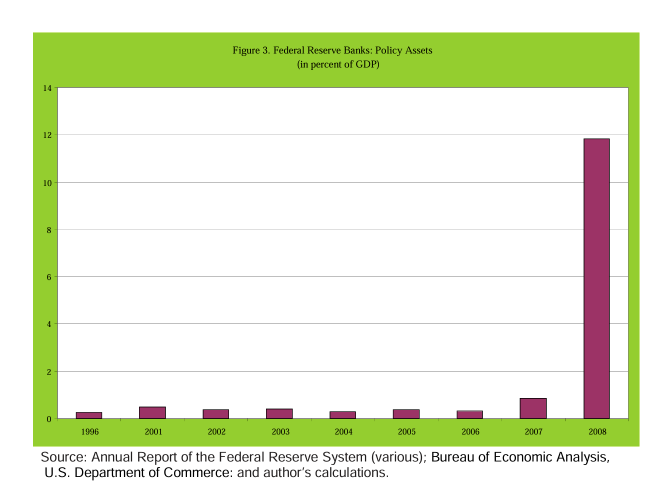
In 1996, the balance sheet stood at just under $500 billion. By August 2008, the Fed balance sheet was just under $910 billion. In 28 years, the balance sheet expanded at a slow steady pace in dollar terms as it kept pace with GDP growth. Through those years, the balance sheet stayed below 1 percent of GDP.
As the International Monetary Fund put it, “Evident in this Figure … is the extremely small FRB role in intermediating credit in the U.S. economy—until 2008.”
In the first round of QE in the wake of the financial crisis beginning in the fall of 2008, the Fed expanded the balance sheet to $2.25 trillion, nearly 12 percent of GDP. In percentage terms, the balance sheet grew by just over 147 percent.
And this was just round one.
There was a small drawdown in the first couple of months of 2009. It’s the first balance sheet reduction noted on Bilello’s chart at 18.25 percent.
But that was something of a feint. Bernanke ramped up the QE machine two more times during the Great Recession. At its peak in early 2015, the balance sheet stood at a staggering (at the time) $4.5 trillion. Between the fall of 2008 and January 2015, the balance sheet expanded by 394.5 percent.
In February 2011, Bernanke said, “Ultimately, at the right time, the Federal Reserve will normalize its balance sheet.”
If “normal” meant back to the pre-Great Recession level and under 1 percent of GDP, that time never came. (And it almost certainly never will.)
The central bank did finally initiate quantitative tightening in early 2018. In the spring, the Fed claimed that balance sheet reduction was “on autopilot.” That lasted about 18 months. When the stock market crashed in the fall of 2018 and the economy got shaky, the Fed panicked. By August 2019, when QT ended, the balance sheet was still at $3.76 trillion.
This is the second drawdown on Bilello’s chart coming in at 16.7 percent.
Remember, the Fed had expanded the balance sheet by nearly 400 percent. This wasn’t “normalization” in any sense of the word, Bernanke’s promises notwithstanding.
The Fed began expanding the balance sheet again even before the pandemic. By the time the pandemic got going, the balance sheet was only about $300 billion below the Great Recession peak.
Once governments started shutting down the economy, quantitative easing went into hyperdrive.
In February 2020 as COVID-19 gripped the world, the balance sheet stood at around $4.2 trillion – 20 percent of GDP. When it was all said and done, the balance sheet had ballooned to just under $9 trillion ($8.95 trillion). That was about 49 percent of GDP.
In the period between the onset of 2008 the financial crisis and the end of the pandemic, the Fed expanded the balance sheet by 889 percent.
The Fed announced its balance sheet reduction in March 2022 after conceding that price inflation wasn’t “transitory.” It wasn’t exactly ambitious. Given the parameters of the plan, it would take 7.8 years just to run off the amount added during the pandemic.
Of course, we’re nowhere near that. Since the pandemic peak, the central bank has run off about $1.76 trillion. As Bilello notes, this represents a 20 percent reduction – an all-time record. That sounds like a lot until you remember that it added almost $5 trillion in just under two years.
But the balance sheet still stands at just over $7.1 trillion — still 680 percent above the pre-2008 financial crisis level.
Now you understand why I’m not impressed.
By the way, in May, the Fed quietly announced that it would begin to taper balance sheet reduction. In other words, they’re about finished with the drawdown.
Maybe someday they’ll get around to fulfilling Bernanke’s promise – when it’s the “right time.”
My guess is that will be never.
Mike Maharrey is a journalist and market analyst for MoneyMetals.com with over a decade of experience in precious metals. He holds a BS in accounting from the University of Kentucky and a BA in journalism from the University of South Florida.
(Mike Gleason, Money Metals News Service) As trading wraps up for the month of August, the gold market is set to record its highest-ever monthly closing price.
Gold defied expectations, in some circles, of a summer slump. The question seems to be how high the monetary metal will go heading into the fall.
Metals markets will have the tailwind of a near-certain Federal Reserve rate cut next month. They may also start reflecting political fear and uncertainty as the November election draws nearer. The threat of a gathering economic storm precipitating a deleveraging event in the financial system also looms as a possibility.
Meanwhile, the white metals have been lagging behind gold throughout the summer. Frankly, they’ve been underperforming gold for years — and in the big picture, for decades.
A major reason why gold is outshining other metals is that it is being accumulated by central banks around the world, led by Russia, China, and others.
The People’s Bank of China reportedly paused its gold purchases earlier this year. At least one keen observer discovered it is nevertheless continuing to accumulate gold without publicly disclosing it.
Data shows large imports continuing to go through the Shanghai Gold Exchange. Whether it’s central bank buying, other institutional orders, or purchases by individual Chinese consumers, China’s appetite for gold remains robust.
Despite gold hitting record highs and commanding some attention in the mainstream financial media, investor demand has yet to really take off. Net assets in exchange-traded funds that track gold prices have barely budged. And buying of retail bullion products has been anything but manic so far this year.
As a result, inventories of coins, rounds, and bars are plentiful, while premiums on popular products remain low at low-cost dealers like Money Metals.
The fact that investor sentiment toward gold remains lukewarm at best suggests that there is still a lot of room for the market to grow to the upside – both in terms of public participation and spot prices.
But of course, the biggest upside potential can be found in the metals that are currently the most undervalued.
Even at roughly $30 per ounce, silver remains well below its previous all-time high near the $50 level. That’s despite the fact that it is seeing rapidly growing sources of industrial demand in photovoltaics and electric vehicles.
Meanwhile, mining supply isn’t growing at all – setting up the prospect of large supply deficits in physical silver. In 2023, the silver market posted a structural deficit of 184 million ounces. That deficit is projected to reach 215 million ounces this year.
Rising silver prices will, in theory, incentivize more production. But the costs of extraction are also rising. And the costs in terms of dollars and time of developing new mines are prohibitive.
S&P Global estimates that it takes an average of 20.8 years worldwide to develop a new gold mine. The time frame is even longer in the United States. It’s also longer for copper, nickel, and other base metals – which often produce silver as a byproduct.
There are few primary silver mines in existence. And since most mined silver is immediately consumed by industry rather than held by central banks or individual investors, above-ground scarcity can quickly turn into a panic-inducing shortage.
When the silver futures market does finally adjust to the reality of a chronic supply deficit, we could see a price spike to new records, and beyond, that makes the magnitude of gold’s current bull run look modest by comparison.
Mike Gleason is a Director with Money Metals Exchange, a national precious metals dealer with over 500,000 customers. Gleason is a hard money advocate and a strong proponent of personal liberty, limited government, and the Austrian School of Economics. A graduate of the University of Florida, Gleason has extensive experience in management, sales, and logistics, as well as precious metals investing. He also puts his longtime broadcasting background to good use, hosting a weekly precious metals podcast since 2011, a program listened to by tens of thousands each week.
(Ken Silva, Headline USA) Democrats, government officials and even many Republicans expressed horror in the wake of the Jan. 6, 2021, Capitol Hill protest—with some going so far as to compare it to Pearl Harbor or the Sept. 11, 2001, terrorist attacks.
But as the events of Jan. 6 were unfolding, at least one top FBI official wasn’t taking them so seriously, according to a newly unearthed DOJ Inspector General’s report obtained by Headline USA. The report, which stems from a sexual misconduct probe into former FBI official Jeffrey Sallet, states that Sallet asked a colleague about her dating habits on Jan. 6.
According to the report, a female FBI employee whose name was redacted stated that she was in Sallet’s office on Jan. 6.
Former FBI Associate Deputy Director Jeffrey Sallet. PHOTO: Ernst & Young
“She looked out the window to see the crowds of people on Pennsylvania Avenue and commented on the large number of people and flags. Sallet allegedly turned to her and said, ‘How many of those guys are you thinking you’d like to date? That’s your type isn’t it?’” the DOJ-OIG report stated.
The DOJ-OIG report said Sallet denied the allegation: “I absolutely did not say that,” he told the inspector general.
However, another unnamed FBI employee told the DOJ-OIG there was “a whole conversation on [THE REDACTED FEMALE COLLEAGUE’S] type.” And yet another employee said the female colleague told her that Sallet made a lot of comments about her dating life, such as who she would date, who did she like, and who she thinks is attractive.
“The evidence shows it is more likely than not that Sallet made comments to [REDACTED] about her dating habits,” the Inspector General concluded.
And here's an even juicier excerpt for the J6ers. Apparently, Sallet wasn't too concerned about the Jan. 6 protests as they unfolded. In fact, he made suggestive comments to a female colleague about dating the MAGA protestors, according to the DOJ-OIG report I've obtained https://t.co/3FWleDs6Rwpic.twitter.com/f9lSUVMsrZ
Sallet was promoted to associate deputy director in February 2021—making him the third highest-ranking official in the bureau—only to leave for the private sector less than a year later.
In January of this year, Headline USA reported on sexual-misconduct allegations against Sallet. But at the time, those allegations were being levied by a former FBI agent who claimed secondhand knowledge. The Justice Department blasted the accusations as “only anonymous hearsay and innuendo,” while Sallet denied any wrongdoing but declined to comment further.
Now, the DOJ-OIG report confirmed that he retired from federal service amidst the sexual-misconduct investigation, which found there was enough evidence substantiate that Sallet’s behavior constituted “harassing conduct.”
In response to the newly unearthed report, Sallet’s attorney, Douglas Brooks, emphasized that his client was not found responsible for sexual harassment. To Brooks’s point, Sallet was found to have violated the DOJ’s “Zero Tolerance Policy,” which does not require that conduct be “severe or pervasive” in order to be deemed actionable.
Instead, the DOJ-OIG blasted Sallet for “unprofessional conduct.”
“Sallet’s conduct constituted ‘Unprofessional Conduct – On Duty’ … [and] seriously call into question Sallet’s judgment regarding appropriate workplace conduct as a senior leader overseeing the human resources operations in a federal law enforcement agency,” the DOJ-OIG report concluded.
For more coverage on the DOJ-OIG report, see here.
(Ken Silva, Headline USA) The FBI’s former third-ranking official, Jeffrey Sallet, apparently has friends in high places—about 41,000 feet in the air, to be specific.
According to a newly unearthed DOJ Inspector General’s report obtained by Headline USA, Sallet bragged to a female colleague about having a Texas oil billionaire friend with a private jet. The heavily redacted report, which investigated sexual-misconduct allegations against Sallet, further states that Sallet invited the female colleague to join his jet-setting billionaire friend’s “harem” in June 2020.
Former FBI Associate Deputy Director Jeffrey Sallet. PHOTO: Ernst & Young
Sallet was promoted to the FBI’s third-highest position in February 2021, only to abruptly leave less than a year later—amidst the DOJ-OIG investigation into his conduct. The DOJ-OIG report found that Sallet didn’t blatantly sexually harass colleagues, but nevertheless found that his lewd remarks constituted “harassing conduct,” and violated the DOJ’s “Zero Tolerance Policy.”
Much of the DOJ-OIG report on Sallet is redacted, but it does detail the time he apparently tried to impress a female colleague by bragging about his billionaire friend in the summer of 2020.
“In June 2020, Sallet was talking about his plans for July Fourth, which included flying to Colorado on the private jet of his Texas oil billionaire friend. [THE REDACTED FEMALE COLLEAGUE] made a comment along the lines of, ‘It must be nice to have really wealthy friends,’” the DOJ-OIG report states.
“In response to [THE FEMALE’S] comment, Sallet allegedly said, ‘If you want me to, I can call him and you can join his harem,’” the report states.
🚨SCOOP🚨I've obtained a previously undisclosed DOJ-OIG report detailing sexual-misconduct allegations against the FBI's former 3rd-highest ranking official, Jeffrey Sallet Here's a particularly interesting excerpt about Sallet's "Texas oil billionaire friend." Sallet invited a… pic.twitter.com/n0sJkN2ou6
When questioned by the DOJ-OIG about his comments, Sallet reportedly said he didn’t recall asking his female colleague to join the billionaire’s harem. Sallet said it was “possible” he made that comment because he has joked before about his friend having a harem.
“According to Sallet, he was part of his friend’s harem. The harem is ‘like an entourage’ of men and women and it had no sexual connotation in Sallet’s mind,” states the DOJ-OIG report, which doesn’t name the billionaire.
A harem is “a group of female animals sharing a single mate,” according to Google.com.
Another FBI official told the DOJ-OIG that he recalled Sallet talking about his billionaire friend with a private jet, but that he didn’t think Sallet would invite anyone to join a harem, other than as a bad joke.
The DOJ-OIG concluded that “the evidence shows it is more likely than not that Sallet told [HIS REDACTED FEMALE COLLEAGUE] he could call his friend so she could join his harem.”
When reached for comment, Sallet’s attorney, Douglas Brooks, emphasized that his client was not found to have sexually harassed anyone. Brooks didn’t comment further.
(Luis Cornelio, Headline USA) Georgia Gov. Brian Kemp could soon remove pro-election integrity members from the Peach State’s election board following their enactment of a rule empowering county election boards to investigate election irregularities.
Kemp has asked Attorney General Christopher Carr whether he has the executive authority to expel members of the board, which includes three experts endorsed by President Donald Trump.
Kemp’s letter to Carr came after Senate Democrats demanded that he expel the members over alleged ethics violations, as reported by the Atlanta Journal-Constitution on Monday.
“Due to uncertainty regarding whether this office has authority to act under Code Section 45-10-4 in response to these complaints, we have sought the Attorney General’s advice regarding the application of the statute to the letters,” Kemp wrote.
In remarks to Fox News, Kemp clarified that the letter also questioned whether the complaints raised by Democrats were “official.” He added, “I really wouldn’t be able to comment too much on that since we’re asking for legal advice.”
The leftist smear campaign targets Georgia Election Board members Janelle King, appointed by the state House in May; Rick Jeffares, appointed by the state Senate in January; and Dr. Janice Johnson, appointed by the Republican Party in March 2023.
The controversy began after this trio approved a rule allowing county election boards to investigate potential irregularities before certifying election results.
Critics argued, without citing specific evidence, that this move aimed to undermine confidence in the election results.
Among the opponents is Georgia Secretary of State Brad Raffensperger, a Republican official who is widely disliked by staunch conservatives and often dubbed a “RINO,” or Republican in Name Only.
“They are a mess,” Raffensperger told USA Today, delivering an ad hominem attack against the board members.
In a press statement released on Aug. 15, Raffensperger accused them of being activists “seeking to impose last-minute changes in election procedures outside of the legislative process undermine voter confidence and burden election workers.”
In contrast, pro-election integrity Republicans celebrated the rule change as a major victory against potential fraud. Former U.S. Sen. Kelly Loeffler remarked, Another big win from the Georgia State Election Board.”
The election rule change, also at the center of a lawsuit filed by the Democratic National Committee, follows Kemp’s reconciliation with Trump over previous disagreements on state election security.
Hardworking people are getting hit in their wallet every single day thanks to this administration.
That’s what this race is about – and our country can’t afford four years of Kamala Harris in the White House. pic.twitter.com/qpAaYO59ch
(Luis Cornelio, Headline USA) The Biden-led DHS has reinstated a controversial parole program that allows up to 30,000 foreigners from Cuba, Haiti, Nicaragua and Venezuela to enter the U.S. without crossing the border illegally.
The Advance Travel Authorizations (ATAs) program had been suspended after an internal report uncovered fraudulent documents, including fake beneficiary profiles and dubious financial records.
A DHS spokesperson told Fox News that the program will not impose additional scrutiny on submitted documents, such as fingerprinting U.S.-based supporters or conducting more thorough criminal and financial background checks.
“DHS is committed to holding accountable individuals who commit fraud or attempt to exploit others for gain,” the spokesperson said. “Any individual found to have committed fraud or other abuse will be referred to law enforcement for potential prosecution.”
#BREAKING DHS is resuming the CHNV parole program after it was paused due to fraud discovered in the sponsorship process—The program allows for 30k migrants from Cuba, Haiti, Nicaragua and Venezuela to fly directly into the county each month.
Dan Stein, president of the Federation for American Immigration Reform—the group that first exposed the fraud—minced no words in his response to the program’s reinstatement.
“DHS has given no indication that they are going to investigate past fraud or move to revoke the parole statuses of those who gained it fraudulently,” Stein said in a statement. “‘What’s done, is done,’ is not an acceptable plan for dealing with past fraud or instilling confidence in the program moving forward.”
The Biden-Harris administration launched the program in October 2022 for Venezuelan nationals but expanded it in January 2023 to include Haitians, Nicaraguans and Cubans.
According to congressional sources cited by Fox News, DHS stopped issuing parole to Venezuelans on July 6 and to other nationalities on July 18 following the discovery of fraud.
Applicants must demonstrate they have U.S.-based sponsors capable of financially supporting their stay while they receive temporary parole protections. Applications can be submitted from their home countries through the USCIS website.
As reported by Fox, FAIR uncovered that 3,218 individuals had posed as the sponsors for a staggering 100,948 applications. This hinted at the existence of massive fraudulent claims.
The program’s weak security, which exposed it to fraud, underscores another failure by the Biden-Harris administration in managing the self-created border crisis.
“The CHNV program was established without congressional authorization and in violation of statutory requirements that parole be granted only on a case-by-case basis for explicit national interest or humanitarian purposes,” Stein said on Aug. 2.
(Headline USA) Vice President Kamala Harris’s campaign has been marked by tension and confusion in recent weeks as it struggles to come up with a cohesive game plan for the Democrat, according to Axios.
Like everything else Harris has been involved in, her campaign staff is apparently a messhttps://t.co/t4dm8CymSE
Harris’s team is largely made up of the vice president’s own aides, Barack Obama alumni, and a few holdovers from Biden’s abandoned campaign. The result is a “Frankenstein”-like campaign, according to six people involved in it.
“The entanglement of these different entities has led to many people feeling a real lack of role clarity,” one source told the outlet.
In particular, Biden’s former staffers said they feel as though they’ve been sidelined by Harris’s aides.
The top “question” in the campaign among staffers is, “‘Who is the first among equals with the vice president?'” a second source said.
“It’s just a mad dash,” someone else explained. “Things are colliding occasionally, but it’s not malicious.”
Harris’s campaign has particularly struggled to nail down its message on policy, with some Biden staffers expressing frustration that they have to defend Harris’s past endorsements of radical leftist policies, such as Medicare for All and her support for a ban on fracking.
They also see some vindication for Biden now that Harris is flipping her position on such issues.
However, in her first sit-down interview since launching her campaign this summer, Harris undermined her campaign’s efforts to distance her from the Democratic Party’s extreme left-wing.
“I think the most important and most significant aspect of my policy perspective and decisions is my values have not changed,” Harris told CNN in a clip of the interview released Thursday.