Religious Leaders Say Trump’s Reelection a Win in War of Angels vs. Demons

(Headline USA) Thousands sang, cheered and prayed as multiple preachers said Donald Trump is God’s favored candidate to defeat the “forces of darkness.”

Attendees stood and recited the “Watchman Decree,” invoking a government that honors God and has “righteous” laws and “biblical” judicial rulings.

“We break every curse against Donald Trump—we break every satanic incantation against his presidency,” stated the host preacher, Hank Kunneman, at the annual Opening the Heavens conference, held in mid-September at the Mid-America Center arena in Council Bluffs.

The conference is one of several of its type around the country this election year, featuring worship and speeches by preachers.

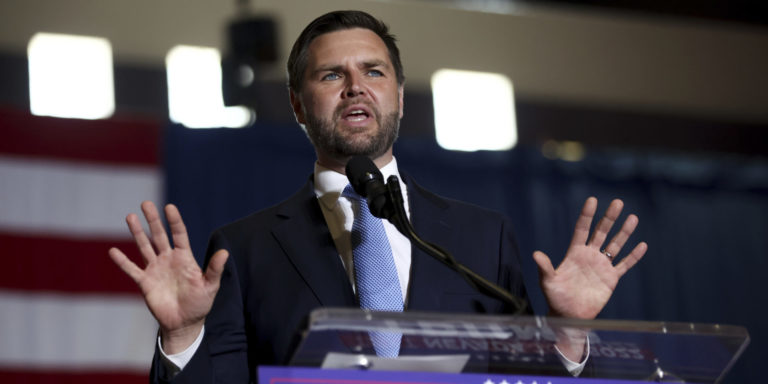
Republican vice presidential nominee JD Vance appeared recently at a similar conference, called the Courage Tour, in Pennsylvania.

Goals for the conference included getting out the vote for Trump and his allies, and mobilizing people to pray.

“Get your butt out there and vote. Get your voice and raise it!” declared Kunneman, who pastors Lord of Hosts Church in nearby Omaha, Nebraska, with his wife, Brenda. “Let every devil fall. … We push back any attempt to steal the executive office.”

Headliners at the Council Bluffs conference repeatedly spoke of being in a true spiritual war.

The “favor of the Lord” is on Trump, said one preacher, Dutch Sheets. “America is going to be saved, and I believe this election is a part of it.”

His brother and fellow preacher, Tim Sheets, recounted seeing a vision of a warrior angel firing an arrow that landed in front of the White House, claiming the territory for God.

“We must move into battle for the Lord,” he said. “The drums of spiritual war are beating.”

Preachers repeatedly denounced abortion and transgender procedures on minors.

With the movement, churches and ministries largely operate independently, even as its leaders speak at each others’ conferences and appear on each others’ broadcasts.

As one example of the overlap: The Opening the Heavens conference in Council Bluffs featured one segment called FlashPoint Live—an in-person version of a television show that mixes Christianity and conservative politics.

It’s one of several such FlashPoint Live conferences this year, hosted by pastor Gene Bailey—whose recently interviewed Trump.

The ReAwaken America tour, started by Trump’s former national security advisor Michael Flynn, has similarly blended the political with revival-like rallies and featured members of Trump’s family.

Separate from the Council Bluffs conference organizers is the Courage Tour. It’s led by Lance Wallnau, who popularized the Seven Mountain concept and was an early booster of Trump’s 2016 candidacy.

Adapted from reporting by the Associated Press
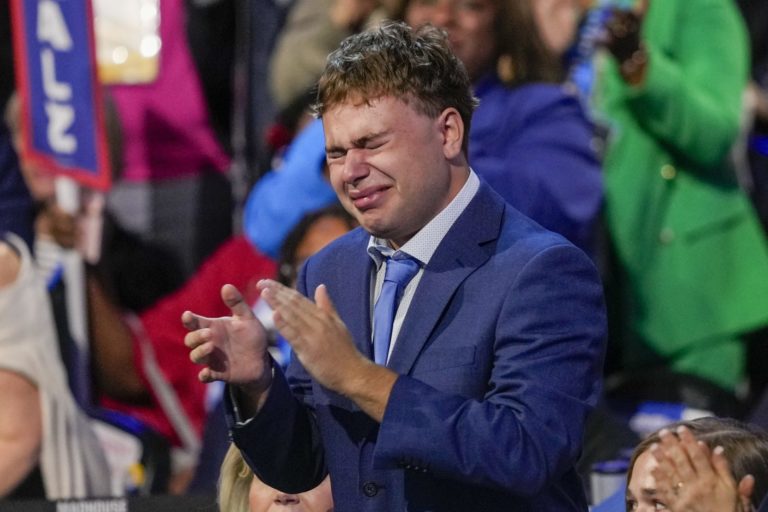
Another Whopper: Coach Reveals Walz’s Special Needs Son Did NOT Witness Shooting

(Headline USA) On Wednesday, volleyball coach David Albornoz admitted during an interview with the Associated Press that Minnesota Gov. Tim Walz’s son, Gus, didn’t actually see a shooting, but only witnessed the aftermath.

The statement contradicted yet another phony “stolen valor” claim from Walz, who faces growing scrutiny over his mischaracterizations and embellishments of his own record on issues including his military service and his presence during the historic Tiananmen Square protests in Hong Kong.

Walz had claimed during the Tuesday night’s vice-presidential debate that Gus Walz, who has special needs, had “witnessed” the shooting.

Gus, 17, was at volleyball practice at the Jimmy Lee Recreation Center in St. Paul the afternoon of Jan. 18, 2023, when a 16-year-old was shot and seriously wounded outside.

Albornoz stated Gus Walz helped other kids to safety and kept them calm inside.

“I was impressed by Gus and the kids in general, and how they handled it,” Albornoz said. “Gus stayed with the kids as he was supposed to do.”

Among other things, he said, Gus saw Albornoz with blood on his hands from performing first aid on the victim.

When the issue of gun violence came up at the vice presidential debate, Tim Walz mentioned that Gus had been at a sports center last year when a shooting took place.

But the Democrat’s remarks Tuesday night at his debate with Republican JD Vance, as the public is still getting to know both vice presidential candidates, offered the biggest stage yet to personalize an issue that has deeply affected many American families.

The shooting came up as Walz and Vance were debating gun violence.

“Well, I think all the parents watching tonight, this is your biggest nightmare,” Walz said. “Look, I’ve got a 17-year-old and he witnessed a shooting at a community center playing volleyball. Those things don’t leave you.”

It wasn’t the first time Tim Walz had spoken about his son’s brush with gun violence.

Walz briefly brought up the shooting at a campaign rally in Grand Rapids, Michigan, on Sept. 12, when he accused Vance and his running mate, former President Donald Trump, of minimizing gun violence at schools.

“My own son was in a location where someone was shot in the head. Too many of us have this,” the governor told the crowd.

Walz also mentioned it in an interview with Minnesota Public Radio in March, when he said Gus was still dealing with his feelings a year later.

“He was there with little kids, littler kids. He was kind of supervising. He shuffled them under the bleachers,” Walz told MPR.

Albornoz broadly backed up the governor’s version, although his memory was that Gus took the kids back to the pool area, where they waited behind locked doors until they got the all clear.

On Tuesday night, after Walz brought up the shooting, Vance expressed his empathy.

“Tim, first of all, I didn’t know that your 17-year-old witnessed a shooting, and I’m sorry about that. Christ, have mercy. It is awful,” Vance said.

“I appreciate that,” Walz replied.

Adapted from reporting by the Associated Press

Money Metals Midweek Memo: The Power of Gold in an Inflationary World

(Money Metals News Service) In the latest episode of the Money Metals Midweek Memo, host Mike Maharrey discusses the current state of the U.S. dollar, the ongoing threat of inflation, and why holding gold and silver remains a vital strategy for preserving wealth.

Maharrey begins with an anecdote from 2019 about Venezuelans using their hyperinflated bolivar notes as napkins, illustrating how fiat currencies can become worthless in extreme inflationary environments.

Although the U.S. dollar’s fate may not mirror that of Venezuela’s, Maharrey emphasizes that hyperinflation is always a possibility when a currency is not backed by anything tangible, like gold or silver.

The episode provides a detailed explanation of fiat currency, describing it as money not pegged to any commodity, such as gold.

Instead, it’s backed solely by the “full faith and credit” of the government. Citing U.S. government debt that exceeds $35 trillion, Maharrey questions the trustworthiness of current political leaders in managing the dollar.

Founding Fathers’ Warnings on Paper Money

Mike Maharrey is not only an analyst for Money Metals Exchange but also a volunteer historian at the Tenth Amendment Center.

Maharrey draws on the wisdom of America’s founding fathers, including Thomas Paine, George Washington, and Thomas Jefferson, all of whom warned of the dangers of unbacked paper money. Their insights remain relevant today as the Federal Reserve continues expanding the money supply through practices like quantitative easing.

As Maharrey highlights, inflation is primarily driven by government money printing, yet many Americans misunderstand the root cause.

A 2019 poll revealed that nearly 30% of respondents believed the U.S. dollar was still backed by gold, while 30% thought it was backed by the U.S. government—indicating widespread confusion about the nature of fiat money.

The Dollar’s Path Since FDR and Nixon

The show touches on significant historical events that severed the dollar’s ties to gold. In the 1930s, President Franklin D. Roosevelt took steps to move away from the gold standard to expand the money supply during the Great Depression. Then in 1971, President Richard Nixon fully severed the dollar’s link to gold. Since that time, the U.S. dollar has lost more than 80% of its value, while gold has increased in value from $35 per ounce to nearly $2,700.

Maharrey stresses that gold remains a reliable store of value because it is not subject to devaluation like fiat currencies. He points out that while other factors can influence gold prices, inflationary pressures have been one of the main reasons behind its rise.

Zimbabwe’s Gold-Backed Currency Experiment

Turning to Zimbabwe’s recent attempt to stabilize its financial system with a gold-backed currency, Maharrey notes that despite introducing the Zimbabwe gold (ZIG) in April 2023, the currency was devalued by 43% within just six months. Zimbabwe’s situation illustrates that a gold peg alone cannot solve inflation if governments cannot resist manipulating their currencies.

Final Thoughts: Why Gold and Silver Matter

Maharrey concludes by encouraging listeners to invest in real money—gold and silver. He warns that governments will always have an incentive to inflate the money supply, leading to the inevitable devaluation of fiat currencies like the dollar.

In contrast, gold and silver have maintained their purchasing power for over 5,000 years and continue to be accumulated by central banks worldwide.

The episode ends with Maharrey urging listeners to call Money Metals Exchange and speak with precious metals specialists to safeguard their wealth with physical gold and silver.

House GOP to Merrick Garland: Don’t Delay Releasing Report on FBI Informants at Jan. 6

(Ken Silva, Headline USA) Rep. Thomas Massie, R-Ky., and other House Judiciary Committee Republicans wrote a letter to Attorney General Merrick Garland on Wednesday, warning him against delaying a forthcoming DOJ Inspector General’s report that will detail the FBI informants and other confidential human sources involved with the Jan. 6, 2021, Capitol Hill uprising.

“We expect that neither you nor anyone at DOJ will prevent Inspector General Horowitz from releasing this report in his preferred manner and on his preferred timeline. As you stated on June 24, you cannot ‘stop [Inspector General Horowitz] from doing what the law requires,’” Massie and the other lawmakers said.

“Accordingly, if you or any of your subordinates, associates, deputies, or agents within the Department act to delay or interfere with the release of this report, Congress will hold you accountable. Thank you for your prompt attention to this matter.”

Massie’s letter to Garland follows him questioning DOJ Inspector General Michael Horowitz about his report at a Sept. 25 congressional hearing.

Massie asked why the report is taking nearly four years to release. Horowitz said he initially commissioned the review immediately after Jan. 6, 2021, but then he had to pause it due to the criminal cases in federal court.

He said he resumed the review last year, and is currently reviewing a draft report. But he said the report wont’ be released before the election because it still must undergo a classification review.

“I doubt it would be done in time for the election. My hope is it’s done before inauguration,” Horowitz said.

When asked about the number of informants involved in Jan. 6, the DOJ Inspector General said he can’t recall—and that he wouldn’t be able to answer in public anyway, since his report hasn’t undergone a classification review.

Horowitz also declined to say whether the informants were reimbursed for their travel to Jan. 6, or whether all the internal informant protocols were followed for the event.

Massie expressed dissatisfaction at Horowitz’s answers, calling for the report to be released before Election Day.

Criminal court proceedings have revealed at least 50 informants that were likely involved with Jan. 6—and possibly far more than that.

Ken Silva is a staff writer at Headline USA. Follow him at x.com/jd_cashless.

Silver Miners Struggle to Keep Up With Demand

(Mike Maharrey, Money Metals News Service) Demand for silver has skyrocketed in recent years, and supply hasn’t been able to keep up.

Silver demand has outstripped supply for three straight years and the Silver Institute projects another market deficit in 2024. This is primarily due to rapidly rising industrial demand, specifically in the solar energy sector.

In 2023, the silver market charted a structural deficit of 184.3 million ounces. The projection is for an even larger supply shortfall this year in the neighborhood of 215 million ounces. This would be the second-largest silver market deficit ever recorded.

Meanwhile, mine output has sagged since peaking in 2016.

This raises an important question: Can silver miners respond and restore the market balance?

There are significant challenges.

According to Metals Focus, silver mine production peaked at 900.1 million ounces in 2016. At the time, the price of silver averaged around $13.30 an ounce. Since 2016, the average price has increased to $20.70 an ounce. Today, the price is well over $31 an ounce.

But mine production has yet to respond to the higher price. Metals Focus projects mine output will come in 62.8 million ounces lower than that 2016 peak, a 7 percent decline.

Metals Focus forecasts that while we will see record silver prices over the next five years, “mine supply growth is likely to remain modest, with only minimal increases globally.”

Why won’t silver production ramp up to meet the demand and take advantage of these higher prices?

Metals Focus blames the price inelasticity on the fact that more than half of silver is mined as a byproduct of base metal operations.

“Although silver can be a significant revenue stream, the economics and production plans of these mines are primarily driven by the markets for copper, lead and zinc. Consequently, even significant increases in silver prices are unlikely to influence production plans that are dependent on other metals.” 

About 28 percent of the silver supply is derived from primary silver mines, where production is more tightly tied to price. But silver mines face their own challenges including declining ore grades and rapidly rising mining costs.

Ore grades have fallen by about 22 percent, meaning the silver price has to rise that much to maintain margins.

Metals Focus summarized the cost challenges facing silver miners.

“Rising production costs have further constrained silver supply. Despite higher silver prices, operating costs in many cases have outpaced revenue growth, leading to little or no improvement in operating cash flow for silver-focused mining companies. Moreover, capital expenditure requirements have continued to rise, with mining cost inflation requiring increasing investment just to maintain current production levels. As a result, many silver miners have been free cash f low negative in recent years.”

If silver prices rise as projected, mines will reach a threshold where higher revenues translate into improved free cash flow.

“At that point, the future of primary silver mine supply will depend on how management allocates capital.”

Even if mining companies allocate significant resources to finding new sources of silver and developing new mines it will take time for production to ramp up and ease the supply shortage. According to Metals Focus, “It is implausible that new production could balance the current deficits over the short to medium term. For those shortfalls to end, we are instead dependent on recycling and demand to react to the forecast price rally.”

For the next few years at least, we will have to depend on drawdowns of above-ground stocks to meet the supply deficit. 

Hungarian Central Bank Announces Increase in Gold Reserves

(Mike Maharrey, Money Metals News Service) The Hungarian National Bank has joined the growing number of central banks globally, increasing their gold reserves. 

In a recent press release, Hungary’s central bank announced it has increased its gold holdings from 94.5 tons to 110 tons this year.

“The increase in the gold reserve was supported by the further strengthening of the global economic, geopolitical, and capital market processes that led to the appreciation of the role of gold in recent years.” 

According to the press release, the Hungarian bank now has the highest gold reserves per capita in Central and Eastern Europe.

The bank’s statement called gold “one of the most important global reserve assets.”

“Amidst the increasing uncertainty characteristic of the world economy as a whole, the function of gold as a safe haven and value preserver is of particular importance because it strengthens trust in the country and supports financial stability.” 

The press release emphasized gold “effectively compliments” reserves even under normal market conditions. When geopolitical and financial uncertainty rises, and the market environment becomes extreme, “the function of gold as a safe haven and value preserver is of particular importance.”

“It can strengthen trust in the country and support financial stability.” 

Hungary began boosting its gold reserves in 2018, tripling its holdings from around 10 tons to 31.5. It increased its gold reserves again in 2021, pushing them to 94.5 tons.

Hungary isn’t the only Eastern European bank interested in gold. Poland was the biggest central bank buyer in the second quarter of 2024 after adding 130 tons to its reserves in 2023.

In 2021, National Bank of Poland Governor Adam Glapiński announced a plan to expand the country’s gold reserves by 100 tons. The central bank reached that goal in September of ’23 and kept buying. 

When he announced the initial plan to expand its gold reserves, Glapiński said holding gold was a matter of financial security and stability.

“Gold will retain its value even when someone cuts off the power to the global financial system, destroying traditional assets based on electronic accounting records. Of course, we do not assume that this will happen. But as the saying goes – forewarned is always insured.

“And the central bank is required to be prepared for even the most unfavorable circumstances. That is why we see a special place for gold in our foreign exchange management process.”

Glapiński also pointed out that “Gold is free from credit risk and cannot be devalued by any country’s economic policy. Besides, it is extremely durable, virtually indestructible.”

Back in 2021, Glapiński also hinted that worry about the U.S. dollar’s stability was driving the decision to increase the country’s gold reserves.

“Gold is characterized by a relatively low correlation with the main asset classes – especially the US dollar dominating the NBP reserve portfolio – which means that including gold in the reserves reduces the financial risk in the process of investing them.”  

Central banks globally added a net 483 tons of gold through the first six months of the year, 5 percent above the record of 460 tons in H1 2023.

Last year, central bank gold buying fell just 45 tons short of 2022’s multi-decade record.

According to the World Gold Council, central banks net gold purchases totaled 1,037 tons in 2023. It was the second straight year central banks added more than 1,000 tons to their total reserves.

Central bank gold buying in 2023 built on the prior record year. Total central bank gold buying in 2022 came in at 1,136 tons. It was the highest level of net purchases on record dating back to 1950, including since the suspension of dollar convertibility into gold in 1971.

China was the biggest buyer in 2023.

Kamala Hosts Hollywood ‘Homecoming’ as Hurricane Victims Go Homeless

0

(Luis Cornelio, Headline USA) Kamala Harris sure is a force to be reckoned with—just ask Hurricane Helene, which couldn’t rain on the vice president’s Hollywood soirée. 

Harris returned to California this weekend for a lavish fundraiser with celebrities and Hollywood executives, just as millions of Americans braced for the destruction of Helene last Thursday.  

The tropical cyclone, which made landfall on Sept. 26, left over 160 people dead, with many others still missing. 

“Oh, it’s good to be home!” Haris reportedly shouted at Sunday’s campaign fundraiser at the JW Marriott in downtown Los Angeles, where she collected over $28 million in donations.

Likely aware of the bad optics, Harris abruptly ended her campaign tour to return to Washington, D.C. on Monday.

While Harris momentarily visited the Federal Emergency Management Agency headquarters earlier this week, she came under fire for dodging the annual hurricane preparedness briefings initiated under the Trump-Pence administration. 

“Harris hasn’t demonstrated the ability — or desire — to do the apolitical parts of the job that have a huge impact on our lives,” a former Pence aide said in an interview with the New York Post. “Why should Americans trust her to start in the Oval Office?” 

Trump held pre-hurricane briefings every year of his administration. President Joe Biden followed suit in 2021, 2022 and 2023. However, Harris was noticeably absent from each one. 

Former acting Homeland Security Secretary Chad Wolf didn’t hold back, condemning Harris for her absence. “It doesn’t seem like she wants to roll up her sleeves and actually get into the governing of the country, which is hard to do. It’s not glamorous. It’s a lot of briefings,” Wolf said. 

“My guess is she would act the very same way [as president], which is hands off — ‘I’m not going to run the country. I’m going to put a team together, and they’ll run it, and I’ll kind of talk about it,’ which is obviously a very different model than what President Trump did,” Wolf added. 

Podcast host Megyn Kelly echoed these sentiments on the Monday episode of her podcast on YouTube. 

“Last night, well into the devastation, the loss of life, men, women, children, pets, the entire devastation and destruction of communities, Kamala Harris attended an L.A. fundraiser,” Kelly said, as reported by Breitbart. “The devastation was ongoing. How dare she!” 

Rep. Anna Paulina Luna’s Opponent Arrested for Making Deadly Threats

(Luis Cornelio, Headline USA) The DOJ charged a former congressional candidate for allegedly threatening to kill Anna Paulina Luna during their Republican primary in 2021. Luna ultimately won both the primary and the general election in 2022. 

Federal prosecutors allege that William Robert Braddock, a former Republican candidate, made several threats against Luna’s life, including during a phone call with one of her friends on June 8, 2021.

In that phone call, Braddock allegedly pledged to summon his “Russian-Ukrainian hit squad” to make the now-congresswoman disappear.

After making the alleged threats, Braddock fled to the Philippines, as alleged by DOJ in a statement on Friday. He was deported to the U.S. and appeared before a judge on Sept. 26. 

The charges are part of Attorney General Merrick Garland’s Election Threats Task Force. It isn’t immediately clear why the DOJ did not prosecute the case three years after the alleged threats occurred.

The arrest comes just weeks after Luna raised concerns that her Democratic challenger in the 2024 cycle was allegedly permitting some of her supporters to issue threats against her on social media.  

The 2021 threats arose from the primary race for the Republican nomination for Florida’s 13th Congressional District, following Democrat Rep. Charlie Crist’s decision not to seek reelection in favor of running for governor. 

According to Politico, Braddock was secretly recorded urging a conservative activist not to support Luna, stating he was prepared to kill her. 

“I really don’t want to have to end anybody’s life for the good of the people of the United States of America,” the unhinged man allegedly said in 2021.  

“That will break my heart. But if it needs to be done, it needs to be done. Luna is a fucking speed bump in the road. She’s a dead squirrel you run over every day when you leave the neighborhood,” he added. 

Pinellas-Pasco prosecutor Kendall Davidson refused to pursue criminal charges against Braddock, citing an alleged lack of probable cause because the threats were not made directly to Luna. 

Federal prosecutors charged Braddock with one count of interstate transmission of a true threat to injure another person. He faces a maximum sentence of five years in prison. 

The DOJ stated that the case is being investigated with the assistance of the St. Petersburg Police Department. 

Politico Can’t Attack J.D. Vance, Attacks His Beard Instead

(Dmytro “Henry” Aleksandrov, Headline USA) The mass media recently reminded everyone once again that if the Left can’t attack someone’s ideas, it will attack the person’s physical appearance instead.

The day after the debate between Sen. J.D. Vance, R-Ohio, and Gov. Tim Walz, D-Minn., leftist news source Politico published an article criticizing Vance’s body language because it was impossible to criticize his ideas.

To not make complete fools out of themselves, leftists who work for Politico even invited Joe Navarro, a body language expert who worked with the FBI, as reported by Breitbart.

“No, I’m not a telepath. I’m a body language expert with over 50 years of experience — 25 of which I spent with the FBI, where I served in the national security division’s elite behavioral analysis program. I’ve used my expertise in the endlessly subtle science of nonverbal communication to help ferret out spies and put away criminals,” Navarro wrote.

In his analysis piece, Navarro stated that Vance’s bear “matters” because beards are synonymous with masculinity, which many people, especially women, find threatening because they “[convey] aggression and opposition to feminist ideals.”

Navarro also mentioned Vance’s precision grip, “little” frown and the politician calling “attention to his heart.”

Additionally, Navarro painted a positive picture of Walz when he mentioned the politician’s body language, such as his wide-open eyes, which could indicate nervousness or fear. Navarro, however, claimed that Walz was just too excited and concerned about the well-being of the United States and its citizens.

Conservatives didn’t fail to use the opportunity to mock the biased body language analysis on Twitter.

“Politico debate analysis: Vance’s beard is sexist, Walz’s bulging eyes are lovely,” @EndWokeness wrote.

Conservative reporter Greg Price also mentioned Politico’s article, writing that it is “pathetic.”

Some people also showed the leftists’ hypocrisy by finding an old article by Politico that stated a beard is a sign of wisdom.

“Politico keeps finding new ways to be more ridiculous,” @Bubblebathgirl wrote.

As previously pointed out, Politico needed to do something like this only because it couldn’t attack Vance’s ideas and rhetoric. Many media propagandists even admitted that Vance won the Tuesday debate.

Biden-Harris Admin. Supports Dockworkers’ Strike

(Dmytro “Henry” Aleksandrov, Headline USA) The Biden–Harris administration recently responded to the dockworkers’ strike by supporting them so that the October surprise would not turn into a potential October disaster for the Democrats, in general, and the Democratic presidential nominee Kamala Harris, in particular.

In her statement, the Biden-Harris administration’s Labor Secretary, Julie Su, praised the workers for “[putting] their health and safety on the line to keep working through the pandemic” while criticizing the port owners for not trying to reach an agreement.

“Over the last week and more, I have spent hours on the phone and in meetings with the parties urging them to find a way to reach a fair contract,” she wrote.

Su then gaslighted Americans by writing that the U.S. economy “has defied all expectations thanks to the Biden-Harris administration’s leadership. She also wrote that workers and companies can negotiate, which Su understands as the companies agreeing to all the workers’ demands.

“The parties need to get back to the negotiating table, and that must begin with these giant shipping magnates acknowledging that if they can make record profits, their workers should share in that economic success,” she wrote.

Harold Daggett, president of the International Longshoremen’s Association, responded to Su’s statement.

“The 85,000 members of the International Longshoremen’s Association (ILA) are grateful for the wisdom, courage and leadership of our Acting U.S. Labor Secretary Julie Su,” he wrote. “Our ILA rank and file members will continue to strike for fair wages and their share of the Foreign Ocean Carriers record billion-dollar profits and we are grateful to have the support of the U.S. Labor Department.”

Harris also supported the strike, with her campaign publishing a statement on Twitter.

“This strike is about fairness,” Harris wrote, adding that the ILA workers “deserve a fair share of these record profits.”

Harris also didn’t miss an opportunity to criticize Donald Trump by claiming that he doesn’t care about workers and only cares about billionaires who gave those workers jobs.

“Donald Trump, on the other hand, wants to pull us back to a time before workers had the freedom to organize,” she wrote. “Donald Trump makes empty promise after empty promise to American workers but never delivers. He thinks our economy should only work for those who own the big skyscrapers, not those who actually build them.”

Headline USA previously reported on Daggett threatening the U.S. government to “cripple” the country if it doesn’t do what he and the union wants.