China’s Secret Gold Buying, U.S. Gold Reserve Transparency, and the Future of BRICS in the Global Gold Market

(Money Metals News Service) In a recent Money Metals podcast, host Mike Maharrey sat down with Jan Nieuwenhuijs, a recognized expert in global gold markets, to discuss his journey into the field and the dynamics of international gold trends, particularly in China.

Here’s a summary of their conversation, which covers Nieuwenhuijs’ unique career path and his expert insights on global central bank gold accumulation, U.S. gold reserves, and BRICS’ potential challenge to the dollar.

(Interview Begins Around 6:16 Mark)

From Sound Engineer to Gold Market Expert

Jan Nieuwenhuijs began his career as a sound engineer in the Dutch film industry but pivoted to economics after the 2009 global financial crisis. The crisis significantly impacted his work, leading him to explore the factors behind economic instability.

His interest in gold was sparked by his understanding of gold’s scarcity and historical track record as a reliable store of value. He began investing in and researching gold, eventually establishing himself as an expert in Chinese gold markets, COMEX, and central bank gold policies.

In 2014, after publishing key insights on China’s gold market, Nieuwenhuijs caught the attention of major bullion dealers and transitioned into professional gold market analysis. His commentary on global gold dynamics, particularly the Chinese gold market, has since earned him recognition as a thought leader in the field.

China’s Secret Gold Accumulation

One key point discussed in the podcast was China’s central bank gold buying strategy. Nieuwenhuijs highlighted China’s geopolitical motive to accumulate gold as a hedge against potential sanctions from the West, similar to those imposed on Russia during the Ukraine conflict. China holds an estimated $3 trillion in foreign exchange reserves, making it vulnerable to international sanctions.

Officially, China claims to hold approximately 2,300 tons of gold, but Nieuwenhuijs believes the true figure is closer to 5,000 tons. He explains that China deliberately underreports its gold holdings to avoid spooking markets, which could drive up prices and hinder its ability to continue purchasing at favorable rates. He also revealed that a significant portion of China’s gold buying is done covertly, a practice shared by other countries like Saudi Arabia. According to Nieuwenhuijs, these secret purchases have skewed official reports by organizations such as the IMF and the World Gold Council.

Nieuwenhuijs estimated that approximately 80% of the gap between reported and actual global central bank gold purchases is due to secret Chinese acquisitions, with 10% attributed to Saudi Arabia.

U.S. Gold Holdings: Transparency Concerns

The conversation also touched on the U.S. gold reserves, which are officially stated to be just over 8,000 tons. However, Nieuwenhuijs pointed out concerns about the transparency and credibility of U.S. gold audits.

While the U.S. regularly audits its gold holdings, the auditing process has been inconsistent, and certain vaults have been opened multiple times, raising questions about the accuracy of these audits.

Despite these irregularities, Nieuwenhuijs stressed that there is no definitive proof that the U.S. gold reserves are lower than reported or that they have been pledged or leased out. However, the lack of transparency continues to fuel speculation and mistrust.

BRICS and the Dollar’s Dominance

The podcast concluded with a discussion on the upcoming BRICS Summit and whether the group poses a credible threat to the U.S. dollar’s global dominance.

While many analysts have speculated about BRICS countries potentially creating an alternative global currency system, Nieuwenhuijs remains skeptical. He argues that while there is clear dissatisfaction with the dollar among BRICS members, the development of a new international currency would take decades, much like the creation of the Euro.

Instead, Nieuwenhuijs finds initiatives like mBridge—a cross-border payment system using central bank digital currencies (CBDCs)—more intriguing. This system involves key players like China, Saudi Arabia, and the United Arab Emirates and offers a viable alternative to the dollar in trade. He noted that while the dollar remains entrenched, particularly due to its liquidity, these initiatives signal growing momentum toward a more multipolar financial world.

Conclusion

Jan Nieuwenhuijs’ insights provide a fascinating look into the mechanics of global gold markets, the geopolitical motivations behind central bank gold buying, and the future of the U.S. dollar. His unique perspective, shaped by years of independent research and a non-traditional path into economics, offers valuable lessons for investors and economists alike.

As geopolitical tensions rise and central banks quietly accumulate gold, Nieuwenhuijs’ analysis highlights the growing importance of gold in the global financial system.

For more in-depth analysis from Jan Nieuwenhuijs, you can read his work on the Money Metals website or follow him on X (formerly Twitter), where he shares regular updates on gold markets and economic trends.

Key Questions & Answers

CHINA BRICS Secret Gold Accumulation Dedollarization Money Metals Exchange

Here are the key questions and answers from the podcast between Mike Maharrey and Jan Nieuwenhuijs:

How did Jan Nieuwenhuijs transition from the movie industry to gold market analysis?

Jan explained that after the 2009 financial crisis, work in the Dutch movie industry dried up, prompting him to explore economics. Fascinated by gold as a scarce resource, he began researching and investing in gold. His first major insight came when he uncovered critical information about the Chinese gold market, which eventually led him to a full-time career in gold market analysis.

Has China really stopped buying gold or just stopped reporting it?

He believes China is continuing to accumulate gold but has chosen not to report it. The official numbers (around 2,300 tons) are likely far lower than the true figure, which he estimates to be around 5,000 tons. China has strong incentives to increase its gold reserves, given its foreign exchange reserves are vulnerable to Western sanctions, similar to what happened to Russia.

What are your thoughts on the U.S. gold holdings and the lack of transparency around audits?

While Jan doesn’t have definitive proof that U.S. gold reserves are lower than reported, he highlighted significant issues with the auditing process, such as vaults being opened multiple times without clear explanations. He suggests that the U.S. gold auditing system lacks credibility, feeding public mistrust and fueling conspiracy theories.

Is BRICS a credible threat to U.S. dollar dominance?

Jan thinks the idea of BRICS replacing the dollar is overstated. Although BRICS has been discussing alternatives to the U.S. dollar since 2009, no concrete progress has been made. He noted that more promising initiatives include projects like mBridge, a CBDC-based payment system among Asian and Middle Eastern nations, which could diminish the dollar’s use in global trade but not immediately replace it.

These questions helped uncover Nieuwenhuijs’ detailed analysis of global gold markets and the evolving geopolitical landscape around gold and currencies.

The Silver Squeeze Has Officially Begun

(Jesse Colombo, Money Metals News Service) For the past several weeks, I’ve been writing about an imminent silver breakout that could quickly push prices to $50. During this time, I’ve observed significant investor cynicism, as many grew frustrated with silver’s sideways movement over the last five months.

I encouraged investors to remain confident, as I believed silver was on the brink of a historic bull market. Sure enough, on Friday, what began as a typical day saw silver surge nearly 7%, meeting the criteria I had outlined to confirm the next phase of its bull market.

Here I will break down the details of silver’s Friday breakout and explain why a powerful silver squeeze has now officially begun.

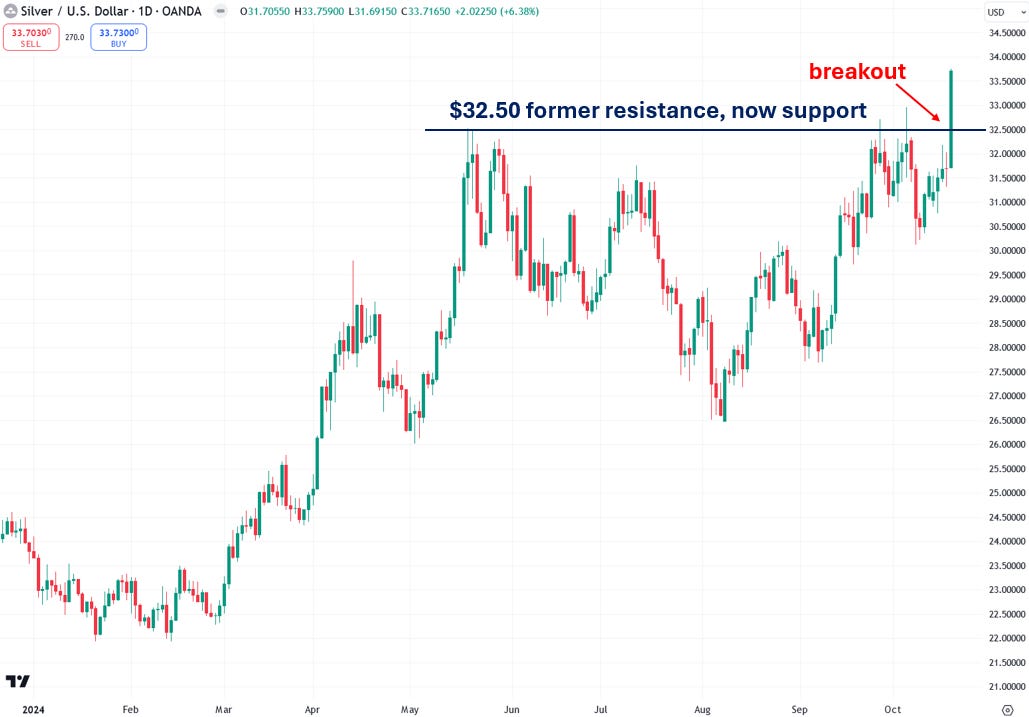
The key criterion I outlined to confirm the next leg of the silver rally was simple yet widely overlooked by investors and surprisingly difficult to achieve: the spot price of silver must decisively close above the $32.50 resistance level, supported by strong trading volume. The $32.50 resistance level was set at the May high, after which silver retreated and stagnated over the summer.

Silver made attempts to break through this level on September 26th and October 4th, but both attempts failed, resulting in further pullbacks. Silver’s impressive $2.02 (6.38%) surge on Friday, accompanied by trading volume more than double the prior week’s average, definitively fulfills that criterion. (A caveat to consider is that if silver closes back below the $32.50 resistance level, it would invalidate Friday’s bullish signal. However, I find that scenario unlikely.)

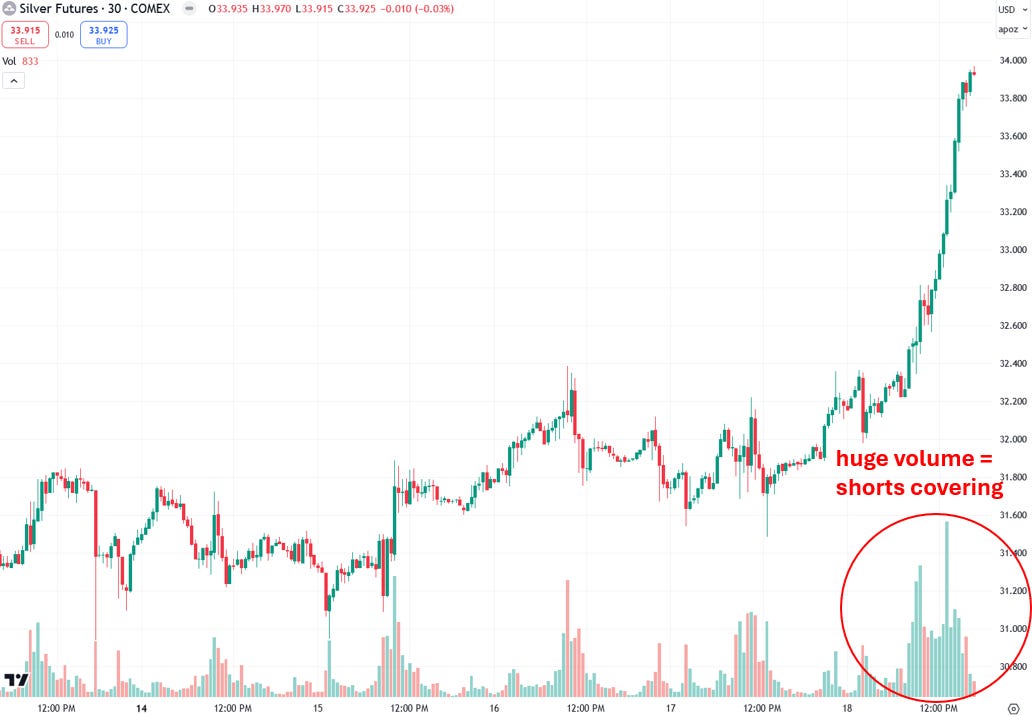
Although Friday’s trading began like any ordinary day, volume surged in the afternoon as it became evident that silver’s breakout above the $32.50 resistance level had staying power.

It’s likely that a good portion of this volume came from traders scrambling to cover their short positions—a topic I’ll explore in greater detail later in this article. The heavy trading volume serves as a crucial confirmation of silver’s breakout, signaling that major institutions or ‘smart money’ are getting on board. This significantly reduces the likelihood that this is a false breakout.

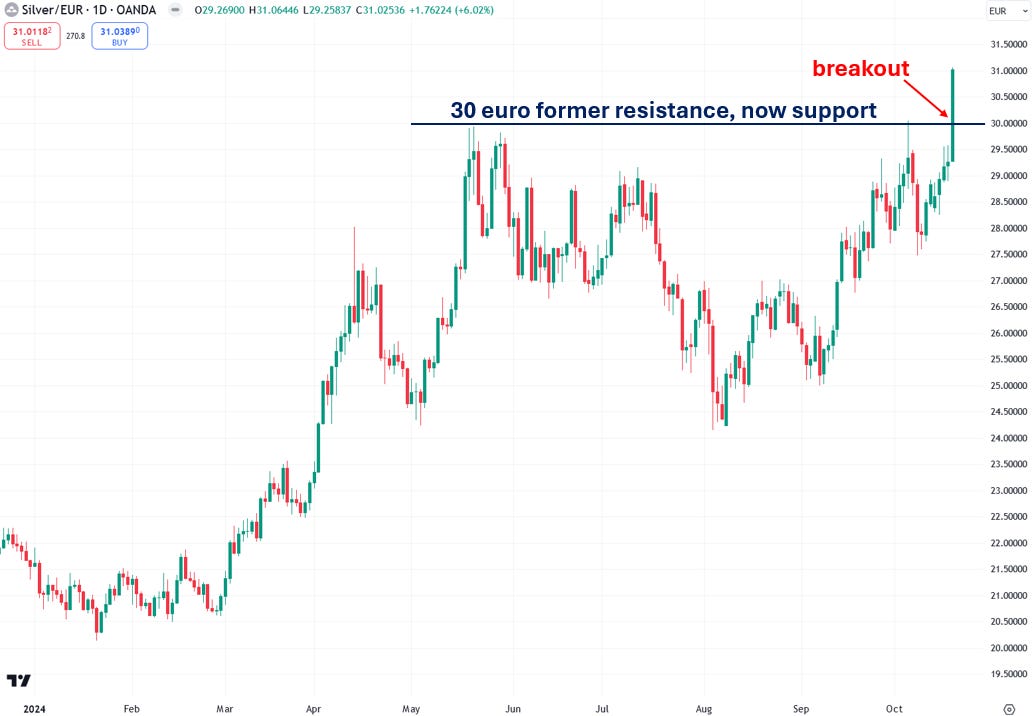
The next condition I outlined was that silver priced in euros must decisively close above the €30 resistance level, which was established at the May peak. I stated that this event would help confirm a close above $32.50, greatly reducing the chances of it being a false breakout.

I find it valuable to analyze silver priced in euros, as this approach removes the impact of U.S. dollar fluctuations, offering a clearer view of silver’s intrinsic strength or weakness. Notably, silver priced in euros often respects round numbers like €26, €27, and €28, frequently establishing key support and resistance levels at these points. On Friday, silver finally broke through the €30 level with such momentum that it even closed above €31, signaling the strong potential for further gains in the coming week.

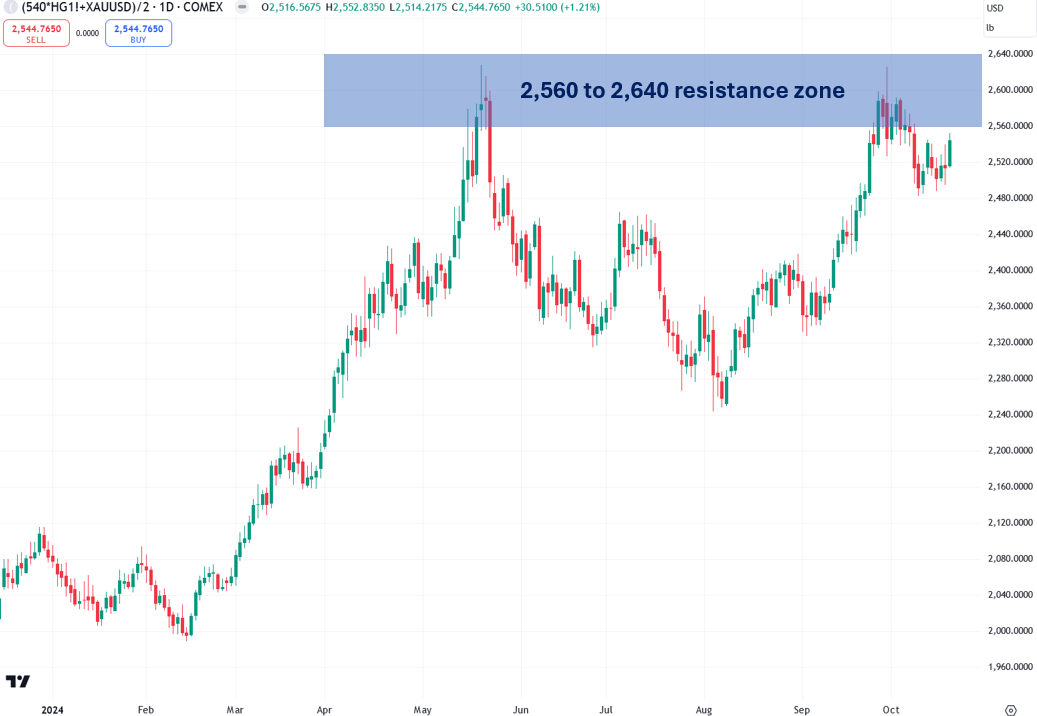
The final condition I listed is more esoteric, but I believe it will significantly reduce the likelihood of a silver breakout being a false one: an index I developed, called the Synthetic Silver Price Index, must close above its key resistance zone between 2,560 and 2,640. This index represents the average of gold and copper prices, with copper’s price adjusted by a factor of 540 to prevent gold’s higher price from disproportionately influencing the index.

The price of copper is an often overlooked factor in silver’s performance and rivals the influence of gold. The index closely mirrors silver’s price movements, yet surprisingly, silver’s price itself isn’t even an input!

Although the Synthetic Silver Price Index didn’t break out on Friday, it still posted a solid 1.21% gain. Given the sheer strength of silver’s breakout, I’m choosing to overlook this criterion for now.

I expect a breakout in the index is still forthcoming, which will further validate silver’s rally and likely provide additional momentum to its current upward trajectory. The index didn’t break out primarily due to copper’s weakness over the past few weeks. However, with a rebound in copper likely soon (as I’ll explain shortly), this should help the index break out in the near future.

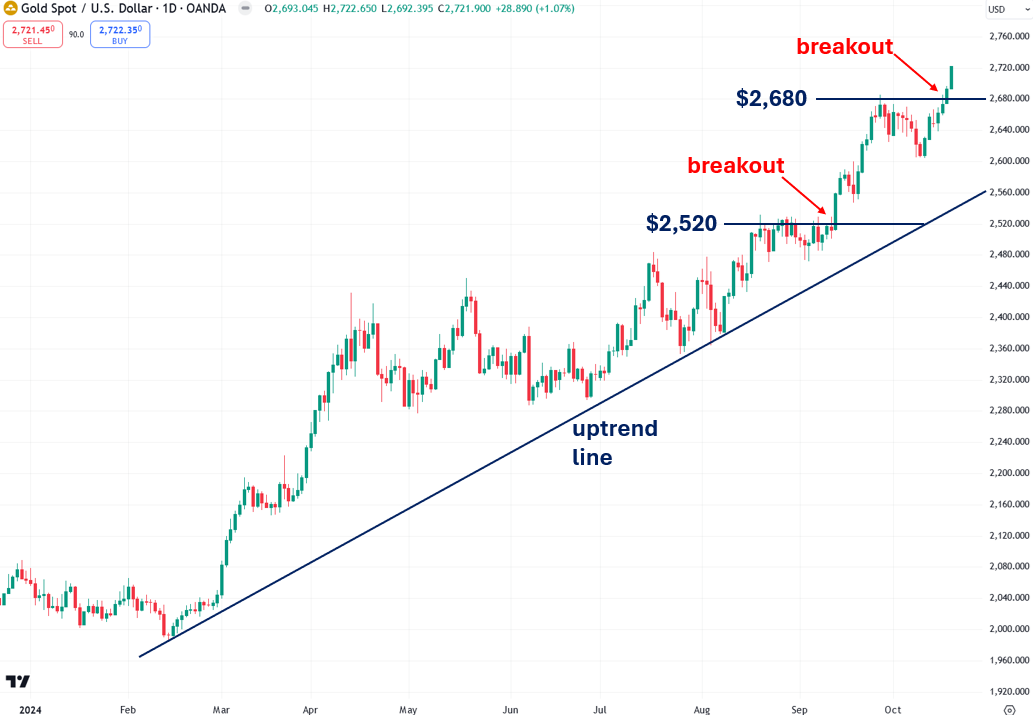
Gold, a major driver of silver prices, is generating a strong tailwind for silver after breaking through two key resistance levels since September. By every measure, gold is in a confirmed uptrend, and I believe it’s on track to reach $3,000 in the near future.

This momentum should continue to bolster silver’s rally. While gold reaching $3,000 might be a bit far-fetched, it’s actually quite realistic, as it’s just over a 10% increase from today’s price.

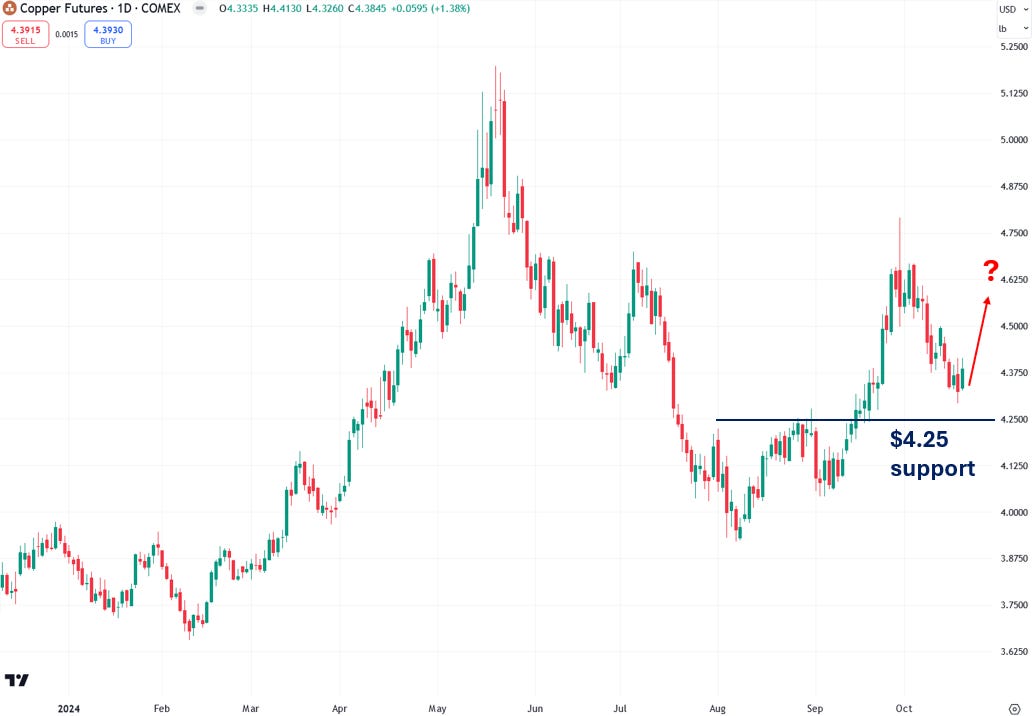
The price of copper is often an underappreciated factor in silver’s performance. Copper’s recent decline has weighed on silver, but there is a strong likelihood that it will find support around the $4.25 level and bounce from there. This rebound should provide an extra boost to silver’s nascent rally.

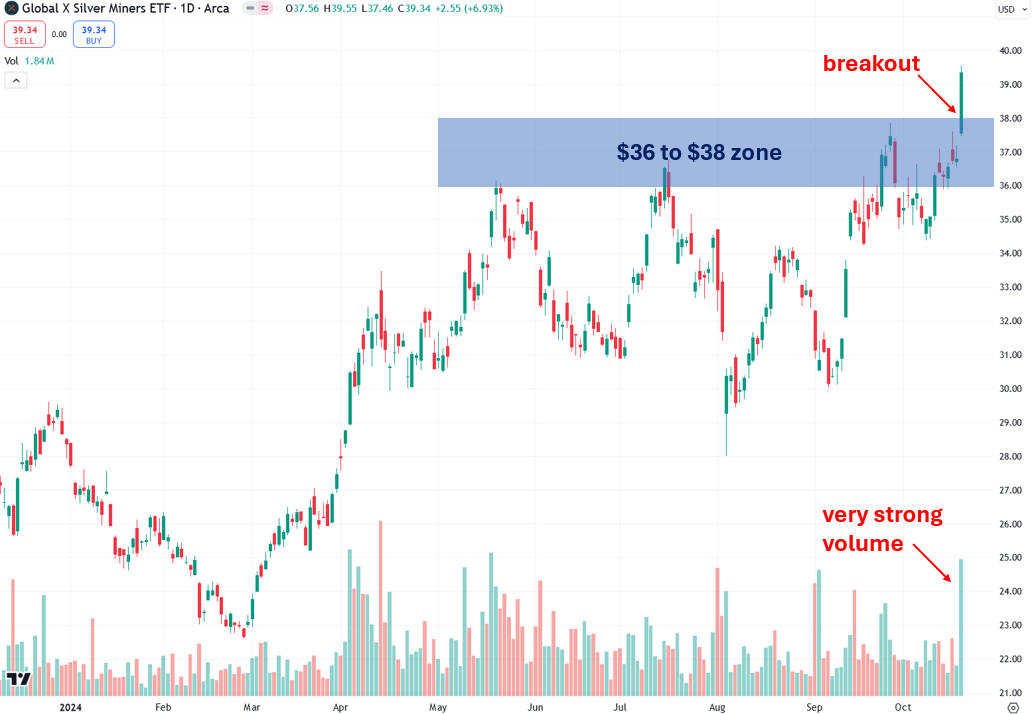
Silver mining stocks are also important to watch for confirming silver’s price movements, as they often mirror investor sentiment toward the metal. The Global X Silver Miners ETF (symbol: SIL), the most heavily traded silver mining stock ETF, had been stuck in a flat range since April.

I’ve been stating that a strong, high-volume close above the $36 to $38 resistance zone would indicate that both silver and silver mining stocks are primed for a major breakout—and that’s exactly what occurred on Friday. I believe that those who were lamenting the poor performance of silver mining stocks will soon be singing a different tune!

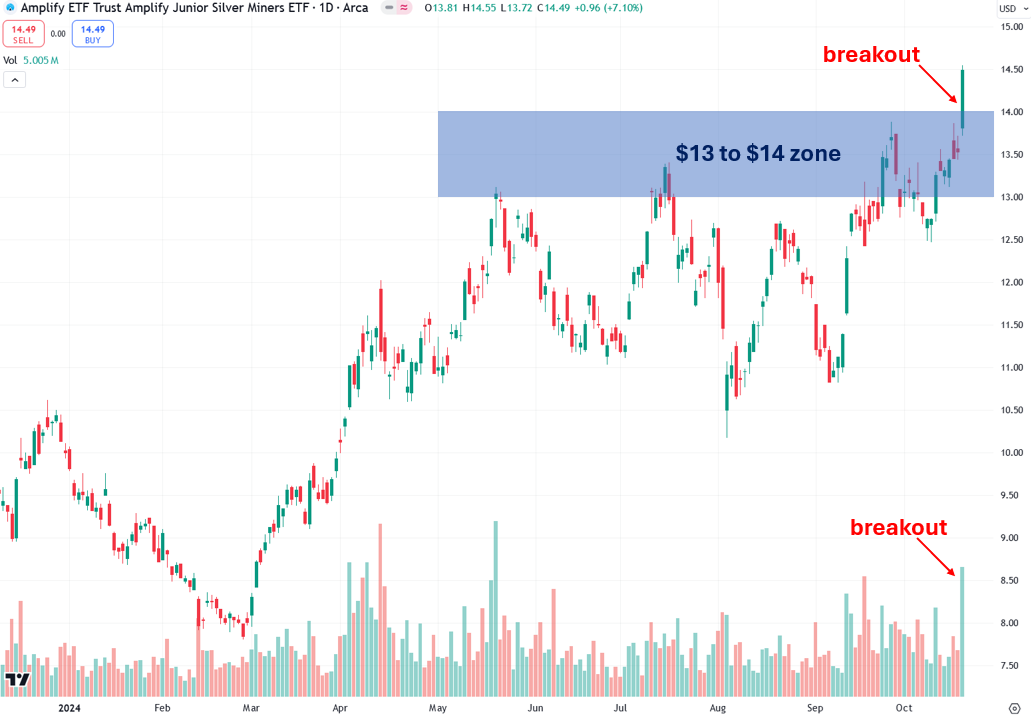
Similarly, the Amplify Junior Silver Miners ETF (symbol: SILJ)—a key proxy for junior silver mining shares—broke above its $13 to $14 resistance zone:

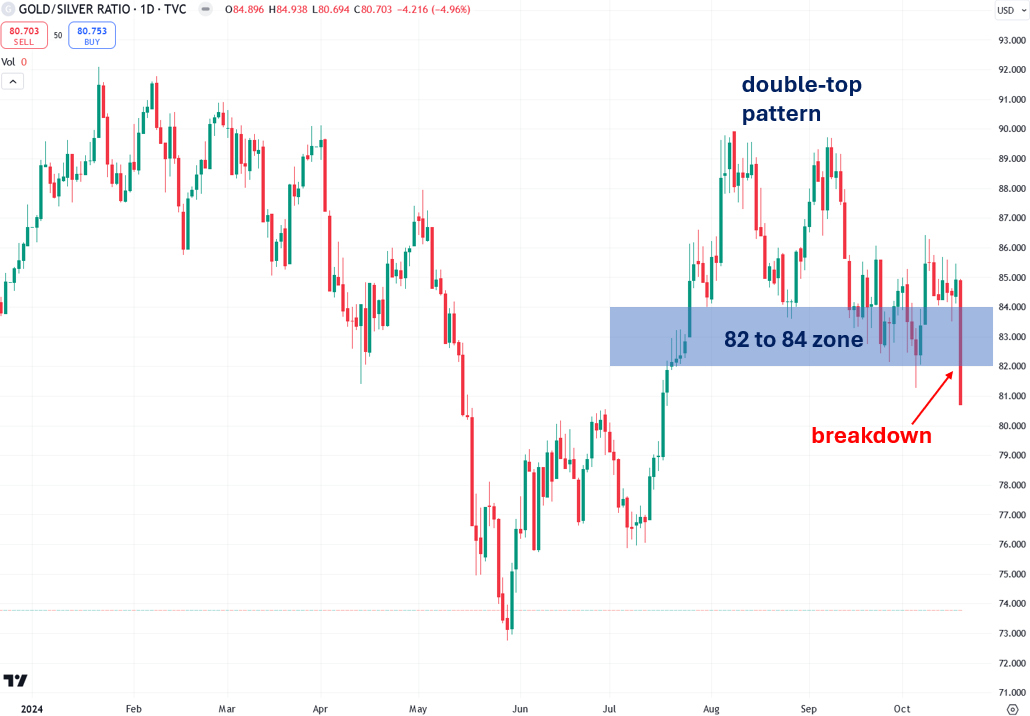
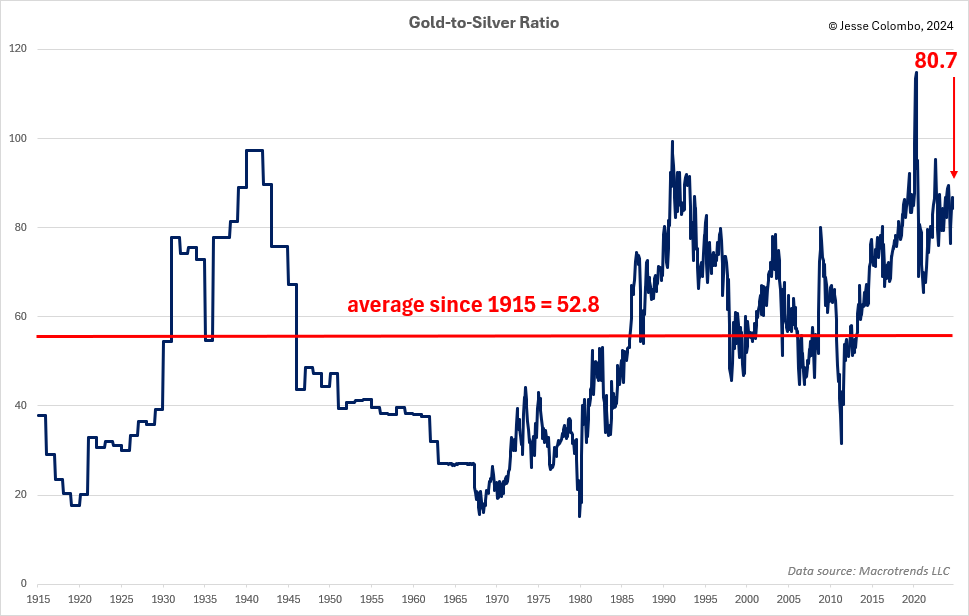
Another key confirmation I’ve been watching for is a breakdown in the gold-to-silver ratio, a useful indicator for assessing silver’s price trajectory.

As I stated, a close below the 83 to 84 support zone is valuable for confirming the start of a silver rally and its outperformance over gold—and that’s exactly what happened on Friday:

The long-term gold-to-silver ratio chart reveals that silver is currently significantly undervalued compared to gold, indicating that silver has much more room to rise in order to catch up.

If the ratio were to revert to its historical average of 52.8 since 1915, even without any increase in gold’s price, silver would be valued at a respectable $51.55 per ounce.

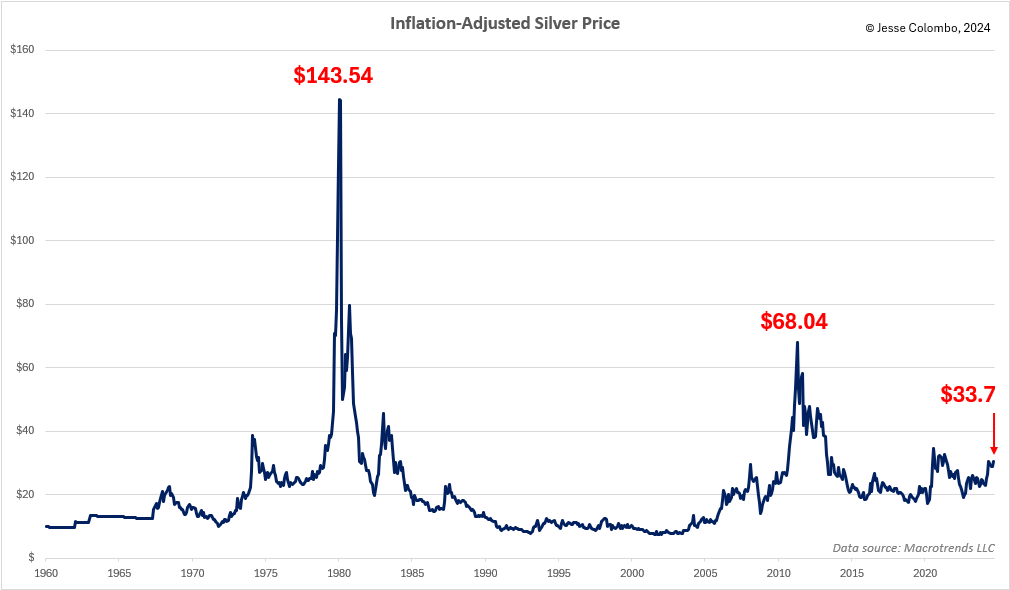
Adjusting silver’s price for inflation further highlights how undervalued it is by historical standards. During the Hunt brothers-induced spike in 1980, silver reached an inflation-adjusted price of $143.54. In the 2011 bull market, driven by quantitative easing, it hit $68.04. Currently trading at just $33.70, silver has significant room to rise if it’s to catch up with these previous inflation-adjusted peaks.

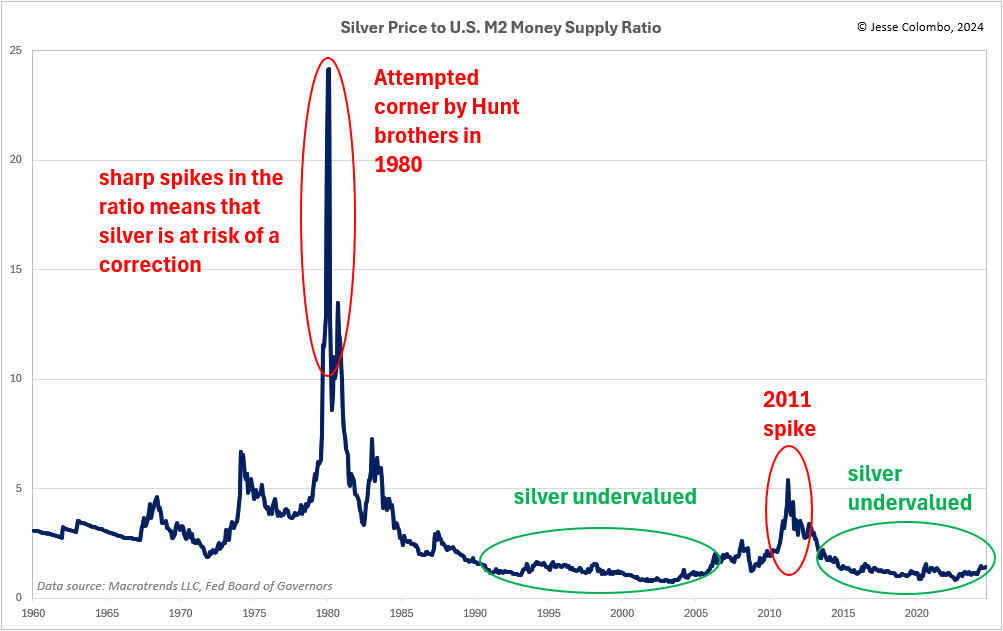
Another way to assess whether silver is undervalued or overvalued is by comparing it to various money supply measures. The chart below shows the ratio of silver’s price to the U.S. M2 money supply, providing insight into whether silver is keeping pace with, outpacing, or lagging behind money supply growth. If silver’s price significantly outpaces money supply growth, the likelihood of a strong correction increases.

Conversely, if silver lags behind money supply growth, it suggests a potential period of strength ahead. Since the mid-2010s, silver has slightly lagged behind M2 growth, which, combined with other factors discussed in this piece, positions it for a strong rally.

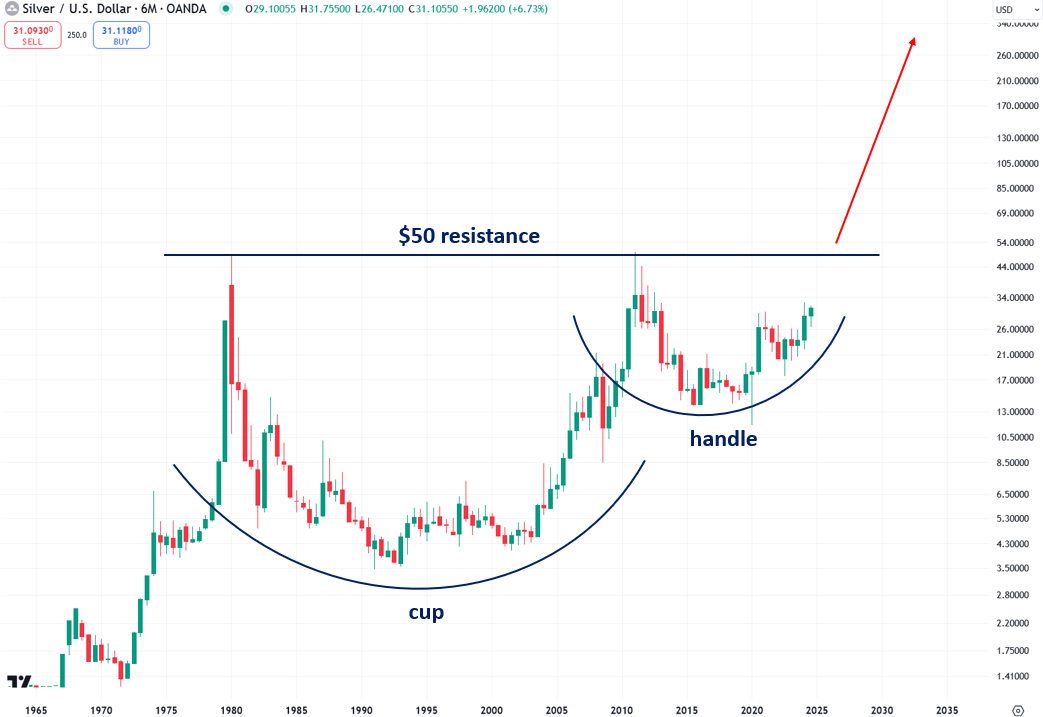
There is a high probability that silver will quickly run to $50 in the course of this rally. I’m focusing on $50 as a relatively short-term target because it’s a significant psychological level and the peak reached during both the 1980 and 2011 rallies.

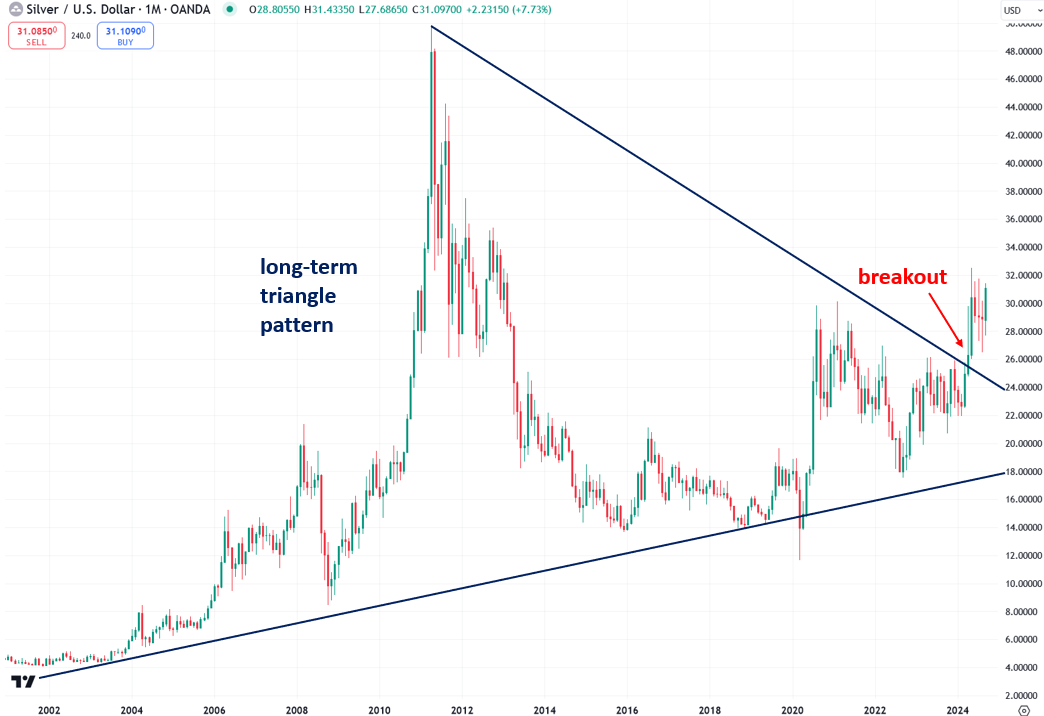
One of the reasons why I’m so bullish on silver is because its monthly chart reveals a recent breakout from a massive, two-decade-long triangle pattern. This breakout confirms that silver is on the verge of a powerful bull market:

Even more exciting is the fact that silver’s logarithmic chart, dating back to the 1960s, reveals a cup-and-handle pattern, indicating the potential for silver to reach several hundred dollars per ounce during this bull market. In order to confirm this particular scenario, silver needs to close decisively above the $50 resistance level.

Earlier in this article, I mentioned that a significant portion of Friday’s silver buying volume was likely driven by short-covering. Short-covering happens when traders who have bet against an asset, like silver, through short-selling are forced to buy it back as the price rallies, in order to limit their losses.

As the asset’s price rises, these traders become increasingly desperate to buy it back to close their positions, which in turn fuels the rally even further. If the buying is aggressive enough, this can lead to a short squeeze, amplifying the upward momentum.

A key condition for a short squeeze is the presence of unusually heavy short positioning in the asset.

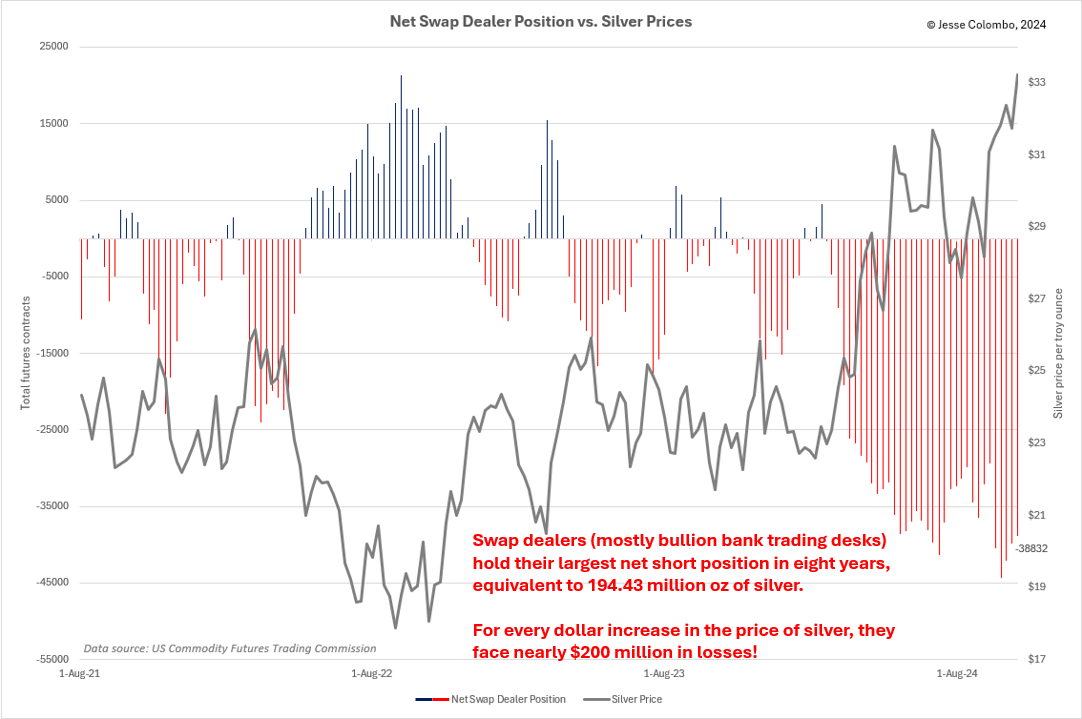
This is currently the case in COMEX silver futures, where swap dealers—mainly bullion bank trading desks—hold their largest net short position in eight years, totaling 38,832 contracts. This is equivalent to 194.43 million ounces of silver, or roughly 23% of the annual global silver production—a staggering figure.

Many analysts believe that bullion banks like JPMorgan and UBS are engaging in aggressive naked short-selling—dumping silver futures without actually holding the physical silver to back them up—in an effort to manipulate silver prices downward. There is a strong chance that these banks will end up on the wrong side of the trade as this rally continues, triggering a powerful silver short squeeze.

Given the current size of their short position, bullion banks face nearly $200 million in losses for every dollar increase in the price of silver. This means they lost nearly $400 million on Friday alone! Now, just imagine what will happen as silver climbs by $5, $10, $20, and beyond from this point.

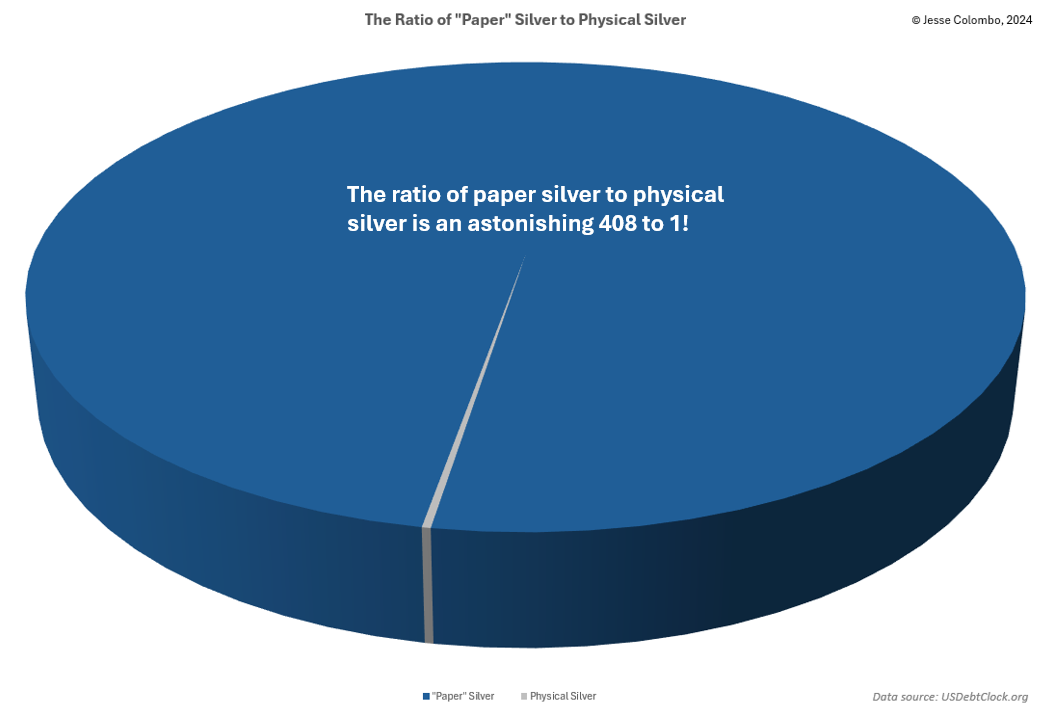
The risk of an explosive silver short squeeze is further amplified by the astonishing ratio of 408 ounces of “paper” silver—ETFs, futures, and other derivatives—for every single ounce of physical silver.

In a violent short squeeze, holders of “paper” silver could be forced to scramble for the extremely scarce physical silver to fulfill their contractual obligations. This would cause the price of “paper” silver products to collapse, while physical silver prices would skyrocket to jaw-dropping levels, potentially reaching several hundred dollars per ounce (this event is what may fulfill the price target implied by the cup and handle pattern I showed earlier).

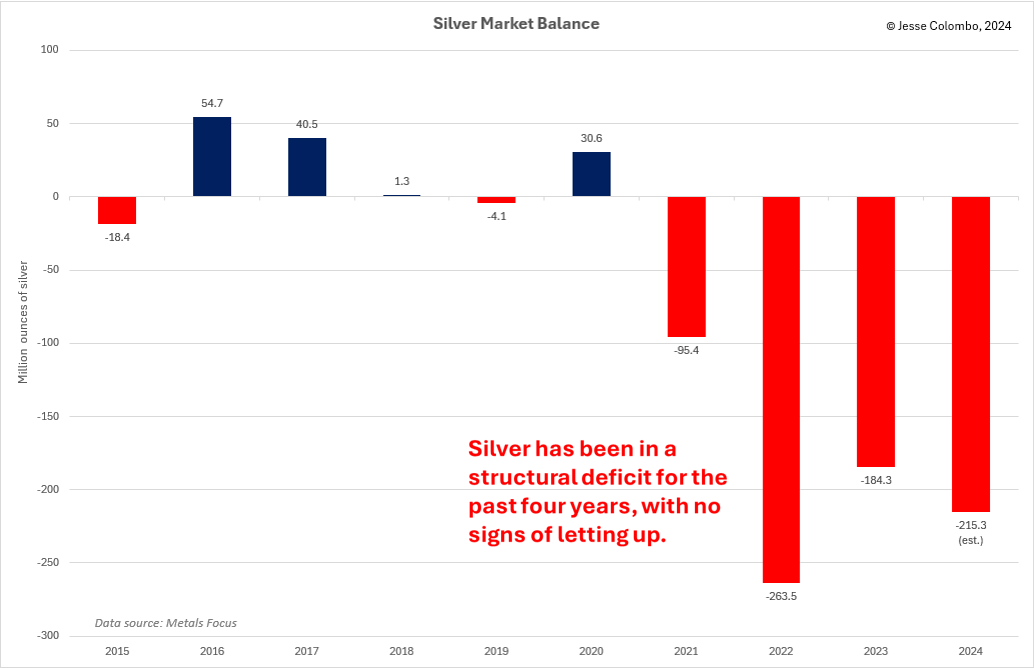
As if the technical outlook weren’t already bullish enough, silver’s fundamentals are just as compelling. Surging industrial demand, coupled with declining global mine production, has kept silver in a structural deficit for the past four years—and there’s no sign of relief on the horizon.

In 2023, the deficit reached 184.3 million ounces, with an even larger shortfall of 215.3 million troy ounces projected for 2024. The silver deficit in recent years has rapidly depleted above-ground supplies, tightening supply even further. This shrinking supply will intensify the impending silver short squeeze, driving an even more dramatic price surge.

Silver’s breakout on Friday marks a pivotal moment in its ongoing bull market, confirming many of the key conditions I’ve been highlighting for weeks. With silver decisively closing above the critical $32.50 resistance level and surging on high volume, the stage is set for a powerful rally. The technical and fundamental drivers behind silver are aligning, from the breakdown in the gold-to-silver ratio to surging demand and shrinking supply.

The looming threat of a short squeeze, combined with silver’s structural deficit, suggests that the price could climb significantly higher, potentially reaching levels not seen in decades. As silver continues its upward trajectory, the potential for explosive gains has never been clearer.

Gold’s Long-Term Returns Are Better Than You Probably Thought!

(Mike Maharrey, Money Metals Exchange) Gold’s long-term return is greater than conventional wisdom might lead you to believe.

Traditional analysis of gold’s returns leaves out important factors. Models considering these elements reveal much better returns over time that far outpace the inflation rate.

Gold is typically viewed as a store of value. Over time, investors expect its price to keep pace with inflation. Using traditional models, we find gold’s returns are tightly correlated with the general price level as measured by the consumer price index (CPI).

Using this assumption, the long-term expected return for gold generally ranges between zero and 1 percent.

However, analysis by the World Gold Council concluded that there are two common features in existing research and forecast models that “mischaracterize gold and have led to biased conclusions.”

First, nearly all models use data from periods with a gold standard. Second, existing models tend to tend to view long-term price dynamics almost exclusively through the lens of demand from financial markets while ignoring other sources of demand.

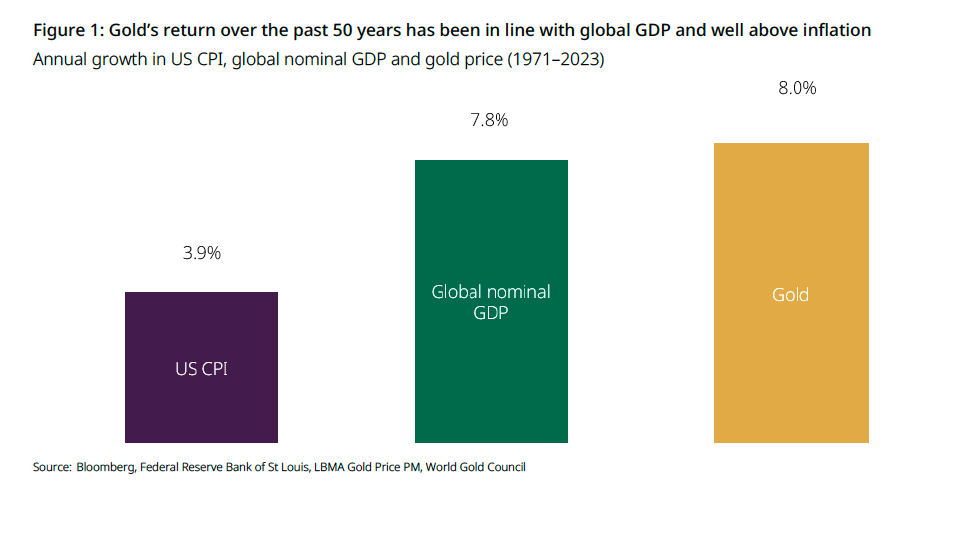
Utilizing an approach that accounts for these two factors, the World Gold Council shows that gold’s long-run real return has been well above inflation for over 50 years and that it tends to mirror global GDP.

Using the World Gold Council formula, we find that between 1971 and 2023, gold’s annual return has been around 8 percent.

The Gold Standard Problem

One of the problems in analyzing and projecting long-term gold returns is using data from the gold standard era. As the World Gold Council points out, typically, more historical data is better than less. Capital market assumptions used in analyzing stocks and bonds typically stretch back to 1900.

But when analyzing gold prices, the longer timeline skews the data because, for most of the 20th century, the price of gold was set by central banks. Up until President Richard Nixon closed the Gold Window in 1971, the conversion rate for gold was $35 per ounce, as set by the Bretton Woods Agreement.

As the World Gold Council pointed out, “While its historical performance during Gold Standard periods is an interesting reference, it is truly its market structure and behavior post-1971 that matters most.”

“By way of an example, to value a company and assess its expected return, one needs to apply the analysis to the business it will be rather than to the business it has been. If the two are materially different, then past is not prologue.”

To avoid the gold standard muddying the water, the World Gold Council uses 1971 as a starting date instead of earlier dates used by most other analyses.

Investment Bias

The second issue that tends to muddy the analysis of the long-term performance of gold is that models generally assume financial investment almost exclusively drives demand, ignoring other important demand factors.

Of course, financial investment is one of the primary short-term price drivers, but the World Gold Council asserts that other sources of buying are more significant over the long term.

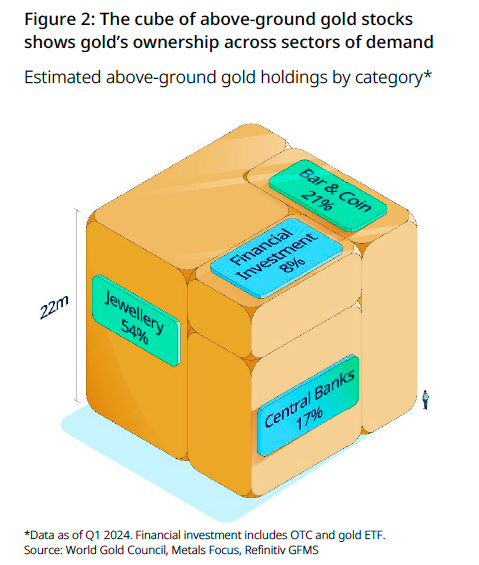
The WGC illustrated this by creating a gold “cube” representing the existing above-ground stock of gold, noting that it would occupy a space barely larger than three Olympic swimming pools.

As you can see, financial investment makes up a relatively small percentage of demand in relation to existing gold stocks.

“It reveals how little financial investment – (referring here to physically backed gold ETFs and over-the-counter [OTC] physical holdings) has been amassed by market participants over the years in relation to other sources of demand – a misleading statistic given the vast volumes of gold that flow through financial centers every day. That so much of this hypothetical cube is not owned via financial instruments implies that any explanation of its total distribution must consider factors beyond those solely linked to the day-to-day decisions of financial market participants.”

A Better Model to Project Gold Returns

Ultimately, two distinct components drive the gold the gold price.

  • An economic component
  • A financial component

Traditional analysts overstate the financial component.

To correct this bias, the World Gold Council created a model that proxies both the economic and financial components driving the gold price.

“Our economic component proxy is global nominal GDP in US dollars. Nominal GDP comprises real GDP, an inflation component (the GDP deflator), and a currency component – used to convert local GDP to US dollars. This captures the flow of capital from income to gold. Our financial component is proxied using the capitalization of global equity and bond markets – the global portfolio – in US dollars. It captures the investments available for investors to reallocate income and wealth.”

Using these assumptions, the number crunchers at the World Gold Council created a mathematical formula. It’s a bit complex for the scope of this article, but if you want to dig into the details, you can read the entire WGC report.

The bottom line is that using this revised model, the World Gold Council finds gold’s returns have been much better over the last 50 years than mainstream analysis suggests – averaging 8 percent annually.

The same model predicts an annual average return of 5.2 percent for the next 15 years.

“This is lower than the historical return we’ve observed, largely down to a lower expected growth in global GDP. However, all asset returns are likely to be impacted. For example, estimates for intermediate U.S. Treasury bonds and World government bonds over the same period are 3.9 percent and 4.8 percent, respectively. And U.S. large-cap stocks are expected to grow at a 7 percent annual rate – below their 20-year return.”

The World Gold Council concludes, “In our view, any model that fails to account for economic growth alongside financial factors will prove insufficient in establishing gold’s long-term expected return.”

Of course, past performance does not guarantee future results. Dynamics could change. And this isn’t to say that if global GDP tanks, gold’s returns will as well. In an economic meltdown, the investment aspect of gold demand would likely become a bigger driver. But this kind of historical analysis does provide a good framework to help understand gold’s performance over time. And it reveals that gold’s real returns are better than the mainstream would have you believe.

Mike Johnson Calls Out Jake Tapper’s Mouthy Obsession w/ Male Genitalia

(Luis Cornelio, Headline USA) House Speaker Mike Johnson scolded Jake Tapper after the CNN anchor made a series of bafflingly and hypocritical questions about President Donald Trump’s comments in recent speeches. 

On the Sunday episode of State of the Union, Johnson called out Tapper for his obsessive focus on a Trump anecdote about late golf legend Arnold Palmer’s well-endowed penis at a rally in Latrobe, Pennsylvania (Palmer’s hometown). 

Tapper couldn’t resist, jumping straight into the topic and asking Johnson if the Palmer comment signaled a cognitive decline in Trump.

“Why is he talking about Arnold Palmer’s penis in front of Pennsylvania voters?” Tapper asked Johnson.

In a witty and dismissive retort, Johnson responded, “Jake, you seem to like that line a lot.” 

“I don’t want to be talking about, right Donald Trump is out there saying it,” Tapper, clearly agitated, interrupted. 

Johnson remained unbothered, adding, “But you continue to. Let’s talk—let’s talk because you won’t…wait a minute.” 

“You won’t address it,” Tapper insisted. 

Johnson continued his answer by contrasting Trump’s speeches, which span personal anecdotes and foreign and domestic policies, with the incoherent and gaffe-prone remarks by outgoing President Joe Biden. 

Earlier in the interview, Tapper initially invoked in an attempt to claim that Republicans would be outraged if Biden had made a similar comment. 

Conveniently, Tapper overlooked past vulgarities and lewd attacks from Democrats. 

Vice President Kamala Harris’s running mate, Tim Walz, once joked about a fake rumor that JD Vance, Trump’s running mate, had sex with a couch.

Several Democrat speakers, including Sen. Elizabeth Warren, repeated this sleazy jab during the Democratic National Convention. 

Not to be outdone, former President Barack Obama poked fun at Trump’s manhood, comparing it to crowd sizes during

U.S. House Committee Launches Investigation into Alleged Misuse of FEMA Money

(Bethany Blankley, The Center Square) Republican members of the U.S. House Committee on Homeland Security have launched an investigation into the alleged misuse of Federal Emergency Management Agency funds by Department of Homeland Security Secretary Alejandro Mayorkas.

DHS, which has oversight of FEMA, has directed that billions of dollars of FEMA funds be used to pay for food, housing, transportation and other services for illegal border crossers.

FEMA in recent years also has prioritized diversity, equity and inclusion (DEI) initiatives, The Center Square reported.

The committee is demanding answers from Mayorkas after on Oct. 2 he said FEMA “does not have the funds, to make it through the [hurricane] season.”

Mayorkas made the remarks after the Category 4 Hurricane Helene made landfall on Sept. 26 and proceeded to cause destruction for 500 miles, causing an estimated $47.5 billion in damages in 16 states, excluding loss of life. Helene particularly devastated portions of the states of Georgia, North Carolina, South Carolina and Tennessee. Hurricane Milton, a category 3 hurricane, next hit Florida on Oct. 8, causing up to $2.5 billion in agricultural damages alone, according to state estimates.

At an Oct. 11 press conference, Mayorkas said more than $350 million in FEMA assistance was distributed to help Helene survivors, “with millions more going out every day.”

By Oct. 16, the White House announced the Biden-Harris administration had approved more than $1.8 billion in assistance for hurricane recovery efforts, with more than $911 million in already approved assistance for Helene survivors. Nearly 8,000 federal personnel “remain on the ground working side-by-side with state and local officials to help survivors with recovery and rebuilding,” the White House said.

House committee Republicans said in a letter to Mayorkas that any FEMA “funding shortfall is extremely disconcerting” because Americans impacted by the deadly hurricanes “face dire circumstances while the Biden-Harris administration may have unwisely and irresponsibly focused funding requests for other FEMA activities.” They also said Congress had met or exceeded appropriation requests for FEMA’s Disaster Relief Fund, with $61.2 billion allocated in fiscal years 2023 and 2024.

Scrutiny comes after in fiscal years 2023 and 2024, FEMA disbursed more than $1.4 billion of taxpayer money through grants to states, local governments and nongovernmental organizations to pay for services for illegal border crossers through its Emergency Food and Shelter Program-Humanitarian Program and Shelter and Services Program.

Congress created the EFSP in 1983, later authorized it under a 1987 homeless assistance act, and has funded it since fiscal 1995, according to the Congressional Research Service. Funds are supposed to be prioritized to help the homeless, unemployed and more recently have been prioritized for “communities most affected by the influx of migrants,” CRS says.

Under the Trump administration, Congress set aside $25 million, 83.3%, of the EFSP funding through supplemental appropriation for southern border state local recipient organizations (LROs).

A March 2023 DHS Inspector General report found that under the Biden-Harris administration, the LROs were not always using the most recent batch of $110 million in funds they received as intended by statute. The LROs “did not always provide the required receipts or documentation for claimed reimbursements” and “were unable to provide supporting documentation” for how the money was spent, the Office of the Inspector General found.

By statute, six private nonprofit organizations govern the allocation of EFSP funds: the American Red Cross, Catholic Charities U.S.A., the Council of Jewish Federations, Inc., the National Council of Churches of Christ in the U.S.A., the Salvation Army, and the United Way of America, CRS notes.

Congress continues to fund DHS and FEMA programs, including in the latest Sept. 26 continuing resolution, allocating $20 billion to FEMA’s Disaster Relief Fund. A recent FEMA advisory states that doing so enabled it to “begin processing obligations of approximately $9 billion for over 3,000 paused projects” to help “communities, schools, and hospitals across the nation recover from and mitigate against disasters.”

“Due to the uncertainty of receiving additional funding, and if current spending rates hold, the agency projects it will reimplement INF before the end of the calendar year,” FEMA said. It’s referring to Immediate Needs Funding restrictions it put in place “to preserve critical resources necessary for lifesaving and life sustaining activities against a rapidly depleting Disaster Relief Fund balance.”

In the most recent omnibus passed by Congress, “roughly $650 million was directed away from U.S. Customs and Border Protection to FEMA to fund the SSP,” the committee says.

“In last year’s supplemental spending request alone, which House Republicans roundly rejected, the Biden-Harris administration asked for $1.4 billion in new funds for the SSP,” the committee said.

The committee gave Mayorkas a deadline of Oct. 25 to provide information it requested related to FEMA disaster recovery efforts, including the EFSP and SSP.

Authorities Investigating Catastrophic Failure of Dock Gangway that Collapsed, Killing 7

(Headline USA) Georgia authorities said Sunday they are investigating the catastrophic failure of a dock gangway that collapsed and killed seven on Sapelo Island, where crowds had gathered for a fall celebration.

“It is a structural failure. There should be very, very little maintenance to an aluminum gangway like that, but we’ll see what the investigation unfolds,” Georgia Department of Natural Resources Commissioner Walter Rabon said at a news conference.

The gangway was installed in 2021, authorities said.

Rabon said three people remained hospitalized in critical condition from Saturday’s collapse.

Rabon said “upwards of 40 people” were on the gangway when the “catastrophic failure” occurred, and at least 20 people fell into the water. The gangway connected an outer dock where people board the ferry to another dock onshore.

None of the seven people killed were residents of the island, Rabon said. Eight people were taken to hospitals, at least six of them were initially reported Saturday to have critical injuries.

The ferry dock was rebuilt after Georgia officials in October 2020 settled a federal lawsuit by residents of the tiny community of Hogg Hummock, who complained the state-operated ferry boats and docks they rely upon to travel between Sapelo Island the mainland failed to meet federal accessibility standards for people with disabilities.

The state agreed to demolish and replace outdated docks while upgrading ferry boats to accommodate people in wheelchairs and those with impaired hearing. The state also paid a cash settlement of $750,000.

Crews from the U.S. Coast Guard, the McIntosh County Fire Department, the Georgia Department of Natural Resources and others searched the water, according to Natural Resources spokesperson Tyler Jones. The agency operates the dock and ferry boats that transport people between the island and the mainland.

A team of engineers and construction specialists were on site early Sunday to begin investigating why the walkway failed, Jones said.

“There was no collision” with a boat or anything else, Jones said. “The thing just collapsed. We don’t know why.”

Helicopters and boats with side-scanning sonar were used in the search, according to a Department of Natural Resources statement.

Among the dead was a chaplain for the state agency, Jones said.

President Joe Biden said federal officials were ready to provide any assistance needed.

Sapelo Island is about 60 miles south of Savannah, reachable from the mainland by boat.

The deadly collapse happened as island residents, family members and tourists gathered for Cultural Day, an annual fall event spotlighting Hogg Hummock, home to a few dozen Black residents. The community of dirt roads and modest homes was founded after the Civil War by former slaves from the cotton plantation of Thomas Spalding.

Adapted from reporting by the Associated Press

Voters Overwhelmingly Say Schools Should Not Keep Student Gender Transitions Hidden

(Brendan Clarey, The Center Square) The overwhelming majority of Americans do not believe schools should hide a student’s gender change at school from parents, according to a recent poll of over 2,200 likely voters.

The issue of parental notification regarding a student’s gender transition has been hotly contested in recent years, especially in California, where the state has sided against school districts that have passed policies to let parents know students are using different names or pronouns.

The Center Square’s Voter Voice Poll, conducted by Noble Predictive Insights, surveyed a nationally representative sample of more than 1,000 Democrats, 1,000 Republicans and almost 200 true independents.

The poll shows that almost three-quarters, 71%, of likely voters said a teacher should notify parents if their students say they want to go by a different gender.

David Byler, chief of research at Noble Predictive Insights, told The Center Square that the poll’s findings are “robust.”

“Pollsters have asked this in a lot of different ways in a lot of different states with a lot of different response options, and this is a durable finding,” Byler said. “If a student changes how they identify in terms of their gender at school, parents should know. That’s what the electorate thinks.”

“The electorate thinks parents have the right to know if something as major as a gender identity change is happening at school,” Byler said. “They want to be involved in their children’s lives and the rest of the public thinks they should be involved in their children’s lives.”

Byler said the poll’s findings were consistent across identity characteristics.

“In terms of demographics, you’ll notice that when you get numbers these lopsided, you don’t get many individual demographics that really disagree, it’s everybody basically agreeing to one extent or another.”

Eighty-six percent of Republicans said they supported parental notification of a student’s gender change, while 8% said parents shouldn’t get to know; 68% of true independents said teachers should have to tell parents, and 17% said they should not.

A majority of Democrats, 55%, said they supported parents knowing about such changes, with 28% of party voters opposed. The only demographic with higher opposition was 18-34-year-olds, 34% of whom said teachers should not tell.

“It’s only the far part of the progressive wing that would say no here,” Byler said. “And everybody else is saying if kids change their identity or their pronouns, that the parents have to know.”

Byler said Republicans are using their advantage on the issue with voters approaching the November election.

“There’s a lot of messaging around trans issues,” Byler said. “If you look at the ads the candidates are running, you see that Republicans are running towards all the issues related to trans students in schools and Democrats high-tailing it away from those issues or publicly moderating or denouncing the far-left’s stances. It’s polls like these that explain why.”

“Public opinion is on the conservative side of this issue when it comes to how to handle the specifics of how trans issues play out in schools,” Byler said.

Kamala Harris Affirms Palestinian Genocide Claims Are ‘Real’

(Luis Cornelio, Headline USA) Vice President Kamala Harris concurred with a pro-Palestinian heckler’s claims that Israel is committing genocide in the Gaza Strip, signaling support for the radical far-left’s rhetoric on the Middle East unrest. 

The heckler interrupted Harris’s speech at the University of Wisconsin-Milwaukee on Thursday, shouting, “Billions of dollars funding genocide! Billions of dollars funding genocide!” as he recorded the disruption. 

Appearing annoyed by the interruption, Harris responded, “You know what? I respect your right to speak. I’m speaking right now. I know what you’re speaking of.” 

The heckler persisted, asking, “What is it? … What about the genocide?”  

Harris replied, “I want the ceasefire. I want the war to end, and I respect your right to speak but I am speaking right now.” 

The man continued walking toward Harris as he was being escorted, whining she “was not speaking about genocide right now.” 

He added, “What about genocide? Billions of dollars! 42,000 people dead. 19,000 children are dead. 19,000 children are dead and you won’t call it a genocide.” 

A separate video captured Harris affirming that the grievances raised by the heckler were “real.” 

“So, listen—what he’s talking about is real, so, that’s not the subject that I came to discuss here but it’s real and I respect his voice,” Harris said.

Harris appeared to validate the disputed narrative from leftist groups about what is transpiring in the Gaza Strip, where Israel is engaged in military operations against Hamas, a foreign terrorist organization. 

Israel responded by entering Gaza to purportedly eliminate Hamas and rescue the hostages—but instead they’ve killed thousands of women and children.  

Estimates of how many civilians have died in Gaza remain contested. Watchdog groups claim that over 41,000 people have died because of Israel’s military operations. According to antiwar.com, 99 American healthcare workers who have volunteered in Gaza recently estimated in an open letter to Biden and Harris that “over 118,00 Palestinians have been killed in Gaza over the past year, a toll that includes indirect deaths caused by the Israeli siege, such as starvation and disease.”

Despite Harris’s sympathetic remarks towards Palestine, she continues to endorse sending billions of dollars in aid to Israel.

Nikki Haley May Join Trump Campaign Trail in Final Days Before Election

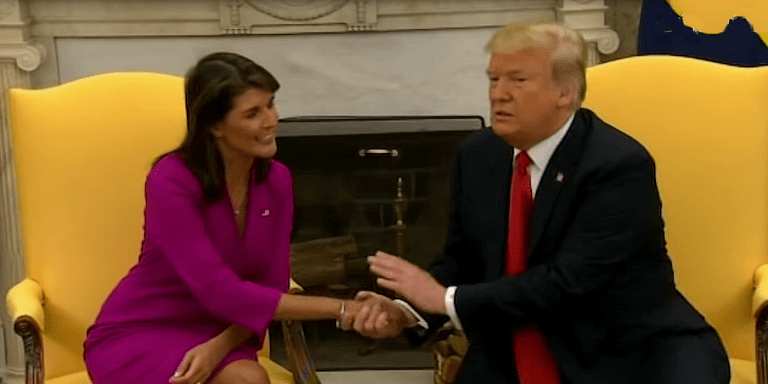
(Luis Cornelio, Headline USA) Nikki Haley, the former Republican presidential candidate and former UN Ambassador, may be considering joining President Donald Trump on the campaign trail just weeks before the November presidential election. 

The Trump campaign is reportedly in talks with Haley to discuss strategies to boost Trump’s support among Republican voters, The Bulwark reported Thursday.

One possibility being floated is a town hall event featuring Haley and Trump, potentially airing on Fox News.

“Trump and his campaign are also keenly aware that Vice President Kamala Harris’s campaign has taken steps to court Haley voters,” the outlet reported. 

“The vice president’s team launched Republicans for Harris two months ago, it has hired a National Republican Engagement Director, and on Wednesday, it showcased the support of more than a hundred Republicans at an event in Pennsylvania,” The Bulwark added. 

These discussions follow Haley’s recent endorsement of Trump, despite her running against him in the 2024 Republican primaries. 

“I’ll start by making one thing perfectly clear, Donald Trump has my strong endorsement, period. Our country is at a critical moment,” Haley said in a speech at the Republican National Convention in July. “We have a choice to make.”

This endorsement came after Trump hinted that Haley could potentially join his team “in some form.” 

While some MAGA backers welcomed Haley’s endorsement as a sign of unity, others remain cautious about the prospect of Haley playing a larger role in a possible second Trump administration.

Among other anti-MAGA positions, Haley has endorsed escalating U.S. involvement in the wars in Ukraine and the Middle East, removing caps on American corporations hiring foreign workers, and removing anonymity from the internet.


Haley’s foreign policy positions often differ from the America First stance that dominates the MAGA movement and Trump’s second-term agenda. 

Despite those differences, Trump appointed her as his ambassador to the U.N., a position she held from January 2017 through December 2018. 

Haley currently hosts a podcast on SiriusXM and serves as chair of national security and foreign policy at the Hudson Institute. 

Gov’t Incompetence on Display w/ Border Patrol Video of 14 Agents Passing 1 Log

(Luis Cornelio, Headline USA) The Biden-Harris administration released a video boasting of its disaster recovery efforts, but many were baffled as the video seemed to expose an inefficient cleanup process. 

U.S. Customs and Border Patrol posted a clip showing 14 agents passing to each other what appeared to be a tree log several dozen feet, all in part of the agency’s effort to clear debris from a backyard. 

“The safety of the American people is our top priority,” CBP captioned the video on X, garnering over 21.9 million views.

Critics quickly noticed the apparent waste of federal tax dollars for a task that a contractor or two workers could have handled 

Tech mogul Vivek Ramaswamy was among the critics: “This video is an artistic depiction of how government agencies work: mostly good-hearted individual Americans, working in a badly over-bloated bureaucracy, that inevitably costs way more than the benefit it produces,” he wrote. 

Daily Wire podcast host Matt Walsh shared similar remarks, writing, “I can’t imagine a better illustration of government inefficiency than this video.” 

“My favorite is the guy on the left, whose job is apparently to stand and observe the log chain,” he added, referring to an agent who did not receive the log. 

Twitter page “Amuse” echoed these sentiments, writing, “The people are good but the leadership is rotten. Why are border patrol workers not on the border dealing with that particular humanitarian crisis?” 

One user suggested a single person could load a dozen logs into a wheelbarrow and transport them to the curb. 

Trending Politics co-founder Collin Rugg estimated the effort cost taxpayers $1 million.

“Elon wasn’t kidding. There is a ton of fat to trim in the federal government,” Rugg added, referring to Musk’s Department of Government Efficiency. 

Headline USA reached out to CBP, but a response was unlikely since this piece was drafted early Sunday morning.