

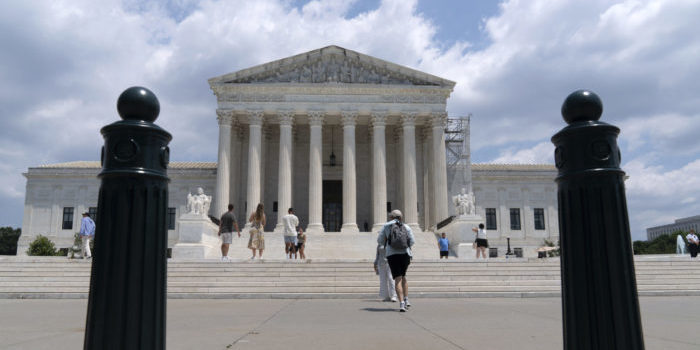
(Andrew Rice, The Center Square) The U.S. Supreme Court will hear oral arguments on Tuesday in a case over whether states can prevent concealed carry holders on private property that is open to the public.
Wolford v. Lopez challenges a Hawaii law that prevents concealed carry permit holders from bringing handguns to beaches, bars, restaurants that serve alcohol and gas stations without the owners permission.
The Hawaii law stems from the Supreme Court’s decision in New York State Rifle & Pistol Association v. Bruen, where justices struck down a New York law requiring concealed carry holders to display the need to defend themselves.
“The Second and Fourteenth Amendments protect an individual’s right to carry a handgun for self-defense outside the home,” Justice Clarence Thomas wrote in the court’s 2022 decision.
Thomas further elaborated that gun restrictions should only be upheld if they are consistent with the “historical tradition” of the United States.
In 2023, Hawaii implemented a law making it a misdemeanor for concealed carry holders to bring a gun on private property. The misdemeanor carries a sentence of up to a year in prison.
Hawaii residents with concealed-carry permits challenged the state’s law. The residents, alongside a gun-rights group, argued that the government has no imperative to prohibit citizens from carrying concealed weapons in public spaces.
“There is no comparable historical – or even modern-day – tradition of allowing the government to create a no-carry default rule for private property open to the public,” lawyers for the residents wrote to the Supreme Court.
Lawyers for the gun-rights group also pointed to the disproportionate effect Hawaii’s law will have on rural areas with parks and beaches.
“These bans are applicable to hundreds of thousands of acres of public land throughout Hawaii, even though the State allows hunting with firearms in many areas of these parks and forests,” lawyers wrote in a petition to the court.
In a brief to the Supreme Court, Hawaii Attorney General Anne Lopez said the state instituted its law to protect citizens from hosting armed individuals on private property. Lopez points to a longstanding history of limiting the right of Hawaiian citizens to carry weapons in public spaces.
“Property owners in Hawai’i could assume that – unless they made express arrangements to the contrary – firearms would not be carried onto their property, even if it was open to the public,” Lopez wrote in a brief to the nation’s highest court.
Lawyers for Hawaii also argue that the Second Amendment, at the time of the nation’s founding, did not include the right to enter private property with a weapon.
“The Founders recognized a property owner’s right to exclude,” the lawyers wrote. “Accordingly, at the Founding, a person had no right to enter private property with a gun unless he had the owner’s express consent or an implied license based on local law or custom.”
In lower court litigation, Hawaii pointed to a 1771 New Jersey law and an 1865 Louisiana law that explicitly required consent before entering a private property of any kind with a gun. Lower courts upheld Hawaii’s arguments on the basis of these laws.
“The overall purpose of all the laws was plainly to protect a property owner’s right to exclude firearms,” lawyers for Hawaii wrote. “Variation in the specific reasons why owners might wish to preclude guns – from preventing unwanted hunting to promoting safety, comfort or self-defense – does not undermine the basic fact that laws that vindicate the fundamental right to exclude are well within the tradition of American firearm regulation.”
Lawyers for the concealed-carry holders argued Hawaii relied on faulty evidence to assert other laws were similar to the state’s ban. They argued certain public spaces, like beaches and public parks, would not be considered in the original bans, which fundamentally alters the state’s argument.
“Under that approach, ‘the original understanding of the Second Amendment,’” the lawyers wrote, referencing a lower court judge’s opinion, “‘Would not apply to any new types of public spaces that would develop in the future.’”
Gun rights and gun control advocates will be watching as justices on the Supreme Court prepare to hear arguments in a consequential Second Amendment case on Tuesday.
