DOJ Looks To ‘Wind Down’ Lawfare Cases Against Trump

(Matt Lamb, Headline USA) The Department of Justice will likely drop its two pending federal cases against President-elect Donald Trump, due to an internal policy not to prosecute sitting presidents.

Trump has pledged to fire special counsel Jack Smith “within 2 seconds.” A Supreme Court ruling this summer that prohibited presidents from being prosecuted for official acts already complicated the two cases, one involving the president-elect’s storage of documents and another concerning his actions on Jan. 6, 2021.

The DOJ is working to “wind down” the cases against Trump, according to NBC News. A former federal prosecutor bemoaned the collapse of the cases against Trump.

“Sensible, inevitable and unfortunate,” NBC’s Chuck Rosenberg stated, according to the news outlet.

Trump’s team is working to get the cases dismissed as well.

“The American people have re-elected President Trump with an overwhelming mandate to Make America Great Again,” Trump campaign spokesman Steven Cheung told the media.

“It is now abundantly clear that Americans want an immediate end to the weaponization of our justice system, so we can, as President Trump said in his historic speech last night, unify our country and work together for the betterment of our nation,” he added.

Other state level charges remain, including Trump’s “hush money” payments to Stormy Daniels and a nearly half-billion civil judgment brought by Attorney General Letitia James in New York. In the latter case, James accused Trump of committing fraud through the valuation of his properties, even though his lender never alleged any impropriety.

Trump still faces a state-level charge in Georgia. However, Fulton County prosecutor Fani Willis has come under scrutiny for her romantic relationship with Nathan Wade, whom her office paid to help go after Trump.

The case is facing appeals, and a hearing on whether Willis will remain on the case is set for Dec. 5.

Legal scholar Jonathan Turley said he expected all the cases to fall apart.

“After years of thrill-kill prosecutions, the thrill is gone for lawfare warriors,” he wrote recently in the New York Post.

He predicted the Georgia case was “unlikely to continue.” Turley, a George Washington University law professor also said the “hush money” case suffered from “many alleged errors.”

The lending case brought by New York Attorney General James suffered from other questionable defects; as Turley pointed out “no one lost a dime, and the alleged victim banks wanted more business with Trump and his company.”

ETFs Report Inflows of Gold for Sixth Straight Month

(Mike Maharrey, Money Metals News Service) ETF gold holdings globally increased for the sixth straight month in October. Big flows of gold into North American and Asian ETFs offset outflows from European-based funds.

Collective ETF gold holdings rose by 43 tons. Gold-backed funds now hold 3,244 tons of metal.

Global assets under management (AUM) by gold-backed ETFs rose by 5 percent to a month-end record of $286 billion due to the addition of metal coupled with the skyrocketing gold price.

Year-to-date, global ETF gold holdings have increased by 18 tons. It was the first positive reading in 2024, with the recent influx of gold finally overtaking outflows through the early months of this year.

Gold-backed ETF AUM has surged by 33 percent in 2024.

North American funds reported a 30.5-ton increase in gold holdings despite rising Treasury yields, which typically create headwinds for gold. In dollar terms, North American ETFs charted an increase of $2.7 billion. World Gold Council analysts speculate that election uncertainty, along with the ongoing military conflicts in Ukraine and the Middle East, boosted safe-haven demand. The WGC also cited “FOMO” (fear of missing out) as a contributing factor to ETF gold demand as prices surged.

Asian funds added 23.4 tons of gold to their stocks in October, boosting holdings by 12.6 percent. This level of gold inflow was atypically high. China dominated inflows thanks to a record-shattering local gold price and increased equity volatility. The Chinese government recently announced an economic stimulus plan that could also boost gold demand. Gold also flowed into Indian ETFs last month.

European funds reported gold outflows of 11.1 tons. The decline in gold holdings was seen across the region, whereas they were concentrated in the UK in September. Unlike in the U.S., rising bond yields created headwinds for gold in the eurozone.

Funds in other regions, including Africa and Australia, reported a 0.6-ton increase in gold holdings. Asian and South African funds led the way. The weakening Aussie dollar helped spur gold investment.

Global gold trading volumes averaged $268 billion in October, a 4 percent month-on-month increase. This was well above the 2023 average of $163 billion.

Global over-the-counter (OTC) gold trading rose 4 percent month on month to 181 billion per day.

Inflows of gold into ETFs can have a significant impact on the global gold market by pushing overall demand higher.

ETFs are a convenient way for investors to play the gold market, but owning ETF shares is not the same as holding physical gold.

A gold ETF is backed by a trust company that holds metal owned and stored by the trust. In most cases, investing in an ETF does not entitle you to any amount of physical gold. You own a share of the ETF, not gold itself.

ETFs are relatively liquid. You can buy or sell an ETF with a couple of mouse clicks. You don’t have to worry about transporting or storing metal. In a nutshell, it allows investors to play the gold market without buying full ounces of metal at the spot price.

Since you are just buying a number in a computer, you can easily trade your ETF shares for another stock or cash whenever you want, even multiple times on the same day. Many speculative investors take advantage of this liquidity.

But while a gold ETF is a convenient way to play the price of gold on the market, you don’t actually possess any gold. You have paper. And you don’t know for sure that the fund has all the gold either, especially when the fund sees inflows. In such a scenario, there have been difficulties or delays in obtaining physical metal.

The Metals Get Mauled

(Brien Lundin, Money Metals News Service) A clear-cut win by Trump negates the risk of political turmoil and sends gold and silver plunging.

But this bull market was never built on geopolitical risk — it’s a decades-long trend of ever-easier money and ever-greater debt that has sent gold to record heights.

The markets will soon realize that the current situation is irreversible and unsolvable by any administration… and the metals bull market will resume in force.

Over the past six months, in interviews and conversations with friends and media in Canada and elsewhere in the world, I was consistently asked how the U.S. presidential election would affect gold.

My answer was always the same: Not a whit.

I would explain that because the debt situation in the U.S. had gotten so completely out of hand…and because neither party was inclined or even able to solve it at this point…far higher gold prices would result no matter who was elected.

Obviously, I should have cautioned that a clear-cut win by Trump would evaporate any perceived geopolitical risk being factored into the gold price by some speculators and, therefore, result in a short-term sell-off.

That’s exactly what’s happened. As I wrote this on Wednesday, gold was off $77 (2.8%), and silver was leveraging the move to the downside with a drop of $1.48 (4.5%).

A move of this magnitude is obviously being driven by traders shorting the metals with wild abandon. I sincerely doubt that much of the big money that’s moved into gold over the past year was motivated by concerns over this election.

Thus, this short-term trade seems destined to reverse soon.

And, if you’ve read anything I’ve been writing for the last few years, you will not be surprised to learn that I view this as a long-term opportunity.

It’s a mixed bag in the post-election markets. With the Dow jumping over 3% and the Dollar Index soaring, investors are obviously considering that lower taxes and looser regulation will unleash the U.S. economy.

But with Treasury yields also rising strongly, they also seem to recognize that higher tariffs will be inflationary.

And finally, the big sell-off in gold and silver is just crazy — rooted in the belief that the rise in the metals over the past year was due to worries over political mayhem following the election and not the intractable debt trap that would have embroiled any presidential administration.

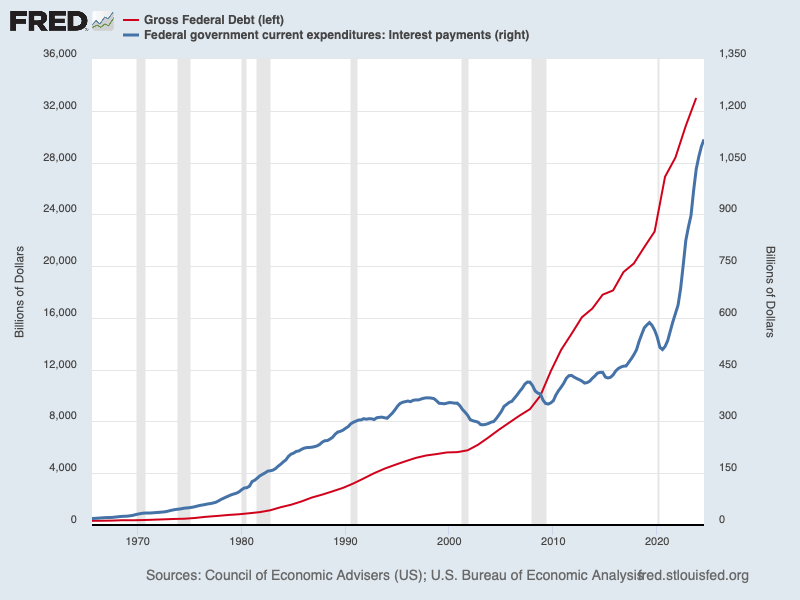
As a reminder, consider again this chart:

The red line above shows the federal debt, which began to accelerate higher with the post-2008 Great Financial Crisis rescue efforts and truly exploded higher with the fiscal and monetary response to Covid…and then the desperate federal spending as the Biden administration attempted to ensure their re-election.

This fiscal stimulus ran in direct opposition to monetary policy, as the Fed attempted to kill off inflation with severe rate hikes. You can see the effect of rising rates meeting head-on with soaring debt loads in the blue line above, showing federal interest expense.

This is a classic debt trap…a “doom loop,” as many have called it…in which the Fed must lower rates to keep the house of cards erect while the markets force rates and gold higher in recognition of the inflationary consequences.

Neither party addressed this situation at all during the campaign, and neither is motivated in the least to do anything about it. Far to the contrary, in fact, as control of the White House and both houses of Congress have never promoted spending restraint.

This is a truth that the markets will realize shortly, I believe, which makes this an extraordinary investment opportunity.

The key to profiting from a secular bull market like this one in the metals is to buy the dips. And this is one heck of a dip.

Election Results Are In: Gold and Silver are the Real Winners of 2024

(Money Metals News Service) In this week’s Money Metals Midweek Memo, host Mike Maharrey dives deep into the broader economic landscape as the U.S. approaches another pivotal election.

Despite the usual hype of each election cycle being “the most important,” Maharrey offers a different perspective, suggesting that regardless of the outcome, Americans are likely to see the same trends continue—big government, increasing debt, and ongoing monetary policy impacts.

Maharrey shares insights on why sound money, particularly gold and silver, may be the best choice for safeguarding wealth.

The Growing Federal Government: A Persistent Trend

Reflecting on past administrations, Maharrey highlights how each president, regardless of party, has increased federal government size, debt, and spending.

“Every administration grows the government,” he says, pointing out that both Republican and Democratic leaders have enacted policies that expand governmental reach. Historical data on spending shows that these trends remain consistent from the Reagan years through Biden, with few, if any, exceptions.

Even Trump, who campaigned on deregulation and smaller government, made significant moves that expanded federal control, particularly in areas like gun regulation. Maharrey warns that any hope placed in presidents to solve the nation’s deepest issues—like the debt, spending, and overall size of government—is likely misplaced.

America’s Founders Warned of This

Quoting Founding Fathers like George Mason and Thomas Jefferson, Maharrey argues that they foresaw the dangers of centralized power. The country, he explains, has shifted from its constitutional foundation, where state governments were meant to hold significant power.

The erosion of decentralized government has led to overreach, excessive taxation, and infringements on personal liberties. Jefferson’s warnings about centralizing control in Washington, D.C., were prophetic; Maharrey calls the current federal government one of the largest in history.

Sound Money: Gold and Silver Lead the Market

The real winners of 2024, according to Maharrey, are gold and silver. Statistics underscore their strong performance:

  • Silver has increased 42.4% in 2024, while gold is up 33.7% by the end of October.
  • Both metals have outperformed major stock indices like the NASDAQ, which posted a 24% gain, and even outpaced the broader commodity markets.

Gold’s price rally is notable, setting 39 all-time highs in 2024. This performance reflects investors’ growing confidence in gold and silver as safe-haven assets amid rising geopolitical tensions and economic uncertainty.

High Demand for Gold Continues

Investment demand for gold surged in the third quarter, driven by geopolitical concerns and economic conditions. Maharrey reports that total gold demand reached 1,313 tons in Q3, with the total value exceeding $100 billion for the first time.

ETF demand also surged, marking a 95-ton increase in global gold-backed funds, a trend driven by Western investors finally joining the gold rally.

Despite high gold prices, central bank buying remains strong, with Poland adding 42 tons to its reserves, making it the top central bank buyer for the quarter. The ongoing accumulation by central banks, even at elevated prices, signals confidence in gold’s role as a long-term asset.

Silver’s Strong Position and Growing Industrial Demand

While gold captures much of the attention, silver is performing remarkably well, especially in industrial applications. It remains well below its all-time high near $50, but it has historically lagged in early bull markets only to make sharp gains. With the gold-to-silver ratio currently above 80:1, silver appears undervalued, suggesting it has room to grow as the market matures.

Silver is seeing an uptick in demand due to green energy initiatives, with industrial demand forecasted to maintain a supply deficit. The cup-and-handle technical pattern on silver’s 50-year chart also suggests a bullish trend, signaling potential for significant price movement in the coming years.

The Case for Decentralized Power and Local Action

Sound Money US Constitution American Flag Money Metals Exchange

A longstanding advocate of decentralized governance, Maharrey emphasizes that focusing on state and local governments is essential for reining in federal overreach. At the Tenth Amendment Center, where Maharrey serves as national communications director, the organization advocates using state and local powers to counter federal policies. Citing the anti-commandeering doctrine and Madison’s Federalist No. 46, he explains how states can refuse to cooperate with federal policies they oppose.

Final Thoughts: Sound Money is the Real “Decision 2024”

Ultimately, Maharrey believes the best decision this election season is to invest in sound money. With rising national debt, aggressive federal spending, and ongoing monetary expansion, gold and silver offer stability against future economic challenges. He recommends exploring precious metals as a hedge, noting that Money Metals offers a range of resources to help individuals incorporate metals into their portfolios.

For more insights and resources on investing in precious metals, Maharrey directs listeners to Money Metals and encourages them to take control of their financial futures through sound money.

As Things Change, Some Things Will Stay the Same

(Mike Maharrey, Money Metals News Service) The votes are counted, and the results are in! Donald Trump will occupy 1600 Pennsylvania Avenue for the next four years.

The GOP will also control both houses of Congress.

Much will change in the next four years. But it’s also important to consider the things that will almost certainly stay the same.

The Times Are Changing!

The markets were giddy with the Trump victory, embracing a “risk on” mentality. Stocks soared to new records. The Dow was up 1,508 points, a 3.6 percent gain. The S&P 500 and the NASDAQ charted similar gains.

Meanwhile, the safe-haven trade in gold unwound, with the yellow metal dropping by as much as 3 percent during the day.

The dollar charted a four-month high, and bond yields rose, creating additional headwinds for gold and silver.

All of this would seem to indicate rather bullish sentiment toward a Trump presidency.

The optimism isn’t unreasonable. Trump will almost certainly ease some of the regulatory burden on businesses. He is also more likely to cut taxes as opposed to raising them as promised by the Democrats.

Many analysts pointed to the specter of an “America First” policy with higher tariffs as the reason for a much stronger dollar. A more aggressive tariff regime could eventually boost domestic economic output but also introduce more upward price pressures into the economy.

Some Things Will Stay the Same

While a Trump presidency coupled with a Republican-controlled Congress would appear generally bullish for the economy, two significant factors should undercut or at least temper that optimism – and they aren’t likely to change with a Trump administration.

And that’s why I think the rush to sell gold and silver might be a bit premature.

The first is the ever-growing national debt driven by the fiscal train wreck in Washington, D.C.

The national debt blew past $35 trillion in July, and it is approaching $36 trillion just four months later. (The debt was $35.9 trillion as of Nov. 5.)

The interest expense on that massive national debt eclipsed $1 trillion for the first time in fiscal 2024. The federal government spent more on interest expense than it did on national defense and Medicare.

If history is any indication, the Trump administration isn’t going to fix the problem.

In fact, it may get even worse.

Trump and his Republican colleagues were no budget hawks during his first term. The administration added $8.2 trillion to the national debt in four years. The only president who left office with more debt in dollar terms was Barack Obama ($8.3 trillion), and it took him eight years to do it.

Many will rightly point out that Trump was saddled with a pandemic during the last year of his term. Government shutdowns and the ensuing crash in economic output, coupled with massive stimulus programs, exploded the deficit. But the Trump administration was already running massive budget shortfalls before the pandemic. The deficit fell just shy of $1 trillion in fiscal 2019, and it was on track to crack the $1 trillion mark in fiscal 2020 before COVID-19 reared its ugly head. Before this, Obama was the only president to run a deficit of over $1 trillion – four times – all during the Great Recession. Trump was running recession-like deficits when the economy was supposedly “the greatest ever.”

Republicans tend to talk a good game when it comes to cutting spending, but their actions don’t match up with their rhetoric. They may tinker around the edges and cut spending in some departments, but they won’t go after the biggest spending categories – national defense and entitlements. It’s simply not politically expedient to do so. And they can’t do anything about the rising interest expense.

Here’s the unpleasant truth – the national debt has expanded under every president since Calvin Coolidge. And Republicans are among some of the biggest debtors. Trump, both Bushes, and Reagan were in the top five debt creators in nominal dollar terms, and Reagan and Bush were in the top five in inflation-adjusted dollars.

We’ve heard Trump promise both tax and spending cuts. But don’t ever forget: cutting taxes is an easy promise to keep. Spending cuts are not.

No matter how much politicians talk about spending cuts, spending always goes up in absolute terms. Every once in a while, they slow the increase in spending and call it a cut. But in pure dollar terms, more and more money flows out of Washington, D.C., every single year – no matter which party is running the show. Politicians always find new things to spend money on, whether a domestic crisis or a foreign war.

Many analysts think Trump will exacerbate the budget shortfalls with tax cuts. As one analyst put it, “The market anticipates inflationary pressures from potential fiscal spending and tax cuts, which Republicans could advance in a Congress under their control … and a Republican sweep may bring economic growth policies that drive bond yields higher and elevate inflation concerns.”

That means more deficits and more debt.

This will likely increase inflationary pressure. At some point, the Federal Reserve will have to intervene with quantitative easing (QE) in order to prop up the sagging bond market. The demand for U.S. debt is waning, and America’s fiscal irresponsibility will only exacerbate that problem.

We were already seeing trouble in the bond market before the election, with yields rising despite the recent Federal Reserve rate cuts. (And rising yields mean even higher interest expenses for Uncle Sam.)

The debt isn’t the only problem a Trump administration can’t or won’t address.

We’re due for an economic crash.

Why?

Because we still haven’t reckoned with the underlying wreckage in the economy caused by more than a decade of monetary malfeasance.

The Federal Reserve slashed interest rates to zero in the wake of the 2008 financial crisis and left them there for nearly 10 years. The central bank injected nearly $4 trillion into the economy through QE. When the Fed tried to unwind this unprecedented monetary policy, the economy got shaky, and the stock market crashed (in the fall of 2018.) By 2019, the central bank was cutting interest rates and running QE. This was before the onset of the pandemic policies.

When COVID-19 showed up, the Fed doubled down on the loose monetary policy of the recession years. It slashed rates to zero again and added another $5 trillion to the economy.

As the pandemic wound down, the inevitable happened – the monetary inflation of the past decade-plus manifested in price inflation. This forced the Fed to raise interest rates and shrink its balance sheet.

But the Fed never did enough to slay the inflation dragon. Now, it has surrendered to inflation with a supersized rate cut, and it’s in the process of creating more inflation.

Most mainstream analysts think the economy is going to glide into a soft landing. They think the aggressive Fed tightening took down inflation without breaking the economy. But the economy was broken long before the Fed started raising rates. The central bank broke things starting with its unprecedented monetary policy during the Great Recession and then doubled down during the pandemic. All of that easy money (inflation, by definition) is still sloshing around out there, and it has caused all kinds of malinvestments and economic distortions that we have yet to reckon with.

We felt tremors when the Federal Reserve started raising rates, precipitating a banking crisis. The Fed managed to paper over it with a bailout, but the fundamental problems remain.

People are cocky because nothing has happened yet. But these things tend to play out slowly. The Fed was already cutting interest rates in 2007, long before the financial crisis. And everybody was insisting everything was fine.

It wasn’t then.

It’s not now.

And there isn’t a thing that the Trump administration can do about it.

The consequences of this monetary malfeasance will manifest. It’s just a matter of when.

When that happens, you can expect more massive stimulus spending, more quantitative easing, and more artificially low interest rates.

All of that equals more inflation and a further devaluation of the dollar.

So, you might want to pause before you hit the sell button on your precious metals.

Voting for Sound Money: Why State Action Trumps Federal Rhetoric

(Jp Cortez, Money Metals News Service) As the United States braces for the aftermath of a decisive Trump victory for the Presidency, the principles of sound money seem destined to take a backseat to what is politically expedient – at least at the federal level.

This is due to the inherent nature of national political campaigns, which often promise more spending, more intervention, and more of the same monetary policies that erode the purchasing power of the U.S. Federal Reserve Note, commonly known as the U.S. dollar.

This is a consequence of detaching a nation’s money from a stable backing, such as gold.

Since Nixon officially ended U.S. dollar interchangeability with actual gold in 1971, we’ve seen what proponents of sound money feared would come to fruition: Endless wars and huge military expenditures, expansion of the bureaucratic state, wasteful spending, and a steady decline in how much your money can buy — all made possible by Federal Reserve-enabled borrowing.

Not only is war an unproductive endeavor that shifts economic resources away from domestic needs, but it’s also unbelievably costly. An unbacked money that is printed or created at will means government is no longer restrained by a limit on spending.

The promise of more programs, whether entitlement programs, infrastructure, or other social policies, often translates to a larger, more complex bureaucracy. With this expansion of the state comes more funding required from the state.

Sound money forces politicians to allocate scarce resources (tax dollars) responsibly.

The establishment of the Federal Reserve in 1913 was one of the most consequential acts in American history. The Fed masquerades as a private institution while always enabling the current administration’s deficit spending agenda.

There’s a consensus among the establishment candidates on maintaining the status quo with the Federal Reserve. It has historically pursued policies like quantitative easing, low interest rates, and corporate bailouts. While intended to stimulate the economy, Fed interventions lead to malinvestment, impaired economic productivity, and currency devaluation over time.

Sound money keeps technocratic bankers from conducting monetary experiments and inventing other attempts at financial alchemy on a global level.

Despite these federal-level challenges, Congressman Alex Mooney (R-WV) and Congressman Thomas Massie (R-KY) have introduced pro-sound money legislation. They are pushing to end the federal capital gains tax on gold and silver, to audit America’s gold holdings (including a full accounting of any swaps, leases, derivatives, of financial encumbrances that may be placed on the gold), and to audit the Federal Reserve.

While these efforts continue to spotlight the importance of sound money at the federal level, the bills haven’t received a hearing or a vote thus far.

However, while the national stage might seem indifferent or even hostile to sound money values, there’s a silver lining, quite literally, at the state level.

Over the last 10 years, Money Metals Exchange, acting through its Sound Money Defense League project, has made significant strides, demonstrating that grassroots activism and state-level legislation can indeed move the needle towards an economy based in honest, sound money.

In 2024 alone, the league has notched seven victories across various states. These include the elimination of sales taxes on gold and silver in states like New Jersey and Wisconsin, and the abolition of income taxes on any nominal gains from these metals in states like Alabama and Nebraska. Nebraska’s measure also included language to protect the citizens of the Cornhusker State from being forced to use a Central Bank Digital Currency.

These moves not only encourage investment in precious metals but also promote their use as a hedge against inflation.

States like Tennessee and Utah have authorized their treasurers to invest in physical gold, recognizing the crucial role that gold and silver can play in stabilizing a state’s investment portfolio.

This isn’t just symbolic; it’s a practical step towards state-level sound money policies.

The success of these legislative changes is largely due to targeted, state-by-state grassroots efforts led by Money Metals to prompt action on sound money principles by state legislatures.

This bottom-up approach showcases that change can indeed start at home, Freedom-minded activists can influence state policies that might create momentum for national-level reforms.

This election might not offer much for sound money enthusiasts on a federal level. However, the real battleground for economic sanity appears to be at the state level, where the Sound Money Defense League and Money Metals are not just discussing but actively implementing policies that could reshape America’s economic future.

Regardless of who sits in the Oval Office, the groundwork for a return to sound money principles is being laid, brick by legislative brick. This movement reminds us that while national politics might set the tone, it’s often local, on-the-ground action that determines the future.

DOJ Seeks 30 Months for Gov’t Provocateur Who Promoted Terrorism in Militia

(Ken Silva, Headline USA) Virginia man Russell Richardson Vane IV stole government documents, experimented with making a biological weapon, and pushed a militia in his area to commit acts of terrorism earlier this year—leading to his expulsion from the group.

Moreover, Vane held a security clearance as an analyst for the Pentagon’s National Geospatial-Intelligence Agency when he committed those crimes.

But despite Vane’s crimes and the position of power he held while committing them, the Justice Department seeks just 30 months imprisonment for him.

“The defendant is plainly remorseful. He understands the impact that his behavior has had on his security clearance, his career, and his family. Perhaps he himself needs no further deterrence to prevent him from reoffending,” DOJ lawyers said in their Wednesday sentencing memorandum—going relatively easy on a man accused of being a government asset.

Vane’s lawyers, for their part, seek an even lighter sentence: time served, or home confinement. Vane only served several months in prison before he was released on bail, allowing him to stay at home and take work as a plumber, his lawyers said.

“The FBI did find ricin, but only because Mr. Vane had done nothing to dispose of the substance in his laundry attic room even though he was well-aware he was being investigated by federal law enforcement authorities. He had created the ricin approximately a year earlier and had not touched it since,” they said—revealing that Vane had tested the ricin on his own skin.

“It was in a closed test tube in a box high on a shelf in the laundry attic room. Mr. Vane forgot about the concrete-like substance because he never intended to use it for any purpose and certainly not to hurt anyone.”

Vane’s lawyers also defended him making ricin—a deadly toxin—saying he only experimented with it in early 2023. They attached the letter of a PhD chemist, who said “Vane was incapable of producing ricin of sufficient purity or in a form that would be lethal to humans.”

Vane is set to be sentenced on Wednesday.

While Vane’s lawyers and the DOJ have downplayed his conduct, the Virginia Kekoas militia that he had been a member with viewed him as a dangerous provacatuer—and for good reason.

According to the Kekoas leaders, Vane IV told them he was working for the CIA. While the leaders had reservations about Vane IV, they allowed him to enter one of their group chats because they thought he might have advanced knowledge of world-altering events.

But within two weeks of entering the chat, Vane IV allegedly asked the Kekoas about a “group fund,” as well as about starting his own chapter of the Kekoas. Vane IV was told that no fund exists and members pay their own way. Such a fund would likely be illegal.

In February, Vane IV promoted the idea of collecting Hydrogen Peroxide in a group chat with the Kekoas and other militias. He was then accused of being a provacatuer, with other members calling his posts “fed plot shit for real.”

But that still didn’t stop Vane IV, who then asked the Kekoas whether they had plans if the President were to be assassinated.

To top it off, Vane IV allegedly gave another Kekoas leader named “Sasquatch” a batch of purported Defense Intelligence Agency documents about using homemade explosives.

The Kekoas issued a statement on the matter earlier this year.

“We The Virginia Kekoas are a militia type emergency preparedness group. We do not condone terrorist activity, nor do we condone violence towards any member of the government, former or current,” the group said.

“Furthermore, The Virginia Kekoas would never partner, ally or whatever with any foreign government.”

Ken Silva is a staff writer at Headline USA. Follow him at x.com/jd_cashless.

How Barron Trump Helped Secure His Father’s Landslide Victory

(Ken Silva, Headline USA) Donald Trump’s appearances on popular independent podcasts is being credited as one of the key factors contributing to his landslide 2024 presidential election victory—with his appearances with younger streamers leading to his best-ever performance with voters under 30 years old.

According to an election retrospective from Time Magazine, Barron Trump was a key factor in influencing what shows his father appeared on.

Time’s deep-dive on Wednesday said that Trump tasked a 27-year-old campaign staffer named Alex Bruesewitz in July to formulate a list of online podcast personalities for interviews.

“I have a list of podcasts I wanted to pitch you on,” Bruesewitz reportedly said, to which Trump responded: “Have you talked this over with Barron?”

At that time, Bruesewitz said he hadn’t talked to Barron, and so Trump hung up the phone on him. “Call Barron and see what he thinks and let me know,” the President told him.

“Bruesewitz reached Barron later that day and learned that he was particularly fond of Adin Ross, a provocateur mostly known for collaborating with celebrities on live-streams of video games, such as NBA2K and Grand Theft Auto. They agreed that’s where Trump should start. The podcast strategy was in motion,” Time wrote.

As Headline USA reported in August, Trump’s appearance with Ross went viral, especially among the male Gen-Z population. Within minutes of hosting, Ross, who holds the record as the number one channel on the streaming service Kick, noted that he had already broken the site as a result of high traffic from viewers.

At the end of the interview, Ross surprised Trump with a gift outside Mar-A-Lago—a wrapped MAGA-themed Tesla Cybertruck.

“That’s an Elon,” Trump said after seeing the vehicle.

After Ross’s show, Trump went on the shows of Logan Paul, Theo Von and Joe Rogan to finalize his campaign heading into Tuesday.

“The campaign made a deliberate decision to avoid most traditional media interviews,” Time reported.

Ken Silva is a staff writer at Headline USA. Follow him at x.com/jd_cashless.

Hispanic Voters Hit w/ Racist Attacks After Massive Shift to Trump

(Luis Cornelio, Headline USA) Far-left activists and self-identified Democrats appear to have found a scapegoat for their humiliating defeat in the 2024 presidential election: Hispanic Americans. 

Many leftists have unleashed racist insults and smears against Hispanic Americans after they played a major role in fueling Donald Trump’s comeback on Election Day.

On average, Hispanic-majority counties went for Trump by 10 percentage points, according to The New York Times. These numbers have sparked vitriolic responses from prominent left-wing voices.

On Wednesday’s episode of The View, host Sunny Hostin suggested Latino men supported Trump to “deport” themselves, invoking a racist stereotype about Hispanics and legal status. Hostin also referred to pro-Trump white women as “uneducated.” 

Elie Mystal, a columnist for the leftist site The Nation, posted several tweets, including one where he accused Hispanics of thinking “they’re white.” In one tweet, he appeared to conflate an unnamed racial minority with white supremacy. 

“White supremacy cannot be defeated unless we’re all in it together (obviously, a majority of white people are not gonna help). But… this election *really shows* that a lot of other ‘people of color’ do not want to defeat white supremacy, they want to join it,” Mystal wrote. 

Other left-leaning users, similar to Hostin, expressed shock that Hispanic Americans would vote for Trump and his pro-border security policies. 

“45% from Latinos while running on a massive mass deportation campaign. I just don’t get it man,” one user wrote, garnering nearly 30 million views and hundreds of mocking replies. 

Chandler Crump, a 20-year-old Republican commentator, swiftly shut down the viral post with a blunt reply: “Did you ever consider the possibility that Latinos are… legal citizens?” 

Commentator Melissa Chen chimed in on the discussion, mocking the left’s rhetoric by tweeting, “Dear Latino Men, You’re now the new face of white supremacy. Welcome to the club. Signed, Asians and Jews.”

Chen’s tweet reflected how Asian and Jewish Americans have also faced condemnation from the far left. 

Screenshots of Reddit conversations revealed additional attacks on Hispanics, with a user commenting, “I know this will sound racist, but Latinos f***ing disgust me,” and another adding, “Latinos aren’t immune from being f***ing idiots.” 

Dems Start Blaming Each Other for Kamala’s Defeat

(Dmytro “Henry” Aleksandrov, Headline USA) After Kamala Harris lost the 2024 election, Democrats started attacking and blaming each other, wondering what they could’ve done to keep the power in the White House and Senate.

Senior White House correspondent Jacqui Heinrich reported that, according to Harris-Walz surrogate and a member of the Democratic National Convention’s National Finance Committee and Pennsylvania commissioner Lindy Li, Harris should’ve chosen Gov. Josh Shapiro, D-Pa., over Gov. Tim Walz, D-Minn., because Shapiro would’ve “carried the blue wall states.”

“People are wondering tonight what would have happened had Shapiro been on the ticket. And not only in terms of Pennsylvania. He’s famously a moderate,” Li said, adding that Americans saw how Harris instead chose radical Walz, who oversaw the violent and destructive 2020 riots.

In addition to admitting that using ad hominem attacks against non-woke Americans backfired and not presenting a clear campaign message, Li also blamed Harris for not telling Americans how different she would be from Joe Biden.

“She knows [it] was a mistake … to say on The View that she couldn’t think of a single thing that she would do differently from the Biden administration. That was [the] opener for her to show. [She could’ve told Americans] that she’s going to get tough on the border [and] that she’s going to take drastic measures to bring down inflation. That was her chance,” she said.

House Speaker Mike Johnson, R-La., also told The Hill that the reason why Harris didn’t pick Shapiro was because he is a Jew.

“I think that clearly was a major factor, is that she was reluctant to put a vice presidential nominee on the ticket with Jewish heritage because they’re having a split in the Democratic Party,” he said. “They have a pro-Palestinian, in some cases pro-Hamas wing of the Democratic Party.”

When pressed on whether the decision was anti-Semitic, Johnson said that he didn’t know if it was a “major factor.”

“I think it was transparently a major factor. And I think they made a political decision that is sad, and I think they’ll regret it.”

Leftists on NBC also started asking whether it was a good idea to replace Biden with Harris.

MSNBC’s Symone D. Sanders went as far as criticizing Democrats for orchestrating a coup against Biden.

“I will just note that it is probably not the best idea that Democrats orchestrated a very public stab fest, a proverbial stabbing in the front of the sitting President of the United States of America, and then didn’t use him in his hometown of Scranton, Pennsylvania,” she said.

As previously reported, Democrats have been considering whether they made the right decision long before the election results.