Bash suggested that Democrat voters lacked the enthusiasm to show up and vote for Harris, saying they would rather sit at home than support her at the polls.
“One of the things that we heard from the Democrats was, are they going to go out and vote for her? Or are they gonna stay home and choose the couch?” Bash said. “And the Democratic vote totals were down.”
“The couch won in a lot of places,” she added.
The Left has settled on 'Voters chose the couch' as the reason for why they lost to Trump: Dana Bash: "The couch won in a lot of places."
If you're a Democrat, it's a lot easier to tell yourself that turnout was down in 2024, instead of facing the hard truth that Joe Biden… pic.twitter.com/CjLp8nJljM
CNN Political Director David Chalian chimed in, saying Harris’s underperformance of President Joe Biden’s 2020 numbers was not surprising because “Democrats were talking about this the entirety of the election cycle.”
Harris was down approximately 12 million votes from Biden’s reported 81 million votes in 2020.
Meanwhile, Trump had 73 million counted votes as of Friday afternoon, just below his 74 million total votes in 2020.
“Her number is much more down than his number went up in the Democratic place. You know, why is that is going to be worthy of exploration for Democrats to figure out,” Chalian said.
Bash noted that Trump performed better than 2020 in blue states like New Jersey, where Democrat Senator-elect Andy Kim won his state’s seat.
The CNN host mentioned that Kim took to X on Thursday and explained Trump’s victory by saying voters have a deep distrust in politics and politicians.
I learned never to underestimate the extent to which people distrust and despise politics, especially those that do not engage regularly. 7/12
“Well, I think we’ve seen that for a while,” CNN Senior Political Analyst Gloria Borger said. “The surprises with the Democratic enthusiasm numbers we saw in polling before the election… you know, you have to scratch your head and say, ‘Well, what happened to that enthusiasm?’”
Julianna Frieman is a freelance writer published by the Daily Caller, Headline USA, The Federalist, and The American Spectator. Follow her on Twitter at @JuliannaFrieman.
(Ken Silva, Headline USA) News media aired footage of the new security detail at Donald Trump’s Mar-a-Lago estate in Florida, showing that robot dogs are not protecting the President-elect.
The robotic dog appeared to have a weapon attached to it. The footage, aired Thursday, also showed U.S. Coast Guard armored patrol boats.
The enhanced security comes in the wake of Trump’s landslide election, and right as the Justice Department purports to have uncovered an Iranian assassination plot against him—though, as Headline USA explains here, there is little actual evidence of an Iranian plot.
After the first assassination attempt against Trump on July 13, the Secret Service claimed it would give him the same level of protection as President Joe Biden.
But Trump had to cancel at least one major event during his campaign, and whistleblowers claim that the Secret Service was still denying him resources. On Sept. 15, another gunman attempted to kill Trump on his Florida golf course, leading him to forego golf for the rest of the campaign.
Now, his security includes robot dogs, which are becoming increasingly common among law enforcement.
Robot dogs have even hit the commercial markets recently.
As Headline USA reported in April, the Ohio-based company Throwflame unveiled what it’s calling the “Thermonator,” which is touted as the first-ever flame-throwing robot dog. The price of the dog is $9,420, including free shipping.
According to the website, the Thermonator is about 30 inches long and weighs 37 pounds. It can shoot blast streams of fire up to 30 feet.
“This quadruped is coupled with the ARC Flamethrower to deliver on-demand fire anywhere!” Throwflame states on its website.
Ken Silva is a staff writer at Headline USA. Follow him at x.com/jd_cashless.
In a statement posted to social media, the two-term senator said 100,000 provisional and overseas ballots remained uncounted—a detail supported by the Pennsylvania State Department on Thursday.
Given McCormick’s 31,000-vote lead, the AP’s decision to call the race in his favor was premature, Casey maintained.
“Pennsylvania is where our democratic process was born,” he said on X.
“We must allow that process to play out and ensure that every vote that is eligible to be counted will be counted,” he added. “That is what Pennsylvania deserves.”
I have dedicated my life to making sure Pennsylvanians’ voices are heard, whether on the floor of the Senate or in a free and fair election. It has been made clear there are more than 100,000 votes still to be counted. Pennsylvania is where our democratic process was born. We…
AP reporter Mike Catalini defended its methodology for calling the race.
“[T]hough there were an estimated 91,000 votes still outstanding [when the AP declared McCormick the winner], there were not enough in areas supporting Casey for him to make up the difference,” Catalini said.
Like President-elect Donald Trump, McCormick cut into Casey’s margins in purple counties and Democratic bastions across the state.
As of Friday morning, state returns showed the candidates just 0.45 percentage points apart.
Far-left Secretary of State Al Schmidt must order a recount for any races that come in at or below the 0.5 threshold by Thursday of next week, unless the defeated candidate opts out. That recount must be completed by noon on Nov. 19.
The Pentagon was slammed prior to the election for its failure to provide sufficient absentee ballots to troops abroad, many of whom traditionally tend to break in favor of Republican candidates.
It is unclear whether that failure contributed to the uncounted ballots. State law required that all absentee ballots be received by no later than 8 p.m. on Election Day.
The flip pads the Republican majority in the U.S. Senate to 53-45, with races in Arizona and Nevada still to be called, according tothe AP.
Authored by Rep. Virginia Foxx, R-N.C., the legislation is supportive of an Oct. 3 letter signed by 14 members of the House and directed to President Joe Biden and four members of his Cabinet.
“Congress can, and should, pursue commonsense solutions to aid in disaster recovery efforts—the solutions that I have placed on the table help lead the way,” Foxx wrote on social media.
Congress can, and should, pursue commonsense solutions to aid in disaster recovery efforts – the solutions that I have placed on the table help lead the way.
The president, if the bill becomes law, would be able to create an Emergency Recovery Board inclusive of federal, state and local entities that navigates suspension or modification of regulations and laws that can slow recovery and development.
Discretion was necessary with regard to the National Environmental Policy Act in order for people of the region to “rebuild and return to normal,” the congressional delegation said in their letter.
“The federal government can support these communities by ensuring federal regulations are waived or interpreted to provide maximum discretion to state and local authorities, consistent with applicable laws and regulations” the letter said.
It was addressed to Biden, Homeland Security Secretary Alejandro Mayorkas, Interior Department Secretary Deb Haaland, Federal Emergency Management Agency Administrator Deanne Criswell, and Environmental Protection Agency Administrator Michael Regan.
The letter was signed by Foxx and Reps. Greg Murphy, R-N.C.; Chuck Edwards, R-N.C.; Dan Bishop, R-N.C.; Patrick McHenry, R-N.C.; David Rouzer, R-N.C.; Richard Hudson, R-N.C.; Richard McCormick, R-Ga.; William Timmons, R-S.C.; John Rose, R-Tenn.; Kat Cammack, R-Fla.; and Neal Dunn, R-Fla.
The mountain counties of North Carolina on Friday began the seventh week of recovery from the storm, which came ashore in the Big Bend of Florida. Helene dissipated over the mountains of North Carolina and Tennessee, dumping more than 30 inches of rain in multiple places.
Helene is responsible for 231 fatalities across the South, including 102 in North Carolina. Respective state officials say 49 were killed in South Carolina, 34 in Georgia, 25 in Florida, 18 in Tennessee, two in Virginia and one in Indiana.
Numbers were confirmed by the Center Square based on information supplied by the North Carolina Department of Health and Human Services; South Carolina Department of Public Safety; Georgia Emergency Management Agency; Florida Department of Law Enforcement; Tennessee Emergency Management Agency; Virginia Gov. Glenn Youngkin; and the Gibson County Sheriff’s Office in Indiana.
Helene is the fourth most deadly hurricane from the Atlantic Basin in the last three-quarters of a century. Only Katrina (2005, deaths 1,392), Audrey (1957, deaths 416) and Camille (1969, deaths 256) killed more people.
Flooding was catastrophic, arguably the worst storm for North Carolina since Hurricanes Floyd in 1999 and Hazel in 1954—the latter the only Category 4 hurricane to make landfall on state shores, the former causing a once-in-500-years flood.
According to PowerOutage.us on Friday morning, the total without power in Yancey County was 304. At the height of the storm the last weekend of September, more than 1 million lost power.
According to DriveNC.org, the total road closures because of Helene were 292. This included one interstate, 21 federal highways, 29 state roads and 241 secondary roads.
(Mike Gleason, Money Metals News Service) It’s been a historic week in American politics as well as in financial markets. Following Donald Trump’s triumph at the ballot box, the S&P 500 spiked to a new record high.
Investors were in part relieved that the presidential election resulted in a clear winner. Many investors also bought stocks on optimism about potential deregulation and tax cuts under a Trump administration. That burst of positive sentiment helped trigger a selloff in safe-haven assets, including precious metals.
The knee-jerk reaction of metals traders to the election results doesn’t come as too much of a surprise. For now, it’s just a reaction and not necessarily a major trend change.
What was surprising about the election results – at least to most media pundits and pollsters – was the magnitude of Trump’s victory. Few thought he would sweep through every battleground state or capture an outright majority of the popular vote.
In his victory speech, Trump claimed a powerful mandate from the public to implement his Make America Great Again agenda. At the top of his to-do list is securing the border and deporting illegal immigrants. Also big on the Trump agenda is bringing down inflation, providing tax relief, and lifting regulatory burdens.
Trump may be able to get many things done at the administrative level through executive orders. Other priorities will require legislation from Congress or approval from the Senate.
He will have the benefit of being able to lean on a Republican-controlled Congress, albeit with what looks to be a very slim majority. In the Senate, Republicans will have a 53 to 47 majority.
GOP Senate candidates in battleground states performed better than expected. In Pennsylvania, David McCormick scored an upset victory over incumbent Democrat Bob Casey.
That victory could prove to be extremely important. Although it wasn’t needed to secure GOP control of the Upper Chamber, a smaller majority would have enabled one or two anti-Trump Republicans to function as obstructionists — much like the late Senator John McCain did during Trump’s first term.
Current Republican Senators Lisa Murkowski, Susan Collins, and Ben Sasse each voted to convict President Trump on impeachment charges brought up by Congress four years ago. Whether these unreliable allies will work to try to sabotage Trump’s legislative agenda, or his cabinet and judicial appointments remains to be seen.
Trump’s agenda will certainly face resistance from the permanent bureaucracy in Washington, D.C., or what some call the deep state. The federal establishment ultimately grew bigger during President Trump’s first term despite his vows to drain the swamp.
Part of the problem was that Trump, having no previous experience in government, relied on the advice of establishment figures from the Bush administration as he was forming his cabinet. In a candid interview with Joe Rogan just a few days before the election, Trump admitted that his biggest mistake was agreeing to appoint people who weren’t on board with his agenda.
One of the appointments Trump came to regret was Jerome Powell as Federal Reserve chairman. Powell moved to cut the Fed funds rate by 25 basis points this week. During his press conference, Powell was asked whether he would step down if President Trump demanded his resignation. Powell was none too pleased with the question -and insisted the President has no legal authority to remove him as Chairman.
One of the potential impediments to Trump’s plans to grow the economy are elevated interest rates. Even as the Fed has begun cutting on the short end, long-term interest rates have actually been rising in recent weeks. That translates into higher costs for mortgages, auto loans, and credit card borrowing.
Trump will likely try to pressure the Fed to bring rates down more aggressively. While lower rates might stimulate the economy, they also risk putting upward pressure back on inflation.
Sound money advocates aren’t necessarily hopeful that the next Trump administration will fix the fiscal and monetary problems that contribute to ongoing currency depreciation. Trump will inherit a national debt that is spiraling toward a crisis. The economy could be entering into an official recession just as he assumes office. The political pressure for more fiscal and monetary stimulus could be immediate.
As a consequence, inflation may never get back down to the Fed’s 2% target.
Investors who wish to protect themselves from inflation risk will still want to hold physical precious metals heading into 2025 and beyond. Gold and silver markets initially slumped following Donald Trump’s election victory in 2016, but they made gains by the end of his first term.
The lesson is that pullbacks in precious metals are buying opportunities regardless of who inhabits the White House. The same inflationary fiat monetary system that has existed under Joe Biden will remain in place under Donald Trump.
(Ken Silva, Headline USA) The Washington Times released a bombshell report Thursday about President-elect Donald Trump’s plans to fire numerous senior FBI and Justice Department officials.
The next day, those officials claim to have uncovered an Iranian plot against Trump’s life.
“The charges announced today expose Iran’s continued brazen attempts to target U.S. citizens, including President-elect Donald Trump,” FBI Director Christopher Wray said in a Friday statement.
Wray’s statement was included in a DOJ press release announcing charges against Farhad Shakeri, 51, of Iran; Carlisle Rivera, also known as Pop, 49, of Brooklyn, New York; and Jonathon Loadholt, 36, of Staten Island, New York—who are all accused of plotting to kill a U.S. journalist of Iranian origin.
According to Wray and the FBI, one of the defendants, Shakeri, disclosed the Iranian plot to kill Trump. “Shakeri has informed law enforcement that he was tasked on Oct. 7, 2024, with providing a plan to kill President-elect Donald J. Trump,” the DOJ press release said.
Shakeri has a lengthy criminal record—he was deported from the U.S. in 2008 after serving 14 years in prison for robbery—and remains at large in Iran.
While Shakeri is one of the defendants, the government’s criminal complaint shows that he appears to have been snitching to the FBI in recent months. According to the charging papers, Shakeri participated in phone interviews with the FBI from Iran on Sept. 30, Oct. 8, Oct. 17, Oct. 28 and Nov. 7—ostensibly trading information in exchange for a sentence reduction for an unidentified individual.
I've read some dubious criminal complaints before, but this is truly one to behold. It's not even a manufactured plot. The FBI's basis for claiming an Iranian assassination plot against Trump comes from one of the defendants charged in this case, who was essentially acting as an… https://t.co/vGzhCDgUvopic.twitter.com/BD97CsWnaE
In one of those interviews, Shakeri told the FBI that an Iran’s Islamic Revolutionary Guard Corps official was pushing him to assassinate Trump. The IRGC official is unidentified but appears to be known to the U.S. government.
“According to SHAKERI, in approximately mid-to-late September 2024, IRGC Official-I asked SHAKERI to put aside his other efforts on behalf of the IRGC and focus on surveilling, and, ultimately, assassinating, former President of the United States, Donald J. Trump (‘Victim-4’ herein),” the criminal complaint said.
“SHAKERI indicated to IRGC Official-I that this would cost a ‘huge’ amount of money. In response, IRGC Official-I said that ‘we have already spent a lot of money … [s]o the money’s not an issue,’ which SHAKERI understood to mean that the IRGC previously had spent a significant sum of money on efforts to murder Victim-4 and was willing to continue spending a lot of money in its attempt to procure Victim-4’s assassination.”
Shakeri further told the FBI that the IRGC official told him on Oct. 7 that he had to provide a plan to kill Trump within seven days. Shakeri said he was unable to do so, and so Iran has paused its plans to kill Trump until after he loses the election—which would make it easier to kill him.
“During the interview, SHAKERI claimed to the FBI that he did not intend to propose a plan to murder Victim-4 within the timeframe set by IRGC Official-I,” the charging papers added.
The FBI admitted in the charging papers that Shakeri is a liar, but said his claims about Trump “appear to be truthful.”
Shakeri, Rivera, and Loadholt have all been charged with murder-for-hire, which carries a maximum penalty of 10 years in prison; conspiracy to commit murder-for-hire, which carries a maximum penalty of 10 years in prison; and money laundering conspiracy, which carries a maximum penalty of 20 years in prison.
The DOJ said that at Shakeri’s instruction, Loadholt and Rivera have spent months surveilling a U.S. citizen of Iranian origin residing in the U.S.—likely, based on the description, Masih Alinejad, who has been an outspoken critic of Iran’s government.
Rivera and Loadholt were arrested in the New York area.
Other Iran Assassination Cases
The DOJ’s charges against Shakeri, Rivera, and Loadholt mark the latest allegation of an Iranian conspiracy to assassinate Trump.
On July 12—the day before the Butler Trump shooting—the FBI arrested a Pakistani man with Iranian ties named Asif Merchant, who was trying to hire hitmen to kill Trump.
The hitmen turned out to be undercover FBI agents, and the whole case appears to be a highly controlled sting operation. While the DOJ claims Merchant has connections to the Iranian government, leaked FBI records show that he had to have his family wire him $5,000 from Pakistan to pay the “hitmen.”
The Merchant case looks similar to the supposed 2022 Iran plot to kill former national security adviser John Bolton. In that case, the FBI claimed that a member of Iran’s Islamic Revolutionary Guard Corps–Qods Force tried assassinating Bolton—but the Iranian was never confirmed to be an IRGC-QF member, and the “assassin” he was trying to hire was an FBI informant.
Ken Silva is a staff writer at Headline USA. Follow him at x.com/jd_cashless.
After losing the majority in the U.S. Senate, Democrats have grown increasingly concerned that Trump may strength the court’s already 6-3 conservative majority by replacing Supreme Court Justice Sonia Sotomayor, 70, during his second term.
One anonymous Democrat senator told Politico Playbook his party fears the risk of Sotomayor resigning without her replacement being approved before Trump takes office.
On CNN News Central, Sellers told host John Berman that President Joe Biden should spend his 10 weeks as a lame duck pushing for Harris to take Sotomayor’s place.
“I hope that Joe Biden makes the next 10 weeks as consequential as he can. I don’t care about drawing outside the lines or what Republicans may think about it,” Sellers continued. “This is within your purview. You could actually do it, and you should do it.”
Sellers called Harris “one Hell if a vice president” and referenced her legal background San Francisco district attorney and attorney general of California as reasons for her potential appointment.
The CNN commentator said his mere suggestion would make Republicans “go crazy.”
What ever could VP Kamala Harris do after losing the presidency to Trump?
CNN commentator suggests Harris should be appointed to the Supreme Court.
“Not only am I floating it, but I want to stir up everything. I want people’s heads to explode…”pic.twitter.com/F47XAD2A5X
“Are you floating… are you floating… 7:39 a.m. on the East Coast. Did Bakari Sellers just float Vice President Kamala Harris as a potential Supreme Court nominee?” Berman asked.
Sellers said he wants to shake things up.
“Not only am I floating it but I want to stir up everything,” he said. “I want people’s heads to explode this morning so we go into the weekend just knowing that the chaos has not ended just yet.”
Julianna Frieman is a freelance writer published by the Daily Caller, Headline USA, The Federalist, and The American Spectator. Follow her on Twitter at @JuliannaFrieman.
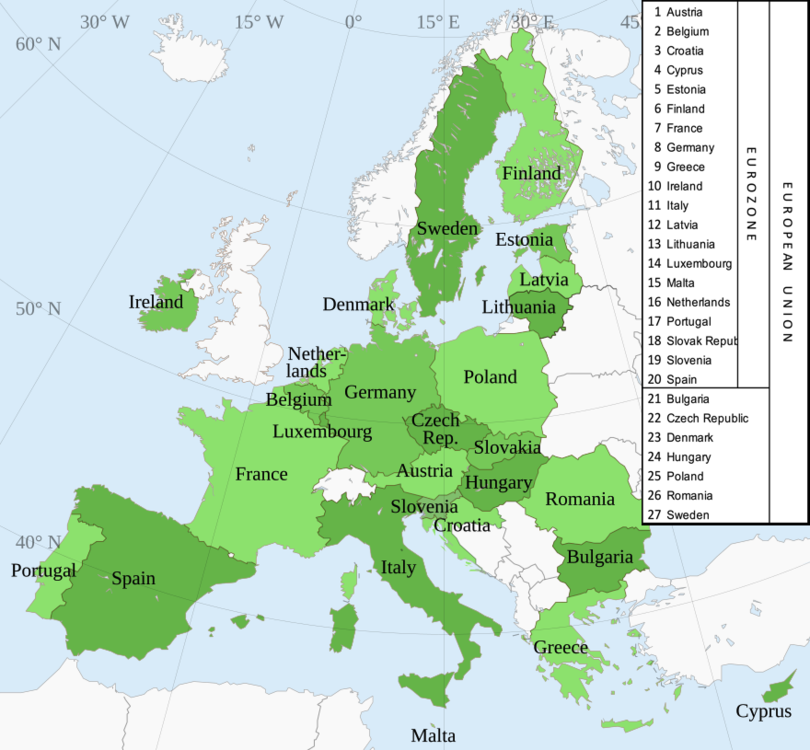
(Jan Nieuwenhuijs, Money Metals News Service) Countries outside the eurozone but inside the European Union, i.e., those that one day might join the eurozone—like Poland, Hungary, and the Czech Republic, are positioning for a new gold standard.
To prepare for a monetary system based on gold, they are buying gold to equalize their reserves to the eurozone average. This balancing of gold reserves in Europe is a key topic I have written about extensively.
And now, additional evidence of these plans has come out, this time from Konrad Raczkowski, former Minister of Finance of Poland.
Raczkowski recently argued official gold reserves in Europe must be evenly distributed relative to GDP, which “in the near future … will be the new gold standard.” His statement adds to a vast body of proof regarding Europe’s preparations for a gold standard.
As the United States, issuer of the world reserve currency, has arrived at a critical phase in its debt spiral and as geopolitical tensions keep mounting, it’s of paramount importance we evaluate what gold’s role will be in the international monetary system moving forward.
Gold Is Central Banks’ Plan B
Most of the largest central banks have a “Plan B” when their paper policy goes haywire, and this backup plan is, to a certain extent, coordinated between them. The first seeds of Plan B were planted by European central bankers and politicians in the 1970s. Only the U.S., together with some of its most obedient vassal states, has been unwilling to cooperate.
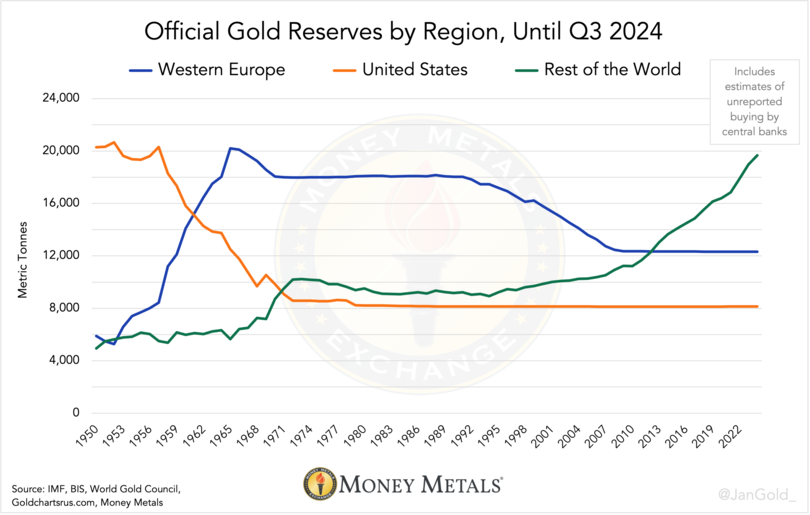
Plan B, of course, is gold, owned by virtually every monetary authority on this planet and bought by non-Western central banks in record amounts in the past years in response to dollar weaponization and debasement (see chart 1 below). A marked change in the international monetary order awaits us.
Why European Nations Want to Evenly Spread Gold Reserves
During the demise of Bretton Woods, it was clear that several European countries wanted to switch to a gold standard. They couldn’t pull it off at the time, partly because the United States was using its military strength to block such efforts. Another reason was that the world’s monetary gold was unevenly distributed at the time. Most metallic reserves were held in Western Europe1.
Chart 1. Official gold reserves are more dispersed across the world than ever.
When the world switches to a new monetary system, that new system will thrive best if all countries have an equal amount (proportionally) of the new monetary unit. In the 19th century, as most countries went on the classic gold standard, gold demand increased, which pushed up the price of gold and led to deflation (gold was the unit of account).
The more skewed the current distribution of official gold reserves, the less smooth a transition towards an international monetary system based on gold.
In the early 1990s, European central banks began selling gold reserves. The central bank of the Netherlands (DNB), for example, sold 400 tonnes in 1992. The gold was sold through the Bank for International Settlements (BIS), off the market, to the Chinese central bank (PBoC). This was the first step towards a more balanced distribution of gold.
As selling by Europe went on, the gold market got worried that uncoordinated sales were destabilizing the market and driving the price down. As a result, in 1999, at the annual IMF meeting in Washington DC, fifteen European central banks signed an agreement to coordinate their sales2. This agreement would become known as the Central Bank Gold Agreements (CBGA).
In the CBGA, they stated that “gold will remain an important element of global monetary reserves. The collective sales will be limited to 2,000 tonnes over the next five years, about 400 tonnes per year.” The signatories also announced that their lending would not increase over the same five-year period (they had 2,119 tonnes on lease in 1999).
The announcements prompted an upward reversal in the gold price—much of the uncertainty surrounding the scale of gold selling by the official sector had been removed. CBGA was repeatedly extended, up until 2014, although most of the selling stopped after 2008.
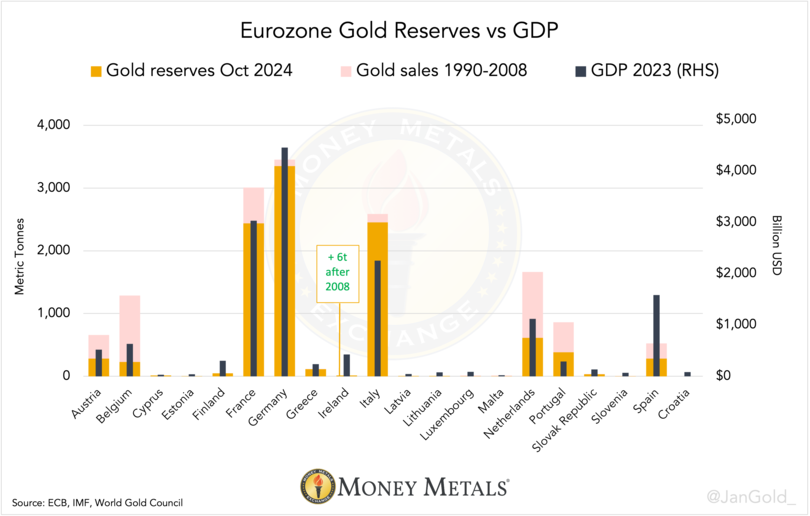
CBGA seemed like an agreement for coordinated gold sales. But for those paying close attention, it was obviously meant to equalize gold reserves among countries relative to GDP. Only medium-sized economies in Europe sold heavily, while large economies sold very little.
Additionally, of the small countries, Cyprus, Estonia, and Lithuania, didn’t sell an ounce of gold during the “concerted programme of sales.” And Ireland even added half a tonne in 2007 and continued buying after 2008.
Chart 2. Eurozone Gold Reserves vs GDP. Source: ECB, IMF, World Gold Council, Money Metals Exchange.
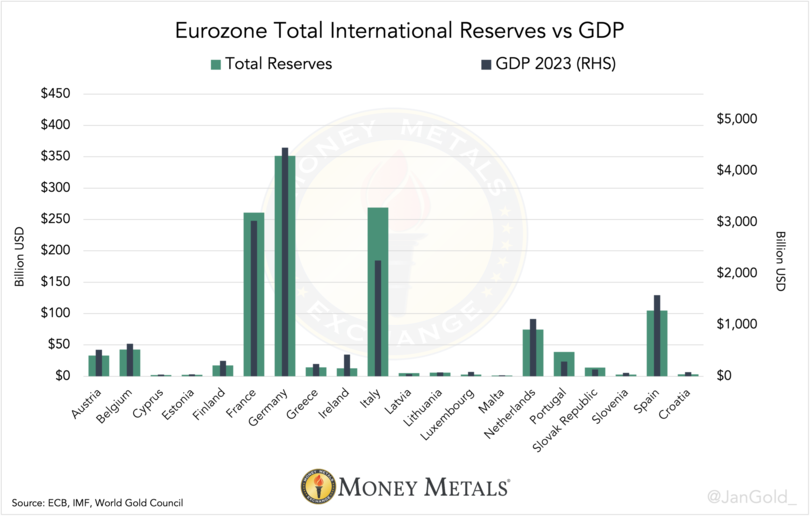
Spain is an outlier in chart 2, although it has more foreign exchange than the other countries. Total reserves (gold and foreign exchange) in the eurozone are more accurately spread than just gold.
Chart 3. Eurozone Total International Reserves vs GDP. Source: ECB, IMF, World Gold Council, Money Metals Exchange.
Within the eurozone, some central banks (that hold too little or too much gold on a relative basis) might cooperate by swapping foreign exchange for gold before gold is revalued. That way, they enjoy the same advantages in their gold revaluation accounts, which can be used to offset bad debt on their balance sheets. This would be the crown on the monetary reset.
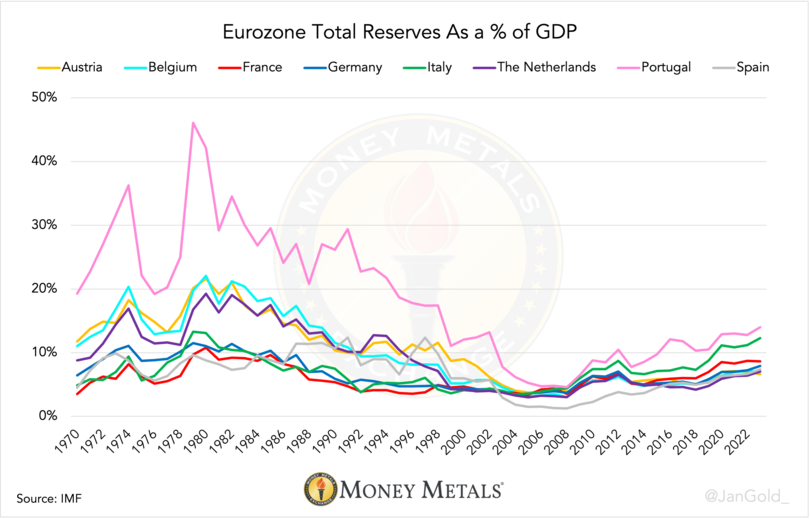
When one sees a visual representation of the total-reserves-to-GDP ratios within the eurozone over time, the coordination of reserves management among these countries is astounding.
Chart 4. Eurozone Total Reserves As a percent (%) of GDP. Source: IMF, Money Metals Exchange.
Remarkably, when I asked central banks about harmonizing reserves within the eurozone, they all replied there is no such policy! Countless Freedom of Information (FOI) requests submitted throughout Europe, directed at central banks and Ministries of Finance, all yielded nil.
Sometimes, for example, in the case of Belgium, I was told the subject was confidential and gold management documents couldn’t be disclosed on grounds of “a legal obligation of secrecy” laid down in a law for its central bank from 1998 (just before CBGA was launched).
Although equalizing gold reserves in Europe is (somehow) not official policy, I have found numerous statements from central banks that prove their ongoing balancing efforts.
With the United States, Germany, Switzerland, France, and Italy, the Netherlands belongs to the group of countries with the largest gold reserves… Within the European Community, when gold reserves are considered in relation to GDP, the Netherlands was and is one of the largest gold-holding countries. On this basis, [DNB] reduced its gold reserves from 1,707 tonnes to 1,307 tonnes in the fall of 1992.
DNB sold another 650 tonnes from 1992 until 2008.
After the Great Financial Crisis (GFC) in 2008, the Minister of Finance of the Netherlands, Jan Kees de Jager, was asked in parliament for the main reason why the Dutch central bank had sold more than 1,000 tonnes of gold since 1992. His answer:
Through gold sales in the past, the Dutch central bank brought its relative gold holdings more in line with other important gold-holding nations.
When he was asked who the buyers were, he answered:
The buyers are developing nations whose international reserves are growing or historically have a small gold stock.
Dutch newspaper NRC Handelsblad covered the 400 tonnes sale by DNB to the PBoC in 1992 and mentioned:
China announced that it is working to build up its [gold] reserves in order to bring it more in line with the size of Chinese GDP.
Even China was in on balancing reserves.
We can read a similar perspective from the Swiss central bank—which was part of CBGA but is not part of the European Union—on why it sold 1,300 tonnes of gold:
The Swiss National Bank completed its gold selling program of 1,300 tonnes on March 30, 2005. Before these sales, Switzerland’s relative position with respect to gold holdings was extreme among the G10 countries.
A statement from the central bank of Austria (OeNB) addresses its gold to total reserves and GDP ratio:
… the volume of gold held by OeNB is deemed to be appropriate relative to the size of both its total reserve assets and the Austrian economy [GDP].
OeNB reveals that gold and foreign exchange reserves are balanced relative to each other and the size of the Austrian economy, affirming the correlations shown in charts 2, 3, and 4.
OeNB officials showing Austrian monetary gold after 90 tonnes from London were repatriated in 2018. Left, OeNB Director Kurt Pribi, right, Governor Ewald Nowotny.
The Banque de France stores 2,435 tonnes of gold in its Underground Vault … These are France’s national gold reserves, valued at around EUR 80 billion. France’s gross domestic product (GDP) is over EUR 2 trillion …. The national gold reserves are thus equivalent to 4% of GDP.
Because the gold price and France’s GDP are not static, the Banque de France’s citing of a gold-to-GDP ratio of 4% must be viewed in comparison to its peers.
Ostensibly, as Germany, France, and Italy hardly sold any gold since the 1990s, many other “important gold-holding nations” aimed to get on par with them by either selling or buying gold. No country’s GDP grows steadily relative to other economies, so gold-to-GDP ratios can somewhat differ but are remarkably proportionate (chart 2).
If countries hold relatively the same amount of gold and the gold price marches on, it will reach levels at which central banks feel comfortable they can stabilize their currencies by pegging them to gold. Or they take action by devaluing their currency against gold until a desired exchange rate is reached.
Eastern Europe Implements Gold Plan
By design, all countries in the European Union but not in the eurozone will someday adopt the euro. Regarding gold reserves, central banks in Eastern Europe historically held less yellow metal than in Western Europe. And so in 2018, the largest economies in Eastern Europe began purchasing gold to catch up.
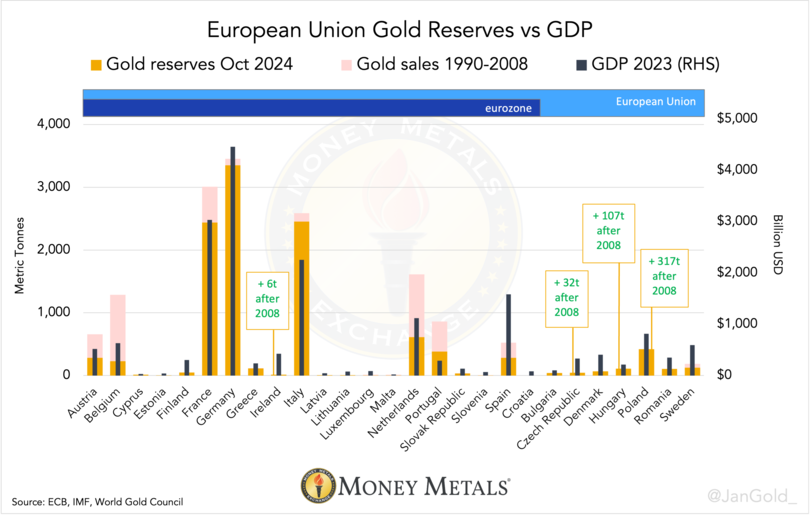
Since 2018, Poland has bought 317 tonnes (+208%), Hungary added 107 tonnes (+3376%), and the Czech Republic increased its holdings by 32 tonnes (+141%).
Chart 5. For “advanced economies” such as Denmark and Sweden, it’s politically sensitive to buy gold. European Union (EU) Gold Reserves vs GDP. Source: ECB, IMF, World Gold Council, Money Metals Exchange.
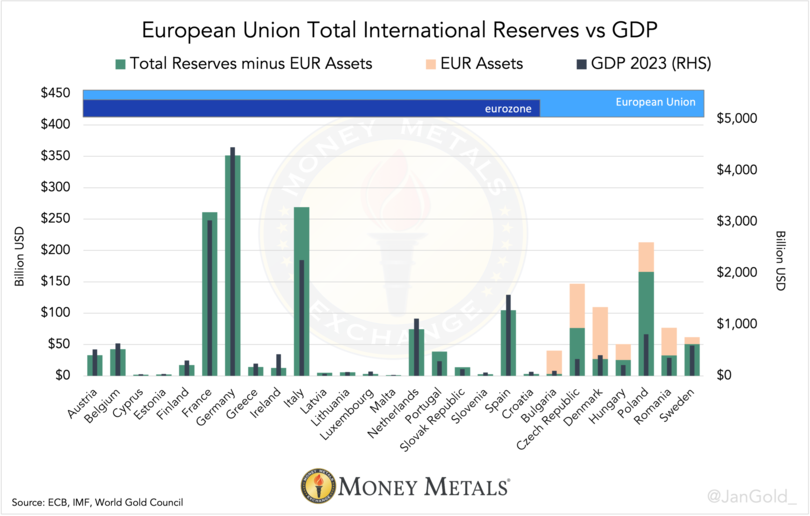
Chart 6. European Union Total International Reserves vs GDP. Source: ECB, IMF, World Gold Council, Money Metals Exchange.
After subtracting euro assets from foreign exchange held by central banks in the EU but outside the eurozone, only Poland and the Czech Republic have too much reserves in total. Bulgaria, Denmark, Hungary (my estimate), Romania, and Sweden’s total reserves to GDP ratios are exactly matched to that in the eurozone. These are amazing statistics, considering these policies officially don’t exist, according to central banks!
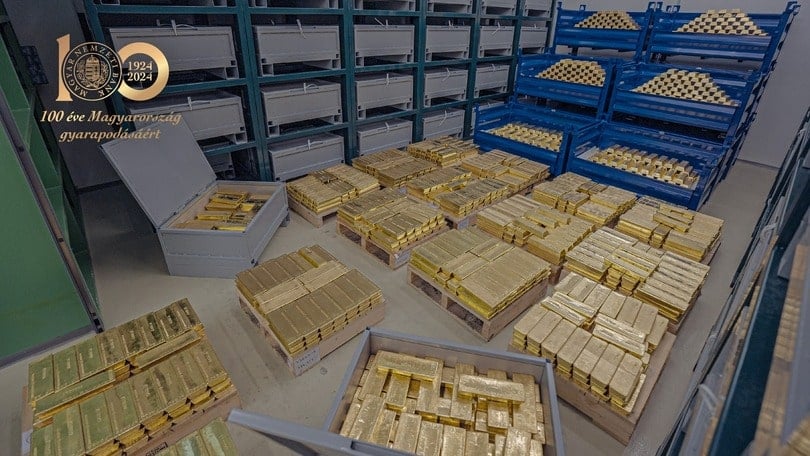
Hungarian monetary gold held domestically displayed for the central bank’s 100th anniversary in 2024. Hungary has bought and repatriated gold since 2018.
The Czech Republic announced it will keep buying gold until it reaches 100 tonnes, and Poland says it is aiming for a little less than 600 tonnes. Both levels would get these countries more in line with the eurozone average gold-to-GDP ratio.
Although I had my suspicions, up until recently, I had never read anything from Eastern Europe about balancing gold to GDP ratios. But then I saw a podcast by Parallel Systems from October 16, 2024, that discussed a quote from Konrad Raczkowski, former Minister of Finance of Poland. The quote was taken from a recent article by Raczkowski in a print magazine published by the central bank of Poland (NBP). From Raczkowski:
In 2017, Polish gold reserves amounted to only 100 tonnes, constituting only 1 percent of GDP. Today, it is over 3 percent of Polish GDP. The National Bank of Poland [NBP] has made justified decisions to significantly increase gold reserves. In the future, … it should buy another 120 tonnes of gold. This level would correspond to … 4 percent of GDP, a level similar to that in the eurozone. It seems that in the near future, this will be the new gold standard for the entire eurozone. These reserves will have to be adjusted to the size of the economy.
As time goes on, this story about balancing gold reserves for a coming gold standard keeps strengthening.
Note, Raczkowski mentions the same gold to GDP ratio as the Banque de France, which is based on data from 2023. Because the gold price has significantly increased this year, the average ratio would be higher by now.
More context about Raczkowski’s remarks was provided by Aerdt Houben, Director of Financial Markets for DNB, in an interview conducted by Anna Dijkman from Het Financieele Dagblad in 2023. (Because Dutch is my native language, that’s where I find the most evidence.)
According to Houben, equalizing gold reserves was a political decision taken in the 1990s. In a crisis, the gold price “shoots up,” and gold will be the foundation of a new monetary system. From the interview:
HOUBEN: [Gold] is really an outstanding commodity to base an exchange rate system on. … If we ever unexpectedly have to create a new currency or a systemic risk arises, the public can have confidence in DNB because whatever money we issue, we can back it with the same value in gold.
In the 1970s, and we did that exercise again in the 1980s and 1990s, we looked at how much gold we had and whether that was still in proportion. … And then we looked at what, globally, what other major central banks were doing. We concluded that we owned too much gold. Our stock of gold was then reduced to about the average of the larger gold-holding countries in Europe.
…
DIJKMAN: So how do you determine what is an appropriate amount then?
HOUBEN: We have about 4% of our GDP in our gold reserves. And that’s comparable to France, Germany, and Italy. … I think it’s more than enough because if everything collapses, then the value of those gold reserves shoots up it skyrockets. … This is not a choice that DNB makes alone. This is in consultation with our shareholders. And that is, of course, the Ministry of Finance, with whom we are in close consultation about our balance sheet and the risks we bear. And also the gold reserves, which are part of that.
You can imagine these quotes made me fire FOI requests all over Europe because they revealed there had to be a political consensus for equalizing gold reserves. Alas, to no avail. The European gold plan is probably “unofficial” not to upset Uncle Sam.
Europe’s Path Towards a New Gold Standard
Next to equalizing metallic reserves, Europe stikes a positive note when communicating about gold, several countries have increased security of their reserves by repatriating their gold, and some even disclosed to have upgraded their bars to current wholesale industry standards, so the world can be confident their gold is ready to be deployed in international markets when needed.
No central bank is served by sudden shocks in the financial system. If the gold price would rise too rapidly, a panic might ensue. After 2008, European central banks have changed how they communicate about gold.
On central bank websites, we can read about the unique properties of this financial asset. These central banks want to convey to the public the inherent risks of paper money that gold is immune to and have the price of gold rise gradually.
For example, this appears on the website for the central bank of Italy:
Gold is an excellent hedge against adversity. … Another good reason for holding a large position in gold is as protection against high inflation since gold tends to keep its value over time. Moreover, unlike foreign currencies, gold cannot depreciate or be devalued …
Gold … is not an asset “issued” by a government or a central bank and so does not depend on the issuer’s solvency.
Exceptional words from an institution that itself issues a paper currency and can go belly up. We can’t conclude Banca d’Italia trusts its own currency, can we?
Shares, bonds, and other securities are not without risk, and prices can go down. But a bar of gold retains its value, even in times of crisis.
Gold is the perfect piggy bank—it’s the anchor of trust for the financial system. If the system collapses, the gold stock can serve as a basis to build it up again.
The French central banks suggests that gold is “the ultimate store of value.” According to former President of the German central bank, Jens Weidmann, gold is “the bedrock of stability for the international monetary system.” And a member of the Board of the Bank of Finland called gold “a genuinely global means of payment [and] a safe haven against both economic and political risks.”
More to the East, the Hungarian central bank discloses it bought gold because “it may play a stabilizing role … in times of structural changes in the international financial system.” The President of NBP, Adam Glapiński, points out that “gold is free from credit risk and cannot be devalued by any country’s economic policy.”
All these central banks are pro-gold.
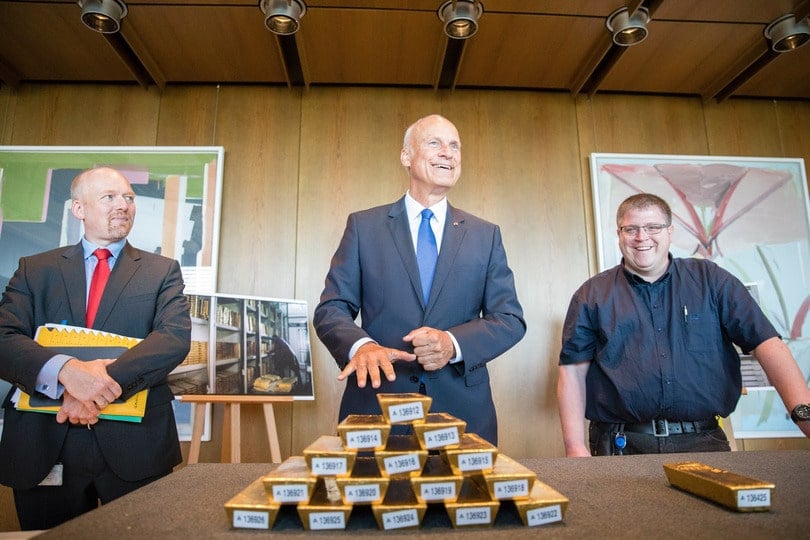
In 2017, Bundesbank Executive Board member Carl-Ludwig Thiele showed the press part of Germany’s gold reserves after repatriation operations from New York and Paris were completed three years ahead of schedule3.
That we know of France, Germany, Sweden, and Poland made all their gold bars adhere to “LBMA Good Delivery” standards for easy access to the global OTC market. Consequently, their metal is liquid and ready for international settlement.
Since 2009, the Banque de France has been engaged in an ambitious programme to upgrade the quality of its gold reserves. The target is to ensure that all its bars comply with LBMA standards so that they can be traded on an international market.
In comparison, the vast majority of the U.S. monetary gold does not comply with current wholesale industry standards and is not liquid.
A Global Gold Standard
Any currency works optimally if all market participants own it and are willing to buy and sell it. Same goes for gold, Europe’s plan B.
This is why Europe has an incentive to encourage central banks and people around the world to own gold. The better gold is distributed around the world, the more liquid gold is, and the more suited it will be as a foundation for a new monetary system when the paper game comes to an end.
As we have discussed, in the 1990s, Europe started selling gold for developing economies to level up. China and other developing countries were probably aware of the distribution of gold by then. The website of the Bank of China—a state-owned bank—states:
From 1973 to 1974, Vice Premier Chen Yun … carried out special research on foreign trade issues. On June 7, 1973, [he] raised ten important questions in international economy and finance.
…
How much money was issued in the U.S., U.K., Japan, France, and Germany from 1969 to 1973? How much were their foreign exchange and gold reserves?
…
What are the possible solutions to problems concerning trade and currency between the U.S., U.K., Japan, France and Germany? Finance Minister Valery Giscard d’Estaing of France advocated the linkage between currency and gold. Can we reckon an approximate ratio between the total monetary flow and the total possession of gold in the world?
Because GDP tends to be correlated to the broad money supply (M2), a future gold standard will likely be a system of gold price targeting by central banks rather than the classical gold standard.
On a classical gold standard, people can redeem national currency for gold at the central bank. With gold price targeting, people can exchange national currency for gold in the free market, in which the central banks aim to stabilize the gold price.
If a country has a balance-of-payments deficit, it can devalue against gold. After all, national currency devaluations are a fact of life. Gold will be the reality check of the international monetary system.
The distribution of gold will never be perfect, though the fact thousands and thousands of tonnes (chart 1) have been bought by countries in the East since 2008 has been encouraging for those who believe “Plan A” will inevitably come to an end.
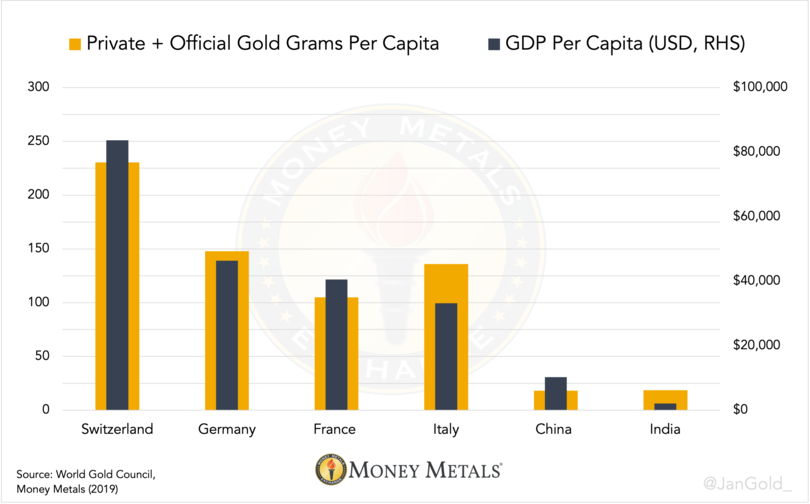
Chart 7. Based on data from 2019. Private & Official Gold Grams Per Capita GDP. Source: World Gold Council, Money Metals Exchange.
As wars rage on and government debt levels keep rising, there will come a point of inflection. Given the pace at which central banks keep buying gold since the war in Ukraine, we may conclude they foresee the end of the dollar hegemony is nearing.
Notes:
What is now the eurozone was then holding nearly half of all monetary gold while contributing 24% to world GDP.
The central banks of the then 11 eurozone countries, plus Sweden, Switzerland, the U.K., and the ECB.
Initially, in 2013, Germany guessed it would take seven years for repatriating because they wanted to upgrade the bars that didn’t adhere to wholesale standards. Eventually, only 4,400 bars had to be sent from New York through Swiss refineries, and the project was finished in 2017 (source).
Previous Articles on this Subject:
Will Gold Be Part Of A New International Monetary System? (2015)
Biden was all smiles as he addressed the nation Thursday following Vice President Kamala Harris’s defeat. Cruz, fresh off his own Senate victory against Democrat challenger Rep. Colin Allred, D-Texas, called Biden “the happiest man in the world” after watching his speech.
Media Weeps: Leftists in Angry Disbelief, ZERO Lessons to be Learned from Kamala's Crushing Loss. @benfergusonshow and I blast the media on Verdict. Available wherever you get your podcasts. https://t.co/B1tFttfyuB
“I gotta say, there’s at least one Democrat right now who is celebrating, who is smiling ear to ear, who may well be the happiest man in the world, and that would be Joseph Robinette Biden,” Cruz said.
He noted how Biden appeared happy during his speech.
“He is joyful. And I’m going to wager you $20 bucks that Joe Biden and Jill Biden, they both pulled the lever for Donald Trump when they voted on Tuesday,” the GOP senator said.
First Lady Jill Biden raised eyebrows after she was photographed wearing a bright red pantsuit to cast her ballot on Election Day.
Dr. Mrs. First Lady Jill Biden wore a bright RED REPUBLICAN dress to go vote today. And her husband will not be attending Kamala's DC watch party. I wonder if the Bidens both voted for Trump/Vance? pic.twitter.com/Ij8owjYqa3
Social media users did not hesitate to resurface the image of Biden donning a MAGA hat in September after Trump was declared the next president, joking that he voted against his own vice president.
“I think Joe Biden is pissed. I don’t think it’s an accident that Joe Biden put on a MAGA hat in the middle of the election,” Cruz continued. “I do not think it is an accident that Jill Biden when she went to vote dressed in all red.”
On July 21, Biden dropped his reelection bid and endorsed Harris following a three-weeks-long pressure campaign for him to step aside.
High-profile Democrats including former House Speaker Nancy Pelosi, former President Barack Obama, Senate Majority Leader Chuck Schumer and House Minority Leader Hakeem Jeffries reportedly urged the Democrat president to withdraw after his poor debate performance against Trump on June 27.
“Yeah, and look, I am certain that Joe Biden looked at his family, looked at his top staff, and said, ‘If it had been me, I’d have won.’ He believes, sure, he believes it through and through,” Cruz remarked. “And I don’t think he will ever forgive Nancy Pelosi and Barack Obama and Chuck Schumer for throwing him overboard, doing it unceremoniously, and saying we want Kamala.”
Cruz added he too is celebrating Trump’s win.
“And Joe Biden, I think is celebrating, and not even that quietly,” the senator said. “And you know what I’m celebrating too, because it means the country it’s morning in America again, we’re turning the country around.”
Julianna Frieman is a freelance writer published by the Daily Caller, Headline USA, The Federalist, and The American Spectator. Follow her on Twitter at @JuliannaFrieman.
(Mike Maharrey, Money Metals News Service) Unsurprising and bland. Those words pretty much sum up the November Federal Reserve meeting.
As anticipated, the Fed cut interest rates by another quarter point. This sets the current interest rate in a range between 4.5 and 4.75 percent.
The messaging coming out of the FOMC meeting wasn’t much more remarkable.
Federal Reserve Chairman Jerome Powell walked a tightrope, being very careful not to send any strong signals about the trajectory of monetary policy.
The FOMC statement noted that “economic activity has continued to expand at a solid pace” but noted that “labor market conditions have generally eased.”
As far as inflation, the FOMC said it “has made progress toward the Committee’s 2 percent objective but remains somewhat elevated.”
The word of the day was “data.”
The FOMC statement said, “In considering additional adjustments to the target range for the federal funds rate, the Committee will carefully assess incoming data, the evolving outlook, and the balance of risks.”
Powell reiterated this “data dependence” in his post-meeting press conference, emphasizing that the central bank is not on any “preset course” and asserting, “We will continue to make our decisions, meeting by meeting.”
Powell went on to paint a picture of a Fed poised to pivot toward any direction necessary.
“If the economy remains strong and inflation is not sustainably moving toward 2 percent, we can dial back policy restraint more slowly. If the labor market were to weaken unexpectedly, or inflation were to fall more quickly than anticipated, we can move more quickly.”
In other words, no matter what the Fed does going forward, Powell can plausibly say he told you so.
While giving no hint at a timeline, Powell indicated that the general trajectory of interest rates will be lower. He said the lower bowering costs are necessary for the Fed to achieve its dual mandate of price stability and maximum employment.
This is perhaps the most revealing statement Powell made. It shows that the central bankers still worry that this higher interest rate environment will crack the bubble economy. And they’re right. This economy can’t function in this rate environment because it is loaded up with debt.
In fact, the NFCI has been showing loose financial conditions for months, even at the peak of the Fed tightening cycle. This hints at the fact that the central bank never did enough to truly rein in inflation.
Powell insisted that the election of Donald Trump would have “no effect on our policy decisions,” at least in the short term. He did concede new policies coming out of the next administration could have an impact on future monetary policy decisions insofar as they change the economic situation.
“Just in principle, it’s possible that any administration’s policies or policies put in place by Congress could have economic effects over time. So, along with countless other factors, forecasts of those economic effects would be included in our models of the economy and would be taken into account.”
In other words, keeping with the theme, Powell gave no hint as to what a Trump presidency may mean for the trajectory of interest rates.
Interestingly, Powell did say he would not resign if Trump asked him to, and he insisted the president couldn’t fire him because it is “not permitted under the law.”
My impression of the Fed’s trajectory hasn’t changed much since it surprised us with a supersized rate cut in September. I still believe the Fed has surrendered to inflation.
Even before the rate cuts, the Fed was already winding down the inflation fight. The central bank loosened monetary policy when it quietly announced that it would begin to taper balance sheet reduction in June.
Since then, the money supply has been increasing. This is, by definition, inflation.
And inflation will continue to increase as the Fed cuts rates – no matter how quickly or slowly it precedes.
How long it takes for this inflationary pressure to show up in consumer prices remains to be seen, but everybody should be aware that inflation is far from dead and buried.