(Ken Silva, Headline USA) House Republicans said Monday that they’re planning to hold the pro-Democrat political action committee ActBlue in contempt of Congress for refusing to comply fully with their subpoenas.
“For more than a year, the Committees have conducted oversight regarding ActBlue’s fundamentally unserious approach to fraud prevention, which may allow foreign nationals and bad actors to make large-scale fraudulent donations on Democrats’ top fundraising platform,” the House Judiciary Committee said in a press release.
“ActBlue continues to obstruct this inquiry by making expansive assertions of attorney-client privilege in an attempt to improperly shield documents that are responsive to the Committees’ subpoenas and essential to its oversight.”
The House committee didn’t say when it would move on contempt proceedings. In an open letter to ActBlue CEO Regina Wallace-Jones, GOP leaders said they’re “prepared to enforce our subpoenas through all available mechanisms.”
The contempt threats from the House follow Wallace-Jones testifying to Congress earlier this month—exercising her 5th Amendment right to remain silent more than 20 times throughout the process.
ActBlue has refused to produce all documents required by the Committees' subpoenas.
We still need answers on their scheme to take illegal donations from foreign sources… pic.twitter.com/OAMsudVtYP
— House Judiciary GOP 🇺🇸🇺🇸🇺🇸 (@JudiciaryGOP) June 22, 2026
Wallace-Jones published an op-ed in the Washington Post the morning before the hearing, explaining her decision to plead the 5th.
“Invoking the Fifth Amendment is not an admission, or even an insinuation, of guilt. It is not a retreat,” she said. “It is the only reasonable response to a proceeding that from the beginning has been about harassing a political opponent’s fundraising platform, not genuine oversight. Now it has become something far more dangerous.”
House Republicans first opened an investigation into ActBlue after Wallace-Jones took over in 2023. By 2025, ActBlue’s own attorneys reportedly urged her to seek personal counsel after concerns she appeared to have misrepresented the group’s safeguards to lawmakers regarding foreign donations.
Along with allegations of receiving illegal donations, a Wall Street Journal report from May detailed the spending and raised fresh questions about Wallace-Jones’s leadership and potential legal exposure.
For example, onths after President Donald Trump defeated then-Vice President Kamala Harris in 2024, ActBlue spent roughly $700,000 on a retreat at the InterContinental San Francisco. The event included hundreds of hotel rooms, while Wallace-Jones stayed in a two-story presidential suite under heavy security.
Security costs have surged to at least $2.8 million since 2023, compared to less than $16,000 between 2020 and 2022, according to The Journal.
Travel expenses also spiked, with ActBlue plowing through $4.9 million in travel costs since 2023, including $2.7 million in 2025 alone. That’s up from less than $400,000 in 2022.
New policies allow executives and board members to book first-class flights and receive largely uncapped accommodations.
Operating costs followed the same trajectory. ActBlue spent $87 million during the 2024 presidential cycle, up from the $42 million spent in 2020. ActBlue has already spent $72 million ahead of the 2026 midterms.
Ken Silva is the editor of Headline USA. Follow him at x.com/jd_cashless.
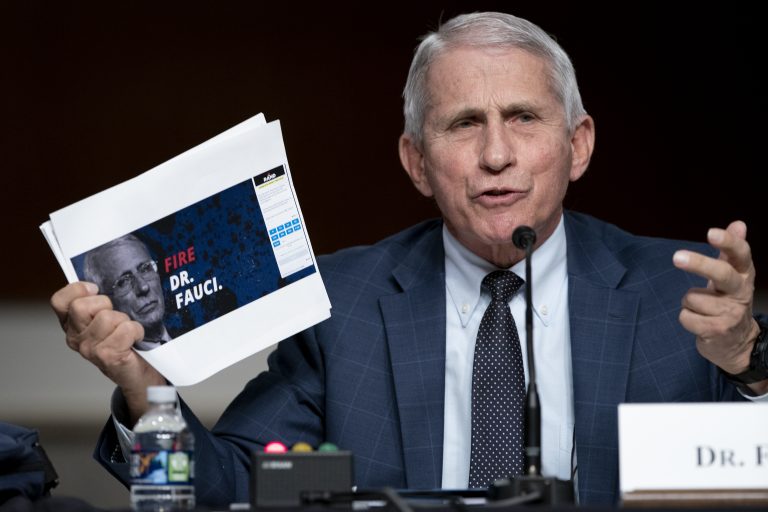
(Ken Silva, Headline USA) Former White House COVID czar Anthony Fauci reportedly agreed earlier this month to testify before Sen. Rand Paul’s Committee on Homeland Security and Governmental Affairs—but he’s since changed his mind.
Sen. Paul said Monday on Twitter/X that he’s subpoenaed Fauci to testify since he’s not speaking voluntarily.
“Last week, Anthony Fauci notified us he will NOT voluntarily testify before the Senate Homeland Security and Governmental Affairs Committee, even though he had previously agreed to do so,” Paul said. “Therefore, today I have issued a subpoena requiring him to testify before the Committee, in public, next month.”
Last week, Anthony Fauci notified us he will NOT voluntarily testify before the Senate Homeland Security and Governmental Affairs Committee, even though he had previously agreed to do so.
Therefore, today I have issued a subpoena requiring him to testify before the Committee,…
Fauci, who was among several officials pardoned by former President Joe Biden for potential federal offenses, has faced ongoing congressional scrutiny over the use of taxpayer-funded grants tied to controversial gain-of-function research. He’s also accused of using private email to avoid public disclosure obligations that come with government communications.
One of Fauci’s former aides, David Morens, has been indicted over the matter.
Presumably, Biden’s pardon wouldn’t apply to Fauci if he lies to Sen. Paul’s committee at his upcoming interview.
The controversy of Fauci, Morens and others trying to hide their communications stems from the infamous $3.7 million grant that the National Institutes of Health gave to Peter Daszak and his firm, EcoHealth Alliance, for “Understanding the Risk of Bat Coronavirus Emergence.” That grant allegedly funded risky gain-of-function research that some think led to the COVID-19 pandemic.
In early 2020, the Trump administration terminated the grant. But according to the indictment, Morens conspired with others to restore the termination of the bat coronavirus grant and counter the narrative that COVID-19 leaked from a lab. The grant was reinstated in April 2023, which was after Morens had left his role at the National Institute of Allergy and Infectious Diseases.
As part of their conspiracy, Morens and the others unnamed used private email to avoid public disclosure obligations that come with government communications.
“Morens, Co-Conspirator 1, and Co-Conspirator 2 agreed in writing to intentionally hide from public view their communications by corresponding using Morens’s personal Gmail account, rather than his official NIH email account,” the DOJ said in a press release.
“The indictment alleges that the conspirators used Morens’s personal Gmail account to exchange non-public NIH information; correspond about their efforts to influence NIH to fund Company #1; exchange edits to drafts of letters addressed to NIH leadership for Company #1 and Co-Conspirator 1; and “back-channel” information to Senior NIAID Official 1.”
The indictment also alleges that Morens conspired with Co-conspirator 1 to pay illegal gratuities.
More recently, outgoing National Intelligence Director Tulsi Gabbard released documents Friday showing that Fauci had compelling evidence that COVID may have leaked from a lab in China. Despite that the Fauci-led medical regime engaged in a censorship campaign against anyone who pushed the lab-leak theory for roughly the next four years.
Ken Silva is the editor of Headline USA. Follow him at x.com/jd_cashless.
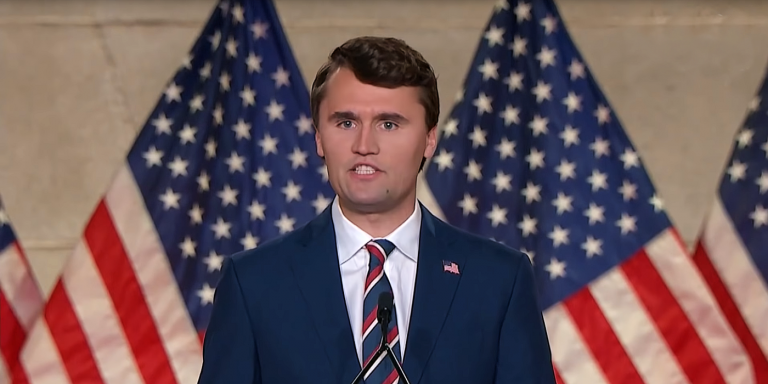
(Ken Silva, Headline USA) A school district in Charlotte, North Carolina that initiated a criminal investigation into a student for painting a memorial to honor conservative activist Charlie Kirk has agreed to pay $95,000 to settle a lawsuit over the matter.
After Kirk’s Sept. 10 assassination, a student at Ardrey Kell High School painted a message on its “spirit rock” in support of Kirk and his Christian message. She, her parents, and two fellow students painted the rock with the words “Freedom 1776” and “Live Like Kirk—John 11:25” on Sept. 13.
Within hours, the student, Gabby Stout learned that school officials ordered the memorial to be painted over, according to the lawsuit, which was filed December in North Carolina federal court with the help of the organization Alliance Defending Freedom.
“The next day, [school] officials publicly accused [Stout] of a crime and a student conduct violation (vandalism), contacted law enforcement, and began cooperating with the criminal investigation,” Stout’s lawsuit says.
“The day after that, the Monday (and first school day) after [Stout] painted the spirit rock, [school] officials called her out of class, forced her to write out a statement summarizing her rock-painting efforts, and forced her to edit that statement to include details they believed to be important. And they did this without first advising [Stout] of her constitutional rights in any criminal proceeding, including the right to remain silent and the right to have legal counsel.”
A Charlotte high school student was criminally investigated for painting a memorial for Charlie Kirk on the school's "spirit rock" The student is suing over the matter. The school previously allowed pro-BLM messages on the rock, her lawsuit says H/t to @NumberSixTNP for flagging pic.twitter.com/sumfGHKHsX
By the end of the week, the school quietly closed its investigation. But the damage had already been done. Along with the distress caused by the prospect of criminal charges, Stout said she felt humiliated and ostracized by other students over the matter.
Some six months later, Stout and the school district reached a settlement. As part of the settlement, the school board agreed to adopt a new free speech policy, to issue a public statement clearing the student of all wrongdoing and expressing “regret that the student had this experience,” and to pay $95,000 in costs and attorneys’ fees, according to a press release from ADF.
“What happened to this student is outrageous. School officials should never censor, punish, or shame a student simply for sharing her views,” said ADF Senior Counsel Travis Barham said in a press release last week.
“Charlie Kirk boldly defended open and respectful discourse on school grounds literally until his last breath, and this courage inspired many across the country, including our client, whom Charlotte-Mecklenburg Schools officials treated so abominably. It is long past time for school officials to learn that they cannot promote student viewpoints they like while punishing students whose views they dislike.”
Ken Silva is the editor of Headline USA. Follow him at x.com/jd_cashless.
(Money Metals News Service) In a recent interview on the Pinnacle Digest Podcast, host Aaron Hoddinott sat down with Money Metals President and CEO Stefan Gleason to discuss central bank gold buying, Federal Reserve policy, the future of the U.S. dollar, and the growing debate surrounding America’s gold reserves.
Gleason argued that the global monetary system is undergoing a major shift as countries increasingly turn to gold to reduce their dependence on the U.S. dollar.
Why Central Banks Are Buying Gold Instead of U.S. Dollars
According to Gleason, the freezing of Russian assets following the 2022 invasion of Ukraine accelerated the global push toward de-dollarization. Nations around the world took notice that access to the dollar-based financial system could be restricted, increasing the appeal of gold as a reserve asset that cannot be frozen or sanctioned by foreign governments.
He believes central bank demand has been a primary driver behind gold’s rise from roughly $2,000 per ounce to successive record highs. Gleason also noted that gold recently surpassed sovereign bonds as the world’s leading reserve asset among central banks, signaling a significant shift in reserve management strategies.
Federal Reserve Policy, Interest Rates, and Gold Prices
The conversation then turned to Federal Reserve Chair Kevin Warsh and whether his recent hawkish comments pose a threat to gold prices.
Gleason argued that investors often misunderstand the relationship between interest rates and gold. Historically, gold has frequently performed well during periods of rising rates when inflation remains above interest rates, resulting in negative real returns for investors holding cash and bonds.
He also questioned how much flexibility the Federal Reserve truly has. With federal debt levels at historic highs and annual interest costs exceeding $1 trillion, Gleason believes policymakers will struggle to maintain restrictive monetary policy for long. In his view, inflation and liquidity injections remain more likely than sustained monetary tightening.
Will the U.S. Face Another Financial Crisis?
When asked whether America could experience another crisis similar to 2008, Gleason acknowledged growing risks in commercial real estate, private credit, technology, and artificial intelligence-related investments. However, he said policymakers are far better prepared to intervene today than they were during the Global Financial Crisis.
Drawing on past conversations with former Federal Reserve Governor Kevin Warsh and economist Mohamed El-Erian, Gleason argued that central banks have developed extensive tools for stabilizing markets. While volatility and asset losses remain possible, he expects authorities to respond aggressively with liquidity measures before allowing a systemic collapse.
As a result, Gleason sees inflation and currency debasement as more likely outcomes than a prolonged deflationary downturn.
Physical Gold and Silver Markets Show Growing Stress
Gleason also provided insight into current conditions in the physical precious metals market. Money Metals has been a net buyer over the last two to three months as investors take profits following strong gains in gold and silver prices.
He noted that local coin shops across North America are seeing heavy selling activity, particularly in silver. The influx of material has overwhelmed portions of the refining industry and exposed significant infrastructure challenges.
According to Gleason, North America lacks sufficient silver refining capacity, leading to major backlogs and forcing some material to be shipped overseas for processing. Despite the selling pressure in the West, he said demand remains extremely strong throughout Asia, where investors continue accumulating precious metals at elevated levels.
Why Physical Silver Trades at a Premium in Asia
The discussion also explored the growing gap between paper silver prices in Western futures markets and physical silver premiums in Asia.
Gleason explained that Western markets rely heavily on leveraged futures trading and hedging activity from miners, refiners, and dealers. This creates significant paper-market selling pressure that can weigh on prices.
Asian markets, by contrast, are driven more by physical ownership and less by leverage. Combined with stronger cultural demand and economic growth, these factors have created persistent premiums for physical silver in countries such as India and across Southeast Asia.
He cited examples of silver flowing from London to New York and eventually to Asia as traders pursued arbitrage opportunities created by regional price differences and shortages of physical metal.
The SILVER Act and U.S. Precious Metals Infrastructure
Introduced by Senator Catherine Cortez Masto of Nevada and Senator Jim Risch of Idaho, the legislation seeks to reduce concentration risk within U.S. precious metals markets. Gleason argued that the majority of gold and silver backing major futures contracts remains concentrated in New York-area vaults, creating a potential single point of failure.
The legislation would allow qualified depositories in other regions of the country to participate more fully in exchange infrastructure, increasing resilience, competition, and market access.
Gleason argued that the United States has not conducted a truly comprehensive audit of its gold reserves in decades. While various reviews have occurred over the years, he contends that many fail to meet modern auditing standards that require physical verification, chain-of-custody controls, and detailed inventory procedures.
He supports the Gold Reserves Transparency Act, which would mandate a comprehensive audit of U.S. gold holdings and determine whether any of the reserves have been leased, swapped, pledged, or otherwise encumbered.
The 83% U.S. Gold Reserve Purity Problem
According to Gleason, one of the least understood issues surrounding America’s gold reserves is purity.
He claims that approximately 83% of U.S. gold reserves consist of older “coin melt bars” containing between 90% and 93% gold. These bars were produced decades ago from melted U.S. gold coins and do not meet today’s international good-delivery standard of 99.99% purity.
Because modern bullion markets require higher purity levels, Gleason argues that much of the nation’s gold would need to be refined before it could be readily traded or used in a financial intervention. Estimates cited during the interview suggest that refining roughly 7,000 tons of non-pure gold reserves could take decades under current industry capacity constraints.
China’s Gold Reserves Could Change the Global Monetary System
The interview concluded with a discussion of China’s gold holdings and their potential implications for the global economy.
China officially reports reserves of roughly 2,000 tons, but Gleason believes the true figure may be significantly higher. Based on import data and other indicators, he suggested China’s actual holdings could eventually prove to be closer to 8,000 to 10,000 tons.
If Beijing were to reveal substantially larger reserves, the announcement could reshape perceptions of global monetary power and potentially accelerate the transition toward a more multipolar financial system.
Whether through continued central bank accumulation, growing questions about sovereign gold reserves, or evolving monetary policies, Gleason believes gold will remain at the center of some of the most important economic debates in the years ahead.
To learn more, visit Pinnacle Digest to stay connected with Aaron and his team, Money Metals for precious metals investing, storage, and lending services, and the Sound Money Defense League for updates on state and federal sound money legislation and precious metals policy initiatives. Together, these organizations continue to contribute to the ongoing conversation surrounding gold, silver, monetary policy, and the future of the global financial system.
(Headline USA) The top U.S. auto regulator opened an investigation Monday after a Tesla using an automated driving feature slammed into a Texas home at high speed and killed a 76-year-old woman standing inside.
The National Highway Traffic Safety Administration said it’s opening a special investigation into the Tesla Model 3 crash on Friday near Houston, a significant probe because the car was using technology that Elon Musk considers key to the company’s future.
The Tesla CEO is rolling out robotaxis using automated software in several U.S. cities this year and plans to invite Tesla owners to put their cars into the fleet using the same system across the country.
The driver told the Harris County Sheriff’s Office that he was using the technology, according to a police report on the crash, but it’s not clear what role, if any, it played in the incident.
The police report also noted that the driver was not drunk and is cooperating. It identified the woman killed as Martha Avila.
Video obtained by KHOU-TV shows the car traveling at top speed over the front lawn of a brick home in Katy, then ramming into a front room. The next shot shows the car encased in the home amid piles of crumbling plaster, split beams and bits of furniture.
Tesla did not respond immediately to a request for comment.
The auto safety regulator, known as NHTSA, has launched several investigations into Tesla, including one late last year into 58 incidents in which Teslas reportedly violated traffic safety laws while using self-driving technology, leading to more than a dozen crashes and fires and nearly two dozen injuries.
A few months earlier, the NHTSA opened an investigation into why Tesla apparently had not been reporting crashes promptly as required.
As for special crash investigations, the NHTSA has opened 46 involving Teslas using self-driving or driver-assistance technology over the past decade, according to the agency’s records. In more than a dozen of those crashes, at least one person — a driver, passenger or pedestrian — was killed.
Tesla stock fell sharply early last year as car sales plunged amid a boycott of Musk after he waded into politics, leading President Donald Trump’s budget-cutting Department of Government Efficiency initiative and embracing European extremist candidates.
Musk has since shifted the Tesla story to one less about car sales and more about AI and robotaxis, and done so successfully. The stock is up 16% in the past year.
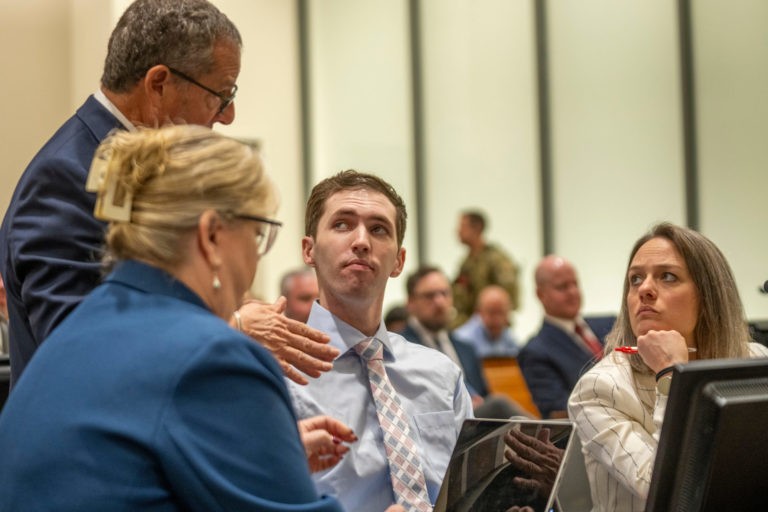
(Headline USA) The Utah judge in the murder case of Charlie Kirk’s killing has denied a defense request to force Tyler Robinson’s former roommate to testify in person during the preliminary hearing, saying that the credibility of any testimony can be challenged later if the case goes to trial.
Judge Tony Graf made the ruling during a hearing Monday morning, saying the purpose of a preliminary hearing is to establish whether there is enough evidence to justify bringing the case to trial, not to determine whether someone is innocent or guilty.
Graf also postponed a ruling on whether prosecutors could face sanctions for comments to the media about a bullet fragment recovered from the conservative activist’s body until Friday. The defense team had asked Judge Tony Graf to block the death penalty in the case, claiming the prosecutors’ comments could sway potential jurors regarding his guilt.
Robinson, 23, has not yet entered a plea. He is charged with aggravated murder in the Sept. 10 killing of Kirk, a close ally of President Donald Trump who was shot in the neck while addressing a crowd of thousands at Utah Valley University.
Prosecutors have said DNA consistent with Robinson’s was found on the trigger of the rifle, the fired cartridge casing and two unfired cartridges. Defense attorneys note that forensic reports indicate multiple people’s DNA was found on some items, which they say requires a more complex analysis.
Robinson reportedly texted his roommate, who was also his romantic partner, that he targeted Kirk because he “had enough of his hatred,” prosecutors have said.
Robinson’s defense team asked the judge to block prosecutors from using recorded statements from the roommate in the preliminary hearing, set to begin on July 6. The roommate should be brought to testify in person, the defense attorneys said, so that Robinson can exercise his right to confront witnesses in person and challenge their credibility. But Graf denied that request, saying the time for challenging witnesses will come later.
“The Utah Supreme Court has repeatedly emphasized that a preliminary hearing is not a trial on the merits, but a gateway to the finder of fact,” Graf said. The task of determining whether a witness is credible is a job for the jury if the case goes to trial, he said.
The case has attracted widespread attention, and online speculation and conspiracy theories grew after the defense team disclosed in public court documents that initial tests were inconclusive to determine whether the bullet was fired from the suspected murder weapon.
Conjecture over that evidence fueled unsubstantiated conspiracy theories that there might have been a second shooter, or that his death was staged. Attorneys on both sides have raised concerns that the misinformation and extensive media attention could taint the potential jury pool.
Judge Graf held a hearing earlier this month over whether prosecutors should be held in contempt for their comments about the bullet.
Robinson’s attorneys accused prosecutors including Deputy Utah County Attorney Christopher Ballard of trying to influence potential jurors by going on a “media tour” to talk about ballistics evidence in the case.
Ballard argued at the June 12 hearing that he didn’t speak to the media about case specifics, and he only remarked generally about how ballistics testing can be inconclusive.
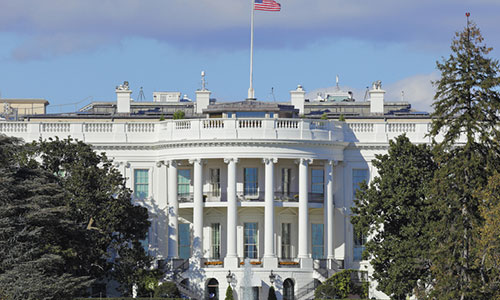
(Headline USA) Two more people in Missouri and Washington state have been arrested in connection with what authorities say was a planned attack targeting President Donald Trump’s UFC cage-fighting show at the White House earlier this month.
Law enforcement officials disrupted the plan a few days before the June 14 White House event, according to court documents.
William Lee Spartacus Falkner of Belfair, Washington, was arrested Friday and charged with conspiracy to commit murder, according to court documents filed Monday in the Western District of Washington. Jordan W. Rincker, 28, was arrested Sunday and charged with conspiracy to commit murder in the Western District of Missouri. A defense attorney appointed to represent Falkner did not immediately respond to an email requesting comment, and court records do not reveal if Rincker has obtained an attorney. Neither man has had the opportunity to enter a plea.
“Law enforcement continues to do what it does — move to disrupt and hold accountable those allegedly plotting to do harm on the White House Grounds on June 14,” Acting Attorney General Todd Blanche said in a news release.
Law enforcement officials learned about the possible threat on June 10, four days before the mixed martial arts extravaganza on the White House’s South Lawn. The Justice Department last week announced federal charges against five people from states including Ohio, Missouri, Nebraska and California. The latest arrests bring the number of people known to be facing federal charges to seven.
NEW: Two more men have been arrested by the FBI in connection to the alleged plot to turn the White House UFC event into a mass-casualty attack.
The two new suspects were arrested in Missouri and Washington state, with prosecutors saying they played a supporting role in the… pic.twitter.com/xliBzOO2p7
Officials say the group members harbored fringe conspiracy theories and hoped the attack would destabilize the government.
The investigation began after the mother of an Ohio man contacted police because she was concerned about her son’s recent firearms purchases and online communications, according to an FBI affidavit filed in the case.
The man, 19-year-old Tycen Proper, told investigators that he was part of a group that wanted to trigger a revolution and target members of the government, and that they planned to fly explosive-laden drones into the event and then shoot panicked crowd members as they fled, according to the affidavit. Proper is charged with firearms offenses and crimes including attempted murder of an officer or employee of the United States.
“Mr. Proper appreciates the serious nature of the charges currently pending against him and will address them appropriately in court at the right time,” Proper’s attorney, Joe Patituce, said Monday. “For now, we are going to move the case forward one step at a time.”
Investigators recovered high-powered firearms from several of the suspects and reviewed encrypted text messages between roughly 20 participants who shared detailed maps and aerial photographs of the area and discussed the need for a “safe house” and escape routes after the intended attack, the documents show.
But it’s unclear from the court records how close the would-be attackers could have come to being able to carry out the plan had it not been thwarted.
Several suspects or co-conspirators who were questioned by the authorities said they did not intend themselves to carry out violence but planned to instead observe others. One said he would have traveled to the UFC event as a protester but had to return home after his vehicle malfunctioned. And though the participants spoke of using drones rigged with explosives, charging documents suggest they were still looking to acquire such equipment when the plot was interrupted.
Prosecutors say Rincker distributed cash to some of the conspiracy members, and that he accepted goods including weapons, a 3D printer, a computer and other items and agreed to produce drone parts. Rincker told an investigator that he didn’t actually intend to help build the drones suing the printer, according to an FBI affidavit, and just wanted the printer so he could make and sell crafts.
An FBI affidavit says Falkner communicated with other group members about his ability to procure and operate drones as well as what tactics and explosives to use in the plot. After news broke that the plan had been disrupted, Falkner texted another group member to say, “Work trip is canceled. My boss got picked up,” and sent a link to an article detailing the initial arrests, according to the affidavit.
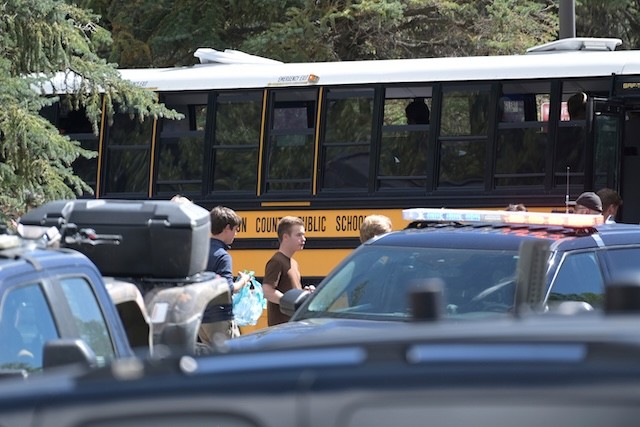
(Headline USA) A shooting at a library in Northern California on Monday left two people dead and a suspect is in custody, according to police.
Police responded to a 911 call soon after 5 p.m. in which the sounds of gun shots and people screaming could be heard coming from inside the Chico branch of the Butte County Library, Billy Aldridge, the city’s chief of police, said during a news conference.
Once officers were inside the library, the suspect fled out of the back, he said. Additional law enforcement behind the library took the suspect into custody, according to Aldridge.
“The incident this evening was obviously very sad, traumatic for a lot of people. Very traumatic for our community,” he said.
The streets around the library were closed temporarily and a family reunification center was set up for the people who were inside the building.
BREAKING: Police have detained a suspect after reports of an active shooter incident at the Butte County Library in Chico, California. pic.twitter.com/xhfL7L4oBy
A child was also taken to the hospital with a minor injury.
Aldridge said there is no serious threat to the public and law enforcement are investigating the shooting.
The police didn’t release the suspect’s name nor details on what prompted the shooting. Law enforcement said they believe the shooter acted alone.
Law enforcement are also not releasing the names of the people killed until next of kin have been notified.
The county urged the public to avoid the area and said all Butte County library branches will be closed Tuesday.
The county in a post on Facebook offered “deepest condolences to everyone affected, including the victims, their loved ones, library staff, and all those impacted by this heartbreaking incident.”
(Luis Cornelio, Headline USA) Twice-failed presidential candidates Hillary Clinton and Kamala Harris may have lost different elections, but they now share a common complaint: the Electoral College.
In a preview of her upcoming Netflix docuseries, The American Experiment, Clinton described the Electoral College as an “abomination.”
“Well, I personally think the Electoral College is an abomination. For obvious reasons,” Clinton said in the series, which is scheduled for release on June 24, as reported by Variety.
Hillary Clinton Still Blames the Electoral College for 2016
In a new Netflix docuseries, Hillary Clinton once again calls the Electoral College an “abomination” and continues to express frustration over her 2016 loss.
— Paul A. Szypula 🇺🇸 (@Bubblebathgirl) June 22, 2026
Clinton’s latest Electoral College lament came just days after Harris offered a similar critique during a June 19 interview with Don Lemon, the fired CNN host-turned-YouTuber.
Harris’ comments first focused on the Supreme Court and proposals pushed by some Democrats to expand the number of justices. Lemon then shifted the discussion to the Electoral College.
“Since we are there, what about the Electoral College?” Lemon asked.
“We need to look at that too,” Harris replied. “I think we need to look at that too, yes. Yes, I do.”
Asked whether eliminating the Electoral College was among her proposals, Harris said: “I think that should be a discussion that we should have. I don’t think we should eliminate that as a point of discussion for potential action.”
Despite criticism from Clinton and Harris, the Electoral College has been praised as a cornerstone of the Constitution’s federal system.
By design, the Electoral College was established by the framers as a check on majority rule and a way to protect the interest of smaller states in presidential elections, as noted by the Heritage Foundation, one of the most prominent think tanks in the U.S.
Clinton lost the 2016 election to President Donald Trump after failing to secure enough electoral votes in key battleground states, including Pennsylvania, Michigan and Wisconsin.
She won the popular vote, though this figure carries no significance in U.S. elections.
Meanwhile, Harris lost both the electoral college and the popular vote to Trump in 2024. In practice, Harris would have still lost the election even under a popular vote system.
Both Clinton and Harris previously sought the Democratic nomination for president in 2008 and 2020, respectively. Clinton lost to Barack Obama, while Harris dropped out of the race before losing to Joe Biden.
(Mike Maharrey, Money Metals News Service) After running a surplus in April thanks to an influx of income tax revenue, the U.S. government returned to the status quo and ran a big deficit in May.
The Trump administration spent $292.65 billion more than it took in as revenues dipped due to tariff refunds.
The May deficit was down about 7 percent compared to last year, but this was an illusion created by calendar effects. Last year, May benefit payments were pushed into June, lowering the month’s outlays. Factoring in those calendar effects, the May 2026 deficit was 32 percent higher than last year.
With four months left in fiscal 2026, the annual deficit grew to $1.25 trillion. That’s down about 9 percent from the same period last year due to a revenue influx.
Tariff Receipts Go Negative
The influx of money into the Treasury was in large part due to tariff receipts, which have provided a nice boost to revenue over the last year; however, it looks like that gravy train may be nearing the end of the tracks. Customs receipts were negative by -42 million due to tariff refunds.
The government collected $21.93 billion in customs duties in May. That was down from a peak of $31.3 billion in October. Customs receipts have been falling modestly since that October high.
Meanwhile, Uncle Sam forked out $21.97 billion in tariff refunds after the duties were declared illegal by the Supreme Court, dropping total customs revenue into the red.
Total May receipts came in at $335.51 billion, down about 10 percent year-on-year.
Through the first eight months of fiscal 2026, government receipts totaled $3.66 trillion, up about 5 percent from last year.
Spending Hand-Over-Fist
The real problem continues to be on the spending side of the ledger.
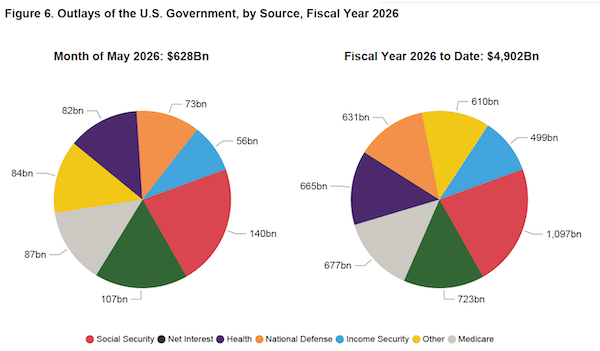
The Trump administration blew through another $628.16 billion last month. That drove total spending for fiscal 2026 to a staggering $4.9 trillion. That was up about 1 percent from last year and set a year-to-date spending record.
A 1 percent increase in spending might not sound significant. But weren’t we told there would be spending cuts?
In fact, there were some cuts in the Big Beautiful Bill (along with spending increases).
The increased spending comes despite cuts to the EPA and the Department of Education budget, along with staffing reductions that are now showing up in the data. Lower disaster spending also helped moderate spending levels through the first two months of fiscal ’26.
However, looking at the big picture, the spending trajectory is up. Even with all the hype about DOGE and some lip service to cutting spending during the early days of the Trump administration, the U.S. government spent just over $7 trillion last year. That’s an average of $583.3 billion per month or $19.2 billion per day.
And now there’s a war.
It’s unclear just how much war spending has shown up in the Treasury data so far. Defense spending is up; however, that doesn’t tell the whole story. Last month, a Treasury official told Reuters that while the increase in defense spending reflected some war spending, the costs of the Iran conflict were spread across several categories, including personnel and maintenance costs, research and development operations, and procurement.
A Pentagon official recently estimated the federal government had spent $29 billion on the war as of mid-May.
Despite some non-specific talk about “spending cuts,” there seems to be little to no commitment to dealing with the runaway spending substantially.
The Big Beautiful Bill trimmed some spending but increased it in other areas. Furthermore, those “cuts” were from projected spending increases. Actual expenditures will still go up, just not as fast as originally planned. The bottom line is that even with the Big Beautiful Bill, spending will increase on an absolute basis. We’re seeing it now.
And all that waste uncovered by DOGE? Virtually none of it was removed from the budget.
This is par for the course. It’s a lot easier to talk about spending cuts than it is to actually cut spending.
You might recall that President Biden promised that the [pretend] spending cuts would save “hundreds of billions” with the debt ceiling deal (aka the [misnamed] Fiscal Responsibility Act).
The ugly truth is the government isn’t committed to cutting spending in any meaningful way, and it always finds new reasons to spend even more, whether for “crises” at home or wars overseas.
Interest Expense Chewing Up the Budget
The cost of servicing the debt continues to climb in this higher interest rate environment as the government keeps piling on new debt.
Interest expense has grown into the second-largest spending category in the federal budget behind only Social Security.
In May, the Treasury forked out $132.62 billion on interest payments alone. That was up 18.8 percent from the prior month and set a new monthly record.
May interest payments pushed total interest expense to $866.82 billion through the first eight months of fiscal 2026. That was up 11.7 percent compared to the same period in fiscal ’25.
Interest on the national debt cost $1.2 trillion in fiscal 2025. That was up 7.3 percent over 2024.
Net interest (interest expense – interest receipts) was $107 billion in May.
Through the first eight months of the fiscal year, the federal government spent more on interest on the debt than it did on national defense ($631 billion) or Medicare ($677 billion). The only higher spending category is Social Security ($1.1 trillion).
Much of the debt currently on the books was financed at very low rates before the Federal Reserve started its hiking cycle. Every month, some of that super-low-yielding paper matures and must be replaced by bonds yielding much higher rates.
The average interest rate on U.S. debt increased to 3.35 percent in May, up modestly from 3.29 percent in May of 2025.
When people say the spending is unsustainable, it feels like an understatement. In fact, it’s fair to call the federal government insolvent.
However, very few people in the political class seem the least bit interested in tackling the problem. The bad news is that at some point, the problem is going to tackle them.
Mike Maharrey is a journalist and market analyst for Money Metals with over a decade of experience in precious metals. He holds a BS in accounting from the University of Kentucky and a BA in journalism from the University of South Florida.