

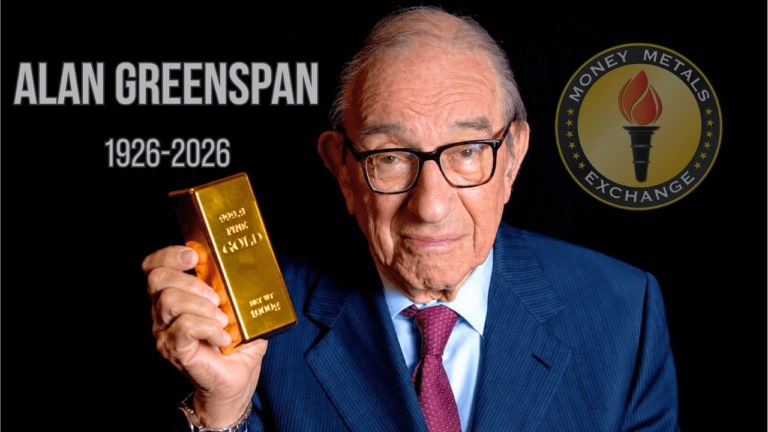
RIP Alan Greenspan, Schizophrenic Gold Bug

(Stefan Gleason, Money Metals News Service) Chairman Alan Greenspan has now passed from the scene at the age of 100.

Greenspan parlayed his sound-money bona fides into the top post at America’s central bank and the stewardship of the world’s dominant fiat currency. In betrayal of his own stated free-market principles, Greenspan spent nearly two decades at the Fed pumping up financial markets with easy money, backstopping Wall Street, and enabling runaway government spending commitments.

Today, the “Maestro” of central banking leaves behind a complicated legacy. He was celebrated by the financial establishment as a master economic steward. Yet many of the financial distortions, asset bubbles, and debt excesses that characterize the modern economy can be traced to policies implemented during his tenure.

The irony is that in his later years, Greenspan increasingly sounded like one of his longtime critics.

Long after leaving office, he repeatedly warned about unsustainable government debt, unfunded entitlement obligations, and the long-term consequences of fiscal recklessness. The man who spent nearly two decades at the helm of the Federal Reserve expressed growing concern over the very debt-based monetary order he had helped oversee.

Perhaps it was a late-life crisis of conscience. Perhaps he simply felt free to speak more candidly after leaving public office. Whatever the reason, Greenspan spent his final decades warning about dangers that many observers believe were exacerbated by the policies he championed while wielding power.

What worried Greenspan most was not any particular election, political movement, or partisan battle. It was the arithmetic.

The federal government now carries more than $39 trillion in officially reported debt. Beyond that lies a mountain of unfunded obligations associated with Social Security, Medicare, and other entitlement programs. Those commitments represent promises that politicians have made without corresponding provisions for funding them.

As Greenspan often noted, the problem is structural. More and more Americans are entitled to government benefits regardless of whether sufficient resources exist to pay for them. Economic growth alone is unlikely to close the gap.

His prognosis was simple and ominous: sooner or later, a crisis becomes unavoidable.

Greenspan correctly observed that elected officials have little incentive to confront the problem. Republicans generally refuse to make meaningful reductions in military spending or entitlement programs. Democrats are equally unwilling to discuss substantial reforms to the welfare state. Both parties prefer to postpone difficult decisions and leave the bill for future generations.

Yet under a fiat monetary system, politicians rarely face immediate consequences for fiscal irresponsibility.

They do not have to ensure that future promises can be met through future revenues. They can continue borrowing and spending so long as financial markets remain willing to absorb government debt and the Federal Reserve stands ready to support the system.

The Fed’s ability to create money electronically and purchase government securities has made sovereign default politically unnecessary. The result is a system in which debt can expand far beyond what would be possible under a monetary regime constrained by a tangible reserve asset.

The government debt bubble is, in many respects, a product of the fiat monetary system itself.

Under a classical gold standard, Congress would be limited by what it could directly extract from taxpayers or borrow from willing lenders. Under today’s system, the monetary authorities possess far greater flexibility to accommodate fiscal excess.

That reality makes one of Greenspan’s most famous observations all the more remarkable.

Before becoming Fed chairman, Greenspan wrote extensively in favor of gold. Even after leaving office, he maintained that a properly functioning gold standard had provided an important discipline for governments and central banks. He often praised the economic dynamism of the late nineteenth century and credited the gold standard for helping to restrain monetary abuse.

The self-described “gold bug” was none other than Alan Greenspan himself.

The same Alan Greenspan who presided over an extraordinary expansion of credit and debt.

The same Alan Greenspan, whose interventions helped establish the expectation that the Federal Reserve would rescue financial markets whenever turmoil emerged.

The same Alan Greenspan who encouraged a generation of investors, lenders, and politicians to believe that ever-expanding credit could substitute for genuine economic savings and productivity.

From the rescue of Long-Term Capital Management in 1998 to the monetary policies that fueled the dot-com bubble and the subsequent housing bubble, Greenspan played a central role in shaping the financial landscape of modern America.

History will likely remember him as one of the most consequential central bankers ever to hold office.

His defenders credit him with navigating financial crises, sustaining economic growth, and helping cement America’s position at the center of the global financial system.

His critics argue that he normalized interventionism, distorted market signals, and laid much of the groundwork for the financial crisis that erupted shortly after his departure from the Fed.

The contradiction at the heart of Greenspan’s legacy never disappeared.

Before entering government, he associated with Ayn Rand and championed free markets, limited government, and sound money. At the Federal Reserve, however, he became the embodiment of discretionary central banking and monetary activism.

Unlike the heroes of Rand’s novels, Greenspan chose influence over ideological purity. He entered the machinery of power and ultimately became one of its most effective operators.

Why did Greenspan spend so much of his career undermining principles he once defended? Why did a lifelong advocate of sound money become the world’s most influential steward of fiat currency?

Only Alan Greenspan himself knew the full answer.


Stefan Gleason is President and CEO of Money Metals Exchange, the company recently named “Best Overall Online Precious Metals Dealer” by Investopedia. A graduate of the University of Florida, Gleason is a seasoned business leader, investor, political strategist, and grassroots activist. Gleason has frequently appeared on national television networks such as CNN, FoxNews, and CNBC and in hundreds of publications such as the Wall Street Journal, TheStreet, and Seeking Alpha.
Vance Says ‘Progress’ Made in Talks with Iran

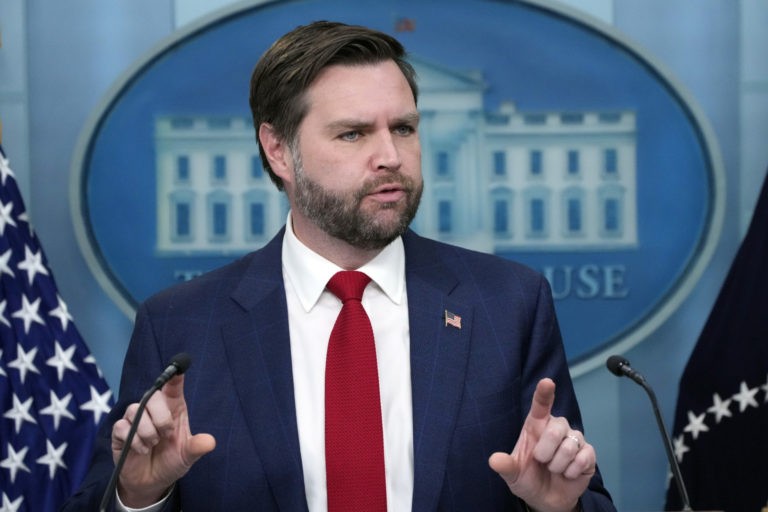
(Sarah Roderick-Fitch, The Center Square)  Following what appeared to be a bumpy weekend between the United States and Iran, Vice President J.D. Vance said progress is being made.

Vance, leading a U.S. delegation in talks with Iran, mediated by Pakistan and Qatar, reassured that talks remain ongoing in Switzerland after Iranian representatives threatened to walk out in response to some strongly worded social media posts from President Donald Trump over the weekend.

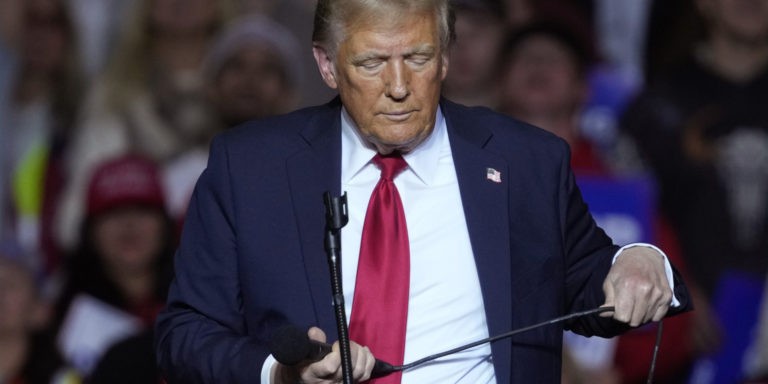
The president responded to Iranian claims that it once again closed the Strait of Hormuz, accusing Israel of violating the ceasefire after the Jewish State retaliated for Hezbollah attacks.

Trump warned that Iran would not impose tolls on the strait during or after the 60-day ceasefire. However, the president left the door open for the U.S. to impose tolls “should the deal not be completed,” adding they would be considered, “services rendered as guardian angel to the countries of the Middle East for the purpose of both past, present, and future reimbursement costs.”

The president also warned Iran against supporting its terror proxies, specifically highlighting Hezbollah.

“Iran must immediately stop their highly paid proxies in Lebanon from causing trouble,” Trump wrote. “If they don’t, we’ll hit Iran very hard again, just like we did last week, only harder!!!”

Despite Iran’s saying it had closed the Strait of Hormuz, Vance confirmed that the vital waterway remains open. He sought to defuse regional tensions, pointing to the situation in Lebanon, which could prompt Iran to increase aggression in the strait.

The vice president also announced Iran’s approval of allowing inspectors from the International Atomic Energy Agency back in to inspect key nuclear sites. The agency has been inspecting sites, but since last year’s strike on the nation’s top nuclear facilities, access has been restricted.

During a brief press conference, Vance also addressed concerns regarding a potential agreement to unfreeze Iranian assets by “setting up a process.” He emphasized that “if” the frozen assets are unfrozen, the funds would be overseen by the U.S. and Qatar to be certain the funds would be used to “go to help the people of Iran.”

The funds would be spent on buying American agricultural products, described as a “classic Trump deal” that would help enrich American farmers.

In addition, the U.S. Treasury Department announced Monday morning that it was issuing a 60-day general license authorizing the production, delivery and sale of Iranian oil until Aug. 21.

The Memorandum of Understanding signed by the U.S. and Iran last week paved the way for the U.S. to lift the naval blockade on Iranian ports. The Trump administration said it was costing the Iranian economy between $400 million and $500 million a day in lost revenue.

Moody’s Analytics estimates the conflict with Iran has cost taxpayers $132 billion and counting since the U.S. began strikes on Feb. 28; much of that cost has come in the form of rising consumer prices, such as gasoline and food.

Milwaukee Mayor Criticizes Investigation into 2020 Election

(Benjamin Yount, The Center Square) Milwaukee’s mayor is again questioning and criticizing the federal investigation into Wisconsin’s 2020 election.

Mayor Cavalier Johnson was on UpFront over the weekend and framed the FBI’s questioning of Milwaukee County election officials and Milwaukee police officers as an attempt to undo the 2020 presidential vote.

“We’ve got a president who, for whatever reason, just refuses to abide by the will of the voters – unless he wins,” Johnson said. “He’s not challenging election results in states or cities where he won. He’s only challenging those results in places where he did not win.”

The Justice Department is investigating Wisconsin’s 2020 election. Investigators have spoken with the Wisconsin Elections Commission and managers at Milwaukee County’s election office.

This month, the Milwaukee Journal Sentinel reported that federal investigators spoke with at least two police officers who were at Milwaukee’s election headquarters on Election Day in 2020.

Johnson said he did not know what those officers were asked or what they said.

Johnson was not asked and did not say anything about the outside law firms that have volunteered to represent Milwaukee in a lawsuit aimed at stopping the investigation into the 2020 election.

Johnson did say that he worries the investigation will continue to breathe life into election conspiracies that have lingered about Wisconsin since the 2020 election.

“I do have another issue, and issue with other people that sign on to some of this nonsense that undermines faith in elections,” the mayor explained. “We are celebrating the 250th anniversary of our country, of American democracy, and it’s a shame to me that we’ve got people at the highest level of our federal government who are trying to undermine those elections.”

Former Federal Reserve Chairman Alan Greenspan Dies at 100

(Headline USA) Alan Greenspan, the jazz-playing U.S. Federal Reserve chair who was celebrated for engineering a decade of prosperity but later shared the blame for a devastating financial crisis, died Monday. He was 100.

Greenspan died from complications of Parkinson’s disease, said his wife of 29 years, NBC News correspondent Andrea Mitchell.

“To me he was my husband, who shaped my life from our very first date in 1984,” Mitchell wrote. “He had ‘irrational exuberance’ for baseball, the Washington Commanders, tennis, golf, and music, especially jazz. He will be remembered for his brilliance and his kindness. Being his life partner was the joy of my life.”

The Fed said Greenspan helped to cement trust in the Fed during a time of economic uncertainty.

“Under his leadership, the Federal Reserve achieved a sustained era of price stability that supported economic growth and helped anchor the public’s confidence in the institution,” the central bank said in a statement Monday.

In 18 1/2 years at the Fed, Greenspan presided over a breathtaking surge in stock prices and a 10-year economic boom that started in March 1991. He was celebrated as “Maestro’’ and “Oracle’’ — an economic virtuoso whose every utterance was dissected for clues on where interest rates and the economy were headed.

The intense scrutiny of Greenspan’s intentions gave birth to new Fed folklore: the “Briefcase Indicator.” A stuffed briefcase carried into Fed meetings implied changes might be afoot because Greenspan carried with him charts and research to make his point.

But his reputation began to suffer almost as soon as he left the Fed in 2006. American housing prices tumbled rapidly, causing huge losses for banks that had repackaged mortgage loans into a dizzying array of complex securities. The growing financial crisis pushed the U.S. economy into the Great Recession of 2007-2009—the deepest downturn since the 1930s.

Critics blamed the devastation on Greenspan’s easy money policies and his support for deregulated financial markets. Greenspan himself later acknowledged “I made a mistake’’ in assuming that banks could essentially regulate themselves.

Adapted from reporting by the Associated Press

Teaching Christian Philosophy Lands ASU Professor in Trouble

(José Niño, Headline USA) An Arizona State University professor found himself penalized in his yearly performance evaluation over allegations of “bias” and “slant” toward Christianity stemming from his instruction on theologian Thomas Aquinas and classroom inquiries about the “highest good,” The College Fix reported.

Owen Anderson, who has been an outspoken critic of ASU’s diversity, equity, and inclusion requirements, instructed two sections of Religions of the World as well as Introduction to Ethics and Issues in Death and Dying within ASU’s School of Humanities, Arts, and Cultural Studies throughout 2025.

Students gave his Religions of the World sections favorable marks of 4.7 and 4.45 out of 5, while his remaining courses received notably weaker scores of 4.2 and 3.38. Anderson informed The College Fix that 3.38 is “well-below the college mean.”

School Director Miriam Mara authored the review and pointed to anonymous student grievances as a significant consideration. According to documents The College Fix examined, one student wrote, “Although I agree with what Owen Anderson teaches, I completely understand if people feel offended after taking his class.”

A second student objected, “If I were a Hindu or Buddhist, and truly believed in reincarnation, I would be offended if I were asked to denounce it.” A third suggested that “grades are based on using the term ‘god’ and thus having the correct religious view.”

Director Mara determined that “such implications are sobering, and it would be helpful if Professor Anderson found a way to address these considerations from students in his courses going forward.”

Anderson disputed the evaluation with The College Fix, asserting these student accusations arrived with scant evidence. He explained that the review should have adhered to an objective rubric calculating points from particular activities to generate a score, but Director Mara strayed from this methodology.

Anderson challenged the decision with Todd Sandrin, dean of the New College of Interdisciplinary Arts and Sciences. The dean sustained the evaluation, pointing to Anderson’s course materials and assessments as exhibiting “unqualified normative language.” The dean identified questions like “What is the highest good?” and exam prompts requesting students explain how St. Thomas Aquinas would respond to philosophical inquiries. Dean Sandrin additionally took issue with the true or false statement “Death should not make us think about life.”

No additional avenue exists for Anderson to contest the ruling. “[Dr. Sandrin] is the last level of appeal for me at ASU,” Anderson stated. “The dean just gets to give me this review and move on and the record shows that my classes are slanted toward Christianity.”

Anderson observed that official course descriptions for both Religions of the World and Death and Dying specifically incorporate Bible study, while Introduction to Ethics addresses major Christian ethical frameworks together with secular alternatives.

“I believe this is overt discrimination against me,” he informed The College Fix.

Peter Wood, who leads the National Association of Scholars, expressed concern to The College Fix that he is “puzzled that the University seems to have done nothing to determine whether the complaints were valid.”

“A professor teaching in a secular university about religion inevitably will irritate some students because students bring with them strong sensitivities on these matters. That doesn’t mean the professor is ‘biased,'” Wood explained. “Bias implies that he grants special favor to his own views.”

ASU failed to respond to repeated requests for comment.

José Niño is the deputy editor of Headline USA. Follow him at x.com/JoseAlNino 

Donald Trump Slams Illinois Governor After Deadly Chicago Weekend

(José Niño, Headline USA) President Donald Trump challenged Illinois Democratic Governor JB Pritzker to seek federal assistance after a bloody weekend left multiple dead and dozens injured across Chicago, Just the News reported.

“Why isn’t Governor Pritzker calling me for help,” Trump wrote Sunday morning on Truth Social. “I could make Chicago a safe City in ONE MONTH, in ONE YEAR, it would be one of the safest!!!”

The president’s rebuke came after a surge of gun violence swept through Chicago during the Juneteenth holiday weekend starting last Friday. The deadliest single episode unfolded shortly after 11 p.m. Friday in the Roseland neighborhood on the Far South Side, when two gunmen in a red SUV pulled alongside a large crowd in the 200 block of West 95th Street near Princeton Avenue and opened fire, per a report by CBS.

13 people were wounded—victims ranging in age from 17 to 47—with at least one 26-year-old woman in critical condition at the University of Chicago Hospital, per Fox 32. As CBS reported, investigators placed more than 100 evidence markers along the block, many flagging what appeared to be rifle shell casings scattered across the street and sidewalk.

The weekend’s cumulative violence reached at least seven fatalities and 38 additional wounded across numerous incidents throughout the city, the Associated Press reported.

Trump has previously sent National Guard forces to New Orleans, Memphis, and Washington to suppress crime. As Townhall reported, Trump highlighted his administration’s achievements in the nation’s capital, asserting it transformed “from one of the worst, to one of the safest cities in the U.S.” and presenting this as proof of what federal action could deliver for Chicago.

Yet Pritzker, frequently mentioned as a prospective 2028 Democratic presidential candidate, has repeatedly rejected Trump’s offers of federal support for America’s third most populous city. Both the governor and Mayor Brandon Johnson maintain that Chicago crime rates are actually falling, pointing to an approximately 30 percent reduction in homicides, and accuse Trump of fabricating a crisis to score political points.

According to a report by the Washington Examiner, Pritzker has charged that Trump desires “mayhem on the ground” as justification for sending additional forces, characterizing the broader initiative as “an authoritarian power grab” designed to threaten political adversaries in Democratic strongholds. The governor earlier issued a stark warning stating “Mr. President, do not come to Chicago,” per a report by the Huffington Post

This confrontation marks the newest episode in a prolonged battle between the president and Illinois leadership. Following a Labor Day 2025 weekend that saw nearly 60 shooting victims, Trump declared he would invoke the Insurrection Act. The following month he issued a presidential directive federalizing 300 Illinois National Guard members to safeguard federal personnel after Pritzker declined to activate them.

Pritzker’s office provided no response to inquiries from Just the News.

José Niño is the deputy editor of Headline USA. Follow him at x.com/JoseAlNino

‘Toy Story 5’ Rakes in the Biggest Box-Office Debut of the Year

(Headline USA“Toy Story” still has a friend in moviegoers.

The fifth installment in the Pixar series debuted with $160 million in domestic ticket sales, according to studio estimates Sunday, easily setting a new franchise record and notching the biggest opening weekend of the year.

Launching 31 years after the original “Toy Story” first landed in theaters, “Toy Story 5” far surpassed the previous series-best debut: $120 million for “Toy Story 4” in 2019. Internationally, it was just as successful, with $152 million in opening-weekend sales, for a worldwide haul of $312 million.

The “Toy Story” franchise is one of the most profitable for The Walt Disney Co. Before “Toy Story 5” launched, the movies had collectively grossed more than $3 billion, while also pulling in billions from merchandising.

Though the series seemed to reach a conclusion with 2010’s “Toy Story 3,” the decision to revive the franchise almost a decade later — while controversial — has been extremely lucrative. “Toy Story 4” exceeded $1 billion in ticket sales, and “Toy Story 5” is all but certain to as well.

Among animated films, only 2018’s “Incredibles 2” had a bigger opening weekend ($182.7 million) than “Toy Story 5.”

These toys aren’t cheap

Keeping the “Toy Story” movies going has gotten more expensive, though. The fifth movie cost $250 million to make, not including marketing. It returns a voice cast led by Tom Hanks (as Woody), Tim Allen (as Buzz Lightyear) and Joan Cusack (as Jessie).

In the sequel, the toys are pushed aside when Bonnie gets a new tablet. It’s directed by Andrew Stanton, the Pixar veteran who helmed “Finding Nemo” (2003) and “WALL-E” (2008). “Toy Story 5” also features a new song by Taylor Swift, “I Knew It, I Knew You.”

Reviews have been very good and audiences gave “Toy Story 5” an “A” CinemaScore, suggesting it should remain a force in theaters for weeks.

After its chart-topping debut, Steven Spielberg’s “Disclosure Day” slipped to second place with $17 million in its second weekend. That’s not the hold that Universal Pictures was hoping for. Dropping 61% from its first weekend suggests “Disclosure Day” might not find the legs Spielberg’s sci-fi thriller needs to break out this summer.

Still, the $115 million budgeted movie, starring Emily Blunt, Josh O’Connor and Colman Domingo, has grossed $160.4 million globally in two weeks. “Disclosure Day” stands a good chance of remaining the top adult-oriented option in theaters in the coming weeks.

“Toy Story 5” faced little competition from newcomers.

‘Robin Hood’ misses the bullseye

A24’s “The Death of Robin Hood,” a violent revisionist approach to the old legend, flopped with $2.6 million on 1,762 screens. The film, starring Hugh Jackman and directed by Michael Sarnoski, was modestly budgeted at $20 million. But after finding mixed reviews, audiences didn’t go for the movie, either. It earned a “C+” CinemaScore.

Neon’s “Leviticus” came out just ahead of “The Death of Robin Hood,” with $2.7 million from 1,076 theaters. Written and directed by Adrian Chiarella, the buzzy low-budget horror film is about two teen boys who meet at conversion therapy. It’s a fine start for an indie with a small budget of $3.5 million and good word-of-mouth. But “Leviticus” also faced unusually strong competition in the still-potent horror hits “Obsession” and “Backrooms.”

The top horror choice remained “Obsession,” the microbudget phenomenon by 26-year-old Curry Barker. In its sixth weekend, it nearly equaled its $17 million opening weekend from mid-May. The Focus Features release, which cost less than $1 million to make, added $14.2 million to bring its domestic total to $215.8 million and its global haul to $333.3 million.

With “Toy Story 5” and “Obsession” driving sales, the summer box office is up 15% from the 2025 summer, according to Rentrak. More impressively, summer ticket sales are nearly equal to the 2019 summer at the same point, not accounting for inflation. The summer to date is just 1.9% down from that year.

Paul Dergarabedian, head of marketplace trends for Rentrak, expects that Hollywood is heading for its best summer since before the pandemic. And the success is coming from both expected and unexpected places.

“To me, this is a hybrid summer and this could be the new blueprint for how you build the perfect summer box-office beast,” says Dergarabedian. “You throw in a mix of very eclectic films and not just the usual suspects — the big franchise films, the known brands — but also films like ‘Backrooms’ and ‘Obsession’ and original films like ‘Disclosure Day.’”

Top 10 movies by domestic box office

With final domestic figures being released Monday, this list factors in the estimated ticket sales for Friday through Sunday at U.S. and Canadian theaters, according to Rentrak:

1. “Toy Story 5,” $160 million.

2. “Disclosure Day,” $17 million.

3. “Obsession,” $14.2 million.

4. “Backrooms,” $7.3 million.

5. “Scary Movie,” $6.7 million.

6. “Masters of the Universe,” $5.6 million.

7. “Star Wars: The Mandalorian and Grogu,” $3.9 million.

8. “Leviticus,” $2.7 million.

9. “The Death of Robin Hood,” $2.6 million.

10. “Michael,” $2.2 million.

Adapted from reporting by the Associated Press

Pentagon Tells Lawmakers It Needs Additional $80 Billion for Iran War and Other Costs

(Dave DeCamp, Antiwar.comThe Pentagon has told Congress that it needs $80 billion to pay for the Iran war and other non-war-related costs, The Wall Street Journal has reported.

The Pentagon had previously claimed that the war cost $29 billion as of mid-May, a number that doesn’t hold up to scrutiny, as an analysis from Stephen Semler of the Security Policy Reform Institute found that the war had cost about $72 billion in just the first 60 days, an estimate that doesn’t factor in indirect costs.

The costs have continued to add up despite the ceasefire, and the US-Iran Memorandum of Understanding, as the US is maintaining its military posture in the Middle East, which includes major naval armadas that were enforcing a blockade of Iranian ports.

US Navy fighter jet prepares to take off from the USS Abraham Lincoln as the ship transits the Arabian Sea (Central Command photo)

The breakdown of what exactly the $80 billion will cover is unclear, but much of it is expected to go toward munitions procurement, as the US used an enormous number of missiles and air-defense interceptors in the war.

The Journal report said that Pentagon leaders have said they will run out of money this summer if Congress doesn’t pass a new wartime spending bill, and would have to cut training exercises due to the war with Iran. The White House is expected to ask Congress for $80 billion, plus additional funds for other non-military spending, in the coming days.

The Pentagon is seeking $80 billion on top of its more than $1 trillion annual budget, as the Trump administration has pushed for record-breaking military spending. In 2027, the US military budget will increase by nearly 50% to $1.5 trillion if President Trump’s plan, which involves combining the annual National Defense Authorization Act with a supplemental spending bill for several hundred billion dollars, is passed by Congress.

LA Superintendent Resigns after FBI Raid

(Headline USAThe superintendent of Los Angeles public schools has resigned four months after he was put on paid leave during a federal investigation, the district’s Board of Education said Monday.

Alberto Carvalho denied any wrongdoing earlier this year and had asked to be reinstated as head of the nation’s second-largest district.

The FBI served search warrants on Feb. 25 at his home and the LA Unified School District’s headquarters. Two days later, the district’s Board of Education voted unanimously to place him on leave pending the outcome of the investigation.

In its statement released early Monday, the Board acknowledged it received a letter of resignation from Carvalho. The resignation was effective as of Sunday.

“The Board remains steadfast in its commitment to ensuring stability, continuity, and continued progress through strong leadership. Our focus remains unchanged: providing every student with a high-quality education, supporting our dedicated workforce, and maintaining the trust of the communities we serve,” it said in the statement.

It said that Andrés Chait, who has been acting superintendent, will remain in that position until a permanent decision is made.

Authorities have not provided details of the nature of the investigation involving the district, which serves more than 500,000 students, nor have they accused Carvalho of any crimes.

The FBI also searched a third location near Miami. The Miami Herald reported the Florida property belonged to Debra Kerr, who previously worked with AllHere, an education technology company that had a contract with Los Angeles schools before it collapsed and its leader was indicted for fraud.

In 2024, Carvalho heavily touted a deal with AllHere for an AI chatbot named “Ed” designed to help students. But about three months after unveiling the technology and paying the company $3 million, the district dropped its dealings with AllHere, which collapsed into bankruptcy. Months later, founder Joanna Smith-Griffin was charged with securities and wire fraud, along with identity theft.

At the time, Carvalho denied personal involvement in the selection of AllHere, according to the Los Angeles Times.

“Mr. Carvalho respects the rule of law and the investigative process and has always acted in the best interests of students and within the bounds of the law,” a statement provided by Holland & Knight, the law firm representing him, had said. “While the government’s investigation remains ongoing, no evidence has been presented by prosecutors supporting any allegation that Mr. Carvalho violated federal law.”

An email seeking comment was sent to the law firm Monday.

Following the search of school headquarters, LA Unified said it was cooperating with investigators and had no further information.

Carvalho became superintendent for LA in 2022. He previously led the public schools in Miami.

Adapted from reporting by the Associated Press

Ariz. AG Forced to Drop Lawsuit over 2020 Electors after Lawfare Plot Exposed

(Ben Sellers, Headline USA) Arizona’s Soros-funded attorney general, Kris Mayes, was forced to drop a long-running lawfare campaign targeting allies of President Donald Trump in an election conspiracy after she herself was exposed as being part of an anti-Trump election conspiracy.

“The prosecutor in Arizona has finally dropped the unjustified and unconstitutional charges against me and all my innocent co-defendants,” wrote former Trump lawyer and New York City Mayor Rudy Giuliani. “All the claims about falsifying data, electors et al was a part of the Democrat massive corruption of our previously world renowned justice system.”

Giuliani was notoriously served his indictment papers while celebrating his 80th birthday party in Palm Beach, Florida, in 2024.

Among his high-profile codefendants in the lawfare case were top Trump advisers Mark Meadows and Boris Epshteyn, as well as lawyers John Eastman and Jenna Ellis.

While many of them overlapped with the Fulton County, Georgia case, in which Trump also was a co-defendant, he was not personally indicted in Arizona.

However, the case also included indictments of top Arizona lawmakers and election officials who were accused of being “fake electors,” as well as Tyler Bowyer, the chief operating officer of Turning Point USA, whose profile has risen considerably since last year’s assassination of TPUSA founder Charlie Kirk.

The case claimed that the defendants conspired to violate the law by acting as alternate electors while the 2020 election in Arizona was still disputed and working its way through the legal system. However, precedent — most notably Hawaii’s use of alternate electors in the 1960 Kennedy–Nixon election — suggested that there was no legitimate legal violation.

That did not stop Mayes from trying her best to inflict punitive and financial damage on the lawfare victims, effectively turning the legal process into the punishment and imposing a chilling effect on those who would seek to challenge Democrat-supported outcomes in future Arizona elections.

Although the 2024 election results had largely rendered the case moot — with the main goal being to derail Trump’s reelection bid — the charges remained pending until last June, when the attorneys for co-defendant Christina Bobb, the Republican National Committee’s former counsel for election integrity, filed suit in Maricopa County seeking to disqualify Mayes on the grounds that she, herself, was colluding with the activist lawfare group  States United Democracy Center, an organization backed by shady dark-money financiers such as the Democracy Fund.

“The Attorney General and her office have abused the laws regulating the use of outside counsel and has involved herself and her office in irreparable conflicts of interest,” Bobb’s June 4, 2025, court filing states. “As a result, she and her staff have violated their oaths of office under the Arizona Rules of Professional Conduct, while creating a significant appearance of impropriety, and should be disqualified from prosecuting this matter.”

The scheme reportedly was exposed due to an errant memo from States United that was filed by the AG’s office as part of an exhibit in the case.

Mayes’s own dark-money ties run deep. She received the maximum financial backing in her 2022 race from at least two of election-meddling oligarch George Soros’s family members: his son Jonathan and daughter-in-law Jennifer Allen–Soros.

After “winning” her own election by a dubious margin of only 280 votes (following an extended period of post-election vote-counting and legal wrangling), Mayes proceeded to target counties that sought to close election-integrity loopholes by requiring ballots to be hand-counted.

She also pursued criminal charges against individuals at the county level who had delayed her and corrupt Gov. Katie Hobbs’s certification and only agreed to it under extreme duress.

Ben Sellers is a freelance writer and former editor of Headline USA. Follow him at x.com/realbensellers.