(Julianna Frieman, Headline USA) Cenk Uygur, founder of leftist media network The Young Turks, went on Timcast IRL on Tuesday and criticized the corporate media for acting as a Democrat “marketing” tool rather than a journalistic outlet.
Host Tim Pool asked how Democrats can restore trust in the media, prompting Uygur to launch an all-out attack on left-leaning cable news networks that ignore his network’s dominance.
“What’s the biggest left-wing network? We are, TYT. It’s 27 million subscribers, right? Thirty billion lifetime views. So, when they’re like, ‘Oh, I wish we had a Joe Rogan of the left!’ Hey, idiots, we have more subscribers, more views, etc. But to them, ‘No, you don’t count because you’re honest,’” Uygur said.
Ugyur told Timcast IRL panelists that Democrats claiming they want their own Joe Rogan—the popular podcaster whose interview with President-elect Donald Trump accumulated millions of views within its first 24 hours—didn’t mean they want a fair and balanced podcaster on their side of the aisle.
“‘We didn’t mean we want left-wing media. We meant we want left-wing media to do our propaganda. But you won’t do our propaganda,’” Ugyur said. “Well, that’s why we’re popular! Because we don’t do your propaganda!”
The Young Turks founder said Democrat politicians only wish they had an influential mouthpiece spouting false narratives that President Joe Biden is youthful or that Vice President Kamala Harris can speak without a teleprompter.
“You’re never gonna get that,” Uygur said.
He mocked leftist corporate media’s coverage of establishment politicians on both sides of the aisle by making the point that they overtax the middle class to fund party elites.
“‘Hey, what are we doing? We’re robbing the middle class to pay the rich. Oh, okay, great. Hey, Mitch McConnell and Joe Biden did a beautiful bipartisan deal!’” Uygur jeered, eliciting laughter from Pool. “‘Oh, that’s so great! They’re both so moderate!’”
Uygur said cable news anchors are actually part of a larger political marketing effort rather than unbiased reporting.
“It’s like a giant marketing operation. If you are on cable news, you are not in news. You are in marketing—you just don’t realize it,” he said.
Julianna Frieman is a freelance writer published by the Daily Caller, Headline USA, The Federalist, and The American Spectator. Follow her on Twitter at @JuliannaFrieman.
(Julianna Frieman, Headline USA) Fox News employees who worked with former host and Trump defense secretary nominee Pete Hegseth spoke out Tuesday after NBC News dropped a report claiming 10 anonymous Fox News colleagues were “worried” about Hegseth’s drinking habits.
Piling on top of other outlets’ disputed smears of sexual misconduct, NBC News propagated the narrative that Hegseth had a drinking problem while working on Fox and Friends Weekend and his co-workers “smelled alcohol on him” before he went on air.
Several Fox News employees went on the record to defend Hegseth, quickly surpassing NBC’s 10-source benchmark.
Hegseth’s Fox and Friends Weekend co-anchor Will Cain compiled the responses in a thread on X.
“Bulls**t. 100 percent bulls**t. Actually… horses**t,” Cain wrote before demanding his name be added to NBC’s report in defense of Hegseth as “the guy who sat next to him 8 hours every week for five years starting at 6 am.”
Your story is horseshit @NBCNews. Put my name on it. On the record. It’ll be your only on the record source. Signed, The guy who sat next to him for 8 hours every week for five years starting at 6am.
“The losers at @NBCNews never reached out to me either. @willcain is right – your story IS horses**t. You now have 2 people who sat next to him 8+ hours a week on the record. Will you retract or correct your story?” Campos-Duffy wrote.
The losers at @NBCNews never reached out to me either. @willcain is right – your story IS horseshit. You now have 2 people who sat next to him 8+ hours a week on the record. Will you retract or correct your story? https://t.co/s5YJsI23EV
Campos-Duffy’s daughter, Evita Duffy-Alfonso, confirmed her mother was not contacted, saying “their mouthpieces in the propaganda press hate Pete because they FEAR Pete—and that’s exactly what America needs.”
I stand with Pete and his beautiful family in the face of these smears. @NBCNews did not contact my mom @RCamposDuffy or @willcain for their latest anonymously sourced hit piece because it is total bs. The state and their mouthpieces in the propaganda press hate Pete because they… pic.twitter.com/RpXLqKtqjh
Former Fox News host Dan Bongino called NBC News’s report “absolute BULLS**T,” while former Fox News producer Breanna Morello said, “I’ve never heard this in my life.”
“This relentless onslaught against @PeteHegseth is getting pathetic. Done @foxandfriends many times with him and never known Pete be anything but utterly professional on camera and a nice, respectful guy off it,” Fox Nation host Piers Morgan wrote.
This relentless onslaught against @PeteHegseth is getting pathetic. Done @foxandfriends many times with him and never known Pete be anything but utterly professional on camera and a nice, respectful guy off it. https://t.co/6CoZApA6mG
Frequent Fox News guest Rob Smith said Hegseth never smelled of alcohol and praised the former host as a kind, helpful mentor.
Former Fox News producer Kyle Becker said Hegseth never showed signs of being drunk: “No bloodshot eyes. No slurred speech. No disheveled appearance. No wobbly gait. Nothing.”
Outkick founder Clay Travis, who often appears on Fox News, blasted NBC News’s story as “ridiculous bulls**t.” Fox News contributor Lisa Boothe criticized the report as “a disgusting and false smear.”
“I can’t stand the propaganda practice of using anonymous sources to smear political opponents, as NBC does here. FWIW, I have nothing but good things to say about Pete and the anonymously sourced stories don’t match my personal experience in any way. Quite the contrary, in fact,” The Federalist Editor-in-Chief Molly Hemingway, a Fox News contributor, wrote.
Julianna Frieman is a freelance writer published by the Daily Caller, Headline USA, The Federalist, and The American Spectator. Follow her on Twitter at @JuliannaFrieman.
(Ken Silva, Headline USA) Billionaire Elon Musk and entrepreneur Vivek Ramaswamy’s plan to downsize the federal government entails requiring bureaucrats to return to pre-COVID working conditions.
“Requiring federal employees to come to the office five days a week would result in a wave of voluntary terminations that we welcome,” Musk and Ramaswamy, who are heading Trump’s new Department of Government Efficiency, reportedly explained in a Wall Street Journal op-ed last month.
But that plan just hit a major roadblock, with Bloomberg reporting Tuesday that the country’s largest federal employees union just signed a deal with the Biden administration to continue remote-work until 2029, when Trump leaves office for good.
According to Bloomberg, American Federation of Government Employees, a union representing 42,000 Social Security Administration workers, reached a deal with the Biden administration that will let workers “maintain current levels of telework.” The deal was reportedly inked by President Joe Biden’s just-departed Social Security Administration Commissioner, Martin O’Malley.
“Under those current arrangements, in-office requirements range from two to five days per week, varying by job,” Bloomberg reported, citing anonymous sources as well as an internal AFGE union message. “Unions have been pushing the outgoing Biden administration to extend existing collective bargaining agreements with federal workers in advance of Trump’s inauguration next month.”
Bloomberg reported that AFGE chapter president Rich Couture told his members that “this deal will secure not just telework for SSA employees, but will secure staffing levels through prevention of higher attrition, which in turn will secure the ability of the Agency to serve the public.”
A federal Office of Management and Budget spokesperson reportedly declined to comment on the matter. An AFGE spokesperson also declined to comment, while a Social Security Administration spokesperson reportedly confirmed that the SSA “memorialized its preexisting telework policy in its contract with AFGE.”
Bloomberg reported that AFGE chapter president Rich Couture told his members that “this deal will secure not just telework for SSA employees, but will secure staffing levels through prevention of higher attrition, which in turn will secure the ability of the Agency to serve the public.”
Bloomberg added that the deal may not stop the Trump administration from requiring at-office work.
“But reneging on a contract could lead to protracted legal disputes, as well as protests and pushback from lawmakers,” the outlet warned.
Ken Silva is a staff writer at Headline USA. Follow him at x.com/jd_cashless.
(Mike Maharrey, Money Metals News Service) Last week, Russia announced a temporary ban on the export of precious metals scrap. The Russian government hopes keeping scrap within its borders will enhance domestic refining operations.
This strategic move is intended to boost the country’s gold and silver supplies and direct those resources to domestic production. In effect, the Russian government hopes the ban will support domestic industries, enhance government revenues, and tighten control over the trade of valuable resources.
Recycled gold accounts for about 25 percent of the annual global supply, with mine output making up the difference. Scrap makes up about 18 percent of the annual silver supply.
The Russian export ban will run from Dec. 1 through May 31, 2025. It includes waste and scrap of precious metals or metals clad with precious metals, and other waste and scrap containing precious metals or precious metal compounds, along with waste and scrap of electrical and electronic products used to extract precious metals.
According to a statement released by the Russian government, “These measures enable increasing capacity utilization of Russian processing enterprises, including refineries, and attracting significant volumes of secondary raw materials containing precious metals into precious metals processing and production processes.”
The move is also expected to boost tax revenue by keeping the entire value chain—from raw materials to refined products—within the national economy.
The Russian government has imposed similar temporary bans in the past.
The ban could impact global gold and silver supplies and may leave some buyers scrambling to find new sources of scrap.
“By keeping these valuable resources within their borders, they’re strengthening their economic foundations and challenging the U.S. dollar’s dominance.”
(Ken Silva, Headline USA) Trump-appointed U.S. Judge Mark Scarsi has agreed to close the Justice Department’s case against Hunter Biden—but not before blasting President Joe Biden’s pardon of Hunter as an attempt to “rewrite history.”
Judge Scarsi agreed to close the case, even though Hunter didn’t file a copy of the pardon in his Monday motion to dismiss.
“The Court has yet to receive the pardon from the appropriate executive agency. The Court directs the Clerk to comply with court procedures for effecting a grant of clemency once the pardon is formally received, which will result in the termination of the case,” the judge said.
JUST IN: Judge Scarsi trashes President Biden’s pardon for his son and the letter justifying it — saying it’s an attempt to rewrite history and impugns judges and DOJ personnel from his own administration. pic.twitter.com/YmHRK8S9mp
“Subject to the following discussion, the Court assumes the pardon is effective and will dispose of the case,” he said.
While the judge expressed mild annoyance at having not received a certified copy of the pardon, his remarks about the pardon itself were even more scathing. He took particular issue with President Biden’s claims that Hunter was “treated differently.” Biden also falsely claimed that Hunter was late on his taxes due to his drug addiction.
“Upon pleading guilty to the charges in this case, Mr. Biden admitted that he engaged in tax evasion after this period of addiction,” the judge said, correcting the record.
Judge Scarsi further noted the irony in President Biden’s assertion that “no reasonable person who looks at the facts of [Mr. Biden’s] cases can reach any other conclusion than [Mr. Biden] was singled out only because he is [the President’s] son.”
“The President’s own Attorney General and Department of Justice personnel oversaw the investigation leading to the charges. In the President’s estimation, this legion of federal civil servants, the undersigned included, are unreasonable people,” the judge said.
President Biden’s pardon followed Hunter’s guilty plea to nine counts of tax crimes. He was previously convicted of three counts of making false statements on a federal gun purchase form. He is expected to be sentenced later this month.
The indictments followed years of investigation by Special Counsel David Weiss, which Republicans alleged was intentionally delayed allowing the statute of limitations to expire on certain offenses. Biden’s pardon stretches back to 2014.
Ken Silva is a staff writer at Headline USA. Follow him at x.com/jd_cashless.
(Mike Maharrey, Money Metals News Service) Distress in the commercial real estate bond market is at all-time highs, a sign that the Fed has messed up the economy more than most people realize.
Most mainstream commentators are sanguine about the economy. They believe the Federal Reserve has effectively reined in price inflation and expect a “soft landing” as the central bank eases monetary policy.
But there are cracks in the economic foundation caused by more than a decade of artificially low interest rates and multiple rounds of quantitative easing. The Federal Reserve addicted the country to easy money. Practically speaking, it incentivized excessive borrowing and created all kinds of malinvestments in the economy.
When the Fed suddenly and aggressively raised interest rates to fight price inflation, it exacerbated the problems it had already caused. We saw that manifest in a banking crisis that the Fed managed to paper over with a bailout.
Where problems will surface next remains to be seen, but the commercial real estate (CRE) sector is a prime candidate.
The CRE sector faces the triple whammy of falling prices, falling demand, and rising interest rates. The post-pandemic rise of telecommuting and work-at-home programs crushed demand for office space. Government lockdowns crushed the retail sector. Vacancy rates in commercial buildings have soared. This has put significant stress on commercial real estate companies. The biggest bankruptcy in 2023 was the failure of the Pennsylvania Real Estate Investment Trust. The company had loaded up with more than $1 billion in liabilities.
The U.S. has the biggest commercial real estate market in the world. According to the IMF, as of January, commercial real estate prices had tumbled by 11 percent since the Fed started hiking rates in 2022. This precipitous drop in commercial real estate value erased the previous two year’s gains.
Despite a 50 basis rate cut in September and another quarter-point of easing in November, the CRE sector remains under stress. We can see this stress manifested in the Commercial Real Estate Collateralized Loan Obligation (CRE-CLO) bond market.
CRE-CLO bonds are backed by a pool of loans secured by commercial properties, such as office buildings, retail centers, industrial properties, hotels, and multifamily housing. CRE-CLOs are generally shorter-term bridge loans used to refinance commercial real estate properties or fund new acquisitions and feature floating interest rates.
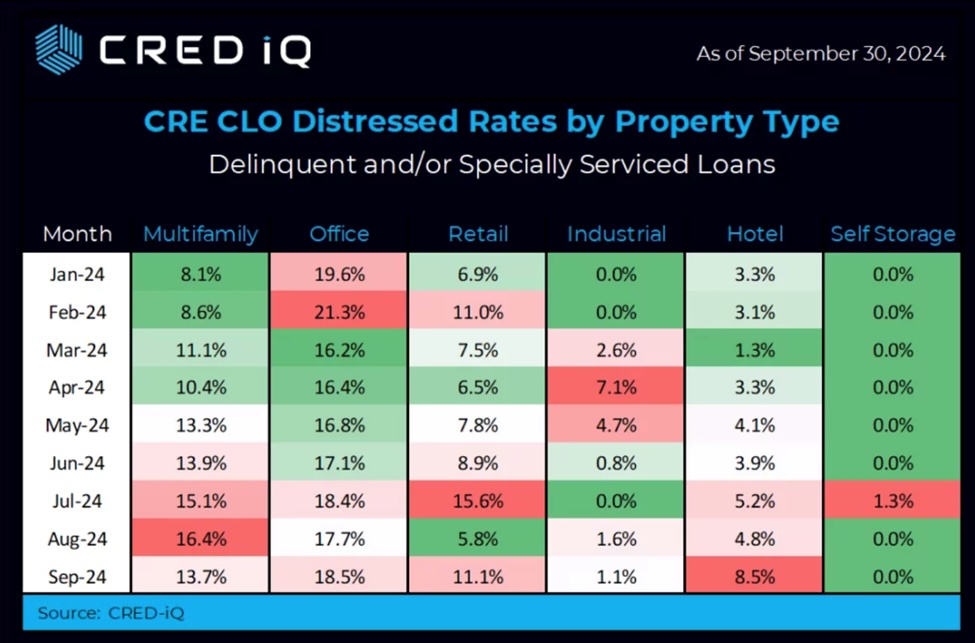
At the end of Q3, the distress rate for CRE-CLO loans across all commercial real estate sectors reached an all-time high of 13.1 percent. “Distress” is defined as any loan reported 30 days delinquent or more, loans past their maturity date, loans in special servicing (typically due to a drop in occupancy or a failure to meet certain performance criteria), or any combination thereof.
Many of the loans held in current CRE-CLO bonds originated between 2020 and 2022 when rates were still near zero and commercial real estate prices were peaking. Given their maturities were three to five years, many of these loans are close to coming due. As Shepherd put it, “A wall of maturities is staring borrowers, lenders, and bondholders in the face, all while underlying property performance disappoints.”
“Despite attempts by lenders to extend and pretend—kicking the can down the road in the short term to avoid defaults until the Federal Reserve lowers rates enough to bail them out—their delusions of reprieve may be fading fast.”
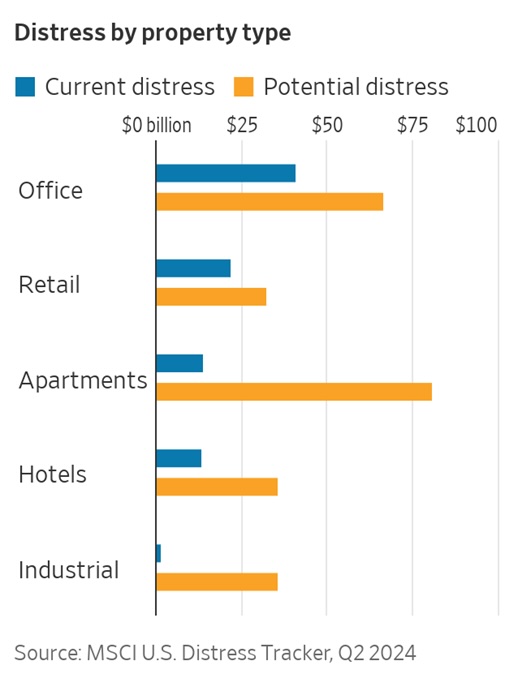
Office properties are feeling the tightest squeeze, with 20 percent of CRE-CLO office loans characterized as distressed. Stress is also high in the retail property sector.
Shepherd said the real story is in the multifamily dwelling sector.
“The distress rate for apartments touched 16.4 percent in August. An astonishing number, indicating that one in six apartment bridge loans were distressed. The improvement to 13.7 percent shown for September is seasonal, as renters settle in at the start of the school year.”
According to a Wall Street Journal report using data through the first half of 2024, the batch of currently distressed apartment bridge loans totaled $14 billion. Even more troubling, there were an additional $81 billion in potentially distressed loans.
Shepherd ran the math and came up with a startling revelation.
“The arithmetically-aware will note that if the $14 billion of currently distressed apartment bridge loans comprise a roughly 14 percent distress rate at the end of Q2 (as shown in Figure 1) and there are an additional $81 billion in potentially distressed loans not yet categorized as ‘currently distressed’ (as shown in Figure 2), then MSCI data implies that 95 percent of all apartment bridge loans are either currently distressed or in imminent danger of distress.”
Shepherd noted how Fed policy incentivized reckless loan writing.
“In the 2020-22 period, bridge loans of this variety were ubiquitous above a certain minimum loan size. And, because of the extreme and reckless nature of money printing undertaken by the Federal Reserve during this time—when interest rates were effectively zero—lenders underwrote property acquisitions with a 1.0x debt service coverage ratio (“DSCR”), meaning the initial net operating income of the property was projected to just cover interest payments, with nothing left over.”
The gamble paid off while rates were low. But Federal Reserve rate hikes to fight price inflation changed the playing field.
Bridge loan interest rates were in the 3.5 percent range until mid-2022. As Shepherd notes, a property acquired during this period with a net operating income of $1 million would have also had interest payments of $1 million at the then-prevailing interest rate.
Today, rates have soared to 8.4 percent. You don’t have to have a Ph.D. in math to see the problem. The interest payment on that same property has more than doubled to $2.4 million.
This is yet another reason people are clamoring for rate cuts even though there are plenty of indications that price inflation isn’t dead and buried.
This underscores the problem facing the Federal Reserve. It needs to drive rates lower to keep the problems it caused by more than a decade of easy money from blowing up in its face, but it also needs to hold rates higher for longer to keep that pesky inflation at bay.
It seems like an impossible balancing act.
The collapse of the commercial real estate market could easily spill over into the financial sector.
According to data from the Mortgage Bankers Association, as of the end of 2023, around $1.2 trillion of commercial real estate debt in the United States was set to mature over the next two years.
According to Trepp (a real estate data provider), $2.56 trillion in commercial real estate loans will mature over the next five years, with $1.4 trillion held by banks.
All of that debt will have to be refinanced. That’s a big problem for debtors who face much higher interest rates to borrow money on buildings with much lower values.
Small and midsized regional banks hold a significant share of commercial real estate debt. They carry more than 4.4 times the exposure to CRE loans than major “too big to fail” banks. According to an analysis by Citigroup, regional and local banks hold 70 percent of all commercial real estate loans. And according to a report by a Goldman Sachs economist, banks with less than $250 billion in assets hold more than 80 percent of commercial real estate loans.
“Financial intermediaries and investors with a significant exposure to commercial real estate face heightened asset quality risks. Smaller and regional U.S. banks are particularly vulnerable as they are almost five times more exposed to the sector than larger banks. … Rising delinquencies and defaults in the sector could restrict lending and trigger a vicious cycle of tighter funding conditions, falling commercial property prices, and losses for financial intermediaries with adverse spillovers to the rest of the economy.”
(Stefan Gleason, Money Metals News Service) As President-elect Donald Trump assembles a cabinet that will be tasked with implementing policy change at the federal level, individual state governments are plotting their own policy responses.
California Gov. Gavin Newsom is organizing a coalition of blue states to resist the “Make America Great Again” agenda.
Democrat governors aim to, for example, defend sanctuary cities against immigration enforcement efforts, impose their own “clean” energy mandates, and retain funding for Diversity, Equity, and Inclusion programs that could be targeted for elimination by the Trump administration.
Meanwhile, red state governors are largely vowing to work with President Trump to help him implement his agenda.
But however hopeful Trump backers may be for sweeping reforms, the incoming administration will face roadblocks from Congress, the courts, and the entrenched bureaucracy in Washington, D.C.
The reality is that not all of the nation’s problems can be solved at the federal level.
The elephant in the room – the rapidly growing $36 trillion national debt – wasn’t even a seriously contested issue in the 2024 campaign. Trump has effectively conceded that the debt won’t be tackled in any meaningful way because the political will to do so does not exist.
It is up to individual citizens to protect themselves from the risks of a debt crisis that could cause the currency to depreciate even more rapidly than it has been in recent years. That means holding sound money in the form of physical precious metals will be no less important in the Trump years that it was in the Biden years.
States can also act to help protect their citizens from unsound fiscal and monetary policies.
In fact, several states passed pro-sound money legislation in 2024, thanks in large part to efforts by Money Metals, its customers, and the Sound Money Defense League. For example, Alabama and Nebraska exempted bullion transactions from income taxes.
Money Metals’ newly released 2025 Sound Money Index reflects this latest progress. It also reveals that several states, including Vermont, Maine, and California, remain hostile environments for precious metals investors.
Although some state governors will never see the light when it comes to sound money principles, that doesn’t mean they can’t be pushed to embrace common sense reforms. In fact, bills to eliminate taxes on precious metals have sailed through on a bipartisan basis to become law in blue states such as New Jersey.
Taxing citizens who choose to exchange fiat currency for bullion (or vice versa) is both unfair and counterproductive. States that tax precious metals transactions are at a competitive disadvantage to states that don’t.
Those states that take the lead in removing all sales and income taxes on gold and silver, holding bullion in official reserves, and fully recognizing gold and silver as legal tender will be the least vulnerable to a meltdown in the U.S. fiat dollar.
(Mike Maharrey, Money Metals News Service) In a region fraught with geopolitical turmoil, Eastern European central banks are loading up on gold.
Poland, Hungary, and the Czech Republic have been among the top gold buyers this year, with Poland leading the way.
As a Bloomberg report put it, “Striving for a sense of security is a powerful motive in a region that’s been ravaged by Europe’s wars of the past — and that now finds itself next door to the continent’s deadliest conflict since World War II.”
The National Bank of Poland is this year’s top gold-buying central bank.
Only 10 countries hold more gold than Poland. Glapiński noted that Poland has bigger gold reserves than Great Britain, adding that Poland “has thus entered the exclusive club of the world’s largest gold reserve holders.” He called gold and hard currency reserves “crucial” to protecting the economy against catastrophic events.
The National Bank of Poland began aggressively increasing its gold reserve in 2021 when Glapiński announced a plan to buy 100 tons of the yellow metal. The central bank reached that goal last fall and continued its buying spree.
When he announced the initial plan to expand its gold reserves, Glapiński said holding gold was a matter of financial security and stability.
“Gold will retain its value even when someone cuts off the power to the global financial system, destroying traditional assets based on electronic accounting records. Of course, we do not assume that this will happen. But as the saying goes – forewarned is always insured.
“And the central bank is required to be prepared for even the most unfavorable circumstances. That is why we see a special place for gold in our foreign exchange management process.”
Glapiński also pointed out that “Gold is free from credit risk and cannot be devalued by any country’s economic policy. Besides, it is extremely durable, virtually indestructible.”
The Czech Republic has also been stockpiling gold at a slow but steady pace.
Czech National Bank chief Ales Michl has committed to doubling the country’s gold reserves to 100 tons in the next three years. He has increased Czech gold holding five-hold since taking the reins of the central bank in 2022.
Earlier this year, Michl told Bloomberg TV, “We need to reduce volatility. And for that, we need an asset with zero correlation to stocks, and that asset is gold.”
In a statement highlighting September’s purchase, the Hungarian central bank noted, “Amid increasing uncertainty in the global economy, the role of gold as a safe-haven asset and a store of value is of particular importance, as it enhances confidence in the country and supports financial stability. Gold continues to be one of the most important reserve assets globally, as shown by the significant purchases of gold by central banks in recent years.”
Bloomberg pointed out that gold has played a crucial role in Hungary’s history.
“The Money Museum, located in one of the palaces owned by the Hungarian National Bank, features a steam locomotive fashioned from yellow bars. The sculpture, called ‘The Rumble,’ depicts the central bank’s staff, which fled the Soviet military at the end of World War II on a train loaded with gold reserves to prevent it from falling into foreign hands.”
Serbian President Aleksandar Vucic recently announced plans to buy more gold “with every surplus of money” left in state reserves “to be safe and secure in hard times.”
Serbia has tripled its reserves to 48 tons since Jorgovanka Tabakovic was named governor of the Serbian central bank in 2012.
“Gold is gaining value and importance in times of global turbulences, especially in geopolitical conflicts and periods of high inflation,” Tabakovic told Bloomberg. “Unfortunately, in recent years, we’ve seen both factors at play.”
Eastern European countries are also bringing their gold home. Serbia repatriated its reserves in 2021. Poland also repatriated 100 tons of gold back in 2019, bringing it home from the Bank of England.
Eastern Europe’s gold binge is part of a broader trend. Central banks globally have been aggressively adding gold to their reserves. Year to date, central banks have bought a net 694 tons of gold. Over the last 12 months, central banks have increased gold holdings by an average of 26 tons per month.
(Ken Silva, Headline USA) David Cassady, 55, a convicted violent sodomizer serving life behind bars at Phillips State Prison in Georgia, is set to receive a taxpayer-funded sex change after suing for one last December—a lawsuit supported by the Justice Department.
Cassady and Georgia’s Department of Corrections filed a joint status report Monday, revealing the impending sex-change surgery. Cassady’s lawsuit was filed anonymously under the “Jane Done” pseudonym, but Headline USA uncovered the inmate’s true identity in July.
“The Gender Dysphoria Committee convened on November 1, 2024. The Committee has medically cleared Ms. Doe for surgery and has informed the Georgia Department of Corrections that the recommended treatment plan for Ms. Doe is gender reassignment surgery. As of the date of this report, Dr. Mulloy (endocrinologist) continues to manage Ms. Doe’s hormone therapy,” the joint status report said, referring to Cassady.
UPDATE: In perhaps the most irony-laden story I've ever broken, the U.S. government has agreed to give a sex change to an inmate who tried bombing the U.S. government.
Ironically, the DOJ filed a brief in support of Cassady’s lawsuit in January, while the inmate was under investigation for alleged bomb-making. Even more ironically, the inmate was under investigation for sending a bomb to 1400 New York Avenue NW in Washington, D.C.—a building that houses a DOJ office.
In other words, the DOJ filed an amicus brief in support of an inmate who apparently tried bombing the DOJ, according to the DOJ. To add a drop of stupidity, the DOJ refers to Cassady as a female in the sex-change litigation, but calls him a man in the bombing case.
Cassady was indicted in April on multiple federal charges for constructing and mailing bombs to federal facilities.
The DOJ declined to comment, while the non-profit groups representing the inmate haven’t responded to emails seeking comment. Georgia’s Department of Corrections also declined to comment, citing the pending litigation.
Cassady was set to stand trial on the bomb charges Dec. 9, but his trial date was recently postponed, and has yet to be rescheduled.
According to the DOJ’s indictment, Cassady’s bomb-making occurred from September 2019 to January 2020. He faces one count of making an unregistered destructive device, two counts of mailing a destructive device, and one count of attempted malicious use of an explosive.
When the indictment was unsealed in April, WSB-TV in Atlanta revealed that Cassady sent a bomb to the widow of a man he sexually assaulted as a teenager.
“How is somebody who is in prison for life, for horrific acts against the community, how is possible that he can still terrorize members of the community from behind bars?” the widow reportedly said. “And now somehow, he was able to access all of this and mail it out of prison. Somebody needs to look at the bigger picture of who he is.”
Cassady has pleaded not guilty to the charges, according to the court docket. The inmate is already serving a life sentence.
Cassady isn’t the only trans bomber to receive DOJ support in a sex-change lawsuit. As Headline USA exclusively documented last year, former neo-Nazi bank robber Pete/Donna Langan, who has ties to the Oklahoma City bombing, reached a settlement with the DOJ to become the first federal inmate in history to receive a sex change.
Correction: The original headline on this story reported that the U.S. government was providing the rapist inmate with a sex change. In fact, it’s the state of Georgia that’s doing so, though the U.S. government did file an amicus brief in the inmate’s support.
Ken Silva is a staff writer at Headline USA. Follow him at x.com/jd_cashless.
(Mike Maharrey, Money Metals News Service) Indians have a strong affinity for gold and silver. This has traditionally been expressed in demand for gold and silver jewelry, along with bars and coins. But over the last year, there has been tremendous growth in gold and silver exchange-traded funds (ETFs).
In simplest terms, an ETF represents a basket of investments that trades on the market as a single entity. For instance, a gold ETF is backed by a trust company that holds metal owned and stored by the trust. In most cases, investing in an ETF does not entitle you to any amount of physical gold or silver. (There are exceptions.) You own a share of the ETF, not the metal itself.
Inflows of gold into ETFs can significantly impact the global gold market by pushing overall demand higher.
2024 Gold and Silver Demand in India
Even with the price of both gold and silver at record levels, Indian demand for both metals has been strong so far in 2024.
The Indian government cut taxes on gold and silver imports by more than half in July, lowering duties from 15 percent to 6 percent.The move initially pushed prices down by about 6 percent and drove record gold imports in August. The price drop boosted demand for both metals.
Despite the import duty cut, gold and silver prices have charted strong gains in rupee terms. According to Metals Focus, gold has surged 20 percent this year, touching Rs.80,000/10g in the process. Silver prices have jumped by 17 percent, briefly exceeding the psychologically important Rs.100,000/kg.
Indian buyers tend to be price sensitive, and the higher price has undoubtedly created some headwinds for retail demand, but according to Metals Focus, rising prices have “attracted fresh investment amid expectations of further price increases.”
Demand for gold bars and coins has jumped by an estimated 38 percent year-on-year to 163 tons through the first nine months of 2024. That’s the highest level since 2013.
Meanwhile, silver investment demand is up an estimated 15 percent to 1,766 tons. That’s the second-highest level since 2015.
Indian Gold ETFs Enjoy Resurgence
Gold and silver ETFs are a relatively new phenomenon in India. The first Indian gold ETF was launched in 2007, and the first silver fund was created in January 2022.
Gold ETFs initially failed to attract meaningful flows. According to Metals Focus, this was due to two factors.
Lack of investor awareness
A preference for physical metal.
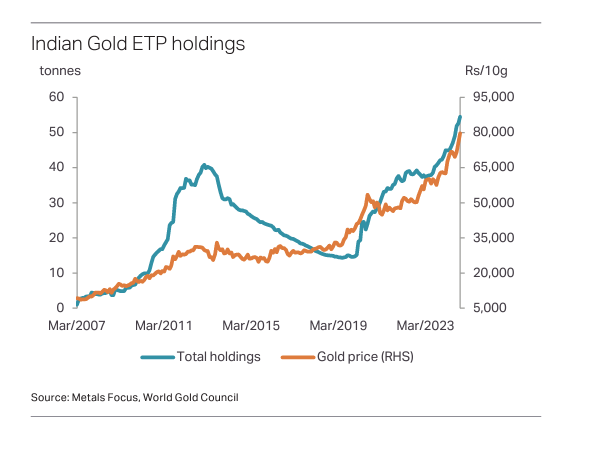
Indian gold ETF holdings initially peaked at 40.8 tons in 2013. As the Great Recession faded into the rearview, tepid interest in ETFs waned even more, with gold-backed fund holdings falling to just 14 tons in 2019.
The introduction of sovereign gold bonds (SGBs) in 2015 put a drag on ETF investment. The government-issued securities are denominated in grams of gold, but they are not backed by physical metal. However, they are guaranteed by the government and offer a 2.5 percent yield. They also have tax advantages.
According to Metals Focus, SGBs attracted gold investment equivalent to 147 tons, with much of the action coming post-pandemic.
“To put this into perspective, up until March 2020, the Reserve Bank of India (RBI) had issued 37 tranches of these bonds, but this attracted just 31 tons of gold. After March 2020, 30 tranches were issued, which brought in 116 tons.”
The government did not issue any SGBs in February 2024, boosting ETF demand.
The positive sentiment toward the yellow metal also boosted gold ETF investment post-COVID. Golding holdings in Indian-based funds rose from 19.4 tons in March 2020 to 54.5 tons as of October 2024. According to Metals Focus, “These inflows, although limited in tonnage terms, were driven by various factors such as a jump in retail trading accounts, the launch of multi-asset funds, and price-driven optimism.”
The pace of gold inflows has accelerated this year. Indian ETF holdings have increased by 12 tons, the highest gain since 2020.
Indian Silver ETFs: A Success Story
India’s love affair with gold is well-known, but Indians also have an affinity for silver. According to Metals Focus, Indian investors have accumulated over 17,000 tons of silver in bar and coin form in the last 10 years.
Indians not only view silver as a store of wealth, but they also see it as a strategic investment option. As Metals Focus put it, the white metal has “tactical appeal, which is driven by its inherent volatility. This has attracted fresh investors in India during the recent bull run they position themselves for potential price gains.”
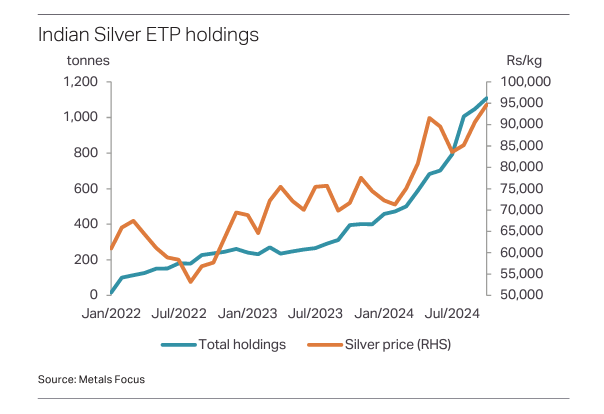
Silver ETFs based in India have experienced remarkable growth since the first one launched just over 2 years ago. Silver holdings exceeded 1,000 tons in August.
Silver ETFs now equal about 40 percent of annual retail silver investment. This compares to about 5 percent for gold ETFs.
According to Metals Focus, silver’s price performance coupled with a lack of competing products, has driven the growth of silver ETFs.
As Metals Focus noted, silver-backed ETFs also solve a practical problem.
“Given the size of silver bars, this can present a challenge for retail participants to store the metal. This issue was addressed with the launch of ETPs, where investors can hold silver as a security in their trading account.”
Looking Ahead
Metals Focus projects both silver and gold ETFs in India to see inflows of metal.
“This reflects both more investment managers recommending exposure to precious metals and a growing awareness among investors of precious metals ETPs. As a result, we expect to see considerable growth in India’s share of global ETPs, which is currently at 1.6 percent for gold and 4 percent for silver.”







 Many of the loans held in current CRE-CLO bonds originated between 2020 and 2022 when rates were still near zero and commercial real estate prices were peaking. Given their maturities were three to five years, many of these loans are close to coming due. As Shepherd put it, “A wall of maturities is staring borrowers, lenders, and bondholders in the face, all while underlying property performance disappoints.”