Repatriated Gold Reaches Historic Highs

(Jan Nieuwenhuijs, Money Metals News Service) The share of global official gold reserves not stored at the Federal Reserve Bank in New York (FRBNY) and Bank of England (BOE) in London has reached 78% in 2024, from 51% in 1972.

The shift in this ratio appears to be accelerating and can be seen as a proxy for the West’s decline in financial dominance.

The Original Buildup of Foreign Gold in New York and London

“Gold is the bedrock of stability for the international monetary system,” wrote former President of the German central bank, Jens Weidmann, in 2019. Not surprisingly, no national currency has ever become the world reserve currency without a substantial amount of precious metal supporting it.

Before the U.S. dollar, the pound sterling was the world reserve currency. In the 19th century, a significant part of global commerce was transacted in sterling (backed by gold) and cleared in London. Central banks could redeem British pounds for gold and build their metallic reserves at the vault of the BOE in the most liquid gold market globally: London.

After the Second World War, the dollar officially took over from sterling during the monetary arrangement dubbed “Bretton Woods.” In the aftermath of the war, the U.S. had the largest gold reserves of all countries by far, assuring confidence in the currency issued by the United States.

As trade was conducted primarily in dollars during Bretton Woods—which could be converted into gold at the Fed (acting as an agent for the Treasury)—countries with balance of payment (BOP) surpluses increased their gold reserves at the FRBNY vault. Many would rather own gold than dollars, especially as concerns grew (particularly by the French) that the greenback would be devalued due to America’s BOP deficit.
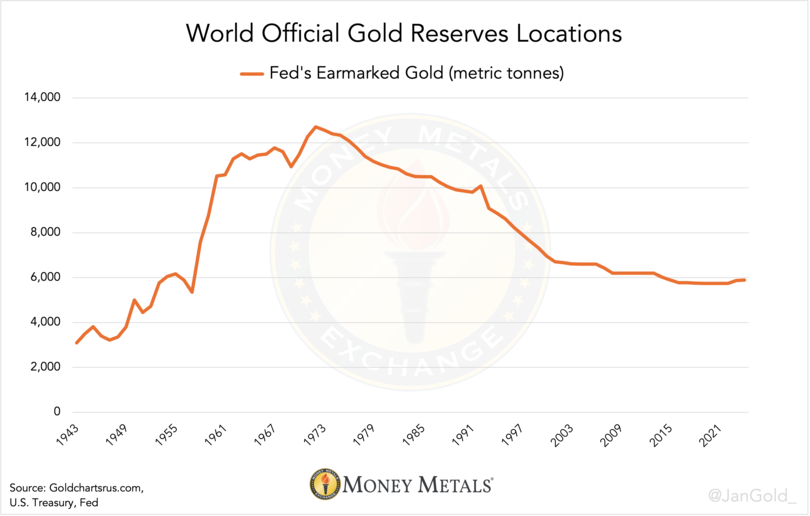
Chart 1. Before 1940, many European central banks shipped gold to New York in anticipation of the Second World War. Jan Nieuwenhuijs. Money Metals Exchange.
Chart 1. Before 1940, many European central banks shipped gold to New York in anticipation of the Second World War.

Technically, the U.S. monetary gold is owned by the Treasury; the Federal Reserve itself does not own gold. Foreign central banks and official international organizations store gold at the New York Fed, no individuals or private sector entities. Data by the Federal Reserve System on its “earmarked” (custodial) gold does not reveal which entities make use of the vault.

Total earmarked gold at the FRBNY reached an astronomical high of 12,711 tonnes in 1972. At that point, the BOE’s total gold holdings accounted for 8,364 tonnes.

The World Starts to Repatriate Its Gold

Countries were pressured by the U.S. not to redeem dollars for gold during Bretton Woods, which de facto ended in 1971. During the demise of Bretton Woods, New York lost some significance as a global gold market to the advantage of London and Zurich.

Since the early 1970s, foreign central banks slowly began withdrawing metal from the Fed’s vault in lower Manhattan. In chart 2, we can see withdrawals accelerated in the early 1990s, which was likely due to selling by European central banks at the time.

The BOE neither owns any gold, but it stores the U.K.’s monetary gold (owned by HM Treasury), foreign official gold reserves, and private gold by bullion banks.

Sadly, the composition of official and private gold at the BOE is unknown. So, in order to get a sense of how much gold official institutions store at the Bank of England, I have relied on research by Ronan Manly and Nick Laird from 2015 and extrapolated the numbers.

Finally, as I have reported in recent months, the People’s Bank of China (PBoC) and the Saudi Central Bank (SAMA) are buying vast amounts of gold under the radar. In the case of the PboC, it buys extraordinarily large amounts of gold in the London Bullion Market and repatriates immediately, not to risk being denied access to its reserves like Venezuela and Afghanistan.

As far as I can tell, outflows of foreign custodial gold at the Fed and BOE have stabilized in recent years, but there is no question the amount of gold held by the rest of the world within national borders has risen dramatically.

Consequently, the amount of world official gold reserves not stored at the infamous vaults of the FRBNY and BOE has gone up to a historic high of 78%.

Put differently, world official gold reserves (minus the gold owned by the U.S. and U.K.) stored in New York and London have reached a historic low of 22%.
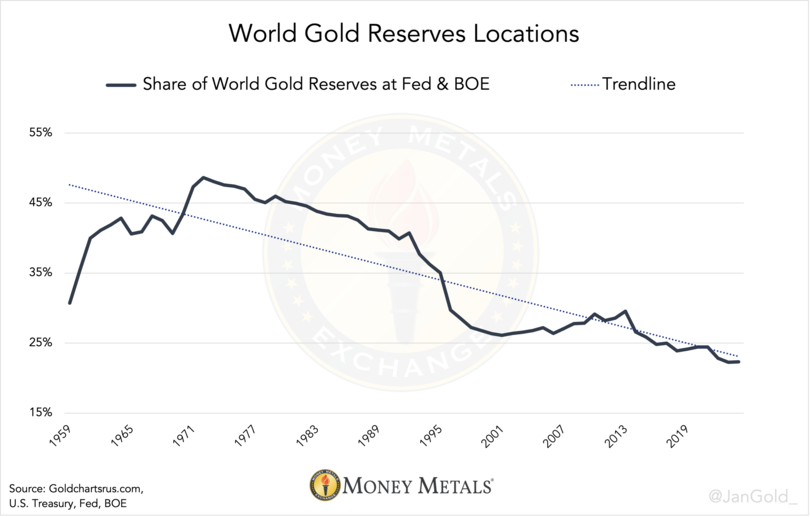
Chart 2. Not included are foreign holdings in other Western storage hubs like Switzerland, France, and Canada, for which no data is available. Jan Nieuwenhuijs. Money Metals Exchange.
Chart 2. Not included are foreign holdings in smaller Western storage hubs like Switzerland, France, and Canada, for which no data is available.

The West Is Losing Power

Not only is the West losing leverage over countries in the East as they repatriate gold, but non-Western countries are quickly catching up, relative to the West, by accumulating more gold.
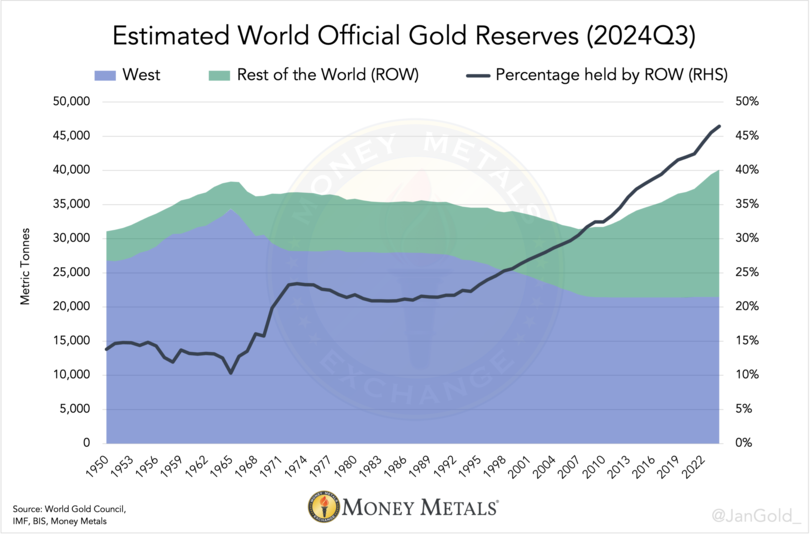
Chart 3. Gold reserves of the West are primarily of the U.S. and eurozone countries. Jan Nieuwenhuijs. Money Metals Exchange.
Chart 3. Gold reserves of the West are primarily of the U.S. and eurozone countries.

Based on calculations of how much Asian central banks keep off the record, my estimate is that non-Western countries (“rest of the world,” or ROW) possess 18,643 tonnes of gold versus 21,470 by the West. Pretty soon, the majority of official gold reserves will be owned by ROW (currently, ROW holds 46%).

Interestingly, the shift in the share of world gold reserves towards ROW is illustrative of global changes in economic and military power. As we are moving towards a more multipolar world, so too are global gold reserves distributed accordingly.

As the saying goes, “Whoever has the gold makes the rules!” Eastern countries will implement rules not in favor of the greenback. They will likely be able to circumvent the dollar by trading in national currencies through Project mBridge and store surpluses in gold.
VA Worker Reportedly Had Sex w/ 32 Women in Mountain Home Gov’t Facility

(Ken Silva, Headline USA) The Department of Veterans Affairs is investigating a sex scandal at its Mountain Home VA Medical Center in Tennessee, where man slept with no fewer than 32 different women who worked there.

The Mountain Home VA sex scandal transpired earlier this year, and was reported by  Under Secretary for Health, Dr. Shereef Elnahal, to the House Committee on Veterans’ Affairs.

The government has released few details of the scandal, but Breitbart reported Tuesday that “a bargaining unit biomedical employee had dozens of sexual relationships with women.”

“In fact, the congressional investigators told Breitbart News this one man slept with no fewer than 32 different women who worked there—and the man and several of the women bragged about their exploits on an online group forum on a government communication portal that VA officials use to communicate about veteran healthcare and facility operations,” Breitbart reported.

The committee’s chairman, Rep. Mike Bost, R-Ill., asked Elnahal about the scandal at a Thursday congressional hearing.

“Why is it that we have at least 15 Mountain Home, Tennessee Va employees who’ve allegedly had sex on the VA property? They have not been disciplined,” Bost said, asking if the facility’s director was still employed by the VA.

Elnahal said the official in question is still employed pending an investigation, but no longer directs the facility. The director wasn’t directly involved in the scandal, but failed to report it to the proper channels when he learned of it, according to Elnahal.

Bost has promised to get to the bottom of the matter.

“The sexual misconduct, harassment, and inappropriate interpersonal relationships that were allowed to persist at the Mountain Home VA facility are disturbing and disgusting. If these allegations are verified, without question, these men and women have no business serving veterans in East Tennessee, and this should have never happened,” he said in a press release.

“I have been clear from the start of this Congress and throughout the multiple investigations we have unveiled, situations of sexual harassment and misconduct like the one in Mountain Home should never happen at VA,” he said.

“That is exactly why one of my top priorities next Congress will be to work with the Trump administration to pass the Restore VA Accountability Act, so that no bureaucrat can stand in the way of getting bad VA employees away from veterans—for good.”

Ken Silva is a staff writer at Headline USA. Follow him at x.com/jd_cashless.

Notorious Vaccine Pusher Hints at Another Plan-demic During Trump’s 2nd Term

(Julianna Frieman, Headline USA) Notorious vaccine promoter Dr. Peter Hotez hinted Wednesday on MSNBC that another pandemic will plague America as soon as President-elect Donald Trump is inaugurated in January.

Nearly five years after the COVID-19 pandemic began, Hotez told MSNBC’s Nicolle Wallace that up to 11 illnesses could threaten the U.S. as soon as President Joe Biden transfers power to Trump.

“Here’s the reason why we really need to care about this stuff,” he told the anchor. “We have some big picture stuff coming down the pike starting on January 21st.”

Hotez listed the following 11 sicknesses as potential threats: bird flu, new coronavirus, SARS, mosquito-transmitted viruses, dengue, Zika virus, oropouche virus, yellow fever, pertussis or whooping cough, measles and polio.

“All that’s going to come crashing down on January 21st on the Trump administration,” he said. “We need a really, really good team to be able to handle this.”

Hotez’s comments came days after the House Select Subcommittee on the Coronavirus Pandemic released its final report on Monday.

The Republican-led probe concluded that the SARS-CoV-2 virus “likely emerged because of a laboratory or research related accident.”

The 520-page document also concluded that various pandemic restrictions, such as masking and social distancing, were “ineffective at controlling the spread of COVID-19.”

Overall, it was found that lockdown policies “did more harm than good” — a truth conservatives faced relentless criticism for at the height of the outbreak.

The House’s probe also focused on EcoHealth Alliance, a nongovernmental organization that sub-awarded NIH grants to global labs, including the ill-fated Wuhan Institute of Virology.

Politico reported Wednesday that Biden may consider pardoning COVID czar Anthony Fauci, the former head of the National Institute of Allergy and Infectious Disease, before he can be charged of any crimes.

Julianna Frieman is a freelance writer published by the Daily Caller, Headline USA, The Federalist, and The American Spectator. Follow her on Twitter at @JuliannaFrieman.

WATCH: Rep. Fallon Accuses Secret Service Boss of Compromising Trump’s Security at 9/11 Event

(Ken Silva, Headline USA) The final House Task Force hearing into the Trump assassination attempts was largely lackluster, with lawmakers and Secret Service Acting Director Ronald Rowe rehashing information that’s been public for months.

But the hearing did become heated at one point, when Task Force member Rep. Pat Fallon, R-Texas, accused Rowe of compromising Donald Trump’s security at the Sept. 11 ceremony in New York this year.

Fallon pulled out a photo showing Rowe standing by President Joe Biden, Trump and others at the Sept. 11 ceremony. Fallon suggested that Rowe was standing where the special agent in-charge of the event’s security detail should have been standing.

 As Fallon pushed Rowe about why he was at the event, Rowe pushed back, yelling at him not to politicize the 9/11 attacks.

“I actually responded to Ground Zero,” Rowe said. “I was there going through the ashes at the World Trade Center … Show respect for our Secret Service members who died on 9/11!”

Rowe further claimed that his presence didn’t compromise Trump or Biden’s security.

Fallon accused him of going to the event to raise his profile in hopes of getting the director’s job.

“You wanted to be visible because you’re auditioning for this job!” Fallon yelled.

“You’re a bully,” he added.

The task force’s inquiry is one of a series of investigations and reports into the Pennsylvania shooting that have faulted the agency for planning and communications failures. The fallout has included the resignation of the agency’s previous director and changes that increased Secret Service protections for Trump before the Republican won the November election.

However, no agent at Butler has been fired, and numerous questions remain unanswered about that day—as well as the subsequent Sept. 15 assassination attempt on Trump at his Florida golf course.

Rep. Laurel Lee, R-Fla., noted that while the Secret Service was largely cooperative with the Task Force, other agencies weren’t. The Task Force never received a digital analysis of the shooter, Thomas Crooks’s, online activity, nor did it receive the FBI’s memoranda on agents’ interviews with the families of Crooks and the second failed assassin, Ryan Routh.

Ken Silva is a staff writer at Headline USA. Follow him at x.com/jd_cashless.

Ex-Journalist Taylor Lorenz Appears to Dox Healthcare CEO after Murder

(Julianna Frieman, Headline USA) Former Washington Post journalist Taylor Lorenz put the CEO of Blue Cross Blue Shield on blast after UnitedHealthcare CEO Brian Thompson was shot dead Wednesday in Midtown Manhattan.

Lorenz published the name and photograph of Blue Cross Blue Shield CEO Kim A. Keck in response to an X post from popular culture account Pop Crave, which announced that the insurance company would no longer cover anesthesia for surgeries running overtime in Connecticut, New York and Missouri.

Her post came hours after a masked shooter assassinated the UnitedHealthcare CEO after he exited the Hilton hotel around 6:46 a.m.

“I hope people learn the names of all of these insurance company CEOs and engage in very peaceful letter writing campaigns so that they stop ruthlessly murdering thousands of innocent Americans by denying coverage. Healthcare is a human right. We need universal healthcare now,” Lorenz wrote below her perceived dog whistle post to go after the Blue Cross Blue Shield CEO.

On her Bluesky Social account, Lorenz was more direct and wrote, “And people wonder why we want these executives dead.”

Popular X user Libs of TikTok, who was doxxed by Lorenz in 2022, called out the former Washington Post journalist’s “completely unhinged” threat against the Blue Cross Blue Shield CEO.

Following Thompson’s murder, Lorenz reposted various anecdotes from X users who said they were denied coverage from UnitedHealthcare.

She suggested her “entire feed” on the social media platform consisted of people rejoicing after the insurance company CEO was killed, posting a before-and-after meme of smiling people.

“It’s so interesting and telling what ‘journalists’ covering this story consider violence and what they don’t,” Lorenz wrote Thursday morning on X.

Conservative social media users called out Lorenz for her perceived threat against Keeks and other healthcare CEOs, including podcaster Tim Pool.

“Holy f**k,” Pool wrote. “Taylor Lorenz straight up saying she wants Healthcare CEOs dead.”

Journalist Claire Lehmann said she had no idea Lorenz “was this crazy.”

“I got banned from BlueSky for declaring that there are only two genders. Taylor Lorenz is inciting acts of terrorism and it’s okay because she is on the right team,” The Dossier publisher Jordan Schachtel wrote.

Political commentator Glenn Beck slammed Lorenz for characterizing the insurance company CEO’s murder as a form of “justice.”

“The gunning down of UnitedHealthcare CEO Brian Thompson wasn’t ‘justice’, as some like @TaylorLorenz have suggested,” Beck wrote. “It was VENGEANCE masquerading as righteousness. That is incredibly DANGEROUS.”

Julianna Frieman is a freelance writer published by the Daily Caller, Headline USA, The Federalist, and The American Spectator. Follow her on Twitter at @JuliannaFrieman.

Jerome Powell: Bitcoin & Gold Are Not in Competition With the Dollar

(Mike Maharrey, Money Metals News Service) During a recent interview, Federal Reserve Chairman Jerome Powell said Bitcoin is “just like” gold and is not competing with the U.S. dollar.

Not long after his comments, Bitcoin surged to over $100,000.

During the New York Times DealBook Summit on Wednesday (Dec. 5), an interviewer asked Powell if he thought the recent surge in the price of Bitcoin represented a loss of faith in the U.S. dollar and the Federal Reserve system more generally. Powell answered, “I don’t think that’s how people think about it.”

He emphasized that people use Bitcoin as a “speculative asset.” He went on to assert that the cryptocurrency is “just like gold, only it’s virtual.”

“People are not using it as a form of payment or as a store of value; it’s highly volatile.”

And he emphasized, “It’s not a competitor for the dollar.”

“It’s really a competitor for gold, that’s really how I think about it.”

Bitcoin has surged from $69,363.70 to over $100,000 since Donald Trump’s election victory. The cryptocurrency is up 133.87 percent this year.

Gold has also had a strong year. Despite selling off with the “Trump shock,” it is still up over 28 percent on the year.

With a market capitalization of $1.92 trillion, Bitcoin has surpassed silver as the eighth most valuable asset in the world with a market value of $1.75 trillion. But it is still far behind gold, with a market value of nearly $18 trillion.

Is Powell Right About Bitcoin and Gold?

Let’s break down Powell’s comments and see how they stack up against reality.

He’s correct in that Bitcoin behaves more like a speculative asset than a currency. It has generally correlated closely with tech stocks.

Powell is also correct to note the volatility of Bitcoin. While the price of Bitcoin has been generally upward over time, it tends to be extremely volatile in the short term.

Since its inception in 2009, Bitcoin’s price has experienced dramatic swings. Starting at fractions of a cent, Bitcoin reached $1,000 in 2013, signaling its potential as a financial tool. However, this milestone was followed by a sharp correction. By 2017, Bitcoin had surged to nearly $20,000, attracting both institutional and retail investors. This was followed by a dip to $3,200 in 2018. In 2021, Bitcoin soared past $60,000, driven by macroeconomic factors like inflation and institutional adoption, only to dip again back into the 30s.

In 2021, Bitcoin’s annualized volatility was approximately 81 percent. However, volatility has decreased modestly as the market has matured. Recent data indicates that its 30-day annualized volatility has remained below 80 percent throughout 2024.

But is Bitcoin “just like gold?”

The simple answer is no.

Gold is not a speculative asset. It is widely viewed as a safe haven hedge and a store of value.

Bitcoin has not historically served as a safe haven.

For instance, Bitcoin failed as a safe-haven hedge as the markets tanked in 2018, instead correlating more closely with other risk assets. The cryptocurrency’s performance was down on par with tech stocks, falling 55 percent in the fourth quarter along with the stock market.

Meanwhile, gold was up significantly in the same period.

The fact of the matter is, gold and Bitcoin don’t tend to correlate at all. A Bloomberg report noted, “The average long-term correlation between Gold and Bitcoin has been close to zero, which makes both together additive to multi-asset portfolios.”

Clearly, Bitcoin and gold aren’t “the same.” They are different assets that can both boost a diversified portfolio.

Challenging the Dollar

Powell’s argument is internally incoherent.

Powell lumped gold and Bitcoin together to argue that neither competes with the dollar. But gold is clearly a competitor with the greenback because it is money. That means insofar as Bitcoin and gold are “the same,” Bitcoin is competing with the dollar as well.

And while they are very different assets, they do share some characteristics.

Gold has served as money for over $5,000, and Investopedia characterizes gold as a “currency” today.

“Under a free market system, gold is a currency. Gold has a price, and that price will fluctuate relative to other forms of exchange, such as the U.S. dollar, the euro (EUR), and the Japanese yen (JPY). Gold can be bought and stored, but it is not usually used directly as a method of payment. However, it is highly liquid and can be converted to cash in almost any currency with relative ease.”

With the advent of electronic payment systems, it has become much easier to use gold in small transactions.

If gold is a currency, then it is competing with the dollar. (And it’s winning, too, as evidenced by its constant appreciation in dollar terms.)

That gold is money is also evidenced by the fact that central banks are aggressively increasing the amount they hold in reserves. Year to date, central banks have bought a net 694 tons of gold. Over the last 12 months, central banks have increased gold holdings by an average of 26 tons per month.

Meanwhile, the number of dollars held in central bank reserves continues to decline, falling 14 percent since 2002.

Gold is literally replacing dollars as a reserve asset. If that’s not competition, I don’t know what is.

Bitcoin is similar to gold in at least one sense – it can also function as money. It has a price and can be quickly converted to other currencies. It can also be used directly in transactions, although its volatility and transaction costs have limited its use in that capacity.

Both Bitcoin and gold have another similarity that makes them both superior to government fiat money. They can’t be printed by the central bank.

The Federal Reserve can create new dollars at will. This money creation (inflation) supports the U.S. government’s prolific borrowing and spending. In effect, the Fed is the engine that drives the massive federal government.

The constant money printing necessary to sustain government spending is precisely why the dollar continues to lose purchasing power month after month.

This is impossible with both gold and Bitcoin. The creation of new Bitcoin is limited by its algorithm, and the creation of gold is limited by nature. The restraint gold put on money creation was precisely why the U.S. government went off the gold standard.

So, Powell is wrong on both counts. Gold and Bitcoin aren’t the same. But insofar as they are similar, they are both competing with the dollar.

Given the superiority of both Bitcoin and gold as money, it’s no wonder Powell wants to downplay this competition.

Central Bank Gold Buying Surged in October

(Mike Maharrey, Money Metals News Service) After rebounding in September, central bank gold buying surged in October, doubling the 12-month average.

Central banks added a net 60 tonnes of gold to reserves in October, the highest monthly total year-to-date, according to data collected by the World Gold Council. That pushed official central bank gold buying to 754 tons for the year after a record third quarter.

It is likely central banks have added even more gold that hasn’t been reported. For instance, the People’s Bank of China secretly purchased 60 tonnes of gold.

India was the biggest official gold buyer in October, adding 27 tonnes of gold to its reserves. That brings its total 2024 purchases to 77 tonnes.

An Indian economist told the Times of India that the push to accumulate gold was based on both political and economic reasons. He said that the “reliability” of the U.S. dollar has “diminished.” He noted the “noticeable decline” in the confidence in U.S. dollar assets.

Another economist told the Times, “It makes a lot of sense (to invest in gold), given the increased volatility in the FX market, elevated interest rates in the U.S., and, of course, also as the central banks in each economy would like to diversify the asset classes in which they are parking their reserves.”

India recently transported 100 tonnes of its gold from the UK back into India.

The Central Bank of Turkey increased its gold holdings by 17 tonnes. The Turkish central bank has increased its gold reserves for 17 straight months. Year to date, Turkey has added 72 tonnes to its holdings, representing around 34 percent of its total reserves.

Earlier this year, National Bank of Poland Governor Adam Glapiński indicated the central bank plans to increase its gold holdings to 20 percent of its reserves.

“This makes Poland a more credible country, we have a better standing in all ratings, we are a very serious partner, and we will continue to buy gold.”

The NBP took another step toward that goal in October, purchasing 8 tonnes of gold. So far this year, the Polish central bank has increased its gold holdings by 69 tonnes. Gold currently makes up 17 percent of Polish reserves.

After five months of selling, Kazakstan flipped to buying in October, adding 5 tonnes of gold to its reserves.

It is not uncommon for banks that buy from domestic production – such as Uzbekistan and Kazakhstan – to switch between buying and selling.

The following central banks also increased their gold reserves in October:

  • Czech Republic – 2 tonnes
  • Kyrgyzstan – 2 tonnes
  • Ghana – 1 tonne

There were no notable gold sellers in October.

The World Gold Council describes central bank gold buying as “robust.”

“While rising gold prices appear to have inhibited some buying and prompted tactical sales over recent months, October’s rebound in reported activity signals continued interest from central banks to accumulate gold within their reserve portfolios. This reaffirms the role gold plays as a strategic asset for central banks to manage risks and diversify reserves.”

There is no indication central bank gold buying will slow down anytime soon.

According to the most recent World Gold Council survey released in June, 29 percent of central banks plan to add more gold to their reserves in the next 12 months. The WGC said it was the highest level since the survey began in 2018.

Only 3 percent said they had plans to decrease gold reserves.

Earlier this year, the World Gold Council said the continuation of gold buying supports its expectation that “2024 will be another solid year of central bank gold demand.”

“Last year, central banks placed great emphasis on gold’s value in crisis response, diversification attributes, and store-of-value credentials. A few months into 2024, the world seems no less uncertain, meaning those reasons for owning gold are as relevant as ever.”

Last year, central bank gold buying fell just 45 tons short of 2022’s multi-decade record.

According to the World Gold Council, central banks net gold purchases totaled 1,037 tons in 2023. It was the second straight year central banks added more than 1,000 tons to their total reserves.

Central bank gold buying in 2023 built on the prior record year. Total central bank gold buying in 2022 came in at 1,136 tons. It was the highest level of net purchases on record dating back to 1950, including since the suspension of dollar convertibility into gold in 1971.

China was the biggest buyer in 2023.

Analysts at ANZ Bank recently said they expect central bank gold buying to remain hot for at least the next six years.

According to these analysts, “Depleted trust in the U.S. fixed-income assets and the rise of non-reserve currencies are other themes that could support central bank gold buying.”

Federal Reserve Woes and Precious Metals Trends

(Money Metals News Service) The latest episode of the Money Metals Midweek Memo, hosted by Mike Maharrey, dug deep into critical topics including the Federal Reserve’s precarious financial situation, ongoing inflationary pressures, and the role of precious metals in safeguarding wealth.

Here’s a comprehensive breakdown of the episode.

The Federal Reserve: Bleeding Red Ink

Mike Maharrey began by exploring the alarming financial state of the Federal Reserve, which reported a $19.9 billion operating loss for the third quarter of 2023. This marked a continuation of the central bank’s losses, which have totaled over $200 billion since the fourth quarter of 2022.

The losses are attributed to a mismatch between the Fed’s short-term liabilities, such as interest payments on bank reserves, and its long-term fixed-rate assets purchased during periods of near-zero interest rates.

Additionally, the Fed holds unrealized losses on its bond portfolio of $818 billion, a figure that could exceed $1 trillion by the end of the year. Maharrey explained how the Fed’s unique accounting practices allow it to convert losses into “deferred assets,” avoiding the repercussions that private businesses would face.

However, these financial losses ultimately burden taxpayers, as reduced remittances to the Treasury exacerbate budget deficits and contribute to the national debt, which now stands at more than $36 trillion.

Inflation: A Persistent Threat

Inflation was another key focus of the episode, with Maharrey emphasizing that rising prices are merely a symptom of monetary inflation—an increase in the money supply. He referenced Milton Friedman’s insight that “inflation is always and everywhere a monetary phenomenon” to underscore that localized price increases, such as those caused by tariffs, do not equate to true inflation.

Maharrey explained that the Federal Reserve’s quantitative easing policies during the pandemic injected nearly $5 trillion into the economy, significantly expanding the money supply and driving inflationary pressures.

While the Fed has raised interest rates in an effort to combat inflation, Maharrey argued that this is a temporary measure. He predicted that the central bank would eventually return to quantitative easing and near-zero interest rates during the next economic crisis, which would likely exacerbate inflation in the long term.

Gold and Silver Markets

Gold Silver Precious Metals Investing Stability Hedge Money Metals Exchange

Maharrey provided an update on the precious metals markets, noting that gold prices have remained stable at $2,600 per ounce despite recent corrections and volatility. He highlighted Jesse Colombo’s analysis of the recent “Trump shock selloff,” describing the market reaction as irrational and short-term in nature.

Maharrey urged listeners to focus on the long-term fundamentals underpinning the gold and silver markets, such as the national debt, persistent inflation, and the Federal Reserve’s monetary policy. Precious metals, he explained, continue to serve as a reliable hedge against economic instability. Maharrey encouraged investors to view the recent correction in gold and silver prices as an opportunity to make strategic purchases.

Solutions and Recommendations

To safeguard wealth in uncertain economic times, Maharrey underscored the importance of holding physical precious metals. He commended JP Cortez and the Sound Money Defense League for their efforts to promote state-level sound money policies, which could gradually undermine the Federal Reserve’s dominance.

While Maharrey expressed doubt that Congress would take meaningful action to reform or dismantle the Fed, he stressed that individuals have the power to protect their financial well-being by investing in gold and silver. He urged listeners to contact Money Metals Exchange for expert guidance and to take advantage of favorable market conditions.

Final Thoughts

In his closing remarks, Maharrey emphasized the systemic risks posed by the Federal Reserve’s financial practices and their implications for taxpayers and the broader economy. He reiterated the need for proactive measures, such as investing in precious metals, to prepare for potential economic crises.

Maharrey encouraged listeners to visit Money Metals Exchange’s website or contact their team for tailored advice on incorporating gold and silver into their portfolios. His parting message was clear: with economic challenges mounting, there is no better time to act than now.

For more information on gold and silver investment opportunities, call Money Metals Exchange at 1-800-800-1865 or visit MoneyMetals.com.

Leftist Comedian Reads the Room, Pledges to Be Less Political

(Jacob Bruns, Headline USA) Far-left comedian Sarah Silverman has decided to be less political in her commentary after the debacle that was Vice President Kamala Harris‘s performance in the 2024 election, the Minnesota Star Tribune reported.

In an interview with the Tribune, Silverman expressed skepticism about trying to use her platform to promote Democratic politicians because Americans are tired of hearing political sermons from the rich and famous.

“I was on the road with this tour, for one thing,” she recounted of the time leading up to the election, noting that “a lot of people asked me if I was going to make a video or something. But my feeling was that no one wanted to hear from celebrities right now.”

Silverman has campaigned for Democrats in the past, including for Obama in 2008 and 2012, even appearing at the Democratic National Convention in 2016.

But this time around, she did very little to support Harris, aside from penning pro-abortion social media posts.

“Maybe I was wrong,” she told the Tribune. “I just focused on reposting thoughts from smarter people.”

One of Harris’s primary campaign strategies was using celebrities and other media figures to stoke popular support. From humiliating cameo videos to Megan Thee Stallion’s obscene gyrations onstage at a Harris campaign event, the VP from the start failed to appeal to the American people.

According to a Fox News report, the Harris campaign dropped $10 million on star-studded events in the final election push, rolling out supporters such as Eminem, Bruce Springsteen and Oprah Winfrey, but to no avail.

Ultimately, however, Silverman concluded that nothing she could have done “would have made a difference” given the landslide Trump victory.

Due to the campaign’s ultimate failure, Silverman pledged to keep politics out of her comedy sketches, at least in the near future.

“This show is not at all political, for better or worse,” she concluded.

Internet Abuzz Over Rare Video of Barron Trump’s Voice: Listen Now

(Julianna Frieman, Headline USA) Social media users were abuzz Wednesday as rare video of President-elect Donald Trump’s son, Barron, speaking to Ultimate Fighting Championship CEO Dana White went viral.

In what many said was their first time hearing Barron Trump speak, the incoming president’s youngest son stunned viewers as they watched him introduce himself to White in election night footage captured for political commentator Tucker Carlson’s documentary series Art of the Surge.

“Hello, how are you? It’s very nice to see you,” Barron Trump first said to a woman off camera before turning his attention to White.

The 18-year-old’s voice was low and confident, and his demeanor quietly commanded respect.

Trump told his UFC boss buddy that his son, who reportedly helmed the president-elect’s social media and podcast strategy, was very popular with his supporters.

“I gave him a shout-out last night, the place went crazy,” Trump told White, mimicking the “Ba-rron, Ba-rron” chants likely heard at the previous night’s campaign event.

Barron Trump took initiative in the interaction and shook the UFC boss’s hand.

“Hello. How are you? It’s very nice to finally meet you,” he said.

Surprised it was their first time meeting, Trump asked White, who introduced him at the Republican National Convention in July, if his son could be a UFC fighter.

“Can we make him into a fighter?” Trump said to the amusement of those around him. Barron shook his head in response.

One X user said Barron Trump’s voice resembled his father’s, while another user called the reveal “historic.”

“Barron has an air of quiet confidence about him. Wonder if he’ll want to enter politics one day?” another commented on the clip.

The 18-year-old Barron Trump did not seem to have his mother, Melania Trump’s, Slovakian accent as heard in previously uncovered video from when he was a toddler.

Julianna Frieman is a freelance writer published by the Daily Caller, Headline USA, The Federalist, and The American Spectator. Follow her on Twitter at @JuliannaFrieman.